

|
시장보고서
상품코드
2063809
BFSI 분야 HCM 소프트웨어 : 시장 점유율 분석, 업계 동향 및 통계, 성장 예측(2026-2031년)HCM Software In The BFSI - Market Share Analysis, Industry Trends & Statistics, Growth Forecasts (2026 - 2031) |
||||||
 Mordor Intelligence
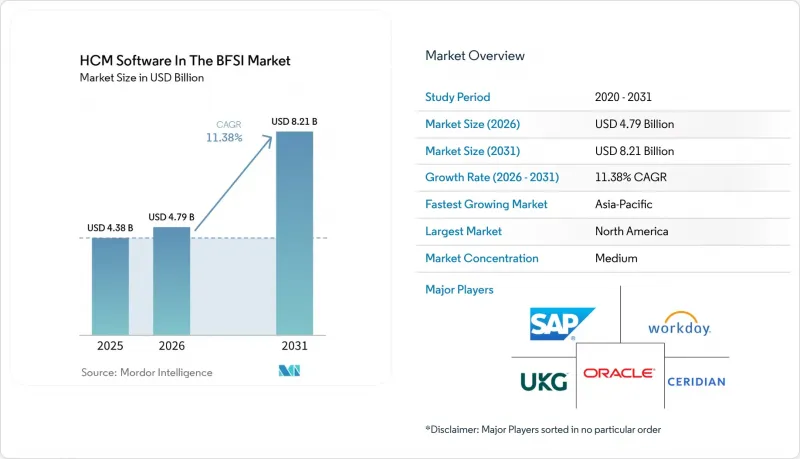
Mordor Intelligence에 의하면, BFSI 분야 HCM 소프트웨어 시장 규모는 2025년 43억 8,000만 달러로 평가되었습니다. 2026년에는 47억 9,000만 달러로 확대되어 2031년까지 82억 1,000만 달러에 이를 것으로 예측되며, 2026년부터 2031년에 걸쳐 CAGR 11.38%로 성장할 전망입니다.
본 보고서는 배포 방식(클라우드 및 On-Premise), 조직 규모(대기업, 중소기업), 소프트웨어 유형(핵심 HR, 급여 관리, 인재 관리, 인력 관리 등), 서비스(구축·통합 서비스, 컨설팅·교육 서비스 등) 및 지역별로 분류되어 있습니다. 시장 전망은 금액(달러) 기준으로 제공됩니다.
세계의 BFSI 분야 HCM 소프트웨어 시장 동향 및 인사이트
세계 금융 서비스 분야의 규제 복잡화
금융 규제 당국은 현재 직원 데이터 거버넌스를 건전성 규제 체계에 직접 통합하고 있으며, HCM 제품군은 규정 준수의 최전선에서 역할을 수행하는 시스템으로 변모하고 있습니다. EU의 디지털 운영 복원력 법(Digital Operational Resilience Act)은 은행에 대해 모든 제3자 HR 서비스 제공업체를 파악하고, 퇴출 전략을 마련할 것을 의무화하고 있으며, 이는 변경 불가능한 감사 로그를 갖춘 클라우드 플랫폼에 적합한 업무입니다. 바젤 III의 제3의 기둥이 개정됨에 따라, 급여, 복리후생 및 계약업체에 대한 지출의 실시간 대조가 요구되면서 분석 모듈의 도입이 촉진되고 있습니다. 미국에서는 뉴욕주의 Part 500 사이버 보안 개정안에 따라 암호화 요건이 인사 데이터베이스까지 확대됨에 따라, 미국 규제 대상 기업에 서비스를 제공하는 벤더에 대한 규정 준수 기준이 강화되었습니다. 이러한 패치워크와 같은 상황은 관할 구역별 규칙 라이브러리를 유지하는 제공업체에 유리하게 작용하는 반면, 소규모 지역 업체들은 법무 엔지니어링 자원을 확보하느라 분주합니다.
대형 은행들의 클라우드 도입 가속화
총 소유 비용(TCO) 조사 결과, 데이터센터의 교체 주기보다 구독형 클라우드 HCM이 점점 더 유리한 선택지로 떠오르고 있습니다. BNY 멜론이 수년에 걸쳐 Workday를 도입한 결과, 35개국에 걸친 전 세계 급여 계산 시스템이 통합되었고, 월말 결산 처리 시간이 40% 단축되어 대규모 SaaS 전환의 경제적 효과가 입증되었습니다. 필리핀에서는 차이나뱅크 세이빙스가 Darwinbox를 도입하여 지점 직원의 온보딩 시간을 40% 단축하는 동시에, 신흥 시장에 적합한 모바일 우선 패러다임을 입증했습니다. 이러한 사례들은 클라우드 기반 HCM이 지점 합리화부터 디지털 채널의 인력 배치에 이르기까지, 자본 배분 의사결정을 이끌어내는 실시간 인력 분석을 어떻게 가능하게 하는지 여실히 보여주고 있습니다.
엄격한 데이터 거주 요건 및 주권 요건
데이터 현지화 의무화로 인해 대상 시장은 지역별로 고립된 시장으로 분할되고 있습니다. 중국의 ‘개인정보보호법’은 은행에 직원 데이터를 중국 본토의 서버에 저장하도록 의무화하고 있어, 다국적 기업들은 여러 HR 시스템을 병행하여 운영할 수밖에 없는 실정입니다. 러시아의 152-FZ 법도 유사한 제한을 두고 있어, 유럽과 미국공급업체들은 현지 호스팅 파트너에 의존할 수밖에 없는 실정입니다. 2026년에 제정될 것으로 예상되는 인도의 ‘디지털 개인 데이터 보호법’ 초안은 해외로의 데이터 유출을 더욱 제한하게 될 것입니다. 이러한 규제는 공급업체의 비용을 증가시키고, 전 세계 플랫폼의 통합을 복잡하게 만들고 있습니다.
부문별 분석
BFSI 분야 HCM 소프트웨어 시장 중 클라우드 부문은 2025년에 61.23%를 차지했으며, 2031년까지 연평균 성장률(CAGR) 11.82%로 성장할 것으로 전망됩니다. 세계 주요 은행들은 DORA 감사 요건을 충족하고 실시간 인력 인사이트를 확보하기 위해 클라우드 제품군을 도입하고 있는 반면, 하이브리드 도입은 규정 준수, 확장성 및 복원력을 보장함으로써 전 세계 금융 기관의 장기적인 현대화를 추진하고 있습니다.
은행들이 메인프레임 시대의 HR 엔진을 폐지함에 따라 클라우드 도입이 가속화되고 있습니다. BNY 멜론과 차이나 뱅크 세이빙스는 전환 후 사이클 타임을 40% 단축했음을 입증했습니다. 하이브리드 모델은 여전히 엄격한 데이터 주권 규정이 존재하는 격차를 해소해 주며, 기밀성이 높은 급여 테이블을 On-Premise에 보관하면서 분석 계층을 클라우드에 배치할 수 있게 해줍니다. 이러한 유연성 덕분에, 유니버설 API 도입을 통해 통합의 병목 현상이 해소될 때까지 그 기세가 유지될 것입니다.
2025년에는 대기업이 매출의 58.23%를 차지하며, 이는 BFSI 분야 HCM 시장에서 대기업의 지배력을 반영했습니다. 이러한 규모 덕분에 대기업은 번들 계약을 협상할 수 있으며, 급여 계산, 규정 준수, 인력 계획에 이르는 복잡한 모듈들을 통합할 수 있습니다. 그러나 시장 포화가 진행됨에 따라 성장세는 둔화되고 있으며, 향후 성장은 신규 도입보다는 규제 강화나 고도화된 분석에 좌우되는 양상을 보이고 있습니다.
시장의 중소기업(SME) 부문은 초기부터 SaaS 플랫폼을 도입한 디지털 전문 대출 기관 및 지역 은행에 힘입어 연평균 성장률(CAGR) 11.89%를 기록하며 성장하고 있습니다. Levo Credit Union은 2026년에 Paylocity를 도입하여 급여 선지급 제도를 통합했습니다. 한편, Ujjivan Small Finance Bank는 현지 언어로 된 인터페이스를 활용하여 지방의 인재 풀에 접근하고 있습니다. 조달 주기의 단축과 맞춤화 부담의 경감 덕분에 중소기업은 몇 주 만에 업그레이드를 도입할 수 있게 되었으며, 지속 가능한 성장의 원동력으로서의 입지를 확고히 하고 있습니다.
지역별 분석
2025년, 북미는 엄격한 사이버 보안 규제와 SaaS의 조기 도입에 힘입어 BFSI 분야 HCM 소프트웨어 시장을 주도했습니다. BNY 멜론의 Workday 도입과 레보 신용협동조합의 Paylocity 도입은 최상위 및 중위권 금융기관들이 통합된 급여 계산 및 급여 선지급 서비스를 얼마나 우선시하고 있는지를 보여줍니다. 캐나다 각 주별 노동법의 차이점과 멕시코의 전자 급여 계산 의무화가 추가적인 수요를 창출하고 있습니다.
아시아태평양은 네오뱅크의 급속한 확산과 아세안 전역에 걸친 규제 조화에 힘입어 2031년까지 가장 빠르게 성장하는 지역이 될 것입니다. 차이나뱅크 세이빙스, 타밀나두 머천타일 뱅크, 우지반 스몰 파이낸스 뱅크는 온보딩 시간을 단축하고 지역별 세무 규정 준수를 자동화하는 ‘모바일 퍼스트’ 도입 사례를 보여주고 있습니다. 중국의 데이터 현지화 규제는 시장을 세분화하고 있지만, 국내 클라우드 서비스 제공업체에게는 기회로 작용하고 있습니다. 한편, 인도에서 제정이 예정된 데이터 보호법은 지역 특유의 사례에 대한 수요를 더욱 부추길 것입니다.
유럽에서는 적극적인 클라우드 전환과 데이터 주권에 대한 엄격한 감독 간의 균형이 유지되고 있습니다. DORA(데이터 보호 규정)가 플랫폼 업그레이드를 촉진하는 한편, GDPR(EU 개인정보보호규정) 및 각국의 거주지 요건이 국경을 초월한 표준화를 지연시키고 있습니다. Zalaris의 매니지드 서비스 계약은 규정 준수 업무 아웃소싱에 대한 수요가 높다는 점을 여실히 보여주고 있습니다. 남미에서는 은행들이 통화 변동성을 고려하고 있어 성장이 보다 꾸준한 반면, 중동 및 아프리카에서는 현지 결제 인프라와 연계된 NexHRM이나 Ramco와 같은 모바일 네이티브 벤더를 통해 시장이 개척되고 있습니다.
기타 혜택 :
- 엑셀 형식 시장 예측(ME) 시트
- 3개월간의 애널리스트 지원
자주 묻는 질문
목차
제1장 서론
제2장 조사 방법
제3장 주요 요약
제4장 시장 구도
제5장 시장 규모 및 성장 예측
제6장 경쟁 구도
제7장 시장 기회 및 향후 전망
KTH 26.06.26According to Mordor Intelligence, the hCM software in the BFSI market size is expected to increase from USD 4.38 billion in 2025 to USD 4.79 billion in 2026 and reach USD 8.21 billion by 2031, growing at a CAGR of 11.38% over 2026-2031.
This report is Segmented by Deployment Mode (Cloud and On-Premise), Organization Size (Large Enterprises, Small and Medium Enterprises), Software Type (Core HR, Payroll Management, Talent Management, Workforce Management, and More), Services (Implementation and Integration Services, Consulting and Training Services, and More), and Geography. The Market Forecasts are Provided in Terms of Value (USD).
Global HCM Software In The BFSI Market Trends and Insights
Rising Regulatory Complexity in Global Financial Services
Financial regulators now weave workforce-data governance directly into prudential frameworks, turning HCM suites into front-line compliance systems. The EU Digital Operational Resilience Act obliges banks to map every third-party HR service provider and maintain exit strategies, a task suited to cloud platforms with immutable audit logs. Basel III Pillar 3 updates demand real-time reconciliation of payroll, benefits, and contractor spend, driving uptake of analytics modules. In the United States, New York's Part 500 cybersecurity amendments extend encryption requirements to HR databases, lifting the compliance bar for vendors serving U.S.-regulated entities. This patchwork rewards providers that maintain jurisdiction-specific rule libraries, leaving smaller regional players scrambling for legal-engineering resources.
Accelerated Cloud Adoption by Tier-1 Banks
Total-cost-of-ownership studies increasingly favor subscription-based cloud HCM over data-center refresh cycles. BNY Mellon's multi-year Workday rollout unified global payroll across 35 countries and trimmed month-end close by 40%, validating large-scale SaaS migration economics. In the Philippines, Chinabank Savings deployed Darwinbox, cutting branch-staff onboarding time by 40% and showcasing a mobile-first paradigm suited to emerging markets. These examples underscore how cloud HCM enables real-time workforce analytics that guide capital-allocation decisions, from branch rationalization to digital-channel staffing.
Stringent Data Residency and Sovereignty Requirements
Data-localization mandates are fragmenting the addressable market into regional islands. China's Personal Information Protection Law requires banks to store employee data on mainland servers, prompting multinationals to maintain parallel HR instances. Russia's 152-FZ imposes similar constraints, pushing Western vendors toward local hosting partners. India's draft Digital Personal Data Protection Act, expected in 2026, would further restrict outbound data flows. These rules inflate vendor costs and complicate global platform harmonization.
Other drivers and restraints analyzed in the detailed report include:
- Integration of AI-Powered Compliance Analytics
- Shift to Employee Experience-Centric HR Models
- Legacy Core Banking System Integration Challenges
For complete list of drivers and restraints, kindly check the Table Of Contents.
Segment Analysis
The cloud slice of the HCM software market in the BFSI sector accounted for 61.23% in 2025 and is forecast to grow at a 11.82% CAGR through 2031. Leading global banks selected cloud suites to meet DORA audit requirements and gain real-time workforce insights, while hybrid adoption ensures compliance, scalability, and resilience, driving long-term modernization across financial institutions worldwide.
Cloud adoption accelerates as banks retire mainframe-era HR engines; BNY Mellon and Chinabank Savings demonstrated 40% cycle-time reductions post-migration. Hybrid models bridge gaps where strict data-sovereignty rules persist, allowing analytics layers to reside in the cloud while sensitive payroll tables stay on-premise. This flexibility sustains momentum until universal API adoption removes integration bottlenecks.
Large enterprises commanded 58.23% of revenue in 2025, reflecting their dominance in the BFSI HCM market. Their scale allows them to negotiate bundled contracts and integrate complex modules across payroll, compliance, and workforce planning. However, growth is slowing as saturation sets in, with future expansion tied more to regulatory upgrades and advanced analytics than to fresh deployments.
SMEs in the market are advancing at an 11.89% CAGR, driven by digital-only lenders and community banks that deploy SaaS platforms from the outset. Levo Credit Union adopted Paylocity in 2026 to integrate earned-wage access, while Ujjivan Small Finance Bank leverages vernacular interfaces to reach rural talent pools. Faster procurement cycles and reduced customization burdens enable SMEs to roll out upgrades in weeks, positioning them as durable growth engines.
Geography Analysis
North America led the HCM software market in BFSI during 2025, driven by stringent cybersecurity rules and early SaaS adoption. BNY Mellon's Workday rollout and Levo Credit Union's Paylocity deployment illustrate how both top-tier and mid-tier institutions prioritize unified payroll and earned-wage access. Canada's provincial labor-law variations and Mexico's electronic payroll mandates add incremental demand.
Asia-Pacific is the fastest-growing region through 2031, fueled by rapid neobank proliferation and regulatory harmonization across ASEAN. Chinabank Savings, Tamilnad Mercantile Bank, and Ujjivan Small Finance Bank showcase mobile-first deployments that cut onboarding times and automate localized tax compliance. China's data-localization rules fragment the landscape but create opportunities for domestic cloud providers, while India's upcoming data-protection act will further boost demand for region-specific instances.
Europe balances aggressive cloud migration with strict oversight of data sovereignty. DORA drives platform upgrades, while GDPR and national residency rules slow cross-border standardization. Zalaris' managed-services deal highlights appetite for outsourcing compliance. South America's growth is steadier as banks weigh currency volatility, and the Middle East and Africa are opening via mobile-native vendors such as NexHRM and Ramco that integrate with local payment rails.
- Workday Inc.
- SAP SE
- Oracle Corporation
- UKG Inc.
- Ceridian HCM Holding Inc.
- Automatic Data Processing Inc.
- Cornerstone OnDemand Inc.
- Paycom Software Inc.
- Paylocity Holding Corporation
- Intuit Inc.
- BambooHR LLC
- Gusto Inc.
- Namely Inc.
- Ramco Systems Limited
- Zoho Corporation Private Limited
- Sage Group plc
- Cegid Group
- Darwinbox Digital Solutions Private Limited
- Personio GmbH
- SumTotal Systems LLC
Additional Benefits:
- The market estimate (ME) sheet in Excel format
- 3 months of analyst support
TABLE OF CONTENTS
1 INTRODUCTION
- 1.1 Study Assumptions and Market Definition
- 1.2 Scope of the Study
2 RESEARCH METHODOLOGY
3 EXECUTIVE SUMMARY
4 MARKET LANDSCAPE
- 4.1 Market Overview
- 4.2 Market Drivers
- 4.2.1 Rising Regulatory Complexity in Global Financial Services
- 4.2.2 Accelerated Cloud Adoption by Tier-1 Banks
- 4.2.3 Integration of AI-Powered Compliance Analytics
- 4.2.4 Shift to Employee Experience-Centric HR Models
- 4.2.5 Demand for Real-Time Payroll and Earned Wage Access
- 4.2.6 Expansion of Digital-Only Financial Institutions
- 4.3 Market Restraints
- 4.3.1 Stringent Data Residency and Sovereignty Requirements
- 4.3.2 Legacy Core Banking System Integration Challenges
- 4.3.3 High Switching Costs for Large Financial Institutions
- 4.3.4 Cybersecurity and Fraud Risks in HR Data
- 4.4 Industry Value-Chain Analysis
- 4.5 Impact of Macroeconomic Factors on the Market
- 4.6 Regulatory Landscape
- 4.7 Technological Outlook
- 4.8 Porter's Five Forces Analysis
- 4.8.1 Threat of New Entrants
- 4.8.2 Bargaining Power of Suppliers
- 4.8.3 Bargaining Power of Buyers
- 4.8.4 Threat of Substitutes
- 4.8.5 Intensdity of Competitive Rivalry
5 MARKET SIZE AND GROWTH FORECASTS (VALUE)
- 5.1 By Deployment Mode
- 5.1.1 Cloud
- 5.1.2 On-Premise
- 5.2 By Organization Size
- 5.2.1 Large Enterprises
- 5.2.2 Small and Medium Enterprises
- 5.3 By Software Type
- 5.3.1 Core HR
- 5.3.2 Payroll Management
- 5.3.3 Talent Management
- 5.3.4 Workforce Management
- 5.3.5 Analytics & Reporting
- 5.4 By Services
- 5.4.1 Implementation and Integration Services
- 5.4.2 Consulting and Training Services
- 5.4.3 Managed Services
- 5.5 By Geography
- 5.5.1 North America
- 5.5.1.1 United States
- 5.5.1.2 Canada
- 5.5.1.3 Mexico
- 5.5.2 South America
- 5.5.2.1 Brazil
- 5.5.2.2 Argentina
- 5.5.2.3 Rest of South America
- 5.5.3 Europe
- 5.5.3.1 United Kingdom
- 5.5.3.2 Germany
- 5.5.3.3 France
- 5.5.3.4 Italy
- 5.5.3.5 Spain
- 5.5.3.6 Russia
- 5.5.3.7 Rest of Europe
- 5.5.4 Asia-Pacific
- 5.5.4.1 China
- 5.5.4.2 India
- 5.5.4.3 Japan
- 5.5.4.4 South Korea
- 5.5.4.5 Australia
- 5.5.4.6 Rest of Asia-Pacific
- 5.5.5 Middle East
- 5.5.5.1 United Arab Emirates
- 5.5.5.2 Saudi Arabia
- 5.5.5.3 Turkey
- 5.5.5.4 Rest of Middle East
- 5.5.6 Africa
- 5.5.6.1 South Africa
- 5.5.6.2 Nigeria
- 5.5.6.3 Kenya
- 5.5.6.4 Rest of Africa
- 5.5.1 North America
6 COMPETITIVE LANDSCAPE
- 6.1 Market Concentration
- 6.2 Strategic Moves
- 6.3 Market Share Analysis
- 6.4 Company Profiles (includes Global Level Overview, Market Level Overview, Core Segments, Financials as available, Strategic Information, Market Rank/Share, Products and Services, Recent Developments)
- 6.4.1 Workday Inc.
- 6.4.2 SAP SE
- 6.4.3 Oracle Corporation
- 6.4.4 UKG Inc.
- 6.4.5 Ceridian HCM Holding Inc.
- 6.4.6 Automatic Data Processing Inc.
- 6.4.7 Cornerstone OnDemand Inc.
- 6.4.8 Paycom Software Inc.
- 6.4.9 Paylocity Holding Corporation
- 6.4.10 Intuit Inc.
- 6.4.11 BambooHR LLC
- 6.4.12 Gusto Inc.
- 6.4.13 Namely Inc.
- 6.4.14 Ramco Systems Limited
- 6.4.15 Zoho Corporation Private Limited
- 6.4.16 Sage Group plc
- 6.4.17 Cegid Group
- 6.4.18 Darwinbox Digital Solutions Private Limited
- 6.4.19 Personio GmbH
- 6.4.20 SumTotal Systems LLC
7 MARKET OPPORTUNITIES AND FUTURE OUTLOOK
- 7.1 White-space and Unmet-Need Assessment


