

|
시장보고서
상품코드
2063818
Wi-Fi 7 라우터 : 시장 점유율 분석, 업계 동향 및 통계, 성장 예측(2026-2031년)Wi-Fi 7 Router - Market Share Analysis, Industry Trends & Statistics, Growth Forecasts (2026 - 2031) |
||||||
 Mordor Intelligence
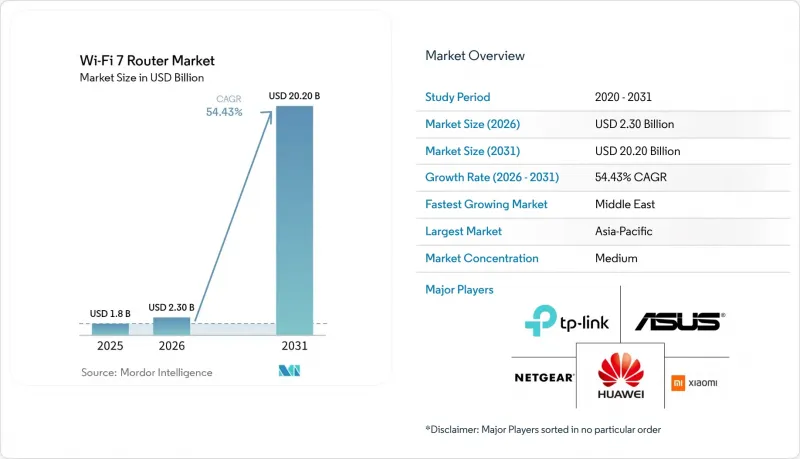
Mordor Intelligence에 의하면, Wi-Fi 7 라우터 시장 규모는 2025년에 18억 달러로 평가되었습니다. 2026년 23억 달러에서 2031년까지 202억 달러에 이를 것으로 예측되며, 2026년부터 2031년 예측 기간 CAGR은 54.43%를 나타낼 전망입니다.
본 보고서는 Wi-Fi 규격(듀얼 밴드, 트라이 밴드, 쿼드 밴드), 설계(기존 독립형, 메시 시스템, 게이밍 최적화형, 엔터프라이즈용 액세스 포인트), 최종 사용자용도(주거용, 중소기업, 대기업, 공공시설, 산업용 IoT), 판매 채널(온라인, 오프라인, 서비스 제공업체를 통한 번들 판매 등), 지역별로 분류되어 있습니다. 시장 전망은 금액(달러) 기준으로 제시되어 있습니다.
세계의 Wi-Fi 7 라우터 시장 동향 및 인사이트
ISP가 제공하는 멀티기가 인터넷 요금제의 급증
통신 사업자들은 5Gbps 및 10 Gbps 광회선 요금제에 Wi-Fi 7 라우터를 번들로 제공하고 있으며, 이에 따라 기기는 별도로 구매해야 하는 제품에서 내장형 서비스 계층으로 전환되고 있습니다. Google Fiber는 2026년 2월, Home 3 Gig 및 Edge 8 Gig 요금제에 Wi-Fi 7 하드웨어를 통합하여 계약 유지율을 높이고 해지율을 낮췄습니다. 지역 통신사들도 이 모델을 본받아, 라우터 수요를 광대역 서비스의 차별화와 직접적으로 연결하고 있습니다. 상각 기간이 단축됨에 따라 OEM 제조업체들은 소프트웨어 중심의 수익 창출로 방향을 전환하고 있는 반면, Wi-Fi 6 기기의 재판매 시장도 확대되고 있습니다.
스마트 오피스에서의 고밀도 Wi-Fi 기업 도입
기업 캠퍼스에서는 1,000제곱피트당 100대 이상의 기기 밀도를 지원하기 위해 Wi-Fi 6에서 Wi-Fi 7 액세스 포인트로의 업그레이드가 진행되고 있습니다. Cisco Catalyst 9170 시리즈는 멀티링크 기능을 활용하여 지연에 민감한 트래픽을 6GHz 대역으로 분리하는 한편, 일반 트래픽을 5GHz 대역으로 전환함으로써 경쟁을 줄이고 있습니다. Ruckus Networks T670sn은 IEEE 802.1AS 기반의 타이밍 제어를 통한 결정론적 기계 제어 기능을 통해 이 기술을 산업 환경으로 확장하고 있습니다. 320MHz의 광대역 채널을 통해 기기당 무선 처리량이 향상되어, 액세스 포인트의 총 수와 도입 비용을 절감합니다. 그러나 주파수 대역 조정이 복잡해짐에 따라, 기업에서 클라우드 기반 네트워크 아키텍처의 도입이 가속화되고 있습니다.
Wi-Fi 7 칩셋의 평균 판매 가격 상승
5nm 및 6nm 공정으로 제조된 첨단 Wi-Fi 7 칩셋은 Wi-Fi 6E 칩에 비해 40%-60%의 추가 비용이 발생하지만, 공급업체들은 이를 최종 사용자에게 전가하지 못하고 있습니다. 엔트리급 트라이밴드 라우터의 가격은 2025년까지 450달러에서 약 250달러로 하락했으며, 매출총이익률은 15% 미만으로 축소되었습니다. 1Gbps 광대역이 주류를 이루는 시장에서는 성능 향상 폭이 업그레이드를 정당화할 만큼 뚜렷하지 않아, 가격 경쟁력을 약화시키고 있습니다. 이를 보완하기 위해 칩셋 공급업체들은 6GHz 대역을 제외한 듀얼 밴드 모델을 도입하고 있지만, 이로 인해 성능 면에서의 차별화가 약화되어 Wi-Fi 7의 가치에 대한 소비자의 이해가 분열될 위험이 있습니다.
부문별 분석
쿼드밴드 Wi-Fi 7 기기는 2031년까지 연평균 성장률(CAGR) 60.12%를 나타낼 것으로 예측되며, 2025년 매출의 46.22%를 차지했던 트라이밴드 모델을 넘어설 전망입니다. 각 벤더사는 5GHz 및 2.4GHz 외에도 2개의 독립적인 6GHz 무선 모듈을 탑재하여, 지연 시간이 중요한 워크로드, 베스트 이포트형 워크로드, IoT 워크로드에 걸쳐 정확한 트래픽 세분화를 실현하고 있습니다. 이 아키텍처를 통해 기업은 확정적인 처리량을 유지하면서 액세스 포인트 밀도를 낮출 수 있으며, 이는 총 소유 비용(TCO) 개선으로 이어집니다. 6GHz를 사용할 수 없는 시장에서는 듀얼 밴드 기기에 대한 수요가 여전히 존재하지만, 차별화 요소가 부족하기 때문에 가격 결정력이 제한되며, Wi-Fi 7 라우터 시장 전체 가치에 대한 기여도도 제한적일 것입니다.
클라이언트 측의 준비 상황이 업그레이드 주기를 뒷받침하고 있습니다. 2026년 중반까지 안드로이드 플래그십 기기의 40% 이상이 FastConnect 7800을 탑재하게 되면서, 고대역폭 라우터에 대한 즉각적인 수요가 발생하고 있습니다. 트리밴드 시스템은 설정이 간편하고 RF 관리의 복잡성이 낮기 때문에 주택용 도입 분야에서 앞으로도 주류를 이룰 것으로 보입니다. 그러나 일반적으로 인프라 갱신 일정에 맞추어 진행되는 기업의 업데이트 주기는 기기 밀도가 높은 환경에 대응하기 위해 쿼드밴드 도입으로 점차 전환되고 있습니다. 이러한 전환으로 인해 평균 판매 가격이 상승하고, 엔터프라이즈급 네트워크 솔루션에 주력하는 벤더로 시장 점유율이 이동할 것으로 예측됩니다.
e스포츠 경기장이나 라이브 스트리밍 크리에이터들이 지속적인 멀티 기가비트 처리량과 1자리 밀리초 대의 지연 시간을 필요로 하고 있기 때문에 게이밍에 최적화된 Wi-Fi 7 라우터 시장은 연평균 성장률(CAGR) 62.53%로 성장할 것으로 전망됩니다. 멀티링크 작동 덕분에 5GHz 대역과 6GHz 대역을 동시에 사용할 수 있게 되어, 경쟁 시나리오에서 발생하는 지터 및 패킷 손실이 감소합니다. 전체 가정용 커버리지 수요에 힘입어 2025년 출하 대수의 51.72%를 메쉬 시스템이 차지한 반면, 게이밍 라우터는 고급 QoS 제어, 트래픽 우선순위 지정, 하드웨어 차별화에 대해 사용자가 비용을 지불하는 프리미엄 틈새 시장을 구축하고 있습니다. 이 부문은 상품화가 진행되고 있는 대중 시장용 라우터 카테고리와 비교했을 때, 가격 면에서 탄탄한 경쟁력을 보이고 있습니다.
아마존의 eero 7 시리즈가 기존 제품보다 약 30% 저렴한 가격으로 출시되면서 메쉬 시스템 간의 가격 경쟁이 치열해지고 있으며, 가격에 민감한 가정에서의 도입이 확대되고 있습니다. 단일 라우터는 좁은 공간에서는 여전히 유용하지만, 시장 점유율은 계속해서 하락하고 있습니다. 기업들이 중앙 집중식 관리와 네트워크 오케스트레이션을 우선시하는 가운데, 엔터프라이즈용 액세스 포인트는 부가가치가 더 높은 성장 분야로 부상하고 있습니다. 동시에, 산업용 등급의 Wi-Fi 7 하드웨어가 틈새 시장으로 부상하고 있으며, 견고한 설계, 내열성, PoE+ 지원 등의 특징을 바탕으로, 높은 신뢰성과 안정적인 무선 연결이 필요한 제조 및 물류 환경의 요구를 충족시키고 있습니다.
지역별 분석
2025년, 아시아태평양이 Wi-Fi 7 라우터 매출의 34%를 차지했습니다. 이는 한국, 인도, 일본에서 6GHz 대역의 조기 도입이 주도한 결과입니다. 한국에서는 실내 EIRP가 1 W로 제한되어 있으므로, 근접 제약 없이 320 MHz 대역의 채널을 최대한 활용할 수 있습니다. 한편, 인도에서는 2026년 1월부터 500 MHz 대역에 대한 면허 의무가 폐지됨에 따라 주요 기술 클러스터 전역에서 기업 캠퍼스의 업그레이드가 가속화되고 있습니다. 일본에서는 5925-7125 MHz 대역이 면허가 필요 없는 대역으로 이용 가능하지만, 동적 주파수 조정으로 인해 도입이 더욱 복잡해지고 있습니다. 반면, 중국에서는 6GHz 대역이 IMT 서비스에 할당되어 있기 때문에 국내용 라우터는 듀얼 밴드 구성으로 제한되고 있으며, 업체들은 수출 주도형 성장 전략을 추진하고 있습니다.
중동은 사우디아라비아와 아랍에미리트(UAE)의 대규모 스마트시티 투자를 배경으로, 2031년까지 연평균 성장률(CAGR) 57.81%를 기록하며 가장 빠른 성장세를 보일 것으로 전망됩니다. 킹 압둘라 금융 지구에서는 2025년 4월에 시 전역에 걸쳐 Wi-Fi 7 네트워크가 도입되어, 고밀도 연결 및 AR을 활용한 공공 서비스가 지원되었습니다. 2026년 말까지 걸프협력회의(GCC) 전역에서 6GHz 대역 주파수 정책의 조화가 이루어질 것으로 예상되며, 이에 따라 인증 장벽이 낮아지고 기기의 상호 운용성이 향상되어 인근 지역 시장 전체의 출하량이 증가할 것으로 전망됩니다.
북미와 유럽에서는 도입 동향에 차이가 나타납니다. Brightspeed 등 미국의 인터넷 서비스 제공업체들은 Wi-Fi 7 라우터를 멀티기가 광대역 요금제에 포함하고 있지만, 여전히 25% 이상의 가구가 Wi-Fi 4 및 Wi-Fi 5에 의존하고 있어 일반 시장에서의 전환 속도는 더딘 임베디드니다. 유럽에서는 Wi-Fi 6에 대한 소비자 만족도와 ETSI EN 303 687에 따른 규제 지연으로 인해, 광회선이 보급된 일부 국가에서도 도입률이 2% 미만에 그치고 있습니다. 남미와 아프리카에서는 투자 우선순위가 첨단 가정용 장비로의 업그레이드보다는 광회선 구축 및 고정 무선망 확장에 계속해서 두어지고 있습니다.
기타 혜택 :
- 엑셀 형식 시장 예측(ME) 시트
- 3개월간의 애널리스트 지원
자주 묻는 질문
목차
제1장 서론
제2장 조사 방법
제3장 주요 요약
제4장 시장 구도
제5장 시장 규모 및 성장 예측
제6장 경쟁 구도
제7장 시장 기회 및 향후 전망
KTH 26.06.26According to Mordor Intelligence, the wi-Fi 7 router market size was valued at USD 1.8 billion in 2025 and is estimated to grow from USD 2.3 billion in 2026 to reach USD 20.2 billion by 2031, at a CAGR of 54.43% during the forecast period 2026-2031.
This report is Segmented by Wi-Fi Standard (Dual-Band, Tri-Band, Quad-Band), Design (Traditional Single-Unit, Mesh Systems, Gaming-Optimized, Enterprise Access Points), End-User Application (Residential, SME, Large Enterprises, Public Venues, Industrial IoT), Distribution Channel (Online, Offline, Service Provider Bundling, and More), and Geography. The Market Forecasts are Provided in Terms of Value (USD).
Global Wi-Fi 7 Router Market Trends and Insights
Surge in Multi-Gig Internet Plans Offered by ISPs
Telecom operators are bundling Wi-Fi 7 routers with 5 Gbps and 10 Gbps fiber tiers, shifting the device from a discretionary purchase to an embedded service layer. Google Fiber integrated Wi-Fi 7 hardware into its Home 3 Gig and Edge 8 Gig plans in February 2026, reinforcing contract lock-ins and reducing churn. Regional carriers are replicating this model, linking router demand directly to broadband differentiation. Compressed amortization cycles are pushing OEMs toward software-led monetization, while resale markets for Wi-Fi 6 devices are expanding in parallel.
Enterprise Adoption of High-Density Wi-Fi in Smart Offices
Corporate campuses are upgrading from Wi-Fi 6 to Wi-Fi 7 access points to support densities above 100 devices per 1,000 square feet. Cisco Catalyst 9170-series uses multi-link operation to segregate latency-sensitive traffic on 6 GHz while shifting routine loads to 5 GHz, reducing contention. Ruckus Networks T670sn extends this into industrial settings with IEEE 802.1AS-based timing for deterministic machine control. Wider 320-MHz channels increase per-radio throughput, lowering the total access point count and deployment cost. However, the complexity of spectrum coordination is accelerating enterprise adoption of cloud-managed network architectures.
Elevated Average Selling Prices of Wi-Fi 7 Chipsets
Advanced Wi-Fi 7 chipsets fabricated on 5 nm and 6 nm nodes carry a 40%-60% cost premium over Wi-Fi 6E silicon, yet vendors have been unable to fully transfer this to end users. Entry-level tri-band router prices fell from USD 450 to ~USD 250 within 2025, compressing gross margins below 15%. In markets where 1 Gbps broadband dominates, incremental performance gains are not sufficiently visible to justify upgrades, weakening price realization. To offset this, chipset suppliers are introducing dual-band variants that exclude the 6 GHz band, but this compromises performance differentiation and risks fragmenting consumer understanding of Wi-Fi 7's value.
Other drivers and restraints analyzed in the detailed report include:
- Expanding Rollout of 6 GHz Spectrum Across Major Economies
- Proliferation of AR and VR Streaming Use-Cases
- Supply Chain Constraints for Advanced (≤ 6 nm) Nodes
For complete list of drivers and restraints, kindly check the Table Of Contents.
Segment Analysis
Quad-band Wi-Fi 7 equipment is projected to expand at a 60.12% CAGR through 2031, surpassing tri-band models that accounted for 46.22% of 2025 revenue. Vendors deploy two separate 6 GHz radios alongside 5 GHz and 2.4 GHz, enabling precise traffic segmentation across latency-critical, best-effort, and IoT workloads. This architecture allows enterprises to reduce access point density while maintaining deterministic throughput, improving the total cost of ownership. In markets without 6 GHz availability, dual-band devices remain relevant but lack differentiation, limiting pricing power and constraining their contribution to the overall Wi-Fi 7 router market value.
Client-side readiness is reinforcing the upgrade cycle. By mid-2026, over 40% of flagship Android devices integrated FastConnect 7800, creating immediate demand for higher-bandwidth routers. Tri-band systems will continue to dominate residential deployments due to simpler configuration and lower RF management complexity. However, enterprise refresh cycles, typically aligned with infrastructure renovation timelines, are shifting toward quad-band deployments to support dense device environments. This transition is expected to lift average selling prices and shift market share toward vendors focused on enterprise-grade networking solutions.
Gaming-optimized Wi-Fi 7 routers are projected to grow at a 62.53% CAGR, driven by esports venues and livestream creators requiring sustained multi-gigabit throughput and single-digit millisecond latency. Multi-Link Operation enables simultaneous use of 5 GHz and 6 GHz bands, reducing jitter and packet loss in competitive scenarios. While mesh systems accounted for 51.72% of 2025 shipments due to demand for whole-home coverage, gaming routers have established a premium niche where users pay for advanced quality of service controls, traffic prioritization, and hardware differentiation. This segment demonstrates stronger pricing resilience relative to commoditizing mass-market router categories.
Price compression in mesh systems is intensifying as Amazon's eero 7 lineup undercuts legacy offerings by ~30%, expanding adoption among cost-sensitive households. Single-unit routers remain viable for smaller spaces but continue to lose share. Enterprise access points represent a higher-value growth vector as organizations prioritize centralized management and network orchestration. Concurrently, industrial-grade Wi-Fi 7 hardware is emerging as a niche segment, with ruggedized designs, temperature tolerance, and PoE+ support addressing the needs of manufacturing and logistics environments that require reliable, deterministic wireless connectivity.
Geography Analysis
Asia-Pacific accounted for 34% of Wi-Fi 7 router revenue in 2025, driven by early 6 GHz enablement across South Korea, India, and Japan. South Korea's 1 W indoor EIRP limit enables full exploitation of 320 MHz channels without proximity constraints, while India's January 2026 de-licensing of 500 MHz is accelerating enterprise campus upgrades across major technology clusters. Japan allows 5925-7125 MHz for unlicensed use, though dynamic frequency coordination increases deployment complexity. In contrast, China assigns 6 GHz to IMT services, restricting domestic routers to dual-band configurations and pushing vendors toward export-driven growth strategies.
The Middle East is projected to register the fastest growth at a 57.81% CAGR through 2031, underpinned by large-scale smart-city investments in Saudi Arabia and the United Arab Emirates. King Abdullah Financial District deployed a city-wide Wi-Fi 7 network in April 2025, supporting high-density connectivity and AR-enabled public services. Anticipated harmonization of 6 GHz spectrum policies across the Gulf Cooperation Council by late 2026 is expected to reduce certification barriers, streamline device interoperability, and accelerate shipment volumes across adjacent regional markets.
Adoption trends diverge across North America and Europe. U.S. providers such as Brightspeed are bundling Wi-Fi 7 routers with multi-gig broadband plans, but over 25% of households still rely on Wi-Fi 4 and Wi-Fi 5, slowing mass-market conversion. European adoption remains below 2% in several fiber-dense countries due to consumer satisfaction with Wi-Fi 6 and regulatory delays under ETSI EN 303 687. In South America and Africa, investment priorities continue to favor fiber rollout and fixed-wireless expansion over upgrades to advanced customer-premises equipment.
- TP-Link Technologies Co., Ltd.
- ASUSTeK Computer Inc.
- Netgear, Inc.
- D-Link Corporation
- Xiaomi Corporation
- Huawei Technologies Co., Ltd.
- ZTE Corporation
- Linksys Holdings, Inc.
- Belkin International, Inc.
- Ubiquiti Inc.
- MikroTikls SIA
- Zyxel Communications Corp.
- Synology Inc.
- QNAP Systems, Inc.
- Mercusys Technologies Co., Ltd.
- Edimax Technology Co., Ltd.
- Ruijie Networks Co., Ltd.
- Ruckus Wireless, Inc.
- Tenda Technology Co., Ltd.
- Keenetic Limited
Additional Benefits:
- The market estimate (ME) sheet in Excel format
- 3 months of analyst support
TABLE OF CONTENTS
1 INTRODUCTION
- 1.1 Study Assumptions and Market Definition
- 1.2 Scope of the Study
2 RESEARCH METHODOLOGY
3 EXECUTIVE SUMMARY
4 MARKET LANDSCAPE
- 4.1 Market Overview
- 4.2 Market Drivers
- 4.2.1 Surge in Multi-Gig Internet Plans Offered by ISPs
- 4.2.2 Enterprise Adoption of High-Density Wi-Fi in Smart Offices
- 4.2.3 Expanding Rollout of 6 GHz Spectrum Across Major Economies
- 4.2.4 Proliferation of AR and VR Streaming Use-Cases
- 4.2.5 Integrated Wi-Fi 7 CPE Bundling Deals by Telecom Operators
- 4.2.6 4 K QAM Algorithm Enhancements Enabling Stable Throughput
- 4.3 Market Restraints
- 4.3.1 Elevated Average Selling Prices of Wi-Fi 7 Chipsets
- 4.3.2 Supply Chain Constraints for Advanced (<=6 nm) Nodes
- 4.3.3 Regulatory Delays on 6 GHz Co-existence Certification
- 4.3.4 Competition From Lower-Cost Wi-Fi 6E Install Base
- 4.4 Impact of Macroeconomic Factors on the Market
- 4.5 Industry Supply-Chain Analysis
- 4.6 Regulatory Landscape
- 4.7 Technological Outlook
- 4.8 Porter's Five Forces Analysis
- 4.8.1 Bargaining Power of Suppliers
- 4.8.2 Bargaining Power of Buyers
- 4.8.3 Threat of New Entrants
- 4.8.4 Threat of Substitutes
- 4.8.5 Competitive Rivalry
5 MARKET SIZE AND GROWTH FORECASTS (VALUE)
- 5.1 By Wi-Fi Standard
- 5.1.1 Dual-Band Wi-Fi 7 Routers
- 5.1.2 Tri-Band Wi-Fi 7 Routers
- 5.1.3 Quad-Band Wi-Fi 7 Routers
- 5.2 By Design
- 5.2.1 Traditional Single-Unit Routers
- 5.2.2 Mesh Wi-Fi Systems
- 5.2.3 Gaming-Optimized Routers
- 5.2.4 Enterprise Access Points
- 5.3 By End-User Application
- 5.3.1 Residential
- 5.3.2 Small and Medium Enterprises
- 5.3.3 Large Enterprises and Campuses
- 5.3.4 Public Venues and Hospitality
- 5.3.5 Industrial IoT
- 5.4 By Distribution Channel
- 5.4.1 Online Retail
- 5.4.2 Offline Retail
- 5.4.3 Service Provider/CPE Bundling
- 5.4.4 Enterprise Direct Sales
- 5.5 By Geography
- 5.5.1 North America
- 5.5.1.1 United States
- 5.5.1.2 Canada
- 5.5.1.3 Mexico
- 5.5.2 South America
- 5.5.2.1 Brazil
- 5.5.2.2 Argentina
- 5.5.2.3 Chile
- 5.5.2.4 Rest of South America
- 5.5.3 Europe
- 5.5.3.1 Germany
- 5.5.3.2 United Kingdom
- 5.5.3.3 France
- 5.5.3.4 Italy
- 5.5.3.5 Spain
- 5.5.3.6 Russia
- 5.5.3.7 Rest of Europe
- 5.5.4 Asia-Pacific
- 5.5.4.1 China
- 5.5.4.2 Japan
- 5.5.4.3 India
- 5.5.4.4 South Korea
- 5.5.4.5 Australia
- 5.5.4.6 Rest of Asia-Pacific
- 5.5.5 Middle East
- 5.5.5.1 United Arab Emirates
- 5.5.5.2 Saudi Arabia
- 5.5.5.3 Turkey
- 5.5.5.4 Rest of Middle East
- 5.5.6 Africa
- 5.5.6.1 South Africa
- 5.5.6.2 Nigeria
- 5.5.6.3 Kenya
- 5.5.6.4 Rest of Africa
- 5.5.1 North America
6 COMPETITIVE LANDSCAPE
- 6.1 Market Concentration
- 6.2 Strategic Moves
- 6.3 Market Share Analysis
- 6.4 Company Profiles (includes Global Level Overview, Market Level Overview, Core Segments, Financials as available, Strategic Information, Market Rank/Share, Products and Services, Recent Developments)
- 6.4.1 TP-Link Technologies Co., Ltd.
- 6.4.2 ASUSTeK Computer Inc.
- 6.4.3 Netgear, Inc.
- 6.4.4 D-Link Corporation
- 6.4.5 Xiaomi Corporation
- 6.4.6 Huawei Technologies Co., Ltd.
- 6.4.7 ZTE Corporation
- 6.4.8 Linksys Holdings, Inc.
- 6.4.9 Belkin International, Inc.
- 6.4.10 Ubiquiti Inc.
- 6.4.11 MikroTikls SIA
- 6.4.12 Zyxel Communications Corp.
- 6.4.13 Synology Inc.
- 6.4.14 QNAP Systems, Inc.
- 6.4.15 Mercusys Technologies Co., Ltd.
- 6.4.16 Edimax Technology Co., Ltd.
- 6.4.17 Ruijie Networks Co., Ltd.
- 6.4.18 Ruckus Wireless, Inc.
- 6.4.19 Tenda Technology Co., Ltd.
- 6.4.20 Keenetic Limited
7 MARKET OPPORTUNITIES AND FUTURE OUTLOOK
- 7.1 White-Space and Unmet-Need Assessment


