

|
시장보고서
상품코드
2063824
적층형 스위치 : 시장 점유율 분석, 업계 동향 및 통계, 성장 예측(2026-2031년)Stackable Switch - Market Share Analysis, Industry Trends & Statistics, Growth Forecasts (2026 - 2031) |
||||||
 Mordor Intelligence
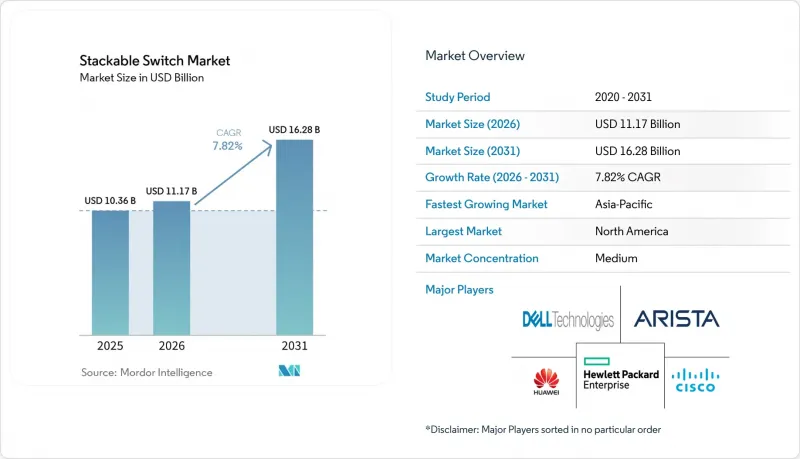
에 의하면, 적층형 스위치 시장 규모는 2025년에 103억 6,000만 달러로 평가되었습니다. 2026년 111억 7,000만 달러에서 2031년까지 162억 8,000만 달러에 이를 것으로 예상되며, 예측 기간(2026-2031년) CAGR은 7.82%를 나타낼 전망입니다.
본 보고서는 제품 유형(적층형 관리형 스위치 및 적층형 비관리형 스위치), 포트 속도(1 GbE 이하, 2.5/5GbE, 10 GbE, 25-40 GbE 및 100 GbE 이상), 포트 수(24포트 이하, 48포트, 48포트 이상), 도입 환경(엔터프라이즈·캠퍼스 등), 최종 사용자 산업(정부·국방 등), 지역별로 분류되어 있습니다. 시장 전망은 금액(달러) 기준으로 제공됩니다.
세계의 적층형 스위치 시장 동향 및 인사이트
클라우드 및 IoT 도입을 통한 기업 네트워크 확장
하이브리드 클라우드 아키텍처로 인해 캠퍼스 코어에는 동서 방향 트래픽이 쇄도하고 있으며, 기업들은 새로운 스위치 스택에 10 Gbps 또는 25Gbps 업링크를 지정하고 있습니다. On-Premise 쿠버네티스 클러스터와 퍼블릭 클라우드 리전 간을 이동하는 컨테이너화된 워크로드에는 5밀리초 미만의 지연 시간이 요구됩니다. 이 요구 사항은 인라인 텔레메트리 기능을 위해 AMD DPU를 탑재한 HPE의 CX 6000(2026년 출시 예정)을 통해 충족됩니다. 제조업 분야의 IoT 기기 밀도는 2023년 1,000제곱피트당 31대에서 2025년에는 47대에 달했으며, 이에 따라 네트워크 기획 담당자들은 1밀리초 미만의 지터를 유지하기 위해 추가적인 스택형 스위치를 도입할 수밖에 없게 되었습니다. 통합된 IT-OT 패브릭은 현재 영상 감시, 출입 통제, 빌딩 자동화 트래픽을 전송하고 있어 세분화의 복잡성을 가중시키고 있습니다. 이 과제는 하드웨어에서 강제되는 VLAN을 통해 관리 대상인 스택형 스위치가 해결합니다. 이상 감지를 위한 AI 추론 엔진을 탑재한 벤더는 인력이 제한된 IT 팀의 운영 부담을 한층 더 줄여줍니다.
Wi-Fi 6 백홀용 멀티 기가비트(2.5/5GbE) 포트
Wi-Fi 6E 액세스 포인트는 2 Gbps를 넘는 처리량을 구현하지만, 기존의 1 GbE 업링크를 사용하면 강당이나 경기장에서의 사용자 경험이 제한될 수밖에 없습니다. IEEE 802.3bz 멀티기가 포트는 기존의 Cat5e/Cat6 케이블을 통해 2.5Gbps 또는 5Gbps의 통신 속도를 구현하여, 비용이 많이 드는 케이블 교체 작업을 피할 수 있게 해줍니다. Cisco Catalyst 9200과 HPE Aruba CX 6300은 2025년에 멀티기가 모델을 출시하며, 교육 기관 및 호텔·관광 업계에서의 도입을 가속화했습니다. 2025년 하반기에 실시된 상호운용성 테스트에서 100m 길이의 Cat6 케이블 배선 시 비트 오류율이 10-12 이하인 것으로 확인되어, 초기 신호 무결성에 대한 우려가 해소되었습니다. 멀티 기가비트 회선에서 PoE Type 3 및 Type 4를 통합함에 따라 열적 제약이 발생하여, 스위치 제조업체들은 기류 경로와 방열판을 재설계해야 하는 상황에 직면해 있습니다. Wi-Fi 7의 시범 도입이 진행되고 있으며, AP당 대역폭 상한이 5Gbps에 가까운 지역에서 수요가 가장 높게 나타나고 있습니다.
ASIC 공급망의 불안정성이 도입을 지연시키고 있습니다.
Broadcom과 Marvell의 리드타임은 2025년 하반기에는 52주로 늘어났으며, 이로 인해 캠퍼스 현대화 프로젝트가 정체되고 공급업체의 미처리 주문량이 증가하고 있습니다. 시스코는 2025 회계연도 3분기 실적 발표에서 캠퍼스 스위칭 부문의 매출이 8% 감소했다고 보고했으며, 그 원인으로 반도체 부족을 꼽았습니다. 생산이 아시아의 소수 파운드리 업체에 집중되어 있는 것은 지정학적 리스크를 초래하고 있으며, 이에 따라 아리스타와 주니퍼는 특정 모델에 대해 듀얼 소싱(여러 공급업체로부터의 조달)을 추진하고 있습니다. 기업 측은 이에 대응하기 위해 도입 9개월 전에 하드웨어를 발주했으며, 이로 인해 자본이 묶이게 되어 분기별 출하 데이터에 왜곡이 발생하고 있습니다. 공급 부족이 장기화될 경우, 일부 갱신 예산이 하드웨어 직접 구매가 아닌 구독형 관리형 서비스로 전환될 가능성이 있습니다.
부문별 분석
스택형 관리형 스위치는 2025년 매출의 64.32%를 차지하며, 기업들이 중앙 집중식 구성 및 SNMP 기반 모니터링에 의존하고 있음을 여실히 보여주었습니다. 이 카테고리는 비관리형 장비에는 없는 라이프사이클 자동화 및 펌웨어 오케스트레이션을 제공함으로써 스택형 스위치 시장 규모를 주도하고 있습니다. 콘포멀 코팅 및 DIN 레일 마운트로 강화된 산업용 스택형 스위치는 인더스트리 4.0 도입이 가속화되고 있는 추세를 반영하여, 2031년까지 연평균 성장률(CAGR) 12.52%로 성장할 것으로 전망됩니다.
현재 매니지드 모델에는 온칩 AI 엔진이 내장되어 있어, 비정상적인 트래픽의 급증을 감지하고 포트 고장을 예측함으로써 IT 담당자가 적은 환경에서의 운영을 효율화하고 있습니다. 산업용 모델은 PROFINET, EtherNet/IP, TSN을 단일 플랫폼에 통합하여 공장 내 캐비닛 설치 면적을 줄여줍니다. 비관리형 모델은 여전히 소규모 사무실이나 소매점의 POS 레인에서 사용되고 있지만, 클라우드 관리형 제품이 비슷한 가격대에 진입함에 따라 스택형 스위치 시장에서의 점유율은 줄어들고 있습니다.
2025년, 1 GbE 이하의 속도를 가진 포트는 적층형 스위치 시장에서 중요한 위치를 차지하며, 출하 점유율의 51.28%를 차지했습니다. 이 부문은 광범위한 보급과 기존 네트워크 인프라와의 호환성 덕분에 계속해서 중요한 역할을 수행하고 있습니다. 그러나 Wi-Fi 7의 시범 도입으로 기가비트 대역폭의 병목 현상이 부각되는 가운데, 멀티 기가비트 인터페이스는 연평균 성장률(CAGR) 18.33%라는 눈부신 성장을 이루고 있습니다. 이 대역은 무전기 비용 절감과 기존 시스템과의 원활한 통합을 가능하게 하는 하위 호환성 있는 케이블 배선의 이점에 힘입어, 시장에서 가장 빠르게 성장하는 부문으로 부상하고 있습니다.
HPE Aruba CX 6300 및 Cisco Catalyst 9200은 기존 랙에 원활하게 통합할 수 있는 24포트 및 48포트 멀티 기가비트 SKU를 제공합니다. 데이터센터의 리프 계층에서는 NVMe-oF의 처리량 수요에 대응하기 위해 25Gbps 및 40 Gbps로의 전환이 진행되고 있는 반면, NVIDIA의 Spectrum-X는 AI 패브릭용 400 Gbps 적층형 모델을 시연하고 있습니다. 자동 협상 기능을 통해 멀티 기가비트 포트는 구형 장치와의 상호 운용성을 유지하며, 감가상각 일정에 맞추어 단계적인 업그레이드가 가능합니다.
지역별 분석
2025년에는 정부의 사이버 보안 규제와 고등교육 기관의 현대화 노력에 힘입어 북미가 전 세계 매출의 37.83%를 차지했습니다. 수명이 다 되어가는 노후화된 Cat5e 케이블로 인해, 조직에서는 멀티 기가비트 스위치 업그레이드와 병행하여 케이블 교체 작업을 진행하고 있습니다. 또한, HPE의 주니퍼 인수를 계기로 이어진 벤더 통합으로 인해 상위 3개사 시장 지위가 강화되어, 현재 총 출하 대수의 약 60%를 차지하고 있습니다.
아시아태평양은 가장 빠르게 성장하는 지역으로, 2031년까지의 연평균 성장률(CAGR)은 17.67%로 예측됩니다. 중국의 1조 4,000억 달러 규모의 디지털 인프라 투자와 인도의 300억 달러 규모의 전자기기 장려책이 하이퍼스케일 데이터센터 및 스마트 공장 건설을 뒷받침하고 있습니다. 아세안 지역에서는 각 도시에서 PoE 지원 감시 시스템 및 환경 센서의 도입이 확대되고 있으며, 이러한 용도를 지원하기 위한 고전력 대응의 견고한 적층형 스위치에 대한 수요가 증가하고 있습니다. 이러한 추세는 해당 지역이 도시 인프라 강화와 스마트시티 구상에 주력하고 있음을 반영하고 있습니다.
유럽의 적층형 스위치 시장은 GDPR(EU 개인정보보호규정) 및 공급업체의 탄소 발자국을 중시하는 새로운 지속가능성 보고 기준 등, 규제 준수에 따라 형성되고 있습니다. 독일, 프랑스, 영국은 도입의 최전선에 서 있으며, 특히 10마이크로초 미만의 지연 시간이 필수 요건인 자동차 및 금융 부문에서 그 추세가 두드러집니다. 이 국가들은 해당 산업의 까다로운 요구 사항을 충족하기 위해 첨단 네트워크 인프라를 활용하고 있습니다. 반면, 남미 및 중동 및 아프리카에서는 적층형 스위치에 대한 총 투자액이 뒤처지고 있습니다. 그러나 브라질, 아랍에미리트, 남아프리카공화국 등의 국가에서 진행되고 있는 개별 스마트시티 프로젝트와 데이터센터 개발은 잠재적인 성장 기회를 시사하고 있습니다. 거시경제의 변동이 진정됨에 따라, 이들 지역에서는 네트워크 인프라에 대한 투자가 증가하여 시장의 추가적인 확장을 뒷받침할 가능성이 있습니다.
기타 혜택 :
- 엑셀 형식 시장 예측(ME) 시트
- 3개월간의 애널리스트 지원
자주 묻는 질문
목차
제1장 서론
제2장 조사 방법
제3장 주요 요약
제4장 시장 구도
제5장 시장 규모 및 성장 예측
제6장 경쟁 구도
제7장 시장 기회 및 향후 전망
KTH 26.06.26According to Mordor Intelligence, the stackable switch market size was valued at USD 10.36 billion in 2025 and estimated to grow from USD 11.17 billion in 2026 to reach USD 16.28 billion by 2031, at a CAGR of 7.82% during the forecast period (2026-2031).
This report is Segmented by Product Type (Stackable Managed Switches, and Stackable Unmanaged Switches), Port Speeds (≤1 GbE, 2. 5/5 GbE, 10 GbE, 25-40 GbE, and ≥100 GbE), Port Counts (≤24 Ports, 48 Ports, and More Than 48 Ports), Deployment (Enterprise Campus, and More), End-User Industry (Government and Defence, and More), and Geography. The Market Forecasts are Provided in Terms of Value (USD).
Global Stackable Switch Market Trends and Insights
Enterprise Network Expansion Via Cloud And IoT Adoption
Hybrid-cloud architectures are flooding campus cores with east-west traffic, prompting enterprises to specify 10 Gbps or 25 Gbps uplinks in new switch stacks. Containerized workloads moving between on-premises Kubernetes clusters and public-cloud regions demand latency under 5 ms, a target met by HPE's CX 6000 launch in 2026 that embeds AMD DPUs for inline telemetry. IoT device density in manufacturing hit 47 endpoints per 1,000 sq ft in 2025, up from 31 in 2023, forcing network planners to deploy additional stackables to preserve sub-millisecond jitter. Converged IT-OT fabrics now carry video surveillance, access control, and building-automation traffic, raising segmentation complexity that managed stackables solve through hardware-enforced VLANs. Vendors embedding AI inference engines for anomaly detection further reduce operational burden in lean IT teams.
Multi-Gig (2.5/5 GbE) Ports For Wi-Fi 6 Backhaul
Wi-Fi 6E access points exceed 2 Gbps throughput, yet legacy 1 GbE uplinks throttle user experience in lecture halls and stadiums. IEEE 802.3bz multi-gig ports deliver 2.5 Gbps or 5 Gbps over existing Cat5e/Cat6, avoiding costly re-cabling. Cisco Catalyst 9200 and HPE Aruba CX 6300 shipped multi-gig variants in 2025, accelerating adoption in education and hospitality. Late-2025 interoperability tests confirmed bit-error rates below 10-12 across 100 m Cat6 runs, addressing early signal-integrity concerns. Integrating PoE Type 3 and Type 4 over multi-gig lines introduces thermal constraints, driving switch makers to redesign airflow paths and heatsinks. Demand is strongest where Wi-Fi 7 pilots are underway and bandwidth ceilings near 5 Gbps per AP.
ASIC Supply-Chain Volatility Delaying Roll-Outs
Broadcom and Marvell lead times stretched to 52 weeks in late 2025, stalling campus refresh projects and inflating vendor backlogs. Cisco cited an 8% revenue dip in campus switching during its fiscal Q3 2025 earnings, attributing the slide to silicon shortages. Concentration of production at a handful of Asian foundries injects geopolitical risk, prompting Arista and Juniper to dual-source select models. Enterprises are countering by ordering hardware nine months ahead of deployment, tying up capital and skewing quarterly shipment data. Persistent scarcity could redirect some refresh budgets toward subscription-based managed services rather than outright hardware purchases.
Other drivers and restraints analyzed in the detailed report include:
- Rising PoE Demand For IoT/VoIP Endpoints
- Campus Upgrades To 10/25/40 Gb Ethernet
- Price Pressure From White-Box Vendors
For complete list of drivers and restraints, kindly check the Table Of Contents.
Segment Analysis
Stackable managed switches generated 64.32% of 2025 revenue, underscoring enterprise reliance on centralized configuration and SNMP-based monitoring. This category anchors the stackable switch market size narrative by offering lifecycle automation and firmware orchestration that unmanaged gear lacks. Industrial stackables, fortified with conformal coatings and DIN-rail mounts, are forecast to expand at a 12.52% CAGR through 2031, reflecting intensified Industry 4.0 rollouts.
Managed models now embed on-chip AI engines that flag anomalous traffic spikes and predict port failures, streamlining operations for lean IT staffs. Industrial variants converge PROFINET, EtherNet/IP, and TSN on a single platform, trimming cabinet footprint on factory floors. Unmanaged units linger in small offices and retail POS lanes but their slice of the stackable switch market is shrinking as cloud-managed offerings approach similar pricing.
In 2025, ports with speeds of ≤1 GbE held a significant position in the stackable switch market, accounting for 51.28% of the shipment share. This segment continues to play a crucial role due to its widespread adoption and compatibility with existing network infrastructure. However, as Wi-Fi 7 pilots highlight gigabit bottlenecks, multi-gig interfaces are experiencing robust growth, with a remarkable CAGR of 18.33%. This speed tier has emerged as the fastest-growing segment in the market, driven by decreasing transceiver costs and the benefit of backward-compatible cabling, which facilitates seamless integration into current systems.
HPE Aruba CX 6300 and Cisco Catalyst 9200 provide 24- and 48-port multi-gig SKUs that slot seamlessly into existing racks. Data-center leaf layers are jumping to 25 Gbps and 40 Gbps to feed NVMe-oF throughput demands, while NVIDIA's Spectrum-X demonstrates 400 Gbps stackables for AI fabrics. Auto-negotiation keeps multi-gig ports interoperable with legacy devices, enabling phased upgrades aligned with depreciation schedules.
Geography Analysis
North America accounted for 37.83% of global revenues in 2025, driven by government cybersecurity mandates and higher-education modernization efforts. The aging Cat5e cabling, approaching its end-of-life, has prompted organizations to synchronize re-cabling efforts with multi-gig switch upgrades. Additionally, vendor consolidation, following HPE's acquisition of Juniper, has strengthened the market position of the top three vendors, who now account for approximately 60% of total shipments.
Asia Pacific is the fastest-growing territory, projected at a 17.67% CAGR to 2031. China's USD 1.4 trillion digital-infrastructure investment and India's USD 30 billion electronics incentive scheme are catalyzing hyperscale data centers and smart-factory build-outs. In ASEAN, cities are increasingly adopting PoE-powered surveillance systems and environmental sensors, which has spurred demand for rugged stackable switches with high power budgets to support these applications. This trend reflects the region's focus on enhancing urban infrastructure and smart city initiatives.
Europe's stackable switch market is shaped by regulatory compliance, including GDPR and new sustainability reporting standards that emphasize vendor carbon footprints. Germany, France, and the United Kingdom are at the forefront of deployments, particularly in the automotive and financial sectors, where sub-10 µs latency is a critical requirement. These countries are leveraging advanced network infrastructure to meet the stringent demands of these industries. In contrast, South America and the Middle East and Africa lag in overall spending on stackable switches. However, isolated smart city projects and data center developments in countries like Brazil, the UAE, and South Africa indicate potential growth opportunities. As macroeconomic volatility subsides, these regions could witness increased investments in network infrastructure, further driving market expansion.
- Cisco Systems Inc.
- Hewlett Packard Enterprise (Aruba)
- Huawei Technologies Co. Ltd.
- Arista Networks Inc.
- Dell Technologies Inc.
- Extreme Networks Inc.
- Netgear Inc.
- TP-Link Technologies Co. Ltd.
- Zyxel Communications Corp.
- Broadcom (Brocade Communications)
- D-Link Corporation
- Lenovo Group Ltd.
- MikroTik SIA
- Allied Telesis Holdings K.K.
- Alcatel-Lucent Enterprise
- Fortinet Inc.
- NVIDIA (Mellanox Switching)
- Edgecore Networks Corp.
- Siemens AG (Industrial Networks)
- Belden Inc. (Hirschmann)
Additional Benefits:
- The market estimate (ME) sheet in Excel format
- 3 months of analyst support
TABLE OF CONTENTS
1 INTRODUCTION
- 1.1 Study Assumptions and Market Definition
- 1.2 Scope of the Study
2 RESEARCH METHODOLOGY
3 EXECUTIVE SUMMARY
4 MARKET LANDSCAPE
- 4.1 Market Overview
- 4.2 Market Drivers
- 4.2.1 Enterprise Network Expansion Via Cloud and IoT Adoption
- 4.2.2 Multi-gig (2.5/5 Gbe) Ports for Wi-fi 6 Backhaul
- 4.2.3 Rising POE Demand for Iot/Voip Endpoints
- 4.2.4 Campus Upgrades to 10/25/40 Gb Ethernet
- 4.2.5 Need For Simplified Scalability and Management
- 4.2.6 Smart-building Retrofits in Tier-2/3 Cities
- 4.3 Market Restraints
- 4.3.1 Cannibalization by Chassis-based Switches
- 4.3.2 Price Pressure From White-box Vendors
- 4.3.3 ASIC Supply-chain Volatility Delaying Roll-outs
- 4.3.4 SD-WAN Edge Lowering Campus Switch Density
- 4.4 Industry Supply-Chain Analysis
- 4.5 Technological Outlook
- 4.6 Porter's Five Forces Analysis
- 4.6.1 Threat of New Entrants
- 4.6.2 Bargaining Power of Suppliers
- 4.6.3 Bargaining Power of Buyers
- 4.6.4 Threat of Substitutes
- 4.6.5 Competitive Rivalry
5 MARKET SIZE AND GROWTH FORECASTS (VALUE)
- 5.1 By Product Type
- 5.1.1 Stackable Managed Switches
- 5.1.2 Stackable Unmanaged Switches
- 5.2 By Port Speeds
- 5.2.1 <=1 GbE (10/100/1000)
- 5.2.2 2.5/5 GbE (Multi-Gig)
- 5.2.3 10 GbE
- 5.2.4 25-40 GbE
- 5.2.5 >=100 GbE
- 5.3 By Port Counts
- 5.3.1 <=24 Ports
- 5.3.2 48 Ports
- 5.3.3 More than 48 Ports
- 5.4 By Deployment
- 5.4.1 Enterprise Campus
- 5.4.2 Data Center Top-of-Rack
- 5.4.3 Service Provider Edge
- 5.4.4 Industrial Networks
- 5.5 By End-user Industry
- 5.5.1 Government and Defence
- 5.5.2 Education
- 5.5.3 Other End-user Industries
- 5.6 By Geography
- 5.6.1 North America
- 5.6.1.1 United States
- 5.6.1.2 Canada
- 5.6.1.3 Mexico
- 5.6.2 South America
- 5.6.2.1 Brazil
- 5.6.2.2 Argentina
- 5.6.2.3 Rest of South America
- 5.6.3 Europe
- 5.6.3.1 United Kingdom
- 5.6.3.2 Germany
- 5.6.3.3 France
- 5.6.3.4 Italy
- 5.6.3.5 Spain
- 5.6.3.6 Russia
- 5.6.3.7 Rest of Europe
- 5.6.4 Asia Pacific
- 5.6.4.1 China
- 5.6.4.2 Japan
- 5.6.4.3 India
- 5.6.4.4 South Korea
- 5.6.4.5 Australia and New Zealand
- 5.6.4.6 Rest of Asia Pacific
- 5.6.5 Middle East and Africa
- 5.6.5.1 Middle East
- 5.6.5.1.1 United Arab Emirates
- 5.6.5.1.2 Saudi Arabia
- 5.6.5.1.3 Rest of the Middle East
- 5.6.5.2 Africa
- 5.6.5.2.1 South Africa
- 5.6.5.2.2 Rest of Africa
- 5.6.5.1 Middle East
- 5.6.1 North America
6 COMPETITIVE LANDSCAPE
- 6.1 Market Concentration
- 6.2 Strategic Moves
- 6.3 Market Share Analysis
- 6.4 Company Profiles (includes Global Overview, Market Overview, Core Segments, Financials, Strategic Information, Market Rank/Share, Products and Services, Recent Developments)
- 6.4.1 Cisco Systems Inc.
- 6.4.2 Hewlett Packard Enterprise (Aruba)
- 6.4.3 Huawei Technologies Co. Ltd.
- 6.4.4 Arista Networks Inc.
- 6.4.5 Dell Technologies Inc.
- 6.4.6 Extreme Networks Inc.
- 6.4.7 Netgear Inc.
- 6.4.8 TP-Link Technologies Co. Ltd.
- 6.4.9 Zyxel Communications Corp.
- 6.4.10 Broadcom (Brocade Communications)
- 6.4.11 D-Link Corporation
- 6.4.12 Lenovo Group Ltd.
- 6.4.13 MikroTik SIA
- 6.4.14 Allied Telesis Holdings K.K.
- 6.4.15 Alcatel-Lucent Enterprise
- 6.4.16 Fortinet Inc.
- 6.4.17 NVIDIA (Mellanox Switching)
- 6.4.18 Edgecore Networks Corp.
- 6.4.19 Siemens AG (Industrial Networks)
- 6.4.20 Belden Inc. (Hirschmann)
7 MARKET OPPORTUNITIES AND FUTURE OUTLOOK
- 7.1 White-Space and Unmet-Need Assessment


