

|
시장보고서
상품코드
2063865
SMD(표면 실장 부품) LED 패키지 시장 : 시장 점유율 분석, 업계 동향 및 통계, 성장 예측(2026-2031년)SMD (Surface Mount Device) LED Package - Market Share Analysis, Industry Trends & Statistics, Growth Forecasts (2026 - 2031) |
||||||
 Mordor Intelligence
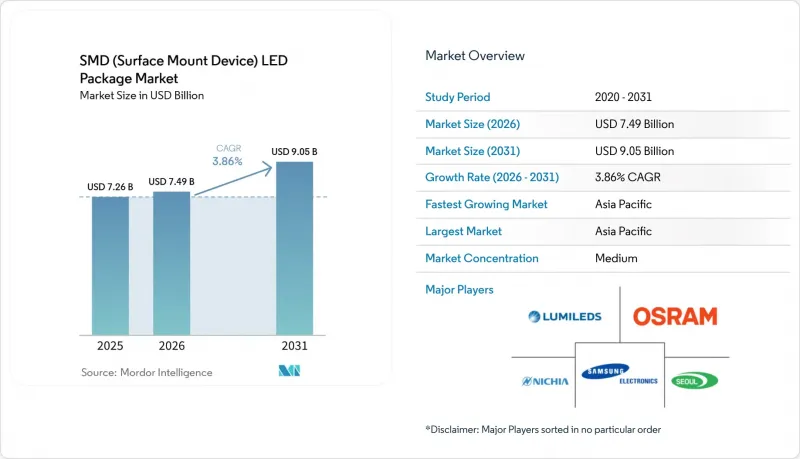
Mordor Intelligence에 의하면, SMD LED 패키지 시장 규모는 2025년에 72억 6,000만 달러로 평가되었고, 2026년에 74억 9,000만 달러로 추정되고, 2031년까지 90억 5,000만 달러에 이를 것으로 예측되며, 2026-2031년 CAGR 3.86%로 성장할 전망입니다.
본 보고서는 출력 등급별(저전력, 중전력, 고전력, 초고전력), 발광 유형별(가시광선, 적외선, 자외선), 주요 소재별(기판, 봉지재, 본딩재, 형광체), 용도별(일반 조명, 자동차, 디스플레이, 특수 용도) 및 지역별로 분류되어 있습니다. 시장 전망은 금액(달러) 기준으로 제시되어 있습니다.
세계의 SMD(표면 실장 소자) LED 패키지 시장 동향 및 인사이트
소형화가 진행되고 있는 가정용 전자기기의 보급
웨어러블 기기 및 스마트폰 설계자들은 실적를 1mm² 미만으로 축소하고 있으며, SMD LED 패키지 제조업체들은 Z축 높이를 0.5mm 미만으로 억제하고, 더욱 엄격한 비닝, -10°C에서 +60°C의 주변 온도 범위에서 색 편차를 3 맥아담 단계 이내로 억제하는 전력 밀도를 실현해야 합니다. VueReal사의 EcoVue 전사 공정은 2025년에 양산 단계에 도달하여, Garmin Fenix 8 Pro에 OLED 백라이트보다 전력 소비가 30% 낮으면서도 실외에서도 10,000니트의 밝기를 구현하는 풀컬러 마이크로 LED 디스플레이를 탑재할 수 있게 했습니다. AUO와 삼성디스플레이는 각각 2028년 가동을 목표로 전용 마이크로 LED 생산 라인을 확정했으며, 이는 액정 디스플레이 대체 제품에 비해 3-5배의 추가 비용이 발생하더라도 장기적인 수요 전망이 밝음을 시사하고 있습니다. 열 부하는 여전히 중요한 과제이지만, Aismalibar사의 상변화 다이 어태치 기술은 200 W m-1K-1의 한계를 돌파하여 핫스팟의 온도 구배를 분산시킵니다. 가정용 기기의 베젤이 얇아지는 추세 속에서 이러한 초슬림형 패키지는 안테나와 센서를 위한 기판 공간을 확대하여 해당 시장의 견조한 연평균 성장률(CAGR)을 뒷받침하고 있습니다.
자동차용 LED 조명 수요 증가
각 OEM 업체들은 고정 빔에서 특정 발광 소자를 밀리초 단위로 조광하는 매트릭스 헤드라이트로 전환하고 있으며, 이러한 변화에 따라 단일 칩을 통한 개별 제어 기능이나 100°C 미만의 접합부 온도 등 패키지 요구 사항이 높아지고 있습니다. LUXEON Altilon SMD-A는 2025년에 두께 433µm로 출시되었으며, 2026년형 차량의 적응형 주행 빔에 관한 유엔 규정 123의 기준을 충족합니다. 기판 상에서는 Lumissil사의 IS32LT3365가 48개의 정전류 채널과 ISO 26262 진단 기능을 통합하고 있는 반면, Diodes Incorporated사의 AL5958Q는 16비트 조광 기능과 전자기 간섭(EMI) 스프레드 스펙트럼 기능을 추가하고 있습니다. 이러한 전자 부품은 세라믹 기판 및 소결 은 접합과 결합함으로써 2.5 K W-1 미만의 열저항을 실현하여, 고급 세단 및 스포츠 유틸리티 차량(SUV)용 고출력 디바이스의 목표 시장(TAM)을 확대되고 있습니다.
열 관리 및 방열의 과제
3W를 초과하는 패키지의 경우, 접합부 온도가 125°C를 초과하는 경우가 많아, 30,000시간 이내의 L70 기준 루멘 유지율이 절반으로 감소하며 치명적인 고장 위험이 발생합니다. COFAN의 수직 탄소나노튜브 계면은 1,500 W m-1K-1의 열전도율을 실현하지만, 유닛당 0.50-1달러의 추가 비용이 발생하므로 일반 조명 용도로는 너무 비쌉니다. Lumileds의 열전도 패드 구조조차 3.5 W밖에 지원하지 못하기 때문에 초고출력 제품의 적용은 자동차나 경기장 조명에 한정되어 있습니다. 수동 부품의 비용이 범용 제품 수준까지 떨어지지 않는 한, 열 설계상의 병목 현상으로 인해 이 부문의 연평균 성장률(CAGR)은 계속해서 0.6포인트 하락할 것입니다.
부문별 분석
고출력 디바이스(1-3W)는 매트릭스 헤드라이트나 하이베이 조명 기구에서 싱글 칩 조광 기능과 세라믹 열전도 경로가 요구되기 때문에 2031년까지 연평균 성장률(CAGR) 4.22%를 기록하며 SMD LED 패키지 시장 전체를 상회하는 성장이 예상됩니다. 따라서 이 등급의 SMD LED 패키지 시장 규모는 2025년에 매출 점유율 30.29%를 차지한 중출력 디바이스보다 더 빠르게 확대될 것입니다. 중출력 제품은 발광 효율 목표치가 140 lm/W 전후에 머무르는 레트로핏 램프에서 여전히 필수적이지만, OLED 및 마이크로 LED 디스플레이가 백라이트 시장을 잠식해 감에 따라 저출력 디바이스는 표시등과 같은 틈새 시장으로 점차 이동하고 있습니다. 초고출력(3W 초과) 제품은 125°C라는 엄격한 접합부 온도 상한으로 인해 수명이 절반으로 줄어들기 때문에 강제 공랭 또는 수랭이 필요한 용도로만 제한됩니다.
자동차 업계의 사양에 따라, 450 lm을 초과하는 광속을 Z축 방향 높이 450µm 미만에서 구현하는 고출력 포맷에 대한 수요가 증가하고 있습니다. Diodes Incorporated의 AL5958Q 및 Lumissil의 IS32LT3365 드라이버는 48개의 조광 가능 채널을 제공하며, 각 OEM 업체들은 이를 활용하여 2026년형 자동차를 위한 눈부심 없는 적응형 주행 빔을 구현하고 있습니다. 이러한 광학 시스템, 드라이버 및 전원 관리 기술의 조합 덕분에 고출력 제품군의 SMD LED 패키지 시장 점유율 확대 추세가 유지되는 한편, 중출력 패키지는 상업용 다운라이트 시장을 계속해서 지켜내고 있습니다. 북미에서 DLC 기준이 상향 조정됨에 따라, 이러한 양극화는 더욱 심화될 전망입니다.
가시광선 발광 소자는 2025년 매출의 87.38%를 차지했지만, UV 장치는 공중보건 및 수처리 규제를 배경으로 연평균 성장률(CAGR) 4.57%를 기록하며 현재 가장 높은 성장률을 보이고 있습니다. UV 용도와 관련된 SMD LED 패키지 시장 규모는 265nm 어레이로 수은 램프를 대체하여 운영 비용을 40% 절감하는 지방자치단체의 소독 시설 덕분에 성장하고 있습니다. 적외선 분야는 생체 인증 및 운전자 모니터링을 중심으로 견조한 추세를 보이고 있으며, 이는 공급업체들에게 가격 변동을 완화해 주는 폭넓은 제품 포트폴리오를 제공합니다. 가시광선 패키지는 출하량 측면에서 계속해서 지배적인 위치를 유지할 것, 효율 향상이 물리적 한계에 가까워지고 조명 개조 시장이 포화 상태에 접어들면서 그 성장세는 둔화될 것입니다.
2026년 하반기에 ams OSRAM에서 200mW급 UV-C 부품이 출시된 사실은 이 분야가 주류로 자리 잡았음을 입증합니다. TrendForce는 이미 2026년 UV 부문 시장 규모를 전년 대비 10% 증가한 2억 1,500만 달러로 전망하고 있으며, 인프라 자금 조달 계획을 고려할 때 의료 및 건축용 공기 정화 분야에서 향후 수년에 걸쳐 설비 투자 붐이 예상됩니다. 양자점 형광체가 가시광선 제품의 연색성을 향상시키는 한편, 자외선(UV)의 도입은 독자적인 수요 주기에 따라 지속적으로 진전되고 있어, 발광 유형을 아우르는 두 가지 축으로 이루어진 전망을 더욱 공고히 하고 있습니다.
지역별 분석
아시아태평양은 2025년 전 세계 SMD LED 패키지 매출의 66.85%를 차지했으며, 2031년까지 연평균 성장률(CAGR) 4.16%를 기록하며 그 우위를 확대할 것으로 전망됩니다. 광둥성 등 중국 각 성에서는 도시 조명 입찰의 40%를 국내 중소기업에 배정하는 조달 할당 제도를 적용하여 지역 내 수요를 확보하고 있습니다. 한편, 후난성과 푸젠성의 신설 시설은 기판 자급률을 높이고 있습니다. 지역 종합적 경제 동반자 협정(RCEP)에 따른 관세 철폐로 인해 일본과 한국의 칩 생산과 베트남 및 태국의 패키징이 더욱 통합되면서 리드타임이 단축되고, 지역 공급 기반이 강화되고 있습니다.
북미와 유럽은 합쳐서 2025년 매출의 약 4분의 1을 차지했지만, 일반 조명 시장의 포화와 상업용 조명 기구의 교체 주기 장기화로 인해 성장은 여전히 둔화되고 있습니다. 그럼에도 불구하고, 정책 긴축으로 인해 고효율 부품에 대한 수요가 계속해서 증가하고 있습니다. DesignLights Consortium의 SSL V6.0 프리미엄 등급 및 유럽의 A등급(>=lm/W) 라벨에서는 OEM의 부품 명세서에 세라믹 기판과 첨단 형광체의 채택이 의무화되어 있어, 판매량은 정체 상태임에도 불구하고 평균 판매 가격을 지탱하고 있습니다. Telensa사의 글로스터셔 지역 사업이나 Tridonic사의 다름슈타트 프로젝트에서 볼 수 있듯이, 지자체의 스마트 조명 도입은 업그레이드 열풍을 일으키며, 리트로핏용 소켓 수요 감소세를 다소 상쇄하고 있습니다.
남미, 중동 및 아프리카의 합계는 세계 판매 점유율에서는 미미하지만, 공급망의 현지화를 촉진하는 인센티브 덕분에 국지적인 수요가 유발되고 있습니다. 베트남의 5억 달러 규모 박닌 LED 클러스터와 인도의 매출 증가분에 대해 4-6%를 지급하는 생산 연계형 인센티브는 대만과 한국공급업체들을 합작 투자로 이끌고 있습니다. 절대적인 수량은 여전히 적은 편이지만, 지역별 보조금 지원으로 인해 중국 연안 지역의 조립 업무 일부가 유출되고 있어, 과거 단일 국가에 의존해 조달하던 전 세계 조명 기구 브랜드들에게는 시장 세분화가 진행되고 있으며, 운송 비용이 상승하고 있습니다.
기타 혜택 :
- 엑셀 형식 시장 예측(ME) 시트
- 3개월간의 애널리스트 지원
자주 묻는 질문
목차
제1장 서론
제2장 조사 방법
제3장 주요 요약
제4장 시장 구도
제5장 시장 규모 및 성장 예측
제6장 경쟁 구도
제7장 시장 기회 및 향후 전망
AJY 26.06.26According to Mordor Intelligence, the SMD lED package market size is projected to be USD 7.26 billion in 2025, USD 7.49 billion in 2026, and reach USD 9.05 billion by 2031, growing at a CAGR of 3.86% from 2026 to 2031.
This report is Segmented by Power Class (Low Power, Mid Power, High Power, and Ultra-High Power), Emission Type (Visible, Infrared, and Ultraviolet), Primary Material (Substrates, Encapsulation, Bonding, and Phosphors), Application (General Lighting, Automotive, Display, and Specialty), and Geography. The Market Forecasts are Provided in Terms of Value (USD).
Global SMD (Surface Mount Device) LED Package Market Trends and Insights
Growing Adoption of Miniaturized Consumer Electronics
Wearable and smartphone designers are shrinking footprints below 1 mm2, forcing SMD LED package makers to deliver sub-0.5 mm z-heights, tighter binning and power densities that hold color shift under 3 MacAdam steps across -10 °C to +60 °C ambient. VueReal's EcoVue transfer process reached commercial volumes in 2025, enabling the Garmin Fenix 8 Pro to feature full-color micro-LED displays with 30% lower drain than OLED backlights and 10,000-nit outdoor brightness. AUO and Samsung Display each confirmed dedicated micro-LED lines for 2028 start-ups, signaling long-term demand visibility even at a three-to-five-times cost premium over liquid-crystal alternatives. Thermal loads remain critical; Aismalibar's phase-change die attach breaks 200 W m-1 K-1 to disperse hotspot gradients. As bezels shrink in consumer devices, these ultrathin packages unlock incremental board space for antennas and sensors, sustaining the driver's positive CAGR.
Increasing Demand for Automotive LED Lighting
Original equipment manufacturers (OEMs) are moving from static beams to matrix headlights that dim specific emitters in milliseconds, a shift that elevates package requirements for single-chip addressability and junction temperatures below 100 °C. The LUXEON Altilon SMD-A debuted in 2025 with a 433 µm profile, meeting United Nations Regulation 123 criteria for adaptive driving beams in 2026 model-year vehicles. Down-board, Lumissil's IS32LT3365 integrates 48 constant-current channels and ISO 26262 diagnostics, while Diodes Incorporated's AL5958Q adds 16-bit dimming and electromagnetic-interference spread-spectrum features. These electronics, combined with ceramic substrates and sintered-silver attachments, achieve a thermal resistance below 2.5 K W-1, widening the TAM for high-power devices in premium sedans and sport-utility vehicles.
Thermal Management and Heat Dissipation Challenges
Packages exceeding 3 W often drive junctions above 125 °C, halving lumen maintenance to L70 within 30,000 hours and risking catastrophic failure. COFAN's vertical carbon-nanotube interface hits 1,500 W m-1 K-1 conductivity yet adds USD 0.50-1.00 per unit, too expensive for general illumination. Even Lumileds' thermal pad architecture only supports 3.5 W, restricting ultra-high-power adoption to automotive and stadium lighting. Unless passive materials fall to commodity cost levels, thermal bottlenecks will continue to shave 0.6 percentage points off the sector's CAGR.
Other drivers and restraints analyzed in the detailed report include:
- Stringent Energy Efficiency Regulations
- Rising Deployment of Smart Lighting Infrastructure
- High Initial Capital Expenditure for Advanced Packaging Lines
For complete list of drivers and restraints, kindly check the Table Of Contents.
Segment Analysis
High-power devices (1-3 W) are set to outpace the broader SMD LED package market at a 4.22% CAGR through 2031 as matrix headlights and high-bay fixtures need single-chip dimming and ceramic thermal paths. The SMD LED package market size for this class will therefore expand faster than mid-power incumbents, which held a 30.29% revenue position in 2025. Mid-power remains indispensable in retrofit lamps where efficacy targets hover near 140 lm W-1, yet low-power devices slip toward indicator niches as OLED and micro-LED displays cannibalize backlight slots. Ultra-high-power (more than 3 W) stays confined to applications with forced-air or liquid cooling, given the severe 125 °C junction ceiling that halves service life.
Automotive specifications amplify demand for high-power formats that stack luminous flux above 450 lm with z-heights under 450 µm. Diodes Incorporated's AL5958Q and Lumissil's IS32LT3365 drivers supply 48 dimmable channels that OEMs leverage for glare-free adaptive driving beams in 2026 cars. This drivetrain of optics, drivers and power management sustains the SMD LED package market share momentum for high-power variants while mid-power packages defend commercial downlights, a dichotomy set to widen as DLC thresholds ratchet upward in North America.
Visible emitters still generate 87.38% of 2025 sales, but UV devices now post the highest slope, rising at a 4.57% CAGR on public-health and water-treatment mandates. The SMD LED package market size tied to UV applications benefits from municipal disinfection plants that replace mercury lamps with 265 nm arrays offering 40% operating-cost cuts. Infrared holds steady around biometric sensing and driver-monitoring, giving suppliers portfolio breadth that cushions pricing swings. Visible packages will continue to dominate shipment counts, yet their growth moderates as efficiency gains approach physical limits and lighting retrofits near saturation.
The arrival of 200 mW UV-C parts from ams OSRAM in late 2026 underscores mainstream acceptance. TrendForce already valued the UV segment at USD 215 million in 2026, up 10% year-over-year, and infrastructure funding pipelines suggest a multi-year capex wave in healthcare and building-air purification. As quantum-dot phosphors push color-rendering of visible products, UV adoption keeps advancing on its separate demand cycle, reinforcing a dual-track outlook across emission types.
Geography Analysis
Asia Pacific accounted for 66.85% of global SMD LED package revenue in 2025 and is projected to widen its lead, with a 4.16% CAGR through 2031. Chinese provinces such as Guangdong apply procurement quotas reserving 40% of municipal lighting bids for domestic SMEs, guaranteeing local offtake while new facilities in Hunan and Fujian extend substrate self-sufficiency. Regional Comprehensive Economic Partnership tariff relief further integrates Japanese and South Korean chip output with Vietnamese and Thai packaging, shortening lead times and hardening the regional supply moat.
North America and Europe collectively contributed roughly one-quarter of 2025 turnover, but growth remains subdued, constrained by saturation in general illumination and longer commercial-fixture replacement cycles. Even so, policy tightening continues to push value toward high-efficacy parts. The DesignLights Consortium's SSL V6.0 Premium tier and Europe's A-grade ≥ lm/W label require OEM bills of materials to adopt ceramic boards and advanced phosphors, cushioning average selling prices despite flattish volumes. Municipal smart-lighting installations, demonstrated by Telensa's Gloucestershire rollout and Tridonic's Darmstadt project, create upgrade waves that modestly offset slowdowns in retrofit sockets.
South America, the Middle East and Africa together hold a small share of global sales but supply-chain localization incentives lift pockets of demand. Vietnam's USD 500 million Bac Ninh LED cluster and India's Production-Linked Incentive of 4-6% on incremental sales lure Taiwanese and Korean suppliers into joint ventures. While absolute volumes stay small, regional subsidies peel some assembly away from coastal China, increasing fragmentation and lifting landed costs for global luminaire brands that once relied on single-country sourcing.
- Nichia Corporation
- ams-OSRAM AG
- Lumileds Holding B.V.
- Cree LED (SGH Company)
- Samsung Electronics Co., Ltd.
- LG Innotek Co., Ltd.
- Seoul Semiconductor Co., Ltd.
- Everlight Electronics Co., Ltd.
- Epistar Corporation
- Lite-On Technology Corporation
- Stanley Electric Co., Ltd.
- Harvatek Corporation
- Toyoda Gosei Co., Ltd.
- NationStar Optoelectronics Co., Ltd.
- Lextar Electronics Corporation
- Bridgelux Inc.
- Dominant Opto Technologies Sdn. Bhd.
- HC Semitek Corporation
- Rohm Co., Ltd.
- Citizen Electronics Co., Ltd.
Additional Benefits:
- The market estimate (ME) sheet in Excel format
- 3 months of analyst support
TABLE OF CONTENTS
1 INTRODUCTION
- 1.1 Study Assumptions and Market Definition
- 1.2 Scope of the Study
2 RESEARCH METHODOLOGY
3 EXECUTIVE SUMMARY
4 MARKET LANDSCAPE
- 4.1 Market Overview
- 4.2 Market Drivers
- 4.2.1 Growing Adoption of Miniaturized Consumer Electronics
- 4.2.2 Increasing Demand for Automotive LED Lighting
- 4.2.3 Stringent Energy Efficiency Regulations
- 4.2.4 Rising Deployment of Smart Lighting Infrastructure
- 4.2.5 Integration of Micro-LED Hybrid Packages into Wearables
- 4.2.6 Supply-Chain Localization Incentives in Emerging Economies
- 4.3 Market Restraints
- 4.3.1 Thermal Management and Heat Dissipation Challenges
- 4.3.2 High Initial CapEx for Advanced Packaging Lines
- 4.3.3 Rapid Price Erosion and Margin Pressure
- 4.3.4 Environmental Restrictions on Antimony-based Encapsulants
- 4.4 Industry Value-Chain Analysis
- 4.5 Technology Analysis
- 4.6 Regulatory Landscape
- 4.7 Impact of Macroeconomic Factors on the Market
- 4.8 Porter's Five Forces Analysis
- 4.8.1 Bargaining Power of Suppliers
- 4.8.2 Bargaining Power of Buyers
- 4.8.3 Threat of New Entrants
- 4.8.4 Threat of Substitutes
- 4.8.5 Intensity of Competitive Rivalry
5 MARKET SIZE AND GROWTH FORECASTS (VALUE)
- 5.1 By Power Class
- 5.1.1 Low Power (Less than 0.5 W)
- 5.1.2 Mid Power (0.5-1 W)
- 5.1.3 High Power (1-3 W)
- 5.1.4 Ultra-High Power (More than 3 W)
- 5.2 By Emission Type
- 5.2.1 Visible LED Packages
- 5.2.2 Infrared (IR) LED Packages
- 5.2.3 Ultraviolet (UV) LED Packages
- 5.3 By Primary Material
- 5.3.1 Substrates
- 5.3.2 Encapsulation
- 5.3.3 Bonding / Die-Attach
- 5.3.4 Phosphors / Coatings
- 5.4 By Application / End-Use
- 5.4.1 General Lighting (Residential, Commercial, Industrial, Street)
- 5.4.2 Automotive Lighting
- 5.4.3 Display and Backlighting
- 5.4.4 Specialty / Niche (Horticulture, Medical, UV Disinfection)
- 5.5 By Geography
- 5.5.1 North America
- 5.5.1.1 United States
- 5.5.1.2 Canada
- 5.5.1.3 Mexico
- 5.5.2 South America
- 5.5.2.1 Brazil
- 5.5.2.2 Argentina
- 5.5.2.3 Rest of South America
- 5.5.3 Europe
- 5.5.3.1 Germany
- 5.5.3.2 United Kingdom
- 5.5.3.3 France
- 5.5.3.4 Italy
- 5.5.3.5 Spain
- 5.5.3.6 Rest of Europe
- 5.5.4 Asia-Pacific
- 5.5.4.1 China
- 5.5.4.2 Japan
- 5.5.4.3 India
- 5.5.4.4 South Korea
- 5.5.4.5 Australia and New Zealand
- 5.5.4.6 Rest of Asia-Pacific
- 5.5.5 Middle East
- 5.5.5.1 Saudi Arabia
- 5.5.5.2 United Arab Emirates
- 5.5.5.3 Rest of Middle East
- 5.5.6 Africa
- 5.5.6.1 South Africa
- 5.5.6.2 Egypt
- 5.5.6.3 Rest of Africa
- 5.5.1 North America
6 COMPETITIVE LANDSCAPE
- 6.1 Market Concentration
- 6.2 Strategic Moves
- 6.3 Market Share Analysis
- 6.4 Company Profiles (includes Global Level Overview, Market Level Overview, Core Segments, Financials as available, Strategic Information, Market Rank/Share, Products and Services, Recent Developments)
- 6.4.1 Nichia Corporation
- 6.4.2 ams-OSRAM AG
- 6.4.3 Lumileds Holding B.V.
- 6.4.4 Cree LED (SGH Company)
- 6.4.5 Samsung Electronics Co., Ltd.
- 6.4.6 LG Innotek Co., Ltd.
- 6.4.7 Seoul Semiconductor Co., Ltd.
- 6.4.8 Everlight Electronics Co., Ltd.
- 6.4.9 Epistar Corporation
- 6.4.10 Lite-On Technology Corporation
- 6.4.11 Stanley Electric Co., Ltd.
- 6.4.12 Harvatek Corporation
- 6.4.13 Toyoda Gosei Co., Ltd.
- 6.4.14 NationStar Optoelectronics Co., Ltd.
- 6.4.15 Lextar Electronics Corporation
- 6.4.16 Bridgelux Inc.
- 6.4.17 Dominant Opto Technologies Sdn. Bhd.
- 6.4.18 HC Semitek Corporation
- 6.4.19 Rohm Co., Ltd.
- 6.4.20 Citizen Electronics Co., Ltd.
7 MARKET OPPORTUNITIES AND FUTURE OUTLOOK
- 7.1 White-space and Unmet-need Assessment


