
|
시장보고서
상품코드
2063894
농업용 아연 화학제품 시장 : 시장 점유율 분석, 업계 동향 및 통계, 성장 예측(2026-2031년)Agricultural Grade Zinc Chemicals - Market Share Analysis, Industry Trends & Statistics, Growth Forecasts (2026 - 2031) |
||||||
 Mordor Intelligence
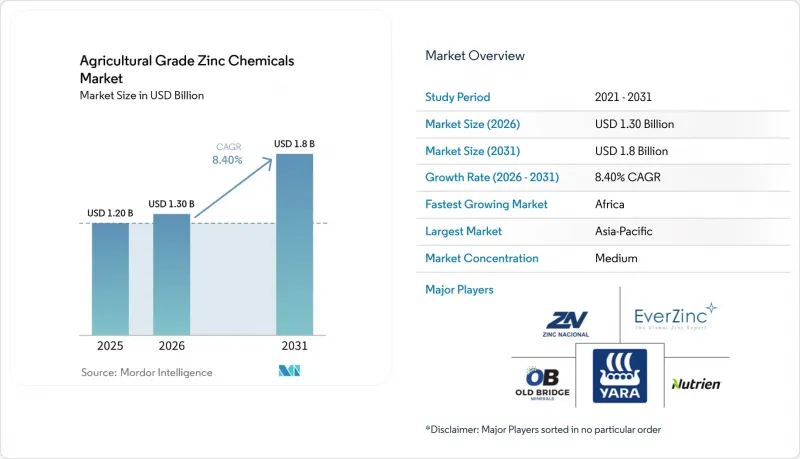
Mordor Intelligence에 의하면, 농업용 아연 화학제품 시장 규모는 2025년 12억 달러로 평가되었고, 2026년에는 13억 달러로 추정되고, 2026-2031년 CAGR 8.4%로 성장을 지속할 전망이며, 2031년까지 18억 달러에 이를 것으로 예측됩니다.
본 보고서는 제품 유형별(일수화물, 칠수화물, 기타), 용도별(비료, 사료, 작물 보호, 토양 개량, 종자 처리), 형태별(분말, 기타), 작물 유형(곡물, 유지종자, 기타), 최종 사용자(혼합업자, 협동조합, 농업 종사자, 기타), 지역(북미, 유럽, 아시아태평양, 기타)에 따라 분류되어 있습니다. 시장 전망치는 금액(달러)으로 표시되어 있습니다.
세계의 농업용 아연 화학제품 시장 동향 및 인사이트
미량영양소 결핍에 관한 인식 제고 캠페인
각국의 프로그램을 통해 농지 토양에서 아연이 광범위하게 부족하다는 사실이 밝혀졌으며, 검사 결과가 정책상의 의무로 반영되고 있습니다. 인도의 ‘토양 건강 카드’ 이니셔티브에 따르면, 2025년 조사 대상 지역의 49%에서 아연 결핍이 확인되었으며, 이에 따라 주 정부 차원의 아연 강화 비료 조달이 시작되었습니다. 에티오피아는 2025년에 아연 결핍이 확인된 밀과 테프 재배 지역 230만 헥타르를 파악하고, 국제비료개발센터와 협력하여 협동조합에 황산아연을 공급했습니다. 2024년 7월 『Nature Food』지에 게재된 메타분석에 따르면, 1헥타르당 10-20Kg의 황산아연을 시비했을 경우, 곡물의 아연 함량이 30-50% 증가하며, 비용 대비 효과 비율은 2.5를 넘는 것으로 보고되었습니다. 현재 농업 지도원들은 수확량 중심의 비료 계획에서 아연을 질소나 인과 동등한 우선순위로 두고 있습니다. 그 결과, 각 혼합 제조업체들은 농업용 등급 아연 화학제품 시장에서 판매량의 지속적인 성장을 기대하고 있습니다.
정밀 농업을 통한 양분 매핑 도입
가변 시비 플랫폼은 위성 이미지, 수확량 이력, 토양 전기 전도도를 통합하여 아연이 집중된 지점을 파악합니다. 미국 농무부 경제조업체국(ERS)의 기록에 따르면, 2025년에는 옥수수와 대두 재배 면적의 18%에서 이 기술이 도입될 것으로 보이며, 이는 2023년 대비 7포인트 증가한 수치입니다. 유럽의 정밀 농업용 장비에 대한 보조금 제도는 프랑스와 독일에서도 이와 같은 보급을 뒷받침하고 있으며, 이들 국가에서는 GPS 유도식 살포기가 주행 중에 아연 살포량을 조절하고 있습니다. 정밀 농업에서는 액제나 킬레이트제가 선호됩니다. 이는 소량이라도 정확하게 계량할 수 있고, 인과의 항진 작용을 피할 수 있기 때문입니다. 기록된 데이터 이력은 생산자가 환경 감사 요건을 충족하는 데에도 도움이 되며, 수요의 지속가능성을 높이고 있습니다. 전반적으로, 정밀 농업의 실천은 농업용 아연 화학제품 시장에 데이터 기반 수요를 창출하고 있습니다.
아연 광석의 가격 변동
2025년, 중국 제련소의 생산 감축과 주요 광산에서의 노사 분쟁으로 인해 아연의 현물 가격은 톤당 2,400-3,200달러 사이에서 등락을 거듭했습니다. 황산아연의 가공 마진은 아연 함량 1톤당 평균 150-250달러이므로, 광석 가격이 10% 상승하면 헤지 수단을 갖추지 않은 무역사의 매출총이익의 4분의 1이 줄어들게 됩니다. 올드브리지 케미컬스는 광석 원가 상승폭이 비료 판매 가격 상승폭을 상회함에 따라 2025년 수익이 감소했다고 보고했습니다. 반면, 힌두스탄 징크는 자사 제련소와의 통합을 통해 가격 변동의 영향을 상쇄했으며, 2025년 9월에는 2억 1,600만 달러 규모의 비료 공장 건설을 발표했습니다. 가격의 급격한 변동이 계속되고 있어, 독립 가공업체들은 생산 능력 확대를 주저하고 있으며, 이로 인해 농업용 아연 화학제품 시장공급 탄력성이 제한되고 있습니다.
부문별 분석
황산아연 일수화물은 톤당 1,200-1,400달러라는 합리적인 공장 인도 가격과 NPK 배합 라인과의 보편적인 호환성을 바탕으로, 2025년 농업용 아연 화학제품 시장에서 42.5%의 점유율을 확보했습니다(산업 가격 데이터). 이 부문은 아연의 최소 함유율을 규정하는 정부의 지속적인 규제의 혜택을 받고 있습니다. 킬레이트 아연은 수량 기준으로는 10% 이하이지만, 고급 원예 및 가변 시비법에서 고pH 토양에서도 안정적으로 흡수된다는 점이 높이 평가되고 있어, 2026-2031년 연평균 성장률(CAGR) 12.8%라는 가장 높은 성장세가 예상됩니다. 7수화물은 보존 안정성이 중요시되는 유럽 시장에서 약 18%의 점유율을 유지하고 있으나, 결정화 설비의 부족으로 인해 신규 생산 능력 확대가 저해되고 있습니다. 산화아연은 약 15%의 시장 점유율을 차지하고 있으며, 여전히 사료 배합에 주로 사용되고 있습니다.
미래를 내다보는 제품 전략에서는 범용 제품과 특수 제품의 길이 갈라집니다. Zinc Nacional이나 Old Bridge Chemicals와 같은 일수화물 제조업체들은 유럽 바이어들이 요구하는 저카드뮴 목표를 달성하기 위해 정제 공정을 추가하고 있습니다. ICL 그룹의 지원을 받는 킬레이트제 혁신 기업은 투여량을 40-60% 줄일 수 있을 것으로 기대되는 알긴산 캡슐화 기술에 대한 특허를 출원했습니다. 현재 시장 점유율이 2% 미만에 그치고 있는 나노킬레이트는 캘리포니아산 아몬드와 인도산 채소에 대한 검사에 도입되어 있으며, 소규모 기반에서 3자리 수 수요 성장이 예상됩니다. 서방형 과립은 고부가가치 온실 재배 작물을 위해 폴리머 코팅과 일수화물을 배합한 것이지만, 광대한 농지에서 곡물을 재배할 때는 여전히 비용이 걸림돌이 되고 있습니다. 이러한 양극화는 농업용 아연 화학제품 시장의 변화하는 추세를 여실히 보여주고 있으며, 저비용의 일수화물이 판매량을 지탱하는 한편, 킬레이트 화합물이 부가가치를 창출하고 있음을 시사합니다.
2025년 기준으로, 농업용 아연 화학제품 시장 규모에서 가장 큰 점유율(58.0%)을 차지한 것은 비료 혼합 제품이었습니다. 이는 공공 보조금 제도가 영양 기준을 충족하는 구매에 대해 환급을 실시하기 때문입니다. 혼합 업체들은 인도의 결제 인센티브를 활용하고, 베트남이나 에티오피아의 유사한 정책을 본따기 위해 중량 기준으로 0.5-1.0%의 황산아연을 배합하고 있습니다. 토양 개량제는 2위를 차지하고 있으며, 2026-2031년 연평균 성장률(CAGR) 11.7%라는 가장 높은 성장률을 보일 것으로 전망됩니다. 이는 미국 그레이트플레인스나 호주의 알칼리성 토양에서 1헥타르당 10-25Kg이라는 목표 살포량과 혼합량이 촉진요인으로 작용하고 있습니다. 시장 점유율은 제한적이지만, 종자 처리에 초기 생육 활력을 높이는 나노 아연 코팅 기술을 도입한 대규모 옥수수 및 대두 농업 종사자들 사이에서 주목을 받고 있습니다. 사료 및 작물 보호 분야는 전반적으로 큰 잠재력을 지니고 있을 뿐만 아니라, 사업 다각화의 기회도 제공합니다.
시용 방법의 선호도는 기술과 유통의 현실을 반영하고 있습니다. 아프리카 토양 건강 프로그램에서는 협동조합을 통해 황산아연 순수 제품을 배포하고 있으며, 이를 통해 토양 개량제 사용이 촉진되고 있습니다. 북미의 가변 시비 장치에서는 질소와 액체 아연을 조합한 혼합 시비 일정이 선호되고 있으며, 이를 통해 1헥타르당 8-12달러의 비용 절감이 가능합니다. 브라질에서는 모자이크사가 2025년 가동을 예정하고 있는 팔메이란테 공장에서 아연과 유익한 미생물을 배합한 새로운 비료 제품군을 공동 생산하고 있습니다. 점적 관개 시스템을 배경으로, 엽면 시비는 곡물의 아연 함량을 40%까지 증가시킬 수 있는 하위 부문으로 부상하고 있습니다. 이러한 동향은 비료 분야의 주도적 지위를 유지하면서 농업용 아연 화학제품 시장을 확대하는 성장 부문을 육성하고 있습니다.
지역별 분석
아시아태평양은 2025년 농업용 아연 화학제품 시장에서 38.6%라는 최대 점유율을 유지했습니다. 이는 아연 강화 비료에 대해 1톤당 500루피(6달러)를 환급해 주는 인도의 2026년 1월 보조금 정책에 힘입은 결과입니다. 중국의 강력한 지방 정부 차원의 노력과 힌두스탄 징크사의 생산 능력 확충에 힘입어, 해당 지역의 자급률과 안정적인 수요가 높아지고 있습니다. 아프리카의 경우, 에티오피아, 케냐, 나이지리아에서 기부금으로 운영되는 토양 건강 프로그램이 아연 시비를 농업 보급 지침에 포함시키고 있기 때문에 2026-2031년 연평균 성장률(CAGR) 10.5%로 가장 높은 성장세를 보일 것으로 전망됩니다. 물류상의 제약이 있음에도 불구하고, 내륙 지역의 혼합 플랜트 확대와 협동조합을 통한 유통 증가가 아프리카의 성장세를 뒷받침하고 있습니다.
유럽, 북미, 남미에서는 정밀 농업과 특수 제품의 보급으로 인해 수요가 안정적인 추세를 보이고 있습니다. 유럽의 카드뮴 규제로 인해, 규정을 준수하는 정광을 원료로 한 저불순물 황산아연 시장에 프리미엄 가격대가 형성되고 있습니다. 북미의 생산자들은 아연을 추가 비료용 질소 용액과 혼합하여 액체 형태로 시비하거나 가변 시비 방식을 선호합니다. 남미에서는 모자이크 컴퍼니가 2025년에 브라질에 건설할 미량영양소 시설 덕분에 대두 및 옥수수 생산자들의 리드타임이 단축되는 한편, 중동에서는 인드라 벤처스의 이집트 복합 시설을 중심으로 수요가 확대되고 있으며, 오세아니아에서는 알칼리성 밀 토양에 아연이 시비되고 있습니다.
지역별 보조금 제도, 생산 능력 확대, 발전하는 농업 기술 덕분에 구매층이 확대되고 공급 안정성이 향상되고 있습니다. 아시아태평양의 생산자들은 유럽의 수입 기준을 충족하기 위해 정제 설비에 투자하고 있으며, 카드뮴 함량이 낮은 제품을 프리미엄 시장으로 전환할 가능성이 있습니다. 아프리카 각국 정부는 아연 공급과 금융·자문 서비스를 결합한 협동조합형 복합 시설을 확대할 계획이며, 이를 통해 소규모 농업 종사자들의 도입을 촉진할 것으로 보입니다. 이러한 노력들이 어우러져 대상 시장이 확대되고, 전 세계 농업용 아연 화학제품 시장이 꾸준한 성장세를 이어갈 것으로 예측됩니다.
기타 혜택
- 엑셀 형식 시장 예측(ME) 시트
- 3개월간의 애널리스트 지원
자주 묻는 질문
목차
제1장 서론
제2장 조사 방법
제3장 주요 요약
제4장 시장 구도
제5장 시장 규모 및 성장 예측
제6장 경쟁 구도
제7장 시장 기회 및 향후 전망
AJY 26.06.26According to Mordor Intelligence, the agricultural grade zinc chemicals market size is anticipated to grow from USD 1.20 billion in 2025 to USD 1.30 billion in 2026 and is forecast to reach USD 1.80 billion by 2031 at 8.4% CAGR over 2026-2031.
This report is Segmented by Product Type (Monohydrate, Heptahydrate, and More), by Application (Fertilizers, Feed, Crop Protection, Soil Amendment, and Seed Treatment), by Form (Powder, and More), Crop Type (Cereals, Oilseeds, and More), by End-User (Blenders, Cooperatives, Farmers, and More), and by Geography (North America, Europe, Asia Pacific, and More). Market Forecasts are in Value (USD).
Global Agricultural Grade Zinc Chemicals Market Trends and Insights
Micronutrient Deficiency Awareness Campaigns
National programs are uncovering widespread zinc scarcity in cropland soils and translating test results into policy mandates. India's Soil Health Card initiative found zinc deficiency in 49% of sampled districts in 2025, triggering state procurement of zinc-fortified fertilizers. Ethiopia mapped 2.3 million hectares of deficient wheat and teff zones in 2025 and partnered with the International Fertilizer Development Center to deliver zinc sulfate to cooperatives. A July 2024 meta-analysis in Nature Food reported grain zinc gains of 30-50% and benefit-cost ratios above 2.5 when 10-20 kilograms per hectare of zinc sulfate were applied. Extension agents now describe zinc as a co-priority with nitrogen and phosphorus in yield-focused fertilizer plans. As a result, blenders anticipate sustained volume growth in agricultural grade zinc chemicals market.
Adoption of Precision Agriculture Nutrient Mapping
Variable-rate platforms overlap satellite imagery, yield history, and soil electrical conductivity to isolate zinc hotspots. The United States Department of Agriculture Economic Research Service recorded adoption on 18% of corn and soybean hectares in 2025, up seven points since 2023. European subsidy programs for precision equipment propelled similar uptake in France and Germany, where GPS-guided spreaders modulate zinc flow on the go. Precision agriculture favors liquid and chelate formulations because these formulations meter accurately at low volumes and avoid phosphorus antagonism. Recorded data trails also help growers meet environmental audit requirements, enhancing demand durability. Collectively, precision practices inject a data-driven pull into the agricultural grade zinc chemicals market.
Price Volatility of Mined Zinc Ores
Spot zinc fluctuated between USD 2,400 and USD 3,200 per metric ton in 2025 due to Chinese smelter curtailments and labor actions in major mines. Processing margins for zinc sulfate average USD 150-250 per metric ton of contained zinc, so a 10% ore uptick can shave one-quarter of gross profit for merchants that lack hedging facilities. Old Bridge Chemicals reported lower 2025 earnings as ore costs rose faster than fertilizer sale prices. Hindustan Zinc, by contrast, offset volatility through captive smelter integration and announced a USD 216 million fertilizer plant in September 2025. Persistent swings deter independent processors from expanding capacity, limiting supply elasticity for the agricultural grade zinc chemicals market.
Other drivers and restraints analyzed in the detailed report include:
- Government Subsidies for Zinc-Enriched Fertilizers
- Commercial Launch of Nano-Chelated Zinc Foliar Sprays
- Stringent Heavy-Metal Residue Regulations
For complete list of drivers and restraints, kindly check the Table Of Contents.
Segment Analysis
Zinc sulfate monohydrate secured 42.5% agricultural grade zinc chemicals market share in 2025 on the back of affordable ex-works prices near USD 1,200-1,400 per metric ton and universal compatibility with NPK blending lines [industry pricing data]. The segment benefits from ongoing government mandates that specify minimum zinc inclusion rates. Chelated zinc, while below 10% in volume, is on track for the fastest 12.8% CAGR over 2026-2031 as premium horticulture and variable-rate farming value consistent uptake in high-pH soils. Heptahydrate's roughly 18% share persists in Europe where storage stability is prized, yet new capacity is hampered by crystallizer shortages. Zinc oxide, at about 15%, remains concentrated in feed formulations.
Forward-looking product strategies separate commodity and specialty paths. Monohydrate producers such as Zinc Nacional and Old Bridge Chemicals are adding purification steps to hit low-cadmium targets demanded by European buyers. Chelate innovators backed by ICL Group are filing patents for alginate encapsulation that promises 40-60% dosage cuts. Nano-chelates, below 2% today, are piloted in California almonds and Indian vegetables with triple-digit demand growth off a small base. Controlled-release granules blend polymer coatings with monohydrate for high-value greenhouse crops, cost remains a barrier for broad-acre cereals. The split underscores an evolving pattern in the market for agricultural grade zinc chemicals, in which low-cost monohydrate carries volume, while chelates capture value.
Fertilizer blends accounted for the largest share of 58.0% of agricultural grade zinc chemicals market size in 2025, as public subsidy schemes reimburse purchases that meet nutrient standards. Blenders incorporate 0.5-1.0% zinc sulfate by weight to unlock India's payment incentive and mirror similar policies in Vietnam and Ethiopia. Soil amendment ranks second and is forecast to have the fastest growth rate of 11.7% CAGR over 2026-2031, propelled by targeted broadcast and incorporation rates of 10-25 kilograms per hectare in alkaline soils of the United States Great Plains and Australia. Seed treatment, accounting for only a limited share, is gaining attention among large corn and soybean farms adopting nano-zinc coatings that deliver early vigor. Feed and crop protection, while collectively holding significant potential, provide diversification opportunities.
Application preferences mirror the realities of technology and distribution. Soil health programs in Africa distribute standalone zinc sulfate through cooperatives, thereby supporting the use of amendments. Variable-rate rigs in North America favor a blend-ready schedule that combines nitrogen with liquid zinc, enabling one-pass savings of USD 8-12 per hectare. In Brazil, Mosaic Company is co-packing zinc and beneficial microbes in new fertilizer lines from its 2025 Palmeirante plant. Foliar spraying is emerging as a sub-segment that can raise grain zinc by 40% in cereals, supported by drip irrigation systems. These dynamics maintain fertilizer primacy while fostering growth pockets that expand the agricultural-grade zinc chemicals market.
Geography Analysis
Asia-Pacific retained the largest 38.6% share of the agricultural grade zinc chemicals market in 2025, supported by India's January 2026 subsidy that reimburses INR 500 (USD 6) per metric ton for zinc-fortified fertilizers. Strong provincial mandates in China and capacity additions at Hindustan Zinc lift regional self-sufficiency and steady demand. Africa is projected to post the fastest CAGR of 10.5% over 2026-2031, as donor-funded soil health programs in Ethiopia, Kenya, and Nigeria embed zinc application into extension guidelines. Expanding inland blending plants and rising cooperative distribution underpin Africa's growth momentum despite logistics constraints.
Europe, North America, and South America exhibit stable demand profiles shaped by precision agriculture and specialty product uptake. European cadmium limits create a premium tier for low-impurity zinc sulfate sourced from compliant concentrates. North American growers favor liquid and variable-rate applications that integrate zinc with side-dress nitrogen solutions. In South America, Mosaic Company's 2025 micronutrient facility in Brazil shortens lead times for soybean and corn growers while Middle Eastern demand builds around Indorama Ventures' Egypt complex and Oceania applies zinc to alkaline wheat soils.
Region-specific subsidy schemes, capacity expansions, and evolving agronomic practices are broadening the buyer base and improving supply resilience. Asia-Pacific producers are investing in purification to meet European import standards, potentially redirecting low-cadmium output to premium markets. African governments plan to scale up cooperative blending units that couple zinc with credit and advisory services, thereby boosting adoption among smallholders. Together, these initiatives are anticipated to enlarge the addressable market and sustain robust growth for agricultural grade zinc chemicals worldwide.
- Zinc Nacional, S.A.
- EverZinc
- Old Bridge Minerals, Inc.
- Yara International ASA
- Nutrien Ltd
- ICL Group Ltd.
- The Mosaic Company
- BASF SE
- Syngenta Crop Protection AG
- Corteva Agriscience LLC
- Omnia Group (Omnia Nutriology Division)
- Nouryon Chemicals B.V.
- Aries Agro Limited
- Frit, Inc.
- Shanxi New Agri Technology Co.,Ltd.
Additional Benefits:
- The market estimate (ME) sheet in Excel format
- 3 months of analyst support
TABLE OF CONTENTS
1 Introduction
- 1.1 Study Assumptions and Market Definition
- 1.2 Scope of the Study
2 Research Methodology
3 Executive Summary
4 Market Landscape
- 4.1 Market Overview
- 4.2 Market Drivers
- 4.2.1 Micronutrient deficiency awareness campaigns
- 4.2.2 Adoption of precision agriculture nutrient mapping
- 4.2.3 Government subsidies for zinc-enriched fertilizers
- 4.2.4 Commercial launch of nano-chelated zinc foliar sprays
- 4.2.5 Integration of zinc with controlled-release coatings
- 4.2.6 Soil microbiome solutions boosting zinc uptake
- 4.3 Market Restraints
- 4.3.1 Price volatility of mined zinc ores
- 4.3.2 Stringent heavy-metal residue regulations
- 4.3.3 Supply bottlenecks of heptahydrate crystalizer units
- 4.3.4 Farmer perception of chelate cost versus yield
- 4.4 Regulatory Landscape
- 4.5 Technological Outlook
- 4.6 Porter's Five Forces
- 4.6.1 Threat of New Entrants
- 4.6.2 Bargaining Power of Suppliers
- 4.6.3 Bargaining Power of Buyers
- 4.6.4 Threat of Substitutes
- 4.6.5 Intensity of Competitive Rivalry
5 Market Size and Growth Forecasts (Value)
- 5.1 By Product Type
- 5.1.1 Zinc Sulfate Monohydrate
- 5.1.2 Zinc Sulfate Heptahydrate
- 5.1.3 Chelated Zinc (EDTA, DTPA)
- 5.1.4 Zinc Oxide
- 5.1.5 Others
- 5.2 By Application
- 5.2.1 Fertilizers
- 5.2.2 Animal Feed
- 5.2.3 Crop Protection
- 5.2.4 Soil Amendment
- 5.2.5 Seed Treatment
- 5.3 By Form
- 5.3.1 Powder
- 5.3.2 Granular
- 5.3.3 Liquid
- 5.4 By Crop Type
- 5.4.1 Cereals and Grains
- 5.4.2 Oilseeds and Pulses
- 5.4.3 Fruits and Vegetables
- 5.4.4 Others
- 5.5 By End-user
- 5.5.1 Fertilizer Blenders
- 5.5.2 Agri-input Manufacturers
- 5.5.3 Farm Cooperatives
- 5.5.4 Individual Farmers
- 5.5.5 Others
- 5.6 By Geography
- 5.6.1 North America
- 5.6.1.1 United States
- 5.6.1.2 Canada
- 5.6.1.3 Rest of North America
- 5.6.2 South America
- 5.6.2.1 Brazil
- 5.6.2.2 Argentina
- 5.6.2.3 Rest of South America
- 5.6.3 Europe
- 5.6.3.1 Germany
- 5.6.3.2 France
- 5.6.3.3 United Kingdom
- 5.6.3.4 Italy
- 5.6.3.5 Spain
- 5.6.3.6 Russia
- 5.6.3.7 Rest of Europe
- 5.6.4 Asia-Pacific
- 5.6.4.1 China
- 5.6.4.2 India
- 5.6.4.3 Japan
- 5.6.4.4 Australia and New Zealand
- 5.6.4.5 Rest of Asia-Pacific
- 5.6.5 Middle East
- 5.6.5.1 Saudi Arabia
- 5.6.5.2 United Arab Emirates
- 5.6.5.3 Rest of Middle East
- 5.6.6 Africa
- 5.6.6.1 South Africa
- 5.6.6.2 Egypt
- 5.6.6.3 Rest of Africa
- 5.6.1 North America
6 Competitive Landscape
- 6.1 Market Concentration
- 6.2 Strategic Moves
- 6.3 Market Share Analysis
- 6.4 Company Profiles (Includes Global level Overview, Market level overview, Core Segments, Financials as available, Strategic Information, Market Rank/Share for key companies, Products and Services, and Recent Developments)
- 6.4.1 Zinc Nacional, S.A.
- 6.4.2 EverZinc
- 6.4.3 Old Bridge Minerals, Inc.
- 6.4.4 Yara International ASA
- 6.4.5 Nutrien Ltd
- 6.4.6 ICL Group Ltd.
- 6.4.7 The Mosaic Company
- 6.4.8 BASF SE
- 6.4.9 Syngenta Crop Protection AG
- 6.4.10 Corteva Agriscience LLC
- 6.4.11 Omnia Group (Omnia Nutriology Division)
- 6.4.12 Nouryon Chemicals B.V.
- 6.4.13 Aries Agro Limited
- 6.4.14 Frit, Inc.
- 6.4.15 Shanxi New Agri Technology Co.,Ltd.