|
시장보고서
상품코드
2063918
AI 기반 CRO 서비스 시장 : 점유율 분석, 업계 동향과 통계, 성장 예측(2026-2031년)AI In CRO Services - Market Share Analysis, Industry Trends & Statistics, Growth Forecasts (2026 - 2031) |
||||||
 Mordor Intelligence
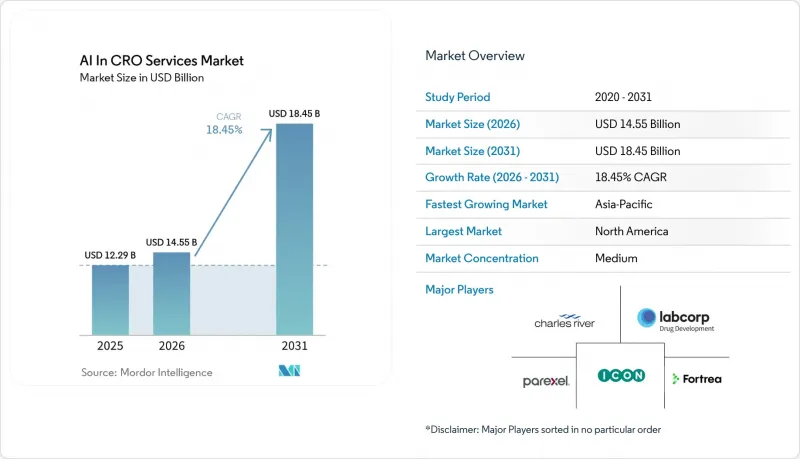
Mordor Intelligence에 의하면, AI 기반 CRO 서비스 시장 규모는 2025년 122억 9,000만 달러, 2026년 145억 5,000만 달러에서 2031년까지 184억 5,000만 달러로 확대되어 2026년부터 2031년까지 연평균 복합 성장률(CAGR)은 18.45%를 나타낼 것으로 예측됩니다.
본 보고서는 서비스 유형(임상시험 관리, 생체통계학·분석 등), AI 기술(머신러닝, 자연어 처리, 생성형 AI 등), 치료 분야(종양학, 희귀질환 등), 시험 단계(1상, 2상, 3상, 4상/RWE), 최종 사용자(제약, 생명공학, 의료기기 등), 지역(북미, 유럽 등)에 따라 분류되어 있습니다. 시장 전망은 금액(달러) 기준으로 제시되어 있습니다.
전 세계 AI 기반 CRO 서비스 시장 동향 및 인사이트
후기 임상시험의 복잡화와 데이터 양 증가
기존 CRO 운영 모델에서는 후기 임상시험 프로그램에서 발생하는 방대한 양의 데이터를 관리하는 것이 점점 더 어려워지고 있습니다. 이 문제는 AI 기반 CRO 서비스 시장의 제3상 임상시험에서 특히 두드러지며, 적응형 평가 지표, 웨어러블 데이터, 바이오마커 데이터 및 실세계 데이터가 단일 프로그램으로 통합되어 있습니다. 통합된 데이터 흐름 접근 방식은 데이터 수집의 자동화, 프로그래밍 사이클 시간 단축, 그리고 데이터 문제 관리의 효율화를 실현할 수 있음이 입증되었습니다. 이러한 발전은 스폰서들이 현재 주요 프로그램을 위탁할 때 AI 기능을 핵심 기준으로 고려하고 있는 이유를 여실히 보여주고 있습니다. 그 결과, AI 기반 CRO 서비스 시장의 관련 CTMS(임상시험 관리 시스템) 및 데이터 플랫폼은 단순한 지원 도구에서 필수적인 상업적 자산으로 전환되고 있습니다.
유연한 임상 역량에 대한 바이오테크 기업의 아웃소싱 수요
대부분의 경우, 최소한의 사내 팀으로 운영되는 생명공학 기업들은 실행 및 계획 수립을 지원하는 데 있어 외부 파트너에 대한 의존도를 높이고 있습니다. AI 기반 CRO 서비스 시장에서 이러한 의존 관계는 단순한 기본적인 아웃소싱에서 벗어나, 시험 시나리오 모델링, 잠재적 병목 현상 파악, 그리고 실현 가능성 판단을 신속하게 수행할 수 있는 CRO와의 협력으로 전환되고 있습니다. 개발 계획이 급속히 변화하는 가운데, 인력 규모만으로는 더 이상 발주처의 요구를 충족시킬 수 없게 되어, 이러한 변화는 공급업체 간경쟁 구도를 재정의하고 있습니다. 또한, 하이브리드 계약 모델이 점차 보급되면서 스폰서는 단일 서비스 구조에 얽매이지 않고 플랫폼이나 전문적인 지원을 이용할 수 있게 되었습니다. 그 결과, AI 대응 역량은 초기 단계의 스폰서와의 관계에서 중요한 요소로 부상하고 있습니다.
AI 검증 및 GxP 규정 준수와 관련된 불확실성
검증은 규제 대상인 임상 워크플로우에 AI를 광범위하게 도입하는 데 있어 여전히 큰 장벽으로 남아 있습니다. 2025년 1월 FDA가 발표한 지침 초안에서는 규제 당국에 제출하는 신청서에서 AI 모델을 위한 7단계 신뢰성 프레임워크가 도입되었습니다. 그러나 최종 지침은 아직 발표되지 않았습니다. 이러한 상황으로 인해, 스폰서와 CRO는 기대치가 어느 정도 명확해졌지만 아직 완전히 정의되지는 않은 과도기에 놓여 있습니다. AI 기반 CRO 서비스 시장에서는 이러한 과제가 주로 용량 선정, 안전성 모니터링, 신청 관련 용도 등의 영역에 영향을 미치고 있지만, 문서 관리나 워크플로우 관리와 같은 위험이 낮은 업무에 미치는 영향은 비교적 적습니다. 그 결과, 시장은 계속해서 급속히 성장하고 있지만, 도입률은 서비스 범주에 따라 차이가 있습니다.
부문별 분석
임상시험 관리 서비스는 2025년에 시장 점유율의 57.34%를 차지하며, AI 기반 CRO 서비스 시장을 주도했습니다. 이러한 선도적인 지위는 전 세계 다기관 조정, 위험 기반 모니터링, 기관 성과 추적 및 규제 관련 문서 관리 분야에서 해당 서비스가 수행하는 중요한 역할을 반영하고 있습니다. AI 기반 오케스트레이션 기능을 통한 효율성 향상은 주요 수익원으로서의 입지를 더욱 공고히 하고 있습니다. 또한, 생체 인식, 데이터 관리, 분석 및 규제 대응 서비스에 대한 꾸준한 투자는 임상시험 수행 과정에서 이러한 요소들의 중요성을 더욱 부각시키고 있습니다.
‘초기 개발·트랜스레이셔널 서비스’는 2026년부터 2031년까지 연평균 성장률(CAGR) 19.20%를 기록하며 성장할 것으로 예상되며, 가장 빠르게 성장하는 부문이 될 전망입니다. 스폰서들은 시험 시작 지연을 줄이기 위해 실현 가능성 시뮬레이션이나 조기 의사 결정에 AI를 활용하는 사례가 늘고 있습니다. AI 플랫폼은 임상시험 실시 기관을 효율적으로 선정하는 능력을 보여주고 있으며, 다국에 걸친 3상 임상시험 프로그램을 가속화하고 있습니다. AI 기반 문서 작성 및 병리 워크플로우 등의 관련 서비스도 발전하고 있으며, 업계가 초기 단계의 AI 기능에 주력하고 있음을 보여주고 있습니다.
2025년에 42.45%의 점유율을 차지한 머신러닝은 주요 기술 분야로서 AI 기반 CRO 서비스 시장을 주도했습니다. 임상시험 기관 선정, 위험 예측, 데이터 정제, 이상 감지, 워크플로우 최적화 등 광범위한 분야에 적용되고 있다는 점은 이 기술의 상업적 지속가능성을 입증하고 있습니다. 이 기술은 반복적인 업무 과제를 개선하는 데 여전히 필수적이지만, 지식 그래프와 같은 새로운 접근 방식이 종양학 및 희귀질환 분야의 업무 흐름에서 주목을 받고 있습니다.
자연어 처리(NLP)는 2031년까지 연평균 성장률(CAGR) 20.35%를 나타낼 것으로 예측되며, AI 기술 부문에서 가장 빠르게 성장하는 분야가 될 전망입니다. 이러한 성장은 전자건강기록(EHR)의 메모나 임상 기록 등 방대한 양의 비정형 데이터를 처리해야 할 필요성에 의해 주도되고 있습니다. AI 시스템은 임상시험 매칭 및 구조화 데이터 추출 분야에서 뛰어난 성능을 발휘하고 있으며, 이는 피험자 모집, 문서화, 데이터 정규화 분야에서 언어 모델의 보다 고도화된 응용으로의 전환을 시사하고 있습니다.
지역별 분석
2025년, 북미는 AI 기반 CRO 서비스 시장에서 44.05%를 차지하며 주도적인 위치를 유지했습니다. 이러한 우위는 강력한 바이오의약품 스폰서 기반, 성숙한 CRO 생태계, 그리고 의약품 개발 분야에서 AI와 관련된 초기 규제 측면의 진전에 기인합니다. 또한, 해당 지역은 AI 전문 벤더의 거점이며, 풀서비스 CRO 플랫폼에 대한 막대한 투자를 유치함으로써 혜택을 누리고 있어, 미국 및 캐나다에서의 상업적 기반을 강화하고 있습니다.
유럽은 독일, 영국, 프랑스의 주도 하에 2위 지역 시장이 되었습니다. 이러한 성장은 강력한 학술 연구 네트워크, 대규모 후원 기반, 그리고 디지털 헬스 및 의약품 연구에 대한 투자에 힘입어 이루어지고 있습니다. 또한, 유럽은 다자간 시험의 주요 거점으로서도 기능하고 있으며, 관할 구역을 넘나드는 규정 준수 및 데이터 워크플로우 관리에 정통한 공급업체에 대한 수요를 창출하고 있습니다.
아시아태평양은 2026년부터 2031년까지 연평균 성장률(CAGR) 23.00%를 나타낼 것으로 예측되며, AI 기반 CRO 서비스 시장에서 가장 빠르게 성장하는 지역이 될 전망입니다. 이 지역의 성장은 방대한 환자 풀, 비용 대비 효과가 높은 임상시험, 그리고 디지털 헬스 분야에 대한 투자 확대에 힘입어 이루어지고 있습니다. 중국은 이러한 확장에서 중요한 역할을 하고 있으며, 개발 과정 전반에 걸쳐 AI 통합이 진행되고 있는 만큼, 아시아태평양은 시장 성장의 주요 영역으로 자리매김하고 있습니다.
기타 혜택:
- 엑셀 형식 시장 예측(ME) 시트
- 3개월간의 애널리스트 지원
자주 묻는 질문
목차
제1장 서론
제2장 조사 방법
제3장 주요 요약
제4장 시장 구도
제5장 시장 규모와 성장 예측
제6장 경쟁 구도
제7장 시장 기회와 향후 전망
JHS 26.06.23According to Mordor Intelligence, the aI in cRO services market size is projected to expand from USD 12.29 billion in 2025 and USD 14.55 billion in 2026 to USD 18.45 billion by 2031, registering a CAGR of 18.45% between 2026 to 2031.
This report is Segmented by Service Type (Clinical Trial Management, Biometrics & Analytics, and More), AI Technology (ML, NLP, Generative AI, and More), Therapeutic Area (Oncology, Rare Diseases, and More), Trial Phase (I, II, III, IV/RWE), End User (Pharma, Biotech, Medical Device, and More), and Geography (North America, Europe, and More). The Market Forecasts are Provided in Terms of Value (USD).
Global AI In CRO Services Market Trends and Insights
Rising Late-Stage Trial Complexity and Data Intensity
Traditional CRO operating models are increasingly inadequate in managing the growing data volumes from late-stage programs. This issue is particularly significant in Phase III studies within the AI in CRO services market, where adaptive endpoints, wearable signals, biomarker data, and real-world inputs are integrated into a single program. Centralized data flow approaches have demonstrated the ability to automate data ingestion, reduce programming cycle times, and enhance efficiency in data issue management. These advancements highlight why sponsors now consider AI capabilities a core criterion when awarding major programs. As a result, CTMS and data platforms in the AI in CRO services market have transitioned from supporting tools to essential commercial assets.
Biotech Outsourcing Demand for Flexible Clinical Capacity
Biotech companies, often operating with lean internal teams, increasingly rely on external partners for execution and planning support. In the AI in CRO services market, this reliance is shifting from basic outsourcing to engaging CROs capable of modeling trial scenarios, identifying potential bottlenecks, and accelerating feasibility decisions. This shift is redefining vendor competition, as staffing depth alone no longer meets sponsor needs when development plans change rapidly. Additionally, hybrid engagement models are gaining traction, allowing sponsors to access platforms and specialized support without committing to a single service structure. Consequently, AI readiness is becoming a critical factor in early-stage sponsor relationships.
AI Validation and GxP Compliance Uncertainty
Validation remains a significant barrier to the broader adoption of AI in regulated clinical workflows. The FDA's draft guidance in January 2025 introduced a seven-step credibility framework for AI models in regulatory submissions. However, final guidance has yet to be issued. This situation places sponsors and CROs in an interim phase where expectations are somewhat clearer but not fully defined. In the AI in CRO services market, this challenge primarily impacts areas such as dose selection, safety monitoring, and submission-related applications, while lower-risk tasks like document or workflow management are less affected. As a result, the market continues to grow rapidly, but adoption rates vary across different service categories.
Other drivers and restraints analyzed in the detailed report include:
- Decentralized and Hybrid Trial Expansion
- Precision Medicine and Biomarker-Driven Recruitment
- Fragmented Sponsor-CRO-Site Data Interoperability
For complete list of drivers and restraints, kindly check the Table Of Contents.
Segment Analysis
Clinical Trial Management Services, holding 57.34% of the market share in 2025, dominated the AI in CRO services market. This leadership reflects its critical role in global multi-site coordination, risk-based monitoring, site performance tracking, and regulatory document management. Efficiency gains from AI-driven orchestration functions have solidified their position as key revenue drivers. Additionally, steady investments in biometrics, data management, analytics, and regulatory support services further highlight their importance in trial execution.
Early Development & Translational Services is expected to grow at a 19.20% CAGR from 2026 to 2031, making it the fastest-growing segment. Sponsors are increasingly using AI for feasibility simulations and early decision-making to reduce delays in trial initiation. AI platforms have demonstrated the ability to identify trial sites efficiently, accelerating Phase III programs across multiple countries. Adjacent services, such as AI-enabled writing and pathology workflows, are also evolving, showcasing the industry's focus on early-stage AI capabilities.
Machine Learning, with a 42.45% share in 2025, led the AI in CRO services market as the primary technology layer. Its widespread application in site selection, risk prediction, data cleaning, anomaly detection, and workflow optimization underscores its commercial durability. The technology remains integral to improving recurring operational tasks, while emerging approaches like knowledge graphs are gaining traction in oncology and rare disease workflows.
Natural Language Processing (NLP) is projected to grow at a 20.35% CAGR through 2031, making it the fastest-growing AI technology segment. This growth is driven by the need to process large volumes of unstructured data, such as EHR notes and clinical narratives. AI systems have demonstrated strong performance in trial matching and structured data extraction, signaling a shift toward deeper applications of language models in recruitment, documentation, and data normalization.
Geography Analysis
In 2025, North America accounted for 44.05% of the AI in CRO services market, maintaining its leadership position. This dominance stems from a strong biopharma sponsor base, a mature CRO ecosystem, and early regulatory advancements for AI in drug development. The region also benefits from being a hub for AI-specialist vendors and significant investments in full-service CRO platforms, strengthening its commercial foundation in the U.S. and Canada.
Europe is the second-largest regional market, driven by Germany, the U.K., and France. Its growth is supported by strong academic research networks, a large sponsor base, and investments in digital health and drug research. Europe also serves as a key base for multi-country studies, creating demand for vendors skilled in managing compliance and data workflows across jurisdictions.
Asia-Pacific is projected to grow at a 23.00% CAGR from 2026 to 2031, making it the fastest-growing region in the AI in CRO services market. The region's growth is fueled by large patient pools, cost-effective trials, and increasing digital health investments. China plays a significant role in this expansion, with AI integration deepening across the development process, positioning Asia-Pacific as a key area for market growth.
- Agilisium
- Ardigen
- Aurora Analytica
- Charles River
- Emmes Group
- Fortrea
- IQVIA
- ICON
- Inductive Quotient
- InnovoCommerce
- LabCorp
- LyfeSci
- MedPace
- Novotech
- Parexel International
- PhaseV
- PSI CRO
- Thermo Fisher Scientific Inc. (PPD)
- Verisian
- Voiant Clinical
Additional Benefits:
- The market estimate (ME) sheet in Excel format
- 3 months of analyst support
TABLE OF CONTENTS
1 Introduction
- 1.1 Study Assumptions & Market Definition
- 1.2 Scope of the Study
2 Research Methodology
3 Executive Summary
4 Market Landscape
- 4.1 Market Overview
- 4.2 Market Drivers
- 4.2.1 Rising Late-Stage Trial Complexity and Data Intensity
- 4.2.2 Biotech Outsourcing Demand for Flexible Clinical Capacity
- 4.2.3 Decentralized and Hybrid Trial Expansion
- 4.2.4 Precision Medicine and Biomarker-Driven Recruitment
- 4.2.5 Genai Compression of Study Start-Up and Medical Writing Cycles
- 4.2.6 RWE-Linked Synthetic Control and Feasibility Models
- 4.3 Market Restraints
- 4.3.1 AI Validation and GxP Compliance Uncertainty
- 4.3.2 Fragmented Sponsor-CRO-Site Data Interoperability
- 4.3.3 Liability Ambiguity for AI-Assisted Regulated Outputs
- 4.3.4 Training-Data Bias in Site and Patient Models
- 4.4 Value / Supply-Chain Analysis
- 4.5 Regulatory Landscape
- 4.6 Technological Outlook
- 4.7 Porter's Five Forces
- 4.7.1 Threat of New Entrants
- 4.7.2 Bargaining Power of Suppliers
- 4.7.3 Bargaining Power of Buyers
- 4.7.4 Threat of Substitutes
- 4.7.5 Competitive Rivalry
5 Market Size & Growth Forecasts (Value, USD Billion)
- 5.1 By Service Type
- 5.1.1 Clinical Trial Management Services
- 5.1.2 Biometrics, Data Management & Analytics Services
- 5.1.3 Laboratory, Imaging & Sample Intelligence Services
- 5.1.4 Regulatory, Safety & Medical Writing Services
- 5.1.5 Early Development & Translational Services
- 5.2 By AI Technology
- 5.2.1 Machine Learning
- 5.2.2 Natural Language Processing
- 5.2.3 Generative AI / Large Language Models
- 5.2.4 Computer Vision
- 5.2.5 Knowledge Graphs & Causal AI
- 5.2.6 Predictive Analytics / Digital Twins
- 5.3 By Therapeutic Area
- 5.3.1 Oncology
- 5.3.2 Rare Diseases
- 5.3.3 Infectious Diseases & Vaccines
- 5.3.4 Neurology
- 5.3.5 Cardiovascular & Metabolic Disorders
- 5.3.6 Immunology & Inflammation
- 5.4 By Trial Phase
- 5.4.1 Phase I
- 5.4.2 Phase II
- 5.4.3 Phase III
- 5.4.4 Phase IV and Real-World Evidence
- 5.5 By End User
- 5.5.1 Pharmaceutical Companies
- 5.5.2 Biotechnology Companies
- 5.5.3 Medical Device Companies
- 5.5.4 Academic & Research Institutes
- 5.5.5 Government and Nonprofit Sponsors
- 5.6 By Geography
- 5.6.1 North America
- 5.6.1.1 United States
- 5.6.1.2 Canada
- 5.6.1.3 Mexico
- 5.6.2 Europe
- 5.6.2.1 Germany
- 5.6.2.2 United Kingdom
- 5.6.2.3 France
- 5.6.2.4 Italy
- 5.6.2.5 Spain
- 5.6.2.6 Rest of Europe
- 5.6.3 Asia-Pacific
- 5.6.3.1 China
- 5.6.3.2 Japan
- 5.6.3.3 India
- 5.6.3.4 Australia
- 5.6.3.5 South Korea
- 5.6.3.6 Rest of Asia-Pacific
- 5.6.4 Middle East & Africa
- 5.6.4.1 GCC
- 5.6.4.2 South Africa
- 5.6.4.3 Rest of Middle East & Africa
- 5.6.5 South America
- 5.6.5.1 Brazil
- 5.6.5.2 Argentina
- 5.6.5.3 Rest of South America
- 5.6.1 North America
6 Competitive Landscape
- 6.1 Market Concentration
- 6.2 Market Share Analysis
- 6.3 Company Profiles (includes Global level Overview, Market level overview, Core Segments, Financials as available, Strategic Information, Market Rank/Share for key companies, Products & Services, and Recent Developments)
- 6.3.1 Agilisium
- 6.3.2 Ardigen
- 6.3.3 Aurora Analytica
- 6.3.4 Charles River Laboratories
- 6.3.5 Emmes Group
- 6.3.6 Fortrea
- 6.3.7 IQVIA
- 6.3.8 ICON plc
- 6.3.9 Inductive Quotient
- 6.3.10 InnovoCommerce
- 6.3.11 Labcorp Drug Development
- 6.3.12 LyfeSci
- 6.3.13 Medpace
- 6.3.14 Novotech
- 6.3.15 Parexel
- 6.3.16 PhaseV
- 6.3.17 PSI CRO
- 6.3.18 Thermo Fisher Scientific Inc. (PPD)
- 6.3.19 Verisian
- 6.3.20 Voiant Clinical
7 Market Opportunities & Future Outlook
- 7.1 White-space & unmet-need assessment