

|
시장보고서
상품코드
2064001
닭 배설물 바이오 비료 시장 : 시장 점유율 분석, 업계 동향 및 통계, 성장 예측(2026-2031년)Poultry Manure Biofertilizers - Market Share Analysis, Industry Trends & Statistics, Growth Forecasts (2026 - 2031) |
||||||
 Mordor Intelligence
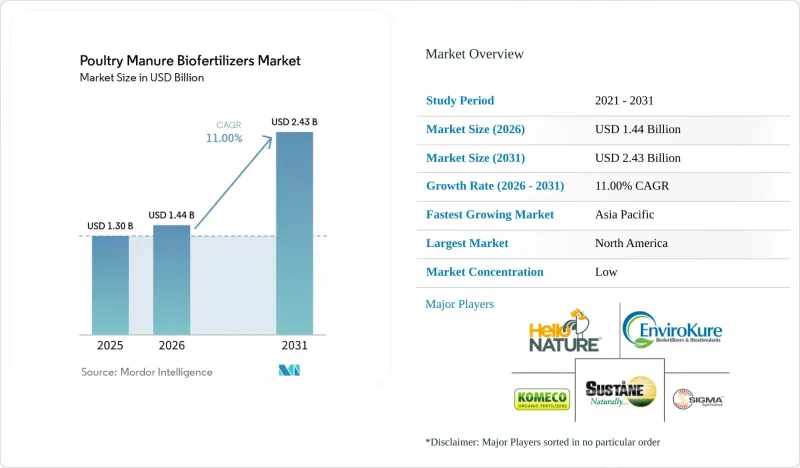
에 의하면, 닭 배설물 바이오 비료 시장은 2025년 13억 달러로 평가되었고, 2026년에는 14억 4,000만 달러로 추정되고, 게다가 2031년까지 24억 3,000만 달러로 성장할 것으로 예측되고 있으며, 2026-2031년 CAGR은 11%를 나타낼 전망입니다.

본 보고서는 유형별(고형 바이오 비료 및 액체 바이오 비료), 용도별(토양 처리 등), 작물 유형별(곡물, 유지종자 및 콩류 등), 형태별(펠릿, 분말 등), 지역별(북미, 남미, 아시아태평양, 유럽, 중동 및 아프리카)로 분류되어 있습니다. 시장 전망은 금액(달러) 기준으로 제시되어 있습니다.
세계의 닭 배설물 바이오 비료 시장 동향 및 인사이트
재생 농업으로의 광범위한 전환
기업 주도의 재생 농업 이니셔티브에 힘입어, 닭 배설물 바이오 비료를 포함한 유기 토양 자재에 대한 수요가 증가하고 있습니다. 예를 들어, 유니레버는 2024년 기준으로 13만 헥타르에 재생 농업 기법을 도입했으며, 2027년까지 55만 헥타르로 확대하는 것을 목표로 하고 있습니다. 마찬가지로, 펩시코는 2030년까지 700만 에이커(약 280만 헥타르)의 농지에서 재생 농업을 실천할 계획입니다. 토양 복원과 화학비료 사용 감축을 위한 이러한 대규모 전환은 닭 배설물 바이오 비료 등 유기 영양원에 대한 의존도를 높이고 있습니다. 이러한 요소들은 토양 건강 개선, 미생물 활성 증진, 그리고 장기적인 농업의 지속가능성을 뒷받침하는 데 필수적입니다.
합성 비료의 탄소 발자국 감축을 위한 규제 움직임
기후 변화 대책에 따라 합성 비료로 인한 배출량을 줄여야 한다는 압력이 거세지고 있어, 유기질 토양 개량 자재로 전환하는 움직임이 활발해지고 있습니다. 2026년 1월 1일부터 시행되는 유럽연합(EU)의 ‘탄소국경조정메커니즘(CBAM)’은 EU의 기후 기준에 부합하도록 하기 위해, 배출량이 많은 제품의 수입에 대해 탄소 비용을 부과하는 제도입니다. 이러한 규제 변경으로 인해 기존 비료의 규정 준수 비용이 증가하고, 저탄소 영양원의 이용이 촉진될 것입니다. 그 결과, 농가와 공급업체들은 지속가능성과 배출 감축 목표를 달성하면서도 비용 효율성을 유지하기 위해 저탄소이며 영양이 풍부한 유기농 대체품을 점점 더 많이 도입하고 있습니다.
닭 배설물 배치 간 영양소 함량의 편차
닭 배설물 바이오 비료의 영양 성분이 일정하지 않은 점은 특히 정밀 농업 시스템에서 이를 효과적으로 활용하는 데 있어 큰 과제가 되고 있습니다. 사료의 조성, 가금류의 유형, 저장 조건, 취급 방법 등의 요인에 따른 변동은 질소나 인과 같은 주요 영양소의 함량 변동으로 이어집니다. 이러한 불균일성은 시비량의 정확한 산정을 어렵게 하여, 영양 불균형, 작물 생산성 저하 및 환경적 위험 가능성을 높입니다. 게다가, 제품 품질의 불균일성은 농가의 신뢰를 떨어뜨리고, 대규모 상업적 도입을 저해합니다.
부문별 분석
2025년 기준으로 닭 배설물 바이오 비료 시장 점유율의 58%를 고형 바이오비료가 차지했으며, 이는 주로 기존의 살포 장비 및 확립된 퇴비화 인프라와의 호환성 덕분입니다. 이러한 제품들은 대량 살포 시 비용 대비 효과가 높고 작업 효율이 뛰어난 곡물 및 목초지 시스템에서 널리 사용되고 있습니다. 그 안정성과 긴 저장 기간, 운송의 용이성 덕분에 대규모 농업 경영에 적합합니다. 가금류 생산이 활발하고, 농작물과 가축을 통합한 시스템이 확립된 지역에서는 수요가 계속해서 견조한 양상을 보이고 있습니다. 이 지역들에서는 분뇨 재활용이 지속 가능한 영양 관리를 뒷받침하며, 여러 번의 재배 주기에 걸쳐 토양의 비옥도를 꾸준히 높이고 있습니다.
액체 바이오 비료 시장 규모는 2026-2031년 연평균 성장률(CAGR) 13.8%라는 견조한 성장세를 보일 것으로 전망됩니다. 이는 온실 재배 및 고부가가치 작물 생산 분야에서 비료 및 관개 시스템의 도입 확대가 주도하고 있습니다. 액체 제제는 영양소를 정밀하게 공급하고, 악취를 줄이며, 흡수 효율을 높일 수 있기 때문에 특히 점적 관개 시스템에 적합합니다. 발효 및 여과 기술의 발전으로 제품의 일관성과 안전성이 향상되었으며, 생분뇨 사용에 따른 기존의 문제점들이 점차 해결되고 있습니다. 특히, 수확량과 작물의 품질을 극대화하기 위해 효율성과 균일한 영양분 분포를 중시하는 제어 환경 농업 분야에서 그 도입이 현저히 증가하고 있습니다.
2025년, 닭 배설물 바이오 비료 시장에서 토양 처리가 46%로 가장 큰 점유율을 차지했습니다. 이는 토양 구조, 유기물 함량 및 미생물 활성 향상에 기여하는 역할이 배경에 있습니다. 이 방법은 토양 탄소 함량을 개선하고 장기적인 생산성을 확보하는 데 중점을 두는 재생 농업의 실천 및 정부가 지원하는 유기 농업 활동과 부합합니다. 대규모 농가들은 기존 설비와의 호환성과, 시간을 두고 균형 잡힌 영양분을 공급할 수 있다는 점에서 토양 혼합 방식을 선호합니다. 또한, 이 기법은 수분 보유력과 영양분 순환을 촉진하기 때문에 곡물 및 기타 대규모 재배 시스템에서 선호되는 선택지가 되고 있습니다.
토양 처리 시장 규모는 2026-2031년 연평균 성장률(CAGR) 13.1%라는 가장 높은 성장률을 기록하며 확대될 것으로 전망됩니다. 이러한 성장은 지속 가능한 농업 방식의 도입 확대와 유기 자재 사용을 장려하는 정책적 인센티브에 기인한 것입니다. 동시에, 정밀 농업의 발전에 힘입어 종자 처리와 엽면 시비도 점차 보급되고 있습니다. 특히 액체 바이오 비료는 중요한 생육 단계에서 필요한 영양분을 집중적으로 공급하여 발아와 식물의 생장을 촉진합니다. 이러한 용도는 수확량 최적화 및 작물의 품질 기준 유지를 위해 효율적이고 통제된 영양 이용이 필수적인 원예 및 고부가가치 작물 분야에서 특히 중요합니다.
지역별 분석
2025년, 북미는 닭 배설물 바이오 비료 시장에서 35%라는 가장 높은 시장 점유율을 차지했습니다. 이는 견조한 가금류 생산과 확립된 분뇨 퇴비 활용 시스템에 힘입은 결과입니다. 이 지역은 작물과 가축을 결합한 통합 농업의 혜택을 누리고 있어, 가금류 폐기물을 바이오 비료로 효율적으로 재활용할 수 있게 되었습니다. 퇴비화, 펠릿화, 유통을 위한 인프라가 잘 갖춰져 있어, 곡물 및 목초지 시스템 전반에 걸친 대규모 도입을 촉진하고 있습니다. 또한, 정부가 지원하는 영양 관리 프로그램과 운송 인센티브가 경제적 실현 가능성을 높여, 해당 지역 시장 지배력을 강화하고 있습니다. 지속 가능한 농업 실천과 토양 건강 관리에 대한 높은 인식이 주요 농업 주와 주 전체에서 꾸준한 수요를 뒷받침하고 있습니다.
아시아태평양 시장 규모는 2026-2031년 연평균 성장률(CAGR) 14%라는 가장 높은 성장률을 기록하며 확대될 것으로 전망됩니다. 이러한 성장은 정부의 보조금, 유기농업의 보급 확대, 그리고 지속 가능한 농업 자재에 대한 수요 증가에 힘입어 이루어지고 있습니다. 인도나 중국 등의 국가들은 화학비료에 대한 의존도를 낮추기 위해 국가 프로그램이나 정책을 통해 바이오비료 사용을 적극적으로 장려하고 있습니다. 온실 농업 및 원예 생산의 확대에 따라 액체 바이오 비료의 도입이 가속화되고 있습니다. 또한, 인구 증가와 식량 수요 증가는 효율적인 영양 관리 방식의 도입을 촉진하고 있으며, 이 지역의 소규모 농가와 상업적 농업 시스템 모두에서 급속한 성장을 뒷받침하고 있습니다.
지역별 동향을 살펴보면, 시장 간 인프라와 투자에 격차가 나타납니다. 선진 지역에서는 첨단 기술 도입이 꾸준히 진행되고 있는 반면, 신흥 지역에서는 기초 역량 강화에 중점을 두고 있습니다. 유럽, 남미 및 기타 신흥 지역에서는 규제 체계와 지속가능성 노력에 힘입어 꾸준한 도입이 진행되고 있습니다. 저배출형 비료 및 유기농업 실천을 촉진하는 정책에 따라, 가금류 유래 바이오 비료의 사용이 장려되고 있습니다. 브라질이나 아르헨티나 등에서는 현지 생산 및 가공 역량을 적극적으로 지원하고 있습니다. 한편, 중동 및 아프리카에서는 원예 작물 및 플랜테이션 작물에 퇴비 기반 비료가 점차 도입되고 있으며, 이는 세계 시장으로의 확산에 기여하고 있습니다.
기타 혜택 :
- 엑셀 형식 시장 예측(ME) 시트
- 3개월간의 애널리스트 지원
자주 묻는 질문
목차
제1장 서론
제2장 조사 방법
제3장 주요 요약
제4장 시장 구도
제5장 시장 규모 및 성장 예측
제6장 경쟁 구도
제7장 시장 기회 및 향후 전망
AJY 26.06.24According to Mordor Intelligence, the poultry manure biofertilizers market is projected to grow from USD 1.30 billion in 2025 to USD 1.44 billion in 2026, and USD 2.43 billion by 2031, with a CAGR of 11% during the 2026-2031 period.
This report is Segmented by Type (Solid Biofertilizers and Liquid Biofertilizers), by Application (Soil Treatment, and More), by Crop Type (Cereals, Oilseeds and Pulses, and More), by Form (Pellets, Powder, and More), and by Geography (North America, South America, Asia-Pacific, Europe, Middle East and Africa). The Market Forecasts are Provided in Terms of Value (USD).
Global Poultry Manure Biofertilizers Market Trends and Insights
Widespread Shift Toward Regenerative Agriculture Practices
Corporate-led regenerative agriculture initiatives are driving increased demand for organic soil inputs, including poultry manure biofertilizers. For example, Unilever has adopted regenerative practices across 130,000 hectares as of 2024, with a target of 550,000 hectares by 2027 . Similarly, PepsiCo plans to implement regenerative farming practices across 7 million acres (approximately 2.8 million hectares) by 2030. This large-scale shift toward soil restoration and reduced-chemical input systems is boosting reliance on organic nutrient sources, such as poultry manure-based biofertilizers, which are essential for improving soil health, enhancing microbial activity, and supporting long-term agricultural sustainability.
Regulatory Push to Cut Synthetic-Fertilizer Carbon Footprints
Climate policies are increasing the pressure to lower emissions from synthetic fertilizers, driving a transition toward organic soil inputs. The European Union's Carbon Border Adjustment Mechanism (CBAM), effective from January 1, 2026, imposes a carbon cost on imports of emission-intensive products to align with EU climate standards . This regulatory change raises compliance costs for conventional fertilizers and promotes the use of low-carbon nutrient sources. Consequently, farmers and suppliers are increasingly adopting low-carbon, nutrient-rich organic alternatives to remain cost-effective while meeting sustainability and emissions-reduction goals.
Nutrient-Content Variability Across Poultry Litter Batches
The inconsistent nutrient composition of poultry manure biofertilizers presents a major challenge for their effective utilization, especially in precision agriculture systems. Variability in factors such as feed composition, bird type, storage conditions, and handling practices leads to fluctuations in key nutrients, such as nitrogen and phosphorus. This inconsistency complicates the accurate calculation of application rates, increasing the likelihood of nutrient imbalances, reduced crop productivity, and environmental risks. Furthermore, inconsistent product quality undermines farmer confidence and hinders large-scale commercial adoption.
Other drivers and restraints analyzed in the detailed report include:
- Poultry Waste-Management Savings Boost Feedstock Supply
- Adoption of Pelleting and Fermentation for Pathogen-Free Products
- Odor and Logistics Challenges in Long-Distance Transport
For complete list of drivers and restraints, kindly check the Table Of Contents.
Segment Analysis
Solid biofertilizers held the largest 58% of the poultry manure biofertilizers market share in 2025, primarily due to their compatibility with conventional spreading equipment and established composting infrastructure. These products are widely used in cereals and pasture systems, where bulk application is cost-effective and operationally efficient. Their stability, long shelf life, and ease of transport make them well-suited for large-scale farming operations. Demand remains strong in regions with significant poultry production and integrated crop systems, where manure recycling supports sustainable nutrient management and ensures consistent improvements in soil fertility across multiple cropping cycles.
The liquid biofertilizers market size is projected to grow at a robust CAGR of 13.8% from 2026 to 2031, driven by the increasing adoption of fertigation systems in greenhouse and high-value crop production. Liquid formulations enable precise nutrient delivery, reduced odor, and improved absorption efficiency, making them particularly suitable for drip irrigation systems. Advances in fermentation and filtration technologies are enhancing product consistency and safety, addressing earlier challenges associated with raw manure use. Adoption is notably increasing in controlled-environment agriculture, where growers prioritize efficiency and uniform nutrient distribution to maximize yield and crop quality.
Soil treatment accounted for the largest 46% of the poultry manure biofertilizers market share in 2025, driven by its role in enhancing soil structure, organic matter content, and microbial activity. This method aligns with regenerative agriculture practices and government-supported organic farming initiatives that focus on improving soil carbon levels and ensuring long-term productivity. Broadacre farmers favor soil incorporation for its compatibility with existing equipment and its ability to deliver balanced nutrients over time. Additionally, this approach supports moisture retention and nutrient cycling, making it a preferred option for cereals and other large-scale cropping systems.
The soil treatment market size is projected to grow at the fastest 13.1% CAGR from 2026 to 2031. This growth is attributed to the increasing adoption of sustainable farming practices and policy incentives encouraging the use of organic inputs. Concurrently, seed treatment and foliar applications are gaining popularity, supported by advancements in precision agriculture. Liquid biofertilizers, in particular, facilitate targeted nutrient delivery during critical growth stages, enhancing germination and plant development. These applications are especially significant in horticulture and high-value crops, where efficient and controlled nutrient use is crucial for optimizing yields and maintaining crop quality standards.
Geography Analysis
North America accounted for the largest market share of 35% of the poultry manure biofertilizers market in 2025, driven by robust poultry production and well-established manure utilization systems. The region benefits from integrated crop and livestock farming, enabling efficient recycling of poultry waste into biofertilizers. Infrastructure for composting, pelletization, and distribution facilitates large-scale adoption across cereals and pasture systems. Additionally, government-backed nutrient management programs and transport incentives enhance economic feasibility, reinforcing the region's market dominance. High awareness of sustainable agriculture practices and soil health management sustains consistent demand across major agricultural states and provinces.
The Asia-Pacific market size is projected to grow at the fastest 14% CAGR from 2026 to 2031. This growth is driven by government subsidies, increasing adoption of organic farming, and rising demand for sustainable agricultural inputs. Countries such as India and China are actively promoting biofertilizer use through national programs and policies to reduce reliance on chemical fertilizers. The expansion of greenhouse farming and horticulture production is accelerating the adoption of liquid biofertilizer formulations. Additionally, a growing population and increasing food demand are driving the adoption of efficient nutrient management practices, supporting rapid growth across both smallholder and commercial farming systems in the region.
Regional dynamics highlight disparities in infrastructure and investment across markets. Developed regions maintain strong adoption of advanced technologies, while emerging regions focus on expanding basic capacities. Europe, South America, and other emerging regions exhibit steady adoption, supported by regulatory frameworks and sustainability initiatives. Policies promoting low-emission fertilizers and organic farming practices encourage the use of poultry-based biofertilizers. In countries like Brazil and Argentina, localized production and processing capabilities are actively supported. Meanwhile, the Middle East and Africa are gradually adopting manure-based fertilizers in horticulture and plantation crops, contributing to broader global market penetration.
- EnviroKure, Inc.
- Hello Nature International
- Ductor Oy
- Sigma AgriScience, LLC.
- Australian Bio-Fert Pty Ltd
- Perfect Blend, LLC
- Kreher Family Farms, Inc.
- Komeco B.V.
- Rocky Point Pty Ltd
- Darling Ingredients Inc.
- The DeLong Co., Inc.
- FOMET S.p.A.
- Stutzman Environmental Products, Inc.
Additional Benefits:
- The market estimate (ME) sheet in Excel format
- 3 months of analyst support
TABLE OF CONTENTS
1 Introduction
- 1.1 Study Assumptions and Market Definition
- 1.2 Scope of the Study
2 Research Methodology
3 Executive Summary
4 Market Landscape
- 4.1 Market Overview
- 4.2 Market Drivers
- 4.2.1 Widespread shift toward regenerative agriculture practices
- 4.2.2 Regulatory push to cut synthetic-fertilizer carbon footprints
- 4.2.3 Poultry waste-management savings boost feedstock supply
- 4.2.4 Adoption of pelleting and fermentation for pathogen-free products
- 4.2.5 Emergence of customized microbial blends from chicken litter
- 4.2.6 Carbon-credit monetization models for manure-based fertilizers
- 4.3 Market Restraints
- 4.3.1 Nutrient-content variability across poultry litter batches
- 4.3.2 Odor and logistics challenges in long-distance transport
- 4.3.3 Growth of controlled-release synthetic fertilizers mimicking organic nutrients
- 4.3.4 Slow farmer adoption in mechanized cereal regions due to application limits
- 4.4 Regulatory Landscape
- 4.5 Technological Outlook
- 4.6 Porter's Five Forces
- 4.6.1 Threat of New Entrants
- 4.6.2 Bargaining Power of Buyers
- 4.6.3 Bargaining Power of Suppliers
- 4.6.4 Threat of Substitutes
- 4.6.5 Intensity of Competitive Rivalry
5 Market Size and Growth Forecasts (Value)
- 5.1 By Type
- 5.1.1 Solid Biofertilizers
- 5.1.2 Liquid Biofertilizers
- 5.2 By Application
- 5.2.1 Soil Treatment
- 5.2.2 Seed Treatment
- 5.2.3 Foliar Application
- 5.3 By Crop Type
- 5.3.1 Cereals
- 5.3.2 Oilseeds and Pulses
- 5.3.3 Fruits and Vegetables
- 5.3.4 Other Crops
- 5.4 By Form
- 5.4.1 Pellets
- 5.4.2 Powder
- 5.4.3 Granules
- 5.4.4 Liquid Suspension
- 5.5 By Geography
- 5.5.1 North America
- 5.5.1.1 United States
- 5.5.1.2 Canada
- 5.5.1.3 Mexico
- 5.5.1.4 Rest of North America
- 5.5.2 South America
- 5.5.2.1 Brazil
- 5.5.2.2 Argentina
- 5.5.2.3 Rest of South America
- 5.5.3 Europe
- 5.5.3.1 Germany
- 5.5.3.2 France
- 5.5.3.3 Russia
- 5.5.3.4 Rest of Europe
- 5.5.4 Asia-Pacific
- 5.5.4.1 China
- 5.5.4.2 India
- 5.5.4.3 Australia
- 5.5.4.4 Rest of Asia-Pacific
- 5.5.5 Middle East
- 5.5.5.1 Saudi Arabia
- 5.5.5.2 United Arab Emirates
- 5.5.5.3 Rest of Middle East
- 5.5.6 Africa
- 5.5.6.1 South Africa
- 5.5.6.2 Kenya
- 5.5.6.3 Rest of Africa
- 5.5.1 North America
6 Competitive Landscape
- 6.1 Market Concentration
- 6.2 Strategic Moves
- 6.3 Market Share Analysis
- 6.4 Company Profiles (Includes Global Level Overview, Market Level Overview, Core Segments, Financials as Available, Strategic Information, Market Rank/Share for Key Companies, Products and Services, and Recent Developments)
- 6.4.1 EnviroKure, Inc.
- 6.4.2 Hello Nature International
- 6.4.3 Ductor Oy
- 6.4.4 Sigma AgriScience, LLC.
- 6.4.5 Australian Bio-Fert Pty Ltd
- 6.4.6 Perfect Blend, LLC
- 6.4.7 Kreher Family Farms, Inc.
- 6.4.8 Komeco B.V.
- 6.4.9 Rocky Point Pty Ltd
- 6.4.10 Darling Ingredients Inc.
- 6.4.11 The DeLong Co., Inc.
- 6.4.12 FOMET S.p.A.
- 6.4.13 Stutzman Environmental Products, Inc.


