

|
시장보고서
상품코드
2064010
바이오해킹 시장 : 점유율 분석, 업계 동향과 통계, 성장 예측(2026-2031년)Biohacking - Market Share Analysis, Industry Trends & Statistics, Growth Forecasts (2026 - 2031) |
||||||
 Mordor Intelligence
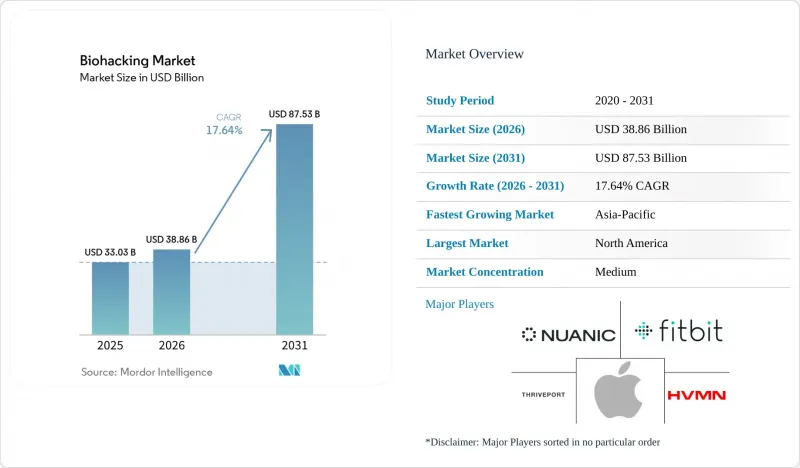
Mordor Intelligence에 의하면, 바이오해킹 시장 규모는 2025년 330억 3,000만 달러, 2026년 388억 6,000만 달러에서 2031년까지 875억 3,000만 달러로 확대되어 2026년부터 2031년까지 연평균 복합 성장률(CAGR)은 17.64%를 나타낼 것으로 예측됩니다.
본 보고서는 제품 유형(웨어러블 기기, 스마트 임플란트, 유전자 편집 키트, 노화 방지제·보충제, 센서·생체 모니터링 패치, 기타), 바이오해킹의 유형(뉴트리제노믹스, DIY 생물학, 그라인더 등), 최종 사용자(소비자, 의료시설 등), 지역(북미, 유럽 등)별로 분류되어 있습니다. 시장 전망은 금액(달러) 기준으로 제시되어 있습니다.
세계 바이오해킹 시장 동향과 인사이트
소비자용 웨어러블 기기의 주류화
소비자용 웨어러블 기기는 단순한 만보계에서 심전도 수준의 심박수 모니터링과 연속 혈당 측정이 가능한 멀티 센서 건강 플랫폼으로 진화하고 있으며, CES 2025에서 최우수상을 수상한 애보트의 ‘Lingo’가 그 대표적인 예입니다. 애플이 향후 발표할 예정인 AI 기반 ‘프로젝트 멀베리(Project Mulberry)’는 개인정보 보호를 위해 클라우드 처리가 아닌 기기 내 분석을 활용해 예방적 건강 지도를 제공하는 빅테크 기업의 노력을 강조하고 있습니다. 홍콩대학교의 엔지니어들은 최근 센서 내부에서 머신러닝 모델을 실행하는 유기 전기화학 트랜지스터를 시연함으로써 데이터 유출 위험을 한층 더 줄였습니다. 지속적인 생체 감지와 엣지 AI의 결합을 통해 생체 모니터링은 수동적인 데이터 수집에서 실시간 폐쇄 루프형 권장 사항으로 전환되었으며, 사용자층은 얼리 어답터를 넘어 확대되고 있습니다. 가격이 기존 스마트 워치와 비슷한 수준이 됨에 따라, 바이오해킹 시장은 일반 소비자 시장으로의 진입점을 확보해 가고 있습니다.
휴먼 오거멘테이션 분야 스타트업으로의 벤처 캐피털 유입
자금 조달 동향을 살펴보면, 라이프스타일용 웨어러블에서 임상적으로 실용 가능한 능력 향상 도구로 초점이 이동하고 있습니다. Elemind사는 2024년, 수면 최적화와 인지 기능 회복력을 목표로 하는 신경 조절 헤드밴드의 상용화를 위해 1,200만 달러의 자금 조달에 성공했습니다. 제너럴 파트너의 투자 조건서에서는 범용 하드웨어보다 독자적인 데이터셋과 알고리즘에 대한 지적재산권이 점점 더 중요시되고 있으며, 이는 장기적인 멀티모달 생체 측정 데이터야말로 방어 가능한 가치를 지닌다는 투자자들의 확신을 반영하고 있습니다. 북미에서 이루어지는 대규모 자금 조달 라운드는 싱가포르나 베를린과 같은 2차 거점으로도 파급되어, 지역적 혁신 클러스터의 형성을 촉진하고 있습니다. 성능 향상과 예방 의료의 연관성은 본인 부담금과 고용주의 지원금을 결합한 하이브리드 보상 모델을 바이오해킹 시장에 도입하는 계기가 되고 있습니다. SPAC(특별목적인수회사)나 기업 인수를 통한 엑시트 전략이 성숙해짐에 따라, 자본의 재순환이 잇달아 등장하는 스타트업들을 뒷받침할 것입니다.
생체 인식 추적 기능을 도입하는 기업을 위한 웰니스 프로그램
고용주들은 획일적인 건강검진에서 벗어나, AI 대시보드에 연결된 손목, 팔 또는 귀에 착용하는 센서를 활용한 지속적인 생체 데이터 관리로 전환하고 있습니다. 포춘 100대 기업에 선정된 한 소매업체에서 진행한 시범 프로그램에서 창고 직원들을 대상으로 변동 분석 웨어러블 기기를 도입한 결과, 부상 사고가 20% 감소한 것으로 보고되었습니다. 한편, 자체 보험 제도를 도입한 기술 기업들은 고위험군 직원들에게 생활 습관 개선을 독려함으로써 심혈관 및 대사 질환 관련 보험 청구 건수를 두 자릿수 비율로 줄이는 성과를 거두었다고 밝혔습니다. 삼성 엔터프라이즈 모빌리티 사업부는 개인의 건강 데이터와 기업의 건강 데이터를 분리하는 보안 컨테이너를 제공함으로써, HIPAA와 관련된 개인정보 보호 문제를 해소하고 있습니다. 인력 부족에 시달리는 노동 시장에서 웰니스 수당이 필수 조건으로 자리 잡은 가운데, 프로그램의 차별화는 일반적인 걸음 수 챌린지가 아닌, 지속적인 혈당 수치 추이에 대한 알림 등 과학적으로 입증된 바이오해킹 개입에 의존하는 방향으로 바뀌고 있습니다. 그러나 노동조합은 생체 인증 점수 산정 방식의 차별적 활용을 막기 위해 알고리즘의 투명성을 요구하고 있습니다.
부문별 분석
웨어러블 기기는 2025년 바이오해킹 시장 점유율의 35.70%를 차지하고 있으며, 이는 스마트 워치와 의료용 당뇨병 관리 분야에서 일반 웰니스 분야로 확산된 손목 착용형 연속 혈당 모니터의 광범위한 채택을 반영한 것입니다. 유전자 편집 키트는 틈새 시장이지만, 저비용 CRISPR 시약이 교육자 및 애호가층에 보급됨에 따라 해당 카테고리 내에서 가장 높은 연평균 성장률(CAGR) 17.88%를 나타낼 것으로 전망됩니다. 현재의 자금 조달 추세가 지속된다면, 유전자 편집 제품을 활용한 바이오해킹 시장 규모는 2031년까지 53억 5,000만 달러를 넘어설 것으로 예측됩니다. 이와 동시에, USC(남캘리포니아 대학교)가 개발한 배터리 없이 작동하는 통증 관리용 신경 자극 장치 등의 스마트 임플란트는 외부 착용형 웨어러블 기기에서 이식형 치료 기기로의 향후 전환을 예고하고 있습니다.
경쟁 환경은 센서, 클라우드 분석, 그리고 맞춤형 개입을 융합한 통합 생태계로 수렴되고 있습니다. 개발 중인 케톤체, 젖산, 코르티솔 연속 측정 센서는 심박수나 혈당 수치를 뛰어넘는 데이터 밀도 향상을 목표로 하고 있으며, 플랫폼 내 입지를 공고히 하고 있습니다. 유서 깊은 의료기기 제조업체들은 규제와 관련된 노하우를 활용해 임상용 제품을 일반 의약품으로 재라벨링하고 있는 반면, 스타트업 기업들은 민첩한 개발 주기를 활용해 펌웨어와 알고리즘을 매주 개선하고 있습니다. 부품의 상품화로 인해 하드웨어의 이익률이 하락하고, 집계된 생체 데이터에서 도출된 인사이트를 기반으로 한 구독 모델로 가치 창출의 원천이 전환됨에 따라, 업계 재편 압력이 높아질 가능성이 있습니다. 소비자들은 파편화된 앱의 사일로화보다는 통합된 대시보드를 선호하기 때문에 제품 수준의 상호운용성 기준이 보급 곡선에 영향을 미칠 것으로 보입니다.
지역별 분석
북미는 2025년 매출의 41.75%를 차지하며, 일반의약품용 바이오센서에 대한 FDA의 신속 승인 절차와 캘리포니아주 및 매사추세츠주의 풍부한 벤처 자금 클러스터에 힘입고 있습니다. 정책 측면에서의 실용주의?치료용 의료기기보다는 낮고, 소비자용 전자기기보다는 높은 증거 기준?덕분에 웰니스 관련 기술에는 예측 가능한 발전 경로가 마련되어 있습니다. 그러나 유전자 편집 키트에 관한 주 차원의 새로운 규제가 국내 규정 준수 체계를 분열시킬 가능성이 있어, 플랫폼 제공업체들은 주별 요건에 대응할 수 있는 모듈식 규제 핵심 체계를 구축해야할 것으로 보입니다.
유럽에서는 자금 측면의 인센티브와 엄격한 개인정보 보호 기준이 조화를 이루고 있습니다. '호라이즌·유럽'의 보조금은 상용화 단계에 있는 웨어러블 기기에 자금을 지원하고 있지만, GDPR(EU 개인정보보호규정) 시행으로 인해 데이터 최소화 아키텍처가 의무화되면서 고정비가 증가하고 있습니다. 이는 자원이 제한적인 스타트업에게 진입 장벽이 되고 있습니다. 유럽사법재판소는 이미 심박수의 상시 스트리밍이 민감한 건강 데이터에 해당한다고 판단하여, 북미에서 흔히 사용되는 광고 기술 기반의 수익화 모델을 제한하고 있습니다. 그럼에도 불구하고, 높은 가처분 소득과 공중보건에 대한 관심이 예방적 장수에 초점을 맞춘 프리미엄 구독층을 뒷받침하고 있습니다.
아시아태평양은 정부의 의료 인프라 디지털화와 장수를 추구하는 중산층 증가로 인해 19.24%라는 가장 높은 연평균 성장률(CAGR)을 기록하고 있습니다. 중국의 전략적 생명공학 계획에서는 오믹스 연구와 센서 제조에 수십억 위안 규모의 예산이 배정되어 있으며, 세계 시세보다 저렴할 가능성이 있는 국내 대규모 생산이 가속화되고 있습니다. 일본은 고령화 사회의 과제를 계기로, 고령자의 이동 지원을 목적으로 한 AI 연동형 외골격의 시범 도입을 추진하고 있으며, 이는 유리한 보험 급여의 선례로 이어지고 있습니다. 인도의 디지털 헬스 미션은 웨어러블 데이터를 국가 의료 인프라에 통합하고 있으며, 스타트업 기업들에게 거대한 테스트베드를 제공합니다. 아세안 시장의 규제 환경 성숙도가 다양하기 때문에 기업은 위험 수준에 맞추어 사업 전개를 조정할 수 있으며, 초기 시범 사업을 통해 얻은 교훈을 바탕으로 서유럽 시장으로의 확장을 도모할 수 있습니다.
기타 혜택:
- 엑셀 형식 시장 예측(ME) 시트
- 3개월간의 애널리스트 지원
자주 묻는 질문
목차
제1장 서론
제2장 조사 방법
제3장 주요 요약
제4장 시장 구도
제5장 시장 규모와 성장 예측
제6장 경쟁 구도
제7장 시장 기회와 향후 전망
JHS 26.06.23According to Mordor Intelligence, the biohacking market size is projected to expand from USD 33.03 billion in 2025 and USD 38.86 billion in 2026 to USD 87.53 billion by 2031, registering a CAGR of 17.64% between 2026 to 2031.
This report is Segmented by Product Type (Wearable Devices, Smart Implants, Gene-Editing Kits, Nootropics & Supplements, Sensors & Biomonitoring Patches, Others), Biohacking Type (Nutrigenomics, DIY Biology, Grinder, and More), End User (Consumers, Healthcare Facilities, and More), and Geography (North America, Europe, and More). The Market Forecasts are Provided in Terms of Value (USD).
Global Biohacking Market Trends and Insights
Mainstream Uptake of Consumer Wearables
Consumer wearables have evolved from simple step counters into multi-sensor health platforms capable of ECG-grade heart monitoring and continuous glucose measurements, exemplified by Abbott's Lingo winning top honors at CES 2025. Apple's forthcoming AI-driven "Project Mulberry" underscores Big-Tech commitment to proactive health coaching using on-device analytics rather than cloud processing to protect privacy. University of Hong Kong engineers recently demonstrated organic electrochemical transistors that run machine-learning models inside the sensor itself, further minimizing data-leak risks. Continuous biosensing combined with edge AI shifts bio-monitoring from passive data collection to real-time, closed-loop recommendations, widening the user base beyond early adopters. As prices converge with conventional smartwatches, the biohacking market gains a mass-market entry point.
Venture Capital Inflows into Human-Augmentation Start-ups
Funding patterns show a pivot from lifestyle wearables toward clinically actionable enhancement tools. Elemind secured USD 12 million in 2024 to commercialize neuromodulation headbands aimed at sleep optimization and cognitive resilience. General-partner term sheets increasingly emphasize proprietary data sets and algorithmic IP instead of commodity hardware, reflecting investor belief that defensible value resides in longitudinal multimodal biometrics. Mega-rounds in North America spill over into secondary hubs such as Singapore and Berlin, seeding regional innovation clusters. The link between performance enhancement and preventive health positions the biohacking market for blended reimbursement models combining out-of-pocket spending with employer stipends. As exits via SPACs and trade sales mature, capital recycling should fuel successive cohorts of start-ups.
Corporate Wellness Programs Adopting Biometric Tracking
Employers are shifting from one-size-fits-all screenings to continuous biometric engagement using wrist, arm, or ear-based sensors connected to AI dashboards. Pilots at Fortune 100 retailers report injury-incident reductions of 20% after adopting movement-analysis wearables for warehouse staff, while self-insured tech firms cite double-digit cuts in cardiometabolic claims by nudging high-risk employees toward lifestyle changes. Samsung's enterprise mobility division provides secure containers that separate personal and corporate health data, easing HIPAA-adjacent privacy worries. As wellness stipends become table stakes in tight labor markets, program differentiation leans on scientifically validated biohacking interventions such as continuous glucose trend alerts rather than generic step challenges. However, unions are pressing for algorithmic transparency to prevent discriminatory use of biometric scoring.
Other drivers and restraints analyzed in the detailed report include:
- Declining Cost of Genetic-Testing Kits
- Regulatory Uncertainty on Human Enhancement
For complete list of drivers and restraints, kindly check the Table Of Contents.
Segment Analysis
Wearable devices commanded 35.70% of the 2025 biohacking market share, reflecting mass adoption of smartwatches and arm-based continuous glucose monitors that have crossed over from medical diabetology into mainstream wellness. Gene-editing kits, though niche, are projected to post an 17.88% CAGR, the fastest within the category, as low-cost CRISPR reagents reach educator and hobbyist audiences. The biohacking market size for gene-editing products is expected to surpass USD 5.35 billion by 2031 if current funding momentum persists. In parallel, smart implants such as USC's battery-less pain-management neurostimulator illustrate future migration from external wearables to embedded therapeutics.
The competitive field is converging on integrated ecosystems that merge sensors, cloud analytics, and personalized interventions. Continuous ketone, lactate, and cortisol sensors under development aim to extend data density beyond heart rate and glucose, heightening platform stickiness. Established medical-device firms leverage regulatory know-how to re-label clinical assets for over-the-counter use, while start-ups exploit agile cycles to iterate firmware and algorithms weekly. Consolidation pressures may surface once component commoditization erodes hardware margins, shifting value capture to subscription insights that mine aggregated biometric databases. Product-level interoperability standards will influence adoption curves, as consumers favor unified dashboards over fragmented app silos.
Geography Analysis
North America controlled 41.75% of 2025 revenue, buoyed by FDA fast tracks for over-the-counter biosensors and abundant venture finance clusters in California and Massachusetts. Policy pragmatism-evidence thresholds lower than therapeutic devices yet higher than consumer electronics-has created a predictable pathway for wellness-grade technologies. However, emerging state-level rules on gene-editing kits may fragment domestic compliance regimes, spurring platform providers to build modular regulatory kernels capable of state-specific toggles.
Europe blends funding incentives with strict privacy standards. Horizon-Europe grants finance translational wearables, yet GDPR enforcement obliges data-minimization architectures that raise fixed costs, an entry hurdle for resource-constrained start-ups. The European Court of Justice has already ruled that constant heart-rate streaming constitutes sensitive health data, restricting ad-tech monetization models common in North America. Nonetheless, high disposable incomes and a public-health orientation support premium subscription tiers focused on preventive longevity.
Asia-Pacific posts the fastest CAGR at 19.24% as governments digitize health infrastructure and middle-class populations pursue longevity. China's strategic biotech plan allocates multibillion-yuan budgets to omics research and sensor fabrication, accelerating domestic scale production that can undercut global prices. Japan leverages its aging-society imperative to pilot AI-linked exoskeletons for elder mobility, translating into favorable reimbursement precedents. India's digital-health mission integrates wearable data into its national health stack, offering start-ups a massive testing ground. Diverse regulatory maturity across ASEAN markets lets firms tailor risk-based rollouts, learning from early pilots before expanding westward.
- Apple
- Alphabet Inc. (Fitbit)
- Oura Health Oy
- WHOOP Inc.
- Abbott Laboratories
- Dexcom
- Garmin
- Regeneron Pharmaceuticals (23andMe Holding Co.)
- HVMN Inc.
- Onnit Labs Inc.
- Neuralink Corp.
- Thync Global Inc.
- Interaxon
- Biohax International AB
- Cyborg Nest Ltd.
- Levels Health Inc.
- NutriSense Inc.
Additional Benefits:
- The market estimate (ME) sheet in Excel format
- 3 months of analyst support
TABLE OF CONTENTS
1 Introduction
- 1.1 Study Assumptions & Market Definition
- 1.2 Scope of the Study
2 Research Methodology
3 Executive Summary
4 Market Landscape
- 4.1 Market Overview
- 4.2 Market Drivers
- 4.2.1 Mainstream uptake of consumer wearables
- 4.2.2 Venture capital inflows into human-augmentation start-ups
- 4.2.3 Declining cost of genetic-testing kits
- 4.2.4 Corporate wellness programs adopting biometric tracking
- 4.2.5 Open-source bio-protocol libraries & DIY labs (under-reported)
- 4.2.6 Military R&D into human-performance enhancement (under-reported)
- 4.3 Market Restraints
- 4.3.1 Regulatory uncertainty on human enhancement
- 4.3.2 Data-privacy concerns around continuous biometrics
- 4.3.3 Bio-risk of at-home CRISPR experimentation
- 4.3.4 Ethical backlash against elective implants
- 4.4 Value / Supply-Chain Analysis
- 4.5 Regulatory Landscape
- 4.6 Technological Outlook
- 4.7 Porter's Five Forces
- 4.7.1 Threat of New Entrants
- 4.7.2 Bargaining Power of Suppliers
- 4.7.3 Bargaining Power of Buyers
- 4.7.4 Threat of Substitutes
- 4.7.5 Competitive Rivalry
5 Market Size & Growth Forecasts
- 5.1 By Product Type (Value)
- 5.1.1 Wearable Devices
- 5.1.2 Smart Implants
- 5.1.3 Gene-Editing Kits
- 5.1.4 Nootropics & Supplements
- 5.1.5 Sensors & Biomonitoring Patches
- 5.1.6 Others
- 5.2 By Biohacking Type (Value)
- 5.2.1 Nutrigenomics
- 5.2.2 DIY Biology
- 5.2.3 Grinder (Implantable)
- 5.2.4 Quantified-Self Tracking
- 5.2.5 Performance Pharmacology
- 5.2.6 Others
- 5.3 By End User (Value)
- 5.3.1 Consumers
- 5.3.2 Healthcare Facilities
- 5.3.3 Research & Academic Institutes
- 5.3.4 Others
- 5.4 By Geography (Value)
- 5.4.1 North America
- 5.4.1.1 United States
- 5.4.1.2 Canada
- 5.4.1.3 Mexico
- 5.4.2 Europe
- 5.4.2.1 Germany
- 5.4.2.2 United Kingdom
- 5.4.2.3 France
- 5.4.2.4 Italy
- 5.4.2.5 Spain
- 5.4.2.6 Rest of Europe
- 5.4.3 Asia-Pacific
- 5.4.3.1 China
- 5.4.3.2 India
- 5.4.3.3 Japan
- 5.4.3.4 South Korea
- 5.4.3.5 Australia
- 5.4.3.6 Rest of Asia-Pacific
- 5.4.4 South America
- 5.4.4.1 Brazil
- 5.4.4.2 Argentina
- 5.4.4.3 Rest of South America
- 5.4.5 Middle East and Africa
- 5.4.5.1 GCC
- 5.4.5.2 South Africa
- 5.4.5.3 Rest of Middle East and Africa
- 5.4.1 North America
6 Competitive Landscape
- 6.1 Market Concentration
- 6.2 Market Share Analysis
- 6.3 Company Profiles (includes Global level Overview, Market level overview, Core Segments, Financials as available, Strategic Information, Market Rank/Share for key companies, Products & Services, and Recent Developments)
- 6.3.1 Apple Inc.
- 6.3.2 Alphabet Inc. (Fitbit)
- 6.3.3 Oura Health Oy
- 6.3.4 WHOOP Inc.
- 6.3.5 Abbott Laboratories
- 6.3.6 Dexcom Inc.
- 6.3.7 Garmin Ltd.
- 6.3.8 Regeneron Pharmaceuticals (23andMe Holding Co.)
- 6.3.9 HVMN Inc.
- 6.3.10 Onnit Labs Inc.
- 6.3.11 Neuralink Corp.
- 6.3.12 Thync Global Inc.
- 6.3.13 Interaxon Inc.
- 6.3.14 Biohax International AB
- 6.3.15 Cyborg Nest Ltd.
- 6.3.16 Levels Health Inc.
- 6.3.17 NutriSense Inc.
7 Market Opportunities & Future Outlook
- 7.1 White-space & Unmet-need Assessment


