|
시장보고서
상품코드
2064356
생체 동일 호르몬 시장 : 점유율 분석, 업계 동향과 통계, 성장 예측(2026-2031년)Bioidentical Hormones - Market Share Analysis, Industry Trends & Statistics, Growth Forecasts (2026 - 2031) |
||||||
 Mordor Intelligence
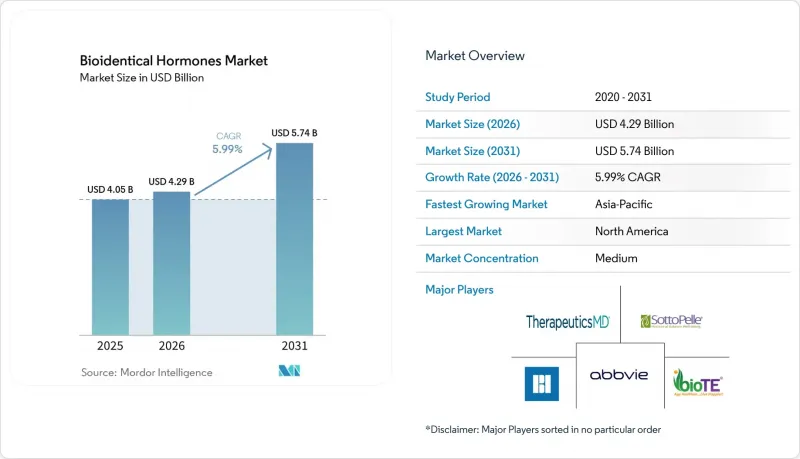
Mordor Intelligence에 의하면, 생체 동일 호르몬 시장 규모는 2025년 40억 5,000만 달러에서 2026년에는 42억 9,000만 달러로 확대되어 2026년부터 2031년까지 CAGR 5.99%로 성장을 지속하여, 2031년까지 57억 4,000만 달러에 이를 것으로 예측됩니다.
본 보고서는 호르몬 유형(에스트로겐, 프로게스테론 등), 제품 유형(정제 및 캡슐, 크림·젤 등), 투여 경로(경구, 경피·국소, 질 내 등), 용도(갱년기 관리 등), 유통 채널(병원, 소매, 온라인 등), 최종 사용자(병원 등), 지역(북미 등)에 따라 분류되어 있습니다. 금액(달러).
세계 생체 동일 호르몬 시장 동향 및 인사이트
갱년기 및 노화에 따른 호르몬 결핍증에 대한 수요 증가
생체 동일 호르몬 시장은 폐경 후 인구 증가에 따라 눈부신 성장을 이루고 있습니다. 2025년까지 전 세계적으로 11억 명 이상의 여성이 폐경기에 접어들 것으로 예상되며, 미국에서는 매년 130만 명 이상의 여성이 폐경을 맞이하고 있습니다. 치료되지 않은 증상으로 인한 경제적 영향은 막대하며, 미국에서는 연간 생산성 손실이 18억 달러에 달하고, 의료비와 생산성 손실을 합치면 266억 달러에 이릅니다. 또한, 시장은 WHI 연구로 인한 위험 우려로 호르몬 요법 사용이 감소했던 상황에서 점차 회복되고 있습니다. 이러한 영향으로 지난 20년 동안 이용률은 27%에서 5% 미만으로 떨어졌습니다. 공급을 신속하게 확대할 수 있는 기업은 이번 회복 국면을 활용할 수 있는 유리한 위치에 있습니다.
개인 맞춤형이며 자연스러운 느낌을 주는 호르몬 제품에 대한 수요
시장은 표준화된 치료에서 벗어나, 개별화된 투여량과 투여 경로의 선택, 그리고 증상에 특화된 관리에 중점을 둔 맞춤형 접근 방식으로 전환되고 있습니다. 오늘날의 환자들은 더 많은 정보를 얻고 있으며, 치료 결정에 적극적으로 참여하게 되었고, 자연스러운 호르몬 패턴을 모방하는 치료법을 선호하는 경향이 있습니다. 그러나 2026년 2월에 두 가지 용량을 출시한 BIJUVA와 같은 승인된 제품들이 이러한 격차를 점차 좁혀가고 있습니다. 시장은 규제된 맞춤형 방향으로 나아가고 있으며, 유연성과 공식 승인을 통한 신뢰성을 모두 갖춘 브랜드 제품들이 그 혜택을 누리고 있습니다.
혼합형 생체 동일 호르몬 요법에 대한 지침상의 회의론
임상적 회의론은 특히 맞춤 조제된 생체 동일 호르몬 요법과 관련하여, 생체 동일 호르몬 시장의 성장을 계속해서 저해하고 있습니다. 내분비학회(Endocrine Society)와 미국 산부인과학회(ACOG)는 FDA 승인을 받은 대체품과 비교했을 때, 조제 제품의 안전성을 뒷받침할 증거가 부족하다는 점을 지적하고 있습니다. ACOG는 또한, 배합 에스트라디올의 함량이 표시된 수치보다 26% 낮은 경우가 있는 반면, 프로게스테론은 31% 높은 경우도 있다고 지적하고 있습니다. 승인된 제품으로는 충족되지 않는 투여량이나 투여 경로와 관련된 미충족 의료 수요에 대응하기 위해 시장이 조제 약국에 의존해 왔기 때문에 이러한 면밀한 검토는 중요한 의미를 지닙니다. 2025년 9월, 미국 재향군인부(VA)는 갱년기 장애, 남성 성선 기능 저하증 및 성욕 감퇴에 대한 처방용 생체 동일 호르몬 요법을 ‘임상시험 단계’이자 ‘불필요’한 것으로 분류하고, 주요 기관을 통한 처방 경로를 배제했습니다. 이는 다른 의료 시스템에도 영향을 미칠 가능성이 있습니다. 수요는 여전히 견조하지만, 시장은 더욱 엄격한 근거 제시 요건과 보험 급여 환경에 직면해 있습니다.
부문별 분석
2025년, 에스트로겐은 생체 동일 호르몬 시장의 41.75%를 차지하며 주요 수익원으로서의 입지를 유지했습니다. 이러한 우위는 혈관운동 증상, 갱년기 비뇨생식기 증후군 및 골다공증 예방 치료에서 확립된 역할에 기인합니다. 2025년 한국 갱년기학회 지침에서는 경구 투여에 비해 경피 에스트라디올 투여가 정맥혈전색전증(VTE) 및 뇌졸중 위험을 감소시킨다는 점이 강조되었으며, 이는 에스트로겐 제제가 시장의 주류를 이루고 있음을 뒷받침하고 있습니다.
프로게스테론은 자궁을 가진 여성에게 여전히 필수적이며, 에스트로겐 단독 요법에 수반되는 자궁내막 관련 위험을 줄여줍니다. 미립자화 프로게스테론 및 복합제제는 처방 추세를 지속적으로 뒷받침하고 있습니다. FDA 승인을 받은 질용 플라스테론을 함유한 DHEA는 비뇨생식기 증상을 치료하는 규모는 작지만 성장하고 있는 시장 부문입니다. 테스토스테론은 여성 전용 승인 제품이 존재하지 않음에도 불구하고, HSDD(성욕 감퇴) 및 안드로겐 요법에 대한 인식이 높아짐에 힘입어 2031년까지 연평균 성장률(CAGR)이 6.30%를 나타낼 것으로 예측되며, 가장 빠르게 성장하고 있는 부문입니다.
패치 및 임플란트는 2025년에 41.6%의 시장 점유율을 차지해, 2031년까지 연평균 성장률(CAGR) 7.10%로 성장할 것으로 전망됩니다. 경피 패치는 에스트라디올을 안정적으로 전달하고 간에서의 첫 통과 대사를 피할 수 있게 해주기 때문에 혈전 위험이 있는 여성에게 더 안전한 선택지가 됩니다. 처방 의사는 증상 관리와 심혈관 위험 간의 균형을 고려하여 패치를 점점 더 선호하는 추세입니다.
임플란트는 장시간 지속되는 호르몬 전달 특성과 남녀 모두에서 테스토스테론 사용이 증가하는 추세와의 시너지 효과로 인해 주목을 받고 있습니다. 지속 방출이 가능하고 일상적인 관리 부담을 최소화하는 피하 펠릿은 임플란트 시장의 확대에 기여하고 있습니다. 패치 제조 및 펠릿 시스템에 대한 전문 지식을 갖춘 제조업체는 경구용 제품에서 전환되는 추세로 인해 유리한 입지에 있습니다.
지역별 분석
2025년, 북미는 생체 동일성 호르몬 시장의 41.67%를 차지하며 주도적인 위치를 유지했습니다. 미국은 규제 변경, 갱년기 치료에 대한 수요 증가, 잘 갖춰진 원격의료 인프라, 그리고 치료에 대한 인식 제고 덕분에 이러한 우위를 점하고 있습니다. 45세에서 54세 사이 여성을 대상으로 한 에스트로겐 기반 호르몬 요법의 처방 건수는 2023년부터 2026년 초까지 거의 두 배로 증가하여, 이 연령대의 5%에 달했습니다. 에스트로겐 패치의 처방 건수도 2018년부터 2026년 2월까지 184% 증가했으며, 이는 경구 투여 이외의 투여 방식으로의 전환을 반영하고 있습니다. 캐나다에서는 Knight Therapeutics사가 TherapeuticsMD사로부터 라이선스를 취득하여 2024년에 IMVEXXY 및 BIJUVA의 판매를 시작함으로써, 그동안 복합 호르몬 제제가 주류를 이루던 시장에 브랜드 제품을 출시했습니다.
유럽은 생체 동일 호르몬 시장에서 성숙 단계에 접어들었음에도 불구하고 계속해서 진화하고 있는 상황입니다. 북유럽 및 서유럽의 갱년기 호르몬 요법 보급률은 WHI(여성 건강 이니셔티브) 연구 이후의 미국 수준보다 여전히 높으며, EU 시장의 대부분에서 4%에서 10% 사이를 기록하고 있습니다. 영국 갱년기 학회, 왕립 산부인과 의사 협회 및 내분비 학회가 발표한 공동 성명은 증상이 있는 여성에 대한 호르몬 요법에 대해 임의적인 연령 제한이나 기간 제한을 두지 않는 것을 지지하고 있습니다. 이로 인해 안정적인 처방 기반이 확보되었지만, 조제 제품은 근거 및 보험 급여와 관련된 과제에 직면해 있습니다. 이 지역에서는 치료에 대한 임상적 수용도가 높은 반면, 품질과 근거에 대한 기대치도 엄격합니다.
아시아태평양은 생체 동일 호르몬 시장에서 가장 빠르게 성장하고 있는 지역으로, 2031년까지 연평균 성장률(CAGR)이 7.15%를 나타낼 것으로 전망됩니다. 이러한 성장은 진단 건수 증가, 지침에 따른 지원 강화, 특정 제품의 가격 경쟁력 향상, 그리고 상업적 투자 증가에 힘입어 이루어지고 있습니다. 중국에서는 2020년에 팬데믹의 영향으로 감소했으나, 2019년부터 2023년까지 갱년기 호르몬 요법의 처방 건수는 86.08% 증가했고, 처방 금액은 126.58% 증가했습니다. 또한, 프로게스테론의 입수 편의성을 높이는 중앙 조달 정책에 힘입어, 에스트로겐·프로게스테론 복합제의 사용도 활발합니다.
기타 혜택:
- 엑셀 형식 시장 예측(ME) 시트
- 3개월간의 애널리스트 지원
자주 묻는 질문
목차
제1장 서론
제2장 조사 방법
제3장 주요 요약
제4장 시장 구도
제5장 시장 규모와 성장 예측
제6장 경쟁 구도
제7장 시장 기회와 향후 전망
JHS 26.06.23According to Mordor Intelligence, the bioidentical hormones market size is expected to grow from USD 4.05 billion in 2025 to USD 4.29 billion in 2026 and is forecast to reach USD 5.74 billion by 2031 at 5.99% CAGR over 2026-2031.
This report is Segmented by Hormone Type (Estrogens, Progesterone, and More), Product Type (Tablets and Capsules, Creams and Gels, and More), Route of Administration (Oral, Transdermal/Topical, Vaginal, and More), Application (Menopause Management, and More), Distribution Channel (Hospital, Retail, Online, and More), End User (Hospitals, and More), and Geography (North America, and More). Value (USD).
Global Bioidentical Hormones Market Trends and Insights
Rising Menopausal and Age-Related Hormone Deficiency Demand
The bioidentical hormones market is experiencing significant growth due to the increasing postmenopausal population. By 2025, over 1.1 billion women globally are expected to be postmenopausal, with more than 1.3 million women in the U.S. entering menopause annually. The financial impact of untreated symptoms is substantial, with annual productivity losses reaching USD 1.8 billion and combined medical and productivity costs at USD 26.6 billion in the U.S. Additionally, the market is recovering from a decline in hormone therapy usage caused by risk concerns from the WHI study, which reduced uptake from 27% to under 5% over two decades. Companies that can rapidly scale supply are well-positioned to capitalize on this rebound.
Demand for Personalized and Natural-Feeling Hormone Products
The market is shifting from standardized treatments to personalized approaches, focusing on individualized dosing, route selection, and symptom-specific management. Patients today are more informed and actively involved in treatment decisions, favoring options that mimic natural hormone patterns. However, approved products like BIJUVA, which introduced two-dose strengths in February 2026, are narrowing this gap. The market is moving toward regulated personalization, benefiting branded products that combine flexibility with the credibility of formal approval.
Guideline Skepticism Toward Compounded Bioidentical Hormone Therapy
Clinical skepticism continues to challenge the growth of the bioidentical hormones market, particularly regarding compounded bioidentical hormone therapy. The Endocrine Society and ACOG have highlighted the lack of evidence supporting the safety of compounded products over FDA-approved alternatives. ACOG also noted that compounded estradiol could test 26% below labeled content, while progesterone could test 31% above. This scrutiny is significant as the market has relied on compounding pharmacies to address dose and route needs unmet by approved products. In September 2025, the VA classified compounded bioidentical hormone therapy as investigational and unnecessary for menopause, male hypogonadism, and low libido, removing a key institutional prescribing pathway and potentially influencing other health systems. While demand remains strong, the market faces a stricter evidence and reimbursement environment.
Other drivers and restraints analyzed in the detailed report include:
- Shift Toward Transdermal and Non-Oral Delivery for Better Outcomes
- Telehealth-Enabled Hormone Care Pathways Expanding Access
- Limited Reimbursement and Self-Pay Affordability Barriers
For complete list of drivers and restraints, kindly check the Table Of Contents.
Segment Analysis
In 2025, estrogens accounted for 41.75% of the bioidentical hormones market, maintaining their position as a key revenue driver. Their dominance is due to their established role in treating vasomotor symptoms, genitourinary syndrome of menopause, and osteoporosis prevention. The 2025 Korean Society of Menopause guidelines highlighted the reduced risk of VTE and stroke with transdermal estradiol compared to oral routes, reinforcing estrogen products as the market's cornerstone.
Progesterone remains critical for women with an intact uterus, mitigating endometrial risks associated with unopposed estrogen therapy. Micronized progesterone and combination products continue to support prescription trends. DHEA, including FDA-approved vaginal prasterone, is a smaller but growing segment addressing genitourinary symptoms. Testosterone, with a projected CAGR of 6.30% through 2031, is the fastest-growing segment, driven by increased awareness of HSDD and androgen therapy, despite the absence of a female-specific approved product.
Patches and implants held a 41.6% market share in 2025 and are projected to grow at a 7.10% CAGR through 2031. Transdermal patches offer consistent estradiol delivery, bypass hepatic first-pass metabolism, and provide a safer option for women with thrombotic risks. Prescribers increasingly favor patches for balancing symptom control and cardiovascular risk.
Implants are gaining traction due to their long-acting hormone delivery and alignment with rising testosterone use in both genders. Subdermal pellets, offering sustained release and minimal daily intervention, have expanded the implant segment. Manufacturers with expertise in patch production or pellet systems are well-positioned to benefit from the shift away from oral products.
Geography Analysis
In 2025, North America accounted for 41.67% of the bioidentical hormones market, maintaining its leadership position. The U.S. drives this dominance due to regulatory changes, rising menopause treatment demand, robust telehealth infrastructure, and increased treatment awareness. Estrogen-based hormone therapy prescriptions among women aged 45 to 54 nearly doubled between 2023 and early 2026, reaching 5% of this demographic. Estrogen patch prescriptions also rose by 184% from 2018 to February 2026, reflecting a shift toward non-oral delivery methods. In Canada, Knight Therapeutics began commercializing IMVEXXY and BIJUVA in 2024 under its license from TherapeuticsMD, introducing institutional branding in a market previously dominated by compounded hormones.
Europe holds a mature yet evolving position in the bioidentical hormones market. Menopausal hormone therapy prevalence in Northern and Western Europe remains higher than the post-WHI U.S. levels, ranging from 4% to 10% in most EU markets. A joint statement by The British Menopause Society, the Royal College of Obstetricians and Gynaecologists, and the Society for Endocrinology supports no arbitrary age or duration limits on hormone therapy for symptomatic women. This provides a stable prescribing base, although compounded products face challenges related to evidence and reimbursement. The region combines strong clinical acceptance of therapy with stringent quality and evidence expectations.
Asia-Pacific is the fastest-growing region in the bioidentical hormones market, with a projected CAGR of 7.15% through 2031. Growth is driven by increased diagnoses, stronger guideline support, improved affordability of select products, and rising commercial investments. In China, menopausal hormone therapy prescriptions rose by 86.08% from 2019 to 2023, with prescription value increasing by 126.58%, despite a pandemic-related decline in 2020. The country also shows strong use of estrogen-progestogen compound preparations, supported by centralized procurement policies improving progesterone affordability.
- Abbvie
- AnazaoHealth
- Besins Healthcare
- BioTE Medical
- BodyLogicMD
- Compounding Pharmacy of America
- Defy Medical
- Empower Pharmacy
- Fagron
- JumpstartMD
- Mayne Pharma
- Neuva Aesthetics LLC.
- Noven Pharmaceuticals Inc.
- Papillon Medical Inc.
- SottoPelle Therapy
- The biostation
- Theramex UK Ltd.
- TherapeuticsMD
- Wells Pharmacy Network
- Women's International Pharmacy
Additional Benefits:
- The market estimate (ME) sheet in Excel format
- 3 months of analyst support
TABLE OF CONTENTS
1 Introduction
- 1.1 Study Assumptions & Market Definition
- 1.2 Scope of the Study
2 Research Methodology
3 Executive Summary
4 Market Landscape
- 4.1 Market Overview
- 4.2 Market Drivers
- 4.2.1 Rising Menopause and Age-Related Hormone Deficiency Burden
- 4.2.2 Demand for Personalized and Natural-Feeling Hormone Regimens
- 4.2.3 Shift Toward Transdermal and Non-Oral Delivery for Better Tolerability
- 4.2.4 Telehealth-Enabled Hormone Care Pathways Expanding Access
- 4.2.5 Reappraisal of Menopause Hormone Therapy Risk-Benefit Profile
- 4.2.6 Unmet Need for Female Testosterone Options Supporting Compounded Demand
- 4.3 Market Restraints
- 4.3.1 Guideline Skepticism Toward Compounded Bioidentical Therapies
- 4.3.2 Limited Reimbursement and Self-Pay Affordability Barriers
- 4.3.3 Estradiol Patch and Menopause-Therapy Shortages Disrupting Continuity
- 4.3.4 Higher Compliance Burden for Compounders and Outsourcing Facilities
- 4.4 Value Chain Analysis
- 4.5 Regulatory Landscape
- 4.6 Technological Outlook
- 4.7 Porter's Five Forces
- 4.7.1 Threat of New Entrants
- 4.7.2 Bargaining Power of Suppliers
- 4.7.3 Bargaining Power of Buyers
- 4.7.4 Threat of Substitutes
- 4.7.5 Industry Rivalry
5 Market Size & Growth Forecasts (Value, USD)
- 5.1 By Hormone Type
- 5.1.1 Estrogens
- 5.1.2 Progesterone
- 5.1.3 Testosterone
- 5.1.4 DHEA and Other Hormones
- 5.2 By Product Type
- 5.2.1 Tablets & Capsules
- 5.2.2 Creams & Gels
- 5.2.3 Patches and implants
- 5.2.4 Injectables
- 5.2.5 Vaginal Inserts, Rings & Suppositories
- 5.2.6 Other
- 5.3 By Route of Administration
- 5.3.1 Oral
- 5.3.2 Transdermal / Topical
- 5.3.3 Vaginal
- 5.3.4 Injectable / Parenteral
- 5.3.5 Subdermal Implant / Pellet
- 5.4 By Application
- 5.4.1 Menopause Management / Vasomotor Symptoms
- 5.4.2 Genitourinary Syndrome of Menopause / Vaginal Atrophy
- 5.4.3 Andropause / Male Hypogonadism
- 5.4.4 Sexual Wellness / HSDD and Related Use Cases
- 5.4.5 Thyroid Disorders
- 5.4.6 Other Hormonal Imbalance Indications
- 5.5 By Distribution Channel
- 5.5.1 Hospital Pharmacies
- 5.5.2 Retail Pharmacies
- 5.5.3 Online Pharmacies
- 5.5.4 Compounding Pharmacies
- 5.5.5 Direct Clinic Dispensing
- 5.6 By End User
- 5.6.1 Hospitals
- 5.6.2 Gynecology Clinics
- 5.6.3 Endocrinology Clinics
- 5.6.4 Specialty Hormone and Wellness Clinics
- 5.6.5 Homecare / Self-administered Care
- 5.7 By Geography
- 5.7.1 North America
- 5.7.1.1 United States
- 5.7.1.2 Canada
- 5.7.1.3 Mexico
- 5.7.2 Europe
- 5.7.2.1 Germany
- 5.7.2.2 United Kingdom
- 5.7.2.3 France
- 5.7.2.4 Italy
- 5.7.2.5 Spain
- 5.7.2.6 Rest of Europe
- 5.7.3 Asia-Pacific
- 5.7.3.1 China
- 5.7.3.2 India
- 5.7.3.3 Japan
- 5.7.3.4 South Korea
- 5.7.3.5 Australia
- 5.7.3.6 Rest of Asia-Pacific
- 5.7.4 Middle East and Africa
- 5.7.4.1 GCC
- 5.7.4.2 South Africa
- 5.7.4.3 Rest of Middle East and Africa
- 5.7.5 South America
- 5.7.5.1 Brazil
- 5.7.5.2 Argentina
- 5.7.5.3 Rest of South America
- 5.7.1 North America
6 Competitive Landscape
- 6.1 Market Concentration
- 6.2 Market Share Analysis
- 6.3 Company Profiles (includes Global level Overview, Market level overview, Core Segments, Financials as available, Strategic Information, Market Rank/Share for key companies, Products & Services, and Recent Developments)
- 6.3.1 AbbVie Inc.
- 6.3.2 AnazaoHealth
- 6.3.3 Besins Healthcare
- 6.3.4 BioTE Medical
- 6.3.5 BodyLogicMD
- 6.3.6 Compounding Pharmacy of America
- 6.3.7 Defy Medical
- 6.3.8 Empower Pharmacy
- 6.3.9 Fagron
- 6.3.10 JumpstartMD
- 6.3.11 Mayne Pharma Group Limited
- 6.3.12 Neuva Aesthetics LLC.
- 6.3.13 Noven Pharmaceuticals Inc.
- 6.3.14 Papillon Medical Inc.
- 6.3.15 SottoPelle Therapy
- 6.3.16 The biostation
- 6.3.17 Theramex UK Ltd.
- 6.3.18 TherapeuticsMD Inc.
- 6.3.19 Wells Pharmacy Network
- 6.3.20 Women's International Pharmacy
7 Market Opportunities & Future Outlook
- 7.1 White-space & unmet-need assessment