

|
시장보고서
상품코드
2064381
패치 관리 시장 : 점유율 분석, 업계 동향과 통계, 성장 예측(2026-2031년)Patch Management - Market Share Analysis, Industry Trends & Statistics, Growth Forecasts (2026 - 2031) |
||||||
 Mordor Intelligence
Mordor Intelligence에 의하면, 패치 관리 시장 규모는 2025년 27억 6,000만 달러, 2026년 30억 1,000만 달러에서 2031년까지 45억 4,000만 달러로 확대되어 2026년부터 2031년까지 연평균 복합 성장률(CAGR)은 8.57%를 나타낼 것으로 예측됩니다.
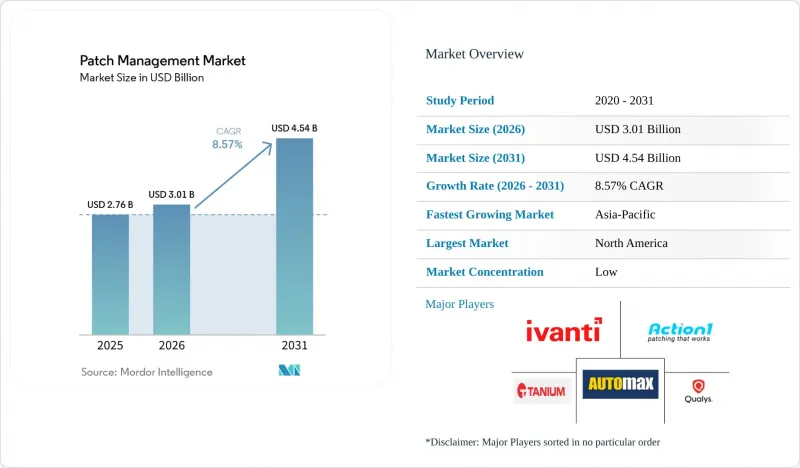
본 보고서는 구성 요소(소프트웨어 및 서비스), 도입 형태(클라우드 기반 및 On-Premise형), 조직 규모(대기업 및 중소기업), 업종(은행, 금융서비스 및 보험(BFSI), IT 및 통신, 헬스케어 및 생명과학, 정부·국방, 소매 및 전자상거래, 에너지 및 유틸리티 등) 및 지역별로 분류되어 있습니다. 시장 전망은 금액(달러) 기준으로 제시되어 있습니다.
전 세계 패치 관리 시장 동향 및 인사이트
알려진 취약점을 악용하는 사례가 급증하고 있습니다.
패치 관리 시장 수요를 단기적으로 가장 강력하게 견인하고 있는 요인은 적극적으로 악용되고 있는 취약점이 지속적으로 증가하고 있다는 점입니다. CISA의 ‘알려진 악용된 취약점(KEV)’ 목록은 2026년 5월 기준으로 1,592건에 달하며, 이는 보안 팀에 방대하고 계속 늘어나는 취약점들이 이미 실제 공격과 연결되어 있다는 분명한 신호를 보내고 있습니다. 이러한 환경에서는 패치 적용 예산의 우선순위 결정 방식이 달라집니다. 왜냐하면, 이미 알려진 악용 사례와 같은 제한된 범위의 문제에 대해 즉각적인 대응이 요구되는 경우, 조직은 광범위한 심각도 기준에 따른 우선순위 설정에 의존할 수 없기 때문입니다. 또한 이러한 상황은 KEV(이미 악용되고 있는 알려진 취약점)에 대한 정보를 신속하게 반영하여, 영향을 받는 자산 및 패치 적용 워크플로우에 직접 매핑할 수 있는 도구로 패치 관리 시장을 이끌고 있습니다. 따라서, 외부 위협 인텔리전스 확보부터 내부 시정 조치 실행까지 소요되는 시간을 단축할 수 있는 공급업체는 기업의 구매 주기에서 더욱 명확한 가치 제안을 확립해 나가고 있습니다.
사이버 복원력 및 규정 준수 요건의 강화
현재 규정 준수는 패치 관리 시장에서 직접적인 지출 요인으로 작용하고 있으며, 특히 취약점 대응이 법적 책임이나 공식적인 감독 심사 및 심사와 연계되어 있는 경우 그 경향이 두드러집니다. 유럽연합 집행위원회는 NIS2가 대상 기관에 취약점 관리 조치를 의무화하고 있으며, 이를 위반할 경우 벌금이 1,000만 유로(1,080만 달러) 또는 전 세계 연간 매출액의 2%에 달할 수 있다고 밝혔습니다. 이에 따라 내부 감사나 규제 당국이 확인할 수 있는 형식으로, 우선순위 결정 논리, 시정 조치의 시기, 승인 절차 및 롤백 절차를 문서화할 수 있는 플랫폼에 대한 수요가 증가하고 있습니다. ENISA의 보고서에 따르면, EU 기관의 70%가 2024년 사이버 보안 투자의 주요 촉진요인으로 규정 준수를 꼽았으며, 50%는 패치 관리를 NIS2 요건 중 대응하기 가장 어려운 항목으로 지목했습니다. 이러한 규제가 점차 정착됨에 따라, 패치 관리 시장에서는 단순히 배포 메커니즘에만 초점을 맞추는 벤더보다 자동화 기능과 상세한 보고 기능을 결합한 벤더가 우위를 점할 가능성이 높을 것으로 보입니다.
패치의 호환성과 업무 중단 위험
많은 조직이 패치 적용 기간을 계획할 때 여전히 시스템 중단 위험과 악용 위험을 저울질하고 있기 때문에 패치와 관련된 서비스 중단은 패치 관리 시장의 큰 걸림돌이 되고 있습니다. 이 문제는 의료, 제조, 금융 인프라 등 가동 중단이 업무나 안전성에 직접적인 영향을 미치는 환경에서 가장 두드러집니다. 이러한 환경에서는本番 환경에 배포를 진행하기 전에 검증, 테스트, 롤백 계획이 필요하기 때문에 자동 배포가 제한되는 경우가 많습니다. 그 결과, 패치에 대한 이해도가 높아지더라도 업데이트로 인해 핵심 워크플로가 중단되지 않을 것이라는 확신이 팀에 부족할 경우, 실행 속도는 여전히 저하될 가능성이 있습니다. 이러한 제약으로 인해, 배포 전 테스트, 단계적 롤아웃 설계 및 변경 관리의 가시성을 높일 수 있는 플랫폼에 대한 수요는 여전히 높습니다.
부문별 분석
2025년 패치 관리 시장에서 소프트웨어는 62.13%를 차지하며 가장 큰 비중을 차지하고 있습니다. 수익은 여전히 OS 패치 적용, 타사 용도 업데이트, 그리고 기업이 대규모의 다양한 기기군을 관리하는 데 도움이 되는 크로스 플랫폼 자동화 계층에 집중되어 있습니다. 2025년 및 2026년의 제품 투자는 보다 광범위한 플랫폼 지원으로 전환되고 있습니다. 이는 2025년 패치 관리 시장의 62.13%를 기업 사용자가 차지하여, 이것이 가장 큰 구성 요소를 이루고 있기 때문입니다. 기업 사용자들은 도구의 수를 줄이고, 보다 통일된 수정 워크플로를 원하고 있습니다. Action1은 2025년 11월, Ubuntu, Debian, Red Hat Enterprise Linux, SUSE를 대상으로 Linux 지원 범위를 확대했습니다. 이는 단일 OS에 패치를 적용하는 것이 아니라, 이기종 혼합 환경에 대응하는 방향으로 전환되고 있는 추세를 반영하고 있습니다.
규정 준수 요건 또한 패치 관리 업계에서 소프트웨어의 중요성을 높이고 있습니다. 조직은 관리 대상 용도에 패치가 기한 내에 적용되고, 전체 환경에서 이를 추적하고 있음을 입증할 수 있는 기록이 필요하기 때문입니다. Adaptiva는 2025년 12월, 자사의 플랫폼 카탈로그가 2만 개가 넘는 제품에 적용되는 25만 개 이상의 패치를 포괄하고 있다고 발표했습니다. 이는 타사 용도에 대한 보다 심층적인 분석과 보다 견고한 감사 대응 체계에 대한 수요를 뒷받침하는 것입니다. 서비스 부문은 가장 빠르게 성장하고 있는 분야이며, 이 부문의 패치 관리 시장 규모는 2031년까지 연평균 성장률(CAGR) 8.97%로 확대될 것으로 전망됩니다. 대기업과 중소기업이 정책 적용, 예외 처리 및 보고서 작성을 외부 팀에 위탁하는 경우가 점점 늘어나고 있기 때문에 매니지드 서비스가 이러한 증가하는 수요의 상당 부분을 차지하고 있습니다. ENISA의 조사 결과에 따르면 EU 기관의 76%가 사이버 보안 인력 확보에 어려움을 겪고 있는 것으로 나타났으며, 이는 서비스 주도형 제공 방식으로의 구조적 전환을 뒷받침하고 있습니다.
클라우드 기반 배포는 2025년에 패치 관리 시장의 55.89%를 차지해, 2031년까지 연평균 성장률(CAGR) 8.92%로 성장할 것으로 전망되는 가장 빠르게 확대되고 있는 배포 방식이기도 합니다. 이러한 우위는 클라우드 기반 에이전트가 On-Premise 중계 인프라나 VPN 연결에 의존하지 않고도 패치 정책을 적용할 수 있다는 점에서 원격 및 하이브리드 환경에서 분명한 이점을 반영하고 있습니다. 이 모델은 중앙 정책 업데이트를 신속하게 처리하고 분산된 디바이스에 광범위하게 적용할 수 있게 해주며, 이 두 가지 모두 패치 관리 시장에서 핵심적인 요구 사항입니다. Adaptiva는 2025년에 신규 고객 확보 건수가 70% 증가했고, 공동 판매를 통한 계약 체결 건수가 75% 증가했다고 보고했으며, 이는 클라우드 네이티브 패치 및 엔드포인트 아키텍처에 대한 고객의 관심이 지속되고 있음을 보여줍니다.
On-Premise 배포는 에어갭 환경, 기밀 네트워크, 그리고 데이터 저장 위치나 네트워크 격리로 인해 클라우드 사용이 제한되는 산업 환경에서 여전히 중요합니다. Ivanti는 2026년 4월에 ISA6500 및 ISA8500 소버린 어플라이언스를 발표했는데, 이는 해당 벤더가 클라우드 기반 정책 오케스트레이션 및 지역별 데이터 관리와 연동된 로컬 폼 팩터에 대한 수요가 여전히 존재한다는 점을 인식하고 있음을 보여줍니다. 이는 On-Premise 분야가 사라지는 것이 아니라 점차 축소되고 있음을 의미하며, 패치 관리 시장은 공유 클라우드 환경으로의 완전한 전환이 불가능한, 규모는 작지만 견고한 전문 고객층을 대상으로 하고 있음을 보여줍니다. 클라우드 플랫폼은 분산된 엔드포인트, 축소된 IT 팀, 그리고 신속한 복구 주기의 추진에 적합하기 때문에 전반적인 방향성은 여전히 명확합니다.
지역별 분석
2025년, 북미가 패치 관리 시장의 41.84%를 차지하며 가장 큰 기여를 한 지역이 되었습니다. 미국이 지역 수요의 대부분을 차지하는 이유는 대기업의 예산 규모, 성숙한 매니지드 서비스 생태계, 그리고 엄격한 내부 거버넌스가 모두 패치 적용에 대한 지출 증가를 뒷받침하고 있기 때문입니다. CISA가 KEV 카탈로그를 지속적으로 확충하고, 취약점 대응에 있어 적극적인 조정자 역할을 수행함으로써, 해당 지역의 조직에 실용적인 정보 피드를 제공하여 우선순위를 명확히 하고 실행 속도를 높일 수 있게 하고 있습니다. 캐나다와 멕시코는 국경을 초월한 기업 네트워크와 중견 기업 대상 계정에서 MSP(관리형 서비스 제공업체)의 서비스 범위 확대를 통해 수요를 견인하고 있습니다. 또한, 이 지역은 벤더 기반이 탄탄하다는 점도 강점으로 작용하여, 패치 관리 시장의 경쟁을 심화시키고 제품 기능 향상을 촉진하고 있습니다.
아시아태평양은 가장 빠르게 성장하고 있는 지역이며, 패치 관리 시장은 2031년까지 연평균 성장률(CAGR) 9.57%로 확대되고 있습니다. 엔드포인트 자산의 규모 확대, 사이버 보안 프레임워크의 강화, 그리고 기업 IT 전반에 걸친 클라우드 기반 운영으로의 지속적인 전환이 이러한 성장을 뒷받침하고 있습니다. 동향마이크로는 2025년 3월, 일본의 패치 적용까지 걸리는 평균 소요 시간이 36.4일이며, 이는 세계 평균보다 1.2배 더 느린 수치라고 보고했습니다. 이는 이 주요 지역 시장에서 자동화 측면에서 뚜렷한 격차가 존재함을 보여줍니다. Action1은 2026년 4월 1일부터 인도의 데이터 거주 요건을 준수할 것을 약속하고 있으며, 이는 해당 벤더가 현재 해당 지역에서의 규정 준수 조치를 해당 지역 내 사업 확장 전략의 일환으로 간주하고 있음을 보여줍니다. 호주 및 기타 아시아태평양 시장에서도 패치 거버넌스가 각국의 사이버 보안 프로그램 내에서 더욱 확고한 위치를 차지하고 있으며, 이것이 장기적인 도입을 뒷받침하고 있습니다.
2025년, 유럽은 두 번째로 큰 시장 점유율을 차지했으며, 영국, 독일, 프랑스가 대기업 및 중견 기업 사용자 전반에서 수요를 주도했습니다. ENISA의 보고서에 따르면, 2024년에 EU 기관의 70%가 규제 준수를 사이버 보안 투자의 주요 촉진요인으로 꼽았으며, NIS2의 적용 범위에 새로 포함된 기관에서는 사이버 보안 예산이 평균 22% 증가했습니다. 이로 인해 패치 관리 시장은 공식적인 규정 준수 프로그램, 문서화된 통제 설계, 그리고 규제 심사를 통해 형성되는 조달 주기와 밀접하게 연계된 상태를 유지하고 있습니다. 남미, 중동 및 아프리카는 여전히 초기 단계에 있는 지역이며, 클라우드 도입이 확대되고 중소규모 조직에서 MSP의 보급이 진전됨에 따라 브라질과 UAE가 수요를 주도하고 있습니다.
기타 혜택:
- 엑셀 형식 시장 예측(ME) 시트
- 3개월간의 애널리스트 지원
자주 묻는 질문
목차
제1장 서론
제2장 조사 방법
제3장 주요 요약
제4장 시장 구도
제5장 시장 규모와 성장 예측
제6장 경쟁 구도
제7장 시장 기회와 향후 전망
JHS 26.06.23According to Mordor Intelligence, the patch management market size is projected to expand from USD 2.76 billion in 2025 and USD 3.01 billion in 2026 to USD 4.54 billion by 2031, registering a CAGR of 8.57% between 2026 and 2031.
This report is Segmented by Component (Software, and Services), Deployment Mode (Cloud-Based, and On-Premises), Organization Size (Large Enterprises, and Small and Medium Enterprises), Industry Vertical (BFSI, IT and Telecom, Healthcare and Life Sciences, Government and Defense, Retail and E-Commerce, Energy and Utilities, and More), and Geography. The Market Forecasts are Provided in Terms of Value (USD).
Global Patch Management Market Trends and Insights
Escalating Exploitation of Known Vulnerabilities
The strongest near-term force behind patch management market demand is the continued rise in actively exploited vulnerabilities. CISA's Known Exploited Vulnerabilities catalog had reached 1,592 entries by May 2026, providing security teams with a clear signal that a large and growing set of flaws is already tied to real-world attacks. That environment changes how patching budgets are prioritized, because organizations cannot rely on broad severity queues when a narrower set of known-exploited issues requires immediate action. It also pushes the patch management market toward tools that can ingest KEV intelligence quickly and map it directly to affected assets and patch workflows. Vendors that can cut the time between external threat intelligence and internal remediation execution are therefore gaining a clearer value proposition in enterprise buying cycles.
Tightening Cyber Resilience and Compliance Mandates
Compliance is now a direct spending driver for the patch management market, especially where vulnerability handling is tied to legal accountability and formal supervisory review. The European Commission states that NIS2 requires covered entities to address vulnerability management, and penalties can reach EUR 10 million (USD 10.8 million) or 2% of global annual turnover for non-compliance. This is raising demand for platforms that can document prioritization logic, remediation timing, approvals, and rollback procedures in a form that internal audit and regulators can review. ENISA reported that 70% of EU organizations named regulatory compliance as their main cybersecurity investment driver in 2024, and 50% identified patch management as the most difficult NIS2 requirement to address. As these rules mature, the patch management market is likely to favor vendors that combine automation with deep reporting rather than those that focus solely on deployment mechanics.
Patch Compatibility and Business Downtime Risk
Patch-related service disruptions remain a significant brake on the patch management market, as many organizations still weigh outage risk against exploit risk when scheduling deployment windows. This issue is most pronounced in environments where downtime has direct operational or safety consequences, including healthcare, manufacturing, and financial infrastructure. In these settings, automated rollout is often limited by the need for validation, testing, and rollback planning before production deployment can proceed. The result is that even when patch intelligence improves, execution speed can still slow down if teams lack confidence that updates will not interrupt core workflows. This restraint keeps demand high for platforms that can improve pre-deployment testing, staged rollout design, and change control visibility.
Other drivers and restraints analyzed in the detailed report include:
- Growth in Hybrid Work and Distributed Endpoints
- Shift Toward Cloud-Native and Automated Patching
- Legacy Systems and Fragmented Endpoint Estates
For complete list of drivers and restraints, kindly check the Table Of Contents.
Segment Analysis
Software accounted for 62.13% of the patch management market in 2025, making it the largest component. Revenue still centers on operating system patching, third-party application updates, and cross-platform automation layers that help enterprises manage large and mixed device fleets. Product investment in 2025 and 2026 has been moving toward broader platform coverage, because buyers accounted for 62.13% of the patch management market in 2025, making it the largest components want fewer tools and a more unified remediation workflow. Action1 expanded to Linux in November 2025 across Ubuntu, Debian, Red Hat Enterprise Linux, and SUSE, which reflects the wider shift toward heterogeneous fleet coverage rather than single-OS patch execution.
Compliance needs are also strengthening the software case in the patch management industry, as organizations need records showing whether managed applications are patched on time and tracked across the estate. Adaptiva said in December 2025 that its platform catalog covered more than 250,000 patches across more than 20,000 products, which supports the demand for deeper third-party application coverage and stronger audit readiness. Services is the fastest-growing component, and the patch management market size for this segment is projected to grow at 8.97% CAGR through 2031. Managed services are capturing most of that incremental demand, as enterprises and SMEs increasingly want external teams to handle policy execution, exception handling, and reporting. ENISA's finding that 76% of EU organizations struggled to attract cybersecurity staff supports the structural shift toward service-led delivery.
Cloud-based deployment captured 55.89% of the patch management market in 2025 and is also the fastest-growing deployment mode, with an 8.92% CAGR through 2031. That lead reflects a clear advantage in remote and hybrid environments, where cloud-based agents can enforce patch policy without depending on on-premises relay infrastructure or VPN connectivity. The model also supports faster central policy updates and broader reach across distributed devices, both of which are core needs in the patch management market. Adaptiva reported 70% growth in new customer acquisition in 2025 and a 75% increase in co-sell wins, indicating sustained customer interest in cloud-native patch and endpoint architectures.
On-premises deployment still matters in air-gapped environments, classified networks, and industrial settings where data residency or network isolation limits cloud use. Ivanti introduced ISA6500 and ISA8500 sovereign appliances in April 2026, which shows that vendors still see demand for local form factors tied to cloud-managed policy orchestration and regional data controls. This means the on-premises segment is narrowing rather than disappearing, and the patch management market is serving a smaller but durable specialist tier of customers that cannot fully move to shared cloud delivery. The broader direction remains clear, as cloud platforms better fit distributed endpoints, leaner IT teams, and the push for faster remediation cycles.
Geography Analysis
North America accounted for 41.84% of the patch management market in 2025, making it the largest regional contributor. The United States accounts for most regional demand because large enterprise budgets, a mature managed services ecosystem, and strict internal governance all support higher patching spend. CISA's continued expansion of the KEV catalog and its active vulnerability coordination role give organizations in the region a practical intelligence feed that sharpens prioritization and speeds execution. Canada and Mexico add demand through cross-border enterprise networks and growing MSP coverage in mid-market accounts. The region also benefits from a dense vendor base, which keeps the patch management market highly competitive and pushes product capabilities upward.
Asia-Pacific is the fastest-growing region, with the patch management market advancing at a 9.57% CAGR through 2031. Larger endpoint estates, stronger cybersecurity frameworks, and a continuing move toward cloud-delivered operations across enterprise IT are supporting growth. Trend Micro reported in March 2025 that Japan had a mean time to patch of 36.4 days, which was 1.2 times slower than the global average, indicating a clear automation gap in a major regional market. Action1 committed to India data residency effective April 1, 2026, which shows that vendors now see local compliance alignment as part of their expansion strategy in the region. Australia and other Asia-Pacific markets are also giving patch governance a firmer place inside national cyber programs, which supports longer-term adoption.
Europe held the second-largest share in 2025, with the United Kingdom, Germany, and France leading demand across enterprise and mid-market users. ENISA reported that 70% of EU organizations identified regulatory compliance as their primary cybersecurity investment driver in 2024, and organizations newly entering the NIS2 scope saw an average 22% increase in cybersecurity budgets. This keeps the patch management market closely tied to formal compliance programs, documented control design, and procurement cycles shaped by regulatory review. South America, the Middle East, and Africa remain early-stage regions, where Brazil and the UAE lead demand as cloud adoption rises and MSP penetration improves across smaller organizations.
- Action1 Corporation
- Addigy, Inc.
- Acronis International GmbH
- Adaptive Protocols, Inc.
- Atera Networks Ltd.
- Automox Inc.
- baramundi software GmbH
- ConnectWise, LLC
- GFI USA, LLC
- Heimdal Security A/S
- Ivanti, Inc.
- NinjaOne
- Kaseya Inc.
- N-able Technologies Ltd.
- PDQ.com Corporation
- Qualys, Inc.
- SecPod Technologies Private Limited
- Tanium Inc.
- Vicarius Ltd.
Additional Benefits:
- The market estimate (ME) sheet in Excel format
- 3 months of analyst support
TABLE OF CONTENTS
1 INTRODUCTION
- 1.1 Study Assumptions and Market Definition
- 1.2 Scope of the Study
2 RESEARCH METHODOLOGY
3 EXECUTIVE SUMMARY
4 MARKET LANDSCAPE
- 4.1 Market Overview
- 4.2 Market Drivers
- 4.2.1 Escalating Exploitation of Known Vulnerabilities
- 4.2.2 Tightening Cyber Resilience and Compliance Mandates
- 4.2.3 Growth in Hybrid Work and Distributed Endpoints
- 4.2.4 Shift Toward Cloud-Native and Automated Patching
- 4.2.5 National Vulnerability Database Enrichment Gaps Are Forcing Risk-Based Patch Intelligence Adoption
- 4.2.6 Explosion of Third-Party Application Sprawl and Browser-Based Exposure
- 4.3 Market Restraints
- 4.3.1 Patch Compatibility and Business Downtime Risk
- 4.3.2 Legacy Systems and Fragmented Endpoint Estates
- 4.3.3 Incomplete Vulnerability Context for Mid-Severity Vulnerabilities
- 4.3.4 Virtual Patching and Compensating Controls Can Delay Full Remediation Spend
- 4.4 Impact of Macroeconomic Factors on the Market
- 4.5 Industry Value Chain Analysis
- 4.6 Regulatory Landscape
- 4.7 Technological Outlook
- 4.8 Porter's Five Forces Analysis
- 4.8.1 Bargaining Power of Suppliers
- 4.8.2 Bargaining Power of Buyers
- 4.8.3 Threat of New Entrants
- 4.8.4 Threat of Substitutes
- 4.8.5 Intensity of Competitive Rivalry
5 MARKET SIZE AND GROWTH FORECASTS (VALUE)
- 5.1 By Component
- 5.1.1 Software
- 5.1.1.1 Operating System Patch Management
- 5.1.1.2 Third-Party Application Patch Management
- 5.1.1.3 Cross-Platform Patch Automation and Analytics
- 5.1.2 Services
- 5.1.2.1 Professional Services
- 5.1.2.2 Managed Services
- 5.1.1 Software
- 5.2 By Deployment Mode
- 5.2.1 Cloud-Based
- 5.2.2 On-Premises
- 5.3 By Organization Size
- 5.3.1 Large Enterprises
- 5.3.2 Small and Medium Enterprises
- 5.4 By Industry Vertical
- 5.4.1 BFSI
- 5.4.2 IT and Telecom
- 5.4.3 Healthcare and Life Sciences
- 5.4.4 Government and Defense
- 5.4.5 Retail and E-commerce
- 5.4.6 Manufacturing
- 5.4.7 Energy and Utilities
- 5.4.8 Education
- 5.4.9 Other Industry Verticals
- 5.5 By Geography
- 5.5.1 North America
- 5.5.1.1 United States
- 5.5.1.2 Canada
- 5.5.1.3 Mexico
- 5.5.2 South America
- 5.5.2.1 Brazil
- 5.5.2.2 Argentina
- 5.5.2.3 Rest of South America
- 5.5.3 Europe
- 5.5.3.1 United Kingdom
- 5.5.3.2 Germany
- 5.5.3.3 France
- 5.5.3.4 Italy
- 5.5.3.5 Spain
- 5.5.3.6 Rest of Europe
- 5.5.4 Asia-Pacific
- 5.5.4.1 China
- 5.5.4.2 Japan
- 5.5.4.3 India
- 5.5.4.4 South Korea
- 5.5.4.5 Rest of Asia-Pacific
- 5.5.5 Middle East and Africa
- 5.5.5.1 Middle East
- 5.5.5.1.1 United Arab Emirates
- 5.5.5.1.2 Saudi Arabia
- 5.5.5.1.3 Rest of Middle East
- 5.5.5.2 Africa
- 5.5.5.2.1 South Africa
- 5.5.5.2.2 Egypt
- 5.5.5.2.3 Rest of Africa
- 5.5.5.1 Middle East
- 5.5.1 North America
6 COMPETITIVE LANDSCAPE
- 6.1 Market Concentration
- 6.2 Strategic Moves
- 6.3 Market Share Analysis
- 6.4 Company Profiles (includes Global Level Overview, Market Level Overview, Core Segments, Financials as available, Strategic Information, Market Rank/Share, Products and Services, Recent Developments)
- 6.4.1 Action1 Corporation
- 6.4.2 Addigy, Inc.
- 6.4.3 Acronis International GmbH
- 6.4.4 Adaptive Protocols, Inc.
- 6.4.5 Atera Networks Ltd.
- 6.4.6 Automox Inc.
- 6.4.7 baramundi software GmbH
- 6.4.8 ConnectWise, LLC
- 6.4.9 GFI USA, LLC
- 6.4.10 Heimdal Security A/S
- 6.4.11 Ivanti, Inc.
- 6.4.12 NinjaOne
- 6.4.13 Kaseya Inc.
- 6.4.14 N-able Technologies Ltd.
- 6.4.15 PDQ.com Corporation
- 6.4.16 Qualys, Inc.
- 6.4.17 SecPod Technologies Private Limited
- 6.4.18 Tanium Inc.
- 6.4.19 Vicarius Ltd.
7 MARKET OPPORTUNITIES AND FUTURE OUTLOOK
- 7.1 White-Space and Unmet-Need Assessment


