

|
시장보고서
상품코드
2064383
직원 포상 및 보상 플랫폼 시장 : 시장 점유율 분석, 산업 동향 및 통계 데이터, 성장 예측(2026-2031년)Employee Recognition And Rewards Platform - Market Share Analysis, Industry Trends & Statistics, Growth Forecasts (2026 - 2031) |
||||||
 Mordor Intelligence
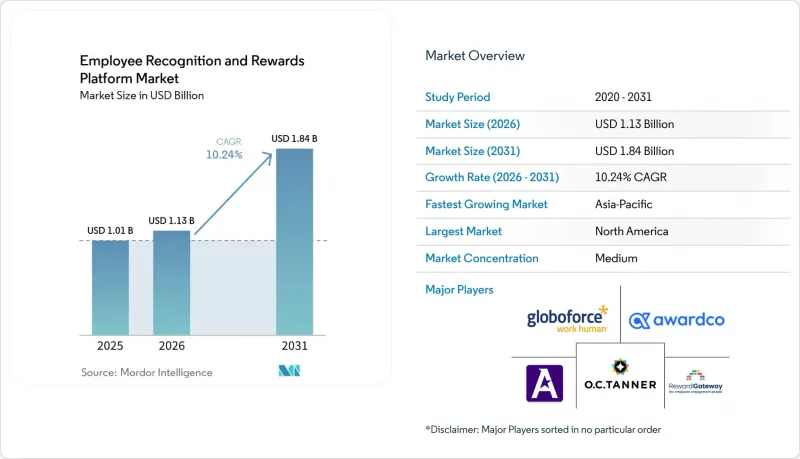
Mordor Intelligence에 의하면, 직원 포상 및 보상 플랫폼 시장 규모는 2025년에 10억 1,000만 달러로 평가되었고, 2026년에 11억 3,000만 달러로 추정되며, 2031년까지 18억 4,000만 달러에 이를 것으로 예측됩니다.
2026-2031년 연평균 성장률(CAGR) 10.24%로 성장할 것으로 전망됩니다.
본 보고서는 구성 요소별(소프트웨어 및 플랫폼, 서비스), 배포 방식별(클라우드 기반, 온프레미스, 하이브리드), 기업 규모별(대기업, 중소기업), 최종 사용자 산업별(은행, 금융서비스 및 보험(BFSI), 의료 및 생명과학, IT 및 통신, 기타), 지역별로 분류되어 있습니다. 시장 전망은 금액(달러) 기준으로 제시되어 있습니다.
세계 직원 포상 및 보상 플랫폼 시장 동향과 고찰
자발적 이직과 번아웃을 줄여야 할 필요성이 커지고 있습니다.
직원 이직률은 직원 포상 및 보상 플랫폼 시장에서 여전히 가장 뚜렷한 수요 견인 요인으로 작용하고 있습니다. 이는 조직이 표창의 질과 정착률이라는 성과를 보다 직접적으로 연결할 수 있게 되었기 때문입니다. 갤럽은 2024년 9월, 5가지 전략적 핵심 요소 중 최소 4가지를 충족하는 표창을 받은 직원은 수준이 낮은 표창을 받은 직원에 비해 적극적으로 이직 활동을 할 가능성이 65% 낮다고 보고했습니다. 또한 갤럽과 워크휴먼은 직원 1만 명 규모의 조직에서 주간 표창 빈도를 2배로 늘릴 경우, 연간 1,610만 달러의 이직 비용 절감, 9,190만 달러의 생산성 향상, 그리고 380만 달러의 결근률 감소를 가져올 수 있음을 밝혔습니다. 이 조사에 따르면, 적절하게 표창을 받은 직원의 번아웃 발생 확률이 최대 90%까지 낮아지는 것으로 나타났으며, 이는 표창이 직원 이직률과 건강 모두와 관련이 있음을 시사합니다. O.C. Tanner는 2026년 3월, 종합적인 평가를 받은 직원의 경우 1년 더 재직할 계획이 있을 확률이 26배 더 높다고 보고했으며, 이를 통해 인사 부서는 재무 책임자와의 ROI(투자 수익률) 관련 논의에서 보다 탄탄한 근거를 확보하게 되었습니다. 그 결과, 직원 포상 및 보상 플랫폼 시장은 평가 프로그램이 단순한 문화적 활동이 아니라 인재 유지를 위한 인프라로 평가받게 된 변화의 혜택을 누리고 있습니다.
하이브리드 근무 및 현장 직원 확대
근무 방식은 이제 더욱 세분화되고 있으며, 이로 인해 직원 포상 및 보상 플랫폼 시장의 설계와 판매 방식이 변화하고 있습니다. 갤럽의 보고서에 따르면, 2025년 3월 기준으로 완전 원격 근무자의 57%와 하이브리드 근무자의 57%가 적극적으로 이직처를 찾고 있었던 반면, 완전 출근 근무자는 45%에 그쳤습니다. 이러한 격차로 인해 고용주들은 분산된 팀 전체에서 표창을 보다 가시화하고, 물리적 근접성에 의존하지 않는 도구를 찾게 되었습니다. 각 벤더사는 모바일 우선 제품 설계, 오프라인 환경에서도 이용하기 쉬운 접근성, 그리고 하루 종일 데스크톱 생산성 향상 도구를 사용하지 않는 직원을 위한 간소화된 워크플로를 제공함으로써 이러한 요구에 부응하고 있습니다. O.C. Tanner사에 따르면, 2026년 1분기에 실시한 ‘Culture Cloud’ 모바일 앱의 기능 강화 덕분에 2026년 1월 기준으로 항공, 금융, 소프트웨어 각 분야의 고객사 기업에서 사용자 참여도가 200% 이상 증가했다고 합니다. 이 점이 중요한 이유는 직원 포상 및 보상 플랫폼 시장에서 플랫폼이 사무실 근무 직원과 동등한 일관성을 유지하며 현장 직원이나 교대 근무 직원에게 효과적으로 다가갈 수 있는지 여부가 점점 더 중요한 요소로 대두되고 있기 때문입니다.
예산 검토와 ROI 귀속 압박
재무 부서가 직원 포상 및 보상에 대한 지출이 이직률 감소와 생산성 향상으로 이어진다는 증거를 점점 더 요구하고 있기 때문에 예산 승인은 여전히 직원 포상 및 보상 플랫폼 시장에서 가장 뚜렷한 장벽 중 하나로 남아 있습니다. HiBob은 2026년 5월, 조사 대상인 인사 담당자의 60%가 단일 의사결정을 위해 기본적인 직원 데이터 수집에 3시간 이상을 소비하는 반면, 통합된 인사·재무 대시보드에 접근할 수 있는 사람은 고작 2%에 불과하다고 보고했습니다. 이 차이가 중요한 이유는 포상 프로그램의 경우 이직률이나 결근률의 변화가 통계적으로 신뢰할 수 있는 수준이 되기까지 6-12개월이 소요되는 경우가 많은 반면, 예산 주기에서는 일반적으로 더 신속한 타당성 입증이 요구되기 때문입니다. 인사 부서가 표창에 드는 비용과 업무 성과 사이에 명확한 연관성을 입증하지 못할 경우, 표창 제도는 업무상 필수적인 것이 아니라 어디까지나 ‘임의적인’ 것으로 간주되기 쉽습니다. 따라서 구매 담당자들은 실시간 대시보드, 더욱 강력한 측정 프레임워크, 그리고 보다 명확한 성과 보고서를 제공하는 공급업체를 선호하는 경향이 있습니다. 이러한 압박은 직원 포상 및 보상 플랫폼 시장 수요를 저해하지는 않지만, 조달이나 계약 갱신 시 공급업체가 충족해야 하는 기준을 높이는 요인이 되고 있습니다.
부문별 분석
2025년, 소프트웨어/플랫폼은 직원 포상 및 보상 플랫폼 시장의 69.42% 점유율을 차지했으며, 이는 지속적인 SaaS 제공이 여전히 이 부문의 상업적 핵심임을 뒷받침하고 있습니다. 이러한 주도적 지위는 기업들이 대규모 직원 기반 전반에 걸쳐 표창 워크플로우, 보고서 작성, 보상 관리를 확장할 수 있는 표준화된 플랫폼 계층을 선호하는 경향을 반영하고 있습니다. Awardco는 기존 시상 시스템에 모듈식 직원 의견 수렴 기능, AI 기반 분석, 마켓플레이스의 개인화 기능, 그리고 더욱 광범위한 워크플로우 유연성을 추가한 ‘Awardco 2.0’의 재설계를 통해 이 모델을 강화했습니다. 이러한 움직임은 벤더가 단일 플랫폼 라이선스로 대응할 수 있는 이용 사례의 수를 확대함으로써 소프트웨어 수익을 확보하고 있음을 보여줍니다. 직원 포상 및 보상 플랫폼 업계에서 소프트웨어가 여전히 핵심 제품으로 자리매김하고 있는 이유는 이 소프트웨어가 표창 데이터, 사용자 접근, 그리고 광범위한 HR 스택과의 통합을 뒷받침하고 있기 때문입니다.
서비스 부문은 가장 빠르게 성장하고 있는 분야이며, 직원 포상 및 보상 플랫폼 시장의 서비스 규모는 2031년까지 연평균 성장률(CAGR) 12.12%로 확대될 것으로 전망됩니다. 이러한 성장은 단순한 운영상의 과제와 밀접한 관련이 있습니다. 많은 조직이 소프트웨어를 신속하게 도입할 수는 있지만, 배포 설계, 행동 변화의 정착, 거버넌스, 그리고 도입 후 최적화에 대해서는 여전히 지원이 필요하기 때문입니다. 프로그램이 여러 국가에 걸쳐 운영되면서 지역별 보상 체계, 세제, 급여 처리에 대한 대응이 필요해짐에 따라 관리형 도입의 가치가 높아지고 있습니다. 또한, 구매자들은 시상 활동을 도입 후 관리직과 직원들이 실제로 활용할 수 있는 정착 계획으로 구체화할 수 있도록 지원해 줄 것을 요구하고 있어, 해당 서비스에 대한 수요도 증가하고 있습니다. 직원 포상 및 보상 플랫폼 시장이 확대됨에 따라, 해당 서비스는 소프트웨어의 핵심적인 역할을 대체하기보다는 기업의 복잡성에 맞추어 그 규모를 확장하고 있습니다.
2025년에는 직원 포상 및 보상 플랫폼 시장의 71.18%를 클라우드 기반 서비스가 차지한 것으로 평가되었으며, 이는 기업용 HR 애플리케이션 전반에 걸쳐 SaaS 제공 방식으로의 광범위한 전환을 반영한 것입니다. 현재 많은 표창 행사가 Microsoft Teams나 Workday와 같은 도구 내에서 이루어지고 있으며, 이들 모두 이미 클라우드 네이티브 환경으로 운영되고 있기 때문에 클라우드에는 분명한 이점이 있습니다. 이 모델은 제품 업데이트 속도 향상, 원격 액세스 용이화, 분산된 직원 대상 배포 간소화도 지원합니다. 내부 감사 관리 및 데이터 주권에 관한 규제로 인해 완전한 클라우드 도입이 제한되는 일부 정부 기관, 국방 기관 및 금융 업계에서는 온프레미스형 도입이 여전히 중요하게 여겨지고 있습니다. 그럼에도 불구하고, 직원 포상 및 보상 플랫폼 시장에서는 현대 HR 소프트웨어 구매자들의 운영 방식에 부합하는 ‘클라우드 우선’ 솔루션이 계속해서 지지를 받고 있습니다.
하이브리드 방식은 가장 빠르게 성장하고 있는 형태로, 2031년까지 연평균 성장률(CAGR)이 13.42%를 나타낼 것으로 전망됩니다. 이는 대기업들이 클라우드 협업 도구와 온프레미스 HRIS(인사 정보 시스템) 및 급여 계산 시스템을 연동하려고 하기 때문입니다. 이는 특히 일부 관할 구역에서 여전히 현지 데이터 처리가 의무화되어 있는 다국적 기업, 구형 핵심 시스템이 아직 완전히 클라우드로 이전되지 않은 기업에서 흔히 볼 수 있습니다. Semos Cloud는 필요한 직원 필드만 동기화하고, 전송 시 TLS 1.2 이상을, 저장된 데이터에는 AES-256 암호화를, API 인증에는 OAuth 2.0을 채택한 멀티 환경 아키텍처를 제시함으로써, 하이브리드 설계가 속도와 제어의 균형을 어떻게 맞추고 있는지를 보여주고 있습니다. 직원 포상 및 보상 플랫폼 업계에서 하이브리드형 성장 양상은 클라우드를 거부하고 있다는 것보다는 기업 아키텍처의 변화가 해당 제품의 혁신보다 뒤처지고 있음을 나타내는 징후라고 할 수 있습니다.
지역별 분석
2025년, 북미는 직원 포상 및 보상 플랫폼 시장의 38.77%를 차지했으며, 매출 측면에서 가장 큰 기여를 한 지역이 되었습니다. 이 지역은 HR 기술 예산이 더욱 성숙해졌으며, 자발적 이직이 경영진에 의해 면밀히 주시되고 있고, 이 분야에서 가장 유력한 벤더 중 일부가 이 지역에 거점을 두고 있다는 점 때문에 계속해서 수요의 중심지로 자리 잡고 있습니다. 미국 노동통계국의 보고서에 따르면, 2026년 2월 자발적 이직자 수는 300만 명에 달했으며, 이로 인해 인재 유지 비용이 여전히 문제로 대두되면서, 표창과 연계된 직원 대상 프로그램에 대한 지속적인 관심을 촉진했습니다. 캐나다 역시 이러한 성장에 기여하고 있으며, 특히 소매 및 엔터테인먼트 업계에서는 AI를 활용한 포상 프로그램이 고객 경험 향상과 연계되고 있습니다. Achievers에 따르면, Cineplex는 자사의 플랫폼을 활용하여 전체 매장의 45%에서 순추천지수(NPS)를 향상시켰습니다고 합니다. 이는 해당 지역에서 표창이 현장의 서비스 성과와 어떻게 연계되어 있는지를 보여줍니다.
아시아태평양은 직원 포상 및 보상 플랫폼 시장에서 2031년까지 연평균 성장률(CAGR) 14.31%라는 가장 높은 성장률을 기록하며 확대될 것으로 전망됩니다. 이러한 성장은 기업의 디지털화, 현장 직원 수 증가, 그리고 인도, 중국, 동남아시아 등 대규모 노동 시장에서 직원들의 기대감이 높아짐에 따라 주도되고 있습니다. 인도와 한국은 고용주들이 앱 기반의 표창 및 협업 기능을 갖춘 도구와 대규모 분산형 팀에 적합한 지역 맞춤형 보상 옵션을 도입하고 있어, 가장 큰 시장 규모를 가진 기회를 지니고 있습니다. 중국은 여전히 매력적인 시장이지만, 데이터 소재지 관련 요건과 국경을 넘는 이용 약관이 전 세계 플랫폼의 운영과 확장을 제한할 가능성이 있어 상황이 더욱 복잡해졌습니다.
2025년 기준으로 유럽은 지역별 점유율에서 2위를 차지했으며, 독일, 영국, 프랑스는 직원 포상 및 보상 플랫폼 시장에서 가장 확고한 국가별 시장을 형성하고 있습니다. GDPR(EU 개인정보보호규정)은 다른 대부분의 지역보다 유럽의 플랫폼 설계에 더 큰 영향을 미치고 있으며, 명확한 동의 기록, 설정 가능한 데이터 저장 위치, 그리고 직원 데이터 전송을 최소화할 수 있는 공급업체에 유리하게 작용하고 있습니다. 남미는 여전히 개발도상 시장이지만, 브라질과 아르헨티나에서는 서비스업 종사자가 많고 데스크톱 접속 환경이 고르지 않은 지역에서 모바일 우선 도구의 이용이 확대되고 있어, 도입이 진행되고 있습니다. 중동 및 아프리카는 현재로서는 시장 규모가 작지만, 사우디아라비아와 아랍에미리트에서는 공공기관이나 호텔 및 관광업계의 고용주들이 직원 표창 프로그램을 공식적으로 도입하는 움직임이 나타나면서 수요가 증가하고 있습니다.
기타 혜택 :
- Excel 형식 시장 예측(ME) 시트
- 3개월간의 애널리스트 지원
자주 묻는 질문
목차
제1장 서론
제2장 분석 방법
제3장 주요 요약
제4장 시장 구도
제5장 시장 규모 및 성장률 예측
제6장 경쟁 구도
제7장 시장 기회 및 향후 전망
AJY 26.06.26According to Mordor Intelligence, the employee recognition and rewards platform market size is projected to be USD 1.01 billion in 2025, USD 1.13 billion in 2026, and reach USD 1.84 billion by 2031, growing at a CAGR of 10.24% from 2026 to 2031.
This report is Segmented by Component (Software/Platform, and Services), Deployment Mode (Cloud-Based, On-Premises, and Hybrid), Enterprise Size (Large Enterprises, and Small and Medium-Sized Enterprises), End-User Industry (BFSI, Healthcare and Life Sciences, Information Technology and Telecom, and More), and Geography. The Market Forecasts are Provided in Terms of Value (USD).
Global Employee Recognition And Rewards Platform Market Trends and Insights
Rising Need To Reduce Voluntary Attrition And Burnout
Employee turnover remains the clearest demand driver in the employee recognition and rewards platform market because organizations can now connect recognition quality more directly to retention outcomes. Gallup reported in September 2024 that employees who received recognition that met at least 4 of 5 strategic pillars were 65% less likely to be actively job hunting than those who received lower-quality recognition. Gallup and Workhuman also found that in a 10,000-person organization, doubling weekly recognition frequency can produce USD 16.1 million in annual turnover cost avoidance, USD 91.9 million in productivity gains, and USD 3.8 million in lower absenteeism. The same research showed that adequately recognized employees were up to 90% less likely to report burnout, suggesting that recognition is relevant to both retention and workforce health. O.C. Tanner reported in March 2026 that employees receiving integrated recognition had 26 times the odds of planning to stay another year, providing HR teams with a stronger basis for ROI discussions with finance leaders. As a result, the employee recognition and rewards platform market is benefiting from a shift where recognition programs are being evaluated less as culture initiatives and more as retention infrastructure.
Expansion Of Hybrid And Frontline Workforces
Work patterns are now more fragmented, and that is changing how the employee recognition and rewards platform market is designed and sold. Gallup reported that in March 2025, 57% of exclusively remote workers and 57% of hybrid workers were actively watching for new jobs, compared with 45% of fully on-site employees. That gap has pushed employers to look for tools that make recognition more visible across distributed teams and less dependent on physical proximity. Vendors are responding with mobile-first product design, offline-friendly access, and simpler workflows for workers who do not spend the day inside desktop productivity tools. O.C. Tanner said its Q1 2026 Culture Cloud mobile app enhancements drove more than 200% growth in user engagement among client organizations in the airline, financial, and software sectors during January 2026. This matters because the employee recognition and rewards platform market is increasingly shaped by whether platforms can reach frontline and shift-based workers with the same consistency as office staff.
Budget Scrutiny And ROI Attribution Pressure
Budget approval remains one of the clearest barriers in the employee recognition and rewards platform market, as finance teams increasingly want proof that recognition spending drives changes in retention and productivity outcomes. HiBob said in May 2026 that 60% of surveyed people managers spent 3 or more hours gathering basic workforce data for a single decision, while only 2% had access to a unified HR and finance dashboard. That gap matters because recognition programs often need 6 to 12 months before changes in retention or absenteeism become statistically credible, yet budget cycles usually require faster justification. When HR teams cannot demonstrate clear links between recognition spend and labor outcomes, recognition tools are more likely to be classified as optional rather than operational. Buyers are therefore leaning toward vendors that provide real-time dashboards, stronger measurement frameworks, and clearer outcome reporting. This pressure does not stop demand in the employee recognition and rewards platform market, but it does raise the standard for what vendors must prove during procurement and renewal.
Other drivers and restraints analyzed in the detailed report include:
- Mainstreaming Of Cloud-Native HR Technology Stacks
- Deeper Integration With Collaboration And HRIS Workflows
- Integration Complexity Across Legacy HR Systems
For complete list of drivers and restraints, kindly check the Table Of Contents.
Segment Analysis
Software/platform held 69.42% of the employee recognition and rewards platform market share in 2025, which confirms that recurring SaaS delivery remains the commercial core of the category. That leadership reflects enterprises' preference for a standardized platform layer that can scale recognition workflows, reporting, and reward administration across large employee populations. Awardco reinforced this model through its Awardco 2.0 redesign, which added modular employee listening, AI-based analytics, marketplace personalization, and broader workflow flexibility to the existing recognition engine. Moves like this show how vendors are protecting software revenue by widening the number of use cases served from a single platform seat. In the employee recognition and rewards platform industry, software remains the core product because it anchors recognition data, user access, and integration with the wider HR stack.
Services is the fastest-growing component, with the employee recognition and rewards platform market size for services projected to expand at a 12.12% CAGR through 2031. That growth is tied to a simple operational issue because many organizations can buy software quickly but still need help with rollout design, behavioral adoption, governance, and post-launch optimization. Managed implementation has become more valuable as programs move across multiple countries and must account for localized reward catalogs, tax rules, and payroll treatment. Services demand is also rising because buyers want help translating recognition activity into adoption plans that managers and employees will actually use after launch. As the employee recognition and rewards platform market expands, services are scaling with enterprise complexity rather than replacing the central role of software.
Cloud-based deployment accounted for 71.18% of the employee recognition and rewards platform market in 2025, reflecting the broader shift toward SaaS delivery across enterprise HR applications. Cloud has a clear advantage because many recognition moments now happen inside tools like Microsoft Teams and Workday, both of which already operate as cloud-native environments. This model also supports faster product updates, easier remote access, and simpler rollout across dispersed workforces. On-premises deployment still matters in some government, defense, and financial environments where internal audit control or data sovereignty rules limit full cloud adoption. Even so, the employee recognition and rewards platform market continues to favor cloud-first solutions because they align with the operational patterns of modern HR software buyers.
Hybrid deployment is the fastest-growing mode, with a 13.42% CAGR through 2031, as large employers seek to connect cloud collaboration tools with on-premises HRIS and payroll systems. This is especially common in multinational enterprises where some jurisdictions still require local data handling or where legacy core systems have not yet moved fully to the cloud. Semos Cloud has outlined a multi-environment architecture that syncs only the required employee fields, uses TLS 1.2+ for transfers, AES-256 data encryption at rest, and OAuth 2.0 API authentication, reflecting how the hybrid design balances speed and control. In the employee recognition and rewards platform industry, hybrid growth is less a rejection of the cloud than a sign that enterprise architecture changes more slowly than recognition product innovation.
Geography Analysis
North America held 38.77% of the employee recognition and rewards platform market in 2025, making it the largest regional contributor to revenue. The region remains the center of demand because HR technology budgets are more mature, voluntary attrition is closely watched by leadership teams, and several of the category's best-known vendors are based there. The U.S. Bureau of Labor Statistics reported 3.0 million voluntary quits in February 2026, which kept retention costs visible and supported ongoing interest in recognition-linked employee programs. Canada is also contributing to growth, especially in retail and entertainment, where AI-supported recognition programs are being linked to customer experience improvement. Achievers noted that Cineplex used its platform to improve Net Promoter Scores at 45% of locations, which shows how recognition is being connected with front-line service outcomes in the region.
Asia-Pacific is forecast to grow at the fastest CAGR of 14.31% through 2031 in the employee recognition and rewards platform market. Growth is being driven by enterprise digitalization, the size of frontline workforces, and rising employee expectations in large labor markets such as India, China, and Southeast Asia. India and South Korea are among the strongest volume opportunities because employers are adopting app-based recognition, collaboration-native tools, and localized reward options that fit large distributed teams. China remains attractive but more complex because data residency expectations and cross-border redemption rules can limit how global platforms operate or scale.
Europe held the second-largest regional share in 2025, with Germany, the United Kingdom, and France representing the most established country markets in the employee recognition and rewards platform market. GDPR has had a stronger effect on platform design in Europe than in most other regions, which favors vendors that can offer clear consent trails, configurable data residency, and minimal employee data transfer. South America is still an earlier-stage market, but Brazil and Argentina are supporting adoption through large service-sector workforces and growing use of mobile-first tools where desktop access is uneven. The Middle East and Africa remains a smaller opportunity set today, although Saudi Arabia and the United Arab Emirates are showing stronger demand from public-sector bodies and hospitality employers that are formalizing workforce recognition programs.
- Globoforce, Inc. d/b/a Workhuman
- Awardco, Inc.
- O.C. Tanner Company
- Achievers Solutions Inc.
- Reward Gateway UK Limited
- Motivosity Inc.
- Kudos, Inc.
- Terryberry Company, LLC
- Smartly, Inc. d/b/a Bonusly
- PerkCity, Inc. d/b/a Nectar HR
- The Guusto Gifts Inc.
- Bucketlist Rewards Inc.
- Vantage Circle Technologies Pvt. Ltd
- Advantage Club Technologies Private Limited
- Workstars Global Ltd.
- Rewardian LLC
- Friendefi Inc. d/b/a Qarrot
- MatterApp, Inc.
- Engagedly Inc
- Emgage Private Limited
Additional Benefits:
- The market estimate (ME) sheet in Excel format
- 3 months of analyst support
TABLE OF CONTENTS
1 INTRODUCTION
- 1.1 Study Assumptions and Market Definition
- 1.2 Scope of the Study
2 RESEARCH METHODOLOGY
3 EXECUTIVE SUMMARY
4 MARKET LANDSCAPE
- 4.1 Market Overview
- 4.2 Market Drivers
- 4.2.1 Rising Need to Reduce Voluntary Attrition and Burnout
- 4.2.2 Expansion of Hybrid and Frontline Workforces
- 4.2.3 Mainstreaming of Cloud-Native HR Technology Stacks
- 4.2.4 Deeper Integration With Collaboration and HRIS Workflows
- 4.2.5 Growing Use of Recognition Data in Human Capital Reporting
- 4.2.6 Expansion of Localized Global Reward Catalogs
- 4.3 Market Restraints
- 4.3.1 Budget Scrutiny and ROI Attribution Pressure
- 4.3.2 Integration Complexity Across Legacy HR Systems
- 4.3.3 Cross-Border Tax and Reward Fulfillment Complexity
- 4.3.4 Recognition Fatigue and AI Governance Risks
- 4.4 Industry Value Chain Analysis
- 4.5 Regulatory Landscape
- 4.6 Technological Outlook
- 4.7 Impact of Macroeconomic Factors on the Market
- 4.8 Porter's Five Forces Analysis
- 4.8.1 Bargaining Power of Buyers
- 4.8.2 Bargaining Power of Suppliers
- 4.8.3 Threat of New Entrants
- 4.8.4 Threat of Substitutes
- 4.8.5 Intensity of Competitive Rivalry
5 MARKET SIZE AND GROWTH FORECASTS (VALUE)
- 5.1 By Component
- 5.1.1 Software/Platform
- 5.1.2 Services
- 5.2 By Deployment Mode
- 5.2.1 Cloud-Based
- 5.2.2 On-Premises
- 5.2.3 Hybrid
- 5.3 By End User Enterprise Size
- 5.3.1 Large Enterprises
- 5.3.2 Small and Medium-Sized Enterprises
- 5.4 By End User Industry
- 5.4.1 BFSI
- 5.4.2 Healthcare and Life Sciences
- 5.4.3 Information Technology and Telecom
- 5.4.4 Retail and E-commerce
- 5.4.5 Industrial Manufacturing
- 5.4.6 Government and Public Sector
- 5.5 By Geography
- 5.5.1 North America
- 5.5.1.1 United States
- 5.5.1.2 Canada
- 5.5.1.3 Mexico
- 5.5.2 South America
- 5.5.2.1 Brazil
- 5.5.2.2 Argentina
- 5.5.2.3 Rest of South America
- 5.5.3 Europe
- 5.5.3.1 Germany
- 5.5.3.2 United Kingdom
- 5.5.3.3 France
- 5.5.3.4 Italy
- 5.5.3.5 Spain
- 5.5.3.6 Russia
- 5.5.3.7 Netherlands
- 5.5.3.8 Rest of Europe
- 5.5.4 Asia-Pacific
- 5.5.4.1 China
- 5.5.4.2 Japan
- 5.5.4.3 India
- 5.5.4.4 South Korea
- 5.5.4.5 Australia and New Zealand
- 5.5.4.6 Rest of Asia-Pacific
- 5.5.5 Middle East
- 5.5.5.1 Saudi Arabia
- 5.5.5.2 United Arab Emirates
- 5.5.5.3 Rest of Middle East
- 5.5.6 Africa
- 5.5.6.1 South Africa
- 5.5.6.2 Nigeria
- 5.5.6.3 Rest of Africa
- 5.5.1 North America
6 COMPETITIVE LANDSCAPE
- 6.1 Market Concentration
- 6.2 Strategic Moves
- 6.3 Market Share Analysis
- 6.4 Company Profiles (includes Global Level Overview, Market Level Overview, Core Segments, Financials as available, Strategic Information, Market Rank/Share, Products and Services, Recent Developments).
- 6.4.1 Globoforce, Inc. d/b/a Workhuman
- 6.4.2 Awardco, Inc.
- 6.4.3 O.C. Tanner Company
- 6.4.4 Achievers Solutions Inc.
- 6.4.5 Reward Gateway UK Limited
- 6.4.6 Motivosity Inc.
- 6.4.7 Kudos, Inc.
- 6.4.8 Terryberry Company, LLC
- 6.4.9 Smartly, Inc. d/b/a Bonusly
- 6.4.10 PerkCity, Inc. d/b/a Nectar HR
- 6.4.11 The Guusto Gifts Inc.
- 6.4.12 Bucketlist Rewards Inc.
- 6.4.13 Vantage Circle Technologies Pvt. Ltd
- 6.4.14 Advantage Club Technologies Private Limited
- 6.4.15 Workstars Global Ltd.
- 6.4.16 Rewardian LLC
- 6.4.17 Friendefi Inc. d/b/a Qarrot
- 6.4.18 MatterApp, Inc.
- 6.4.19 Engagedly Inc
- 6.4.20 Emgage Private Limited
7 MARKET OPPORTUNITIES AND FUTURE OUTLOOK
- 7.1 White-space and Unmet-Need Assessment


