

|
시장보고서
상품코드
2064399
발포성 포장 시장 : 점유율 분석, 업계 동향과 통계, 성장 예측(2026-2031년)Effervescent Packaging - Market Share Analysis, Industry Trends & Statistics, Growth Forecasts (2026 - 2031) |
||||||
 Mordor Intelligence
Mordor Intelligence에 의하면, 발포성 포장 시장 규모는 2025년에 6억 4,798만 달러, 2026년에 6억 9,313만 달러, 2031년까지 9억 5,571만 달러에 이를 것으로 예측되며, 2026년부터 2031년까지 CAGR 6.64%로 성장할 전망입니다.
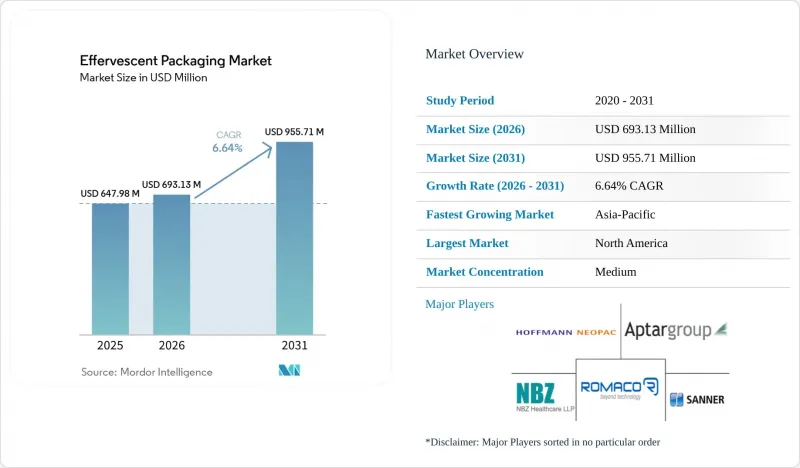
본 보고서는 포장 형태(튜브, 블리스터, 소포장 및 스틱팩, 병 및 캐니스터, 스트립 팩), 소재 유형(플라스틱, 알루미늄, 유리, 종이 등), 제품 형태(정제, 분말, 과립), 최종 사용자 산업(식품 및 음료, 뉴트라슈티컬 및 영양 보조 식품, 가정용품 등), 그리고 지역별로 분류되어 있습니다. 시장 전망은 금액(달러) 기준으로 제시되어 있습니다.
세계 발포성 포장 시장 동향 및 인사이트
발포성 일반의약품 및 건강기능식품 소비 확대
발포성 포장 시장은 건강기능식품 및 일반의약품(OTC) 분야에서 빠르게 용해되어 복용하기 더 쉬운 제형으로의 뚜렷한 전환의 혜택을 누리고 있습니다. 기존 정제를 삼키기 어려운 이용 사례에서는 환자들이 여전히 발포성 제제를 선호하는 경향이 강하며, 이것이 특수 튜브, 블리스터, 소포장에 대한 지속적인 수요를 뒷받침하고 있습니다. 『RSC Pharmaceutics』지에 게재된 동료 심사 논문에 따르면, 파라세타몰, 아스피린, 비타민제의 발포제 제형은 흡수가 빠르고 환자들로부터도 높은 지지를 받고 있는 것으로 보고되어, 발포제 포장 시장에서 이 제형의 지속적인 채택을 뒷받침하고 있습니다. 또한, 브랜드 소유사는 발포제 제품 라인을 인접한 웰니스 분야로까지 확대하고 있으며, 이에 따라 발포제 포장 시장의 고객 기반은 기존의 약국 수요를 넘어 확장되고 있습니다. 이러한 변화는 중요한 의미를 지닙니다. 왜냐하면 이러한 제품들이 규제가 엄격한 유통 채널이나 약국 주도의 유통 채널에 진출하면, 대개 그에 따라 포장 규격도 더욱 엄격해지기 때문입니다. 그 결과, 발포제 포장 시장은 수량과 금액 양면에서 성장하고 있으며, 조달 동향은 고성능이면서 외관을 고려한 포장 형태로 전환되고 있습니다.
방습 튜브, 블리스터, 건조제가 포함된 캡에 대한 수요 증가
발포성 제제의 포장 시장은 제품의 반응성으로 인해 안정성이 습도에 매우 민감하기 때문에 강력한 방습 성능에 의존하고 있습니다. 이에 따라 컨버터와 브랜드 소유주들은 건조제 캡이 일체형으로 설계된 튜브나, 더욱 신뢰할 수 있는 차단 성능을 발휘할 수 있는 블리스터 구조로 전환하고 있습니다. 의약품 포장에 관한 업계 보고서에 따르면, 일체형 건조제 시스템은 포장 구조를 단순화하고 흡습재가 환자와 직접 접촉하는 것을 방지할 수 있어 점차 널리 채택되고 있습니다. 실용적인 관점에서 볼 때, 이는 발포성 제제의 포장 시장에서 가치 제안을 변화시키는 요소입니다. 왜냐하면 검증된 캡의 성능이 재료 선택만큼이나 중요하기 때문입니다. 남아시아 및 동남아시아의 고습도 시장에서도 냉간 성형 알루미늄 포장에 대한 프리미엄 수요가 증가하고 있으며, 이 지역에서는 방습성이 종종 필수 요건으로 간주되고 있습니다. 또한, 스마트 흡습제 기술도 인증 절차를 밟고 있어, 발포성 제제의 포장 시장이 수동적인 밀봉 방식에서 보다 능동적인 보호 시스템으로 전환되고 있음을 보여줍니다.
차단성이 뛰어난 소재 및 건조제 성분의 높은 비용
발포성 포장 시장은 여전히 고품질 차단재와 특수 건조제 성분의 높은 비용 문제에 직면해 있습니다. 이는 의약품 등급의 보호가 필요하지만 대규모 구매자와 같은 규모의 경제를 누릴 수 없는 중규모 영양보조식품 및 소비자 건강 브랜드에게는 특히 어려운 상황입니다. 무역 보고서에 따르면, 2025년 중반까지 미국의 제232조에 따른 알루미늄 관세가 50%에 달하게 되어, 이로 인해 포장용 알루미늄의 납품 비용이 급격히 상승했습니다. 또한 2026년 보고서에 따르면, 미국 중서부 지역의 알루미늄 지역 프리미엄이 1파운드당 1달러를 넘어섰다는 사실이 밝혀졌는데, 이는 비철금속의 가격 변동 위험을 헤지하고 있다 하더라도 지역 프리미엄이 비용 압박을 더욱 가중시킬 가능성이 있음을 뒷받침하고 있습니다. 이로 인해 소규모 변환업체들은 발포성 포장 시장에서 불리한 입장에 놓이게 될 것입니다. 왜냐하면 그들은 원자재 비용 상승과 이익률 회복을 위한 험난한 여정이라는 두 가지 과제에 직면해 있기 때문입니다. 또한, 이는 발포성 포장 시장에서의 업계 재편을 촉진하는 요인이 될 것입니다. 왜냐하면 대규모 통합형 기업이 조달 리스크, 배합 변경 비용, 그리고 장기화되는 고객 인증 절차의 관리 측면에서 더 유리한 입장에 있기 때문입니다.
부문별 분석
2025년 기준, 발포성 포장 시장에서 튜브 제품의 점유율은 42.71%를 차지했으나, 2031년까지 시장 규모 전망에 따르면 블리스터 포장이 연평균 성장률(CAGR) 7.53%로 확대될 것으로 예측됩니다. 튜브 제품은 소비자에게 친숙할 뿐만 아니라, 건조제가 내장된 캡 기능과 간편한 사용 방법을 모두 갖추고 있어, 발포성 포장 시장의 핵심 제품으로 자리매김하고 있습니다. 이 구조는 여러 회분의 보관과 습기 관리를 동일한 패키지 내에서 실현해야 하는 약국, 건강기능식품, 가정용품 유통 채널에서 계속해서 원활하게 작동하고 있습니다. 그러나 블리스터 포장은 새로운 규정 준수 요건 및 복약 순응도 목표에 부합하는 1회 투여 관리, 달력식 관리, 추적성 기능을 지원하기 때문에 발포성 포장 시장에서 빠르게 보급되고 있습니다. 열대 지역이나 습도가 높은 지역에서는 비용 문제보다 차단 성능이 우선시되는 경우, 콜드폼 블리스터 솔루션도 점차 받아들여지고 있습니다.
사셰나 스틱 팩은 휴대성과 1회분 단위의 편의성이 제품 포지셔닝의 핵심이 되는 스포츠용 수분 보충제나 기능성 식품 분야를 통해, 발포성 제제의 포장 시장에 새로운 수요를 창출하고 있습니다. Hermes Pharma사가 검증한, 어린이용 안전 기능과 고령자 배려를 겸비한 스틱팩은 편의성을 중시하는 발포성 포장 시장에서도 보다 공식적인 안전 기준으로의 전환이 진행되고 있음을 보여줍니다. 병, 캐니스터, 스트립팩은 가격 경쟁력, 대용량 충전, 혹은 신흥 시장에서 투여량 확보가 여전히 중요시되는 발포성 포장 시장에서 그 입지를 유지하고 있습니다. 동시에, PPWR(플라스틱 용기 재활용 요건)은 발포성 포장 시장 전반에 걸쳐 포장재 재설계를 촉진하고 있으며, 사나(Sana)사가 출시한 테더가 부착된 캡은 기존 충전 라인을 변경할 필요 없이, 변환업체들이 튜브 형태를 재활용 요건에 부합하도록 조정하고 있음을 보여줍니다.
2025년 현재 알루미늄은 수요의 33.28%를 차지하고 있으며, 이는 블리스터, 스트립 팩, 튜브 구조에 이르는 발포성 포장 시장에서 알루미늄이 확고한 입지를 차지하고 있음을 입증합니다. 제제가 극도로 민감하여 이미 검증된 포장 사양에 얽매여 있는 경우, 알루미늄의 매우 낮은 수분 투과성과 산소 차단성은 다른 소재로는 쉽게 재현할 수 없기 때문에 그 위상은 여전히 확고합니다. 이로 인해 발포성 제제의 포장 시장에서 특히 소재 대체가 쉽지 않은 규제 대상 의약품 용도 분야에서 알루미늄은 구조적인 우위를 점하고 있습니다. 한편, 관세 조치와 지역별 가격 프리미엄으로 인해 비용 측면의 과제가 커지고 있어, 컨버터와 브랜드 소유사의 조달 압박이 커지고 있습니다. 따라서 구매자들이 더 가볍고 재활용성이 높거나 복합 소재를 대체할 대안을 모색하고 있는 상황에서도, 알루미늄은 발포성 포장 업계에서 전략적으로 중요한 위치를 계속 차지하고 있습니다.
발포성 포장 시장에서 플라스틱은 여전히 수량 기준으로 가장 널리 사용되는 소재입니다. 특히 튜브나 병의 경우, 폴리에틸렌이나 폴리프로필렌이 기존 생산 라인의 경제성과 주류 충전 시스템에 적합합니다. PPWR(폴리프로필렌 와이드 리사이클)의 보급으로 인해 단일 소재 플라스틱 구조로의 전환이 가속화되고 있으며, 재활용 가능성이 이전보다 더 직접적으로 소재 선정에 영향을 미치고 있습니다. 종이 소재를 활용한 개발도 진전되고 있으며, 네오팩(Neopac)은 ‘PaperX FiberTop’ 콘셉트를 발표했으며, 몬디(Mondi)는 고차단성 종이가 더욱 복잡한 다중 소재 구조를 대체하기 시작하는 용도를 위해 차단성 종이 생산 능력 확대에 1,600만 유로(1,870만 달러)를 투자했습니다. 콘스탄티아 플렉서블스도 콘스탄티아 타이히 공장의 생산 능력 확장에 5,000만 유로(5,400만 달러)를 투자했습니다. 이는 탄산음료 포장 시장이 공급 확보와 보다 지속 가능한 소재로의 전환을 점진적으로 모색하는 것 사이에서 균형을 잡고 있음을 보여줍니다.
지역별 분석
2025년 기준, 북미는 발포성 포장 시장의 32.74%를 차지했으나, 아시아태평양은 2031년까지의 발포성 포장 시장 규모 전망에서 연평균 성장률(CAGR) 7.89%로 확대될 것으로 예측됩니다. 북미가 발포성 포장 시장을 주도하고 있는 이유는 OTC(일반의약품) 유통망이 확립되어 있고, 브랜드 건강기능식품의 판로가 깊고 체계적이며, 대형 유통점에서 높은 인지도를 자랑하고 있기 때문입니다. 또한, 이 지역은 의약품 포장 분야에서 더 높은 기술 수준을 갖추고 있어, 이를 바탕으로 고도의 블리스터 포장, 스트립 팩, 그리고 건조제 일체형 튜브 형태에 대한 수요가 뒷받침되고 있습니다. 2025년 Sanner사가 노스캐롤라이나주 그린즈버러에 시설을 개설한 것은 미국 내 생산이 지닌 상업적 가치를 반영한 것이며, 리드타임 단축과 관세 위험 감소는 의약품 및 뉴트라슈티컬(영양보조식품) 고객들에게 직접적인 이점이 됩니다. 캐나다와 멕시코는 의약품 제조 및 수출 활동을 통해 지역 내 수요를 더욱 부양하고 있으며, 니어쇼어링 추세가 발포성 포장 시장에서 북미의 전략적 중요성을 유지하는 데 기여하고 있습니다.
유럽은 다른 대부분의 지역에 비해 규제가 포장 디자인에 직접적인 영향을 미치기 때문에 발포성 포장 시장의 주요 중심지로 자리매김하고 있습니다. PPWR(포장재 규제)는 2025년 2월에 발효되며, 2026년 8월부터 적용됩니다. 이는 해당 지역에 서비스를 제공하는 컨버터가 이미 재활용 가능한 설계 목표와 습기 성능 요건 간의 균형을 맞추고 있음을 의미합니다. 독일, 영국, 프랑스, 이탈리아, 스페인이 계속해서 지역 수요를 주도하고 있으며, 그중에서도 독일은 포장 가공 및 의약품 제조의 거점으로 두각을 나타내고 있습니다. 영국에서는 브렉시트 이후의 표시 요건으로 인해 독자적인 규정 준수 요건이 추가됨에 따라, 영국과 EU 양쪽 시장을 모두 공략해야 하는 제품 라인의 경우 그 복잡성이 더욱 커지고 있습니다.
아시아태평양은 발포성 포장 시장에서 가장 빠르게 성장하고 있는 지역 블록입니다. 이는 소득 증가, 도시화, 그리고 건강에 대한 인식 제고가 발포성 제제 제품의 고객 기반을 확대하고 있기 때문입니다. 중국과 인도는 내수 수요의 성장과 대규모 의약품 및 영양보조식품 생산 능력을 모두 갖추고 있어, 발포성 포장 시장에 있어 특히 중요한 시장입니다. 일본과 한국은 보다 성숙한 수요 구조를 보이고 있으며, 더욱 엄격한 품질 기대와 환자 친화적인 제형에 대한 높은 관심을 통해 발포성 포장 시장을 뒷받침하고 있습니다. 중동 및 아프리카 및 남미는 절대적인 규모 면에서는 여전히 작지만, 습한 기후와 확대되는 약국 네트워크 덕분에 발포성 포장 시장에서 높은 차단성과 프리미엄 부가가치를 지닌 제형에 대한 기회가 생겨나고 있습니다.
기타 혜택:
- 엑셀 형식 시장 예측(ME) 시트
- 3개월간의 애널리스트 지원
자주 묻는 질문
목차
제1장 서론
제2장 조사 방법
제3장 주요 요약
제4장 시장 구도
제5장 시장 규모와 성장 예측
제6장 경쟁 구도
제7장 시장 기회와 향후 전망
JHS 26.06.23According to Mordor Intelligence, the effervescent packaging market size is projected to be USD 647.98 million in 2025, USD 693.13 million in 2026, and reach USD 955.71 million by 2031, growing at a CAGR of 6.64% from 2026 to 2031.
This report is Segmented by Packaging Format (Tubes, Blisters, Sachets and Stick Packs, Bottles and Canisters, and Strip Packs), Material Type (Plastic, Aluminum, Glass, Paper, and More), Product Form (Tablets, Powders, and Granules), End-User Industry (Food and Beverage, Nutraceuticals and Dietary Supplements, Household, and More), and Geography. The Market Forecasts are Provided in Terms of Value (USD).
Global Effervescent Packaging Market Trends and Insights
Rising Consumption of Effervescent OTC and Supplement Products
The effervescent packaging market is benefiting from a clear shift toward fast-dissolving, more palatable delivery systems for supplements and over-the-counter products. Patient preference for effervescent formats remains strong in use cases where swallowing conventional tablets is less convenient, and this supports repeat demand for specialized tubes, blisters, and sachets. Peer-reviewed work in RSC Pharmaceutics reported faster absorption and strong patient preference for effervescent forms of paracetamol, aspirin, and vitamins, supporting continued adoption of this format in the effervescent packaging market. Brand owners are also extending effervescent lines into adjacent wellness categories, which broadens the served base of the effervescent packaging market beyond traditional pharmacy demand. This shift matters because once these products move into more regulated or pharmacy-led channels, packaging specifications usually rise with them. The result is that the effervescent packaging market is growing in both volume and value, with procurement moving toward higher-performing, more presentation-sensitive pack formats.
Growing Need for Moisture-Barrier Tubes, Blisters, and Desiccant Closures
The effervescent packaging market relies on strong moisture protection because product reactivity makes stability highly sensitive to humidity. This is pushing converters and brand owners toward tubes with integrated desiccant closures and toward blister structures that can deliver more dependable barrier performance. Industry reports on pharmaceutical packaging indicate that integrated desiccant systems are gaining acceptance because they simplify pack architecture and help keep sorbent material out of direct patient contact. In practical terms, this changes the value proposition in the effervescent packaging market, because validated closure performance becomes as important as material choice. High-humidity markets in South and Southeast Asia also support premium demand for cold-form aluminum-based formats, where moisture protection is often treated as a non-negotiable requirement. Smart sorbent technologies are also entering qualification processes, indicating that the effervescent packaging market is moving beyond passive containment toward more active protection systems.
High Cost of High-Barrier Materials and Desiccant Components
The effervescent packaging market remains exposed to the high cost of premium barrier materials and specialized desiccant components. This is especially difficult for mid-sized nutraceutical and consumer health brands that need pharmaceutical-grade protection but lack the scale advantages of larger buyers. Trade reporting showed that U.S. Section 232 aluminum duties reached 50% by mid-2025, which sharply increased delivered aluminum costs for packaging applications. Additional reporting in 2026 also showed that the U.S. Midwest aluminum premium moved above USD 1 per pound, reinforcing the point that regional premiums can intensify cost pressure even when base metal exposure is hedged. This leaves smaller converters in a weaker position inside the effervescent packaging market, because they face both higher input costs and a tighter path to margin recovery. It also supports consolidation in the effervescent packaging market, as larger integrated players are better placed to manage procurement risk, reformulation costs, and longer customer qualification cycles.
Other drivers and restraints analyzed in the detailed report include:
- Expansion of Sports Hydration and Electrolyte Tablet Formats
- Shift Toward Senior-Friendly and Portable Unit Formats
- Moisture Sensitivity Raising Validation and Product-Failure Risk
For complete list of drivers and restraints, kindly check the Table Of Contents.
Segment Analysis
Tubes held 42.71% of the effervescent packaging market share in 2025, while blisters are projected to advance at an 7.53% CAGR in the effervescent packaging market size outlook through 2031. Tubes remain central to the effervescent packaging market because they combine consumer familiarity with integrated desiccant closure capability and straightforward dispensing. That structure continues to work well in the pharmacy, supplement, and household channels, where multi-dose storage and moisture control must be in the same pack. Blisters, however, are moving faster in the effervescent packaging market because they support unit-dose control, calendarization, and traceability features that fit new compliance expectations and adherence goals. In tropical or high-humidity regions, cold-form blister solutions are also gaining acceptance where barrier performance overrides cost sensitivity.
Sachets and stick packs are adding incremental demand to the effervescent packaging market through sports hydration and functional food applications, where portability and single-serve convenience are central to product positioning. Hermes Pharma's validated child-resistant and senior-friendly stick pack showed that even this convenience-led part of the effervescent packaging market is moving toward more formal safety standards. Bottles, canisters, and strip packs keep a place in the effervescent packaging market where value pricing, larger fills, or emerging-market dose access still matter. At the same time, PPWR is pushing redesign work across the effervescent packaging market, with Sanner's tethered cap launch showing how converters are adapting tube formats to recycling requirements without forcing changes on existing filling lines.
Aluminum held a 33.28% share of demand in 2025, underscoring its strong presence in the effervescent packaging market across blister, strip pack, and tube structures. Its position remains strong because extremely low moisture transmission and oxygen protection are hard to match when formulations are highly sensitive and already tied to validated pack specifications. That creates a structural advantage for aluminum in the effervescent packaging market, especially in regulated pharmaceutical uses where material substitution moves slowly. At the same time, the cost profile has become more challenging due to tariff actions and regional premiums, which have increased sourcing pressure on converters and brand owners. This keeps aluminum strategically important in the effervescent packaging industry even while buyers explore lighter, more recyclable, or mixed-material alternatives.
Plastic remains the most widely used material by volume in the effervescent packaging market, especially in tubes and bottles, where polyethylene and polypropylene fit existing line economics and mainstream filling systems. PPWR is accelerating the shift toward mono-material plastic structures, meaning recyclability is now influencing material choice more directly than before. Paper-based development is also moving forward, with Neopac introducing its PaperX FiberTop concept and Mondi investing EUR 16 million (USD 18.7 million) in barrier paper capacity for applications where high-barrier paper can begin to replace more complex multi-material formats. Constantia Flexibles also invested EUR 50 million (USD 54 million) in capacity expansion at Constantia Teich, which shows that the effervescent packaging market is balancing supply assurance with a gradual search for more sustainable material pathways.
Geography Analysis
North America held 32.74% of the effervescent packaging market share in 2025, while Asia-Pacific is forecast to expand at a 7.89% CAGR in the effervescent packaging market size outlook through 2031. North America leads the effervescent packaging market because its OTC distribution network is well established and its branded supplement channel is deep, organized, and highly visible in mass retail. The region also operates with a higher technical baseline for pharmaceutical packaging, and that supports demand for advanced blister, strip-pack, and desiccant-integrated tube formats. Sanner's opening of its Greensboro, North Carolina, facility in 2025 reflected the commercial value of U.S. local manufacturing, where shorter lead times and reduced tariff exposure can directly matter to pharmaceutical and nutraceutical customers. Canada and Mexico add to regional demand through pharmaceutical manufacturing and export activity, while near-shoring trends are helping North America retain strategic relevance inside the effervescent packaging market.
Europe remains a major center of the effervescent packaging market because regulation affects packaging design more directly there than in most other regions. The PPWR entered into force in February 2025 and applies from August 2026, which means converters serving the region are already balancing recyclable design targets with moisture-performance needs. Germany, the United Kingdom, France, Italy, and Spain continue to shape regional demand, with Germany standing out as a packaging conversion and pharmaceutical manufacturing hub. The United Kingdom adds a distinct layer of compliance through post-Brexit labeling requirements, which increases complexity for product lines that still need to move across both UK and EU settings.
Asia-Pacific is the fastest-growing regional block in the effervescent packaging market because rising incomes, urbanization, and broader health awareness are expanding the customer base for effervescent products. China and India are especially important to the effervescent packaging market because they combine domestic demand growth with large-scale pharmaceutical and nutraceutical manufacturing capacity. Japan and South Korea add a more mature demand profile, but they also support the effervescent packaging market through stricter quality expectations and strong interest in patient-friendly formats. Middle East and Africa and South America remain smaller in absolute size, yet humid climates and widening pharmacy networks create targeted opportunities for high-barrier and premium value-added formats in the effervescent packaging market.
- Sanner GmbH
- Romaco Pharmatechnik GmbH
- NBZ Healthcare LLP
- Gerresheimer AG
- AptarGroup, Inc.
- Constantia Flexibles Group GmbH
- Parekhplast India Limited
- Hoffmann Neopac AG
- Huhtamaki Oyj
- UFlex Limited
- Tekni-Plex, Inc.
- ACG
- ALPLA Werke Alwin Lehner GmbH & Co KG
- Mondi plc
- SCHOTT AG
Additional Benefits:
- The market estimate (ME) sheet in Excel format
- 3 months of analyst support
TABLE OF CONTENTS
1 INTRODUCTION
- 1.1 Study Assumptions and Market Definition
- 1.2 Scope of the Study
2 RESEARCH METHODOLOGY
3 EXECUTIVE SUMMARY
4 MARKET LANDSCAPE
- 4.1 Market Overview
- 4.2 Market Drivers
- 4.2.1 Rising Consumption of Effervescent OTC and Supplement Products
- 4.2.2 Growing Need for Moisture-Barrier Tubes, Blisters, and Desiccant Closures
- 4.2.3 Expansion of Sports Hydration and Electrolyte Tablet Formats
- 4.2.4 Shift Toward Senior-Friendly and Portable Unit Formats
- 4.2.5 EU Recyclability Rules Accelerating Mono-Material Packaging Innovation
- 4.2.6 Smart Traceability and Adherence Features Entering Oral Solid Dose Packs
- 4.3 Market Restraints
- 4.3.1 High Cost of High-Barrier Materials and Desiccant Components
- 4.3.2 Moisture Sensitivity Raising Validation and Product-Failure Risk
- 4.3.3 Fragmented Regulatory and Child-Resistance Requirements
- 4.3.4 Aluminum and Polymer Cost Volatility, Including Tariff Exposure
- 4.4 Industry Value Chain Analysis
- 4.5 Regulatory Landscape
- 4.6 Technological Outlook
- 4.7 Porter's Five Forces Analysis
- 4.7.1 Threat of New Entrants
- 4.7.2 Bargaining Power of Suppliers
- 4.7.3 Bargaining Power of Buyers
- 4.7.4 Threat of Substitutes
- 4.7.5 Competitive Rivalry
5 MARKET SIZE AND GROWTH FORECASTS (VALUE)
- 5.1 By Packaging Format
- 5.1.1 Tubes
- 5.1.2 Blisters
- 5.1.3 Sachets and Stick Packs
- 5.1.4 Bottles and Canisters
- 5.1.5 Strip Packs
- 5.2 By Material Type
- 5.2.1 Plastic
- 5.2.2 Aluminum
- 5.2.3 Glass
- 5.2.4 Paper
- 5.2.5 Other Material Types
- 5.3 By Product Form
- 5.3.1 Tablets
- 5.3.2 Powders
- 5.3.3 Granules
- 5.4 By End-user Industry
- 5.4.1 Food and Beverage
- 5.4.2 Pharmaceuticals
- 5.4.3 Personal Care and Cosmetics
- 5.4.4 Nutraceuticals and Dietary Supplements
- 5.4.5 Household
- 5.4.6 Other End-User Industries
- 5.5 By Geography
- 5.5.1 North America
- 5.5.1.1 United States
- 5.5.1.2 Canada
- 5.5.1.3 Mexico
- 5.5.2 South America
- 5.5.2.1 Brazil
- 5.5.2.2 Argentina
- 5.5.2.3 Rest of South America
- 5.5.3 Europe
- 5.5.3.1 Germany
- 5.5.3.2 United Kingdom
- 5.5.3.3 France
- 5.5.3.4 Italy
- 5.5.3.5 Spain
- 5.5.3.6 Russia
- 5.5.3.7 Rest of Europe
- 5.5.4 Asia-Pacific
- 5.5.4.1 China
- 5.5.4.2 Japan
- 5.5.4.3 South Korea
- 5.5.4.4 India
- 5.5.4.5 Australia and New Zealand
- 5.5.4.6 Rest of Asia-Pacific
- 5.5.5 Middle East and Africa
- 5.5.5.1 Middle East
- 5.5.5.1.1 Saudi Arabia
- 5.5.5.1.2 United Arab Emirates
- 5.5.5.1.3 Turkey
- 5.5.5.1.4 Rest of Middle East
- 5.5.5.2 Africa
- 5.5.5.2.1 South Africa
- 5.5.5.2.2 Nigeria
- 5.5.5.2.3 Rest of Africa
- 5.5.5.1 Middle East
- 5.5.1 North America
6 COMPETITIVE LANDSCAPE
- 6.1 Market Concentration
- 6.2 Strategic Moves
- 6.3 Market Share Analysis
- 6.4 Company Profiles (includes Global level Overview, Market level overview, Core Segments, Financials as available, Strategic Information, Market Rank/Share for key companies, Products and Services, and Recent Developments)
- 6.4.1 Sanner GmbH
- 6.4.2 Romaco Pharmatechnik GmbH
- 6.4.3 NBZ Healthcare LLP
- 6.4.4 Gerresheimer AG
- 6.4.5 AptarGroup, Inc.
- 6.4.6 Constantia Flexibles Group GmbH
- 6.4.7 Parekhplast India Limited
- 6.4.8 Hoffmann Neopac AG
- 6.4.9 Huhtamaki Oyj
- 6.4.10 UFlex Limited
- 6.4.11 Tekni-Plex, Inc.
- 6.4.12 ACG
- 6.4.13 ALPLA Werke Alwin Lehner GmbH & Co KG
- 6.4.14 Mondi plc
- 6.4.15 SCHOTT AG
7 MARKET OPPORTUNITIES AND FUTURE OUTLOOK
- 7.1 White-Space and Unmet-Need Assessment


