

|
시장보고서
상품코드
2064430
미국의 혈액 투석과 복막 투석 시장 : 시장 점유율 분석, 업계 동향 및 통계, 성장 예측(2026-2031년)United States Hemodialysis And Peritoneal Dialysis - Market Share Analysis, Industry Trends & Statistics, Growth Forecasts (2026 - 2031) |
||||||
 Mordor Intelligence
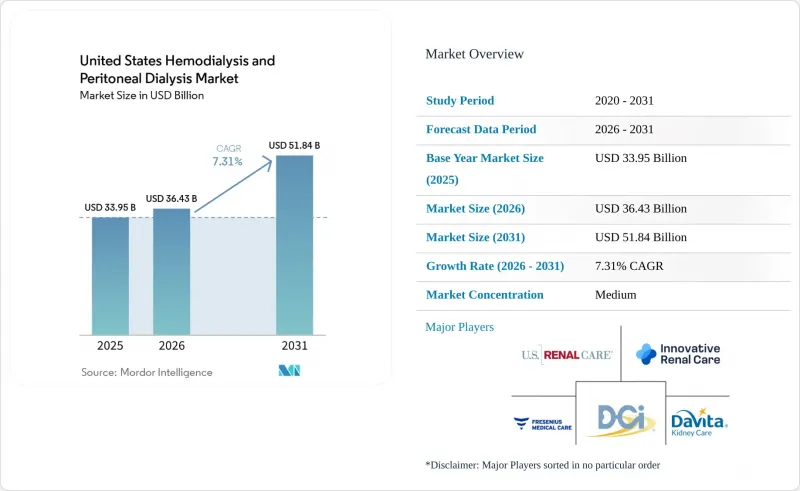
Mordor Intelligence에 의하면, 미국의 혈액 투석과 복막 투석 시장 규모는 2025년에 339억 5,000만 달러로 평가되었고, 2026년 364억 3,000만 달러로 추정되고, 2031년까지 518억 4,000만 달러에 이를 것으로 예측되며, 예측 기간 CAGR은 7.31%(2026-2031년)로 성장이 전망됩니다.
본 보고서는 치료법별(혈액투석, 복막투석), 제품 및 서비스별(기기, 소모품, 서비스), 적응 질환별(말기 신장 질환, 급성 신장 손상), 이용 환경별(독립형 시설, 병원 내 시설, 재택 간호 시설, 전문 간호 및 장기 요양 시설)로 분류되어 있습니다. 시장 전망은 금액(달러) 기준으로 제시되어 있습니다.
미국의 혈액투석 및 복막투석 시장 동향과 인사이트
당뇨병과 고혈압으로 인한 말기 신장 질환(ESKD)의 부담 증가
당뇨병성 신증과 고혈압성 신장 질환은 미국 혈액투석 및 복막투석 시장에서 주요 치료 파이프라인을 지속적으로 뒷받침하고 있습니다. 미국에서는 2025년에 13만 5,000건의 새로운 말기 신부전(ESKD) 사례가 기록될 것으로 예상되며, 만성 신장 질환(CKD)은 미국 성인의 15%에게 영향을 미치고 있어, 장기 투석 치료로 진행될 위험이 있는 대규모 잠재 환자군이 존재합니다. 아프리카계 미국인의 말기 신부전(ESKD) 발병률은 백인계 미국인의 3.8배에 달하며, 이로 인한 가장 큰 부담은 여전히 만성 질환 관리 역량이 낮은 주에 집중되어 있습니다. 이러한 인종적 및 지역적 집중 현상으로 인해, 의료 제공업체들이 이식 건수를 늘리거나 선별 검사를 개선하더라도 미국의 혈액투석 및 복막투석 시장은 계속해서 확대되고 있습니다. GLP-1 요법에서 기대되는 효과는 분명히 존재하지만, 프레제니우스사는 여전히 그 효과를 2026년부터 2031년에 걸친 단기적인 환자 수 회복 요인이 아닌, 장기적인 요인으로 간주하고 있습니다.
재택 투석의 보급 및 보험 급여 지원
CMS는 2025년 1월 1일부터 재택 투석에 대한 메디케어 지급 대상을 급성 신장 손상(AKI) 수급자로까지 확대함으로써 재택 치료에 대한 지원을 강화했습니다. 또한, 이 규정에 따라 말기 신부전(ESRD) 시설은 급성 신장 손상(AKI) 수혜자에 대해 재택 및 자가 투석 교육에 대한 추가 보상을 청구할 수 있게 되었으며, 최종 규정에서는 교육 추가 보상이 1회당 95.6달러로 책정되었습니다. Vantive사는 자사의 원격 모니터링 플랫폼 ‘Sharesource’를 통해 전체 사망률 감소와 입원 건수 감소 간의 연관성을 보여주고 있으며, 이를 통해 재택 치료의 의의는 단순한 환자 편의성을 넘어 더욱 확대되고 있습니다. 또한, CMS는 TPNIES의 적용 대상을 특정 재택 투석 기기로 확대하고, 지급액을 MAC이 결정한 사전 조정 가격의 65%(9.32달러 공제 후)로 정하며, 이를 2년 동안 적용하기로 했습니다. 이러한 변화들이 종합적으로 작용하여 도입 장벽을 낮추고, 미국 가정 환경에서의 혈액투석 및 복막투석 시장 내 설치 대수 확대를 촉진할 것입니다.
의료 제공업체의 환급액과 비용 간의 불일치
2026년도 ESRD PPS 기본 단가는 1회당 281.7 달러로 확정되었습니다. 이는 2025년도 대비 2.2% 증가한 수치입니다. DaVita의 보고서에 따르면, 1회당 환자 치료 비용은 2025년에 273.3달러, 2026년 1분기에는 280.1달러로 나타났으며, 이를 통해 의료 제공업체의 비용이 얼마나 빠르게 보상 상한선에 근접하고 있는지 알 수 있습니다. 이러한 압박은 대형 사업자에 비해 구매력이나 재무 기반이 취약하고 수직적 공급망 통합을 갖추지 못한 독립형 단독 시설에 있어 더욱 가혹하게 다가옵니다. 프레제니우스사는 또한 메디케이드와 메디케어 이중 수급 환자를 비교적 많이 수용하고 있는 시설의 경우, 2034년까지 이어질 메디케이드 자금 삭감 전망을 부차적인 위험 요인으로 지적했습니다. 이러한 불균형이 지속될 경우, 미국의 혈액투석 및 복막투석 시장에서는 신규 설비에 대한 투자가 위축되고, 시설의 경영 상황이 어려워지며, 전국 체인점과 소규모 제공업체 간의 격차가 급속히 확대될 가능성이 있습니다.
부문별 분석
2025년 기준으로, 혈액투석은 미국 내 혈액투석 및 복막투석 시장 점유율의 88.31%를 차지했습니다. 이는 이미 도입된 임상 기반, 의사들이 오랫동안 익숙해져 온 치료법, 시설 내 치료를 중심으로 구축된 지불 주체의 업무 흐름을 반영한 것입니다. 또한, 프레제니우스가 2025년 5월 FDA 승인을 받아 미국에서 ‘5008X CAREsystem’의 상용화를 시작함에 따라, 이 치료법은 장비 교체 측면에서도 계속해서 핵심적인 위치를 차지하고 있습니다. 프레제니우스사는 2026년에 미국 내 설치 기반의 20%를 갱신하고, 2030년 말까지 전체 설치 기반을 5008X로 교체하는 것을 목표로 하고 있으며, 이를 통해 혈액투석은 운영상의 정체 없이 임상적으로 최첨단 상태를 유지하게 될 것입니다. 이 점은 중요합니다. 이는 고유량 혈액투석 여과(HDF)를 통해 의료진이 치료 성과와 인력 배치 효율성 향상이라는 압박에 직면하는 가운데, 혈액투석 분야에 임상적 개선의 길을 제시하기 때문입니다.
복막투석은 여전히 규모가 작은 치료법이지만, 연평균 성장률(CAGR) 8.38%를 기록하며 2031년까지 미국의 혈액투석 및 복막투석 산업에서 가장 빠르게 성장하는 부문으로 자리매김하고 있습니다. 이러한 변화는 재택 치료 관련 정책, 원격 모니터링, 그리고 적절한 환자를 시설 내 고정된 일정에 얽매이지 않게 해야 한다는 실질적인 필요성에 의해 뒷받침되고 있습니다. CMS(미국 의료보험 및 의료서비스 센터)는 급성 신장 손상(AKI) 수혜자에 대한 재택 투석 급여를 확대하고, TPNIES를 통해 재택용 장비에 대한 지원 체계를 지속함으로써 이러한 방향성을 강화했습니다. 또한 Vantive는 Sharesource가 전 세계에서 1억 회 이상의 재택 투석 치료를 지원해 왔습니다고 밝혔으며, 이는 원격 환자 관리가 단순한 편의 기능에서 일상적인 치료 도구로 전환되고 있음을 보여줍니다. 2027년도 지급 연도에 적용된 CMS의 Kt/V 적정성 지표 업데이트에서는 혈액투석(HD) 및 복막투석(PD)에 대한 개별 보고 요건이 추가되었습니다. 이는 미국의 혈액투석 및 복막투석 시장에서 치료법의 발전이 더욱 엄격해진 성과 가시화와 병행하여 진행되고 있음을 의미합니다.
2025년 매출에서 서비스 부문이 차지한 비중은 68.24%이며, 미국의 혈액투석 및 복막투석 시장에서 가장 큰 점유율은 여전히 기기 판매가 아닌 치료 제공에서 비롯된 것입니다. 이러한 구조는 수천 곳에 달하는 치료 거점에서의 청구 업무, 인력 배치, 보험사와의 계약을 규모의 경제를 통해 뒷받침할 수 있기 때문에 대형 사업자에게 유리하게 작용합니다. DaVita는 2026년 1분기 1회 치료당 평균 수익이 417.6달러였다고 보고했으며, 이는 비용 중시 환경 속에서도 서비스 수익이 여전히 핵심 수익원임을 보여줍니다. 또한, 서비스 중심의 구조는 미국 혈액투석 및 복막투석 시장에서 의료 제공업체들의 전략이 단순히 시설 수를 늘리는 데 그치지 않고, 센터의 생산성, 환자 유지율, 위험 기반 치료 관리에 점점 더 중점을 두게 된 이유를 설명해 줍니다.
소모품은 성장세가 더욱 빠른 부문으로, 미국 혈액투석 및 복막투석 시장의 소모품 시장 규모는 2031년까지 연평균 성장률(CAGR) 8.52%로 확대될 것으로 전망됩니다. 이러한 성장은 특히 재택 투석 일정의 경우, 일반 투석 시설에서의 투석보다 더 빈번한 세션이 필요할 수 있기 때문에 치료에 따른 지속적인 사용에서 기인한 것입니다. Outset의 보고서에 따르면, 2026년 1분기 매출의 70%를 소모품과 서비스가 차지하고 있으며, 이는 기존 고객 기반을 통한 수익 창출이 주요 상업적 레버리지로 자리 잡고 있음을 보여줍니다. 록웰사는 2025년 2월, 1억 달러 규모의 일회용 제품 하위 시장을 겨냥한 일회용 중탄산염 카트리지를 출시함으로써 이러한 추세를 입증했습니다. 연결형 HDF 및 재택 치료 플랫폼이 수년 단위의 기기 교체 수요를 창출함에 따라, 기기의 중요성은 여전히 높지만, 미국의 혈액투석 및 복막투석 산업의 이익 구조는 분명히 소모품 및 관련 서비스 쪽으로 전환되고 있습니다.
기타 혜택
- 엑셀 형식 시장 예측(ME) 시트
- 3개월간의 애널리스트 지원
자주 묻는 질문
목차
제1장 서론
제2장 조사 방법
제3장 주요 요약
제4장 시장 구도
제5장 시장 규모 및 성장 예측
제6장 경쟁 구도
제7장 시장 기회 및 향후 전망
AJY 26.06.24According to Mordor Intelligence, the united states hemodialysis and peritoneal dialysis market size was valued at USD 33.95 billion in 2025 and is estimated to grow from USD 36.43 billion in 2026 to reach USD 51.84 billion by 2031, at a CAGR of 7.31% during the forecast period (2026-2031).
This report is Segmented by Modality (Hemodialysis, Peritoneal Dialysis), Product and Service (Devices, Consumables, Services), Disease Indication (End-Stage Kidney Disease, Acute Kidney Injury), and End-Use Setting (Freestanding Centers, Hospital-Based Centers, Home Care, Skilled Nursing and Long-Term Care). The Market Forecasts are Provided in Terms of Value (USD).
United States Hemodialysis And Peritoneal Dialysis Market Trends and Insights
Rising ESKD Burden from Diabetes and Hypertension
Diabetic nephropathy and hypertensive renal disease continue to feed the core treatment pipeline for the US hemodialysis and peritoneal dialysis market. The United States recorded 135,000 new ESKD cases in 2025, and CKD affected 15% of U.S. adults, which leaves a large upstream pool at risk of progression into long-duration dialysis care. Incident ESKD among Black Americans runs at 3.8 times the rate seen among White Americans, and the heaviest burden remains concentrated in states with weaker chronic disease management capacity. That racial and regional concentration means the US hemodialysis and peritoneal dialysis market continues to expand even when providers add transplant referrals or improve screening. The emerging benefit from GLP-1 therapies is real, but Fresenius still framed that effect as a long-range factor rather than a near-term volume reset for 2026 through 2031.
Home Dialysis Adoption and Reimbursement Support
CMS widened support for home treatment when it extended Medicare payment for dialysis in the home setting to beneficiaries with acute kidney injury beginning January 1, 2025. The rule also allowed ESRD facilities to bill the home and self-dialysis training add-on payment for AKI beneficiaries, and the training add-on was set at USD 95.6 per session in the final rule. Vantive linked its Sharesource remote monitoring platform with lower all-cause mortality and fewer hospitalizations, which broadens the case for home modalities beyond patient convenience alone. CMS also expanded TPNIES eligibility to certain home dialysis machines and set payment at 65% of the MAC-determined pre-adjusted price, reduced by a USD 9.32 offset, for 2 calendar years. Together, those changes lower adoption friction and support a larger installed base for the US hemodialysis and peritoneal dialysis market in home settings.
Reimbursement-Cost Mismatch for Providers
The 2026 ESRD PPS base rate was finalized at USD 281.7 per treatment, which was a 2.2% increase from 2025. DaVita reported patient care costs per treatment of USD 273.3 in 2025 and USD 280.1 in the first quarter of 2026, which shows how quickly provider costs moved toward the reimbursement ceiling. This pressure is harder for independent freestanding centers because they do not have the same purchasing leverage, balance sheet strength, or vertical supply integration as the largest operators. Fresenius also highlighted projected Medicaid funding cuts through 2034 as a secondary risk for centers that serve dually eligible patients in greater proportions. If that mismatch persists, the US hemodialysis and peritoneal dialysis market could see slower investment in new equipment, tighter center economics, and a faster gap between national chains and smaller providers.
Other drivers and restraints analyzed in the detailed report include:
- Kidney Transplant Shortage Sustaining Dialysis Demand
- Connected Dialysis and Therapy Upgrade Cycle
- Nephrology Nursing and Technician Shortage
For complete list of drivers and restraints, kindly check the Table Of Contents.
Segment Analysis
Hemodialysis held 88.31% of the US hemodialysis and peritoneal dialysis market share in 2025, which reflects the installed clinical base, long-standing physician familiarity, and payer workflows built around in-center treatment. The modality also remains central to equipment replacement because Fresenius began commercial rollout of the 5008X CAREsystem in the United States after FDA clearance in May 2025. Fresenius is converting 20% of its U.S. installed base in 2026 and aims to replace the full installed base with the 5008X by the end of 2030, which keeps hemodialysis clinically current rather than operationally static. That matters because high-volume hemodiafiltration gives the hemodialysis segment a clinical upgrade path at the same time that providers face pressure to improve outcomes and staffing efficiency.
Peritoneal dialysis remains the smaller modality, but its 8.38% CAGR makes it the faster-moving part of the US hemodialysis and peritoneal dialysis industry through 2031. The shift is supported by home treatment policy, remote monitoring, and the practical need to move appropriate patients away from fixed in-center schedules. CMS strengthened that direction by extending home dialysis payment to AKI beneficiaries and by continuing support mechanisms for home equipment through TPNIES. Vantive also said Sharesource has supported more than 100 million home dialysis treatments globally, which shows how remote patient management is moving from a helpful feature to a routine care tool. The CMS update to Kt/V adequacy measures for payment year 2027 adds separate reporting expectations for HD and PD, which means modality growth in the US hemodialysis and peritoneal dialysis market now sits alongside tighter performance visibility.
Services accounted for 68.24% of revenue in 2025, so the largest share of the US hemodialysis and peritoneal dialysis market still comes from treatment delivery rather than device sales. That structure favors large operators because scale supports billing, labor deployment, and payer contracting across thousands of treatment sites. DaVita reported average revenue per treatment of USD 417.6 in the first quarter of 2026, which shows that service revenue remains the core earnings driver even in a cost-sensitive environment. The service-heavy mix also explains why provider strategy in the US hemodialysis and peritoneal dialysis market increasingly focuses on center productivity, patient retention, and risk-based care management rather than simple unit expansion.
Consumables are the faster-growth layer, with the US hemodialysis and peritoneal dialysis market size for consumables projected to expand at 8.52% CAGR through 2031. That growth comes from recurring treatment use, especially as home schedules can require more frequent sessions than the standard in-center pattern. Outset reported that consumables and services made up 70% of revenue in the first quarter of 2026, which shows how installed-base monetization is becoming a major commercial lever. Rockwell reinforced that theme when it launched a single-use bicarbonate cartridge in February 2025 to target a USD 100 million disposables sub-market. Devices still matter because connected HDF and home-capable platforms create multi-year replacement demand, but the margin logic in the US hemodialysis and peritoneal dialysis industry is moving more clearly toward recurring supplies and associated services.
List of Companies Covered in this Report:
- B. Braun
- DaVita
- Dialysis Clinic, Inc.
- Dialyze Direct
- Fresenius Medical Care AG
- Innovative Renal Care
- Merit Medical Systems
- Mozarc Medical
- Nikkiso Medical America, Inc.
- Nipro
- Northwest Kidney Centers
- Outset Medical, Inc.
- Quanta Dialysis Technologies
- Rockwell Medical
- Satellite Healthcare
- The Rogosin Institute
- U.S. Renal Care, Inc.
- Vantive Health LLC
- W. L. Gore & Associates
Additional Benefits:
- The market estimate (ME) sheet in Excel format
- 3 months of analyst support
TABLE OF CONTENTS
1 Introduction
- 1.1 Study Assumptions & Market Definition
- 1.2 Scope of the Study
2 Research Methodology
3 Executive Summary
4 Market Landscape
- 4.1 Market Overview
- 4.2 Market Drivers
- 4.2.1 Rising ESKD Burden From Diabetes and Hypertension
- 4.2.2 Home Dialysis Adoption and Reimbursement Support
- 4.2.3 Kidney Transplant Shortage Sustaining Dialysis Demand
- 4.2.4 Connected Dialysis and Therapy Upgrade Cycle
- 4.2.5 AKI Home Dialysis Reimbursement Expansion
- 4.2.6 Medicare Advantage and Value-Based Kidney Care Steering
- 4.3 Market Restraints
- 4.3.1 Reimbursement-Cost Mismatch for Providers
- 4.3.2 Nephrology Nursing and Technician Shortage
- 4.3.3 PD Fluid Supply Fragility
- 4.3.4 Oral Phosphate-Binder Bundle Workflow Burden
- 4.4 Value Chain Analysis
- 4.5 Regulatory Landscape
- 4.6 Technological Outlook
- 4.7 Porter's Five Forces
- 4.7.1 Threat of new entrants
- 4.7.2 Bargaining power of suppliers
- 4.7.3 Bargaining power of buyers
- 4.7.4 Threat of substitutes
- 4.7.5 Intensity of competitive rivalry
5 Market Size & Growth Forecasts (Value, USD)
- 5.1 By Modality
- 5.1.1 Hemodialysis
- 5.1.2 Peritoneal Dialysis
- 5.2 By Product & Service
- 5.2.1 Devices
- 5.2.2 Consumables
- 5.2.3 Services
- 5.3 By Disease Indication
- 5.3.1 End-stage Kidney Disease/CKD
- 5.3.2 Acute Kidney Injury
- 5.4 By End-use Setting
- 5.4.1 Freestanding Dialysis Centers
- 5.4.2 Hospital-based Dialysis Centers
- 5.4.3 Home Care Settings
- 5.4.4 Skilled Nursing and Long-term Care Settings
6 Competitive Landscape
- 6.1 Market Concentration
- 6.2 Market Share Analysis
- 6.3 Company Profiles {(includes Global level Overview, Market level overview, Core Segments, Financials as available, Strategic Information, Market Rank/Share for key companies, Products & Services, and Recent Developments)}
- 6.3.1 B. Braun Medical Inc.
- 6.3.2 DaVita Inc.
- 6.3.3 Dialysis Clinic, Inc.
- 6.3.4 Dialyze Direct
- 6.3.5 Fresenius Medical Care AG
- 6.3.6 Innovative Renal Care
- 6.3.7 Merit Medical Systems, Inc.
- 6.3.8 Mozarc Medical
- 6.3.9 Nikkiso Medical America, Inc.
- 6.3.10 Nipro Medical Corporation
- 6.3.11 Northwest Kidney Centers
- 6.3.12 Outset Medical, Inc.
- 6.3.13 Quanta Dialysis Technologies
- 6.3.14 Rockwell Medical, Inc.
- 6.3.15 Satellite Healthcare
- 6.3.16 The Rogosin Institute
- 6.3.17 U.S. Renal Care, Inc.
- 6.3.18 Vantive Health LLC
- 6.3.19 W. L. Gore & Associates, Inc.
7 Market Opportunities & Future Outlook
- 7.1 White-space & unmet-need assessment


