
|
시장보고서
상품코드
2064490
미국의 행동 건강 시장 : 시장 점유율 분석, 업계 동향 및 통계, 성장 예측(2026-2031년)U.S. Behavioral Health - Market Share Analysis, Industry Trends & Statistics, Growth Forecasts (2026 - 2031) |
||||||
 Mordor Intelligence
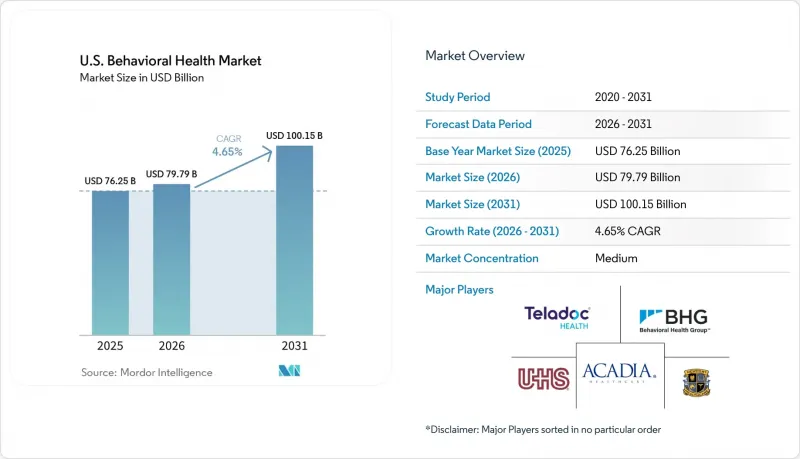
Mordor Intelligence에 의하면, 미국의 행동 의료 시장 규모는 2025년에 762억 5,000만 달러로 평가되었고, 2026년에 797억 9,000만 달러로 추정되고, 2031년까지 1,001억 5,000만 달러에 이를 것으로 예측되며, 2026-2031년 CAGR 4.65%로 성장할 전망입니다.
본 보고서는 치료 형태별(외래 진료, 처방약, 기타 서비스), 질환군별(정신질환, 약물 사용 장애, 동반 질환), 의료 제공 장소별(외래, 부분 입원/IOP, 입원, 주거 시설, 기타), 연령대별(소아, 청소년, 성인, 노인)로 분류되어 있습니다. 시장 전망은 금액(달러) 기준으로 제시되어 있습니다.
미국의 행동 건강 시장 동향 및 인사이트
평등성 확보를 철저히 함으로써 상환 및 네트워크의 적정화를 재구축
주 및 연방 차원의 패리티 법 집행으로 인해, 규정 준수는 미국 행동 건강 시장에서 수익과 직결되는 중요한 과제로 변모하고 있습니다. 2024년과 2025년에 조지아주는 비정량적인 치료 제한을 이유로 22개 보험사에 약 2,500만 달러의 벌금을 부과했습니다. 한편, 워싱턴주는 카이저 파운데이션 헬스플랜에 30만 달러, 레전스 블루실드와 프리미어 블루크로스에는 동일한 위반 사항에 대해 각각 55만 달러의 벌금을 부과했습니다. 보험사는 규제 당국의 감독을 완화하기 위해 의료 제공업체 네트워크를 확대하고 외래 진료의 보상 조건을 개선하고 있습니다. 2024년 MHPAEA 최종 규정에서는 2025년 5월 연방 정부의 집행을 유예하는 방침이 채택되었으나, 워싱턴주, 콜로라도주, 메릴랜드주, 캘리포니아주 등의 주에서는 해당 규정을 주법에 반영하여 주요 민간 보험 시장에서 규정 준수 요건을 유지하고 있습니다. 이러한 주 차원의 도입을 통해 접근성 및 문서화 기준에 관한 전국적인 기준이 확립되며, 이러한 기준을 충족하는 의료 제공업체는 더 높은 수준의 보상을 받을 수 있게 됩니다.
메디케어 및 메디케이드 적용 범위 확대 : 중등도 중증도 수준에서의 접근성 확대
보험 적용 범위가 확대됨에 따라, 미국 행동 건강 시장의 격차, 특히 외래 진료와 입원 서비스 사이의 중간 단계에 해당하는 치료 수준에서의 격차가 점차 해소되고 있습니다. 메디케어는 2023년 통합지출법에 따라 2024년 1월 1일부터 집중 외래 프로그램(IOP) 서비스 적용을 시작했으며, 6,000만 명 이상의 수급자가 보상 대상이 되는 중등도 중증 치료 서비스를 이용할 수 있게 되었습니다. 행동 건강 원격의료에 대한 지리적 제한이 영구적으로 철폐됨에 따라, 수혜자들은 2027년 원격의료 일반 적용 기한이 지난 후에도 자택에서 치료를 받을 수 있게 되었습니다. 또한 메디케이드는 인증 지역 행동 건강 클리닉(CCBHC)을 2017년 8개 주 67개 시설에서 46개 주와 컬럼비아 특별구를 아우르는 500개 이상의 시설로 확대했습니다. 2025 회계연도까지 19개 주가 CCBHC를 메디케이드 제공업체로 인증했습니다. 2026년 7월, 85개 행동 건강 기관과 주요 보험사 간의 협력을 바탕으로 시작되는 CMS ACCESS 행동 건강 모델은 성과 연계형 결제 제도를 강화하고, 확장 가능한 중등도 급성기 치료 채널을 지원합니다.
인력 부족과 공적 보험자의 낮은 환급률
인력 부족은 미국 행동 건강 시장에서 여전히 큰 걸림돌로 남아 있습니다. 2025년 12월 기준으로, 1억 3,700만 명의 미국인(인구의 40%)이 연방 정부가 지정한 정신건강 전문인력 부족 지역에 거주하고 있으며, 이러한 지정 지역의 수는 2024년 6,418곳에서 2026년에는 6,807곳으로 증가했습니다. 2038년까지 9만 9,840명의 정신건강 상담사, 9만 9,840명의 심리학자, 7만 7,050명의 중독 상담사, 3만 6,780명의 성인 정신과 의사가 부족할 것으로 예측됩니다. 정신과 의사공급 수는 연간 수요가 40.7% 증가하는 반면, 2026년 3만 7,470명에서 2038년에는 3만 6,550명으로 감소할 것으로 예측됩니다. 지방 지역에서는 의료 접근성에 심각한 문제가 발생하고 있으며, 지방 카운티는 도시 지역 카운티에 비해 심리 상담사가 부족한 가능성이 약 3배 더 높고, 지방 카운티의 22%가 임상 사회복지사가 없습니다고 보고하고 있습니다.
부문별 분석
2025년, 미국 행동 건강 시장에서 외래 진료가 41.10%를 차지했으며, 진료가 외래 및 온라인 진료로 전환되는 과정에서 주도적인 역할을 수행했습니다. 2024년에는 미국 전체 원격의료 진료 중 행동 건강이 65.6%를 차지했으며, 2018년의 18.4%에서 크게 증가했습니다. 행동 의학 분야의 원격의료 진료 건수는 총 6,640만 건에 달하고, 같은 기간 1차 진료 분야의 원격의료 진료 건수인 6,280만 건을 넘어섰습니다. 이러한 변화는 텔레헬스가 일상적인 치료, 약물 관리, 경과 관찰을 위한 표준 제공 채널로 진화하고 있음을 보여줍니다.
처방약은 가장 빠르게 성장하고 있는 치료법이며, 이 부문에서 미국의 행동 건강 시장은 2026-2031년 연평균 성장률(CAGR) 5.25%로 성장할 것으로 전망됩니다. 2018-2024년 각성제의 혼합량은 53.3% 증가했고, 항정신병제의 혼합량은 45.4% 증가했습니다. 2024년에는 간호사 실무자와 의사 보조가 진료 건수의 34.3%를 담당하며, 정신과 의사와 1차 진료 의사를 앞질렀습니다.
2025년에는 정신 질환이 72.2%의 점유율을 차지했으며, 미국의 행동 의학 시장에서 가장 큰 질환군으로 부상했습니다. 2024년, 메디케어 수급자의 원격의료 이용 건수에서 불안 장애가 945만 건으로 1위를 차지했으며, 그 다음으로 우울증이 877만 건이었습니다. 약물 사용 장애는 여전히 규모는 작지만, 일부 주에서 메디케이드 제1115조 면제 조치를 통해 지원되는 비상 관리 프로그램 덕분에 증가 추세를 보이고 있습니다. 기저질환 시장은 가장 빠르게 성장하고 있는 부문으로, 2026-2031년 연평균 성장률(CAGR) 5.95%를 나타낼 것으로 전망됩니다. 2026년에 실시된 연구에서는 부프레노르핀과 심리치료를 결합한 통합 치료가 관해율을 현저히 개선한 것으로 나타났으며, 이로써 이중 진단 환자에 대한 통합 치료의 가치가 입증되었습니다.
기타 혜택
- 엑셀 형식 시장 예측(ME) 시트
- 3개월간의 애널리스트 지원
자주 묻는 질문
목차
제1장 서론
제2장 조사 방법
제3장 주요 요약
제4장 시장 구도
제5장 시장 규모 및 성장 예측
제6장 경쟁 구도
제7장 시장 기회 및 향후 전망
AJY 26.06.26According to Mordor Intelligence, the u.S. behavioral health market size is projected to be USD 76.25 billion in 2025, USD 79.79 billion in 2026, and reach USD 100.15 billion by 2031, growing at a CAGR of 4.65% from 2026 to 2031.
This report is Segmented by Treatment Modality (Ambulatory Visits, Prescription Medicines, Other Services), Condition Group (Mental Health Conditions, Substance Use Disorders, Co-Occurring Conditions), Site of Care (Outpatient, Partial Hospitalization/IOP, Inpatient, Residential, Others), and Age Cohort (Children, Adolescents, Adults, Geriatric). Market Forecasts are Provided in Terms of Value (USD).
U.S. Behavioral Health Market Trends and Insights
Tightening Parity Enforcement Reshapes Reimbursement and Network Adequacy
State and federal parity enforcement is transforming compliance into a revenue-critical issue for the United States behavioral health market. In 2024 and 2025, Georgia imposed nearly USD 25 million in fines on 22 insurers for non-quantitative treatment limitations, while Washington fined Kaiser Foundation Health Plan USD 300,000, and Regence BlueShield and Premera Blue Cross USD 550,000 each for similar violations. Payers are expanding provider networks and improving outpatient reimbursements to reduce regulatory scrutiny. Although the 2024 MHPAEA Final Rule adopted a federal non-enforcement stance in May 2025, states like Washington, Colorado, Maryland, and California incorporated its provisions into state laws, maintaining compliance expectations in major commercial markets. This state-level adoption establishes a national baseline for access and documentation standards, ensuring providers who meet these criteria benefit from higher reimbursement quality.
Medicare and Medicaid Coverage Expansion Unlocking Access at Mid-Acuity Levels
Coverage expansions are addressing gaps in the United States behavioral health market, particularly for care levels between outpatient visits and inpatient services. Medicare began covering intensive outpatient program services on January 1, 2024, under the Consolidated Appropriations Act, 2023, enabling over 60 million beneficiaries to access reimbursable mid-acuity care. Geographic restrictions for behavioral health telehealth were permanently removed, allowing beneficiaries to receive care at home beyond the 2027 general telehealth deadline. Medicaid has also expanded Certified Community Behavioral Health Clinics from 67 facilities in 8 states in 2017 to over 500 across 46 states and the District of Columbia. By FY2025, 19 states recognized CCBHCs as Medicaid providers. The CMS ACCESS behavioral health model, launching in July 2026 with 85 behavioral health organizations and major payer alignment, strengthens outcome-linked payment systems and supports scalable mid-acuity care pathways.
Workforce Shortages and Low Public-Payer Reimbursement Rates
Workforce shortages remain a significant barrier in the United States behavioral health market. By December 2025, 137 million Americans, or 40% of the population, lived in federally designated mental health professional shortage areas, with the number of such designations increasing from 6,418 in 2024 to 6,807 in 2026. By 2038, projected shortfalls include 99,840 mental health counselors, 99,840 psychologists, 77,050 addiction counselors, and 36,780 adult psychiatrists. The supply of psychiatrists is expected to decline from 37,470 in 2026 to 36,550 in 2038, even as annual demand rises by 40.7%. Rural areas face significant access challenges, with rural counties nearly three times more likely than urban ones to lack psychologists, and 22% of rural counties reporting no clinical social workers.
Other drivers and restraints analyzed in the detailed report include:
- Persistent Unmet Demand in Co-occurring Mental Health and SUD Conditions
- Sustained Tele-buprenorphine and Controlled-Substance Telehealth Prescribing
- Ghost Networks, Prior Authorization Friction, and Utilization Management Barriers
For complete list of drivers and restraints, kindly check the Table Of Contents.
Segment Analysis
In 2025, ambulatory visits accounted for 41.10% of the United States behavioral health market, leading as care shifted toward outpatient and virtual settings. Behavioral health made up 65.6% of all United States telehealth visits in 2024, a significant rise from 18.4% in 2018. Total behavioral health telehealth visits reached 66.4 million, surpassing the 62.8 million primary care telehealth visits during the same period. This shift highlights telehealth's evolution into a standard delivery channel for routine therapy, medication management, and follow-ups.
Prescription medicines are the fastest-growing treatment modality, with the United States behavioral health market for this segment projected to grow at a 5.25% CAGR from 2026 to 2031. Stimulant prescriptions rose by 53.3% between 2018 and 2024, while antipsychotic volumes increased by 45.4%. Nurse practitioners and physician assistants managed 34.3% of prescription volume in 2024, surpassing psychiatrists and primary care physicians.
Mental health conditions held a 72.2% share in 2025, making them the largest condition group in the United States behavioral health market. Anxiety disorders led telehealth use among Medicare beneficiaries in 2024, with 9.45 million visits, followed by 8.77 million visits for depressive disorders. Substance use disorders remain smaller but are growing due to contingency management programs supported by Medicaid Section 1115 waivers in several states. Co-occurring conditions are the fastest-growing segment, with a projected 5.95% CAGR from 2026 to 2031. A 2026 study demonstrated that integrated buprenorphine and psychotherapy significantly improved remission rates, reinforcing the value of combined care for dual-diagnosis populations.
List of Companies Covered in this Report:
- Acadia Healthcare Company, Inc.
- Behavioral Health Group
- Boulder Care
- Brightside Health, Inc.
- Charlie Health
- Eleanor Health
- Hazelden Betty Ford Foundation
- Headway
- LifeStance Health Group, Inc.
- Lyra Health, Inc.
- Newport Healthcare
- Oceans Healthcare
- Pyramid Healthcare
- Rogers Behavioral Health
- Rula Health
- Sheppard Pratt
- Spring Health
- Talkspace, Inc.
- Teladoc Health, Inc. / BetterHelp
- Universal Health Services
Additional Benefits:
- The market estimate (ME) sheet in Excel format
- 3 months of analyst support
TABLE OF CONTENTS
1 Introduction
- 1.1 Study Assumptions & Market Definition
- 1.2 Scope of the Study
2 Research Methodology
3 Executive Summary
4 Market Landscape
- 4.1 Market Overview
- 4.2 Market Drivers
- 4.2.1 Tightening Parity Enforcement and Network Accountability
- 4.2.2 Medicare and Medicaid Coverage Expansion for Behavioral Clinicians
- 4.2.3 Persistent Unmet Demand in Co-Occurring Mental Health and SUD Care
- 4.2.4 Sustained Tele-Buprenorphine and Controlled-Substance Telehealth Flexibility
- 4.2.5 Shift From Cash-Pay Point Solutions Toward Payer-Embedded Behavioral Care
- 4.2.6 Measurement-Based Care and AI-Enabled Operating Leverage in Outpatient Platforms
- 4.3 Market Restraints
- 4.3.1 Workforce Shortages and Low Public-Payer Provider Participation
- 4.3.2 Ghost Networks, Prior Authorization Friction, and Parity Compliance Gaps
- 4.3.3 Medicaid Eligibility Churn and Supplemental-Payment Volatility
- 4.3.4 Safety-Net Facility Closures in Residential and Higher-Acuity Settings
- 4.4 Value Chain Analysis
- 4.5 Regulatory Landscape
- 4.6 Technological Outlook
- 4.7 Porter's Five Forces Analysis
- 4.7.1 Threat of New Entrants
- 4.7.2 Bargaining Power of Suppliers
- 4.7.3 Bargaining Power of Buyers
- 4.7.4 Threat of Substitutes
- 4.7.5 Industry Rivalry
5 Market Size & Growth Forecasts (Value, USD)
- 5.1 By Treatment Modality
- 5.1.1 Ambulatory Visits
- 5.1.2 Prescription Medicines
- 5.1.3 Other Treatment Services
- 5.2 By Condition Group
- 5.2.1 Mental Health Conditions
- 5.2.1.1 Mood Disorders
- 5.2.1.2 Anxiety Disorders
- 5.2.1.3 Psychotic Disorders
- 5.2.1.4 Trauma- and Stressor-Related Disorders
- 5.2.1.5 Eating Disorders
- 5.2.1.6 Neurodevelopmental and Behavioral Disorders
- 5.2.2 Substance Use Disorders
- 5.2.2.1 Alcohol Use Disorder
- 5.2.2.2 Opioid Use Disorder
- 5.2.2.3 Stimulant Use Disorder
- 5.2.2.4 Cannabis Use Disorder
- 5.2.3 Co-occurring Mental Health and SUD Conditions
- 5.2.1 Mental Health Conditions
- 5.3 By Site of Care
- 5.3.1 Outpatient Clinics and Office-Based Care
- 5.3.2 Partial Hospitalization and Intensive Outpatient Programs
- 5.3.3 Inpatient Psychiatric Hospitals
- 5.3.4 Residential Treatment Centers
- 5.3.5 Others
- 5.4 By Age Cohort
- 5.4.1 Children
- 5.4.2 Adolescents
- 5.4.3 Adults
- 5.4.4 Geriatric Population
6 Competitive Landscape
- 6.1 Market Concentration
- 6.2 Market Share Analysis
- 6.3 Company Profiles {(includes Global level Overview, Market level overview, Core Segments, Financials as available, Strategic Information, Market Rank/Share for key companies, Products & Services, and Recent Developments)}
- 6.3.1 Acadia Healthcare Company, Inc.
- 6.3.2 Behavioral Health Group
- 6.3.3 Boulder Care
- 6.3.4 Brightside Health, Inc.
- 6.3.5 Charlie Health
- 6.3.6 Eleanor Health
- 6.3.7 Hazelden Betty Ford Foundation
- 6.3.8 Headway
- 6.3.9 LifeStance Health Group, Inc.
- 6.3.10 Lyra Health, Inc.
- 6.3.11 Newport Healthcare
- 6.3.12 Oceans Healthcare
- 6.3.13 Pyramid Healthcare
- 6.3.14 Rogers Behavioral Health
- 6.3.15 Rula Health
- 6.3.16 Sheppard Pratt
- 6.3.17 Spring Health
- 6.3.18 Talkspace, Inc.
- 6.3.19 Teladoc Health, Inc. / BetterHelp
- 6.3.20 Universal Health Services, Inc.
7 Market Opportunities & Future Outlook
- 7.1 White-space & Unmet-Need Assessment