|
시장보고서
상품코드
2064522
직원 펄스 서베이 및 청취 플랫폼 시장 : 시장 점유율 분석, 산업 동향 및 통계 데이터, 성장 예측(2026-2031년)Employee Pulse Survey And Listening Platform - Market Share Analysis, Industry Trends & Statistics, Growth Forecasts (2026 - 2031) |
||||||
 Mordor Intelligence
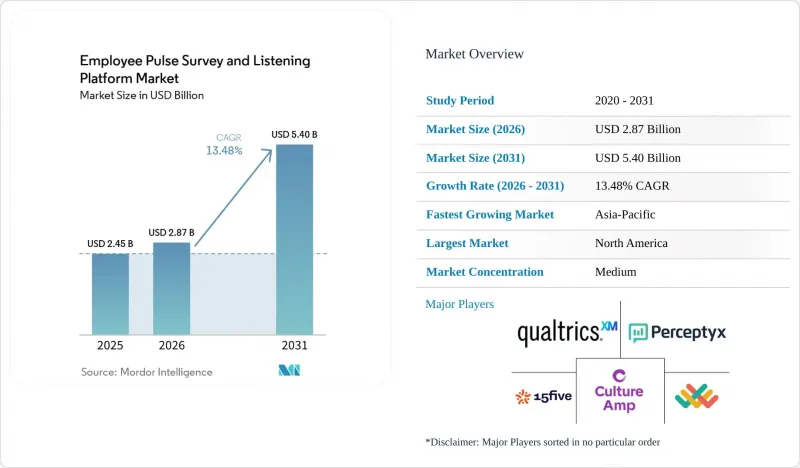
Mordor Intelligence에 의하면, 직원 펄스 서베이 및 청취 플랫폼 시장 규모는 2025년에 24억 5,000만 달러로 평가되었고, 2026년에 28억 7,000만 달러로 추정되며, 2031년까지 54억 달러에 이를 것으로 예측됩니다.
2026-2031년 연평균 성장률(CAGR) 13.48%로 성장할 것으로 전망됩니다.
본 보고서는 구성 요소별(플랫폼/소프트웨어, 서비스), 배포 방식별(클라우드 기반 등), 기업 규모별(대기업, 중소기업), 기능별(참여도 조사·펄스 설문조사 등), 최종 이용 산업별(은행, 금융서비스 및 보험(BFSI), 의료 및 생명과학 등), 지역별로 분류되어 있습니다. 시장 전망은 금액(달러) 기준으로 제시되어 있습니다.
세계의 직원 펄스 서베이 및 청취 플랫폼 시장 동향 및 인사이트
AI를 활용한 감정 분석 및 예측 인사이트
대규모 언어 모델은 직원 펄스 서베이 및 청취 플랫폼 시장을 수동적인 데이터 수집 단계에서 보다 능동적인 인력 인텔리전스 시스템으로 변화시키고 있습니다. 현재, 자유 서술문 분석을 통해 벤더는 각 단계에서 수동적인 해석에 의존하지 않고도 번아웃 징후, 이직 위험, 그리고 관리자별 구체적인 다음 단계를 파악할 수 있게 되었습니다. 이 변화는 중요합니다. 왜냐하면, 짧은 형식의 펄스 설문조사만으로도 유용한 주제를 도출할 수 있으므로, 장문의 설문조사에 대한 의존도를 줄이고 설문조사 피로를 해소하는 데 기여하기 때문입니다. 직원 펄스 서베이 및 청취 플랫폼 시장에서 AI는 중요한 지표로 자리 잡고 있습니다. 이는 자동화에 대한 직원들의 감정이 신뢰, 준비 태세, 그리고 도입에 영향을 미치게 되었기 때문입니다. 갤럽은 2026년 4월, AI 도구에 대한 관리직의 지지가 직원들의 AI 도입을 예측하는 가장 강력한 지표라고 보고했습니다. 이를 통해 청취 기능은 보다 광범위한 생산성 향상 노력과 밀접하게 연계되게 되었습니다.
하이브리드 및 원격 근무 모델의 확대
하이브리드 및 원격 근무는 더 이상 일시적인 운영 모델이 아니라, 인력 설계의 구조적인 일부로 기능하고 있습니다. 이러한 변화로 인해, 기술을 통해 직원들의 목소리에 귀를 기울이는 것이 훨씬 더 중요해졌습니다. 왜냐하면 분산형 팀에서는 관리자가 과거 대면 상황에서 포착하던 비공식적인 신호 중 상당수가 사라지기 때문입니다. 연례 참여도 조사는 이러한 상황에 적합하지 않습니다. 팀 구성, 업무 부담, 관리자와의 관계가 빈번하게 변화하기 때문에 단일 연도 조사 결과만으로는 유용성을 유지할 수 없기 때문입니다. 직원 펄스 서베이 및 청취 플랫폼 시장은 이러한 추세의 혜택을 받고 있습니다. 구매자들은 직원들에게 다른 시스템에 로그인하도록 요구하는 대신, 협업 도구 내에서 이용할 수 있는 모바일 우선의 비동기식 컨텐츠 제공 방식을 점점 더 선호하고 있기 때문입니다. 맨파워그룹 독일은 2026년 1월, 독일 근로자의 58%가 번아웃 증상을 보이고 있는 반면, 65%는 현재 고용주와 계속 근무할 의향이 있으며, 54%는 여전히 새로운 일자리를 찾고 있다는 보고서를 발표했습니다. 이는 업무상 지속적인 ‘경청’이 그 어느 때보다 중요해질 필요성을 여실히 보여주고 있습니다.
데이터 개인정보 보호, 익명성 및 국경을 초월한 규정 준수 관련 우려
개인정보 보호 규제는 직원 펄스 서베이 및 청취 플랫폼 시장에서 여전히 가장 엄격한 운영상의 제약 중 하나입니다. GDPR(EU 개인정보보호규정)에 따르면, 주요 처리 규정을 위반할 경우 최대 2,000만 유로(2,260만 달러) 또는 전 세계 연간 매출액의 4%에 해당하는 벌금이 부과될 수 있으므로, 공급업체와 고용주는 직원의 피드백 데이터에 대해 더욱 엄격하게 관리해야 합니다. 실무상의 과제는 익명으로 판매되는 조사라 하더라도 팀 규모가 작거나 인구통계학적 필터와 타임스탬프 데이터를 결합할 경우, 여전히 개인을 식별할 수 있게 될 가능성이 있다는 점입니다. 2026년 3월, 직원 설문조사 프로그램은 GDPR(EU 개인정보보호규정)에 따라 동의, 인구통계, 처리자 및 익명성 기준에 대해 신중하게 다루어야 한다는 점이 지적되었습니다. 이는 거버넌스가 단순한 법적 심사가 아니라 제품 설계의 일부가 되었음을 보여줍니다. 그 결과, 구매 주기의 장기화, 공급업체에 대한 더욱 엄격한 심사, 그리고 지역별 호스팅, 임계값 관리, 설정 가능한 데이터 보존 규칙에 대한 수요가 증가하고 있습니다.
부문별 분석
2025년 기준으로 플랫폼/소프트웨어 부문은 직원 펄스 서베이 및 청취 플랫폼 시장 규모의 71.20%를 차지했으나, 서비스 부문은 2031년까지 연평균 성장률(CAGR) 15.23%로 확대될 것으로 전망됩니다. 소프트웨어는 조사 수행, 대시보드 표시, 벤치마킹 및 대규모 분석을 관리하기 위해 여전히 지출의 핵심 분야로 자리 잡고 있습니다. 또한, 직원과 관리자가 일상적으로 소통하는 시스템으로도 기능하기 때문에 초기 구매 결정의 상당 부분은 여전히 플랫폼 자체에 집중되어 있습니다. 그럼에도 불구하고, 많은 HR 팀은 대규모 조직 전체에서 수집된 청취 데이터를 관리자가 실행 가능한 조치로 전환할 시간이나 내부 역량이 부족하기 때문에 서비스의 성장 속도가 더 빠릅니다.
서비스 수요는 도입 작업, 분석 컨설팅, 실행 계획 수립 지원 및 지속적인 프로그램 관리를 통해 주도되고 있습니다. 이러한 수익원은 벤더와의 관계가 거버넌스, 해석, 변화 실행에 이르기까지 미치기 때문에 소프트웨어 전용 구독보다 고객 유지율이 더 높습니다. 직원 펄스 서베이 및 청취 플랫폼 시장에서 이는 중요한 의미를 지닙니다. 왜냐하면 구매자들은 측정 결과와 관리자의 구체적인 대응 사이의 격차를 해소하기 위한 지원을 점점 더 요구하고 있기 때문입니다. Leapsome이 2026년 5월에 보다 종합적인 HRIS 모델로 전환한 것도 이와 같은 논리에 기반한 것으로, 단일 운영 환경 내에서 직원 참여도 데이터를 급여 계산, 결근 관리 및 성과 기록과 연계했습니다. 따라서 직원 펄스 서베이 및 청취 플랫폼 업계에서는 단순히 보고 계층을 추가하는 것뿐만 아니라, 데이터를 워크플로우 개선으로 전환하는 서비스가 더욱 높이 평가받고 있습니다.
2025년에는 클라우드 기반 도입이 68.45%의 점유율을 차지했으나, 하이브리드 도입은 2031년까지 연평균 성장률(CAGR) 14.89%를 나타낼 것으로 예측됩니다. 클라우드는 신속한 프로비저닝, 지속적인 업데이트, 유지보수 부담 경감, 분산된 팀의 접근 용이성을 지원하기 때문에 여전히 기본 선택지로 자리 잡고 있습니다. 또한, 클라우드는 대부분의 SaaS 기반 HR 소프트웨어 제공 모델과 잘 부합하여, 많은 고용주에게 조달 및 도입 과정을 간소화해 줍니다. 이러한 장점 덕분에 클라우드는 다국적 기업과 중견 기업에서 신규 도입의 주류로 자리 잡았습니다.
하이브리드 도입이 확대되고 있는 이유는 규제 대상인 대규모 고용주들이 기밀성이 높은 직원 데이터에 대한 관리 권한을 포기하지 않으면서도 클라우드 분석 기능과 최신 인터페이스를 필요로 하기 때문입니다. 직원 펄스 서베이 및 청취 플랫폼 시장에서 하이브리드 방식은 단순한 풀 클라우드 도입을 위한 과도기적 단계에 그치지 않습니다. 데이터 상주 요건과 내부 보안 규정이 중복되는 BFSI(은행 및 금융 및 보험), 의료, 공공 부문 및 기타 조직의 경우, 하이브리드 방식이 안정적이고 최종적인 선택지로 자리 잡고 있습니다. 기존 정책 및 보안 관리 하에서 제3자 클라우드를 통한 직원 데이터 처리가 불가능한 경우, 온프레미스 환경은 여전히 중요합니다. 직원 펄스 서베이 및 청취 플랫폼 시장이 성숙해짐에 따라, 거버넌스와 인프라가 일단 구축되면 전환 비용이 높아지기 때문에 도입의 유연성 자체가 구매 기준이 되어가고 있습니다.
지역별 분석
2025년 기준으로, 직원 펄스 서베이 및 청취 플랫폼 시장 규모의 40.05%를 북미가 차지한 반면, 아시아태평양은 2031년까지 연평균 성장률(CAGR) 16.89%를 나타낼 것으로 예측됩니다. 북미가 여전히 최대의 수익원인 이유는 HR 기술 도입이 성숙 단계에 이르렀고, 많은 대기업이 이미 전용 인력 분석 기능을 운영하고 있기 때문입니다. 2025년 기준 미국과 캐나다의 직원 몰입도는 31%로, 조사 대상 지역 중 가장 높은 수치를 기록했으며, 일상적인 스트레스 수준도 50%에 달하고, 더 나은 경청 인프라에 대한 수요는 여전히 높은 수준을 유지하고 있습니다. 또한, 도입이 미국 본사의 주도적인 전개에 의존하지 않고 지역 주도형으로 전환됨에 따라 캐나다와 멕시코에서도 수요가 증가하고 있습니다. 북미의 직원 펄스 서베이 및 청취 플랫폼 시장은 규모가 크다는 점뿐만 아니라, 인재 데이터와 비즈니스 성과를 연계하는 경향이 강하다는 점에서도 혜택을 보고 있습니다.
유럽은 규정 준수 규제와 구매 결정이 밀접하게 연관되어 있기 때문에 직원 펄스 서베이 및 청취 플랫폼 시장에서 전략적으로 중요한 위치를 계속 차지하고 있습니다. CSRD(기업 지속가능성 보고 지침)에 따른 직원 정보 공개 압박으로 인해, 여러 사업체에서 재현 가능한 보고가 필요한 상장 기업에게 있어 적절하게 관리된 직원 의견 데이터는 더욱 높은 가치를 지니게 되었습니다. 2025년 유럽의 직원 참여도는 12%로, 5년 연속 세계 최저 수준을 기록하고 있어, 적절하게 운영되는 플랫폼의 경우 개선의 여지가 여전히 많이 남아 있습니다. 고용주가 지역 내 호스팅, 노동 협의회와의 협력 관계, 그리고 GDPR(EU 개인정보보호규정)을 준수하는 환경을 우선시하는 경우, EU에 기반을 둔 공급업체가 경쟁 우위를 점할 수 있을 것입니다.
아시아태평양은 인도, 중국, 일본, 한국, 호주의 인사 부문 디지털화에 힘입어, 직원 펄스 서베이 및 청취 플랫폼 시장에서 가장 빠르게 성장하고 있는 지역입니다. 언어적으로 다양한 직원을 보유한 다국적 기업의 사업 확장은 다국어 지원 및 통합 관리에 대한 수요를 높이고 있습니다. 남미, 중동 및 아프리카은 여전히 규모는 작지만, 현지 기업이나 다국적 기업의 자회사들이 인사 시스템을 표준화하고 스마트폰을 주축으로 한 조사 채널을 도입함에 따라 그 중요성이 높아지고 있습니다. 이러한 광범위한 확대 속에서 모바일 배포를 통해 기존의 접근 장벽이 해소되고, 또한 노동력의 정규화가 아직 진행 중인 지역에서 직원 펄스 서베이 및 청취 플랫폼 시장이 탄력을 받고 있습니다.
기타 혜택:
- Excel 형식 시장 예측(ME) 시트
- 3개월간의 애널리스트 지원
자주 묻는 질문
목차
제1장 서론
제2장 분석 방법
제3장 주요 요약
제4장 시장 구도
제5장 시장 규모 및 성장 예측
제6장 경쟁 구도
제7장 시장 기회 및 향후 전망
AJY 26.06.26According to Mordor Intelligence, the employee pulse survey and listening platform market size is projected to be USD 2.45 billion in 2025, USD 2.87 billion in 2026, and reach USD 5.40 billion by 2031, growing at a CAGR of 13.48% from 2026 to 2031.
This report is Segmented by Component (Platform/Software and Services), Deployment Mode (Cloud-Based, and More), Enterprise Size (Large Enterprises and Small and Medium-Sized Enterprises), Capability (Engagement and Pulse Surveys, and More), End-User Industry (BFSI, Healthcare and Life Sciences and More), and Geography. The Market Forecasts are Provided in Terms of Value (USD).
Global Employee Pulse Survey And Listening Platform Market Trends and Insights
Ai-Powered Sentiment Analytics And Predictive Insights
Large language models are changing the employee pulse survey and listening platform market from a passive collection layer into a more active workforce intelligence system. Open-text analysis now helps vendors flag burnout signals, attrition risk, and manager-specific next steps without relying on manual interpretation at every step. That change matters because shorter pulse formats can still produce useful themes, reducing dependence on long surveys and helping counter survey fatigue. In the employee pulse survey and listening platform market, AI is also becoming a key metric, as employee sentiment around automation now affects trust, readiness, and adoption. Gallup reported in April 2026 that manager support for AI tools was the strongest predictor of employee AI adoption, which tied listening capability more closely to broader productivity agendas.
Expansion Of Hybrid And Remote Work Models
Hybrid and remote work now function as a structural part of workforce design rather than a temporary operating model. That shift has made technology-mediated listening much more important because distributed teams lose many of the informal signals that managers once picked up in person. Annual engagement surveys don't fit well in this setting because team composition, workload levels, and manager relationships change too often for a single annual snapshot to remain useful. The employee pulse survey and listening platform market is benefiting from this pattern because buyers increasingly want mobile-first, asynchronous delivery that reaches people inside collaboration tools instead of asking them to log in to a separate system. ManpowerGroup Deutschland reported in January 2026 that 58% of German employees showed burnout symptoms, while 65% planned to stay with their employer and 54% were still searching for new roles, underscoring the need for continuous listening to become more operationally relevant.
Data Privacy, Anonymity, And Cross-Border Compliance Concerns
Privacy regulation remains one of the hardest operating constraints in the employee pulse survey and listening platform market. GDPR can impose fines of up to EUR 20 million (USD 22.6 million) or 4% of global annual turnover for violations of core processing rules, so vendors and employers need much tighter controls around employee feedback data. The practical challenge is that surveys marketed as anonymous can still become re-identifiable when teams are small or when demographic filters and timestamp data are combined. In March 2026, it was noted that employee survey programs have to address consent, demographics, processors, and anonymity thresholds carefully under GDPR, which shows how governance has become part of product design rather than just legal review. The result is longer buying cycles, tighter vendor scrutiny, and stronger demand for regional hosting, threshold controls, and configurable data retention rules.
Other drivers and restraints analyzed in the detailed report include:
- Rising Enterprise Focus On Employee Engagement And Retention
- Growth Of Cloud-Native Hr Technology Stacks
- Survey Fatigue And Declining Response Quality
For complete list of drivers and restraints, kindly check the Table Of Contents.
Segment Analysis
Platform/software held 71.20% of the employee pulse survey and listening platform market size in 2025, while services are forecast to expand at a 15.23% CAGR through 2031. Software remained the core layer of spending because it manages survey delivery, dashboarding, benchmarking, and analytics at scale. It also serves as the daily system through which employees and managers interact, so most initial buying decisions still center on the platform itself. Even so, services are growing faster because many HR teams lack the time or in-house capability to translate listening data into manager-ready actions across large organizations.
Services demand is being pulled by implementation work, analytics consulting, action-planning support, and ongoing program management. These revenue streams are also stickier than software-only subscriptions because the vendor relationship extends into governance, interpretation, and change execution. In the employee pulse survey and listening platform market, that matters because buyers increasingly want help closing the gap between measurement and visible manager response. Leapsome's May 2026 move to a broader HRIS model followed the same logic, tying engagement data to payroll, absence management, and performance records within a single operating environment. The employee pulse survey and listening platform industry is therefore placing greater value on services that convert data into workflow changes rather than just producing another reporting layer.
Cloud-based deployment commanded a 68.45% share in 2025, while hybrid deployment is expected to grow at a 14.89% CAGR through 2031. Cloud remained the default choice because it supports rapid provisioning, continuous updates, lower maintenance burden, and easier access for distributed teams. It also aligns with the delivery model of most SaaS-based HR software, which makes procurement and rollout simpler for many employers. These advantages kept the cloud at the center of new deployments across multinational and mid-market accounts.
Hybrid deployment is growing because large regulated employers need cloud analytics and modern interfaces without sacrificing control over sensitive employee data. In the employee pulse survey and listening platform market, hybrid is not just a bridge toward full cloud adoption. It is a stable destination for BFSI, healthcare, public sector, and other organizations dealing with overlapping data residency and internal security rules. On-premises still matters when workforce data cannot be processed by third-party clouds under existing policy or security controls. As the employee pulse survey and listening platform market matures, deployment flexibility is becoming a buying criterion in its own right because switching costs rise once governance and infrastructure are set.
Geography Analysis
North America held 40.05% of the employee pulse survey and listening platform market size in 2025, while Asia-Pacific is forecast to grow at a 16.89% CAGR through 2031. North America remained the largest revenue pool because HR technology adoption is mature and many large employers already operate dedicated people analytics functions. Employee engagement in the United States and Canada stood at 31% in 2025, the highest among measured regions, but daily stress also reached 50%, which keeps demand for better listening infrastructure elevated. Canada and Mexico are also adding demand as adoption becomes more locally driven and less dependent on U.S. headquarters-led rollouts. The employee pulse survey and listening platform market in North America benefits from both scale and a stronger tendency to connect people data with business performance.
Europe remains strategically important in the employee pulse survey and listening platform market because compliance rules and buying decisions are closely linked. Workforce disclosure pressure under CSRD is making well-governed listening data more valuable for public companies that need repeatable reporting across multiple entities. Employee engagement in Europe was 12% in 2025 for the fifth straight year, which left the region with the lowest engagement level globally and a large improvement opportunity for well-executed platforms. EU-based vendors can hold an advantage when employers prioritize regional hosting, works council familiarity, and GDPR-aligned configuration.
Asia-Pacific is the fastest-growing geography in the employee pulse survey and listening platform market, supported by HR digitization in India, China, Japan, South Korea, and Australia. Multinational expansion across linguistically diverse workforces is also raising demand for multilingual delivery and centralized oversight. South America, the Middle East, and Africa remain smaller but increasingly relevant as domestic groups and multinational subsidiaries standardize workforce systems and adopt smartphone-first survey channels. Within this broader expansion, the employee pulse survey and listening platform market is gaining traction in regions where mobile delivery solves earlier access barriers and where workforce formalization is still progressing.
- Qualtrics, LLC
- Culture Amp Pty Ltd
- 15Five, Inc.
- Degree, Inc. d/b/a Lattice
- Perceptyx, Inc.
- Quantum Workplace, Inc.
- Leapsome GmbH
- WorkTango, Inc.
- Energage, LLC
- Effectory B.V.
- Explorance Inc.
- EngageRocket Pte. Ltd.
- CultureMonkey Private Limited
- Workleap Software Inc.
- Achievers Solutions Inc.
- SurveySparrow Inc.
- Betterworks System Inc.
- Synergita Software Private Limited
- LutherOne a.s.
- Bargain Technologies Private Limited
Additional Benefits:
- The market estimate (ME) sheet in Excel format
- 3 months of analyst support
TABLE OF CONTENTS
1 INTRODUCTION
- 1.1 Study Assumptions and Market Definition
- 1.2 Scope of the Study
2 RESEARCH METHODOLOGY
3 EXECUTIVE SUMMARY
4 MARKET LANDSCAPE
- 4.1 Market Overview
- 4.2 Market Drivers
- 4.2.1 Expansion of Hybrid and Remote Work Models
- 4.2.2 Rising Enterprise Focus on Employee Engagement and Retention
- 4.2.3 AI-Powered Sentiment Analytics and Predictive Insights
- 4.2.4 Growth of Cloud-Native HR Technology Stacks
- 4.2.5 Multilingual and Frontline-Friendly Survey Delivery
- 4.2.6 Human Capital Disclosure and Well-Being Governance Requirements
- 4.3 Market Restraints
- 4.3.1 Data Privacy, Anonymity, and Cross-Border Compliance Concerns
- 4.3.2 Survey Fatigue and Declining Response Quality
- 4.3.3 Manager Actionability Gap After Survey Cycles
- 4.3.4 Bundling Pressure from HCM Suites and Price Compression
- 4.4 Industry Value-Chain Analysis
- 4.5 Regulatory Landscape
- 4.6 Technological Outlook
- 4.7 Porter's Five Forces Analysis
- 4.7.1 Bargaining Power of Buyers
- 4.7.2 Bargaining Power of Suppliers
- 4.7.3 Threat of New Entrants
- 4.7.4 Threat of Substitutes
- 4.7.5 Intensity of Competitive Rivalry
5 MARKET SIZE AND GROWTH FORECASTS (VALUE)
- 5.1 By Component
- 5.1.1 Platform/Software
- 5.1.2 Services
- 5.2 By Deployment Mode
- 5.2.1 Cloud-Based
- 5.2.2 On-Premises
- 5.2.3 Hybrid
- 5.3 By End User Enterprise Size
- 5.3.1 Large Enterprises
- 5.3.2 Small and Medium-sized Enterprises
- 5.4 By Capability
- 5.4.1 Engagement and Pulse Surveys
- 5.4.2 Lifecycle Listening
- 5.4.3 Sentiment Analytics and Text Intelligence
- 5.4.4 Action Planning and Manager Enablement
- 5.4.5 Other Capabilities
- 5.5 By End User Industry
- 5.5.1 BFSI
- 5.5.2 Healthcare and Life Sciences
- 5.5.3 Information Technology and Telecom
- 5.5.4 Retail and E-commerce
- 5.5.5 Industrial Manufacturing
- 5.5.6 Government and Public Sector
- 5.5.7 Other End-user Industries
- 5.6 By Geography
- 5.6.1 North America
- 5.6.1.1 United States
- 5.6.1.2 Canada
- 5.6.1.3 Mexico
- 5.6.2 South America
- 5.6.2.1 Brazil
- 5.6.2.2 Argentina
- 5.6.2.3 Rest of South America
- 5.6.3 Europe
- 5.6.3.1 Germany
- 5.6.3.2 United Kingdom
- 5.6.3.3 France
- 5.6.3.4 Italy
- 5.6.3.5 Spain
- 5.6.3.6 Russia
- 5.6.3.7 Netherlands
- 5.6.3.8 Rest of Europe
- 5.6.4 Asia-Pacific
- 5.6.4.1 China
- 5.6.4.2 Japan
- 5.6.4.3 India
- 5.6.4.4 South Korea
- 5.6.4.5 Australia and New Zealand
- 5.6.4.6 Rest of Asia-Pacific
- 5.6.5 Middle East
- 5.6.5.1 Saudi Arabia
- 5.6.5.2 United Arab Emirates
- 5.6.5.3 Rest of Middle East
- 5.6.6 Africa
- 5.6.6.1 South Africa
- 5.6.6.2 Nigeria
- 5.6.6.3 Rest of Africa
- 5.6.1 North America
6 COMPETITIVE LANDSCAPE
- 6.1 Market Concentration
- 6.2 Strategic Moves
- 6.3 Market Share Analysis
- 6.4 Company Profiles (includes Global Level Overview, Market Level Overview, Core Segments, Financials as available, Strategic Information, Market Rank/Share, Products and Services, Recent Developments).
- 6.4.1 Qualtrics, LLC
- 6.4.2 Culture Amp Pty Ltd
- 6.4.3 15Five, Inc.
- 6.4.4 Degree, Inc. d/b/a Lattice
- 6.4.5 Perceptyx, Inc.
- 6.4.6 Quantum Workplace, Inc.
- 6.4.7 Leapsome GmbH
- 6.4.8 WorkTango, Inc.
- 6.4.9 Energage, LLC
- 6.4.10 Effectory B.V.
- 6.4.11 Explorance Inc.
- 6.4.12 EngageRocket Pte. Ltd.
- 6.4.13 CultureMonkey Private Limited
- 6.4.14 Workleap Software Inc.
- 6.4.15 Achievers Solutions Inc.
- 6.4.16 SurveySparrow Inc.
- 6.4.17 Betterworks System Inc.
- 6.4.18 Synergita Software Private Limited
- 6.4.19 LutherOne a.s.
- 6.4.20 Bargain Technologies Private Limited
7 MARKET OPPORTUNITIES AND FUTURE OUTLOOK
- 7.1 White-Space and Unmet-Need Assessment