

|
시장보고서
상품코드
2065537
미국의 의료용 산소발생기 : 시장 점유율 분석, 산업 동향 및 통계 데이터, 성장 예측(2026-2031년)United States Medical Oxygen Concentrators - Market Share Analysis, Industry Trends & Statistics, Growth Forecasts (2026 - 2031) |
||||||
 Mordor Intelligence
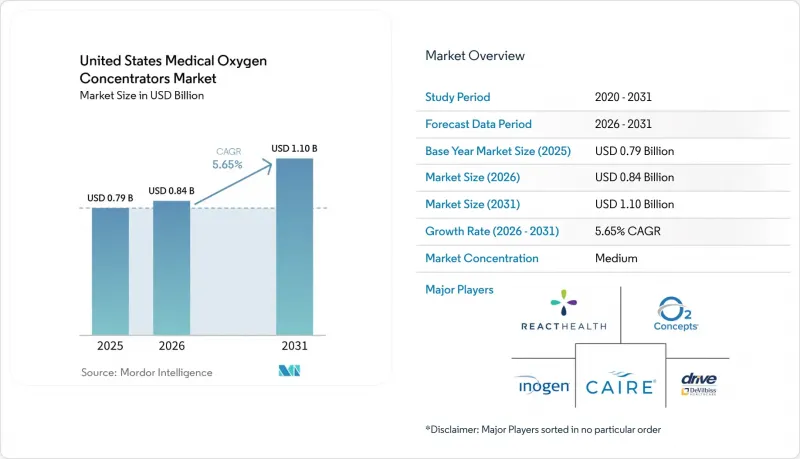
Mordor Intelligence에 의하면, 미국의 의료용 산소발생기 시장 규모는 2025년에 7억 9,000만 달러로 평가되었습니다. 2026년 8억 4,000만 달러에서 2031년까지 11억 달러에 이를 것으로 예상되며, 예측 기간(2026-2031년) CAGR은 5.65%를 나타낼 전망입니다.
본 보고서는 제품 유형(휴대형, 고정형), 기술(연속 유량형, 펄스 유량형), 치료 환경(재택치료, 병원·의료 시스템, 장기 요양 시설·특별양호노인홈(SNF), 응급 이송), 적응증(COPD, 천식, 수면 무호흡증·수면 관련 저산소혈증, 기타)별로 분류되어 있습니다. 시장 전망치는 금액(달러)으로 표시되어 있습니다.
미국의 의료용 산소발생기 시장 동향 및 인사이트
COPD로 인한 부담과 고령의 LTOT 환자층
이 시장은 COPD 분야에서 안정적인 판매량 기반을 갖추고 있지만, 더 강력한 성장 요인은 신규 발병이 아니라 고령층의 질환 중증화입니다. 2023년, COPD는 미국에서 5번째로 많은 사망 원인이었으며, 14만 1,733명의 사망자를 냈고, 45세 이상 성인의 경우 연간 240억 달러의 의료비를 발생시켰습니다. 연령별 유병률에는 현저한 차이가 나타나는데, 18-24세 성인의 경우 0.4%인 반면, 75세 이상 성인의 경우 10.5%에 달할 전망입니다. 이러한 점이 고령의 메디케어 수급자들이 연속 유량형 산소발생기의 처방 및 장기 사용에서 큰 비중을 차지하는 이유 중 하나입니다. 베이비붐 세대가 75세 이상으로 점점 더 진입함에 따라, 미국의 의료용 산소발생기 시장에서는 야간 및 주간 동안 지속적인 지원이 필요한 환자들을 위한 대용량 고정형 시스템에 대한 수요가 계속 집중될 것입니다. 고령 환자에 대한 이러한 집중은 메디케어의 보상 규정에 대한 의존도를 높이는 결과로 이어집니다. 왜냐하면 지불률이 장비, 서비스, 배송 비용을 따라가지 못할 경우, 공급업체는 제품 선택의 폭을 좁히는 경향이 있기 때문입니다. 그 결과, 판매량은 안정적이지만 고령의 장기 산소 요법(LTOT) 환자층에 대한 서비스 제공에 따른 경제적 요인으로 인해, 제품 구성에 여전히 제약이 발생할 수 있는 시장입니다.
재택 산소 요법으로의 전환
미국의 의료용 산소발생기 시장은 재택 산소 요법으로의 전환에 힘입어 지속적인 성장세를 보이고 있습니다. 재택 산소 요법은 현재 환자의 희망은 물론, 퇴원 계획과도 밀접하게 연관되어 있습니다. CMS(미국 의료보험 및 의료보조 서비스 센터)의 전국 적용 결정 240.2는 재택 산소 요법에 관한 주요 연방 적용 체계로 계속 유지되고 있으며, 2026 회계연도 재택치료에 관한 최종 규정에서는 재택 산소 요법의 제공 및 관리 방식에 영향을 미치는 공급자 관련 변경 사항도 확정되었습니다. CAIRE사가 2025년 1월에 출시한 ‘IntenOxy 5’는 바로 이러한 환경 변화를 염두에 두고 기획된 제품으로, 소비 전력은 350 W 미만, 무게는 34.2 lbs로, 두 가지 모두 재택 서비스 및 도입 비용 절감에 기여하고 있습니다. 지역별 수요도 이러한 추세를 뒷받침하고 있습니다. 2023년 중서부 및 남부 지역의 COPD 유병률은 각 지역별로 4.2%로, 전국 평균인 3.8%를 상회하고 있는데, 이는 이러한 환자들 중 상당수가 병원 접근성이 제한된 지역에 거주하고 있기 때문입니다. 또한, 지방 지역의 흡연 경향과 이러한 지역에서 금연 추진이 더딘 점도, 시설에서의 반복적인 치료보다 가정용 산소 공급 시스템이 더 적합한 광범위한 환자층이 존재한다는 사실을 더욱 뒷받침하고 있습니다. 이에 따라 미국의 의료용 산소발생기 시장은 주거용 모델과 환자 1인당 유지보수 비용을 절감하도록 설계된 제품을 중심으로 계속해서 성장하고 있습니다.
기기 및 배터리의 높은 초기 구입 비용
미국의 의료용 산소발생기 시장에서 기기를 대여하는 대신 직접 구매하는 환자들에게 소유 비용은 여전히 현실적인 장벽으로 남아 있습니다. 고급 휴대용 산소발생기의 소매 가격은 2,000-4,500달러이며, 확장 배터리 팩은 개당 200-600달러의 추가 비용이 듭니다. 따라서 많은 저소득 환자들에게 휴대용 시스템의 전체 세트는 감당하기 어려운 수준입니다. 연방 빈곤선 근처에 있는 성인층의 COPD 유병률이 8.2%에 달하는 점을 고려할 때, 이러한 비용 부담은 더욱 중요한 문제가 됩니다. 이는 경제적 부담과 임상적 요구가 종종 동일한 환자 집단 내에서 겹쳐진다는 것을 의미합니다. 대여 모델은 이러한 부담을 어느 정도 덜어주지만, 장기 이용자에게는 부담을 완전히 해소해 주는 것은 아닙니다. 이노젠사의 보고서에 따르면, 2025년에는 급여 상한선에 도달한 환자가 해당사의 서비스 이용 환자 총수의 17.6%를 차지했으며, 이는 기기 관련 지속적인 비용에 대해 확고한 구조적 보상 경로가 마련되지 않은 채 급여 상한선 이후 기간으로 넘어갈 가능성이 있는 환자 집단의 규모를 보여줍니다. 보다 광범위한 유지보수 및 추가 보상 옵션이 보편화되지 않는 한, 휴대용 제품이 개선되더라도 이러한 비용 장벽이 직접 구매 수요를 계속해서 제한할 것입니다.
부문별 분석
2025년, 휴대용 의료용 산소발생기는 미국의 의료용 산소발생기 시장 점유율의 54.31%를 차지했으며, 2031년까지 연평균 성장률(CAGR)이 7.38%에 달하고, 가장 빠르게 성장하고 있는 제품군이기도 합니다. 현재의 주도적 지위와 미래의 성장이 공존하는 이러한 상황은 이례적인 것으로, 미국의 의료용 산소발생기 시장이 얼마나 결정적으로 외래 진료로 전환되고 있는지를 보여줍니다. 수요를 지탱하고 있는 요인은 고령화되고 있음에도 여전히 활동적인 환자층, FAA(미국 연방항공청) 기준을 준수한 여행에서의 이용, 그리고 고정된 공간에서의 사용보다 일상적인 이동에 적합한 시스템을 선호하는 환자들의 경향이 확산되고 있다는 점입니다. 또한, 새로운 펄스 도즈 방식의 도입으로 휴대용 기기의 임상적 평가도 향상되어, 과거에는 많은 사례에서 고정식 장치가 선호되었던 신뢰성 격차가 줄어들고 있습니다. CAIRE사의 autoSAT 플랫폼은 『Pulmonary Therapy』지에 게재된 2025년 조지아 주립대학교의 연구 결과를 통해 그 효과가 입증되었으며, 호흡수가 높은 상황에서도 안정적인 FiO2 성능을 보여주었습니다. 이로 인해 활동적인 환자에게 휴대용 기기를 사용하는 것이 더욱 타당해졌습니다.
고정형 의료용 산소발생기는 재택치료, 장기 요양 및 전문 요양 시설에서 여전히 중요한 도입 기반을 유지하고 있습니다. 이는 많은 환자들이, 특히 야간 치료 중에 더 높은 연속 유량에 의한 지원이 필요하기 때문입니다. 미국의 의료용 산소발생기 업계에서 이러한 기반은 여전히 중요하며, 이는 고유량 가정용 사용, 체계화된 시설 관리, 그리고 환자의 이동 능력 제한과 같은 요인들이 여전히 고정식 플랫폼에 유리하게 작용하고 있기 때문입니다. 이노젠(Inogen)사가 2,720만 달러 규모의 주식 투자를 바탕으로, 유웰(Uwell)사가 개발한 ‘Voxi 5’를 통해 2025년에 고정형 기기 시장에 진출한 것은 휴대용 기기의 선두 제조업체조차도, 미국의 의료용 산소발생기 시장에서 고정형 치료법에 대한 수요가 여전히 존재한다고 보고 있음을 시사합니다. Philips사가 산소 제품 사업에서 철수한 것도, 고정형 기기의 교체 주기를 앞당기고 있습니다. 이는 구형 장비를 보유하고 있는 의료 제공업체들이 신속하게 도입할 수 있는 대체 장비가 필요하기 때문입니다. 드라이브 메디컬(Drive Medical)사의 ‘555 Compact’는 이 회사가 재출시한 ‘DeVilbiss by Drive’ 시리즈 중 미국에서 조립된 첫 번째 모델로 자리매김하고 있으며, 운송 효율을 중시하여 설계되었습니다. 팔레트당 적재 대수는 이전 모델의 27대에서 36대로 증가했으며, 이는 운송비와 서비스 비용이 엄격하게 관리되는 이 부문에서 중요한 요소입니다.
2025년 기준으로 연속 유량 기술은 미국의 의료용 산소발생기 시장 점유율의 61.24%를 유지했으나, 펄스 유량 기술은 2031년까지 연평균 성장률(CAGR) 6.22%로 더 빠르게 성장할 것으로 전망됩니다. 지속적 산소 유량은 호흡 감지에 의존하지 않고 끊김 없이 산소를 공급하기 때문에 중등도에서 중증의 만성폐쇄성폐질환(COPD) 및 야간 사용에 있어 여전히 임상적 기준으로 자리 잡고 있습니다. 이는 수면 중에 특히 중요한데, 불규칙한 호흡 패턴이나 호흡 수의 감소로 인해 일부 환자의 경우 맥박식 공급 방식의 신뢰성이 떨어질 가능성이 있기 때문입니다. 연속 유량 방식의 강점은 미국의 의료용 산소발생기 시장에서 여전히 중증도가 높고 보다 지속적인 산소 수요가 있는 환자에 대한 대응이 큰 비중을 차지하고 있다는 점도 반영하고 있습니다. 한편, 가정 내 이동형 사용이 확대되고 소형 기기의 배터리 수명이 향상되며 휴대 중량이 줄어들면서, 펄스 유량 방식도 꾸준히 시장 점유율을 확대되고 있습니다.
더 중요한 기술적 변화는 유량 모드 그 자체뿐만 아니라, 펄스식 공급 및 원격 장비 관리에 추가된 지능에 있습니다. FreeStyle Comfort에 탑재된 CAIRE사의 UltraSense 및 autoDOSE 기능은 호흡이 감지되지 않는 경우에도 산소를 공급함으로써, 허약한 환자나 호흡이 얕은 환자와 관련된 주요 임상적 우려 사항을 직접 해결합니다. GCE Healthcare사의 ‘Clarity Connected Care’ 플랫폼은 Zen-O 및 Zen-O Lite 기기에 대해 산소 순도, 배터리 상태, 사용 이력을 원격으로 확인할 수 있는 기능을 추가했으며, 이를 통해 이 기기 카테고리는 의료기기(DME) 공급업체에게 있어 보다 서비스 중심의 제안으로 변화하고 있습니다. 따라서 미국의 의료용 산소발생기 시장의 기술 경쟁은 단순히 표면적인 유량뿐만 아니라, 장기적인 공급, 치료 준수 및 기기군의 모니터링을 얼마나 일관되게 관리할 수 있는지에 초점이 맞추어지고 있습니다. 그 결과, 펄스 플로우의 성장은 기동성에 대한 수요뿐만 아니라, 과거 휴대형 사용과 연관되어 있던 것으로 여겨졌던 임상적 단점을 완화하는 보다 스마트한 공급 시스템으로 이어지고 있습니다.
기타 혜택 :
- 엑셀 형식 시장 예측(ME) 시트
- 3개월간의 애널리스트 지원
자주 묻는 질문
목차
제1장 서론
제2장 분석 방법
제3장 주요 요약
제4장 시장 구도
제5장 시장 규모 및 성장률 예측
제6장 경쟁 구도
제7장 시장 기회 및 향후 전망
KTH 26.06.29According to Mordor Intelligence, the united states medical oxygen concentrators market size was valued at USD 0.79 billion in 2025 and is estimated to grow from USD 0.84 billion in 2026 to reach USD 1.10 billion by 2031, at a CAGR of 5.65% during the forecast period (2026-2031).
This report is Segmented by Product Type (Portable, Stationary), Technology (Continuous Flow, Pulse Flow), Care Setting (Home Care, Hospitals and Health Systems, Long-Term Care and SNFs, Ambulatory Transport), Indication (COPD, Asthma, Sleep Apnea and Sleep-Related Hypoxemia, Others). The Market Forecasts are Provided in Terms of Value (USD).
United States Medical Oxygen Concentrators Market Trends and Insights
COPD Burden and Aging LTOT Population
The market has a stable volume base in COPD, but the stronger growth driver is disease severity in older adults rather than new incidence. COPD was the fifth leading cause of death in the United States in 2023, with 141,733 deaths, and it generated annual medical costs of USD 24 billion among adults aged 45 and older. The age pattern is sharp, with prevalence rising from 0.4% in adults aged 18 to 24 to 10.5% in adults aged 75 and older, which helps explain why older Medicare patients account for a large share of continuous-flow prescriptions and long-duration use. As the Baby Boom population moves further into the 75+ bracket, the United States medical oxygen concentrators market will continue to see demand clustered in patients who need higher-capacity stationary systems for overnight and sustained daytime support. This concentration in older patients also increases dependence on Medicare reimbursement rules, because providers tend to narrow product choice when payment rates do not keep pace with device, service, and delivery costs. The result is a market where volume is dependable, but product mix can still be constrained by the economics of serving a large aging LTOT population.
Shift Toward Home-Based Oxygen Therapy
The United States medical oxygen concentrators market continues to benefit from the move toward home-based oxygen therapy, which is now tied as much to discharge planning as to patient preference. CMS National Coverage Determination 240.2 remains the key federal coverage framework for home oxygen, and the CY 2026 Home Health final rule also finalized supplier-related changes that affect how home oxygen is provided and managed. CAIRE's January 2025 launch of IntenOxy 5 was positioned directly around this setting shift, with a power draw below 350 W and a weight of 34.2 lbs, both of which support lower service and deployment costs in the home. Geographic demand reinforces the same direction, because COPD prevalence in the Midwest and South was 4.2% in each region in 2023, above the national 3.8% rate, and many of these patients live in areas where hospital access is more limited. Rural smoking patterns and slower smoking cessation in those areas further support a wide patient pool that is better served by home-ready oxygen systems than by repeated facility-based care. This keeps the United States medical oxygen concentrators market centered on residential delivery models and on products built for lower servicing cost per patient.
High Upfront Device and Battery Ownership Cost
Ownership cost remains a real barrier in the United States medical oxygen concentrators market for patients who buy devices directly rather than rent them. Premium portable oxygen concentrators retail at USD 2,000 to USD 4,500, and extended battery packs add USD 200 to USD 600 per unit, which places a full portable setup beyond reach for many lower-income patients. The cost burden is more important because COPD prevalence reaches 8.2% among adults near the federal poverty level, which means financial strain and clinical need often overlap in the same patient group. The rental model softens some of that burden, but it does not eliminate it for long-term users. Inogen reported that capped patients accounted for 17.6% of its total patients on service in 2025, which shows the size of the cohort that can move into a post-cap period without a strong structural coverage pathway for ongoing device-related costs. Unless broader maintenance or supplemental coverage options become more common, this cost barrier will continue to limit direct ownership demand even as portable products improve.
Other drivers and restraints analyzed in the detailed report include:
- Portable Concentrator Adoption and Mobility Demand
- Reimbursement and Access Reform Momentum
- Reimbursement Bias Toward Basic Stationary Units
For complete list of drivers and restraints, kindly check the Table Of Contents.
Segment Analysis
Portable medical oxygen concentrators commanded 54.31% of the United States medical oxygen concentrators market share in 2025, and they are also the fastest-growing product type with a CAGR of 7.38% through 2031. That mix of current leadership and future growth is unusual and shows how decisively the United States medical oxygen concentrators market has moved toward ambulatory care. Demand is being supported by an aging but still active patient base, by FAA-compatible travel use, and by a broader patient preference for systems that fit daily movement rather than fixed-room use. Newer pulse-dose architectures have also improved the clinical standing of portable devices, which has narrowed the credibility gap that once favored stationary units in a much larger share of cases. CAIRE's autoSAT platform, supported by a 2025 Georgia State University study published in Pulmonary Therapy, showed stable FiO2 performance during higher breathing rates, which strengthens the case for portable use in more active patients.
Stationary medical oxygen concentrators still keep a meaningful installed base in home care, long-term care, and skilled nursing facilities because many patients need higher continuous-flow support, especially during overnight therapy. In the United States medical oxygen concentrators industry, that base remains important because high-flow home use, structured facility management, and limited patient mobility still favor stationary platforms. Inogen's 2025 move into stationary devices through the Yuwell-developed Voxi 5, backed by a USD 27.2 million equity investment, showed that even the leading portable specialist sees room for stationary therapy in the United States medical oxygen concentrators market. Philips' withdrawal from oxygen products has added to the stationary replacement cycle, because providers with legacy fleets need alternatives that can be deployed quickly. Drive Medical's 555 Compact, positioned as the first U.S.-assembled unit in the relaunched DeVilbiss by Drive line, was engineered for shipping efficiency with 36 units per pallet compared with 27 for the prior model, which matters in a category where freight and service costs are tightly managed.
Continuous flow technology retained 61.24% of the United States medical oxygen concentrators market share in 2025, while pulse flow is projected to grow faster at a CAGR of 6.22% through 2031. Continuous flow remains the clinical standard for moderate-to-severe COPD and for overnight use because it delivers uninterrupted oxygen without depending on breath detection. That matters during sleep, when irregular breathing patterns and lower respiratory rates can make pulse-based delivery less reliable in some patients. The strength of continuous flow also reflects how much of the United States medical oxygen concentrators market still serves patients with higher acuity and more sustained oxygen need. At the same time, pulse flow continues to gain ground as ambulatory home use expands and as smaller devices deliver better battery life and lower carrying weight.
The more important technology shift is not flow mode alone, but the intelligence added to pulse delivery and to remote fleet oversight. CAIRE's UltraSense and autoDOSE functions in the FreeStyle Comfort deliver oxygen even when no breath is detected, which directly addresses a core clinical concern around frail or shallow-breathing patients. GCE Healthcare's Clarity Connected Care platform adds remote visibility into oxygen purity, battery status, and usage history for Zen-O and Zen-O Lite devices, which turns the device category into a more service-driven proposition for DME providers. This makes technology competition in the United States medical oxygen concentrators market less about headline flow rate alone and more about how consistently delivery, adherence, and fleet monitoring can be managed over time. As a result, the growth of pulse flow is tied not only to mobility demand, but also to smarter delivery systems that reduce the clinical tradeoff once associated with portable use.
List of Companies Covered in this Report:
- 3B Medical
- AirSep (Chart Industries)
- ARYA BioMed Corp.
- Belluscura Health
- Caire
- Compass Health
- Drive DeVilbiss Healthcare
- GCE Healthcare
- Inogen
- MedaCure Inc.
- Nidek Medical Products, Inc.
- O2 Concepts, LLC
- Philips Respironics
- Precision Medical
- React Health
- Rhythm Healthcare
- Roscoe Medical
- Sunset Healthcare Solutions
Additional Benefits:
- The market estimate (ME) sheet in Excel format
- 3 months of analyst support
TABLE OF CONTENTS
1 Introduction
- 1.1 Study Assumptions & Market Definition
- 1.2 Scope of the Study
2 Research Methodology
3 Executive Summary
4 Market Landscape
- 4.1 Market Overview
- 4.2 Market Drivers
- 4.2.1 COPD Burden and Aging LTOT Population
- 4.2.2 Shift Toward Home-Based Oxygen Therapy
- 4.2.3 Portable Concentrator Adoption and Mobility Demand
- 4.2.4 Reimbursement and Access Reform Momentum
- 4.2.5 Philips Exit-Driven Replacement Cycle
- 4.2.6 Connected DME Fleet Management and Telehealth Integration
- 4.3 Market Restraints
- 4.3.1 High Upfront Device and Battery Ownership Cost
- 4.3.2 Reimbursement Bias Toward Basic Stationary Units
- 4.3.3 Post-Recall Regulatory Scrutiny and Supplier Qualification Delays
- 4.3.4 Portable Clinical Limits for High-Flow and Nocturnal Patients
- 4.4 Supply-Chain Analysis
- 4.5 Regulatory Landscape
- 4.6 Technological Outlook
- 4.7 Porter's Five Forces
- 4.7.1 Threat of New Entrants
- 4.7.2 Bargaining Power of Suppliers
- 4.7.3 Bargaining Power of Buyers
- 4.7.4 Threat of Substitutes
- 4.7.5 Industry Rivalry
5 Market Size & Growth Forecasts (Value, USD)
- 5.1 By Product Type
- 5.1.1 Portable Medical Oxygen Concentrators
- 5.1.2 Stationary Medical Oxygen Concentrators
- 5.2 By Technology
- 5.2.1 Continuous Flow
- 5.2.2 Pulse Flow
- 5.3 By Care Setting
- 5.3.1 Home Care
- 5.3.2 Hospitals and Health Systems
- 5.3.3 Long-Term Care and Skilled Nursing Facilities
- 5.3.4 Ambulatory Transport and Transitional Care
- 5.4 By Indication
- 5.4.1 Chronic Obstructive Pulmonary Disease
- 5.4.2 Asthma
- 5.4.3 Sleep Apnea and Sleep-Related Hypoxemia
- 5.4.4 Other Indications
6 Competitive Landscape
- 6.1 Market Concentration
- 6.2 Market Share Analysis
- 6.3 Company Profiles {(includes Global level Overview, Market level overview, Core Segments, Financials as available, Strategic Information, Market Rank/Share for key companies, Products & Services, and Recent Developments)}
- 6.3.1 3B Medical
- 6.3.2 AirSep (Chart Industries)
- 6.3.3 ARYA BioMed Corp.
- 6.3.4 Belluscura Health
- 6.3.5 CAIRE Inc.
- 6.3.6 Compass Health Brands
- 6.3.7 Drive DeVilbiss Healthcare
- 6.3.8 GCE Healthcare
- 6.3.9 Inogen, Inc.
- 6.3.10 MedaCure Inc.
- 6.3.11 Nidek Medical Products, Inc.
- 6.3.12 O2 Concepts, LLC
- 6.3.13 Philips Respironics
- 6.3.14 Precision Medical, Inc.
- 6.3.15 React Health
- 6.3.16 Rhythm Healthcare
- 6.3.17 Roscoe Medical
- 6.3.18 Sunset Healthcare Solutions
7 Market Opportunities & Future Outlook
- 7.1 White-space & unmet-need assessment


