

|
시장보고서
상품코드
2065562
비디오 인터뷰 플랫폼 시장 : 시장 점유율 분석, 업계 동향 및 통계, 성장 예측(2026-2031년)Video Interviewing Platform - Market Share Analysis, Industry Trends & Statistics, Growth Forecasts (2026 - 2031) |
||||||
 Mordor Intelligence
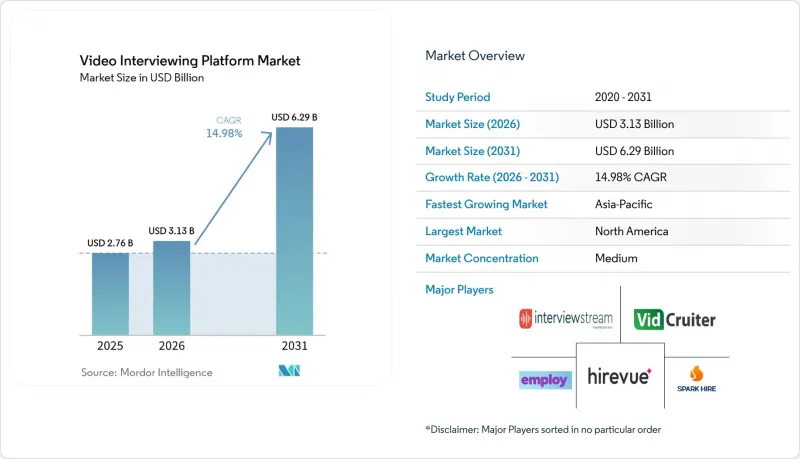
Mordor Intelligence에 의하면, 비디오 인터뷰 플랫폼 시장 규모는 2025년에 27억 6,000만 달러로 평가되었고, 2026년 31억 3,000만 달러로 추정되고, 2031년까지 62억 9,000만 달러에 이를 것으로 예측되며, 예측 기간(2026-2031년) CAGR은 14.98%를 나타낼 전망입니다.
본 보고서는 플랫폼 인터페이스별(웹 기반 플랫폼, 모바일 애플리케이션), 배포 모델별(클라우드 기반, 온프레미스, 하이브리드), 조직 규모별(중소기업, 대기업), 최종 사용자 산업별(IT 및 통신, 은행, 금융서비스 및 보험(BFSI), 의료, 소매, 인력 파견, 교육, 정부, 제조, 기타), 지역별로 분류되어 있습니다. 시장 전망은 금액(달러) 기준으로 제시되어 있습니다.
세계의 비디오 인터뷰 플랫폼 시장 동향 및 인사이트
기업들의 체계적인 원격 채용으로의 전환
비디오 인터뷰 플랫폼 시장은 비공식적인 온라인 면접에서 벗어나, 고용주가 다수의 지원자에게 일관되게 적용할 수 있는 체계화된 원격 채용 시스템으로의 꾸준한 전환에 힘입어 성장하고 있습니다. 분산형 근무 방식의 확산으로 근무지에 구애받지 않는 채용이 일반화되면서, 그 결과 고용주는 면접관이나 시간대에 따라 달라지는 실시간 화상 통화에 의존하기보다는 질문, 평가 기준, 평가 자료 수집을 표준화해야 할 필요에 직면해 있습니다. 현재 대기업들은 모든 지원자가 동일한 절차를 거치도록 요구하고 있으며, 이로 인해 규제가 엄격한 업계나 여러 지역에서 진행되는 채용 프로그램에서 체계화된 비디오 워크플로의 유용성이 높아지고 있습니다. 최근 몇 년간 고용주들은 채용 활동에서 인공지능(AI) 도입을 가속화하고 있으며, 많은 조직이 AI를 채용 과정에 통합하고 있습니다. 이러한 추세는 더욱 체계화되고 기술 중심의 채용 프레임워크로의 광범위한 전환을 반영하고 있으며, 자동화, 후보자 인텔리전스, 예측 분석이 인재 확보 전략의 필수 요소로 자리 잡고 있습니다. 이러한 변화로 인해 비디오 인터뷰 플랫폼 시장에 대한 구매자들의 기대도 변화하고 있습니다. 왜냐하면, 이제 요구되는 것은 더 이상 기본적인 비디오 연결 기능이 아니라, 평가 기준을 관리하고, 기록을 저장하며, 재현 가능한 평가를 지원할 수 있는 시스템이기 때문입니다. 화상 인터뷰 플랫폼 시장이 단순한 면접의 편의성을 넘어 프로세스 관리와 감사 가능성으로 전환되는 가운데, 기업 규모에 맞추어 표준화된 워크플로를 제공하지 못하는 벤더는 그 존재 가치를 점차 잃어가고 있습니다.
더 신속한 심사 및 채용 기간 단축에 대한 수요
비디오 인터뷰 플랫폼 시장은 특히 채용이 어려운 직종에서 여러 경쟁사의 채용 제안이 들어올 경우, 초기 단계의 심사 지연을 단축하고자 하는 고용주들의 요구에 힘입어 성장하고 있습니다. 비동기식 면접을 통해 채용 담당자와 지원자의 일정을 별도로 조정할 수 있으므로, 팀은 더 많은 지원자를 동시에 심사하고, 지원자의 관심이 식기 전에 유망한 지원자를 다음 단계로 진행할 수 있게 됩니다. 이러한 일정의 유연성은 속도가 고용주가 채용 제안 단계에 도달할 수 있는지 여부를 좌우하는 경우가 많은 기술, 의료 및 기타 인력 부족 분야에서 가장 중요합니다. SmartRecruiters는 2025-2026년 채용 벤치마크 보고서에서 성과가 뛰어난 채용 팀들 사이에서 체계화된 스코어카드의 도입이 거의 보편화되고 있다고 보고하고 있습니다. 이는 현대의 채용 업무에서 표준화와 속도가 점점 더 밀접하게 연관되어 있음을 보여줍니다. 이러한 비즈니스상의 효과는 단순히 일정 효율화에 그치지 않습니다. 왜냐하면 1차 전형의 신속화는 지원자들의 반응에 박차를 가하고, 각 단계 간의 대기 시간을 단축하며, 채용 담당자가 여러 이해관계자와의 마찰을 최소화하면서 의사결정을 조율하는 데 도움이 되기 때문입니다. 비디오 인터뷰 플랫폼 시장이 성숙해짐에 따라, 비동기식 선발 과정과 내장형 평가 구조, AI를 활용한 요약 기능을 결합한 업체들이, 여전히 수기 메모나 비정형화된 평가로 인해 발생하는 시간적 격차를 해소하고 있습니다.
AI 채용에 따른 규정 준수 및 편향성 감사에 대한 부담 증가
규제 준수 관련 압박은 비디오 인터뷰 플랫폼 시장에서 가장 뚜렷한 제약 요인 중 하나이며, 특히 북미와 유럽에서 사업을 영위하는 구매자 및 공급업체에게 해당됩니다. 뉴욕시 지방법 제144호에 따르면, 자동화된 채용 결정 도구에 대해 연 1회 독립적인 편향성 감사를 실시하고, 그 결과를 공개하며, 후보자에게 사전에 통지해야 할 의무가 부과되어 있으며, 이에 따라 거버넌스와 문서화가 일반적인 플랫폼 평가의 일부가 되었습니다. EU의 AI 법안은 여기에 또 다른 요건을 추가하고 있습니다. 고위험 AI로 분류되는 채용 시스템은 2026년 8월부터 전면적으로 적용되는 적합성, 문서화 및 시판 후 모니터링 의무를 충족해야 합니다. 이러한 규정은 도입을 막는 것은 아니지만, 조달 심사를 장기화시키고 제품의 정당성을 입증하기 위한 장벽을 높이고 있습니다. 특히, 소규모 공급업체가 성숙한 거버넌스 관리 체계를 갖추지 못한 경우에는 그 영향이 두드러집니다. 구매자들은 현재 감사 로그, 수동 검토 단계, 평가 기준에 연동된 채점, 그리고 개별 정책 문서가 아닌 제품 내부에서의 명확한 설명 책임을 기대하고 있습니다. 따라서 비디오 인터뷰 플랫폼 시장의 제약 요인은 규제상의 금지보다는 채용 시스템이 안전하고 설명 가능하며 채용 목적에 적합함을 입증하기 위해 드는 비용과 복잡성이 증가하는 데 기인한다고 할 수 있습니다.
부문별 분석
2025년에는 웹 기반 플랫폼이 시장의 57.98%를 차지했으며, 비디오 인터뷰 플랫폼 시장 전체에서 브라우저를 통한 접속이 주요 운영 모델로서의 위상을 유지했습니다. 이러한 장점은 기존 ATS(채용 관리 시스템)의 워크플로우에 부합하며, 별도의 기기 설치 없이 데스크톱에서 바로 이용할 수 있는 심사 환경을 기업의 채용 담당자나 채용 관리자가 선호하는 경향을 반영하고 있습니다. 또한, 많은 대기업에서는 관리 대상 기기에 앱을 설치하는 것에 대해 보다 엄격한 관리를 실시하고 있기 때문에 브라우저를 통한 제공은 사내 IT 정책과의 부합성도 높아집니다. 그런 의미에서 자동화 및 규정 준수에 대한 구매자의 기대가 계속해서 높아지는 상황에서도 웹 액세스는 비디오 인터뷰 플랫폼 시장의 안정적인 핵심 요소로 자리 잡고 있습니다. 이 형식은 휴대성보다는 화면 크기, 멀티태스킹 기능, 보고서의 가시성이 중시되는 채용 담당자의 심사, 패널 조정, 평가 기록 관리에 특히 유용합니다.
한편, 모바일은 비디오 인터뷰 플랫폼 시장의 후보자 측을 빠른 속도로 변화시키고 있으며, 모바일 애플리케이션는 2031년까지 연평균 성장률(CAGR) 15.37%로 성장할 것으로 전망됩니다. 이러한 성장은 현장 업무 종사자, 시급제 근로자, 원격지 채용 프로그램의 비중이 높아지고 있음을 반영하며, 구직자들은 구인 검색이나 1차 전형 과정에서 점점 더 스마트폰을 기본 수단으로 활용하고 있습니다. 중요한 변화는 단순히 작은 화면에서도 면접이 가능해졌습니다는 점뿐만 아니라, 완료율이 모바일 지원 녹화 기능, 짧은 로딩 시간, 그리고 로그인 시의 번거로움을 최소화함으로써 크게 좌우되게 되었습니다는 점에 있습니다. 앱 다운로드 요건을 줄이고 브라우저에서 원활하게 녹화할 수 있는 플랫폼은 책상에 앉아 있지 않거나 노트북에 쉽게 접근할 수 없는 구직자층에게 더 적합합니다. 이로 인해 비디오 인터뷰 플랫폼 업계에는 구조적인 불균형이 발생하고 있습니다. 그 이유는 채용 담당자의 업무 흐름이 여전히 웹 접속에 치우쳐 있는 반면, 구직자의 경험은 ‘모바일 우선’ 설계 방식에 따라 점점 더 형성되고 있기 때문입니다.
2025년에는 클라우드 기반 도입이 시장의 61.24%를 차지했으며, 도입 모델별로는 화상 인터뷰 플랫폼 시장에서 가장 큰 점유율을 기록했습니다. 또한, 해당 부문은 2031년까지 연평균 성장률(CAGR) 14.88%를 기록하며 성장할 것으로 전망되는데, 이는 클라우드 도입이 단순히 기존 고객 기반을 유지할 뿐만 아니라 여전히 확대되고 있음을 보여줍니다. 구매자들은 하드웨어 조달을 피할 수 있고, 업그레이드 주기를 단축할 수 있으며, 도입 규모에 따라 유연하게 대응할 수 있는 가격 모델을 이용할 수 있기 때문에 계속해서 클라우드 서비스를 선호하고 있습니다. 이러한 장점은 계절, 프로젝트 또는 사업 확장 단계에 따라 채용 수요가 급격히 변동하는 경우에 중요해집니다. 또한, 클라우드 아키텍처를 통해 비디오 인터뷰 플랫폼 시장공급업체들은 고객 측의 업그레이드 주기를 기다릴 필요 없이 새로운 AI 기능, 워크플로우 조정, 규정 준수 관리 기능을 손쉽게 제공할 수 있게 됩니다.
하이브리드 방식은 데이터 저장 위치에 대한 우려나 내부 거버넌스 규정으로 인해 클라우드로의 완전한 전환이 어려운, 규제가 엄격한 환경에서 여전히 그 역할을 수행하고 있습니다. 온프레미스 모델은 정부 기관이나 방위 관련 분야의 일부 도입 사례에서는 여전히 중요하지만, 비디오 인터뷰 플랫폼 시장 전체의 신규 도입 결정에 있어서는 그 기세를 잃어가고 있습니다. 현재, 진정한 경쟁의 분수령은 소프트웨어가 어디에서 호스팅되는가 하는 점보다는 그 호스팅 모델이 생태계 참여를 어느 정도 효과적으로 지원할 수 있는가에 있습니다. 2026년 HireVue가 Workday와 제휴한 것은 클라우드 네이티브 설계가 연동된 인사 워크플로우 전반에 걸쳐 보다 긴밀한 연동을 위한 기본 요건으로서 그 중요성이 점점 더 커지고 있음을 보여줍니다. 이러한 추세가 확산됨에 따라, 클라우드 우선 제품을 보유한 벤더들은 기존 인프라를 기반으로 한 도입 모델보다 통합, 자동화, 지역별 규정 준수 설정 측면에서 신속하게 대응할 수 있으므로, 계속해서 유리한 입지를 유지할 것으로 보입니다.
지역별 분석
2025년, 북미는 화상 인터뷰 플랫폼 시장 점유율의 44.36%를 차지했으며, 이러한 우위는 기업들의 조기 도입, 탄탄한 공급업체 기반, 그리고 디지털 채용 도구에 대한 고용주들의 이해도가 더 높기 때문인 것으로 분석됩니다. 미국은 여전히 지역 수요의 중심지 역할을 하고 있습니다. 이는 기술, 금융 서비스, 헬스케어 업계의 고용주들이 채용까지 걸리는 기간 단축과 체계적인 원격 전형을 일반적인 인재 확보 업무의 일환으로 정착시키고 있기 때문입니다. 캐나다 역시 이와 유사한 기업 도입 경로를 따르고 있는 반면, 멕시코는 원격 사전 심사 의존도가 높아지고 있는 니어쇼어 제조 및 기술 서비스와 관련된 채용 확대의 혜택을 누리고 있습니다. 규제의 명확화 또한 북미의 위상을 강화하고 있습니다. 이는 해당 지역의 고용주들이 AI를 활용한 채용 시스템의 편향성 감사, 통지 및 거버넌스 요건을 평가하는 경험을 쌓아왔기 때문입니다. 유럽은 비디오 인터뷰 플랫폼 시장에서 여전히 2위를 차지하고 있으며, 독일, 영국, 프랑스에서의 도입이 순조롭게 진행되고 있습니다. 이들 국가에서는 기업의 채용 팀이 ‘비디오 퍼스트’ 워크플로우로 점차 정착해 가고 있습니다.
유럽의 동향은 수요 증가와 마찬가지로 컴플라이언스 아키텍처에 의해서도 형성되고 있습니다. GDPR(EU 개인정보보호규정)의 의무는 녹화된 면접 워크플로우 전반에 걸친 동의, 저장, 보존, 처리 방식에 영향을 미치고 있으며, 이는 공급업체의 설계와 구매자의 선정 모두에 영향을 주고 있습니다. EU AI법은 현재 설명 가능성, 문서화, 모니터링을 고위험 시스템 시장 진입 핵심 요건으로 삼음으로써, 고용 관련 AI에 대한 기대치를 한층 더 엄격하게 하고 있습니다. 이러한 조건으로 인해 유럽의 화상 인터뷰 플랫폼 시장은 강력한 워크플로우 기능과 신뢰할 수 있는 거버넌스 관리 기능을 모두 갖춘 공급업체를 선호하는 추세로 나아가고 있습니다. 또한, 서유럽 주요 경제권 이외의 지역에서도 도입이 용이하도록 언어 지원, 가격 책정, 규정 준수 기능을 지역화한 점도 해당 지역의 성장을 뒷받침하고 있습니다.
아시아태평양은 연평균 성장률(CAGR) 15.93%로 확대될 것으로 예상되며, 2031년까지 화상 인터뷰 플랫폼 시장에서 가장 빠르게 성장하는 지역이 될 전망입니다. 이러한 성장은 인도의 신입사원 및 전문직 채용 규모가 크고, 동남아시아에서 클라우드 기반 인사 관리 도구의 도입이 확대되고 있으며, 국경을 초월한 채용을 위한 다국어 워크플로우에 대한 관심이 높아지고 있는 데 힘입은 것입니다. 싱가포르, 인도네시아, 베트남 등 시장에서는 분산된 채용 프로그램을 보다 효율적으로 관리해야 할 필요성 덕분에 혜택을 보고 있는 반면, 호주, 뉴질랜드, 일본, 한국, 중국에서는 기업의 현대화와 AI 도입이 다양한 형태로 결합되면서 해당 지역 수요 기반을 확대되고 있습니다. 남미, 중동 및 아프리카는 절대적인 규모로 보면 여전히 작지만, 고용주들이 채용 프로세스의 디지털화를 추진하며 언어, 지역, 인프라의 격차를 넘어 보다 일관된 선발 과정을 추구함에 따라 화상 면접 플랫폼 시장은 확대되고 있습니다. 남미에서는 브라질과 아르헨티나가 수요를 주도하고 있으며, 아랍에미리트와 사우디아라비아는 AI를 활용한 인사 시스템에 투자하고 있습니다. 또한, 아프리카의 일부 지역에서는 대역폭 품질이나 기기 제한으로 인해 여전히 광범위한 도입이 저해되고 있음에도 불구하고, 조기 도입이 진행되고 있습니다.
기타 혜택 :
- 엑셀 형식 시장 예측(ME) 시트
- 3개월간의 애널리스트 지원
자주 묻는 질문
목차
제1장 서론
제2장 조사 방법
제3장 주요 요약
제4장 시장 구도
제5장 시장 규모 및 성장 예측
제6장 경쟁 구도
제7장 시장 기회 및 향후 전망
AJY 26.06.26According to Mordor Intelligence, the video interviewing platform market size was valued at USD 2.76 billion in 2025 and estimated to grow from USD 3.13 billion in 2026 to reach USD 6.29 billion by 2031, at a CAGR of 14.98% during the forecast period (2026-2031).
This report is Segmented by Platform Interface (Web-Based Platforms, and Mobile Applications), Deployment Model (Cloud-Based, On-Premises, and Hybrid), Organization Size (SMEs, and Large Enterprises), End-User Industry (IT and Telecom, BFSI, Healthcare, Retail, Staffing, Education, Government, Manufacturing, and More), and Geography. The Market Forecasts are Provided in Terms of Value (USD).
Global Video Interviewing Platform Market Trends and Insights
Enterprise Shift To Structured Remote Hiring
The video interviewing platform market is being lifted by the steady move from informal virtual interviewing to structured remote hiring systems that employers can apply consistently across large candidate pools. Distributed work has made location-flexible recruiting normal, and that has pushed employers to standardize questions, evaluation criteria, and evidence capture instead of depending on live calls that vary by interviewer and time slot. Large organizations now want every candidate to move through the same process, which makes structured video workflows more useful in regulated sectors and multi-site hiring programs. In recent years, employers have increasingly adopted artificial intelligence in recruitment, with numerous organizations integrating AI into their hiring processes. This trend reflects a broader transition toward a more structured and technology-driven recruitment framework, where automation, candidate intelligence, and predictive analytics have become integral to talent acquisition strategies. This shift is changing what buyers expect from the video interviewing platform market, because the requirement is no longer basic video connectivity but a system that can hold rubrics, preserve records, and support repeatable evaluation. Vendors that cannot deliver standardized workflows at enterprise scale are losing relevance as the video interviewing platform market moves toward process control and auditability instead of simple interview convenience
Demand For Faster Screening and Lower Time-To-Hire
The video interviewing platform market is also benefiting from employer pressure to reduce early-stage screening delays, especially where hard-to-fill roles attract multiple competing offers. Asynchronous interviewing separates recruiter availability from candidate availability, which lets teams review more applicants in parallel and move stronger candidates forward before interest fades. That scheduling flexibility matters most in technology, healthcare, and other labor-tight fields where speed often determines whether an employer even reaches the offer stage. SmartRecruiters reported in its 2025-2026 recruiting benchmarks that structured scorecard adoption is now close to universal among high-performing hiring teams, which shows how standardization and speed are increasingly linked in modern recruitment operations. The commercial effect is broader than calendar efficiency, because a faster first screen improves response momentum, reduces idle time between steps, and helps recruiters coordinate decisions across several stakeholders with less friction. As the video interviewing platform market matures, vendors that combine async screening with built-in review structure and AI-assisted summaries are closing the remaining time gaps that manual note-taking and unstructured review still create.
Rising AI Hiring Compliance And Bias Audit Burden
Compliance pressure is one of the clearest checks on the video interviewing platform market, especially for buyers and vendors operating across North America and Europe. New York City's Local Law 144 requires annual independent bias audits for automated employment decision tools, public disclosure of results, and advance notice to candidates, which has made governance and documentation part of normal platform review. The EU AI Act adds another layer, because recruitment systems classified as high-risk AI must meet conformity, documentation, and post-market monitoring obligations that became fully applicable in August 2026. These rules do not stop adoption, but they do lengthen procurement reviews and raise the threshold for product defensibility, especially when smaller vendors cannot show mature governance controls. Buyers now expect audit logs, human review checkpoints, rubric-linked scoring, and clear accountability inside the product rather than in separate policy documents. The restraint on the video interviewing platform market, therefore, comes less from regulatory prohibition and more from the rising cost and complexity of proving that a hiring system is safe, explainable, and fit for employment use.
Other drivers and restraints analyzed in the detailed report include:
- ATS And HRIS Integration as a Buying Prerequisite
- Adoption Of AI-Assisted Summaries And Interview Intelligence
- Integration Complexity With Legacy HR Tech Stacks
For complete list of drivers and restraints, kindly check the Table Of Contents.
Segment Analysis
Web-based platforms held 57.98% of the market in 2025, which kept browser access as the main operating model across the video interviewing platform market. That lead reflects the preference of enterprise recruiters and hiring managers for desktop review environments that fit existing ATS workflows and do not require additional device-level installation. Browser delivery also aligns better with internal IT policies, because many large organizations place tighter controls on app installation across managed devices. In that sense, web access remains the stable operating center of the video interviewing platform market even as buyer expectations around automation and compliance continue to rise. The format is especially useful for recruiter-side review, panel coordination, and evaluation record keeping, where screen size, multitasking, and reporting visibility matter more than portability.
Mobile, however, is reshaping the candidate side of the video interviewing platform market at a faster pace, and mobile applications are projected to grow at a 15.37% CAGR through 2031. That growth reflects the rising share of frontline, hourly, and distributed hiring programs where candidates increasingly default to smartphones for job search activity and first-stage screening. The important shift is not simply that interviews can happen on smaller screens, it is that completion rates depend more heavily on mobile-friendly recording, short load times, and minimal sign-in friction. Platforms that reduce app-download requirements and offer smooth in-browser capture are better positioned for candidate populations that do not sit at desks or have easy access to laptops. This has created a structural asymmetry in the video interviewing platform industry, because recruiter workflows still lean toward web access while candidate experience is increasingly shaped by mobile-first design choices.
Cloud-based deployment accounted for 61.24% of the market in 2025, giving it the largest position in the video interviewing platform market by deployment model. The same segment is also projected to grow at a 14.88% CAGR through 2031, which shows that cloud adoption is still widening rather than simply defending an installed base. Buyers continue to prefer cloud delivery because it avoids hardware provisioning, shortens upgrade cycles, and supports pricing models that can flex with hiring volume. Those advantages matter when recruitment demand changes quickly across seasons, projects, or expansion phases. Cloud architecture also makes it easier for vendors in the video interviewing platform market to push new AI features, workflow adjustments, and compliance controls without waiting for a customer-side upgrade cycle.
Hybrid deployment still has a place in highly regulated environments where data residency concerns or internal governance rules complicate full migration to the cloud. On-premises models remain relevant in parts of government and defense-related hiring, but they are losing momentum in new buying decisions across the broader video interviewing platform market. The real competitive divide is now less about where software is hosted and more about how well that hosting model supports ecosystem participation. HireVue's Workday partnership in 2026 showed that cloud-native design increasingly serves as the base requirement for deeper orchestration across connected HR workflows. As that pattern spreads, vendors with cloud-first products will continue to hold the stronger position because they can move faster on integration, automation, and regional compliance configuration than deployment models built around older infrastructure.
Geography Analysis
North America held 44.36% of the video interviewing platform market share in 2025, and that lead came from early enterprise adoption, a deep vendor base, and more developed employer familiarity with digital hiring tools. The United States remains the center of regional demand because technology, financial services, and healthcare employers have made time-to-hire reduction and structured remote screening part of normal talent acquisition practice. Canada is moving on a similar enterprise adoption path, while Mexico is benefiting from hiring growth tied to nearshore manufacturing and technology services that increasingly rely on remote pre-screening. Regulatory clarity also strengthens North America's position, because employers there are becoming more practiced at evaluating bias audit, notice, and governance requirements in AI-assisted hiring systems. Europe remains the second-largest region in the video interviewing platform market, with strong adoption in Germany, the United Kingdom, and France, where enterprise talent acquisition teams have matured into more video-first workflows.
Europe's path is being shaped as much by compliance architecture as by demand expansion. GDPR obligations influence how platforms handle consent, storage, retention, and processing across recorded interview workflows, which affects both vendor design and buyer selection. The EU AI Act is now further tightening expectations around employment-related AI by making explainability, documentation, and monitoring central to market access for higher-risk systems. These conditions are pushing the video interviewing platform market in Europe toward vendors that can combine strong workflow capability with credible governance controls. Regional growth is also being helped by localization of language support, pricing, and compliance features that make adoption easier beyond the largest Western European economies.
Asia-Pacific is projected to advance at a 15.93% CAGR, making it the fastest-growing regional block in the video interviewing platform market through 2031. Growth is being supported by India's scale of graduate and professional hiring, Southeast Asia's rising adoption of cloud HR tools, and stronger interest in multilingual workflows for cross-border recruitment. Markets such as Singapore, Indonesia, and Vietnam are benefiting from the need to manage distributed hiring programs more efficiently, while Australia, New Zealand, Japan, South Korea, and China broaden the region's demand base through different mixes of enterprise modernization and AI adoption. South America, the Middle East, and Africa remain smaller in absolute terms, but the video interviewing platform market is expanding there as employers digitize recruitment and seek more consistent screening across language, location, and infrastructure gaps. Brazil and Argentina lead South American demand, the United Arab Emirates and Saudi Arabia are investing in AI-enabled HR systems, and parts of Africa are showing early adoption even though bandwidth quality and device limitations still restrain broader rollout.
- HireVue, Inc.
- Employ, Inc.
- VidCruiter Inc.
- Spark Hire, Inc.
- interviewstream, Inc.
- Talview Inc.
- iCIMS, Inc.
- Radancy, Inc.
- SHL Group Limited
- Harver B.V.
- Jobma, Inc.
- Phenom People, Inc.
- TestGorilla B.V.
- Cangrade, Inc.
- Kira Talent, Inc.
- Recright Oy
- Willo Technologies Ltd.
- ClearCompany, LLC
- Yello.co, Inc.
- Wamly (Pty) Ltd.
Additional Benefits:
- The market estimate (ME) sheet in Excel format
- 3 months of analyst support
TABLE OF CONTENTS
1 INTRODUCTION
- 1.1 Study Assumptions and Market Definition
- 1.2 Scope of the Study
2 RESEARCH METHODOLOGY
3 EXECUTIVE SUMMARY
4 MARKET LANDSCAPE
- 4.1 Market Overview
- 4.2 Impact of Macroeconomic Factors on the Market
- 4.3 Market Drivers
- 4.3.1 Enterprise Shift to Structured Remote Hiring
- 4.3.2 Demand for Faster Screening and Lower Time-to-Hire
- 4.3.3 ATS and HRIS Integration as a Buying Prerequisite
- 4.3.4 Adoption of AI-Assisted Summaries and Interview Intelligence
- 4.3.5 Demand for Audit-Ready Human Oversight Workflows
- 4.3.6 Growth of Cross-Border and Multilingual Hiring Programs
- 4.4 Market Restraints
- 4.4.1 Rising AI Hiring Compliance and Bias Audit Burden
- 4.4.2 Integration Complexity With Legacy HR Tech Stacks
- 4.4.3 Candidate Drop-Off From One-Way Interview Fatigue
- 4.4.4 Reliability Gaps in Low-Bandwidth and Low-Device-Quality Environments
- 4.5 Industry Value Chain Analysis
- 4.6 Regulatory Landscape
- 4.7 Technological Outlook
- 4.8 Porter's Five Forces Analysis
- 4.8.1 Threat of New Entrants
- 4.8.2 Bargaining Power of Buyers
- 4.8.3 Bargaining Power of Suppliers
- 4.8.4 Threat of Substitutes
- 4.8.5 Intensity of Competitive Rivalry
5 MARKET SIZE AND GROWTH FORECASTS (VALUE)
- 5.1 By Platform Interface
- 5.1.1 Web-Based Platforms
- 5.1.2 Mobile Applications
- 5.2 By Deployment Model
- 5.2.1 Cloud-Based
- 5.2.2 On-Premises
- 5.2.3 Hybrid
- 5.3 By Organization Size
- 5.3.1 Small Medium Enterprises (SMEs)
- 5.3.2 Large Enterprises
- 5.4 By End-User Industry
- 5.4.1 IT and Telecom
- 5.4.2 BFSI
- 5.4.3 Healthcare and Life Sciences
- 5.4.4 Retail and E-Commerce
- 5.4.5 Staffing and Recruiting
- 5.4.6 Education and University Admissions
- 5.4.7 Government and Public Sector
- 5.4.8 Manufacturing
- 5.4.9 Other End-User Industries
- 5.5 By Geography
- 5.5.1 North America
- 5.5.1.1 United States
- 5.5.1.2 Canada
- 5.5.1.3 Mexico
- 5.5.2 South America
- 5.5.2.1 Brazil
- 5.5.2.2 Argentina
- 5.5.2.3 Rest of South America
- 5.5.3 Europe
- 5.5.3.1 Germany
- 5.5.3.2 United Kingdom
- 5.5.3.3 France
- 5.5.3.4 Italy
- 5.5.3.5 Spain
- 5.5.3.6 Russia
- 5.5.3.7 Rest of Europe
- 5.5.4 Asia-Pacific
- 5.5.4.1 China
- 5.5.4.2 India
- 5.5.4.3 Japan
- 5.5.4.4 South Korea
- 5.5.4.5 Australia and New Zealand
- 5.5.4.6 Southeast Asia
- 5.5.4.7 Rest of Asia-Pacific
- 5.5.5 Middle East
- 5.5.5.1 Saudi Arabia
- 5.5.5.2 United Arab Emirates
- 5.5.5.3 Turkey
- 5.5.5.4 Israel
- 5.5.5.5 Rest of Middle East
- 5.5.6 Africa
- 5.5.6.1 South Africa
- 5.5.6.2 Egypt
- 5.5.6.3 Nigeria
- 5.5.6.4 Kenya
- 5.5.6.5 Rest of Africa
- 5.5.1 North America
6 COMPETITIVE LANDSCAPE
- 6.1 Market Concentration
- 6.2 Strategic Moves
- 6.3 Market Share Analysis
- 6.4 Company Profiles (includes Global Level Overview, Market Level Overview, Core Segments, Financials as available, Strategic Information, Market Rank/Share, Products and Services, Recent Developments)
- 6.4.1 HireVue, Inc.
- 6.4.2 Employ, Inc.
- 6.4.3 VidCruiter Inc.
- 6.4.4 Spark Hire, Inc.
- 6.4.5 interviewstream, Inc.
- 6.4.6 Talview Inc.
- 6.4.7 iCIMS, Inc.
- 6.4.8 Radancy, Inc.
- 6.4.9 SHL Group Limited
- 6.4.10 Harver B.V.
- 6.4.11 Jobma, Inc.
- 6.4.12 Phenom People, Inc.
- 6.4.13 TestGorilla B.V.
- 6.4.14 Cangrade, Inc.
- 6.4.15 Kira Talent, Inc.
- 6.4.16 Recright Oy
- 6.4.17 Willo Technologies Ltd.
- 6.4.18 ClearCompany, LLC
- 6.4.19 Yello.co, Inc.
- 6.4.20 Wamly (Pty) Ltd.
7 MARKET OPPORTUNITIES AND FUTURE OUTLOOK
- 7.1 White-Space and Unmet-Need Assessment


