

|
시장보고서
상품코드
2065564
HR용 AI 편향 감사 및 알고리즘 공정성 시장 : 시장 점유율 분석, 업계 동향 및 통계, 성장 예측(2026-2031년)AI Bias Audit And Algorithmic Fairness In HR - Market Share Analysis, Industry Trends & Statistics, Growth Forecasts (2026 - 2031) |
||||||
 Mordor Intelligence
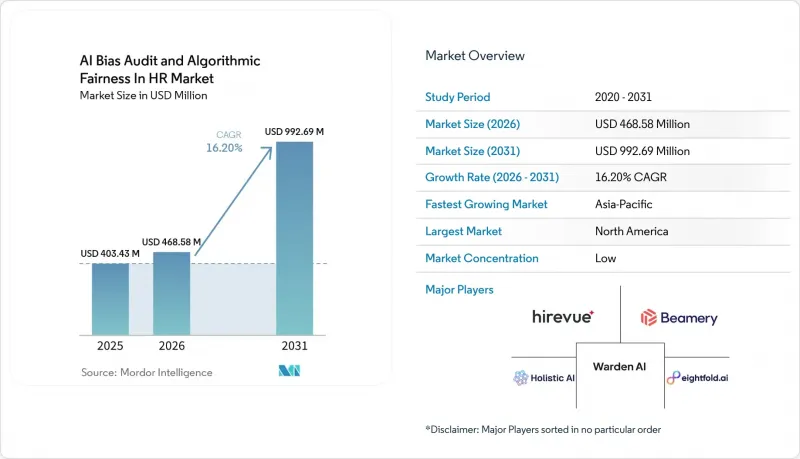
Mordor Intelligence에 의하면, HR용 AI 편향 감사 및 알고리즘 공정성 시장 규모는 2025년에 4억 343만 달러로 평가되었고, 2031년까지 9억 9,269만 달러에 이를 것으로 예측되며, 2026-2031년 CAGR 16.20%로 성장할 전망입니다.
본 보고서는 구성 요소별(소프트웨어 및 서비스), HR 워크플로우별(후보자 선별·순위 매기기 등), 배포 방식별(클라우드 기반, 온프레미스형, 하이브리드형), 조직 규모별(대기업, 중소기업), 최종 사용자 산업 분야별(소매 및 전자상거래 등), 지역별로 분류되어 있습니다. 시장 전망은 금액(달러) 기준으로 제시되어 있습니다.
세계의 HR용 AI 편향 감사 및 알고리즘 공정성 시장 동향과 인사이트
규제 강화에 따른 자동화된 채용 결정 도구에 대한 편향성 감사 확대
뉴욕시가 자동화된 채용 결정 도구에 대한 독립적인 편향 감사를 의무화함에 따라, HR용 AI 편향 감사 및 알고리즘 공정성 시장은 더욱 엄격한 규정 준수 단계로 접어들었습니다. 이 규정에 따르면, 해당 고용주는 도입 후 12개월 이내에 감사를 받고, 요약 보고서를 공개하며, 평가 도구를 사용하기 전에 후보자에게 이를 통지해야 할 의무가 있습니다. 또한, 해당 체계에서는 위반 건당 하루 500-1,500달러의 과태료가 도입됨에 따라, 감사 비용은 재량적 예산 항목에서 법적 리스크 관리 조치로 전환되었습니다. 일리노이주에서는 공법 103-0804호에 따라 일리노이주 인권법이 개정됨에 따라, 2026년 1월 1일부터 고용 분야에서 AI 활용으로 인한 차별적 영향이 고용주의 직접적인 관심사가 됨에 따라, 관련 규정 준수 압박이 더욱 강화되었습니다. 이러한 변화가 중요한 이유는 AI 도구가 채용, 선발 또는 관련 의사결정에 영향을 미치는 경우, 고용주가 더 이상 공급업체의 주장에만 의존할 수 없게 되었기 때문입니다. 더 많은 관할 구역이 이러한 추세를 따르면서, HR용 AI 편향 감사 및 알고리즘 공정성 시장은 장기적인 내부 거버넌스 프로그램이 아닌 법적 기한에 의해 추진되고 있습니다.
EU AI법상 고용 AI의 ‘고위험’ 분류
HR용 AI 편향 감사 및 알고리즘 공정성 시장은 EU AI법에 힘입어 성장하고 있습니다. 이는 채용, 선발, 승진, 업무 배정, 성과 모니터링에 사용되는 고용 시스템이 고위험 범주에 속하기 때문입니다. EU 규정 2024/1689는 고위험 AI 시스템에 대해 기술 문서, 데이터 거버넌스, 인적 감독, 시판 후 모니터링, 공식적인 규정 준수 관리를 의무화하고 있습니다. 또한, 제4조에 따라 직원이 이러한 시스템을 이용하는 조직에 대해 AI 리터러시 의무가 시행되었습니다. 이는 향후 시행 일정이 본격적으로 시작되기 전부터 이미 규정 준수 활동이 진행 중임을 의미합니다. 제99조는 규정 위반 시 최대 1,500만 유로(1,620만 달러) 또는 전 세계 매출액의 3%에 해당하는 벌금이 부과될 수 있으므로, 조직에 막대한 재정적 부담을 안겨줍니다. 다국적 기업에게 있어 이는 미국의 편향성 감사 규정을 대체하는 것이 아니라, 그와 병행하여 시행되는 새로운 업무 절차가 됩니다. 그 결과, HR용 AI 편향 감사 및 알고리즘 공정성 관련 시장은 전 세계 인사 업무 전반에 걸친 규정 준수 준비, 문서화 지원, 워크플로우 수준 관리에 대한 수요의 혜택을 받고 있습니다.
도구와 법역을 아우르는 표준화된 공정성 벤치마크의 부재
HR용 AI 편향 감사 및 알고리즘 공정성 시장에서는 여전히 모든 법적·운영 환경에 적용될 수 있는 단일한 공정성 기준이 부재한 실정입니다. Warden AI의 조사에 따르면, 표면상 유사한 시스템 간에도 공정성 점수에서 최대 40%의 편차가 나타났으며, 감사 대상 도구의 15%는 특정 인구통계학적 임계값에서는 기준을 충족하지 못하는 반면, 다른 임계값에서는 기준을 충족하는 것으로 밝혀졌습니다. 감사 결과는 지표 선정, 테스트 설계, 심사 시 적용되는 법적 체계에 크게 좌우될 가능성이 있으므로, 이는 고용주에게 문제가 됩니다. AI와 윤리에 관한 학술연구도 같은 결론에 도달했으며, 보다 강력하고 다양한 감시 체제가 마련되지 않는 한 AI-HR 시스템은 서로 다른 법적 환경에서 공정성 요건을 확실히 충족시킬 수 없습니다고 주장하고 있습니다. 공급업체의 경우, 단일 감사 방식을 지역 간에 그대로 재사용할 수 없기 때문에 다국적 구매자에게 서비스를 제공하는 비용이 증가합니다. 구매 담당자의 입장에서 볼 때, 각 공급업체가 서로 다른 테스트 논리를 통해 공정성을 정의하기 때문에 경쟁 업체 간의 비교가 어려워지고, 조달 프로세스가 지연될 수 있습니다.
부문별 분석
2025년, HR용 AI 편향 감사 및 알고리즘 공정성 시장 점유율 중 소프트웨어가 67.31%를 차지했습니다. 이는 기업들이 일시적인 프로젝트 수행보다는 확장성이 있는 거버넌스 도구를 선호하는 경향을 반영한 것입니다. 지출의 첫 단계에서 구매자들은 감사 대시보드, 테스트 환경, 워크플로 제어, 문서화를 통합할 수 있는 플랫폼을 선호했습니다. 대규모 고용주는 여러 채용 워크플로를 동시에 관리하는 경우가 많으며, 이 모든 과정에 걸쳐 재현 가능한 모니터링이 필요하기 때문에 이러한 경향은 여전히 강하게 나타나고 있습니다. 따라서, HR용 AI 편향 감사 및 알고리즘 공정성 시장에서는 소프트웨어가 정책 이행, 증거 수집, 관할 구역을 넘나드는 보고를 위한 운영 기반 계층으로 취급되어 왔습니다. HR용 AI 편향 감사 및 알고리즘 공정성 업계의 이 부분은 일회성 감사 활동이 아니라, 로그 유지 관리, 모델 동작 문서화, 팀 간 규정 준수 활동 조정과 같은 요구 사항에 의해 뒷받침되고 있습니다.
HR용 AI 편향 감사 및 알고리즘 공정성 관련 서비스 시장 규모는 2031년까지 연평균 성장률(CAGR) 19.84%로 확대될 것으로 예상되며, 이는 구매자들이 ‘도구만 도입하는 것’의 한계를 얼마나 빠르게 인식하고 있는지를 보여줍니다. 소프트웨어 도입부터 시작한 기업들은 독립적인 검토, 시정 계획, 정책 수립, 기술 자문 업무에는 여전히 전문가의 참여가 필요하다는 점을 인식하고 있습니다. 감사 및 모니터링 서비스는 특히 공개 공시나 후보자에 대한 통지가 수반되는 경우, 개발자의 주장과 제3자에 의한 검증을 분리하는 규제 구조의 이점도 누리고 있습니다. 그 결과, HR용 AI 편향 감사 및 알고리즘 공정성 시장에서는 소프트웨어 구독 서비스에 더해, 관리형 감사 및 규정 준수 지원을 결합한 복합적인 계약이 증가하고 있습니다. 이러한 중복은 개별 자문가에게는 이익률 압박 요인이 되는 한편, 조직이 도입 후 거버넌스 관리를 재검토함에 따라 지속적인 서비스 수요를 확대시키고 있습니다.
2025년에는 후보자 선별 및 순위 매기기가 시장의 36.49%를 차지했으며, HR용 AI 편향 감사 및 알고리즘 공정성 시장에서 가장 큰 워크플로우가 되었습니다. 이러한 위치는 규제 및 소송 위험이 가장 두드러지게 나타나는 분야를 반영하고 있습니다. 이는 자동화된 선별 과정이 후보자의 채용 기회를 직접 좌우하는 첫 번째 채용 단계인 경우가 많기 때문입니다. 스탠포드 HAI는 2026년 5월, 150개 고용주를 대상으로 한 400만 건의 지원 데이터를 분석한 조사 결과를 발표했습니다. 이에 따르면, 흑인 지원자의 26%, 아시아계 지원자의 15%가 AI 도구를 통해 산출된 결과가 연방 정부의 차별 조사 대상이 되는 직종에 지원한 것으로 밝혀졌습니다. 바로 이 사실이야말로, 특히 다수의 지원자를 다루는 고용주들 사이에서 선별 심사에 초기 단계에서 가장 많은 예산이 배정되는 이유를 설명해 줍니다. HR용 AI 편향 감사 및 알고리즘 공정성이라는 시장에서 스크리닝은 여전히 가장 주목받는 워크플로우입니다. 왜냐하면 랭킹 모델, 후보자 선별 도구, 자동 추천 기능이 누가 다음 단계로 진출할지 직접 결정하기 때문입니다.
인사 거버넌스, 모니터링 및 보고 시장은 2031년까지 연평균 성장률(CAGR) 18.23%로 확대될 것으로 예상되며, 이는 구매자들이 심사 범위를 선별 단계를 넘어 점차 확대하고 있음을 보여줍니다. 고용주들은 채용, 승진, 성과 모니터링 또는 이직률 개선 모델이 다른 분야에서 편향을 초래하는 경우, 규정 준수에 부합하는 심사 도구만으로는 위험을 제거할 수 없습니다는 사실을 점차 깨닫기 시작하고 있습니다. EU의 AI법은 고용 관련 AI의 적용 범위가 채용에만 국한되지 않고 승진, 업무 배정, 성과 감독까지 미칩니다고 규정하고 있으며, 이는 이러한 광범위한 해석을 뒷받침하고 있습니다. 이에 따라, HR용 AI 편향 감사 및 알고리즘 공정성 시장은 지속적인 보고, 예외 처리, 감사 대응을 지원하는 워크플로우 전반에 걸친 관리 체제로 전환되고 있습니다. 또한, HR 분야를 위한 AI 편향 감사 및 알고리즘 공정성은 온보딩, 학습 경로 배정, 보상 보정 등 새로운 활용 사례에서도 그 이점을 누리고 있습니다. 이러한 분야에서는 공식적인 감독 체제의 정비보다 도입이 먼저 이루어져, 향후 재검토가 필요할 가능성이 있습니다.
지역별 분석
2025년, 북미는 HR용 AI 편향 감사 및 알고리즘 공정성 시장 점유율의 38.21%를 차지했으며, 이 지역은 계속해서 1위를 유지했습니다. 이 지역은 가장 엄격한 법 집행 환경이 특징이며, 뉴욕시에서는 해당 자동화된 채용 결정 도구에 대해 독립적인 감사와 지원자에 대한 통지가 의무화되어 있습니다. 일리노이주에서는 2026년 1월 1일부터 ‘일리노이주 인권법’을 개정하여, 고용 분야에서 AI 사용으로 인한 차별적 영향에 대처함으로써 이에 대한 중요성을 한층 더 강조했습니다. 이러한 조치로 인해 고용주는 감사에 대한 준비를 미래의 계획 과제가 아닌, 현재 진행 중인 운영 요건으로 다루어야 할 압박을 받고 있습니다. 또한, 북미에는 주요 HR 기술 구매자와 공급업체가 집중되어 있다는 장점도 있어, 이 지역의 규정 준수 관련 지출은 HR용 AI 편향 감사 및 알고리즘 공정성 시장에서 다른 지역의 제품 설계 및 상업적 우선순위에 신속한 영향을 미칠 가능성이 있습니다.
유럽은 여전히 주요 수요 거점으로 남아 있습니다. 이는 EU AI법이 채용, 승진, 업무 배정, 성과 모니터링 시스템을 고용 환경에서 고위험 요소로 분류하고 있기 때문입니다. 제4조에 규정된 AI 리터러시에 관한 의무는 이미 시행되고 있으며, 조직은 향후 단계별 목표를 기다리지 않고 거버넌스 프로세스 구축을 추진하고 있습니다. GDPR(EU 개인정보보호규정)과 관련된 민감한 데이터의 이용 제한으로 인해 직접적인 인구통계학적 데이터가 제한적인 상황에서 공정성 검토를 지원할 수 있는 대조 실험 및 기타 기법의 필요성이 계속해서 높아지고 있습니다. 독일, 프랑스, 네덜란드에는 현지 노동 관행을 보다 광범위한 AI 규정 준수 의무와 조화시켜야 하는 다국적 기업들이 다수 진출해 있어, 여전히 중요한 시장으로 남아 있습니다.
아시아태평양의 HR용 AI 편향 감사 및 알고리즘 공정성 시장 규모는 2031년까지 연평균 성장률(CAGR) 18.79%로 확대될 것으로 예상되며, 지역별 부문 중 가장 빠르게 성장하는 분야가 될 전망입니다. 이러한 성장은 주요 경제권에서 AI의 일반적인 도입에서 보다 공식적인 직장 거버넌스에 대한 기대감으로의 전환이 가속화되고 있는 데 힘입은 것입니다. SHRM의 보고서에 따르면, 아시아태평양 전체에서 인사 분야의 AI 도입률은 이미 높은 수준이며, 채용 결정에 AI를 활용하는 관행이 더욱 깊게 정착하기 전에 관리 체계를 구축할 필요가 있다고 합니다. 남미, 중동 및 아프리카는 현재 수익 규모로 볼 때 여전히 미미한 수준이지만, 대기업과 다국적 기업들이 채용 관행에 개인정보 보호, 차별 금지, AI 거버넌스 원칙을 적용함에 따라 수요가 점차 나타나기 시작하고 있습니다. 이 지역들은 현재로서는 아직 제한된 시장 점유율만을 차지하고 있지만, 규제의 성숙화와 국경을 초월한 규정 준수 요구에 힘입어 2031년까지 HR용 AI 편향 감사 및 알고리즘 공정성 시장의 세계 평균보다 높은 성장률을 보일 것으로 전망됩니다.
기타 혜택 :
- 엑셀 형식 시장 예측(ME) 시트
- 3개월간의 애널리스트 지원
자주 묻는 질문
목차
제1장 서론
제2장 조사 방법
제3장 주요 요약
제4장 시장 구도
제5장 시장 규모 및 성장 예측
제6장 경쟁 구도
제7장 시장 기회 및 향후 전망
AJY 26.06.26According to Mordor Intelligence, the aI bias audit and algorithmic fairness in HR market size was valued at USD 403.43 million in 2025 and is forecast to reach USD 992.69 million by 2031, advancing at a CAGR of 16.20% during 2026-2031.
This report is Segmented by Component (Software, and Services), HR Workflow (Candidate Screening and Ranking, and More), Deployment Mode (Cloud-Based, On-Premises, and Hybrid), Organization Size (Large Enterprises, and Small and Medium-Sized Enterprises), End-User Industry (Retail and E-Commerce, and More), and Geography. The Market Forecasts are Provided in Terms of Value (USD).
Global AI Bias Audit And Algorithmic Fairness In HR Market Trends and Insights
Enforcement-Led Expansion of Bias Audits for Automated Employment Decision Tools
The AI bias audit and algorithmic fairness in HR market moved into a stricter compliance phase after New York City required independent bias audits for automated employment decision tools. The rule requires covered employers to obtain an audit within 12 months of deployment, publish a summary, and notify candidates before the tool is used in evaluation. The same framework also introduced penalties of USD 500 to USD 1,500 per violation per day, which changed audit spending from a discretionary budget item into a legal risk-control measure. Illinois extended this compliance pressure when Public Act 103-0804 amended the Illinois Human Rights Act and made discriminatory effects from AI use in employment a direct employer concern from January 1, 2026. That shift matters because employers can no longer rely on vendor claims alone when AI tools affect hiring, screening, or related decisions. As more jurisdictions follow this pattern, the AI bias audit and algorithmic fairness in HR market is being pulled forward by legal deadlines rather than long-cycle internal governance programs.
EU AI Act Classification of Employment AI as High-Risk
The AI bias audit and algorithmic fairness in HR market is also being supported by the EU AI Act because employment systems used in recruitment, selection, promotion, task allocation, and performance monitoring fall within the high-risk category. Regulation EU 2024/1689 requires technical documentation, data governance, human oversight, post-market monitoring, and formal compliance controls for high-risk AI systems. Article 4 also brought AI literacy obligations into force for organizations whose staff interact with these systems, meaning compliance activity is already underway before later enforcement milestones fully arrive. Article 99 imposes significant financial pressure, as non-compliance can lead to fines of up to EUR 15 million (USD 16.2 million) or 3% of global turnover. For multinational employers, this creates a parallel workstream that sits alongside U.S. bias audit rules rather than replacing them. As a result, the AI bias audit and algorithmic fairness in HR market is benefiting from demand for conformity preparation, documentation support, and workflow-level controls across global HR operations.
Lack of Standardized Fairness Benchmarks Across Tools and Jurisdictions
The AI bias audit and algorithmic fairness in HR market still lacks a single fairness standard that works across every legal and operational setting. Warden AI found that fairness scores can vary by up to 40% across nominally similar systems and that 15% of audited tools fail at least one demographic threshold while passing others. That creates a problem for employers because the audit result can depend heavily on the choice of metrics, test design, and the legal framework applied during the review. Academic research in AI and Ethics reached a similar conclusion, arguing that AI-HR systems cannot reliably satisfy fairness requirements across different legal settings without stronger and more plural oversight structures. For vendors, this increases the cost of serving multinational buyers because a single audit approach cannot be cleanly reused across regions. For buyers, it slows procurement because comparing competing vendors becomes harder when each supplier frames fairness through a different testing logic.
Other drivers and restraints analyzed in the detailed report include:
- Enterprise Shift to Explainable, Bias-Audited Talent Intelligence Platforms
- Cloud-Based Continuous Monitoring and Governance Tooling Adoption
- Privacy, Black-Box Complexity, and Data Access Barriers Slow Independent Audits
For complete list of drivers and restraints, kindly check the Table Of Contents.
Segment Analysis
Software held 67.31% of AI bias audit and algorithmic fairness in HR market share in 2025, which reflected enterprise preference for scalable governance tooling over one-off project delivery. In the first wave of spending, buyers favored platforms that could centralize audit dashboards, testing environments, workflow controls, and documentation. That logic remains strong because large employers often manage multiple hiring workflows simultaneously and need repeatable oversight across them. The AI bias audit and algorithmic fairness in HR market has therefore treated software as the operational base layer for policy enforcement, evidence capture, and cross-jurisdiction reporting. This part of the AI bias audit and algorithmic fairness in HR industry is supported by the need to maintain logs, document model behavior, and coordinate compliance activity across teams rather than around one isolated audit event.
The AI bias audit and algorithmic fairness in HR market size for services is projected to expand at a 19.84% CAGR through 2031, which shows how quickly buyers are discovering the limits of tool-only adoption. Enterprises that started with software are finding that independent reviews, remediation plans, policy design, and technical advisory work still require specialist input. Audit and monitoring services are also benefiting from regulatory structures that separate developer claims from third-party validation, especially when public disclosures or candidate notifications are involved. As a result, the AI bias audit and algorithmic fairness in HR market is seeing more blended contracts where software subscriptions sit beside managed audits and compliance support. That overlap creates margin pressure for stand-alone advisers, but it also expands recurring service demand as organizations revisit governance controls after deployment.
Candidate screening and ranking accounted for 36.49% of the market in 2025, making it the largest workflow in the AI bias audit and algorithmic fairness in HR market. This position reflects where regulation and litigation risk have been most visible, since automated screening is often the first hiring step that directly affects candidate access. Stanford HAI reported in May 2026 that its study of 4 million applications across 150 employers found that 26% of Black applicants and 15% of Asian applicants applied to positions where an AI tool produced outcomes triggering federal discrimination scrutiny. That evidence explains why screening audits have drawn the largest early budgets, especially among employers that process large candidate pools. In the AI bias audit and algorithmic fairness in HR market, screening remains the most exposed workflow because ranking models, shortlisting tools, and automated recommendations directly shape who moves forward.
HR governance, monitoring, and reporting is projected to expand at a 18.23% CAGR through 2031, indicating that buyers are widening the scope of review beyond the screening stage. Employers are realizing that a compliant screening tool does not eliminate risk if sourcing, promotion, performance monitoring, or retention models create bias elsewhere. The EU AI Act reinforces this broader view, as employment-related AI is not limited to recruitment and extends to promotion, task allocation, and performance oversight. That is shifting the AI bias audit and algorithmic fairness in HR market toward workflow-spanning controls that support continuous reporting, exception handling, and audit readiness. The AI bias audit and algorithmic fairness in HR market also gains from emerging use cases in onboarding, learning-path assignment, and compensation calibration, where adoption can move faster than formal oversight and create future review needs.
Geography Analysis
North America held 38.21% of AI bias audit and algorithmic fairness in HR market share in 2025, which kept the region in the lead. The region is defined by the strongest enforcement backdrop, with New York City requiring independent audits and candidate notice for covered automated employment decision tools. Illinois added further weight from January 1, 2026, by amending the Illinois Human Rights Act to address discriminatory effects arising from AI use in employment. These actions have pushed employers to treat audit readiness as a live operating requirement rather than a future planning task. North America also benefits from the concentration of major HR technology buyers and vendors, which means compliance spending in the region can quickly influence product design and commercial priorities elsewhere in the AI bias audit and algorithmic fairness in HR market.
Europe remains a major demand center because the EU AI Act classifies recruitment, promotion, task allocation, and performance monitoring systems as high-risk in employment contexts. Article 4 AI literacy obligations are already in effect, meaning organizations are not waiting for later milestones before building governance processes. GDPR-related limits on sensitive data use continue to raise the need for counterfactual testing and other methods that can support fairness reviews where direct demographic data is limited. Germany, France, and the Netherlands remain important because they host many multinational employers that must align local labor practices with broader AI compliance duties.
The AI bias audit and algorithmic fairness in HR market size in Asia-Pacific is projected to expand at an 18.79% CAGR through 2031, making it the fastest-growing regional segment. Growth is being supported by a faster move from general AI adoption toward more formal workplace governance expectations across key economies. SHRM reported that HR AI adoption is already high across Asia-Pacific, which increases the need for control layers before use becomes more deeply embedded in employment decisions. South America, the Middle East, and Africa remain smaller in terms of current revenue, but they are beginning to build demand as large enterprises and multinational employers apply privacy, anti-discrimination, and AI governance principles to hiring practices. These regions still contribute a limited share today, yet their regulatory maturation and cross-border compliance needs support above-average expansion through 2031 relative to the global baseline of the AI bias audit and algorithmic fairness in HR market.
- HireVue, Inc.
- Eightfold AI Inc.
- Beamery Inc.
- Holistic AI Limited
- Warden AI, Inc.
- Harver B.V.
- Sapia.ai Pty Ltd
- Findem, Inc.
- Credo AI, Inc.
- FairNow, Inc.
- BABL AI, Inc.
- O'Neil Risk Consulting & Algorithmic Auditing, Inc.
- Fairly AI Inc.
- Affirmity, Inc.
- Talview, Inc.
- X0PA AI Pte. Ltd.
- Textio, Inc.
- SeekOut, Inc.
- HumanlyHR Inc.
- Equalture B.V.
Additional Benefits:
- The market estimate (ME) sheet in Excel format
- 3 months of analyst support
TABLE OF CONTENTS
1 INTRODUCTION
- 1.1 Study Assumptions and Market Definition
- 1.2 Scope of the Study
2 RESEARCH METHODOLOGY
3 EXECUTIVE SUMMARY
4 MARKET LANDSCAPE
- 4.1 Market Overview
- 4.2 Market Drivers
- 4.2.1 Enforcement-Led Expansion of Bias Audits for Automated Employment Decision Tools
- 4.2.2 EU AI Act Classification of Employment AI as High-Risk
- 4.2.3 Enterprise Shift to Explainable, Bias-Audited Talent Intelligence Platforms
- 4.2.4 Cloud-Based Continuous Monitoring and Governance Tooling Adoption
- 4.2.5 Synthetic Resume and Counterfactual Testing Unlocking Audits Where Demographic Data Is Sparse
- 4.2.6 Procurement Shift From Vendor Trust to Pre-Purchase Algorithm Assurance and Public Audit Dashboards
- 4.3 Market Restraints
- 4.3.1 Lack of Standardized Fairness Benchmarks Across Tools and Jurisdictions
- 4.3.2 Privacy, Black-Box Complexity, and Data Access Barriers Slow Independent Audits
- 4.3.3 Deployer-Led Compliance Slows Procurement Cycles
- 4.3.4 Audit Scope Gaps Create Residual Exposure for Intersectional and Disability Risk
- 4.4 Industry Value Chain Analysis
- 4.5 Regulatory Landscape
- 4.6 Technological Outlook
- 4.7 Impact of Macroeconomic Factors on the Market
- 4.8 Porter's Five Forces Analysis
- 4.8.1 Threat of New Entrants
- 4.8.2 Bargaining Power of Buyers
- 4.8.3 Bargaining Power of Suppliers
- 4.8.4 Threat of Substitutes
- 4.8.5 Intensity of Competitive Rivalry
5 MARKET SIZE AND GROWTH FORECASTS (VALUE)
- 5.1 By Component
- 5.1.1 Software
- 5.1.2 Services
- 5.1.2.1 Audit and Monitoring Services
- 5.1.2.2 Advisory and Compliance Services
- 5.2 By HR Workflow
- 5.2.1 Candidate Screening and Ranking
- 5.2.2 Talent Sourcing and Matching
- 5.2.3 Internal Mobility and Promotion Analytics
- 5.2.4 Workforce Performance and Retention Analytics
- 5.2.5 HR Governance, Monitoring and Reporting
- 5.2.6 Other HR Workflows
- 5.3 By Deployment Mode
- 5.3.1 Cloud-Based
- 5.3.2 On-Premises
- 5.3.3 Hybrid
- 5.4 By Organization Size
- 5.4.1 Large Enterprises
- 5.4.2 Small and Medium-Sized Enterprises
- 5.5 By End-User Industry
- 5.5.1 Banking, Financial Services and Insurance
- 5.5.2 Healthcare and Life Sciences
- 5.5.3 Information Technology and Telecommunications
- 5.5.4 Manufacturing
- 5.5.5 Retail and E-commerce
- 5.5.6 Government and Public Sector
- 5.5.7 Other End-User Industries
- 5.6 By Geography
- 5.6.1 North America
- 5.6.1.1 United States
- 5.6.1.2 Canada
- 5.6.1.3 Mexico
- 5.6.2 South America
- 5.6.2.1 Brazil
- 5.6.2.2 Argentina
- 5.6.2.3 Chile
- 5.6.2.4 Rest of South America
- 5.6.3 Europe
- 5.6.3.1 United Kingdom
- 5.6.3.2 Germany
- 5.6.3.3 France
- 5.6.3.4 Italy
- 5.6.3.5 Spain
- 5.6.3.6 Russia
- 5.6.3.7 Rest of Europe
- 5.6.4 Asia-Pacific
- 5.6.4.1 China
- 5.6.4.2 Japan
- 5.6.4.3 India
- 5.6.4.4 South Korea
- 5.6.4.5 Australia and New Zealand
- 5.6.4.6 Rest of Asia-Pacific
- 5.6.5 Middle East
- 5.6.5.1 United Arab Emirates
- 5.6.5.2 Saudi Arabia
- 5.6.5.3 Turkey
- 5.6.5.4 Rest of Middle East
- 5.6.6 Africa
- 5.6.6.1 South Africa
- 5.6.6.2 Nigeria
- 5.6.6.3 Rest of Africa
- 5.6.1 North America
6 COMPETITIVE LANDSCAPE
- 6.1 Market Concentration
- 6.2 Strategic Moves
- 6.3 Market Share Analysis
- 6.4 Company Profiles (includes Global Level Overview, Market Level Overview, Core Segments, Financials as available, Strategic Information, Market Rank/Share, Products and Services, Recent Developments)
- 6.4.1 HireVue, Inc.
- 6.4.2 Eightfold AI Inc.
- 6.4.3 Beamery Inc.
- 6.4.4 Holistic AI Limited
- 6.4.5 Warden AI, Inc.
- 6.4.6 Harver B.V.
- 6.4.7 Sapia.ai Pty Ltd
- 6.4.8 Findem, Inc.
- 6.4.9 Credo AI, Inc.
- 6.4.10 FairNow, Inc.
- 6.4.11 BABL AI, Inc.
- 6.4.12 O'Neil Risk Consulting & Algorithmic Auditing, Inc.
- 6.4.13 Fairly AI Inc.
- 6.4.14 Affirmity, Inc.
- 6.4.15 Talview, Inc.
- 6.4.16 X0PA AI Pte. Ltd.
- 6.4.17 Textio, Inc.
- 6.4.18 SeekOut, Inc.
- 6.4.19 HumanlyHR Inc.
- 6.4.20 Equalture B.V.
7 MARKET OPPORTUNITIES AND FUTURE OUTLOOK
- 7.1 White-Space and Unmet-Need Assessment


