

|
시장보고서
상품코드
2065565
ERP 매니지드 서비스 시장 : 시장 점유율 분석, 업계 동향 및 통계, 성장 예측(2026-2031년)Enterprise Resource Planning Managed Services - Market Share Analysis, Industry Trends & Statistics, Growth Forecasts (2026 - 2031) |
||||||
 Mordor Intelligence
Mordor Intelligence에 의하면, ERP 매니지드 서비스 시장 규모는 2025년에 59억 달러로 평가되었고, 2026년에 65억 8,000만 달러로 추정되고, 2031년까지 125억 달러에 이를 것으로 예측되며, 2026-2031년 CAGR 13.7%로 성장할 전망입니다.
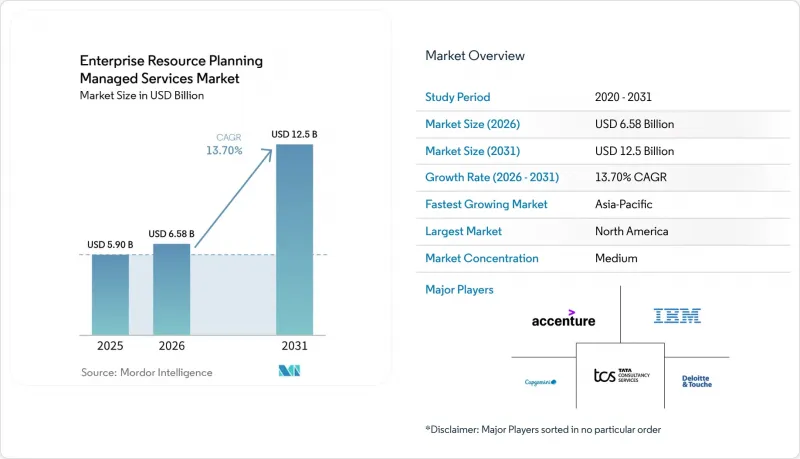
본 보고서는 배포 모델별(온프레미스, 클라우드, 하이브리드), 기업 규모(중소기업·대기업), 업종(제조, 소매 및 소비재, 의료, 은행 및 금융 서비스·보험(BFSI), IT 및 통신, 정부·공공 부문 등), 지역별로 분류되어 있습니다. 시장 전망치는 금액(달러)으로 표시되어 있습니다.
세계의 ERP 매니지드 서비스 시장 동향 및 인사이트
클라우드 기반 ERP 솔루션 도입 확대
현재 기업의 70% 이상이 적어도 하나의 핵심 ERP 모듈을 클라우드에서 운영하고 있으며, 신규 구매자의 75%는 온프레미스 구축보다 클라우드 네이티브 아키텍처를 선호하고 있습니다. 하이퍼스케일러와의 파트너십을 통해 ERP 구독에 인프라 크레딧 및 AI 서비스가 번들로 제공되는데, IBM Power Virtual Server상의 SAP ‘RISE’ 서비스가 그 대표적인 예입니다. 또한, Oracle Cloud Infrastructure의 매출은 ERP 전환을 배경으로 2025 회계연도에 52% 급증했습니다. 중국과 유럽연합(EU)에서 ‘소버린 클라우드’를 의무화함에 따라 법적으로 분리된 다중 리전 ERP 인스턴스가 추진되고 있지만, 연합 데이터 모델을 통해 국경을 초월한 분석은 여전히 가능합니다. Unit4의 ‘Success4U’와 같은 종량제 요금제나 90일간의 도입 프레임워크 덕분에 중견 시장 진출이 촉진되고 있으며, 하이퍼스케일러와의 견고한 제휴 관계나 규정 준수 대응 모델을 갖추지 못한 서비스 제공업체들은 시장 점유율을 내줄 수밖에 없는 상황에 처해 있습니다.
IT 인프라 비용 절감의 필요성 증가
구독형 관리형 서비스가 고정적인 인프라 지출을 대체하며, 데이터센터의 감가상각비를 운영비로 전환하고 있습니다. IBM이 15만 명의 사용자를 대상으로 SAP S/4HANA Cloud로 사내 시스템을 전환한 실증 사례에서는 IT 총 지출을 최대 30% 절감하는 데 성공했습니다. 정부 기관의 조달 담당자들도 이에 발맞추고 있습니다. 미국 국방물류청(DLA)은 9억 300만 달러 규모의 7년 계약을 체결했습니다. 이 계약은 예산 예측 가능성과 관련된 위험을 서비스 제공업체에 전가하는 동시에, 99.9%의 가용성과 FedRAMP IL4 준수를 의무화하고 있습니다. 중소기업만 해도 2026년까지 900억 달러 이상을 관리형 IT 서비스에 투자할 것으로 예측됩니다. 이는 사내 ERP 팀을 불필요하게 만드는 정액 요금제에 매력을 느끼기 때문입니다. 한편, 멀티클라우드 인증을 받은 ERP 전문가의 인건비가 상승하고 있다는 역풍도 있어, 공급업체들은 이익률을 유지하기 위해 기술 재교육 및 AI 제공 플랫폼에 대한 투자를 할 수밖에 없는 상황입니다.
아웃소싱 환경에서의 데이터 보안 및 개인정보 보호에 대한 우려
2024년 7월에 발생한 Smart ERP Solutions의 정보 유출 사건에서는 7만 9,000건의 개인정보가 유출되었습니다. 이로 인해 GDPR(EU 개인정보보호규정)에 따른 48만 유로(54만 달러)의 과태료에 더해 약 84만 유로(94만 5,000달러)의 사업 손실이 발생했으며, 단 한 건의 사고만으로도 수년에 걸친 매니지드 서비스 수익을 모두 상쇄시킬 가능성이 있다는 사실이 드러났습니다. SAP NetWeaver에서 발생한 제로데이 공격을 계기로, 고객사들은 지속적인 침투 테스트와 제로 트러스트 아키텍처를 갖춘 연중무휴 24시간 관리형 보안 서비스 도입을 추진하고 있습니다. 현재 공공 부문의 조달 요건에는 소버린 클라우드 도입, 정부 소유의 암호화 키, 미국 시민으로 구성된 인력 배치 등이 규정되어 있어, 공급업체가 준수해야 할 기준이 더욱 엄격해지고 있습니다. ISO 27001 인증이나 사이버 보험을 보유하지 않은 공급업체는 규제가 엄격한 업계에서 조달 심사를 통과하는 데 어려움을 겪게 될 것입니다.
부문별 분석
2025년 기준으로 ERP 매니지드 서비스 시장의 54.8%를 클라우드 솔루션이 차지했으며, 2031년까지 연평균 성장률(CAGR) 12.9%로 성장할 전망입니다. Oracle Cloud Infrastructure의 2025 회계연도 매출 급증, SAP의 RISE로의 전환, 중국 내 Alibaba Cloud의 소버린 클라우드 도입은 구독형 가격 책정, 자동 갱신, 하이퍼스케일러의 AI 서비스가 이제 결정적인 구매 기준이 되었음을 뒷받침하고 있습니다. 에어갭을 통한 보안이 요구되는 국방 및 중요 인프라 분야에서는 여전히 온프레미스 도입이 이루어지고 있지만, 이러한 구매자들조차 핵심 재무 시스템 위에 클라우드 기반 분석 기능을 추가로 도입하고 있습니다. 혁신을 위한 워크로드에는 퍼블릭 클라우드를, 규제 대상 데이터에는 프라이빗 클라우드나 소버린 클라우드를 결합한 하이브리드 구성이 꾸준히 증가하고 있으며, 일부 제공업체만이 보유한 오케스트레이션 기술이 요구되고 있습니다.
각 벤더사가 연구 개발 자원을 클라우드 네이티브 기능에 집중하고 있기 때문에 기존의 온프레미스 계약의 이익률은 압박을 받고 있으며, 고객들은 마지못해 전환을 선택하고 있습니다. 한편, 컴플라이언스 도구, 모듈식 업그레이드, 수익 분배 모델을 결합한 매니지드 서비스는 기존의 용도 관리 계약에서 시장 점유율을 빼앗아가고 있습니다. 그 결과, ERP 매니지드 서비스 시장은 클라우드 중심의 구조로 결정적으로 기울고 있으며, 하이퍼스케일러의 인증을 취득하지 못한 제공업체는 시대에 뒤처질 위험에 직면해 있습니다.
지역별 분석
2025년 북미는 연방 정부의 현대화 프로그램과 확립된 성과 기반 조달 체계에 힘입어 전 세계 매출의 34.1%를 차지했습니다. 국방물류국(DLA)의 9억 300만 달러 규모 계약과 에스티 로더와 액센츄어의 5억 달러 규모 제휴는 AI 기반 자동화와 소버린 클라우드 규정 준수를 통합한 다년 계약의 대표적인 사례입니다. 풍부한 자본과 성숙한 벤더 생태계가 성장을 뒷받침하고 있지만, 한편으로는 인력 부족으로 인해 인증을 받은 ERP 인력의 인건비가 상승하고 있습니다.
아시아태평양은 중국의 ‘신창’ 정책, 인도의 Microsoft Copilot 라이선스 대규모 도입, 그리고 일본의 레거시 ECC 시스템에서 S/4HANA로의 전환에 힘입어 연평균 성장률(CAGR) 13.6%를 기록하며 가장 빠르게 성장하고 있는 지역입니다. 중국의 ERP 매니지드 서비스 시장은 2025년에 단독으로 34억 달러에 달했습니다. 국내 벤더인 Yonyou와 Kingdee가 국영 기업의 지출 대부분을 차지하는 반면, 다국적 기업들은 Alibaba Cloud의 소버린 인스턴스를 통해 SAP에 의존하고 있습니다. 인도의 Tier 1 통합업체들은 저렴한 비용으로 AI 지원 도구를 전 세계로 수출하며, 인도 아대륙을 세계적인 서비스 제공 인력 거점으로 탈바꿈시키고 있습니다.
유럽에서는 매출 성장세가 둔화되고 있지만, 인력 부족이 심화되고 있어 S/4HANA 전문가 채용에 현재 90일이 소요되고 있습니다. 2026년 9월까지 프랑스에서 의무화될 전자 청구서 발행 및 에너지 및 유틸리티 분야의 디지털 제품 여권 요건으로 인해, 규정 준수를 주도하는 수요가 급증하고 있습니다. 남미, 중동 및 아프리카는 여전히 개발도상국이지만, 특히 세무, 급여 계산, 관세와 관련된 현지화 템플릿이 부족한 분야에서는 풍부한 비즈니스 기회가 잠들어 있습니다. 지속적인 규정 준수 업데이트를 병행하면서 여러 국가에서의 사업을 원활하게 추진할 수 있는 공급업체는 이러한 신흥 지역에서 선구자로서의 우위를 확립할 수 있을 것입니다.
기타 혜택 :
- 엑셀 형식 시장 예측(ME) 시트
- 3개월간의 애널리스트 지원
자주 묻는 질문
목차
제1장 서론
제2장 조사 방법
제3장 주요 요약
제4장 시장 구도
제5장 시장 규모 및 성장 예측
제6장 경쟁 구도
제7장 시장 기회 및 향후 전망
AJY 26.06.26According to Mordor Intelligence, the eRP managed services market size is projected to be USD 5.90 billion in 2025, USD 6.58 billion in 2026, and reach USD 12.50 billion by 2031, growing at a CAGR of 13.7% from 2026 to 2031.
This report is Segmented by Deployment Model (On-Premises, Cloud, and Hybrid), Enterprise Size (Small and Medium Enterprises and Large Enterprises), Industry Vertical (Manufacturing, Retail and Consumer Goods, Healthcare, Banking, Financial Services and Insurance (BFSI), IT and Telecom, Government and Public Sector, and More), and Geography. The Market Forecasts are Provided in Terms of Value (USD).
Global Enterprise Resource Planning Managed Services Market Trends and Insights
Growing Adoption of Cloud-Based ERP Solutions
More than 70% of enterprises now operate at least one core ERP module in the cloud, and 75% of new buyers favor cloud-native architectures over on-premises deployments. Hyperscaler partnerships bundle ERP subscriptions with infrastructure credits and AI services, as demonstrated by SAP's RISE offering on IBM Power Virtual Server, while Oracle Cloud Infrastructure revenue surged 52% in fiscal 2025 on the back of ERP migrations. Sovereign-cloud mandates in China and the European Union drive multi-region, legally isolated ERP instances that still enable cross-border analytics through federated data models. Consumption-based pricing and 90-day deployment frameworks, such as Unit4's Success4U, are unlocking the mid-market, forcing service providers without deep hyperscaler alliances or compliance-ready delivery models to cede share.
Increasing Need to Reduce IT Infrastructure Costs
Subscription-driven managed services are replacing fixed infrastructure outlays, converting data-center depreciation into operating expense and trimming total IT spend by up to 30% in documented cases such as IBM's 150,000-user internal migration to SAP S/4HANA Cloud. Government buyers are following suit: the U.S. Defense Logistics Agency issued a USD 903 million, seven-year contract that shifts budget-predictability risk to service providers while mandating 99.9% availability and FedRAMP IL4 compliance. Small and medium enterprises alone will direct more than USD 90 billion to managed IT services through 2026, lured by fixed-fee models that eliminate the need for in-house ERP teams. The countertrend is a rising unit cost for multi-cloud-certified ERP specialists, compelling providers to invest in reskilling and AI delivery platforms to protect margins.
Data Security and Privacy Concerns in Outsourced Environments
The July 2024 Smart ERP Solutions breach exposed 79,000 personal records and triggered EUR 480,000 (USD 540,000) in GDPR fines, plus nearly EUR 840,000 (USD 945,000) in lost business, illustrating how a single incident can erase multiple years of managed-service fees. Zero-day exploits in SAP NetWeaver prompted clients to adopt 24x7 managed security services with continuous penetration testing and zero-trust architectures. Public-sector solicitations now stipulate sovereign-cloud deployment, government-owned encryption keys, and U.S.-citizen staffing, raising the compliance bar for providers. Vendors lacking ISO 27001 certification or cyber-insurance will struggle to pass procurement gates in regulated verticals.
Other drivers and restraints analyzed in the detailed report include:
- Rising Demand for Real-Time Data Analytics
- Growing Complexity of ERP Landscapes Due to Multi-Vendor Ecosystems
- High Switching Costs and Vendor Lock-In
For complete list of drivers and restraints, kindly check the Table Of Contents.
Segment Analysis
Cloud solutions accounted for 54.8% of the ERP managed services market in 2025 and are on track to expand at a 12.9% CAGR through 2031. Oracle Cloud Infrastructure's FY 2025 revenue surge, SAP's RISE migrations, and Alibaba Cloud sovereign deployments in China confirm that subscription pricing, automatic updates, and hyperscaler AI services are now decisive purchase criteria. While on-premises deployments linger in defense and critical-infrastructure sectors that require air-gapped security, even those buyers are layering cloud-based analytics on top of core financial systems. Hybrid configurations blending public cloud for innovation workloads with private or sovereign cloud for regulated data are steadily growing, demanding orchestration skills that only a subset of providers possess.
Margins in legacy on-premises arrangements are pinched as vendors funnel Research and Development to cloud-native functionality, pushing customers toward migration. Meanwhile, managed service practices that combine compliance tooling, modular upgrades, and gain-share economics are capturing wallet share from traditional application management contracts. As a result, the ERP managed services market is tilting decisively toward cloud-centric frameworks, and providers without hyperscaler certifications risk obsolescence.
Geography Analysis
North America generated 34.1% of global revenue in 2025, anchored by federal modernization programs and well-established outcome-based procurement frameworks. The Defense Logistics Agency's USD 903 million contract and Estee Lauder's USD 500 million partnership with Accenture typify multi-year deals that integrate AI automation and sovereign-cloud compliance. Strong capital pools and mature vendor ecosystems sustain growth, even as labor shortages drive up the cost of certified ERP talent.
Asia-Pacific is the fastest-growing region, with a 13.6% CAGR, driven by China's Xinchuang mandates, India's mass deployment of Microsoft Copilot licenses, and Japan's shift from legacy ECC systems to S/4HANA. The ERP managed services market in China alone reached USD 3.40 billion in 2025, with domestic vendors Yonyou and Kingdee capturing the bulk of state-owned enterprise spend, while multinational corporations rely on SAP via Alibaba Cloud sovereign instances. India's tier-1 integrators are exporting low-cost, AI-enabled support tooling worldwide, turning the subcontinent into the labor fulcrum of global delivery.
Europe shows slower topline growth but acute talent scarcity, with S/4HANA specialists now taking 90 days to recruit. Mandatory e-invoicing in France by September 2026 and Digital Product Passport requirements in energy utilities create compliance-driven demand spikes. South America, the Middle East, and Africa remain nascent but opportunity-rich, particularly where localization templates for tax, payroll, and customs are scarce. Providers that can orchestrate multi-country rollouts with continuous compliance updates will unlock first-mover advantages across these emerging regions.
- Accenture plc
- International Business Machines Corporation
- Deloitte Touche Tohmatsu Limited
- Capgemini SE
- Infosys Limited
- Cognizant Technology Solutions Corporation
- Tata Consultancy Services Limited
- Wipro Limited
- HCL Technologies Limited
- NTT DATA Corporation
- DXC Technology Company
- Atos SE
- Fujitsu Limited
- Tech Mahindra Limited
- CGI Inc.
- SAP SE
- Oracle Corporation
- Syntax Systems GmbH and Co. KG
- Rimini Street, Inc.
- Navisite LLC
Additional Benefits:
- The market estimate (ME) sheet in Excel format
- 3 months of analyst support
TABLE OF CONTENTS
1 INTRODUCTION
- 1.1 Study Assumptions and Market Definition
- 1.2 Scope of the Study
2 RESEARCH METHODOLOGY
3 EXECUTIVE SUMMARY
4 MARKET LANDSCAPE
- 4.1 Market Overview
- 4.2 Market Drivers
- 4.2.1 Growing Adoption of Cloud-Based ERP Solutions
- 4.2.2 Increasing Need to Reduce IT Infrastructure Costs
- 4.2.3 Rising Demand for Real-Time Data Analytics
- 4.2.4 Growing Complexity of ERP Landscapes Due to Multi-Vendor Ecosystems
- 4.2.5 Emergence of AI-Driven Autonomous ERP Operations
- 4.2.6 Vendor Push for Outcome-Based Managed Service Contracts
- 4.3 Market Restraints
- 4.3.1 Data Security and Privacy Concerns in Outsourced Environments
- 4.3.2 High Switching Costs and Vendor Lock-In
- 4.3.3 Shortage of Domain-Specific ERP Talent in Service Providers
- 4.3.4 Rising Scrutiny of Scope 3 Emissions from Outsourced IT Operations
- 4.4 Industry Value Chain Analysis
- 4.5 Regulatory Landscape
- 4.6 Technological Outlook
- 4.7 Porter's Five Forces Analysis
- 4.7.1 Threat of New Entrants
- 4.7.2 Bargaining Power of Suppliers
- 4.7.3 Bargaining Power of Buyers
- 4.7.4 Threat of Substitutes
- 4.7.5 Competitive Rivalry
- 4.8 Impact of Macroeconomic Factors on the Market
5 MARKET SIZE AND GROWTH FORECASTS (VALUE)
- 5.1 By Deployment Model
- 5.1.1 On-Premises
- 5.1.2 Cloud
- 5.1.3 Hybrid
- 5.2 By Enterprise Size
- 5.2.1 Small and Medium Enterprises (SMEs)
- 5.2.2 Large Enterprises
- 5.3 By Industry Vertical
- 5.3.1 Manufacturing
- 5.3.2 Retail and Consumer Goods
- 5.3.3 Healthcare
- 5.3.4 Banking, Financial Services and Insurance (BFSI)
- 5.3.5 Information Technology and Telecom
- 5.3.6 Government and Public Sector
- 5.3.7 Energy and Utilities
- 5.3.8 Transportation and Logistics
- 5.3.9 Other Industry Verticals
- 5.4 By Geography
- 5.4.1 North America
- 5.4.1.1 United States
- 5.4.1.2 Canada
- 5.4.1.3 Mexico
- 5.4.2 South America
- 5.4.2.1 Brazil
- 5.4.2.2 Argentina
- 5.4.2.3 Rest of South America
- 5.4.3 Europe
- 5.4.3.1 Germany
- 5.4.3.2 United Kingdom
- 5.4.3.3 France
- 5.4.3.4 Italy
- 5.4.3.5 Spain
- 5.4.3.6 Russia
- 5.4.3.7 Rest of Europe
- 5.4.4 Asia-Pacific
- 5.4.4.1 China
- 5.4.4.2 India
- 5.4.4.3 Japan
- 5.4.4.4 South Korea
- 5.4.4.5 Australia
- 5.4.4.6 Rest of Asia-Pacific
- 5.4.5 Middle East
- 5.4.5.1 Saudi Arabia
- 5.4.5.2 United Arab Emirates
- 5.4.5.3 Qatar
- 5.4.5.4 Turkey
- 5.4.5.5 Rest of Middle East
- 5.4.6 Africa
- 5.4.6.1 South Africa
- 5.4.6.2 Egypt
- 5.4.6.3 Nigeria
- 5.4.6.4 Rest of Africa
- 5.4.1 North America
6 COMPETITIVE LANDSCAPE
- 6.1 Market Concentration
- 6.2 Strategic Moves
- 6.3 Market Share Analysis
- 6.4 Company Profiles (includes Global Level Overview, Market Level Overview, Core Segments, Financials as available, Strategic Information, Market Rank/Share, Products and Services, Recent Developments)
- 6.4.1 Accenture plc
- 6.4.2 International Business Machines Corporation
- 6.4.3 Deloitte Touche Tohmatsu Limited
- 6.4.4 Capgemini SE
- 6.4.5 Infosys Limited
- 6.4.6 Cognizant Technology Solutions Corporation
- 6.4.7 Tata Consultancy Services Limited
- 6.4.8 Wipro Limited
- 6.4.9 HCL Technologies Limited
- 6.4.10 NTT DATA Corporation
- 6.4.11 DXC Technology Company
- 6.4.12 Atos SE
- 6.4.13 Fujitsu Limited
- 6.4.14 Tech Mahindra Limited
- 6.4.15 CGI Inc.
- 6.4.16 SAP SE
- 6.4.17 Oracle Corporation
- 6.4.18 Syntax Systems GmbH and Co. KG
- 6.4.19 Rimini Street, Inc.
- 6.4.20 Navisite LLC
7 MARKET OPPORTUNITIES AND FUTURE OUTLOOK
- 7.1 White-Space and Unmet-Need Assessment


