

|
시장보고서
상품코드
2065568
유럽의 인사 컴플라이언스 및 개인정보보호규정(GDPR) 플랫폼 : 시장 점유율 분석, 업계 동향 및 통계, 성장 예측(2026-2031년)Europe HR Compliance And General Data Protection Regulation (GDPR) Platform - Market Share Analysis, Industry Trends & Statistics, Growth Forecasts (2026 - 2031) |
||||||
 Mordor Intelligence
Mordor Intelligence에 의하면, 유럽의 인사 컴플라이언스 및 개인정보보호규정(GDPR) 플랫폼 시장 규모는 2025년에 19억 4,000만 달러로 평가되었습니다. 2031년까지 34억 7,000만 달러에 이를 것으로 예측되며, 2026년부터 2031년에 걸쳐 CAGR 10.17%로 성장할 전망입니다.
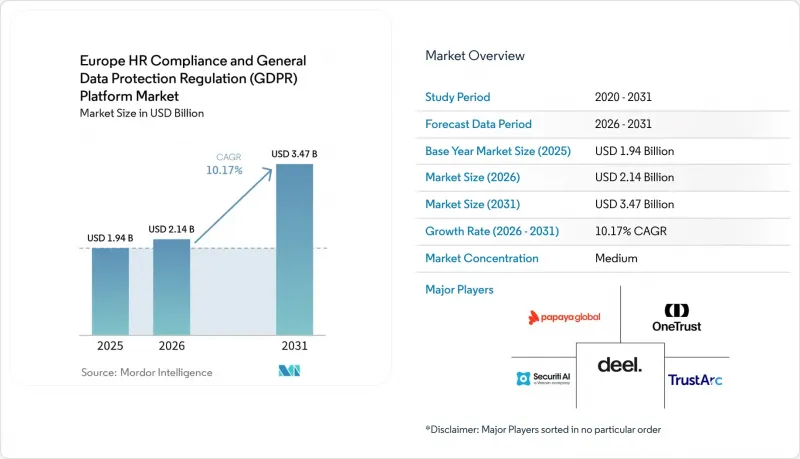
본 보고서는 기능별(정책·절차 관리 등), 배포 모드별(On-Premise 등), 조직 규모별(대기업, 중소기업), 최종 사용자 산업별(은행/금융서비스/보험 등), 지역별로 분류되어 있습니다. 시장 전망치는 금액(달러)으로 표시되어 있습니다.
유럽의 인사 컴플라이언스 및 개인정보보호규정(GDPR) 플랫폼 시장 동향 및 인사이트
GDPR(EU 개인정보보호규정)의 엄격한 시행과 규정 위반에 대한 처벌 강화
2025년, 유럽 각국의 데이터 보호 당국은 GDPR(EU 개인정보보호규정) 위반에 대해 11억 4,000만 유로(12억 8,000만 달러)의 벌금을 부과했으며, 이에 따른 집행 위험은 대부분의 고용주가 무시할 수 없는 수준으로 남아 있었습니다. 동 연도 연례 보고서에 따르면, 2025년에는 414건의 새로운 국경 간 사건과 1,299건의 원스톱 숍 절차가 기록되었으며, 이는 집행 활동이 광범위하게 이루어지고 막대한 비용이 수반됨을 보여줍니다. 이러한 환경 속에서 유럽의 인사 컴플라이언스 및 개인정보보호규정(GDPR) 플랫폼 시장은 단순한 정책 문서에 그치지 않고, 워크플로우 수준에서 관리 조치, 의사 결정, 감사 추적을 문서화할 수 있는 도구로 전환되었습니다. 또한, 고객이 규제 당국의 감시라는 관점에서 제품을 평가하는 경향이 강해짐에 따라, 공급업체 입장에서도 보안 설계, 계약상 보호 조치, 증거 관리를 강화해야 할 더 강력한 이유가 생겼습니다. 그 결과, 지속적인 거버넌스 입증, 처리 기록의 명확화, 기술적·조직적 조치의 입증이 용이한 플랫폼을 선호하는 구매 패턴이 형성되었습니다. 이러한 변화로 인해, 이미 이전 단계에서 개인정보 보호 도구의 도입을 완료하고 더 통합된 솔루션을 필요로 하던 조직들에서도 플랫폼 도입이 촉진되었습니다.
다국간 노동법 및 급여 계산의 현지화에 따른 복잡성
EU 27개 회원국에 걸친 규정 준수 관리는 고용주들이 단일 국가의 도구가 아닌, 보다 광범위한 플랫폼에 투자하는 주된 이유로 계속해서 꼽혀 왔습니다. 이러한 압박은 GDPR(EU 개인정보보호규정)에 그치지 않고, 노동법, 급여 계산 규정, 단체협약, 직원 데이터에 대한 기대치가 관할 구역마다 크게 달랐으며, 변화의 속도도 각기 달랐기 때문입니다. 따라서 유럽의 인사 컴플라이언스 및 개인정보보호규정(GDPR) 플랫폼 시장에서는 국가별 법규 내용을 유지하면서, 고객 측의 도입 주기를 길게 하지 않고도 업데이트를 제공할 수 있는 공급업체가 높은 평가를 받았습니다. SD Worx는 2026년 4월, 당초 독일, 룩셈부르크, 스페인, 스웨덴, 네덜란드를 대상으로 한 AI 기반 모니터링 플랫폼 ‘Legal Watch’를 출시하며 이러한 방향성을 한층 더 강화했습니다. 현지화가 미흡할 경우, 급여 계산, 휴가 관리, 보상 보고, 직원 관련 서류 등 각 분야에서 위험이 발생할 수 있으므로, 구매자들은 규제 준수 수준을 주요 제품 기능으로 중시하게 되었습니다. 이러한 추세에 따라, 다국어 지원 플랫폼은 대상 범위가 좁은 대체 제품에 비해 더 높은 가격 책정과 강력한 고객 유지율을 유지할 수 있었습니다.
기존 HRIS, 급여 계산, ERP 시스템 간의 높은 통합 작업 비용
많은 고용주들이 서로 다른 세대의 HRIS, 급여 계산, ERP, 근태 관리 시스템을 혼용하여 운영하고 있었기 때문에 통합은 여전히 도입 과정에서 가장 뚜렷한 단기적 장애물로 남아 있었습니다. 이 문제는 특히 다국적 사업 환경에서 두드러졌으며, 규정 준수 데이터는 구형 급여 계산 엔진, 각국의 근태 관리 도구, 중앙 보고 계층 간에 일관되게 전송되어야 했습니다. 그 결과, 유럽의 인사 컴플라이언스 및 개인정보보호규정(GDPR) 플랫폼 시장에서는 강력한 네이티브 커넥터, 미리 구축된 국가별 패키지, 그리고 보다 간소화된 도입 절차를 갖춘 공급업체들이 우위를 점하고 있었습니다. 또한, 2025년 5월 독일 연방노동법원의 판결에 따라 구매자들의 태도는 더욱 신중해졌습니다. 해당 판결에서는 적용되는 노동 협약의 범위를 벗어나 개인 데이터를 전송한 클라우드 기반 HR 시스템과 관련하여, 직원에게 200유로(224.6달러)의 비재산적 손해배상이 인정되었습니다. 이 판결은 데이터 전송에 관한 거버넌스가 미흡할 경우 도입 시 직접적인 법적 위험이 발생할 수 있으므로, 통합이 단순한 기술적 문제가 아니라는 점을 다시금 부각시켰습니다. 이로 인해 구매 의향은 여전히 높았으나, 계약 체결부터 본격적인 가동까지 이어지는 프로젝트 진행 속도는 둔화되었습니다.
부문별 분석
2025년, 유럽의 인사 컴플라이언스 및 개인정보보호규정(GDPR) 플랫폼 시장에서 ‘인사 규정 준수 및 규제 관리’는 37.05%의 점유율을 차지하며 가장 큰 기능 카테고리가 되었습니다. 이 직책은 노동법 준수, 직원 기록 관리, GDPR(EU 개인정보보호규정)에 따른 설명 책임이 해당 지역의 거의 모든 고용주에게 필수 요건이라는 사실을 반영한 것입니다. 유럽의 인사 컴플라이언스 및 개인정보보호규정(GDPR) 플랫폼 시장에서는 하나의 라이선스로 여러 법적 의무를 동시에 충족할 수 있기 때문에 플랫폼 도입을 위한 초기 예산은 계속해서 이 부문에 배정되었습니다. 이러한 폭넓은 대응 능력 덕분에, 단일 과제만을 개별적으로 해결하는 제한적인 도구에 비해 이 부문은 우위를 점했습니다.
근태 관리 규정 준수 시장은 2026년부터 2031년까지 연평균 성장률(CAGR) 11.38%를 나타낼 것으로 예측되며, 이 기간 동안 가장 빠르게 성장하는 기능 분야가 될 전망입니다. 이러한 성장의 요인으로는 근로시간 기록에 대한 필요성, 보다 상세한 휴가 관리, 규정이 각기 다른 국가들에서 감사 가능한 기록을 유지해야 한다는 압박이 커지고 있다는 점 등을 들 수 있습니다. 각 벤더사는 현지 규정을 준수한 휴가 설정 및 남녀 간 임금 격차 분석 템플릿을 잇달아 추가하고 있으며, 이는 근태, 보상, 보고 요건이 동일한 워크플로우 내에서 서로 겹치기 시작하고 있음을 보여줍니다. 또한, GDPR(EU 개인정보보호규정)에 기반한 데이터 개인정보 보호 관리 및 정책·절차 관리 분야에서도, 고용주들이 단일 기능 도구를 보다 종합적인 솔루션 제품군으로 통합하는 추세에 따라 기존 시스템을 대체하려는 수요가 계속해서 이어졌습니다. 임금 투명성과 보상 규정 준수는 현재 매출 기준으로는 여전히 소규모 수준이었으나, 직원 150명 이상의 고용주를 대상으로 한 2027년 6월 보고 주기에 힘입어 단기적인 구매 의향은 견조한 추세를 보였습니다.
2025년 유럽의 인사 컴플라이언스 및 개인정보보호규정(GDPR) 플랫폼 시장 규모 중 클라우드 도입이 68.11%를 차지하며, 계속해서 주요 제공 모델로서의 입지를 유지했습니다. 이는 구독형 SaaS 플랫폼이 지닌 명확한 운영상의 이점을 반영한 것으로, 공급업체는 고객 측의 IT 릴리스 주기를 기다릴 필요 없이 규제 대상 컨텐츠의 업데이트를 즉시 제공할 수 있습니다. 유럽의 인사 컴플라이언스 및 개인정보보호규정(GDPR) 플랫폼 시장은 소버린 클라우드 인프라 구축이 진전된 점도 호재로 작용했습니다. 이를 통해 데이터 소재지와 관련된 오랜 장벽이 완화되었습니다. ‘Workday EU Sovereign Cloud’와 ‘AWS European Sovereign Cloud’는 모두 ‘클라우드가 규정 준수 요건을 충족할 수 있는가’라는 논의에서 ‘규제 대상인 인사 워크로드를 위해 클라우드를 어떻게 구축해야 하는가’라는 논의로 전환하는 데 일조했습니다.
하이브리드 방식은 2026년부터 2031년까지 연평균 성장률(CAGR) 11.71%를 나타낼 것으로 예측되어, 가장 높은 성장률을 보이는 사업 모델이 되었습니다. 이러한 경향은 최신 컴플라이언스 모듈에 클라우드의 유연성을 기대하면서도, 기밀성이 가장 높은 데이터 계층에 대해서는 보다 엄격한 관리를 유지하고자 하는 금융 서비스 및 의료 분야의 고용주들의 요구와 부합했습니다. 또한, 하이브리드 방식은 직원 데이터 전송과 관련하여 국가 차원의 감독 대상인 조직, 특히 현지 심사 기관이 처리 계약에 대해 보다 상세한 거버넌스를 요구하는 경우에 적합합니다. On-Premise에 대한 수요는 관리가 가장 엄격한 환경에서는 여전히 중요하게 여겨지고 있지만, 단독 옵션으로서의 비중은 계속 감소하는 추세를 보였습니다. 또한, ISO 27001이나 SOC 2 Type II와 같은 보안 인증도 조달 시 선정 기준으로 그 중요성이 커지면서, 인프라 통제 및 용도 기능을 입증할 수 있는 공급업체로 선택의 폭이 좁혀졌습니다.
기타 혜택 :
- 엑셀 형식 시장 예측(ME) 시트
- 3개월간의 애널리스트 지원
자주 묻는 질문
목차
제1장 서론
제2장 조사 방법
제3장 주요 요약
제4장 시장 구도
제5장 시장 규모 및 성장 예측
제6장 경쟁 구도
제7장 시장 기회 및 향후 전망
KTH 26.06.29According to Mordor Intelligence, the europe hR compliance and General Data Protection Regulation (GDPR) platform market size was valued at USD 1.94 billion in 2025 and is projected to reach USD 3.47 billion by 2031, expanding at a CAGR of 10.17% from 2026 to 2031.
This report is Segmented by Functionality (Policy and Procedure Management, and More), Deployment Mode (On-Premises, and More), Organization Size (Large Enterprises, and Small and Medium-Sized Enterprises), End-User Industry (Banking, Financial Services and Insurance, and More), and Geography. The Market Forecasts are Provided in Terms of Value (USD).
Europe HR Compliance And General Data Protection Regulation (GDPR) Platform Market Trends and Insights
Stringent GDPR Enforcement and Rising Non-Compliance Penalties
National data protection authorities across Europe imposed EUR 1.14 billion (USD 1.28 billion) in GDPR fines in 2025, keeping enforcement risk at a level few employers could ignore. The same annual report recorded 414 new cross-border cases and 1,299 One-Stop-Shop procedures in 2025, indicating that enforcement activity is broad and costly. This environment pushed the Europe HR compliance and General Data Protection Regulation (GDPR) platform market toward tools that can document controls, decisions, and audit trails at the workflow level rather than only in policy files. Vendors also had stronger reasons to tighten security design, contractual safeguards, and evidence management, as customers increasingly evaluated products through the lens of regulatory scrutiny. The result was a buying pattern that favored platforms able to show continuous governance, cleaner records of processing, and easier proof of technical and organizational measures. That shift supported adoption even in organizations that had already completed an earlier round of privacy tooling and now needed something more integrated.
Multi-Country Labor-Law and Payroll Localization Complexity
Managing compliance across 27 EU member states remained a major reason employers invested in broader platforms instead of single-country tools. This pressure went beyond GDPR because labor laws, payroll rules, collective agreements, and employee data expectations varied widely across jurisdictions and changed at different paces. The Europe HR compliance and General Data Protection Regulation (GDPR) platform market, therefore, rewarded vendors that could maintain country-level legislative content and deliver updates without long customer-side deployment cycles. SD Worx reinforced this direction in April 2026 when it launched Legal Watch, an AI-based monitoring platform initially covering Germany, Luxembourg, Spain, Sweden, and the Netherlands. Buyers increasingly treated regulatory depth as a primary product feature because weak localization creates exposure across payroll, leave management, compensation reporting, and worker documentation. That dynamic helped multi-country platforms defend higher pricing and stronger retention than narrower alternatives.
High Integration Costs Across Legacy HRIS, Payroll, and ERP Stacks
Integration remained the clearest near-term brake on adoption because many employers still ran mixed estates of HRIS, payroll, ERP, and time systems from different generations. That problem was especially evident in multi-country rollouts, where compliance data had to be consistently moved across legacy payroll engines, local attendance tools, and central reporting layers. The Europe HR compliance and General Data Protection Regulation (GDPR) platform market, therefore, favored vendors with stronger native connectors, pre-built country packs, and simpler implementation paths. Buyers were also more cautious after the May 2025 ruling by the German Federal Labor Court, which awarded an employee EUR 200 (USD 224.6) in non-material damages for a cloud-based HR system that transferred personal data beyond the scope of an applicable works agreement. The case reinforced that integration is not only a technical issue because weak governance around transfers can create direct legal risk during deployment. That kept purchasing interest strong, but it also slowed the pace at which projects could move from contract signing to full operation.
Other drivers and restraints analyzed in the detailed report include:
- Cloud Migration and Digitization of HR and Privacy Workflows
- Rising Data Subject Access Request and Consent-Management Volumes
- Shortage of Privacy, Payroll, and Compliance Specialists
For complete list of drivers and restraints, kindly check the Table Of Contents.
Segment Analysis
HR Compliance and Regulatory Management held 37.05% of the Europe HR compliance and General Data Protection Regulation (GDPR) market share in 2025, making it the largest functional category. That position reflected the fact that labor-law tracking, employee recordkeeping, and GDPR accountability are baseline requirements for nearly every employer in the region. The Europe HR compliance and General Data Protection Regulation (GDPR) platform market continued to direct first-time platform budgets toward this category, as one license can support multiple statutory obligations simultaneously. That breadth gave the segment an advantage over narrower tools that solve only one issue in isolation.
Time and Attendance Compliance is projected to grow at a 11.38% CAGR from 2026 to 2031, making it the fastest-growing functionality during this period. Growth came from working-time documentation needs, more detailed leave governance, and rising pressure to keep auditable records across countries with different rules. Vendors increasingly added locally compliant leave configuration and gender pay gap analytics templates, demonstrating how attendance, compensation, and reporting requirements are starting to overlap within the same workflow. GDPR Data Privacy Management, Policy, and Procedure Management also continued to attract replacement demand as employers consolidated single-point tools into broader suites. Pay Transparency and Compensation Compliance remained smaller in current revenue terms, but the June 2027 reporting cycle for employers with 150 or more employees kept near-term buying interest firm.
Cloud deployment accounted for 68.11% of the Europe HR compliance and General Data Protection Regulation (GDPR) market size in 2025, which kept it as the leading delivery model. This reflected the clear operating advantage of subscription SaaS platforms, where vendors can push regulatory content updates without waiting for customer-side IT release cycles. The Europe HR compliance and General Data Protection Regulation (GDPR) platform market also benefited from a better sovereign-cloud foundation, which reduced a long-standing obstacle around data residency. Workday EU Sovereign Cloud and the AWS European Sovereign Cloud both helped shift the discussion from whether cloud could meet compliance expectations to how cloud should be structured for regulated HR workloads.
Hybrid deployment is forecast to grow at an 11.71% CAGR from 2026 to 2031, which made it the fastest-growing mode. This pattern fit employers in financial services and healthcare that wanted cloud flexibility for newer compliance modules while retaining tighter control over their most sensitive data layers. Hybrid is also suited to organizations subject to country-level scrutiny of employee data transfers, especially where local review bodies expect more detailed governance of processing arrangements. On-premises demand continued to decline as a standalone preference, even though it remained relevant in the most tightly controlled environments. Security certifications such as ISO 27001 and SOC 2 Type II also became stronger procurement filters, narrowing the field to vendors that could evidence infrastructure controls and application features.
List of Companies Covered in this Report:
- OneTrust, LLC
- Personio SE & Co. KG
- SD Worx People Solutions NV
- Deel Inc.
- Hi Bob Limited
- BambooHR LLC
- Papaya Global Ltd.
- TrustArc Inc.
- Securiti, Inc.
- BigID, Inc.
- Remote Technology, Inc.
- Employment Hero Pty Ltd
- DataGrail, Inc.
- Transcend, Inc.
- Ketch Kloud, Inc.
- IRIS Software Group Limited
- Osano, Inc.
- Didomi SAS
- Syrenis Limited
- consentmanager AB
Additional Benefits:
- The market estimate (ME) sheet in Excel format
- 3 months of analyst support
TABLE OF CONTENTS
1 INTRODUCTION
- 1.1 Study Assumptions and Market Definition
- 1.2 Scope of the Study
2 RESEARCH METHODOLOGY
3 EXECUTIVE SUMMARY
4 MARKET LANDSCAPE
- 4.1 Market Overview
- 4.2 Market Drivers
- 4.2.1 Stringent GDPR Enforcement and Rising Non-Compliance Penalties
- 4.2.2 Multi-Country Labor-Law and Payroll Localization Complexity
- 4.2.3 Cloud Migration and Digitization of HR and Privacy Workflows
- 4.2.4 Rising Data Subject Access Request and Consent-Management Volumes
- 4.2.5 EU Pay Transparency Directive Expanding Audit-Ready HR Data Requirements
- 4.2.6 EU AI Act Obligations for Recruitment and Worker-Management Systems
- 4.3 Market Restraints
- 4.3.1 High Integration Costs Across Legacy HRIS, Payroll, and ERP Stacks
- 4.3.2 Shortage of Privacy, Payroll, and Compliance Specialists
- 4.3.3 NIS2 and DORA Vendor-Assurance Burdens Raising Proof-and-Control Costs
- 4.3.4 German Works Council and Employee-Data Transfer Scrutiny Slowing Rollouts
- 4.4 Industry Value Chain Analysis
- 4.5 Regulatory Landscape
- 4.6 Technological Outlook
- 4.7 Impact of Macroeconomic Factors on the Market
- 4.8 Porter's Five Forces Analysis
- 4.8.1 Threat of New Entrants
- 4.8.2 Bargaining Power of Buyers
- 4.8.3 Bargaining Power of Suppliers
- 4.8.4 Threat of Substitutes
- 4.8.5 Intensity of Rivalry
5 MARKET SIZE AND GROWTH FORECASTS (VALUE)
- 5.1 By Functionality
- 5.1.1 HR Compliance and Regulatory Management
- 5.1.2 Time and Attendance Compliance
- 5.1.3 Policy and Procedure Management
- 5.1.4 GDPR Data Privacy Management
- 5.1.5 Pay Transparency and Compensation Compliance
- 5.1.6 Other Functionalities
- 5.2 By Deployment Mode
- 5.2.1 Cloud
- 5.2.2 On-Premises
- 5.2.3 Hybrid
- 5.3 By Organization Size
- 5.3.1 Large Enterprises
- 5.3.2 Small and Medium-Sized Enterprises
- 5.4 By End-User Industry
- 5.4.1 Banking, Financial Services and Insurance
- 5.4.2 Healthcare and Life Sciences
- 5.4.3 Information Technology and Telecommunications
- 5.4.4 Manufacturing
- 5.4.5 Retail and E-commerce
- 5.4.6 Government and Public Sector
- 5.4.7 Other End-User Industries
- 5.5 By Geography
- 5.5.1 United Kingdom
- 5.5.2 Germany
- 5.5.3 France
- 5.5.4 Italy
- 5.5.5 Spain
- 5.5.6 Russia
- 5.5.7 Rest of Europe
6 COMPETITIVE LANDSCAPE
- 6.1 Market Concentration
- 6.2 Strategic Moves
- 6.3 Market Share Analysis
- 6.4 Company Profiles (includes Global Level Overview, Market Level Overview, Core Segments, Financials as available, Strategic Information, Market Rank/Share, Products and Services, Recent Developments)
- 6.4.1 OneTrust, LLC
- 6.4.2 Personio SE & Co. KG
- 6.4.3 SD Worx People Solutions NV
- 6.4.4 Deel Inc.
- 6.4.5 Hi Bob Limited
- 6.4.6 BambooHR LLC
- 6.4.7 Papaya Global Ltd.
- 6.4.8 TrustArc Inc.
- 6.4.9 Securiti, Inc.
- 6.4.10 BigID, Inc.
- 6.4.11 Remote Technology, Inc.
- 6.4.12 Employment Hero Pty Ltd
- 6.4.13 DataGrail, Inc.
- 6.4.14 Transcend, Inc.
- 6.4.15 Ketch Kloud, Inc.
- 6.4.16 IRIS Software Group Limited
- 6.4.17 Osano, Inc.
- 6.4.18 Didomi SAS
- 6.4.19 Syrenis Limited
- 6.4.20 consentmanager AB
7 MARKET OPPORTUNITIES AND FUTURE OUTLOOK
- 7.1 White-Space and Unmet-Need Assessment


