
|
시장보고서
상품코드
2065569
자동차 전사적 자원 계획(ERP) : 시장 점유율 분석, 업계 동향 및 통계, 성장 예측(2026-2031년)Automotive Enterprise Resource Planning - Market Share Analysis, Industry Trends & Statistics, Growth Forecasts (2026 - 2031) |
||||||
 Mordor Intelligence
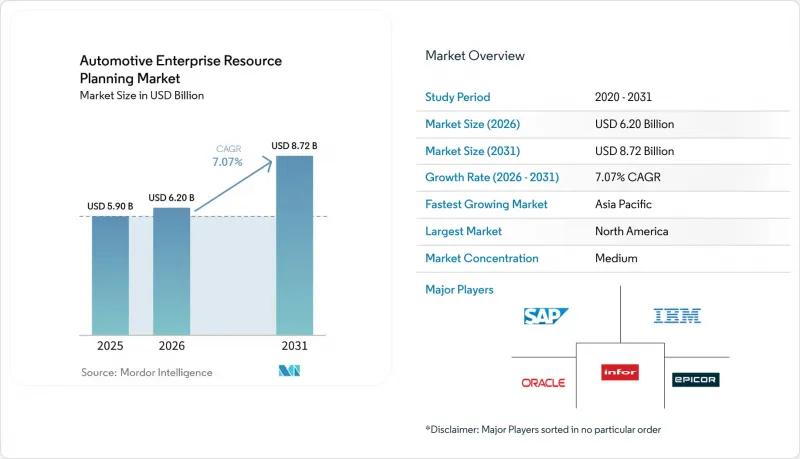
Mordor Intelligence에 의하면, 자동차 전사적 자원 계획(ERP) 시장 규모는 2025년 59억 달러로 평가되었습니다. 2026년 62억 달러에서 2031년까지 87억 2,000만 달러에 이를 것으로 예상되며 2026년부터 2031년까지 연평균 복합 성장률(CAGR)은 7.07%를 나타낼 전망입니다.
본 보고서는 배포 모델(클라우드 기반·On-Premise형), 조직 규모(중소기업·대기업), 용도(생산 계획·스케줄링, 공급망·재고 관리, 재무 및 회계, 인사·급여, 품질 관리 등), 최종 사용자(OEM, Tier 1·Tier 2 공급업체 등), 지역별로 분류되어 있습니다. 시장 전망은 금액(달러) 기준으로 제시되어 있습니다.
세계의 자동차 전사적 자원 계획(ERP) 시장 동향 및 인사이트
자동차 제조 업계에서의 클라우드 기반 ERP 도입 확대
2024년부터 2025년에 걸쳐, 구독형 모델을 통한 비용 구조의 전환으로 자본 지출이 운영비로 전환되고, 온사이트 인프라에 대한 부담이 경감됨에 따라 자동차 공장에서 클라우드 도입이 확대되었습니다. 현재 각 OEM 기업들은 싱글 테넌트형 클라우드 환경에서 지역별 인스턴스를 통합하고, 수십 개 공장에 걸친 재고 현황을 실시간으로 파악함으로써 사이클 타임을 1주일 이상 단축하고, 부품 부족 상황에 신속하게 대응할 수 있게 되었습니다. 그러나 조기 도입 기업들은 끊김 없는 연결성이 필수적이라는 점을 인식하고, 실행 데이터를 로컬에 캐시한 뒤 예정된 간격으로 동기화하는 하이브리드형 토폴로지의 도입을 추진하고 있습니다. 이 타협안을 통해 클라우드 분석을 활용하면서도 현장의 신뢰성을 유지할 수 있게 되었지만, 미들웨어의 복잡성이 증가함에 따라 IT 팀 내에서 새로운 통합 기술이 요구되게 되었습니다. 그 결과, 다운타임 없이 전환을 수행하거나 에지에서 클라우드로의 동기화 패턴을 설계할 수 있는 컨설팅 파트너들이 고수익 서비스 업무를 수주하고 있습니다.
예지 보전과 품질 관리를 위한 AI와 IoT의 통합
최신 자동차 전사적 자원 계획 제품군은 프로그래머블 로직 컨트롤러(PLC) 및 로봇 셀에서 진동, 온도, 음향에 대한 원격 측정 데이터를 수집하고, 머신러닝을 통해 예측을 도출함으로써 유지보수 팀에 3-4일 전에 고장을 경고합니다. 이러한 기능을 도입한 공급업체들은 컴퓨터 비전을 활용한 결함 검출을 품질 워크플로우에 통합한 결과, 예상치 못한 가동 중단 시간이 두 자릿수 감소했을 뿐만 아니라 초기 합격률도 향상되었다고 보고하고 있습니다. ERP가 단순한 거래 장부에서 처방적 의사결정 엔진으로 변모함에 따라, 직원들의 역량도 수작업에 의한 검사가 아닌 알고리즘에 기반한 권장 사항을 해석하는 데 중점을 두도록 진화해야 합니다. 노코드 모델 학습 환경과 사전 학습된 결함 라이브러리를 제공하는 벤더들은 데이터 사이언스 인력이 부족한 2차 공급업체들의 진입 장벽을 낮추고, 생산 네트워크 전반으로의 확산을 가속화하고 있습니다.
Tier 2 공급업체의 경우 높은 초기 비용과 긴 도입 주기
2차 공급업체인 기계 가공 및 성형 기업들은 대개 순이익률이 낮아, 6자리 수의 소프트웨어 투자나 1년에 걸친 도입 프로젝트는 재정적으로 큰 부담이 됩니다. 학술연구에 따르면, 데이터 정제 과정에서 발생하는 예상치 못한 문제, 맞춤화 범위의 확대, 외부 컨설턴트에 대한 의존 등이 비용 초과를 초래하는 원인으로 지목되고 있습니다. 계절적인 생산 성수기도 문제를 더욱 심각하게 만들고 있습니다. 수주가 급증하는 시기에는 전문 지식을 갖춘 담당자를 워크숍이나 사용자 인수 테스트에 투입할 수 없기 때문입니다. 클라우드 구독 서비스는 설비 투자 부담을 줄여주지만, 지속적인 운영 비용이 발생하기 때문에 공급업체가 고객과 가격 재협상을 하지 않는 한 수익성을 압박하게 됩니다. 그 결과, 많은 2차 공급업체들이 ERP의 본격적인 도입을 미루거나 제한적인 기능만 도입하는 방식을 선택하고 있어, OEM이 기대하는 종단간 디지털 통합의 네트워크 효과가 지연되고 있습니다.
부문별 분석
클라우드 플랫폼은 2025년 지출의 62%를 차지했으며, 2031년까지 연평균 성장률(CAGR) 13.40%를 기록하며 자동차 전사적 자원 계획(ERP) 시장 전체를 상회하는 성장세를 보일 것으로 전망됩니다. 이러한 추세는 인공지능(AI)을 활용한 수요 예측이나 제로 터치 업그레이드 등, 클라우드 전용 혁신을 우선시하는 벤더들의 로드맵을 반영한 것입니다. Tier 1 공급업체들 사이에서는 On-Premise형 솔루션의 자동차 전사적 자원 계획(ERP) 시장 규모가 계속 축소되고 있지만, 광대역 연결의 신뢰성이 낮은 공장이나 엄격한 주권 요건이 적용되는 공장에서는 여전히 거부감이 나타나고 있습니다. 제조 실행 워크로드를 로컬에 보관하고 정기적으로 동기화하는 하이브리드 구성은 지연 시간과 내결함성 간의 균형을 맞출 수 있지만, 미들웨어 오버헤드와 모니터링 부담이 증가합니다. 시간이 지남에 따라 기능 면에서의 격차가 확대됨에 따라, 레거시 버전에서는 이용할 수 없는 예측 유지보수나 공급망 컨트롤 타워 기능을 원하는 고객들은 설령 도입에 소극적이라 하더라도 클라우드로의 전환을 피할 수 없게 되었습니다.
2024년 6월에 발생하여 수천 개의 딜러를 마비 상태에 빠뜨린 사이버 사고를 계기로, 새로운 조달 주기에서는 엄격한 제3자 보안 감사와 수백만 달러 규모의 사이버 보험 가입 요건이 요구되고 있습니다. 각 인터넷 서비스 제공업체들은 ISO 27001 인증 획득, 제로 트러스트 프레임워크 도입, 15분 이내 복구 목표(RPO) 설정 등의 조치를 취함으로써 구매자들의 신뢰를 회복했습니다. 비용을 장기간에 걸쳐 분산시키는 구독형 가격 책정은 소규모 공급업체에게 매력적이지만, 총 수명 주기 비용 측면에서는 여전히 감가상각이 완료된 On-Premise 자산과의 경쟁을 견뎌내야 합니다. 그 결과, 구매자들은 현재 명확한 5년간의 총소유비용(TCO) 모델, 투명성이 높은 해지 조항, 지역별로 구분된 데이터 저장 옵션을 요구하는 제안 요청서(RFP)를 발행하고 있으며, 자동차 전사적 자원 계획(ERP) 시장에서 조달 방식의 성숙도가 높아지고 있습니다.
2025년에는 대기업이 매출의 54%를 차지했으며, 이는 재무, 물류, 설계 변경 관리 분야에서 수십억 달러 규모의 OEM(원청 브랜드 제조) 도입을 반영한 것입니다. 전자 데이터 교환(EDI)의 의무화로 인해 스프레드시트 기반의 업무 흐름이 더 이상 유지될 수 없게 되면서, 중소기업을 대상으로 한 자동차 전사적 자원 계획(ERP) 시장 점유율이 급속히 확대되고 있습니다. 각 벤더사는 120일 이내에 가동을 시작하겠다고 약속하는 사전 설정된 템플릿이나 신속한 도입 지원 도구를 통해 이 시장을 공략하고 있지만, 이러한 속도 위주의 접근 방식은 맞춤 설정을 제한하여 나중에 재작업이 필요한 경우가 적지 않습니다. 도입에 성공한 기업들로부터는 자재 발주가 고객의 생산 일정과 직접 연동되게 됨에 따라 전화로 이루어지던 긴급 대응이 불필요해졌고, 생산 라인 가동 중단 사고가 감소했다는 보고가 접수되고 있습니다.
도입의 성패는 여전히 경영진의 지원과 변화 관리 역량에 달려 있지만, 많은 중소기업은 이러한 요소가 부족하여 결과적으로 프로젝트가 일정이나 예산을 초과하는 사례가 발생하고 있습니다. 이러한 격차를 해소하기 위해 생태계 파트너들은 원격 용도 관리 및 정기적인 프로세스 감사를 제공하는 관리형 서비스를 패키지로 구성하여, ERP를 일회성 기술 구매가 아닌 운영형 구독 모델로 전환하고 있습니다. 클라우드의 성숙도가 높아짐에 따라, 집합적인 지식이 축적되면서 설정 오류가 줄어들고, 템플릿에는 고장 모드 영향 분석(FMEA)과 같은 업계 모범 사례가 처음부터 반영되게 됩니다. 이를 통해 리스크가 줄어들고, 자동차 전사적 자원 계획(ERP) 시장에 중소기업의 진출이 더욱 촉진될 것입니다.
지역별 분석
2025년에는 디트로이트 자동차 제조업체들의 확고한 ERP 환경과 딜러 관리 시스템의 대대적인 업데이트에 힘입어 북미가 매출 점유율 33%를 차지하며 1위를 차지했습니다. 자동차 전사적 자원 계획 공급업체들이 확장 가능한 인프라와 인공지능(AI) 기능을 활용하고, 북미의 구매자들이 이를 신속하게 수익화함에 따라 클라우드 도입이 가속화되고 있습니다. 데이터 현지화에 관한 규제는 비교적 완화된 편이며, 캐나다, 멕시코, 미국에 걸친 업무를 통합하는 다지역 테넌트 구축을 가속화하고 있습니다.
아시아태평양은 2031년까지 연평균 성장률(CAGR) 11.90%를 기록할 전망입니다. 이는 중국의 거대한 자동차 생산 기반과, 현지 제조 부문의 4분의 3 가량을 이미 차지하고 있는 국내 ERP 대기업을 우대하는 정부 정책에 힘입은 결과입니다. 인도의 부품 수출 증가세는 전 세계 전자 데이터 교환(EDI) 및 지속가능성 요건 준수를 목표로 하는 2차 공급업체들 사이에서 클라우드의 급속한 확산을 촉진하고 있습니다. 일본은 레거시 인프라의 ‘2025년 문제’에 직면해 있으며, 문화적으로 신중한 태도 때문에 여전히 국내 관리 하의 하이브리드 클라우드나 프라이빗 클라우드 도입을 선호하는 한편, 긴급한 현대화 프로젝트가 진행되고 있습니다.
유럽의 엄격한 환경 지침에 따라 구매 기준이 탄소 회계 기능을 중시하는 방향으로 재편되면서, 규정 준수 워크플로우에서 ERP의 역할이 확고해졌습니다. 남미, 중동 및 아프리카에서는 자금적 제약과 통신 환경의 한계로 인해 전환 속도가 더딘 탓에 성장세가 비교적 완만하지만, 급증하는 조립 공장이 소프트웨어 구독 서비스와 통신 하드웨어를 세트로 제공하는 SaaS 공급업체들을 끌어들이고 있습니다. 전반적으로 볼 때, 이러한 지역별 동향은 자동차 전사적 자원 계획(ERP) 시장이 순수한 기술적 요인뿐만 아니라 정책 및 데이터 주권에 의해서도 크게 좌우되고 있음을 여실히 보여주고 있습니다.
기타 혜택 :
- 엑셀 형식 시장 예측(ME) 시트
- 3개월간의 애널리스트 지원
자주 묻는 질문
목차
제1장 서론
제2장 조사 방법
제3장 주요 요약
제4장 시장 구도
제5장 시장 규모 및 성장 예측
제6장 경쟁 구도
제7장 시장 기회 및 향후 전망
KTH 26.06.29According to Mordor Intelligence, the automotive ERP market size is projected to expand from USD 5.90 billion in 2025 and USD 6.20 billion in 2026 to USD 8.72 billion by 2031, registering a CAGR of 7.07% between 2026 and 2031.
This report is Segmented by Deployment Model (Cloud-Based and On-Premises), Organization Size (SMEs and Large Enterprises), Application (Production Planning and Scheduling, Supply Chain and Inventory Management, Finance and Accounting, HR and Payroll, Quality Management, and More), End User (OEMs, Tier 1 and Tier 2 Suppliers, and More), and Geography. The Market Forecasts are Provided in Terms of Value (USD).
Global Automotive Enterprise Resource Planning Market Trends and Insights
Rising Adoption of Cloud-Based ERP in Automotive Manufacturing
Cloud adoption in automotive plants rose between 2024 and 2025 as subscription economics converted capital expenses into operating expenses, reducing the burden of on-site infrastructure. Original equipment manufacturers now unify regional instances on single-tenant clouds to gain real-time inventory visibility across dozens of factories, cutting close-cycle times by more than one week and enabling faster responses to part shortages. Early adopters, however, discovered that uninterrupted connectivity is essential, prompting hybrid topologies in which execution data is cached locally and synchronized at scheduled intervals. This compromise preserves shop-floor reliability while still tapping cloud analytics, although it introduces middleware complexity that requires new integration skills inside information technology teams. Consequently, consulting partners that can blueprint zero-downtime cutovers and edge-to-cloud synchronization patterns are winning high-margin service work.
Integration of AI and IoT for Predictive Maintenance and Quality Control
Modern automotive ERP suites ingest vibration, temperature, and acoustic telemetry from programmable logic controllers and robot cells, generating machine-learning forecasts that warn maintenance teams of failures three to four days ahead of time. Suppliers deploying these capabilities have reported double-digit reductions in unplanned downtime and a boost in first-pass yield after embedding computer-vision defect detection into quality workflows. As ERP morphs from a transactional ledger into a prescriptive decision engine, workforce skills must evolve to focus on interpreting algorithmic recommendations rather than manual inspections. Vendors that supply no-code model-training environments and pre-trained defect libraries lower the barrier for Tier-2 suppliers that lack data-science talent, accelerating diffusion across the production network.
High Upfront Costs and Lengthy Implementation Cycles for Tier-2 Suppliers
Tier-2 machining and molding firms often operate on thin net margins, making six-figure software investments and year-long deployment projects financially daunting. Academic research highlights cost overruns rooted in data-cleansing surprises, customization creep, and reliance on external consultants. Seasonal production peaks compound the challenge, as subject-matter experts cannot be spared for workshops and user acceptance testing during order surges. Cloud subscriptions ease capital expenditure yet introduce permanent operating charges that shrink profitability unless suppliers renegotiate prices with customers. Consequently, many Tier-2 firms defer full-scale ERP adoption or choose narrow functional rollouts, delaying the network effects that original equipment manufacturers expect from end-to-end digital integration.
Other drivers and restraints analyzed in the detailed report include:
- Shift Toward Modular Architectures to Support Software-Defined Vehicles
- Compliance with Stringent Emissions and Traceability Regulations
- Data Security and IP Protection Concerns in Cloud Deployments
For complete list of drivers and restraints, kindly check the Table Of Contents.
Segment Analysis
Cloud platforms represented 62% of spending in 2025 and are projected to outpace the overall automotive ERP market at a 13.40% CAGR through 2031. This momentum reflects vendor roadmaps that prioritize cloud-only innovation, such as artificial intelligence-driven demand sensing and zero-touch upgrades. The automotive ERP market size for on-premises solutions continues to shrink among Tier-1 suppliers, yet pockets of resistance remain in plants with unreliable broadband or stringent sovereignty mandates. Hybrid configurations, where manufacturing execution workloads remain local and synchronize periodically, balance latency and resilience but add middleware overhead and monitoring burden. Over time, the widening functionality gap pushes even reluctant customers toward cloud adoption as they seek predictive maintenance and supply chain control tower features unavailable in legacy releases.
The June 2024 cyber incident that crippled thousands of dealerships stimulated rigorous third-party security audits and multimillion-dollar cyber-insurance requirements in new procurement cycles. Providers responded with ISO 27001 certifications, zero-trust frameworks, and recovery point objectives of 15 minutes or less, restoring buyer confidence. Subscription pricing that spreads expenses over time appeals to small suppliers, yet total lifetime costs must still compete with depreciated on-premises assets. Consequently, buyers now issue requests for proposal that demand clear five-year total cost of ownership models, transparent exit clauses, and regionally partitioned data-storage options, shaping a maturing procurement discipline inside the automotive ERP market.
Large enterprises accounted for 54% of revenue in 2025, reflecting multibillion-dollar original equipment manufacturer rollouts across finance, logistics, and engineering change control. The automotive ERP market share among small and medium enterprises is expanding rapidly as electronic data interchange mandates make spreadsheet-based workflows untenable. Vendors court this segment with pre-configured templates and rapid deployment accelerators that promise go-live in under 120 days, though such speed often limits customization and later triggers rework. Successful adopters report reduced line-stop incidents because material call-offs now synchronize directly from customer production schedules, eliminating phone-call firefighting.
Implementation success still hinges on executive sponsorship and change management skills that many small firms lack, resulting in projects missing timelines or budgets. To mitigate the gap, ecosystem partners bundle managed services that provide remote application management and periodic process audits, turning ERP into an operational subscription rather than a one-time technology purchase. As cloud maturity rises, collective learning reduces configuration errors, and templates embed industry best practices such as failure mode and effects analysis out of the box, lowering risk and encouraging broader SME participation in the automotive ERP market.
Geography Analysis
North America led with 33% revenue share in 2025, buoyed by entrenched ERP estates at Detroit original equipment manufacturers and a wave of dealer management system replacements. Cloud adoption accelerates as automotive ERP vendors capitalize on scalable infrastructure and artificial intelligence features that North American buyers quickly monetize. Data-localization rules are comparatively lenient, enabling faster rollout of multi-region tenants that consolidate operations across Canada, Mexico, and the United States.
Asia-Pacific is on track to post an 11.90% CAGR through 2031, driven by China's vast vehicle production base and government policies favoring domestic ERP champions that already hold nearly three-quarters of the local manufacturing segment. India's component export growth fuels rapid cloud uptake among Tier-2 suppliers aiming to meet global electronic data interchange and sustainability requirements. Japan faces the 2025 cliff for legacy infrastructure, prompting urgent modernization projects, even as cultural caution continues to favor hybrid or private-cloud deployments under domestic control.
Europe's stringent environmental directives reshape buying criteria toward carbon-accounting capabilities, cementing ERP's role in compliance workflows. South America and the Middle East and Africa expand more modestly as capital constraints and limited connectivity slow migrations, but burgeoning assembly plants attract SaaS vendors that bundle connectivity hardware alongside software subscriptions. Overall, regional dynamics underscore that the automotive ERP market is governed as much by policy and data sovereignty as by pure technology considerations.
- SAP SE
- Oracle Corporation
- Microsoft Corporation
- Infor, Inc.
- Epicor Software Corporation
- QAD Inc.
- Plex Systems, Inc.
- IFS AB
- Sage Group plc
- Acumatica, Inc.
- SYSPRO (Pty) Ltd.
- CDK Global, Inc.
- Tekion Corp.
- Auto/Mate Dealership Systems, Inc.
- AutoSoft, Inc.
- DealerTrack, Inc.
- Reynolds and Reynolds Company
- PBS Systems Group Inc.
- Dominion Enterprises
- RouteOne LLC
Additional Benefits:
- The market estimate (ME) sheet in Excel format
- 3 months of analyst support
TABLE OF CONTENTS
1 INTRODUCTION
- 1.1 Study Assumptions and Market Definition * Scope of the Study
2 RESEARCH METHODOLOGY
3 EXECUTIVE SUMMARY
4 MARKET LANDSCAPE
- 4.1 Market Overview
- 4.2 Market Drivers
- 4.2.1 Rising Adoption of Cloud-Based ERP in Automotive Manufacturing
- 4.2.2 Integration of AI and IoT for Predictive Maintenance and Quality Control
- 4.2.3 Shift Toward Modular Architectures to Support Software-Defined Vehicles
- 4.2.4 Compliance with Stringent Emissions and Traceability Regulations
- 4.2.5 Consolidation of Global Supply Chains Post Semiconductor Shortages
- 4.2.6 Growing Demand for Real-Time Analytics in EV Battery Lifecycle Management
- 4.3 Market Restraints
- 4.3.1 High Upfront Costs and Lengthy Implementation Cycles for Tier-2 Suppliers
- 4.3.2 Data Security and IP Protection Concerns in Cloud Deployments
- 4.3.3 Shortage of Skilled ERP Professionals in Emerging Markets
- 4.3.4 Legacy System Integration Complexities in Large OEM Environments
- 4.4 Industry Value Chain Analysis
- 4.5 Regulatory Landscape
- 4.6 Technological Outlook
- 4.7 Impact of Macroeconomic Factors on the Market
- 4.8 Porter's Five Forces Analysis
- 4.8.1 Threat of New Entrants
- 4.8.2 Bargaining Power of Suppliers
- 4.8.3 Bargaining Power of Buyers
- 4.8.4 Threat of Substitutes
- 4.8.5 Competitive Rivalry
5 MARKET SIZE AND GROWTH FORECASTS (VALUE)
- 5.1 By Deployment Model
- 5.1.1 Cloud-Based
- 5.1.2 On-Premises
- 5.2 By Organization Size
- 5.2.1 Small and Medium Enterprises
- 5.2.2 Large Enterprises
- 5.3 By Application
- 5.3.1 Production Planning and Scheduling
- 5.3.2 Supply Chain and Inventory Management
- 5.3.3 Finance and Accounting
- 5.3.4 Human Resources and Payroll
- 5.3.5 Quality Management
- 5.3.6 Customer Relationship Management
- 5.3.7 Other Applications
- 5.4 By End User
- 5.4.1 Original Equipment Manufacturers
- 5.4.2 Tier 1 and Tier 2 Suppliers
- 5.4.3 Dealerships and Distributors
- 5.4.4 Fleet Operators
- 5.5 By Geography
- 5.5.1 North America
- 5.5.1.1 United States
- 5.5.1.2 Canada
- 5.5.1.3 Mexico
- 5.5.2 South America
- 5.5.2.1 Brazil
- 5.5.2.2 Argentina
- 5.5.2.3 Rest of South America
- 5.5.3 Europe
- 5.5.3.1 Germany
- 5.5.3.2 France
- 5.5.3.3 United Kingdom
- 5.5.3.4 Italy
- 5.5.3.5 Russia
- 5.5.3.6 Rest of Europe
- 5.5.4 Asia-Pacific
- 5.5.4.1 China
- 5.5.4.2 Japan
- 5.5.4.3 India
- 5.5.4.4 South Korea
- 5.5.4.5 Australia
- 5.5.4.6 Rest of Asia-Pacific
- 5.5.5 Middle East
- 5.5.5.1 Turkey
- 5.5.5.2 Saudi Arabia
- 5.5.5.3 United Arab Emirates
- 5.5.5.4 Rest of Middle East
- 5.5.6 Africa
- 5.5.6.1 South Africa
- 5.5.6.2 Egypt
- 5.5.6.3 Nigeria
- 5.5.6.4 Rest of Africa
- 5.5.1 North America
6 COMPETITIVE LANDSCAPE
- 6.1 Market Concentration
- 6.2 Strategic Moves
- 6.3 Market Share Analysis
- 6.4 Company Profiles (includes Global Level Overview, Market Level Overview, Core Segments, Financials as available, Strategic Information, Market Rank/Share, Products and Services, Recent Developments)
- 6.4.1 SAP SE
- 6.4.2 Oracle Corporation
- 6.4.3 Microsoft Corporation
- 6.4.4 Infor, Inc.
- 6.4.5 Epicor Software Corporation
- 6.4.6 QAD Inc.
- 6.4.7 Plex Systems, Inc.
- 6.4.8 IFS AB
- 6.4.9 Sage Group plc
- 6.4.10 Acumatica, Inc.
- 6.4.11 SYSPRO (Pty) Ltd.
- 6.4.12 CDK Global, Inc.
- 6.4.13 Tekion Corp.
- 6.4.14 Auto/Mate Dealership Systems, Inc.
- 6.4.15 AutoSoft, Inc.
- 6.4.16 DealerTrack, Inc.
- 6.4.17 Reynolds and Reynolds Company
- 6.4.18 PBS Systems Group Inc.
- 6.4.19 Dominion Enterprises
- 6.4.20 RouteOne LLC
7 MARKET OPPORTUNITIES AND FUTURE OUTLOOK
- 7.1 White-space and Unmet-Need Assessment