|
시장보고서
상품코드
2065601
의료 환경 서비스 시장 : 점유율 분석, 업계 동향과 통계, 성장 예측(2026-2031년)Healthcare Environmental Services - Market Share Analysis, Industry Trends & Statistics, Growth Forecasts (2026 - 2031) |
||||||
 Mordor Intelligence
Mordor Intelligence에 의하면, 의료 환경 서비스 시장 규모는 2025년 539억 달러에서 2026년에는 580억 7,000만 달러로 확대되어 2031년까지 843억 5,000만 달러에 이를 것으로 예상되고 있어 2026년부터 2031년까지 CAGR 7.75%로 성장할 전망입니다.
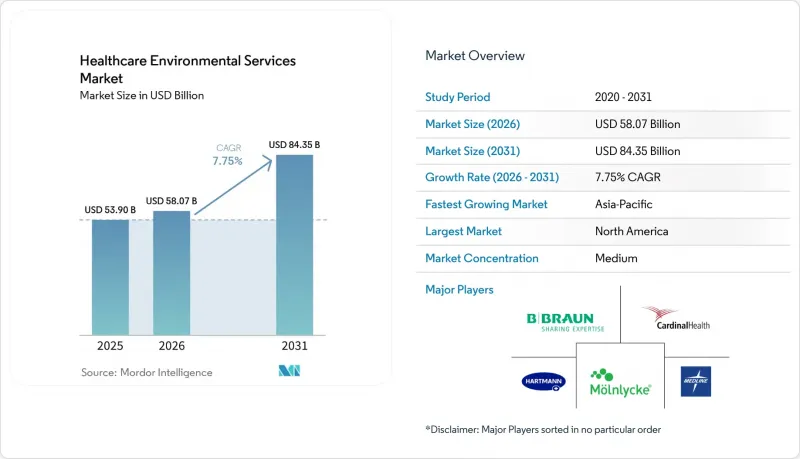
본 보고서는 서비스 유형별(청소·소독, 린넨·세탁, 폐기물 관리, 해충 방제, 직원 교육), 제공 모델별(정기형, 주문형), 시설 유형별(병원, 당일 수술센터(ASC), 진료소·개원 의사 진료소, 연구소·연구시설, 장기 요양 시설, 진단·영상 진단 시설), 그리고 지역(북미, 유럽, 아시아태평양(APAC), 중동 및 아프리카(MEA), 남미)별로 분류되어 있습니다. 예측치는 금액(달러)으로 표시되어 있습니다.
세계 의료 환경 서비스 시장 동향 및 인사이트
병원 내 감염(HAI) 예방 및 위생 기준 강화
감염 관리는 의료 환경 서비스 시장에서 여전히 중요한 촉진요인으로 작용하고 있으며, 표면 위생, 폐기물 처리 및 검증된 청소 절차는 이제 환자 안전에 없어서는 안 될 요소가 되었습니다. 미국 보건복지부(HHS)는 카테터 관련 혈류 감염(CLABSI), 병원 내 발병 MRSA 균혈증, 그리고 클로스트리디움 디피실 감염증(CDI)을 줄이기 위한 야심찬 목표를 설정하고 있으며, 소독 방법 강화의 필요성을 강조하고 있습니다. 포자 형성 병원체와 관련된 뿌리 깊은 문제로 인해, 의료 서비스 제공업체들은 UV-C 시스템, 정전기 분무 기술, 그리고 엄격한 청소 성능 검증과 같은 첨단 기술을 도입해야 하는 상황에 직면해 있습니다. 시설 측에서는 청소 빈도보다는 환경 서비스의 성과와 감염 결과를 연관 짓는 경향이 강해지고 있습니다.
HCAHPS 점수 및 환자 충성도 향상을 위한 아웃소싱
청결도는 의료 서비스의 질과 환자의 충성도 모두에 영향을 미치기 때문에 의료 환경 서비스 시장에서 환자 경험 점수의 중요성이 점점 더 커지고 있습니다. 소덱소는 어드벤티스트 헬스와의 제휴를 확대하여 시설 수와 직원 수를 늘렸습니다. 이는 환경 서비스(EVS)의 아웃소싱 관계가 심화되고 있는 추세를 반영하고 있습니다. 마찬가지로, 아라마크와 펜실베이니아 대학교 헬스 시스템 간의 계약은 환경 서비스와 기타 지원 기능을 결합한 파트너십에 대한 수요가 증가하고 있음을 여실히 보여주고 있습니다. 외부 위탁 업체는 여러 시설에 걸쳐 첨단 도구를 활용하여 일관된 청소 서비스, 체계적인 보고 체계, 유연한 인력 배치 솔루션을 제공합니다.
대규모 의료 시스템을 통한 환경 서비스(EVS)의 사내화
대규모 의료 시스템에서는 감염 예방, 청결 유지, 노사 관계 관리를 강화하기 위해 환경 서비스를 사내에서 직접 운영하는 추세가 점점 더 확산되고 있습니다. 이러한 접근 방식을 통해 여러 병원으로 구성된 네트워크는 청소 및 폐기물 처리 수요를 유지하면서 특정 기능을 자체화하거나 하이브리드 모델을 도입할 수 있게 됩니다. 경영진은 서비스의 일관성, 직원의 책임감, 그리고 내부 품질 목표와의 부합성을 높일 수 있다는 점을 이유로 인소싱에 매력을 느끼고 있습니다. 그러나 인소싱의 경우, 채용, 교육, 규정 준수 모니터링 및 기술 유지보수와 관련된 비용이 과소평가되기 쉬우며, 이러한 비용은 도입 후에야 드러나게 됩니다. 인증 및 감사 요건으로 인해 많은 의료 기관은 여전히 전문가의 지식에 의존할 수밖에 없으며, 순수한 내부 처리의 범위는 제한적입니다.
부문별 분석
청소·소독 서비스는 의료 환경 서비스 시장을 주도하고 있으며, 2025년에는 시장 점유율의 54.35%를 차지할 것으로 전망됩니다. 이러한 주도적인 위상은 병원, 진료소, 장기 요양 시설에서 표면 제염이 지극히 중요하다는 점을 반영하고 있습니다. 위생 관리의 미비는 환자의 예후, 감사 결과, 신뢰에 영향을 미칠 가능성이 있으므로, 이 분야는 감염 예방에 있어 여전히 필수적입니다. 예산이 재검토되더라도 이 부문에 대한 지출은 견조한 추세를 보이고 있습니다.
린넨 세탁 서비스 시장은 2031년까지 연평균 성장률(CAGR) 8.75%를 기록하며 성장할 것으로 예상되며, 가장 높은 성장세를 보일 것으로 전망됩니다. 병원에서는 광열비, 물 사용량 및 오염 관리를 보다 적절히 관리하기 위해 세탁 업무의 외부 위탁을 확대되고 있습니다. RFID 추적 및 감염 방지 기능이 탑재된 섬유 제품 등 혁신적인 기술을 통해, 린넨 서비스는 중요한 임상 지원 기능으로 변모하고 있습니다.
지역별 분석
2025년, 북미는 의료 환경 서비스 시장에서 39.77%의 점유율을 차지하며 매출 기준 1위를 유지했습니다. 이러한 우위를 주도하고 있는 것은 미국이며, 그 배경에는 진료보수와 연계된 엄격한 위생 기준, 높은 인증 기준, 그리고 성숙한 아웃소싱 환경이 있습니다. 2026년 1월 소덱소가 어드벤티스트 헬스와 체결한, 26개 시설을 대상으로 하며 계약액이 7,000만 달러로 예상되는 이 제휴는 대규모 의료 서비스 제공업체가 달성할 수 있는 사업 규모를 여실히 보여주고 있습니다. 이 지역에서는 병원 네트워크 전반에 걸친 청소, 침구 관리, 해충 방제, 유해 폐기물 처리 및 교육 수요를 충족시킬 수 있는 다양한 공급업체가 존재한다는 점이 강점으로 작용하고 있습니다. 또한, 일부 주에서 의약품 폐기물에 관한 규제가 강화됨에 따라 전문 서비스 제공업체에 대한 지속적인 규정 준수 수요가 증가하고 있습니다.
유럽은 의료 환경 서비스 시장에서 여전히 중요한 역할을 하고 있지만, 아웃소싱의 보급 정도는 국가나 조달 모델에 따라 다릅니다. 영국과 유럽 대륙의 일부 지역에서는 광범위한 아웃소싱이 이루어지고 있지만, 기타 지역에서는 더 많은 업무가 병원의 관리 하에 남아 있습니다. 공급업체는 현지 노동법, 노동조합의 기대 사항 및 공공 부문의 계약 관행에 부합해야 합니다. 지속가능성과 폐기물 관리에 대한 수요가 증가함에 따라, 의약품 폐기물, 린넨 처리 및 추적 가능한 환경 보고 분야의 전문 서비스 제공업체의 가치가 높아지고 있습니다.
아시아태평양은 2031년까지 연평균 성장률(CAGR) 8.98%를 기록하며 성장할 것으로 예상되며, 의료 환경 서비스 시장에서 가장 빠르게 성장하는 지역이 될 전망입니다. 이러한 성장은 의료 제공 능력의 확대, 환자 수 증가, 그리고 중·저소득 지역의 물·위생·위생 관리·폐기물 처리 서비스 격차에 의해 주도되고 있습니다. 일본, 한국, 호주 등 선진국 시장은 유럽의 환경 기준에 점차 가까워지고 있는 반면, 동남아시아에서는 종합적인 아웃소싱을 위한 큰 기회가 생겨나고 있습니다. 중동 및 아프리카 및 남미에서는 WASH(물·위생·위생 관리) 및 보다 안전한 의료 폐기물 처리에 관한 공중보건 이니셔티브에 힘입어 환경 서비스 요건의 정비가 점차 진행되고 있습니다.
기타 혜택:
- 엑셀 형식 시장 예측(ME) 시트
- 3개월간의 애널리스트 지원
자주 묻는 질문
목차
제1장 서론
제2장 조사 방법
제3장 주요 요약
제4장 시장 구도
제5장 시장 규모와 성장 예측,
제6장 경쟁 구도
제7장 시장 기회와 향후 전망
JHS 26.06.29According to Mordor Intelligence, the healthcare environmental services market size is expected to increase from USD 53.90 billion in 2025 to USD 58.07 billion in 2026 and reach USD 84.35 billion by 2031, growing at a CAGR of 7.75% over 2026-2031.
This report is Segmented by Service Type (Cleaning & Disinfection, Linen & Laundry, Waste Management, Pest Control, Staff Training), Delivery Model (Scheduled, On-Demand), Facility Type (Hospitals, Ascs, Clinics & Physician Offices, Labs & Research, Long-Term Care, Diagnostic & Imaging), and Geography (North America, Europe, APAC, MEA, South America). Forecasts are in Terms of Value (USD).
Global Healthcare Environmental Services Market Trends and Insights
HAI Prevention and Stricter Hygiene Standards
Infection control remains a critical driver in the healthcare environmental services market, with surface hygiene, waste handling, and validated cleaning protocols now integral to patient safety. The HHS has set ambitious targets for reducing CLABSI, hospital-onset MRSA bacteremia, and CDI, emphasizing the need for enhanced disinfection methods. Persistent challenges with spore-forming pathogens are pushing providers to adopt advanced technologies like UV-C systems, electrostatic applications, and rigorous cleaning performance verification. Facilities are increasingly linking environmental service performance to infection outcomes rather than cleaning frequency.
Outsourcing to Lift HCAHPS and Patient Loyalty Scores
Patient experience scores are becoming increasingly important in the healthcare environmental services market, as cleanliness impacts both quality outcomes and patient loyalty. Sodexo expanded its partnership with Adventist Health, adding sites and employees, reflecting the trend of deepening outsourced EVS relationships. Similarly, Aramark's agreement with the University of Pennsylvania Health System highlights the growing preference for partnerships that combine environmental services with other support functions. Outsourced providers leverage advanced tools across multiple sites, offering consistent cleaning, robust reporting, and flexible staffing solutions.
In-house EVS Insourcing by Large Health Systems
Large health systems are increasingly insourcing environmental services to gain tighter control over infection prevention, cleanliness, and labor relations. This approach enables multi-hospital networks to bring specific functions in-house or adopt hybrid models while maintaining cleaning and waste handling needs. Executives are drawn to insourcing for its potential to enhance service consistency, staff accountability, and alignment with internal quality goals. However, insourcing often underestimates costs related to hiring, training, compliance monitoring, and technology maintenance, which become evident post-implementation. Accreditation and audit requirements continue to anchor many systems to specialist expertise, limiting the extent of pure insourcing.
Other drivers and restraints analyzed in the detailed report include:
- Higher Hospital and Ambulatory Throughput
- Tightening Medical and Pharmaceutical Waste Regulations
- Labor Intensity, Wage Inflation, and Turnover
For complete list of drivers and restraints, kindly check the Table Of Contents.
Segment Analysis
Cleaning & Disinfection Services dominate the healthcare environmental services market, holding 54.35% of the market share in 2025. This leadership reflects the critical need for surface decontamination in hospitals, clinics, and long-term care settings. The segment remains essential for infection prevention, as lapses in hygiene can impact patient outcomes, audits, and trust. Spending in this category remains resilient despite budget reviews.
Linen & Laundry Services are projected to grow at an 8.75% CAGR through 2031, making it the fastest-growing segment. Hospitals are increasingly outsourcing laundering to better manage utilities, water use, and contamination control. Innovations like RFID tracking and infection-barrier textiles are transforming linen services into critical clinical support functions.
Geography Analysis
In 2025, North America held a 39.77% share of the healthcare environmental services market, maintaining its leading position by revenue. The U.S. drives this dominance due to stringent cleanliness standards tied to reimbursements, strong accreditation benchmarks, and a mature outsourcing landscape. Sodexo's January 2026 partnership with Adventist Health, covering 26 sites with a projected value of USD 70 million, highlights the scale large providers can achieve. The region benefits from a diverse mix of vendors addressing cleaning, linen, pest control, hazardous waste, and training needs across hospital networks. Additionally, stricter pharmaceutical waste regulations in several states are driving recurring compliance demand for specialist service providers.
Europe remains a key player in the healthcare environmental services market, though outsourcing depth varies by country and procurement models. The UK and parts of continental Europe support broad outsourcing, while others retain more activities under hospital control. Vendors must adapt to local labor laws, union expectations, and public-sector contracting norms. Rising sustainability and waste management demands are increasing the value of specialist providers in pharmaceutical waste, linen handling, and traceable environmental reporting.
Asia-Pacific is projected to grow at an 8.98% CAGR through 2031, making it the fastest-growing region in the healthcare environmental services market. Growth is driven by expanding healthcare capacity, rising patient volumes, and gaps in water, sanitation, hygiene, and waste services in lower-middle-income regions. Developed markets like Japan, South Korea, and Australia are nearing European environmental standards, while Southeast Asia offers significant opportunities for full-scope outsourcing. The Middle East, Africa, and South America are gradually formalizing environmental service requirements, supported by public health initiatives around WASH and safer healthcare waste practices.
- ABM Industries Incorporated
- Aramark
- Clean Earth, Inc.
- Clean Harbors
- Compass Group
- Coverall North America, Inc.
- Daniels Sharpsmart
- Ecolab
- Healthcare Services Group
- Hospital Housekeeping Systems, LLC
- ISS A/S
- Kellermeyer Bergensons Services, LLC
- MedPro Disposal, LLC
- Rentokil Initial plc
- ServiceMaster Clean
- Servicon Systems, Inc.
- Sodexo S.A.
- Veolia Environnement S.A.
- WM Healthcare Solutions
- Xanitos, Inc.
Additional Benefits:
- The market estimate (ME) sheet in Excel format
- 3 months of analyst support
TABLE OF CONTENTS
1 Introduction
- 1.1 Study Assumptions & Market Definition
- 1.2 Scope of the Study
2 Research Methodology
3 Executive Summary
4 Market Landscape
- 4.1 Market Overview
- 4.2 Market Drivers
- 4.2.1 HAI Prevention and Stricter Hygiene Standards
- 4.2.2 Outsourcing to Lift HCAHPS and Patient Loyalty
- 4.2.3 Higher Hospital and Ambulatory Throughput
- 4.2.4 Tightening Medical and Pharmaceutical Waste Compliance
- 4.2.5 WASH and Waste-Service Gaps in Emerging-Market Facilities
- 4.2.6 Reusable Sharps and Circular-Medtech Programs
- 4.3 Market Restraints
- 4.3.1 In-House EVS Insourcing by Large Health Systems
- 4.3.2 Labor Intensity, Wage Inflation, and Turnover
- 4.3.3 Incineration Permitting and Treatment-Capacity Bottlenecks
- 4.3.4 Waste Misclassification and Weak Segregation
- 4.4 Value / Supply-Chain Analysis
- 4.5 Regulatory Landscape
- 4.6 Technological Outlook
- 4.7 Porter's Five Forces Analysis
- 4.7.1 Threat of New Entrants
- 4.7.2 Bargaining Power of Suppliers
- 4.7.3 Bargaining Power of Buyers
- 4.7.4 Threat of Substitutes
- 4.7.5 Competitive Rivalry
5 Market Size & Growth Forecast, (Value, USD)
- 5.1 By Service Type
- 5.1.1 Cleaning & Disinfection Services
- 5.1.2 Linen & Laundry Services
- 5.1.3 Waste Management Services
- 5.1.4 Pest Control Services
- 5.1.5 Staff Training & Consultancy Services
- 5.2 By Delivery Model
- 5.2.1 Scheduled Services
- 5.2.2 On-demand Services
- 5.3 By Facility Type
- 5.3.1 Hospitals
- 5.3.2 Ambulatory Surgical Centers
- 5.3.3 Clinics & Physician Offices
- 5.3.4 Laboratories & Research Facilities
- 5.3.5 Long-term Care Facilities
- 5.3.6 Diagnostic & Imaging Centers
- 5.4 By Geography
- 5.4.1 North America
- 5.4.1.1 United States
- 5.4.1.2 Canada
- 5.4.1.3 Mexico
- 5.4.2 Europe
- 5.4.2.1 Germany
- 5.4.2.2 United Kingdom
- 5.4.2.3 France
- 5.4.2.4 Italy
- 5.4.2.5 Spain
- 5.4.2.6 Rest of Europe
- 5.4.3 Asia-Pacific
- 5.4.3.1 China
- 5.4.3.2 India
- 5.4.3.3 Japan
- 5.4.3.4 Australia
- 5.4.3.5 South Korea
- 5.4.3.6 Rest of Asia-Pacific
- 5.4.4 Middle East and Africa
- 5.4.4.1 GCC
- 5.4.4.2 South Africa
- 5.4.4.3 Rest of Middle East and Africa
- 5.4.5 South America
- 5.4.5.1 Brazil
- 5.4.5.2 Argentina
- 5.4.5.3 Rest of South America
- 5.4.1 North America
6 Competitive Landscape
- 6.1 Market Concentration
- 6.2 Market Share Analysis
- 6.3 Company Profiles (includes Global level Overview, Market level overview, Core Segments, Financials as available, Strategic Information, Market Rank/Share for key companies, Products & Services, and Recent Developments)
- 6.3.1 ABM Industries Incorporated
- 6.3.2 Aramark
- 6.3.3 Clean Earth, Inc.
- 6.3.4 Clean Harbors, Inc.
- 6.3.5 Compass Group PLC
- 6.3.6 Coverall North America, Inc.
- 6.3.7 Daniels Sharpsmart Inc.
- 6.3.8 Ecolab Inc.
- 6.3.9 Healthcare Services Group, Inc.
- 6.3.10 Hospital Housekeeping Systems, LLC
- 6.3.11 ISS A/S
- 6.3.12 Kellermeyer Bergensons Services, LLC
- 6.3.13 MedPro Disposal, LLC
- 6.3.14 Rentokil Initial plc
- 6.3.15 ServiceMaster Clean
- 6.3.16 Servicon Systems, Inc.
- 6.3.17 Sodexo S.A.
- 6.3.18 Veolia Environnement S.A.
- 6.3.19 WM Healthcare Solutions
- 6.3.20 Xanitos, Inc.
7 Market Opportunities & Future Outlook
- 7.1 White-space & Unmet-need Assessment