
|
시장보고서
상품코드
2065768
혁신 관리 시장 : 시장 점유율 분석, 업계 동향 및 통계, 성장 예측(2026-2031년)Innovation Management - Market Share Analysis, Industry Trends & Statistics, Growth Forecasts (2026 - 2031) |
||||||
 Mordor Intelligence
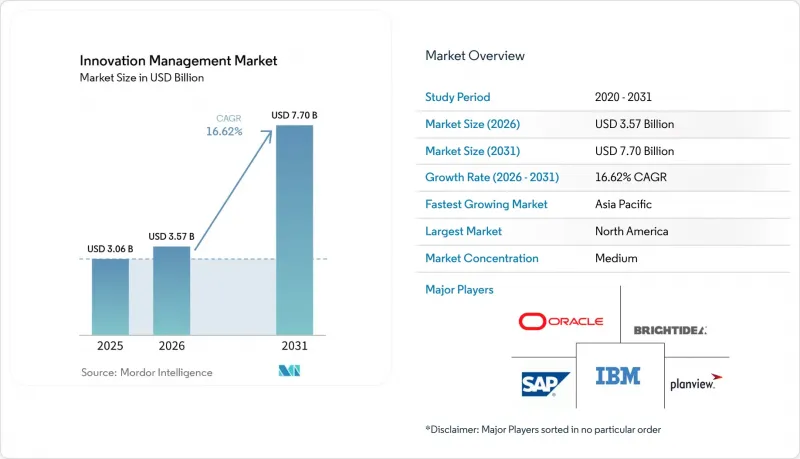
Mordor Intelligence에 의하면, 혁신 관리 시장 규모는 2026년 35억 7,000만 달러로 추정되고, 2025년 30억 6,000만 달러에서 확대해, 2031년에는 77억 달러에 이를 것으로 예측됩니다.
2026-2031년 연평균 성장률(CAGR)은 16.62%가 될 것으로 전망됩니다.
본 보고서는 제공 내용별(솔루션 및 서비스), 최종 사용자 기업 규모별(대기업 및 중소기업(SME)), 도입 형태별(클라우드 및 온프레미스), 용도별(프로젝트 관리 플랫폼, 마케팅 플랫폼 등), 최종 사용자별(은행, 금융서비스 및 보험(BFSI), 헬스케어 등) 및 지역별로 분류되어 있습니다. 시장 전망은 금액(달러) 기준으로 제시되어 있습니다.
세계의 혁신 관리 시장 동향 및 인사이트
업계를 아우르는 디지털 전환의 진전
혁신 관리 시장에서 진행되고 있는 디지털 전환 노력에 따라, 조직들은 단편적인 제안함을 분석 기능과 워크플로우 조정을 통합한, 아이디어 창출, 평가, 상용화를 아우르는 통합 프레임워크로 대체할 수밖에 없게 되었습니다. 경영진은 신뢰성이 높은 AI를 확장 가능한 혁신의 전제조건으로 점점 더 중요하게 여기고 있으며, 리더의 77%가 투명성이 높은 시스템의 필요성을 강조하고 있습니다. 제조 기업들은 인더스트리 4.0의 센서 및 분석 기능을 혁신 솔루션에 통합함으로써 안전 사고를 최대 50%까지 줄이는 동시에 직원들의 참여 의욕을 높이고 있습니다. 직원 중심의 디자인 접근 방식은 뿌리 깊은 문화적 장벽을 극복하고, 계층을 초월하여 아이디어 창출을 민주화하는 플랫폼의 도입 여지를 넓혀주고 있습니다.
증가하는 기업의 연구개발(R&D) 예산
혁신 관리 시장에서 연구 개발(R&D) 지출이 확대됨에 따라, 투자부터 상용화 성과까지 추적할 수 있는 거버넌스 도구에 대한 수요가 증가하고 있습니다. Oracle은 2023 회계연도에 86억 달러를 투자하여 기존 제품의 개선과 신기술 개발에 주력하고 있으며, 이는 대규모 연구개발과 체계적인 혁신 파이프라인의 필요성 사이의 연관성을 여실히 보여주고 있습니다. 대형 컨설팅 기업인 액센츄어는 매년 12억 달러를 탐색 연구소에, 11억 달러를 직원 역량 강화에 배정하고 있으며, 인적 자본 프로그램을 플랫폼 주도형 혁신 추적과 연계하고 있습니다. 금융 서비스 기업들도 이에 발맞추어, 이익률이 압박받는 환경 속에서 수익원을 지키기 위해 AI 및 클라우드 예산을 확대되고 있습니다.
다중 테넌트 통합의 복잡성
비용 효율성과 맞춤화 기능 간의 균형을 맞추려는 기업들은 클라우드 혁신 제품군을 수십 개의 레거시 시스템에 연결함으로써 사내 IT 자원이 부족해질 수 있다는 사실을 종종 깨닫게 됩니다. ServiceNow의 멀티 인스턴스 아키텍처는 이러한 장단점을 여실히 보여주고 있습니다. 즉, 분리성은 높아지는 반면, 업그레이드 시 조정 부담은 커지게 됩니다. 보험사 및 제조업체들은 각 테넌트에 걸친 ID 관리, 데이터 매핑, 규정 준수 테스트에 어려움을 겪고 있어, 전문적인 통합 파트너에 대한 수요가 증가하고 있습니다.
부문별 분석
2025년, 솔루션은 혁신 관리 시장 점유율의 67.92%를 차지했으며, 구매자들은 단일 사용자 경험 내에서 아이디어 수집, 스테이지게이트 거버넌스, 포트폴리오 분석을 아우르는 통합 플랫폼을 선호하는 것으로 나타났습니다. 번들로 제공되는 AI 모델, 로우코드 워크플로 빌더, 그리고 미리 구축된 API 커넥터는 올인원 제품군의 수준을 지속적으로 높여가고 있습니다. 전문 서비스 시장은 규모는 작지만, 기업들이 변경 관리, 알고리즘 조정 및 통합 워크스트림에 대한 자문 지원을 요청함에 따라 연평균 성장률(CAGR) 19.12%라는 견실한 성장세를 보이고 있습니다. 액센츄어의 컨설팅 부문은 분기 매출 50억 6,800만 달러를 기록했으며, 이는 변혁 프로그램을 일정대로 추진하기 위한 전문적인 도입 서비스에 대한 수요가 견조함을 보여줍니다.
도입 후 최적화에 대한 수요 역시 서비스 분야를 견인하고 있습니다. 지속적인 개선을 위한 리테이너 계약에서는 신규 기능 도입, 직원 교육 업데이트, 성과 벤치마킹 등이 대상이 됩니다. 멀티테넌트형 기능의 출시가 가속화되는 가운데, 조직들은 플랫폼 파트너와 계약을 체결하고, 혁신 KPI를 재조정하며, 최신 분석 모델이 변화하는 전략적 목표와 부합하도록 보장하고 있습니다. 이러한 추세에 따라 매니지드 서비스 제공업체는 플랫폼의 수명 주기 전반에 걸쳐 혁신의 속도를 유지하기 위한 핵심 파트너로서의 입지를 확고히 하고 있습니다.
2025년에는 대기업이 혁신 관리 시장 규모의 58.05%를 차지했으며, 전용 연구개발(R&D) 예산과 사내 아키텍처 팀을 활용하여 제품 수명 주기, 인사, 고객 경험 시스템에 걸친 솔루션 제품군을 통합했습니다. 그럼에도 불구하고 중소기업(SME)은 가장 역동적인 부문으로, 구독형 요금제, 턴키 방식의 클라우드 도입, 안내형 온보딩 프로그램 등을 통해 기존의 진입 장벽이 낮아짐에 따라 연평균 성장률(CAGR) 21.05%로 성장하고 있습니다. 혁신 관리 시장은 템플릿 라이브러리, 노코드 통합, AI를 활용한 로드맵 작성 도구를 통해 예산 한도나 인력 부족과 같은 중소기업의 과제를 해결하고 있습니다.
지역별 정책 인센티브 또한 중소기업의 도입을 더욱 촉진하고 있습니다. 유럽연합(EU)은 디지털화 프로젝트에 보조금을 지원하고 있으며, 북미의 개발은행은 클라우드 전환 자금을 보증하고 있습니다. 역량 격차를 해소하기 위해 각 벤더사는 부서 간 협업 팀을 구성하고, 분산형 아이디어 창출 문화를 조성하기 위한 모범 사례를 공유하는 가상 코칭 및 커뮤니티 포럼을 패키지로 제공합니다. 이러한 종합적인 지원 덕분에 도입까지 걸리는 기간이 단축되었으며, 자원이 제한적인 기업에서 플랫폼의 정착도가 높아지고 있습니다.
지역별 분석
북미는 2025년, 성숙한 기업 소프트웨어 생태계, 풍부한 벤처 자금, 그리고 체계적인 아이디어 창출 프로토콜에 대한 경영진의 폭넓은 수용을 바탕으로 혁신 관리 시장의 38.22% 점유율을 차지했습니다. 마이크로소프트는 2024년 매출이 2,450억 달러(전년 대비 16% 증가)라고 발표했으며, 이는 제품 및 서비스 파이프라인을 조정하기 위한 혁신 제품군을 우선시하는 지속적인 투자 사이클이 결실을 맺고 있음을 입증합니다. 미국 연방 정부의 클라우드 지출은 8년 동안 5배로 증가했으며, 정부 기관 및 규제 산업 분야에서 클라우드 호스팅형 혁신 플랫폼의 도입이 더욱 보편화되었습니다. 캐나다와 멕시코는 절대적인 지출 규모는 작지만, 제조업, 천연자원, 핀테크 분야의 도입을 통해 이 지역의 성장세를 뒷받침하고 있습니다.
아시아태평양은 가장 빠르게 성장하고 있는 지역으로, 2031년까지 연평균 성장률(CAGR) 22.1%로 성장할 전망입니다. 중국, 호주, 동남아시아의 기업들은 기존의 IT 인프라를 뛰어넘어, 슈퍼앱 문화와 현금 없는 경제에 부합하는 ‘모바일 퍼스트’이자 ‘클라우드 네이티브’인 혁신 스택을 도입하고 있습니다. 국내 AI 모델 도입 노력과 데이터 현지화 규제로 인해, 지역에 최적화된 혁신 솔루션에 대한 수요가 촉진되고 있습니다. 일본과 한국은 소버린 클라우드 및 지적재산권 보호 규제를 중시하며, 첨단 디지털 인프라와 엄격한 규정 준수 요건을 조화시키고 있습니다. 현지 시스템 통합사업자와 하이퍼스케일러는 플랫폼 벤더와 제휴하여 제조, 전자, 공공 부문의 이용 사례에 적합한 수직 통합형 솔루션 번들을 제공합니다.
유럽에서는 더욱 엄격해진 환경 정보 공개 규제와 GDPR(EU 개인정보보호규정) 등 개인정보 보호 관련 규제의 영향으로, 완만하기는 하지만 꾸준한 성장세를 보이고 있습니다. EU의 ‘기업 지속가능성 보고 지침’은 기업이 혁신 워크플로우에 ESG 점검 항목을 반영하도록 장려함으로써, 감사 가능한 플랫폼의 사업적 타당성을 강화하고 있습니다. 각국의 클라우드 주권 정책으로 인해, 해당 지역 내의 데이터센터나 암호화 절차가 선호되는 경향이 있습니다. 영국, 독일, 프랑스가 도입을 주도하는 한편, 남유럽 및 동유럽 국가들은 보다 광범위한 디지털 경제의 발전에 발맞추어 진전을 보이고 있습니다. 남미, 중동 및 아프리카는 여전히 개발도상 지역으로, 인프라 격차나 투자 우선순위로 인해 플랫폼 보급이 지연될 가능성이 있지만, 현지 상황에 맞춘 SaaS 가격 책정 및 정부 주도의 디지털화 추진을 통해 시장 접근성은 점차 개선되고 있습니다.
기타 혜택 :
- 엑셀 형식 시장 예측(ME) 시트
- 3개월간의 애널리스트 지원
자주 묻는 질문
목차
제1장 서론
제2장 조사 방법
제3장 주요 요약
제4장 시장 구도
제5장 시장 규모 및 성장 예측
제6장 경쟁 구도
제7장 시장 기회 및 향후 전망
AJY 26.06.24According to Mordor Intelligence, innovation management market size in 2026 is estimated at USD 3.57 billion, growing from 2025 value of USD 3.06 billion with 2031 projections showing USD 7.7 billion, growing at 16.62% CAGR over 2026-2031.
This report is Segmented by Offerings (Solutions and Services), End-User Enterprise Size (Large Enterprises and Small and Medium-Sized Enterprises (SMEs)), Deployment (Cloud and On-Premise), Application (Project Management Platforms, Marketing Platforms, and More), End-User (BFSI, Healthcare, and More) and by Geography. The Market Forecasts are Provided in Terms of Value (USD).
Global Innovation Management Market Trends and Insights
Ongoing Digital Transformation Across Industries
Digital transformation initiatives in the innovation management market compel organizations to replace isolated suggestion boxes with integrated ideation, evaluation, and commercialization frameworks that embed analytics and workflow orchestration. Executives increasingly regard trustworthy AI as a prerequisite for scalable transformation, with 77% of leaders emphasizing the need for transparent systems. Manufacturing firms integrate Industry 4.0 sensors and analytics into innovation suites, cutting safety incidents by up to 50% while elevating employee participation. Employee-centric design approaches address persistent cultural barriers, opening room for platforms that democratize ideation across hierarchies.
Rising Enterprise RandD Budgets
Escalating RandD outlays in the innovation management market intensify demand for governance tools that trace investment to commercial output. Oracle invested USD 8.6 billion in fiscal 2023 to refine existing products and pioneer new technologies, underscoring the link between large-scale RandD and the need for structured innovation pipelines.Consulting leader Accenture allocates USD 1.2 billion each year to exploration labs and USD 1.1 billion to workforce upskilling, aligning human-capital programs with platform-driven innovation tracking. Financial-services players follow suit, expanding AI and cloud budgets to protect revenue streams in a tightening margin environment.
Complexity of Multi-Tenant Integrations
Enterprises balancing cost efficiency with customization often discover that connecting cloud innovation suites to dozens of legacy systems strains internal IT bandwidth. ServiceNow's multi-instance architecture demonstrates the trade-off: higher isolation but heavier upgrade coordination. Insurance carriers and manufacturers grapple with identity-management, data-mapping, and compliance testing across each tenant, amplifying demand for specialized integration partners.
Other drivers and restraints analyzed in the detailed report include:
- Cloud-First Procurement Policies
- AI-Enabled Ideation Quality Scoring
- Data-Sovereignty and IP Leakage Concerns
For complete list of drivers and restraints, kindly check the Table Of Contents.
Segment Analysis
Solutions accounted for 67.92% of innovation management market share in 2025, demonstrating that buyers favor unified platforms spanning ideation capture, stage-gate governance, and portfolio analytics within a single user experience. Bundled AI models, low-code workflow builders, and pre-built API connectors continue to raise the bar for all-in-one suites. Professional services, although smaller, grow briskly at 19.12% CAGR as enterprises seek advisory support for change management, algorithm calibration, and integration workstreams. Accenture's consulting arm reported USD 5.068 billion in quarterly revenue, signaling healthy demand for specialized deployment services that keep transformation programs on schedule.
Demand for post-implementation optimization also propels the services category. Continuous-improvement retainers address new feature rollouts, employee-training refreshers, and performance benchmarking. As multi-tenant feature releases accelerate, organizations contract platform partners to recalibrate innovation KPIs, ensuring that fresh analytics models align with shifting strategic objectives. This dynamic positions managed-service providers as pivotal allies for sustaining innovation velocity over the platform life cycle.
Large enterprises commanded 58.05% of innovation management market size in 2025, leveraging dedicated RandD budgets and in-house architecture teams to integrate suites across product-lifecycle, HR, and customer-experience systems. Nonetheless, SMEs represent the most dynamic cohort, expanding at a 21.05% CAGR as subscription pricing, turnkey cloud deployments, and guided-onboarding programs shrink historic entry barriers. The innovation management market caters to SME pain points-budget ceilings and talent shortages-via template libraries, no-code integrations, and AI-assisted road-mapping tools.
Regional policy incentives further buoy SME adoption. European Union funds channel grants toward digitalization projects, while North American development banks underwrite cloud migrations. To counter capability gaps, vendors bundle virtual coaching and community forums that share best practices for engaging cross-functional teams, nurturing a culture of distributed ideation. Such wraparound support compresses ramp-up timelines and heightens platform stickiness among resource-constrained businesses.
Geography Analysis
North America captured 38.22% of innovation management market share in 2025, supported by mature enterprise software ecosystems, abundant venture funding, and broad C-suite acceptance of structured ideation protocols. Microsoft disclosed USD 245 billion in 2024 revenue-a 16% uplift-validating sustained investment cycles that favor innovation suites for orchestrating product and service pipelines. U.S. federal cloud outlays quintupled over eight years, further normalizing cloud-hosted innovation platforms within government and regulated industries. Canada and Mexico augment regional momentum with manufacturing, natural-resources, and fintech deployments, albeit at lower absolute spend.
Asia-Pacific stands as the fastest-growing region, expanding at a 22.1% CAGR through 2031. Enterprises in China, Australia, and Southeast Asia leapfrog legacy IT layers, adopting mobile-first, cloud-native innovation stacks that align with super-app cultures and cashless economies. Domestic AI-model initiatives and data-localization rules stimulate demand for region-tuned innovation suites. Japan and South Korea emphasize sovereign-cloud and IP-protection controls, harmonizing advanced digital infrastructure with rigorous compliance expectations. Local integrators and hyperscalers partner with platform vendors to deliver vertical solution bundles that suit manufacturing, electronics, and public-sector use cases.
Europe records measured yet resilient expansion, propelled by stricter environmental-disclosure regulations and privacy mandates such as GDPR. The EU Corporate Sustainability Reporting Directive motivates firms to embed ESG checkpoints inside innovation workflows, strengthening the business case for auditable platforms. National cloud-sovereignty policies foster a preference for regional data centers and encryption procedures. United Kingdom, Germany, and France spearhead adoption, while southern and eastern nations progress in line with broader digital-economy upgrades. South America, Middle East, and Africa remain nascent frontiers where infrastructure gaps and investment priorities can slow platform uptake, but localized SaaS pricing and government digitalization drives are gradually improving market accessibility.
- Accenture plc
- Aha! Labs Inc.
- Brightidea Inc.
- Crowdicity Ltd. (Wazoku)
- HYPE Innovation GmbH
- IBM Corporation
- IdeaScale Inc.
- Inno360 Inc.
- Medallia Inc.
- Nosco A/S
- Oracle Corporation
- Planbox Inc.
- Planview Inc.
- Qmarkets Ltd.
- Salesforce Inc. (IdeaExchange)
- SAP SE
- Sopheon plc
- Spigit Inc. (Planview)
- Wipro Ltd. (Innovation Services)
- Wazoku Ltd.
Additional Benefits:
- The market estimate (ME) sheet in Excel format
- 3 months of analyst support
TABLE OF CONTENTS
1 INTRODUCTION
- 1.1 Study Assumptions and Market Definition
- 1.2 Scope of the Study
2 RESEARCH METHODOLOGY
3 EXECUTIVE SUMMARY
4 MARKET LANDSCAPE
- 4.1 Market Overview
- 4.2 Market Drivers
- 4.2.1 Ongoing digital transformation across industries
- 4.2.2 Rising enterprise RandD budgets
- 4.2.3 Cloud-first procurement policies
- 4.2.4 Expanding open-innovation ecosystems
- 4.2.5 AI-enabled ideation quality scoring
- 4.2.6 Mandatory sustainability-linked innovation targets
- 4.3 Market Restraints
- 4.3.1 Complexity of multi-tenant integrations
- 4.3.2 Data-sovereignty and IP leakage concerns
- 4.3.3 Organizational culture inertia
- 4.3.4 Algorithmic bias in idea-ranking engines
- 4.4 Value Chain Analysis
- 4.5 Regulatory Landscape
- 4.6 Technological Outlook
- 4.7 Porter's Five Forces Analysis
- 4.7.1 Bargaining Power of Suppliers
- 4.7.2 Bargaining Power of Buyers
- 4.7.3 Threat of New Entrants
- 4.7.4 Threat of Substitutes
- 4.7.5 Competitive Rivalry
5 MARKET SIZE AND GROWTH FORECASTS (VALUE)
- 5.1 By Offerings
- 5.1.1 Solutions
- 5.1.2 Services
- 5.2 By End-user Enterprise Size
- 5.2.1 Large Enterprises
- 5.2.2 Small and Medium-sized Enterprises (SMEs)
- 5.3 By Deployment
- 5.3.1 Cloud
- 5.3.2 On-premises
- 5.4 By Application
- 5.4.1 Project Management Platforms
- 5.4.2 Marketing Platforms
- 5.4.3 Design Platforms
- 5.4.4 HR Platforms
- 5.4.5 Other Platforms
- 5.5 By End-user
- 5.5.1 BFSI
- 5.5.2 Healthcare
- 5.5.3 IT and Telecom
- 5.5.4 Media and Entertainment
- 5.5.5 Government
- 5.5.6 Other End-users
- 5.6 By Region
- 5.6.1 North America
- 5.6.1.1 United States
- 5.6.1.2 Canada
- 5.6.1.3 Mexico
- 5.6.2 South America
- 5.6.2.1 Brazil
- 5.6.2.2 Argentina
- 5.6.2.3 Rest of South America
- 5.6.3 Europe
- 5.6.3.1 United Kingdom
- 5.6.3.2 Germany
- 5.6.3.3 France
- 5.6.3.4 Italy
- 5.6.3.5 Spain
- 5.6.3.6 Russia
- 5.6.3.7 Rest of Europe
- 5.6.4 Asia-Pacific
- 5.6.4.1 China
- 5.6.4.2 India
- 5.6.4.3 Japan
- 5.6.4.4 South Korea
- 5.6.4.5 Australia and New Zealand
- 5.6.4.6 Southeast Asia
- 5.6.4.7 Rest of Asia-Pacific
- 5.6.5 Middle East and Africa
- 5.6.5.1 Middle East
- 5.6.5.1.1 Saudi Arabia
- 5.6.5.1.2 United Arab Emirates
- 5.6.5.1.3 Turkey
- 5.6.5.1.4 Rest of Middle East
- 5.6.5.2 Africa
- 5.6.5.2.1 South Africa
- 5.6.5.2.2 Nigeria
- 5.6.5.2.3 Kenya
- 5.6.5.2.4 Rest of Africa
- 5.6.5.1 Middle East
- 5.6.1 North America
6 COMPETITIVE LANDSCAPE
- 6.1 Market Concentration
- 6.2 Strategic Initiatives and Partnerships
- 6.3 Market Share Analysis
- 6.4 Company Profiles (includes Global level Overview, Market level overview, Core Segments, Financials as available, Strategic Information, Market Rank/Share, Products and Services, Recent Developments)
- 6.4.1 Accenture plc
- 6.4.2 Aha! Labs Inc.
- 6.4.3 Brightidea Inc.
- 6.4.4 Crowdicity Ltd. (Wazoku)
- 6.4.5 HYPE Innovation GmbH
- 6.4.6 IBM Corporation
- 6.4.7 IdeaScale Inc.
- 6.4.8 Inno360 Inc.
- 6.4.9 Medallia Inc.
- 6.4.10 Nosco A/S
- 6.4.11 Oracle Corporation
- 6.4.12 Planbox Inc.
- 6.4.13 Planview Inc.
- 6.4.14 Qmarkets Ltd.
- 6.4.15 Salesforce Inc. (IdeaExchange)
- 6.4.16 SAP SE
- 6.4.17 Sopheon plc
- 6.4.18 Spigit Inc. (Planview)
- 6.4.19 Wipro Ltd. (Innovation Services)
- 6.4.20 Wazoku Ltd.
7 MARKET OPPORTUNITIES AND FUTURE OUTLOOK
- 7.1 White-space and Unmet-Need Assessment