

|
시장보고서
상품코드
2065775
네트워크 기능 가상화(NFV) 시장 : 시장 점유율 분석, 업계 동향 및 통계, 성장 예측(2026-2031년)Network Function Virtualization (NFV) - Market Share Analysis, Industry Trends & Statistics, Growth Forecasts (2026 - 2031) |
||||||
 Mordor Intelligence
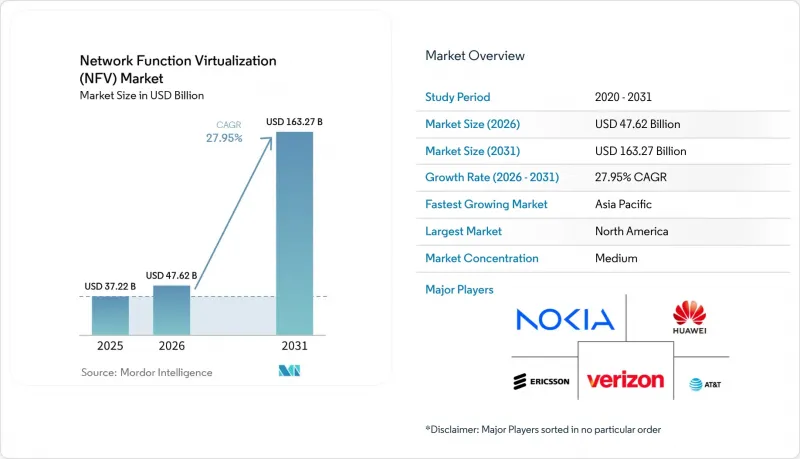
Mordor Intelligence에 의하면, 네트워크 기능 가상화(NFV) 시장 규모는 2025년 372억 2,000만 달러로 평가되었고, 2026년에는 476억 2,000만 달러로 추정되고, 2026-2031년 CAGR 27.95%로 성장을 지속할 전망이며, 2031년에는 1,632억 7,000만 달러에 이를 것으로 예측됩니다.
본 보고서는 구성 요소별(하드웨어, 소프트웨어 등), 용도별(가상 어플라이언스, 코어 네트워크 가상화 등), 최종 사용자별(통신 서비스 제공업체, 기업 등), 도입 형태별(온프레미스, 퍼블릭 클라우드 등), 가상화 네트워크 기능별(컴퓨팅 등) 및 지역별로 분류되어 있습니다. 시장 전망은 금액(달러) 기준으로 제시되어 있습니다.
세계의 네트워크 기능 가상화(NFV) 시장 동향 및 인사이트
5G 및 네트워크 슬라이싱에 대한 수요 증가
네트워크 슬라이싱을 통해 통신 사업자는 공통 인프라 위에서 각각의 특정 성능 목표에 맞추어 최적화된 여러 개의 독립적인 가상 네트워크를 구축할 수 있습니다. 소프트웨어 정의 네트워크(SDN)와 NFV를 결합함으로써, 통신 사업자는 컴퓨팅, 스토리지, 전송 자원을 동적으로 할당하여 몇 달이 아닌 몇 분 만에 새로운 서비스를 출시할 수 있게 됩니다. 초기 상용화 사례로는 자율주행차의 텔레메트리, 로봇 프로세스 자동화(RPA), 스마트 시티의 센서 백홀 등이 포함됩니다. 이 모델은 지연 시간 및 신뢰성에 따른 차별화된 가격 책정을 지원하며, 통신 사업자의 역할을 단순한 대역폭 재판매업자에서 서비스 제공업체로 전환시킵니다.
클라우드 네이티브 NFV 인프라를 통한 통신 사업자의 CAPEX에서 OPEX로의 전환
컨테이너화된 네트워크 기능과 마이크로서비스를 통해 통신 사업자는 모놀리식 네트워크 요소를 분해하고 신속하게 구축함으로써, 실제로 소비한 리소스만큼만 비용을 지불할 수 있게 됩니다. Dish사가 올클라우드 5G 네트워크에 100억 달러를 투자하겠다고 공식적으로 밝힌 것은 고정적인 하드웨어 수명 주기에서 유연한 소프트웨어 수명 주기로 전환하는 것의 경제적 매력을 보여줍니다. 비용 절감은 단순히 하드웨어 가격이 저렴하기 때문만이 아니라, 제로 터치 프로비저닝 및 자동화된 라이프사이클 관리를 통해 현장에 기술자를 파견하거나 수동 설정으로 인한 오류를 줄임으로써도 이루어집니다.
벤더 종속성을 완화하는 오픈소스 생태계
O-RAN 사양은 무선 액세스 네트워크를 상호 운용 가능한 구성 요소로 분해하며, ONAP는 종단 간 서비스 오케스트레이션을 위한 오픈소스 플랫폼을 제공합니다. 오픈 인터페이스를 채택하는 통신 사업자는 단일 벤더에 대한 의존도를 낮추고, 다중 벤더를 통한 혁신 주기를 가속화합니다. 유럽의 규제 정책은 디지털 주권을 강화하고 집중 위험을 억제하기 위해 개방형 아키텍처를 적극적으로 추진하고 있습니다.
부문별 분석
2025년 네트워크 기능 가상화(NFV) 시장 규모의 64.30%는 여전히 하드웨어가 차지했는데, 이는 캐리어급 컴퓨팅 및 가속 카드가 5G 트래픽의 초기 급증 시기에도 예측 가능한 처리량을 보장하기 때문입니다. 그러나 컨테이너형 네트워크 기능과 AI 오케스트레이션 제품군의 성장에 힘입어, 소프트웨어 매출은 2031년까지 연평균 성장률(CAGR) 29.2%를 기록하며 성장할 것으로 전망됩니다. 하이퍼컨버지드 엣지 플랫폼의 급속한 확산은 통신 사업자들이 클라우드 네이티브 패킷 처리에 최적화된 단일 어플라이언스에 컴퓨팅, 스토리지, 스위칭 기능을 통합하고 있음을 보여줍니다.
소프트웨어의 성장세는 개발 주기를 단축하고 커뮤니티 주도의 혁신을 촉진하는 오픈소스 생태계에 힘입어 더욱 가속화되고 있습니다. 통신 사업자들이 GitOps나 CI/CD 파이프라인을 도입함에 따라, 릴리스 빈도는 하드웨어 업데이트 일정이 아닌 클라우드 관행에 맞추어지고 있습니다. 이러한 전환으로 인해 맞춤형 어플라이언스는 몇 분 만에 배포 가능한 프로그래밍 가능한 서비스로 대체되면서, 네트워크 기능 가상화 시장 전체의 벤더 수익 구조가 재편되고 있습니다.
2025년에는 가상 어플라이언스(방화벽, vCPE, vRAN)가 네트워크 기능 가상화(NFV) 시장 규모의 44.65%를 차지했습니다. 그러나 서비스의 민첩성은 수천 개에 달하는 분산형 VNF를 조정하는 인텐트 기반 프로비저닝 엔진에 의존하고 있기 때문에 오케스트레이션 및 자동화 분야는 연평균 성장률(CAGR) 28.2%를 기록하며 다른 모든 부문을 앞지르는 성장을 이룰 것으로 전망됩니다. 통신 사업자들은 트래픽이 기하급수적으로 증가하는 상황에서 네트워크 슬라이스의 수익화와 서비스 품질 유지를 위해서는 자동화된 폐쇄 루프 제어가 필수적이라고 보고 있습니다.
컨테이너화는 애플리케이션의 다양화를 촉진하고 있습니다. Edge의 Kubernetes 클러스터는 현재 경량 UPF 및 사용자 플레인 가속기를 호스팅하며, 산업용 IoT 및 몰입형 미디어 워크로드를 구현하고 있습니다. 각 벤더사는 분석 기능과 정책 적용 기능을 오케스트레이터 내에 직접 통합함으로써, 보증 영역과 제어 영역 사이의 기존 경계를 해소하고 있습니다. 이러한 혁신을 통해 네트워크 기능 가상화 시장은 계속해서 ‘소프트웨어 우선’의 궤도를 확고히 따라가고 있습니다.
지역별 분석
2025년 북미가 네트워크 기능 가상화 시장에서 37.60%의 점유율을 차지하게 된 배경에는 AT&T 등의 통신 사업자들이 조기에 가상화 노력을 기울인 점과, 안전하고 국내 주도의 5G 인프라 분야에서 리더십을 확립하려는 미국의 전략적 추진이 있습니다. 오픈 RAN 연구에 대한 연방 정부의 장려책과 풍부한 자금 조달 환경이 맞물리면서 상용화가 가속화되고 있습니다. 캐나다의 통신 사업자들도 비슷한 경로를 밟으며, 패킷 코어의 현대화를 통해 민첩성을 높이고, 까다로운 서비스 품질 요건을 충족하고 있습니다.
유럽에서는 규제 당국이 디지털 주권, 지속가능성, 경쟁을 우선시하고 있어, 꾸준한 도입이 진행되고 있습니다. BEREC의 클라우드 엣지 프레임워크는 NFV와 자연스럽게 조화를 이루는 개방형 인터페이스와 연합 클라우드 모델을 촉진하고 있습니다. 도이치 텔레콤이나 텔레포니카와 같은 통신 사업자들은 AI 기반 오케스트레이션 및 GitOps 파이프라인을 시범 운영하며, 동적 워크로드 통합을 통해 온실가스 배출량을 5% 감축할 수 있음을 보여주고 있습니다. 그러나 각국마다 규제가 제각각이기 때문에 국경을 초월한 규제 조화에는 시간이 걸리고 있습니다.
아시아태평양은 연평균 성장률(CAGR) 29.3%를 기록하며, 향후 성장의 원동력이 되고 있습니다. 중국에서는 대규모 5G 구축에 따라 무선에서 코어에 이르기까지 가상화가 도입된 반면, 인도에서는 폭발적으로 증가하는 모바일 데이터 수요에 대응하기 위해 소프트웨어 정의 아키텍처를 도입한 현대화가 진행되고 있습니다. 일본과 한국에서는 이미 5G를 지원하는 사설 공장이 가동 중이며, 저지연 엣지 클라우드의 효과가 입증되었습니다. 레거시 네트워크의 제약을 받지 않는 아세안(ASEAN)의 신흥 경제국들은 클라우드 네이티브 도입으로 즉시 전환하고 있으며, 이는 네트워크 기능 가상화(NFV) 시장 전반에서 공급업체들의 비즈니스 기회를 확대되고 있습니다.
기타 혜택 :
- 엑셀 형식 시장 예측(ME) 시트
- 3개월간의 애널리스트 지원
자주 묻는 질문
목차
제1장 서론
제2장 조사 방법
제3장 주요 요약
제4장 시장 구도
제5장 시장 규모 및 성장 예측
제6장 경쟁 구도
제7장 시장 기회 및 향후 전망
AJY 26.06.24According to Mordor Intelligence, the network function virtualization market size is expected to grow from USD 37.22 billion in 2025 to USD 47.62 billion in 2026 and is forecast to reach USD 163.27 billion by 2031 at 27.95% CAGR over 2026-2031.
This report is Segmented by Component (Hardware, Software, and More), Application (Virtual Appliances, Core Network Virtualization, and More), End User (Telecom Service Providers, Enterprise, and More), Deployment Mode (On-Premise, Public Cloud, and More), Virtualized Network Function (Compute, and More), and Geography. The Market Forecasts are Provided in Terms of Value (USD).
Global Network Function Virtualization (NFV) Market Trends and Insights
Rising demand for 5G and network slicing
Network slicing lets operators create multiple isolated virtual networks on common infrastructure, each optimized for specific performance targets. By pairing software-defined networking with NFV, carriers dynamically allocate compute, storage, and transport resources to run new services in minutes rather than months. Early commercial slices span autonomous vehicle telemetry, robotic process automation, and smart-city sensor backhaul. The model supports differentiated pricing linked to latency or reliability, repositioning operators from bandwidth resellers to service enablers.
Telco CAPEX-to-OPEX shift via cloud-native NFV infrastructure
Containerized network functions and microservices allow operators to decompose monolithic network elements, spin them up rapidly, and pay only for the resources consumed. Dish's public commitment to spend USD 10 billion on an all-cloud 5G network showcases the financial appeal of shifting fixed hardware cycles toward elastic software lifecycles. Cost savings emerge not merely from cheaper hardware but from zero-touch provisioning and automated life-cycle management that cut field-engineering visits and manual configuration errors.
Open-Source ecosystems lowering vendor lock-in
The O-RAN specification disaggregates radio access networks into interoperable components, while ONAP delivers an open-source platform for end-to-end service orchestration. Carriers using open interfaces reduce single-vendor dependence and accelerate multivendor innovation cycles. Europe's regulatory agenda actively promotes open architectures to strengthen digital sovereignty and curb concentration risk.
Other drivers and restraints analyzed in the detailed report include:
- Edge-cloud deployments for URLLC and mMTC use-cases
- AI-Driven MANO and service assurance
- Private-5G adoption in Industry 4.0 driving on-prem NFV
- Integration with legacy OSS/BSS stacks
- Multi-vendor VNF interoperability gaps
For complete list of drivers and restraints, kindly check the Table Of Contents.
Segment Analysis
Hardware still underpins 64.30% of the 2025 network function virtualization market size because carrier-grade compute and acceleration cards guarantee predictable throughput during early 5G traffic spikes. Yet software revenues, propelled by container network functions and AI orchestration suites, are set to grow at 29.2% CAGR through 2031. A surge in hyper-converged edge platforms illustrates how operators bundle compute, storage, and switching in a single appliance optimized for cloud-native packets.
Software's momentum is reinforced by open-source ecosystems that shorten development cycles and encourage community-driven innovation. As operators adopt GitOps and CI/CD pipelines, release cadences mirror cloud disciplines rather than hardware refresh timelines. This transition displaces bespoke appliances with programmable services deployable in minutes, reshaping vendor economics across the network function virtualization market.
In 2025 virtual appliances-firewalls, vCPE, and vRAN-occupied 44.65% share of the network function virtualization market size. Orchestration and automation, however, will outpace all other categories at a 28.2% CAGR because service agility depends on intent-driven provisioning engines that coordinate thousands of distributed VNFs. Operators view automated closed-loop control as indispensable to monetizing network slices and maintaining quality of service amid exponential traffic growth.
Containerization is catalyzing application diversity. Edge Kubernetes clusters now host lightweight UPFs and user plane accelerators, enabling industrial IoT and immersive media workloads. Vendors integrate analytics and policy enforcement directly inside orchestrators, collapsing traditional boundaries between assurance and control domains. These innovations keep the network function virtualization market firmly on a software-first trajectory.
Geography Analysis
North America's 37.60% network function virtualization market share in 2025 stems from early virtualization initiatives by operators such as AT&T and the United States' strategic push for secure, domestic 5G infrastructure leadership. Federal incentives for open-RAN research, coupled with ample capital access, accelerate commercial deployments. Canadian carriers follow similar trajectories, modernizing packet cores to increase agility and satisfy aggressive service-quality mandates.
Europe registers steady adoption as regulators prioritize digital sovereignty, sustainability, and competition. BEREC's cloud-edge framework encourages open interfaces and federated cloud models that align naturally with NFV. Operators like Deutsche Telekom and Telefonica pilot AI-native orchestration and GitOps pipelines, demonstrating potential 5% greenhouse-gas reductions from dynamic workload consolidation. Fragmented national rules, however, prolong cross-border harmonization.
Asia-Pacific's 29.3% CAGR makes it the powerhouse of future growth. China's sweeping 5G rollout embeds virtualization from the radio to the core, while India's modernization drive embraces software-defined architectures to meet exploding mobile-data demand. Japan and South Korea already run private 5G-enabled factories, validating low-latency edge clouds. Emerging ASEAN economies, unencumbered by legacy networks, jump straight to cloud-native deployments, broadening supplier opportunities across the network function virtualization market.
- Cisco Systems Inc.
- Huawei Technologies Co. Ltd.
- Ericsson AB
- Nokia Corp.
- VMware Inc.
- Juniper Networks Inc.
- Hewlett Packard Enterprise (HPE)
- Dell Technologies Inc.
- Intel Corp.
- ATandT Inc.
- Verizon Communications Inc.
- ZTE Corp.
- Ribbon Communications
- NEC Corp.
- IBM Corp.
- Samsung Electronics
- Radisys Corp.
- Affirmed Networks (Microsoft)
- Mavenir Systems
- F5 Networks
Additional Benefits:
- The market estimate (ME) sheet in Excel format
- 3 months of analyst support
TABLE OF CONTENTS
1 INTRODUCTION
- 1.1 Study Assumptions and Market Definition
- 1.2 Scope of the Study
2 RESEARCH METHODOLOGY
3 EXECUTIVE SUMMARY
4 MARKET LANDSCAPE
- 4.1 Market Overview
- 4.2 Market Drivers
- 4.2.1 Rising demand for 5G and network slicing
- 4.2.2 Telco CAPEX-to-OPEX shift via cloud-native NFV Infrastructure
- 4.2.3 Edge-cloud deployments for URLLC and mMTC use-cases
- 4.2.4 AI-driven MANO and service assurance
- 4.2.5 Open-source ecosystems (O-RAN, ONAP) lowering vendor lock-in
- 4.2.6 Private-5G adoption in Industry 4.0 driving on-prem NFV
- 4.3 Market Restraints
- 4.3.1 Integration with legacy OSS/BSS stacks
- 4.3.2 Multi-vendor VNF interoperability gaps
- 4.3.3 Telco skill-set shortage for cloud-native operations
- 4.3.4 Security and compliance risks in disaggregated supply chain
- 4.4 Value / Supply-Chain Analysis
- 4.5 Regulatory Landscape
- 4.6 Technological Outlook
- 4.7 Porter's Five Forces
- 4.7.1 Bargaining Power of Suppliers
- 4.7.2 Bargaining Power of Consumers
- 4.7.3 Threat of New Entrants
- 4.7.4 Threat of Substitutes
- 4.7.5 Intensity of Competitive Rivalry
- 4.8 Industry Ecosystem and Partnerships
5 MARKET SIZE AND GROWTH FORECASTS (VALUES)
- 5.1 By Component
- 5.1.1 Hardware
- 5.1.2 Software
- 5.1.3 Services
- 5.2 By Application
- 5.2.1 Virtual Appliances (vCPE, vFW, vRAN)
- 5.2.2 Core Network Virtualization (vEPC, vIMS, vSR)
- 5.2.3 Orchestration and Automation
- 5.3 By End User
- 5.3.1 Telecom Service Providers
- 5.3.2 Cloud Service Providers
- 5.3.3 Enterprises
- 5.3.3.1 Banking, Financial Services, and Insurance (BFSI)
- 5.3.3.2 Retail and e-Commerce
- 5.3.3.3 Healthcare and Life Sciences
- 5.3.3.4 Manufacturing and Industrial
- 5.3.3.5 Government and Defense
- 5.4 By Deployment Mode
- 5.4.1 On-premise
- 5.4.2 Public Cloud
- 5.4.3 Hybrid / Multi-cloud
- 5.5 By Virtualized Network Function
- 5.5.1 Compute (vRouter, vSwitch)
- 5.5.2 Storage
- 5.5.3 Network (vLoad Balancer, vSR)
- 5.6 By Geography
- 5.6.1 North America
- 5.6.1.1 United States
- 5.6.1.2 Canada
- 5.6.2 Europe
- 5.6.2.1 United Kingdom
- 5.6.2.2 Germany
- 5.6.2.3 France
- 5.6.2.4 Italy
- 5.6.2.5 Spain
- 5.6.2.6 Russia
- 5.6.2.7 Rest of Europe
- 5.6.3 Asia-Pacific
- 5.6.3.1 China
- 5.6.3.2 India
- 5.6.3.3 Japan
- 5.6.3.4 South Korea
- 5.6.3.5 Australia and New Zealand
- 5.6.3.6 Rest of Asia-Pacific
- 5.6.4 South America
- 5.6.4.1 Brazil
- 5.6.4.2 Argentina
- 5.6.4.3 Rest of South America
- 5.6.5 Middle East and Africa
- 5.6.5.1 Middle East
- 5.6.5.1.1 Saudi Arabia
- 5.6.5.1.2 United Arab Emirates
- 5.6.5.1.3 Turkey
- 5.6.5.1.4 Rest of Middle East
- 5.6.5.2 Africa
- 5.6.5.2.1 South Africa
- 5.6.5.2.2 Nigeria
- 5.6.5.2.3 Rest of Africa
- 5.6.5.1 Middle East
- 5.6.1 North America
6 COMPETITIVE LANDSCAPE
- 6.1 Market Concentration
- 6.2 Strategic Moves
- 6.3 Market Share Analysis
- 6.4 Company Profiles (includes Global level Overview, Market level overview, Core Segments, Financials as available, Strategic Information, Market Rank/Share, Products and Services, Recent Developments)
- 6.4.1 Cisco Systems Inc.
- 6.4.2 Huawei Technologies Co. Ltd.
- 6.4.3 Ericsson AB
- 6.4.4 Nokia Corp.
- 6.4.5 VMware Inc.
- 6.4.6 Juniper Networks Inc.
- 6.4.7 Hewlett Packard Enterprise (HPE)
- 6.4.8 Dell Technologies Inc.
- 6.4.9 Intel Corp.
- 6.4.10 ATandT Inc.
- 6.4.11 Verizon Communications Inc.
- 6.4.12 ZTE Corp.
- 6.4.13 Ribbon Communications
- 6.4.14 NEC Corp.
- 6.4.15 IBM Corp.
- 6.4.16 Samsung Electronics
- 6.4.17 Radisys Corp.
- 6.4.18 Affirmed Networks (Microsoft)
- 6.4.19 Mavenir Systems
- 6.4.20 F5 Networks
7 MARKET OPPORTUNITIES AND FUTURE OUTLOOK
- 7.1 White-space and Unmet Need Analysis


