|
시장보고서
상품코드
2065784
실크 시장 : 시장 점유율 분석, 업계 동향 및 통계, 성장 예측(2026-2031년)Silk - Market Share Analysis, Industry Trends & Statistics, Growth Forecasts (2026 - 2031) |
||||||
 Mordor Intelligence
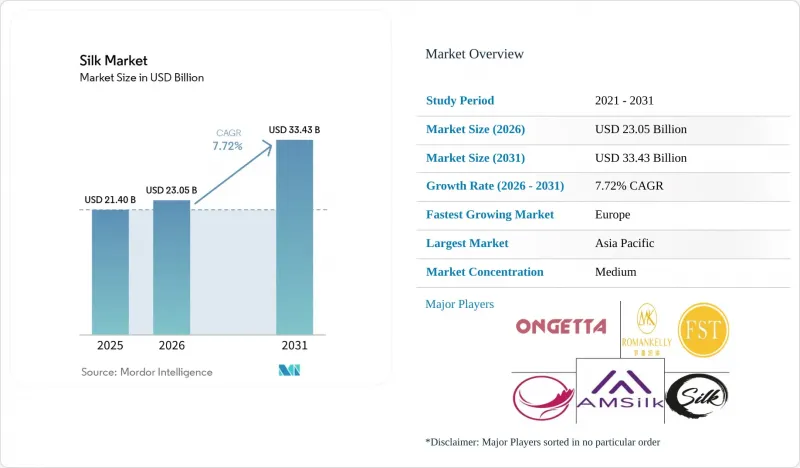
Mordor Intelligence에 의하면, 실크 시장 규모는 2025년 214억 달러로 평가되었고, 2026년에는 230억 5,000만 달러로 추정되고, 2026-2031년 CAGR 7.72%로 성장을 지속할 전망이며, 2031년에는 334억 3,000만 달러에 이를 것으로 예측됩니다.
본 보고서는 유형별(뽕나무 실크, 타사 실크, 엘리 실크, 무가 실크 등), 용도별(섬유 및 의류, 인테리어, 화장품 및 퍼스널케어 등), 그리고 지역별(북미, 유럽, 아시아태평양, 남미, 중동 및 아프리카)로 분류되어 있습니다. 시장 전망은 금액(달러) 기준으로 제시되어 있습니다.
세계의 실크 시장 동향 및 인사이트
고급 의류 및 홈 텍스타일에 대한 수요 증가
실크가 본래 지닌 광택과 드레이프성은 전 세계 럭셔리 소비가 체험형 가치 제안으로 전환되고 있는 상황 속에서도 프리미엄 제품에 대한 안정적인 수요를 뒷받침하고 있습니다. 중국 소비자들의 가처분 소득 증가는 수제 실크 의류와 고급 침구에 대한 지역적 수요를 뒷받침하고 있습니다. 럭셔리 브랜드들은 전통의 이야기와 지속가능성에 대한 메시지를 결합함으로써, 천연섬유를 선호하는 밀레니얼 세대와 Z세대의 취향을 충족시키고 있습니다. 패스트 패션의 사이클에서 상대적으로 벗어나 있음으로써, 실크 생산자들은 가격 결정력을 유지할 수 있으며, 이것이 실크 시장의 장기적인 성장 궤도를 뒷받침하고 있습니다.
양잠 및 방적 기술의 발전
선별 육종과 유전자 변형을 통해 실크 생산량이 많고, 병해 저항성이 뛰어나며, 섬유 품질이 향상된 누에 품종이 개발되었습니다. pH 조절을 통한 나노피브리르 형성에 관한 연구 결과는 천연섬유에 필적하는 강도를 지닌 인공 실크의 방적 기술 개발로 이어지고 있습니다. 일본의 NARO는 유전자 변형 누에를 통해 생산된 형광 고치를 상품화하여, 창의적이고 기술적인 용도 범위를 넓혀가고 있습니다. 대두박을 배합한 인공 사료 덕분에 누에고치의 품질이 안정화되었으며, 원료 가격 변동 위험이 줄어들었습니다. 중국 방적 공장에 디지털 트윈을 도입함으로써 처리 능력이 향상되고 폐기물이 감소했으며, 이는 인더스트리 4.0 도구가 실크 시장 전체의 생산성을 어떻게 높이고 있는지를 보여줍니다.
높은 생산 비용 및 생사 가격의 변동
실크 생산에는 30개 이상의 개별 공정이 포함되어 있어 인건비가 높은 수준을 유지하고 있습니다. 누에고치 가격의 변동은 방적 공장의 이익률을 압박하고 있으며, 생산 능력 확대 의지를 위축시키고 있습니다. 2023년 중국의 수출액이 14% 감소한 8억 100만 달러를 기록한 것은 이러한 공급 측면의 압박을 반영한 것입니다. 생사 공급이 계속해서 부족해진 상황은 실크 시장의 단기적인 성장세를 둔화시킬 가능성이 있습니다.
부문별 분석
2025년, 뽕나무 실크은 실크 시장 규모에서 최대 점유율을 유지하며 매출의 70.65%를 차지했습니다. 생명공학을 활용한 거미 실크는 아직 발전 단계에 있지만, 2031년까지 연평균 성장률(CAGR) 18.73%로 급성장할 전망이며, 이는 막대한 벤처 캐피털의 유입과 시범 생산 실적을 반영한 것입니다. 뛰어난 인장 강도와 경량성 덕분에 거미줄은 방위용 의류, 항공우주용 복합재료, 고급 스포츠 용품 분야에서 매력적인 소재로 자리 잡고 있습니다. 바이로이트 대학의 CRISPR 기술을 활용한 형광 실크는 유전자 편집을 통해 단백질 사슬을 특수한 기능에 맞게 조정할 수 있음을 보여주고 있습니다. 전통적인 타사르와 엘리 품종은 윤리적인 틈새 시장을 개척하고 있는 반면, 무가 실크는 틈새 오트쿠튀르 시장에서 여전히 고급 제품으로서의 프리미엄 가격을 유지하고 있습니다. 재조합 단백질을 둘러싼 연구 개발이 활발해지고 있는 만큼, 상업적 생산이 확대됨에 따라 거미줄이 실크 시장에서 더 큰 점유율을 차지할 것으로 예측됩니다.
뽕나무 실이 계속해서 지배적인 지위를 유지할 수 있을지는 중국과 인도에 뿌리내린 양잠 및 방적 네트워크에 달려 있습니다. 그러나 이익률 악화로 인해 방적 업체들은 혼방 원단이나 기능성 코팅의 도입을 서둘러야 하는 상황에 처해 있습니다. 병에 강한 누에를 대상으로 한 정부 지원 육종 프로그램을 통해 생산량이 안정화되고, 비용 급등을 억제할 수 있을 것으로 보입니다. 한편, 합성생물학 분야의 스타트업 기업들은 발효 배지 및 다운스트림 공정의 정제 과정을 최적화함으로써, 기존의 필라멘트 등급 제품과의 비용 경쟁력을 확보하는 것을 목표로 하고 있습니다. 생명공학과 기존 양잠 기술의 융합은 유전자 변형 품종과 전통 섬유가 공존하는 다양화된 미래의 실크 시장을 예고하고 있습니다.
지역별 분석
2025년, 아시아태평양 지역은 실크 시장의 61.92%를 차지했으며, 중국은 노동력 부족과 가격의 급등락에도 불구하고 8억 100만 달러 상당의 실크을 수출했습니다. 인도는 2023 회계연도에 3만 6,582미터톤의 생사를 생산했으며, ‘실크 사마그라(Silk Samagra)’ 계획에 따라 뽕나무 재배 면적을 확대하고 있어 공공 부문의 지속적인 지원이 이어지고 있음을 보여주고 있습니다. 베트남은 1억 4,300만 달러 규모의 수출을 기록하며, 인도의 방적 공장에 제품을 공급하는 한편, 지역 내 공급원의 다각화를 도모했습니다. 기계화에 따라 세균 오염 문제가 대두되면서, 기존 처리 방식보다 뛰어난 성능을 지닌 나노 플래티넘·폴리헥사메틸렌계 소독제의 도입이 확대되고 있습니다. 남중국해의 해양 긴장은 물류 체계의 취약성을 여실히 드러내고 있으며, 구매자들은 실크 시장에서 여러 공급원을 확보해야 하는 상황에 직면해 있습니다.
유럽은 가장 빠르게 성장하고 있는 지역으로, 2031년까지 연평균 성장률(CAGR) 7.19%를 기록하며 성장할 전망입니다. 이탈리아는 장인들이 마무리 가공에 사용할 수 있도록 1억 6,100만 달러 상당의 중국산 생사를 수입함으로써, 세계 명품 공급망에서 자국의 역할을 강화했습니다. EU의 공방에서는 추적 가능하고 환경 부하가 낮은 실크를, 가격이 다소 비싸더라도 구매할 의사가 있는 환경 의식이 높은 소비자들에게 판매하고 있습니다. AMSilk와 같은 생명공학 분야 스핀오프 기업들은 고성능 신발 및 의료기기용 재조합 섬유의 생산을 확대하고 있으며, 지역 혁신 클러스터의 기반이 되고 있습니다.
북미는 고성능 및 생의학 분야의 틈새 시장에 주력하고 있습니다. 미국은 2024년에 특수 후가공용으로 1,465만 달러 상당의 실크을 수입했습니다. Kraig Biocraft Laboratories사는 베트남에서 시범 농장을 운영하고 있으며, 방위 관련 계약을 위해 국내에서 섬유 생산도 계획하고 있습니다. 중동 및 아프리카는 여전히 개발도상국이지만, 럭셔리 소비 증가와 의례용 의상에서 실크에 대한 문화적 친화성이 나타나고 있으며, 물류 및 소매 인프라가 성숙해짐에 따라 향후 수요 증가를 위한 기반이 마련되고 있습니다.
기타 혜택 :
- 엑셀 형식 시장 예측(ME) 시트
- 3개월간의 애널리스트 지원
자주 묻는 질문
목차
제1장 서론
제2장 조사 방법
제3장 주요 요약
제4장 시장 구도
제5장 시장 규모 및 성장 예측
제6장 경쟁 구도
제7장 시장 기회 및 향후 전망
AJY 26.06.24According to Mordor Intelligence, the silk market size is expected to grow from USD 21.4 billion in 2025 to USD 23.05 billion in 2026 and is forecast to reach USD 33.43 billion by 2031 at 7.72% CAGR over 2026-2031.
This report is Segmented by Type (Mulberry Silk, Tussar Silk, Eri Silk, Muga Silk, and More), by Application (Textiles and Apparel, Home Furnishings, Cosmetics and Personal Care, and More), and by Geography (North America, Europe, Asia-Pacific, South America, Middle East, and Africa). The Market Forecasts are Provided in Terms of Value (USD).
Global Silk Market Trends and Insights
Rising Demand for Luxury Apparel and Home Textiles
Silk's intrinsic luster and drape underpin steady premium demand even as global luxury spending shifts toward experiential value propositions. Chinese consumers' rising disposable income sustains regional appetite for hand-crafted silk garments and upscale bedding. Luxury brands couple heritage narratives with sustainability messaging, satisfying Millennial and Gen Z preferences for natural fibers. Relative insulation from fast-fashion cycles enables silk producers to maintain pricing power, supporting the long-term growth arc of the silk market.
Technological Advances in Sericulture and Reeling
Selective breeding and genetic modification have led to silkworm strains with higher silk yield, disease resistance, and better fiber quality. pH-controlled nanofibril formation insights are guiding artificial silk spinning techniques that rival native fibers' strength. Japan's NARO commercialized fluorescent cocoons generated by genetically modified silkworms, widening creative and technical applications. Artificial diets formulated with soybean meal ensure consistent cocoon quality, easing feedstock volatility. Digital twins in Chinese reeling plants lift throughput and cut wastage, illustrating how Industry 4.0 tools raise productivity across the silk market.
High Production Cost and Raw-Silk Price Volatility
Silk production involves more than 30 discrete steps, keeping labor costs elevated. Cocoon price swings compress mill margins and dampen the willingness to scale capacity. China's 2023 export decline of 14% to USD 801 million reflects these supply-side pressures. A persistently tight raw silk supply can curtail the near-term growth pulse of the silk market.
Other drivers and restraints analyzed in the detailed report include:
- Government Subsidies and Integrated Development Programs
- Accelerating Biomedical Use of Silk Fibroin
- Competition from Synthetics and Regenerated Cellulose
For complete list of drivers and restraints, kindly check the Table Of Contents.
Segment Analysis
Mulberry silk retained the largest slice of the silk market size in 2025, capturing 70.65% of revenue. Bio-engineered spider silk, though nascent, is accelerating at a 18.73% CAGR through 2031, reflecting sizeable venture capital flows and pilot-scale production wins. Superior tensile strength and light weight make spider silk attractive for defense wear, aerospace composites, and premium sports gear. The University of Bayreuth's CRISPR-enabled fluorescent silk showcases how genetic editing can tailor protein chains for specialized functions. Traditional tussar and eri varieties are carving ethical niches, while muga silk continues to fetch luxury premiums in niche couture circles. Intensifying Research and Development around recombinant proteins suggests spider silk will secure a larger silk market share as commercial output scales.
The Continued dominance of mulberry hinges on well-entrenched farming and reeling networks in China and India. Yet margin headwinds push mills to introduce blended fabrics and performance coatings. State-backed breeding programs for disease-resistant silkworms may stabilize yields and curb cost spikes. Meanwhile, synthetic biology startups target cost parity with conventional filament grades by optimizing fermentation media and downstream purification. The convergence of bio-engineering and legacy sericulture points to a diversified future silk market where engineered variants coexist with heritage fibers.
Geography Analysis
Asia-Pacific accounted for 61.92% of the silk market in 2025, with China exporting USD 801 million of silk despite labor shortages and price turbulence. India produced 36,582 metric tons of raw silk in FY 2023 and expanded mulberry acreage under Silk Samagra, signaling continued public-sector backing. Vietnam recorded USD 143 million in exports, supplying Indian mills and diversifying regional supply. Mechanization brings bacterial-load challenges, prompting the adoption of nano platinum-poly hexamethylene disinfectants that outperform legacy treatments. Maritime tensions in the South China Sea highlight logistics vulnerabilities, pushing buyers to dual-source within the silk market.
Europe is the fastest-growing region, advancing at a 7.19% CAGR through 2031. Italy imported USD 161 million of Chinese greige silk for artisanal finishing, reinforcing its role in global luxury supply chains. EU workshops market traceable, low-impact silk to eco-conscious consumers willing to pay premiums. Bio-engineered spin-outs such as AMSilk are scaling recombinant fibers for performance footwear and medical devices, anchoring regional innovation clusters.
North America focuses on high-performance and biomedical niches. The United States imported USD 14.65 million of silk in 2024 for specialized downstream processing. Kraig Biocraft Laboratories operates pilot farms in Vietnam, yet plans domestic spinning for defense contracts. The Middle East and Africa remain nascent but show rising luxury consumption and cultural affinity for silk in ceremonial attire, setting the stage for future demand pickup as logistics and retail infrastructures mature.
- Anhui Silk Co. Ltd.
- Wujiang First Textile Co. Ltd.
- Zhejiang Jiaxin Silk Corp. Ltd.
- Hangzhou Lihai Silk Co. Ltd.
- Shanghai Silk Group Co. Ltd.
- Hangzhou Wensli Silk Culture Co. Ltd.
- Sichuan Nanchong Liuhe Group Co. Ltd.
- Barth and Konenkamp Seiden GmbH and Co. KG
- SILK & PROGRESS, spol. s r.o.
- Ongetta Srl
- AMSilk GmbH
- Kraig Biocraft Laboratories, Inc.
- Suzhou Kuangjie Trading Co., Ltd.
- Wujiang Wanshiyi Silk Co. Ltd.
Additional Benefits:
- The market estimate (ME) sheet in Excel format
- 3 months of analyst support
TABLE OF CONTENTS
1 Introduction
- 1.1 Study Assumptions and Market Definition
- 1.2 Scope of the Study
2 Research Methodology
3 Executive Summary
4 Market Landscape
- 4.1 Market Overview
- 4.2 Market Drivers
- 4.2.1 Rising demand for luxury apparel and home textiles
- 4.2.2 Technological advances in sericulture and reeling
- 4.2.3 Government subsidies and integrated development programs
- 4.2.4 Accelerating biomedical use of silk fibroin
- 4.2.5 Eco-sericulture hubs for traceable ethical silk
- 4.2.6 Scale-up of lab-grown spider silk for performance wear
- 4.3 Market Restraints
- 4.3.1 High production cost and raw-silk price volatility
- 4.3.2 Competition from synthetics and regenerated cellulose
- 4.3.3 Climate change-linked crop disease outbreaks
- 4.3.4 Supply-chain concentration risk
- 4.4 Regulatory Landscape
- 4.5 Technological Outlook
- 4.6 Porter's Five Forces
- 4.6.1 Bargaining Power of Suppliers
- 4.6.2 Bargaining Power of Buyers
- 4.6.3 Threat of New Entrants
- 4.6.4 Threat of Substitutes
- 4.6.5 Intensity of Competitive Rivalry
5 Market Size and Growth Forecasts (Value)
- 5.1 By Type
- 5.1.1 Mulberry Silk
- 5.1.2 Tussar Silk
- 5.1.3 Eri Silk
- 5.1.4 Muga Silk
- 5.1.5 Bio-engineered Spider Silk
- 5.2 By Application
- 5.2.1 Textiles and Apparel
- 5.2.2 Home Furnishings
- 5.2.3 Cosmetics and Personal Care
- 5.2.4 Biomedical and Tissue Engineering
- 5.2.5 Nutraceutical and Food Additives
- 5.3 By Geography
- 5.3.1 North America
- 5.3.1.1 United States
- 5.3.1.2 Canada
- 5.3.1.3 Mexico
- 5.3.1.4 Rest of North America
- 5.3.2 South America
- 5.3.2.1 Brazil
- 5.3.2.2 Argentina
- 5.3.2.3 Rest of South America
- 5.3.3 Europe
- 5.3.3.1 Germany
- 5.3.3.2 United Kingdom
- 5.3.3.3 France
- 5.3.3.4 Italy
- 5.3.3.5 Spain
- 5.3.3.6 Norway
- 5.3.3.7 Finland
- 5.3.3.8 Rest of Europe
- 5.3.4 Asia-Pacific
- 5.3.4.1 China
- 5.3.4.2 India
- 5.3.4.3 Japan
- 5.3.4.4 Australia
- 5.3.4.5 Rest of Asia-Pacific
- 5.3.5 Middle East
- 5.3.5.1 Turkey
- 5.3.5.2 Saudi Arabia
- 5.3.5.3 United Arab Emirates
- 5.3.5.4 Rest of Middle East
- 5.3.6 Africa
- 5.3.6.1 South Africa
- 5.3.6.2 Nigeria
- 5.3.6.3 Egypt
- 5.3.6.4 Rest of Africa
- 5.3.1 North America
6 Competitive Landscape
- 6.1 Market Concentration
- 6.2 Strategic Moves
- 6.3 Market Share Analysis
- 6.4 Company Profiles (includes Global level Overview, Market level overview, Core Segments, Financials as available, Strategic Information, Market Rank/Share, Products and Services, and Recent Developments)
- 6.4.1 Anhui Silk Co. Ltd.
- 6.4.2 Wujiang First Textile Co. Ltd.
- 6.4.3 Zhejiang Jiaxin Silk Corp. Ltd.
- 6.4.4 Hangzhou Lihai Silk Co. Ltd.
- 6.4.5 Shanghai Silk Group Co. Ltd.
- 6.4.6 Hangzhou Wensli Silk Culture Co. Ltd.
- 6.4.7 Sichuan Nanchong Liuhe Group Co. Ltd.
- 6.4.8 Barth and Konenkamp Seiden GmbH and Co. KG
- 6.4.9 SILK & PROGRESS, spol. s r.o.
- 6.4.10 Ongetta Srl
- 6.4.11 AMSilk GmbH
- 6.4.12 Kraig Biocraft Laboratories, Inc.
- 6.4.13 Suzhou Kuangjie Trading Co., Ltd.
- 6.4.14 Wujiang Wanshiyi Silk Co. Ltd.