
|
시장보고서
상품코드
2065787
나한과 시장 : 점유율 분석, 업계 동향과 통계, 성장 예측(2026-2031년)Luo Han Guo - Market Share Analysis, Industry Trends & Statistics, Growth Forecasts (2026 - 2031) |
||||||
 Mordor Intelligence
Mordor Intelligence에 의하면, 나한과 시장 규모는 2025년 1억 4,060만 달러에서 2026년에는 1억 5,920만 달러로 확대되어 2031년까지 2억 9,580만 달러에 이를 것으로 예측되며, 2026년부터 2031년까지 기간 CAGR은 13.2%를 나타낼 전망입니다.
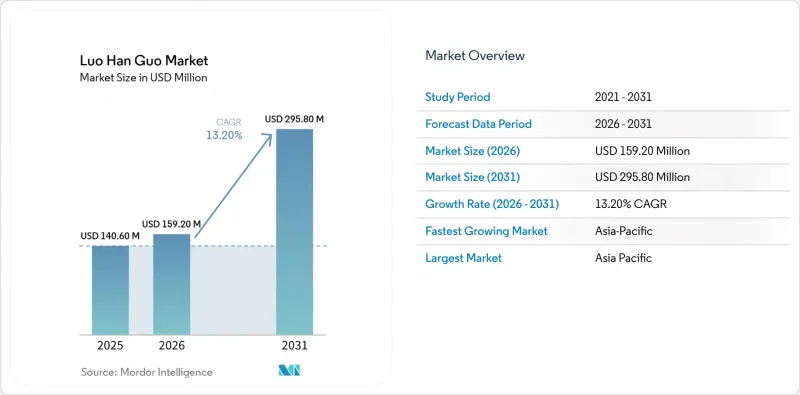
본 보고서는 지역별(북미, 남미, 유럽, 아시아태평양, 기타)로 분류되어 있습니다. 본 보고서에는 생산 분석(수량), 소비 분석(금액 및 수량), 수입 분석(금액 및 수량), 수출 분석(금액 및 수량), 도매 가격 동향 분석 및 예측 등이 포함되어 있습니다. 시장 전망은 금액(달러) 및 수량(미터톤) 단위로 제시되어 있습니다.
세계 나한과 시장 동향 및 분석
제로 칼로리 감미료에 대한 ‘클린 라벨’ 수요
국제식품정보협의회(IFIC)의 ‘2025년 식품·건강 조사’에 따르면, 소비자의 34%가 ‘저당질’을 건강한 식품의 중요한 특성으로 인식하고 있으며, 당분 섭취량 감소를 향한 큰 변화가 부각되고 있습니다. 이러한 추세에 따라 제조업체들이 클린 라벨 요건을 충족하기 위해 제품 배합을 재검토하는 가운데, 나한과(루오항고)와 같은 천연 무칼로리 감미료에 대한 수요가 증가하고 있습니다. 당분 절감에 대한 관심이 높아지면서, 특히 음료나 스낵류에서 인공 감미료를 식물 유래 대체재로 대체하는 움직임도 촉진되고 있으며, 진화하는 제품 처방에서 기능성과 라벨 투명성을 모두 제공하는 나한과의 역할이 강조되고 있습니다.
당뇨병 및 비만 유병률 증가
국제당뇨병연맹(IDF)에 따르면, 2024년에는 전 세계적으로 20세에서 79세 사이의 성인 5억 8,900만 명이 당뇨병을 앓고 있어, 당분 제한 식단에 대한 수요가 높아지고 있음이 드러나고 있습니다. 당뇨병 유병률이 증가함에 따라, 소비자와 제조업체 모두 더 건강한 당 대체재를 선호하는 가운데, 나한과와 같이 혈당 지수가 낮고 칼로리가 없는 감미료에 대한 수요가 높아지고 있습니다. 그 결과, 식품 및 음료 기업들은 신진대사 관련 건강 요건을 충족하기 위해, 특히 기능성 음료나 다이어트 지향 제품을 중심으로 제품의 배합을 재검토하고 있습니다. 이러한 추세는 당뇨병과 비만에 대한 우려로 인해 발생하는 식생활 변화에 대응하는 과정에서 나한과의 역할이 확대되고 있음을 여실히 보여주고 있습니다.
재배는 주로 광시 좡족 자치구와 후난성에 국한되어 있습니다.
재배 지역이 극히 제한적이라는 점은 여전히 나한과 시장에 큰 제약 요인으로 작용하고 있으며, 이는 공급 확대를 저해하고 지역적 공급 차단의 영향을 받기 쉽게 만들고 있습니다. 멜버른 대학교 연구진에 따르면, 2024년 기준으로 나한과 생산량의 90% 이상이 중국 광시 좡족 자치구의 룽셩현, 링구이현, 용푸현에 집중되어 있습니다. 이러한 단일 미기후에 대한 의존은 악천후나 계절적 변동에 따른 위험을 증폭시켜 공급의 불안정성을 초래하고 있습니다. 그 결과, 제조업체들은 조달상의 문제에 직면해 있으며, 사업 확장 기회도 제한적이어서 시장의 지속적인 성장이 저해되고 있습니다.
지역별 분석
2025년 현재, 아시아태평양은 나한과 시장의 45%를 차지하고 있으며, 시장 규모는 2026년부터 2031년까지 연평균 성장률(CAGR) 14.6%라는 가장 높은 성장률을 기록하며 확대될 것으로 전망됩니다. 이 지역의 성장은 중국의 추출 거점 확대와 동남아시아에서의 시험 재배 진전에 힘입어 이루어지고 있으며, 이러한 요인들이 공급망 강화로 이어지고 있습니다. Layn Natural Ingredients 등의 기업들이 뒷받침하는 광시 좡족 자치구의 수직 통합형 생태계는 규모의 경제를 실현하고 있습니다. 또한, 일본의 기능성 음료 부문은 특히 유기농 인증이나 ‘Non-GMO Project Verified’ 인증을 획득한 제품에 대한 프리미엄 수요를 주도하고 있습니다. 신흥 동남아시아 시장도 가처분 소득 증가와 당뇨병 확산 방지 대책의 일환으로 시행되고 있는 설탕세 도입에 힘입어 성장에 기여하고 있습니다.
북미는 소비량 기준으로 2위를 차지하고 있으며, 미국은 10여년전 미국 식품의약국(FDA)으로부터 ‘일반적으로 안전하다고 인정되는(GRAS)’ 인증을 받은 바 있어, 이 성분을 가장 먼저 도입한 시장이 되었습니다. 그러나 2025년에 도입이 제안된 관세는 비용 면에서 부담을 주고 있으며, Layn사의 인디애나주 시설과 같은 국내 가공 능력 확충을 통해 그 영향이 완화되지 않는 한, 단기적인 시장 성장을 저해할 가능성이 있습니다. 캐나다 역시 유사한 규제 체계를 채택하고 있어 국경을 초월한 통합 공급망의 혜택을 누리고 있지만, 인구가 적기 때문에 전체적인 판매량의 잠재력은 제한적입니다.
유럽에서는 규제가 명확해짐에 따라 꾸준한 진전이 나타나고 있습니다. 영국 식품표준청(FSA)이 2024년에 내린 ‘신규성 없음’ 판정에 따라, 나한과 달인액의 사용이 촉진되었습니다. 그러나 모그로사이드 V의 함유율이 50%를 초과하는 추출물의 경우, 유럽식품안전청(EFSA)의 승인을 아직 받지 못해 규격의 불일치와 고순도 제품의 보급 지연으로 이어지고 있습니다. 남유럽의 제빵 및 제과 제조업체들은 로한과의 열안정성을 높이 평가하고 있지만, 북유럽에 비해 인지도는 여전히 낮은 상황입니다. 중동 및 아프리카와 남미는 나한과의 새로운 시장으로 부상하고 있습니다. 당뇨병 유병률 증가와 다국적 기업의 음료 출시 등은 초기 단계에서 수요가 발생할 가능성을 시사하고 있습니다. 그러나 높은 수입 비용과 소매점에서 구하기 어려운 점 등으로 인해, 이들 지역에서의 본격적인 시장 침투는 여전히 더딘 상태입니다.
- 엑셀 형식 시장 예측(ME) 시트
- 3개월간의 애널리스트 지원
자주 묻는 질문
목차
제1장 서론
제2장 조사 방법
제3장 주요 요약
제4장 시장 구도
제5장 시장 규모와 성장 예측
제6장 최종 용도 및 용도
제7장 경쟁 구도
제8장 시장 기회와 향후 전망
JHS 26.06.29According to Mordor Intelligence, the luo han guo market size is projected to grow from USD 140.6 million in 2025 to USD 159.20 million in 2026, reaching USD 295.80 million by 2031, with a CAGR of 13.2% during the period 2026-2031.
This report is Segmented by Geography (North America, South America, Europe, Asia-Pacific, and More). The Report Includes Production Analysis (Volume), Consumption Analysis (Value and Volume), Import Analysis (Value and Volume), Export Analysis (Value and Volume), Wholesale Price Trend Analysis and Forecast, and More. The Market Forecasts are Provided in Terms of Value (USD) and Volume (Metric Tons)
Global Luo Han Guo Market Trends and Insights
Clean-Label Demand for Zero-Calorie Sweeteners
According to the International Food Information Council's 2025 Food and Health Survey, 34% of consumers consider "low in sugar" a key attribute of healthy food, highlighting a significant shift toward reduced sugar consumption. This trend is driving increased demand for natural, zero-calorie sweeteners like monk fruit (Luo Han Guo), as manufacturers reformulate products to meet clean-label requirements. The focus on sugar reduction is also prompting the replacement of artificial sweeteners with plant-based alternatives, particularly in beverages and snacks, emphasizing monk fruit's role in providing both functionality and label transparency in evolving product formulations.
Rising Prevalence of Diabetes and Obesity
According to the International Diabetes Federation, 589 million adults aged 20-79 were living with diabetes globally in 2024, underscoring the growing need for sugar-controlled diets. This increasing prevalence of diabetes is driving demand for low-glycemic, zero-calorie sweeteners such as luo han guo, as both consumers and manufacturers prioritize healthier sugar alternatives. As a result, food and beverage companies are reformulating products, particularly functional beverages and diet-focused offerings, to meet metabolic health requirements. This trend highlights monk fruit's expanding role in addressing dietary changes driven by concerns about diabetes and obesity.
Cultivation Confined Largely to Guangxi and Hunan Provinces
The extreme geographic concentration of cultivation continues to be a significant limitation for the Luo Han Guo market, restricting supply scalability and increasing susceptibility to regional disruptions. According to the researchers of the University of Melbourne, as of 2024, over 90% of monk fruit production is concentrated in Longsheng, Lingui, and Yongfu counties within Guangxi Province, China. This reliance on a single microclimate amplifies the risks associated with adverse weather conditions and seasonal variability, resulting in supply instability. Consequently, manufacturers encounter sourcing challenges and limited opportunities for expansion, which impede sustained market growth.
Other drivers and restraints analyzed in the detailed report include:
- Expansion of Natural-Ingredient Beverage Launches
- Regulatory Approvals in North America and the European Union
- High Extraction and Purification Costs versus Stevia
For complete list of drivers and restraints, kindly check the Table Of Contents.
Geography Analysis
Asia-Pacific accounted for 45% of the Luo Han Guo market share in 2025, and the market size is projected to grow at at he fastest 14.6% CAGR from 2026 to 2031. The region's growth is driven by the expansion of Chinese extraction hubs and Southeast Asian test plantings, which enhance supply routes. Guangxi's vertically integrated ecosystems, supported by companies such as Layn Natural Ingredients, provide a scale advantage. Additionally, Japan's functional beverage sector fuels premium demand, particularly for certified-organic and Non-GMO Project Verified grades. Emerging Southeast Asian markets also contribute to growth, supported by rising disposable incomes and sugar-tax initiatives aimed at addressing diabetes prevalence.
North America ranked second in consumption, with the United States being the earliest adopter due to the Food and Drug Administration's Generally Recognized as Safe (GRAS) status granted over a decade ago. However, the proposed 2025 tariff introduces cost pressures that may hinder short-term market growth unless domestic processing expansions, such as Layn's Indiana facility, mitigate these impacts. Canada follows similar regulatory frameworks and benefits from integrated cross-border supply chains, though its smaller population limits overall volume potential.
Europe is advancing at a steady pace as regulatory clarity improves. The United Kingdom Food Standards Agency's 2024 non-novel ruling has facilitated the use of monk fruit decoctions. However, extracts with mogroside V content above 50% still await European Food Safety Authority (EFSA) approval, leading to fragmented specifications and slower adoption of high-purity products. Southern European bakery and confectionery manufacturers value monk fruit's heat stability, but awareness remains lower compared to Northern Europe. The Middle East, Africa, and South America are emerging markets for Luo Han Guo. Rising diabetes prevalence and multinational beverage launches indicate early demand potential. However, high import costs and limited retail availability continue to delay significant market penetration in these regions.
- The market estimate (ME) sheet in Excel format
- 3 months of analyst support
TABLE OF CONTENTS
1 Introduction
- 1.1 Study Assumptions and Market Definition
- 1.2 Scope of the Study
2 Research Methodology
3 Executive Summary
4 Market Landscape
- 4.1 Market Overview
- 4.2 Market Drivers
- 4.2.1 Clean-label demand for zero-calorie sweeteners
- 4.2.2 Rising prevalence of diabetes and obesity
- 4.2.3 Expansion of natural-ingredient beverage launches
- 4.2.4 Regulatory approvals in North America and Europe
- 4.2.5 AI-enabled flavor-modulation improving taste profiles
- 4.2.6 Supply-chain diversification driven by 2025 tariff regime
- 4.3 Market Restraints
- 4.3.1 Cultivation confined largely to Guangxi and Hunan provinces
- 4.3.2 High extraction and purification costs vs. stevia
- 4.3.3 Tight novel-food regulations delaying European Union product roll-outs
- 4.3.4 Climate-change-linked crop-yield volatility in subtropics
- 4.4 Opportunities
- 4.5 Challenges
- 4.6 Value Chain Analysis
- 4.7 Technologies and usage of AI in the Industry
- 4.8 Input Market Analysis
- 4.8.1 Seeds
- 4.8.2 Fertilizers
- 4.8.3 Crop Protection Chemicals
- 4.9 Distribution Channel Analysis
- 4.10 Market Sentiment Analysis
- 4.11 PESTLE Analysis
5 Market Size and Growth Forecast (Value and Volume)
- 5.1 By Geography
- 5.1.1 North America
- 5.1.1.1 United States
- 5.1.1.1.1 Production Analysis (Production Volume)
- 5.1.1.1.2 Consumption Analysis (Consumption Value and Volume)
- 5.1.1.1.3 Import Market Analysis (Import Value, Volume, and Key Supplying Markets)
- 5.1.1.1.4 Export Market Analysis (Export Value, Volume, and Key Destination Markets)
- 5.1.1.1.5 Wholesale Price Trend Analysis and Forecast
- 5.1.1.1.6 Regulatory Framework
- 5.1.1.1.7 List of Key Players
- 5.1.1.1.8 Logistics and Infrastructure
- 5.1.1.1.9 Seasonality Analysis
- 5.1.1.2 Canada
- 5.1.1.2.1 Production Analysis (Production Volume)
- 5.1.1.2.2 Consumption Analysis (Consumption Value and Volume)
- 5.1.1.2.3 Import Market Analysis (Import Value, Volume, and Key Supplying Markets)
- 5.1.1.2.4 Export Market Analysis (Export Value, Volume, and Key Destination Markets)
- 5.1.1.2.5 Wholesale Price Trend Analysis and Forecast
- 5.1.1.2.6 Regulatory Framework
- 5.1.1.2.7 List of Key Players
- 5.1.1.2.8 Logistics and Infrastructure
- 5.1.1.2.9 Seasonality Analysis
- 5.1.1.1 United States
- 5.1.2 South America
- 5.1.2.1 Brazil
- 5.1.2.1.1 Production Analysis (Production Volume)
- 5.1.2.1.2 Consumption Analysis (Consumption Value and Volume)
- 5.1.2.1.3 Import Market Analysis (Import Value, Volume, and Key Supplying Markets)
- 5.1.2.1.4 Export Market Analysis (Export Value, Volume, and Key Destination Markets)
- 5.1.2.1.5 Wholesale Price Trend Analysis and Forecast
- 5.1.2.1.6 Regulatory Framework
- 5.1.2.1.7 List of Key Players
- 5.1.2.1.8 Logistics and Infrastructure
- 5.1.2.1.9 Seasonality Analysis
- 5.1.2.2 Argentina
- 5.1.2.2.1 Production Analysis (Production Volume)
- 5.1.2.2.2 Consumption Analysis (Consumption Value and Volume)
- 5.1.2.2.3 Import Market Analysis (Import Value, Volume, and Key Supplying Markets)
- 5.1.2.2.4 Export Market Analysis (Export Value, Volume, and Key Destination Markets)
- 5.1.2.2.5 Wholesale Price Trend Analysis and Forecast
- 5.1.2.2.6 Regulatory Framework
- 5.1.2.2.7 List of Key Players
- 5.1.2.2.8 Logistics and Infrastructure
- 5.1.2.2.9 Seasonality Analysis
- 5.1.2.1 Brazil
- 5.1.3 Europe
- 5.1.3.1 Germany
- 5.1.3.1.1 Production Analysis (Production Volume)
- 5.1.3.1.2 Consumption Analysis (Consumption Value and Volume)
- 5.1.3.1.3 Import Market Analysis (Import Value, Volume, and Key Supplying Markets)
- 5.1.3.1.4 Export Market Analysis (Export Value, Volume, and Key Destination Markets)
- 5.1.3.1.5 Wholesale Price Trend Analysis and Forecast
- 5.1.3.1.6 Regulatory Framework
- 5.1.3.1.7 List of Key Players
- 5.1.3.1.8 Logistics and Infrastructure
- 5.1.3.1.9 Seasonality Analysis
- 5.1.3.2 France
- 5.1.3.2.1 Production Analysis (Production Volume)
- 5.1.3.2.2 Consumption Analysis (Consumption Value and Volume)
- 5.1.3.2.3 Import Market Analysis (Import Value, Volume, and Key Supplying Markets)
- 5.1.3.2.4 Export Market Analysis (Export Value, Volume, and Key Destination Markets)
- 5.1.3.2.5 Wholesale Price Trend Analysis and Forecast
- 5.1.3.2.6 Regulatory Framework
- 5.1.3.2.7 List of Key Players
- 5.1.3.2.8 Logistics and Infrastructure
- 5.1.3.2.9 Seasonality Analysis
- 5.1.3.3 United Kingdom
- 5.1.3.3.1 Production Analysis (Production Volume)
- 5.1.3.3.2 Consumption Analysis (Consumption Value and Volume)
- 5.1.3.3.3 Import Market Analysis (Import Value, Volume, and Key Supplying Markets)
- 5.1.3.3.4 Export Market Analysis (Export Value, Volume, and Key Destination Markets)
- 5.1.3.3.5 Wholesale Price Trend Analysis and Forecast
- 5.1.3.3.6 Regulatory Framework
- 5.1.3.3.7 List of Key Players
- 5.1.3.3.8 Logistics and Infrastructure
- 5.1.3.3.9 Seasonality Analysis
- 5.1.3.4 Spain
- 5.1.3.4.1 Production Analysis (Production Volume)
- 5.1.3.4.2 Consumption Analysis (Consumption Value and Volume)
- 5.1.3.4.3 Import Market Analysis (Import Value, Volume, and Key Supplying Markets)
- 5.1.3.4.4 Export Market Analysis (Export Value, Volume, and Key Destination Markets)
- 5.1.3.4.5 Wholesale Price Trend Analysis and Forecast
- 5.1.3.4.6 Regulatory Framework
- 5.1.3.4.7 List of Key Players
- 5.1.3.4.8 Logistics and Infrastructure
- 5.1.3.4.9 Seasonality Analysis
- 5.1.3.5 Italy
- 5.1.3.5.1 Production Analysis (Production Volume)
- 5.1.3.5.2 Consumption Analysis (Consumption Value and Volume)
- 5.1.3.5.3 Import Market Analysis (Import Value, Volume, and Key Supplying Markets)
- 5.1.3.5.4 Export Market Analysis (Export Value, Volume, and Key Destination Markets)
- 5.1.3.5.5 Wholesale Price Trend Analysis and Forecast
- 5.1.3.5.6 Regulatory Framework
- 5.1.3.5.7 List of Key Players
- 5.1.3.5.8 Logistics and Infrastructure
- 5.1.3.5.9 Seasonality Analysis
- 5.1.3.1 Germany
- 5.1.4 Asia-Pacific
- 5.1.4.1 China
- 5.1.4.1.1 Production Analysis (Production Volume)
- 5.1.4.1.2 Consumption Analysis (Consumption Value and Volume)
- 5.1.4.1.3 Import Market Analysis (Import Value, Volume, and Key Supplying Markets)
- 5.1.4.1.4 Export Market Analysis (Export Value, Volume, and Key Destination Markets)
- 5.1.4.1.5 Wholesale Price Trend Analysis and Forecast
- 5.1.4.1.6 Regulatory Framework
- 5.1.4.1.7 List of Key Players
- 5.1.4.1.8 Logistics and Infrastructure
- 5.1.4.1.9 Seasonality Analysis
- 5.1.4.2 Japan
- 5.1.4.2.1 Production Analysis (Production Volume)
- 5.1.4.2.2 Consumption Analysis (Consumption Value and Volume)
- 5.1.4.2.3 Import Market Analysis (Import Value, Volume, and Key Supplying Markets)
- 5.1.4.2.4 Export Market Analysis (Export Value, Volume, and Key Destination Markets)
- 5.1.4.2.5 Wholesale Price Trend Analysis and Forecast
- 5.1.4.2.6 Regulatory Framework
- 5.1.4.2.7 List of Key Players
- 5.1.4.2.8 Logistics and Infrastructure
- 5.1.4.2.9 Seasonality Analysis
- 5.1.4.3 Thailand
- 5.1.4.3.1 Production Analysis (Production Volume)
- 5.1.4.3.2 Consumption Analysis (Consumption Value and Volume)
- 5.1.4.3.3 Import Market Analysis (Import Value, Volume, and Key Supplying Markets)
- 5.1.4.3.4 Export Market Analysis (Export Value, Volume, and Key Destination Markets)
- 5.1.4.3.5 Wholesale Price Trend Analysis and Forecast
- 5.1.4.3.6 Regulatory Framework
- 5.1.4.3.7 List of Key Players
- 5.1.4.3.8 Logistics and Infrastructure
- 5.1.4.3.9 Seasonality Analysis
- 5.1.4.4 Malaysia
- 5.1.4.4.1 Production Analysis (Production Volume)
- 5.1.4.4.2 Consumption Analysis (Consumption Value and Volume)
- 5.1.4.4.3 Import Market Analysis (Import Value, Volume, and Key Supplying Markets)
- 5.1.4.4.4 Export Market Analysis (Export Value, Volume, and Key Destination Markets)
- 5.1.4.4.5 Wholesale Price Trend Analysis and Forecast
- 5.1.4.4.6 Regulatory Framework
- 5.1.4.4.7 List of Key Players
- 5.1.4.4.8 Logistics and Infrastructure
- 5.1.4.4.9 Seasonality Analysis
- 5.1.4.1 China
- 5.1.5 Middle East
- 5.1.5.1 Saudi Arabia
- 5.1.5.1.1 Production Analysis (Production Volume)
- 5.1.5.1.2 Consumption Analysis (Consumption Value and Volume)
- 5.1.5.1.3 Import Market Analysis (Import Value, Volume, and Key Supplying Markets)
- 5.1.5.1.4 Export Market Analysis (Export Value, Volume, and Key Destination Markets)
- 5.1.5.1.5 Wholesale Price Trend Analysis and Forecast
- 5.1.5.1.6 Regulatory Framework
- 5.1.5.1.7 List of Key Players
- 5.1.5.1.8 Logistics and Infrastructure
- 5.1.5.1.9 Seasonality Analysis
- 5.1.5.2 United Arab Emirates
- 5.1.5.2.1 Production Analysis (Production Volume)
- 5.1.5.2.2 Consumption Analysis (Consumption Value and Volume)
- 5.1.5.2.3 Import Market Analysis (Import Value, Volume, and Key Supplying Markets)
- 5.1.5.2.4 Export Market Analysis (Export Value, Volume, and Key Destination Markets)
- 5.1.5.2.5 Wholesale Price Trend Analysis and Forecast
- 5.1.5.2.6 Regulatory Framework
- 5.1.5.2.7 List of Key Players
- 5.1.5.2.8 Logistics and Infrastructure
- 5.1.5.2.9 Seasonality Analysis
- 5.1.5.1 Saudi Arabia
- 5.1.6 Africa
- 5.1.6.1 South Africa
- 5.1.6.1.1 Production Analysis (Production Volume)
- 5.1.6.1.2 Consumption Analysis (Consumption Value and Volume)
- 5.1.6.1.3 Import Market Analysis (Import Value, Volume, and Key Supplying Markets)
- 5.1.6.1.4 Export Market Analysis (Export Value, Volume, and Key Destination Markets)
- 5.1.6.1.5 Wholesale Price Trend Analysis and Forecast
- 5.1.6.1.6 Regulatory Framework
- 5.1.6.1.7 List of Key Players
- 5.1.6.1.8 Logistics and Infrastructure
- 5.1.6.1.9 Seasonality Analysis
- 5.1.6.2 Nigeria
- 5.1.6.2.1 Production Analysis (Production Volume)
- 5.1.6.2.2 Consumption Analysis (Consumption Value and Volume)
- 5.1.6.2.3 Import Market Analysis (Import Value, Volume, and Key Supplying Markets)
- 5.1.6.2.4 Export Market Analysis (Export Value, Volume, and Key Destination Markets)
- 5.1.6.2.5 Wholesale Price Trend Analysis and Forecast
- 5.1.6.2.6 Regulatory Framework
- 5.1.6.2.7 List of Key Players
- 5.1.6.2.8 Logistics and Infrastructure
- 5.1.6.2.9 Seasonality Analysis
- 5.1.6.1 South Africa
- 5.1.1 North America
6 End Use and Application
- 6.1 Primary Applications and Emerging Applications
- 6.2 Consumption Breakdown by Industries
7 Competitive Landscape
- 7.1 Overview of the Competition
- 7.2 Recent Developments
- 7.3 Market Concentration Analysis