|
시장보고서
상품코드
2065794
대나무 시장 : 시장 점유율 분석, 업계 동향 및 통계, 성장 예측(2026-2031년)Bamboos - Market Share Analysis, Industry Trends & Statistics, Growth Forecasts (2026 - 2031) |
||||||
 Mordor Intelligence
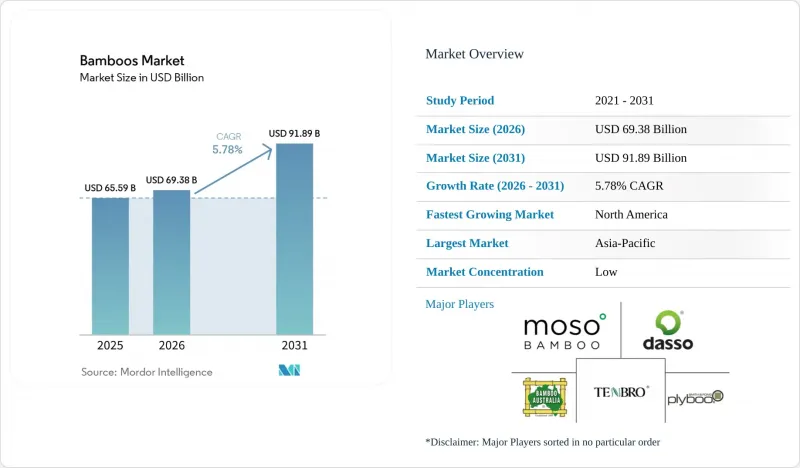
Mordor Intelligence에 의하면, 대나무 시장 규모는 2025년에 655억 9,000만 달러로 평가되었고, 2026년 693억 8,000만 달러로 추정되고, 2031년까지 918억 9,000만 달러로 성장할 전망이며, 2026-2031년 CAGR 5.78%를 나타낼 것으로 예측됩니다.
본 보고서는 용도별(원자재, 공업 제품, 가구, 대나무 새순, 기타 용도) 및 지역별(북미, 남미, 유럽, 아시아·태평양, 중동 및 아프리카)로 분류되어 있습니다. 시장 전망치는 금액(달러)으로 표시되어 있습니다.
세계의 대나무 시장 동향 및 인사이트
플라스틱 대체 의무화가 대나무 포장재 수요를 견인하고 있습니다.
플라스틱 대체 노력은 포장 및 산업 분야에서 대나무를 원료로 한 대체재의 채택을 촉진함으로써 대나무 시장의 성장을 이끌고 있습니다. 인도 보도정보국에 따르면, 2025년 기준으로 인도는 1,396만 헥타르에 달하는 세계 최대의 대나무 재배 면적을 보유하고 있습니다. 또한 인도는 중국에 이어 대나무의 다양성이 두 번째로 풍부한 나라로, 125종의 토종과 11종의 외래종을 포함해 총 136종이 확인되었습니다. 이러한 방대한 원료 기반은 대나무 가공 산업을 뒷받침하는 동시에, 플라스틱 소재를 대체할 수 있는 지속 가능한 대나무 제품의 생산을 촉진하고 있습니다.
그린 건설 프로젝트에서 엔지니어드 대나무의 도입
건축가와 개발업자들이 지속 가능한 건축 용도를 위해 저탄소 구조용 자재를 점점 더 중요하게 여기게 됨에 따라, 친환경 건설 프로젝트에서 엔지니어드 대나무의 채택이 대나무 시장의 성장을 주도하고 있습니다. 2026년 2월, Guadua Bamboo S.A.S.는 벨기에에서 높이 28미터의 구조용 대나무 타워를 완공함으로써, 현대 건설 현장에서 엔지니어링 대나무의 상업적 실현 가능성을 입증했습니다. 이 프로젝트를 통해 건축가, 엔지니어, 공공 인프라 조달 담당자 등에게 대나무를 주재료로 한 구조 시스템에 대한 인지도가 높아졌을 뿐만 아니라, 구조적 성능과 지속 가능한 조달 실적이 검증된, 인증을 받고 규격 기준을 충족하는 대나무 자재에 대한 수요도 증가했습니다.
원료 공급의 분산화와 등급 평가 기준의 불일치
원료 공급의 분산과 등급 평가 기준의 불일치는 대나무 시장의 성장을 저해하고 있습니다. 대나무의 품질에 편차가 있기 때문에 가공 효율이 떨어지고, 표준화된 제조가 어려워지기 때문입니다. 피츠버그 대학교 연구진이 2025년에 실시하여 『npj Materials Sustainability』지에 게재된 조사에 따르면, 안전성 및 노출 요인을 고려한 후에도 대나무 전체 줄기를 사용한 구조물의 설계 응력은 실제 재료 강도의 20% 미만에 그치는 경우가 많은 것으로 밝혀졌습니다. 대나무의 크기, 벽 두께, 구조의 일관성에서 나타나는 편차는 가공 시 폐기물 증가로 이어지며, 이는 엔지니어링 건축 및 수출 지향적 제조 분야에서 대나무의 보다 광범위한 산업적 활용을 제한하고 있습니다.
부문별 분석
2025년 기준으로, 공업 제품 부문의 대나무 시장 점유율은 40.6%로 가장 높은 비중을 차지했으며, 이 부문 시장 규모는 2026-2031년 연평균 성장률(CAGR) 5.5%라는 가장 빠른 속도로 확대될 것으로 전망됩니다. 산업용 분야는 엔지니어링 패널, 대나무 섬유 소재, 복합 제품, 포장 자재, 그리고 목재나 석유 유래 소재와 경쟁하는 건설 관련 중간 제품에 이르기까지 지속적으로 확대되고 있습니다. 또한, 지속가능성 목표와 저탄소 조달 전략을 뒷받침하는 규격 기준을 충족한 대나무 제품에 대한 수요도 증가하고 있습니다. 가공 기술, 산업용 처리 능력 및 수출 지향적 제조의 발전에 힘입어, 건설, 포장, 운송, 소비재 등 각 분야에서 산업용 대나무 제품의 상업적 역할은 계속해서 강화되고 있습니다.
대나무 제품은 지속 가능한 가구 및 인테리어 제품에 대한 수요와 점점 더 부합하고 있기 때문에 가구 및 관련 소비재 용도는 대나무 산업 전체에서 여전히 중요한 위치를 차지하고 있습니다. 대나무 가구는 기존의 활엽수 제품에 비해 가볍고, 자연스러운 아름다움을 지녔으며, 재생 가능한 자원이라는 장점이 있습니다. 또한, 아시아태평양 시장에서는 가공식품 부문에서 죽순에 대한 수요도 안정적입니다. 대나무 섬유, 대나무 감김 복합 파이프, 활성탄, 바이오차 등의 새로운 용도는 기존의 건설 및 수공예 용도를 넘어선 다각화를 뒷받침하기 때문에 계속해서 상업적인 관심을 끌고 있습니다. 용도의 다양화가 진행됨에 따라 업계의 장기적인 회복력이 강화되는 동시에, 전 세계적으로 고수익률을 자랑하는 가공 대나무 제품 개발을 위한 새로운 기회가 창출되고 있습니다.
지역별 분석
2025년, 아시아태평양 지역의 대나무 시장 점유율은 79%로 가장 높은 비중을 차지했습니다. 중국은 광대한 대나무 숲 자원, 잘 갖춰진 가공 인프라, 그리고 플라스틱이나 목재의 대체 소재로서 대나무를 장려하는 정부 정책에 힘입어 여전히 세계 최대의 대나무 생산국으로 자리매김하고 있습니다. 신화사 통신에 따르면, 약 800만 헥타르에 달하는 대나무 숲에 힘입어 2026년 1월 중국의 대나무 산업 생산액은 5,200억 위안(717억 달러)을 넘어섰습니다. 또한, 이 지역은 중국, 베트남, 인도네시아, 인도 등 여러 국가가 보유한 비용 효율적인 생산 능력과 견고한 수출 인프라의 혜택을 누리고 있어, 세계 대나무 가공 및 공급망에서 아시아태평양의 역할을 더욱 공고히 하고 있습니다.
북미 대나무 시장 규모는 2026-2031년 연평균 성장률(CAGR) 6.2%라는 가장 높은 성장률을 기록하며 확대될 것으로 전망됩니다. 지속 가능한 건축자재, 바이오 포장재, 엔지니어드 플로어링, 저탄소 인테리어 제품에 대한 수요가 증가함에 따라 주택 및 상업 분야에서 대나무의 활용이 확대되고 있습니다. 수입업체와 유통업체들은 건축가, 소매업체, 인프라 프로젝트를 대상으로 사양 기준을 충족하는 대나무 제품의 품목 구색을 확대되고 있습니다. 또한, 소비자들도 가구 및 주택 리모델링 분야에서 재생 가능하고 인증을 받은 소재를 점점 더 선호하는 경향을 보이고 있습니다. 또한, 환경 규제의 강화와 열대 활엽수 제품에 대한 대체재에 대한 관심이 높아짐에 따라 북미 시장에서 가공 대나무 제품의 상업적 이용이 확대되고 있습니다.
유럽은 여전히 중요한 수출 시장이며, 바이어들은 인증을 받은 조달, 추적 가능성, 그리고 지속 가능한 건축자재를 점점 더 중요하게 여기고 있습니다. MOSO International B.V.에 따르면, 2025년 유럽연합(EU)이 중국산 다층 목재 마루에 대해 시행한 반덤핑 조치에서 대나무 마루 제품이 제외됨에 따라, 대나무 마루는 가격 면에서 우위를 점하게 되었습니다. 이러한 규제상의 진전에 따라, 유럽의 건설 및 리모델링 시장에서 대나무를 원료로 한 마루재와 인테리어 자재에 대한 상업적 기회가 확대되었습니다. 이 지역에서는 더욱 엄격해진 환경 조달 기준과 재생 가능하며 저탄소 건축자재에 대한 선호도가 높아지는 것을 배경으로, 바닥재, 가구, 호텔 및 리조트 업계의 인테리어, 지속 가능한 건축 프로젝트 등 폭넓은 분야에서 수요가 지속적으로 확대되고 있습니다.
기타 혜택 :
- 엑셀 형식 시장 예측(ME) 시트
- 3개월간의 애널리스트 지원
자주 묻는 질문
목차
제1장 서론
제2장 조사 방법
제3장 주요 요약
제4장 시장 구도
제5장 시장 규모 및 성장 예측
제6장 경쟁 구도
제7장 시장 기회 및 향후 전망
AJY 26.06.24According to Mordor Intelligence, the bamboos market size was valued at USD 65.59 billion in 2025 and is projected to grow from USD 69.38 billion in 2026 to USD 91.89 billion by 2031, registering a CAGR of 5.78% from 2026 to 2031.
This report is Segmented by Application (Raw Materials, Industrial Products, Furniture, Shoots, and Other Applications) and by Geography (North America, South America, Europe, Asia-Pacific, Middle East, and Africa). The Market Forecasts are Provided in Terms of Value (USD).
Global Bamboos Market Trends and Insights
Plastic Substitution Mandates Boosting Bamboo Packaging Demand
Plastic substitution initiatives are driving growth in the bamboo market by promoting the adoption of bamboo-based alternatives in packaging and industrial applications. According to the Press Information Bureau of India, as of 2025, India possesses the largest bamboo-growing area globally, covering 13.96 million hectares. It is also the second-richest country in bamboo diversity after China, with 136 species, including 125 indigenous and 11 exotic species. This extensive raw material base is bolstering bamboo processing industries and facilitating the production of sustainable bamboo products as substitutes for plastic-based materials.
Engineered Bamboo Adoption in Green Construction Projects
The adoption of engineered bamboo in green construction projects is driving growth in the bamboos market, as architects and developers increasingly prioritize low-carbon structural materials for sustainable building applications. In February 2026, Guadua Bamboo S.A.S. completed a 28-meter structural bamboo tower in Belgium, showcasing the commercial feasibility of engineered bamboo in modern construction. This project enhanced the visibility of bamboo-based structural systems among architects, engineers, and public infrastructure buyers, while boosting demand for certified, specification-grade bamboo materials with verified structural performance and sustainable sourcing credentials.
Fragmented Feedstock Supply and Inconsistent Grading Standards
Fragmented feedstock supply and inconsistent grading standards are hindering growth in the bamboos market, as variability in bamboo quality reduces processing efficiency and complicates standardized manufacturing. A 2025 study by researchers from the University of Pittsburgh, published in npj Materials Sustainability, revealed that designed stresses in full-culm bamboo structures often remain below 20% of the actual material strength after accounting for safety and exposure factors. Variations in culm size, wall thickness, and structural consistency contribute to increased processing waste and limit the broader industrial use of bamboo in engineered construction and export-oriented manufacturing applications.
Other drivers and restraints analyzed in the detailed report include:
- Bamboo-for-Plastic Policies Increasing Industrial Bamboo Demand
- Carbon Monetization Improving Bamboo Plantation Project Economics
- Scrutiny over Textile Certification and Traceability Compliance
For complete list of drivers and restraints, kindly check the Table Of Contents.
Segment Analysis
The bamboos market share for the industrial products segment accounted for the largest 40.6% in 2025, and the bamboos market size for this segment is forecasted to expand at the fastest 5.5% CAGR from 2026 to 2031. Industrial applications continue expanding across engineered panels, bamboo fiber materials, composite products, packaging formats, and construction-related intermediates that compete with wood and petroleum-based materials. Demand is also increasing for specification-grade bamboo products that support sustainability goals and lower-carbon procurement strategies. Growth in processing technology, industrial treatment capability, and export-focused manufacturing continues to strengthen the commercial role of industrial bamboo applications across construction, packaging, transportation, and consumer goods sectors.
Furniture and related consumer applications remain important across the bamboo industry because bamboo products increasingly align with demand for sustainable home furnishing and interior products. Bamboo furniture benefits from lower weight, natural aesthetics, and renewable sourcing advantages compared to traditional hardwood products. Bamboo shoots also maintain stable demand within processed food categories across Asia-Pacific markets. Emerging applications including bamboo textiles, bamboo-wound composite pipes, activated carbon, and biochar continue attracting commercial interest because they support diversification beyond traditional construction and handicraft uses. The expanding application mix is strengthening long-term industry resilience while creating additional opportunities for higher-margin processed bamboo product development globally.
Geography Analysis
The bamboos market share for the Asia-Pacific held the largest 79% in 2025. China remains the leading producer of bamboo globally, driven by its extensive bamboo forest resources, well-developed processing infrastructure, and government policies promoting bamboo as a substitute for plastics and wood materials. According to Xinhua News Agency, the output of China's bamboo industry surpassed CNY 520 billion (USD 71.7 billion) in January 2026, supported by nearly 8 million hectares of bamboo forests. Additionally, the region benefits from cost-effective manufacturing capabilities and robust export infrastructure in countries such as China, Vietnam, Indonesia, and India, further solidifying the Asia-Pacific's role in global bamboo processing and supply chains.
The bamboos market size for North America is forecasted to grow at the fastest 6.2% CAGR from 2026 to 2031. Increasing demand for sustainable construction materials, bio-based packaging, engineered flooring, and low-carbon interior products is driving the adoption of bamboo across residential and commercial sectors. Importers and distributors are expanding their offerings of specification-grade bamboo products for architects, retailers, and infrastructure projects. Consumers are also showing a growing preference for renewable and certified materials in furniture and home improvement categories. Furthermore, stricter environmental regulations and rising interest in alternatives to tropical hardwood products are supporting the broader commercial use of processed bamboo materials in the North American market.
Europe remains a significant export destination as buyers increasingly emphasize certified sourcing, traceability, and sustainable construction materials. According to MOSO International B.V., bamboo flooring gained a pricing advantage in 2025 when European Union anti-dumping measures on multilayered wood flooring from China excluded bamboo flooring products. This regulatory development enhanced commercial opportunities for bamboo-based flooring and interior materials in European construction and renovation markets. Demand in the region continues to grow across applications such as flooring, furniture, hospitality interiors, and sustainable building projects, driven by stricter environmental procurement standards and a rising preference for renewable, low-carbon construction materials.
- Moso International B.V.
- Dasso Industrial Group Co., Ltd.
- Shanghai Tenbro Bamboo Textile Co., Ltd. (Lorpar Industrial Co., Ltd.)
- Bamboo Australia Pty Ltd
- Smith & Fong Company Inc
- EcoPlanet Bamboo Group LLC
- Hunan Taohuajiang Bamboo Science & Technology Co., Ltd.
- Kerala State Bamboo Corporation Ltd. (Government of Kerala)
- Bamboo Village Company Limited
- Fujian Heqichang Bamboo Industry Co., Ltd.
- Xiamen HBD Industry & Trade Co., Ltd.
- Hunan Taohuajiang Bamboo Science & Technology Co., Ltd.
- Guadua Bamboo S.A.S.
- Zhejiang Yongyu Household Co., Ltd.
- Xingyun Bamboo Products Co., Ltd.
Additional Benefits:
- The market estimate (ME) sheet in Excel format
- 3 months of analyst support
TABLE OF CONTENTS
1 Introduction
- 1.1 Study Assumptions and Market Definition
- 1.2 Scope of the Study
2 Research Methodology
3 Executive Summary
4 Market Landscape
- 4.1 Market Overview
- 4.2 Market Drivers
- 4.2.1 Plastic substitution mandates boosting bamboo packaging demand
- 4.2.2 Engineered bamboo adoption in green construction projects
- 4.2.3 Furniture sector shifting toward low-carbon bamboo materials
- 4.2.4 Rising bamboo fiber demand across industrial applications
- 4.2.5 Bamboo-for-plastic policies increasing industrial bamboo demand
- 4.2.6 Carbon monetization improving bamboo plantation project economics
- 4.3 Market Restraints
- 4.3.1 Fragmented feedstock supply and inconsistent grading standards
- 4.3.2 Processing capacity concentrated within limited producer countries
- 4.3.3 Competition from plastics and alternative composite materials
- 4.3.4 Scrutiny over textile certification and traceability compliance
- 4.4 Regulatory Landscape
- 4.5 Technological Outlook
- 4.6 Porter's Five Forces Analysis
- 4.6.1 Bargaining Power of Suppliers
- 4.6.2 Bargaining Power of Buyers
- 4.6.3 Threat of New Entrants
- 4.6.4 Threat of Substitutes
- 4.6.5 Intensity of Competitive Rivalry
5 Market Size and Growth Forecasts (Value)
- 5.1 By Application
- 5.1.1 Raw Materials
- 5.1.2 Industrial Products
- 5.1.3 Furniture
- 5.1.4 Shoots
- 5.1.5 Others
- 5.2 By Geography
- 5.2.1 North America
- 5.2.1.1 United States
- 5.2.1.2 Canada
- 5.2.1.3 Mexico
- 5.2.1.4 Rest of North America
- 5.2.2 South America
- 5.2.2.1 Brazil
- 5.2.2.2 Argentina
- 5.2.2.3 Rest of South America
- 5.2.3 Europe
- 5.2.3.1 Germany
- 5.2.3.2 United Kingdom
- 5.2.3.3 France
- 5.2.3.4 Netherlands
- 5.2.3.5 Rest of Europe
- 5.2.4 Asia-Pacific
- 5.2.4.1 China
- 5.2.4.2 India
- 5.2.4.3 Japan
- 5.2.4.4 Indonesia
- 5.2.4.5 Vietnam
- 5.2.4.6 Philippines
- 5.2.4.7 Rest of Asia-Pacific
- 5.2.5 Middle East
- 5.2.5.1 United Arab Emirates
- 5.2.5.2 Saudi Arabia
- 5.2.5.3 Turkey
- 5.2.5.4 Rest of Middle East
- 5.2.6 Africa
- 5.2.6.1 Ethiopia
- 5.2.6.2 Ghana
- 5.2.6.3 South Africa
- 5.2.6.4 Rest of Africa
- 5.2.1 North America
6 Competitive Landscape
- 6.1 Market Concentration
- 6.2 Strategic Moves
- 6.3 Market Share Analysis
- 6.4 Company Profiles (Includes Global Level Overview, Market Level Overview, Core Segments, Financials as Available, Strategic Information, Market Rank/Share for Key Companies, Products and Services, and Recent Developments)
- 6.4.1 Moso International B.V.
- 6.4.2 Dasso Industrial Group Co., Ltd.
- 6.4.3 Shanghai Tenbro Bamboo Textile Co., Ltd. (Lorpar Industrial Co., Ltd.)
- 6.4.4 Bamboo Australia Pty Ltd
- 6.4.5 Smith & Fong Company Inc
- 6.4.6 EcoPlanet Bamboo Group LLC
- 6.4.7 Hunan Taohuajiang Bamboo Science & Technology Co., Ltd.
- 6.4.8 Kerala State Bamboo Corporation Ltd. (Government of Kerala)
- 6.4.9 Bamboo Village Company Limited
- 6.4.10 Fujian Heqichang Bamboo Industry Co., Ltd.
- 6.4.11 Xiamen HBD Industry & Trade Co., Ltd.
- 6.4.12 Hunan Taohuajiang Bamboo Science & Technology Co., Ltd.
- 6.4.13 Guadua Bamboo S.A.S.
- 6.4.14 Zhejiang Yongyu Household Co., Ltd.
- 6.4.15 Xingyun Bamboo Products Co., Ltd.