

|
시장보고서
상품코드
2066406
혈당 측정 스트립 시장 : 점유율 분석, 업계 동향과 통계, 성장 예측(2026-2031년)Blood Glucose Test Strips - Market Share Analysis, Industry Trends & Statistics, Growth Forecasts (2026 - 2031) |
||||||
 Mordor Intelligence
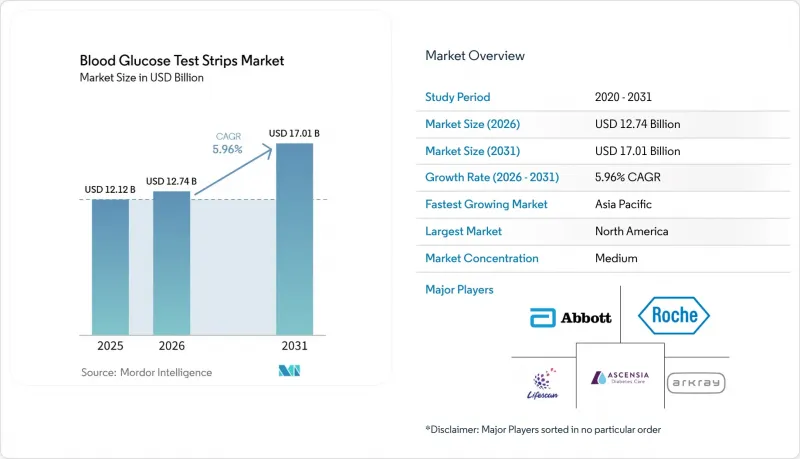
Mordor Intelligence에 의하면, 혈당 측정 스트립 시장 규모는 2025년에 121억 2,000만 달러로 평가되었고 2026년 127억 4,000만 달러에서 2031년까지 170억 1,000만 달러에 이를 것으로 예측되며, 예측 기간(2026-2031년) CAGR은 5.96%를 나타낼 전망입니다.
본 보고서는 제품 유형(후막, 박막, 광학/광도 측정식), 당뇨병 유형(제1형, 제2형, 임신성 당뇨병, 기타), 최종 사용자(병원 및 진료소, 기타), 유통 채널(병원, 기타), 지역(북미, 유럽, 아시아태평양, 중동 및 아프리카, 남미)별로 분류되어 있습니다. 시장 전망은 금액(달러) 기준으로 제시되어 있습니다.
전 세계 혈당 측정 스트립 시장 동향 및 인사이트
전 세계 당뇨병 유병률 증가
2024년 현재, 전 세계 당뇨병 환자 수는 성인 5억 8,870만 명에 달하며, 이 중 2억 5,170만 명은 아직 진단을 받지 못한 상태입니다. 이는 테스트 스트립의 잠재적 사용자층이 매우 광범위함을 보여줍니다. 중국에서는 2021년에 1억 4,090만 명의 환자가 기록되었으며, 동반 질환 증가에 따라 혈당 수치를 자주 측정하는 고령층이 연간 약 1,000만 명씩 증가하고 있습니다. 인도에서는 2024년에 공공 1차 의료 센터를 통해 120만 대의 혈당 측정기가 배포될 예정이며, 각 측정기당 연간 100-200장의 테스트 스트립이 필요하기 때문에 1억 2,000만-2억 4,000만 장 수요 증가가 예상됩니다. 국제당뇨병연맹(IDF)은 2050년까지 당뇨병 환자 수가 8억 5,250만 명에 달할 것으로 예측하고 있으며, 그 증가세가 가장 급격한 곳은 CGM(연속 혈당 모니터링)이 여전히 비싸서 이용하기 어려운 사하라 이남 아프리카 및 동남아시아 지역입니다. 이처럼 환자 수가 증가함에 따라, 기술이 발전하더라도 혈당 측정 스트립 시장을 지탱하는 구조적인 수요가 창출되고 있습니다.
자기 관리와 예방 의료에 중점을 두다.
미국당뇨병협회(ADA)의 ‘2026년 치료 지침’에서는 혈당 수치의 변동이 관찰되는 인슐린을 사용하지 않는 2형 당뇨병 환자에게 자가 측정을 새롭게 권장하고 있으며, 이에 따라 대상 환자층이 약 30% 확대될 것으로 예상됩니다(diabetes.org). 메디케어의 2024년 시범 프로그램에서는 고위험군 중 인슐린을 사용하지 않는 환자에게 분기당 100장의 혈당 측정 스트립 사용이 승인되었으며, 이를 통해 최대 200만 명의 추가 수혜자가 혜택을 받을 수 있게 될 전망입니다. 현재 유럽 전역에서 1차 진료 의사가 분기마다 HbA1c 검사를 실시하고 있으며, 이에 가정에서의 테스트 스트립 검사가 보완되는 형태로, 영국에서는 환자 1인당 테스트 스트립 사용량이 연간 50장에서 150장으로 증가하고 있습니다. 존슨앤드존슨 등 미국의 주요 기업들은 공복 혈당 수치가 높은 직원들에게 매년 무료로 혈당 측정기와 테스트 스트립 200장을 제공하고 있으며, 이러한 예방적 검진이 정기적인 구매로 이어지고 있습니다. 이러한 정책들이 맞물려 매일 혈당을 측정하는 습관이 자리 잡게 되었으며, 이는 혈당 측정 스트립 시장을 지탱하고 있습니다.
연속 혈당 모니터링(CGM) 시스템의 보급 확대
2024년 7월에 승인된 애보트사의 ‘FreeStyle Libre Rio’는 센서 1개당 14일 사용 기준 55달러로, 하루 4회 이상 측정을 하는 테스트 스트립 다용도 사용자에게 있어 CGM 가격이 비슷한 수준이 되었습니다. 덱스콤(Dexcom)사의 ‘G7’은 착용 기간을 15일로 연장했으며, 연간 비용은 1,460달러이지만, 현재 많은 메디케어 어드밴티지 플랜에서 사전 승인 없이 보험 적용을 받고 있습니다. ADA(미국당뇨병학회)의 2026년 기준에 따르면, 모든 집중 인슐린 요법에서 CGM 사용이 권장되고 있으며, 그동안 하루 최대 10장의 테스트 스트립을 사용하던 미국의 1형 당뇨병 환자 160만 명을 대상으로 CGM으로의 전환이 가속화되고 있습니다. Senseonics사의 365일 지속형 이식형 센서는 손가락 채혈을 통한 보정이 필요 없으며, 3,500달러의 초기 비용을 지불할 의향이 있는 경제적으로 여유가 있는 사용자에게 테스트 스트립을 전혀 사용하지 않는 대안을 제공합니다. CGM 가격 하락과 보험 적용 범위 확대에 따라, 고소득층의 테스트 스트립 사용량은 계속해서 감소할 것으로 예상되며, 이는 혈당 측정 스트립 시장 전체의 성장을 저해할 것으로 보입니다.
부문별 분석
2025년, 후막 방식의 혈당 측정 스트립은 제조 비용이 0.08달러 미만이고 정확도가 ±10%인 점에 힘입어 혈당 측정 스트립 시장의 46.43%를 차지했습니다. 한편, 광학식 스트립은 특히 사하라 이남 아프리카나 아시아의 농촌 지역 등 안정적인 전력 공급을 확보하기 어려운 진료소에서 비색법이 널리 채택되고 있는 만큼, 2031년까지 연평균 성장률(CAGR) 7.54%로 성장할 전망입니다. 세계보건기구(WHO)의 2024년판 ‘필수 진단 기기 목록’이 배터리가 필요 없는 기기를 우선시하고 있는 만큼, 광학식 혈당 측정 스트립 시장 규모는 확대될 것으로 전망됩니다.
전기화학 기술도 진화를 거듭하고 있습니다. 로슈사의 다공성 탄소 전극은 2초도 채 되지 않는 시간에 혈액을 흡수하며, 두꺼운 막 방식의 비용 효율성과 얇은 막 방식의 속도를 모두 갖추고 있습니다. 애보트사의 듀얼 효소 시스템은 투석 환자의 말토오스에 의한 간섭을 제거합니다. 또한, 2024년부터 적용되는 FDA의 ±10%라는 더욱 엄격한 지침에 따라, 기준을 충족하지 못하는 제네릭 제품은 단계적으로 시장에서 퇴출될 것이며, 수요는 기준을 충족하는 브랜드 제품으로 이동하게 될 것입니다. 이러한 경쟁적 상호작용으로 인해 광학식 제품 시장 진입이 증가하고 있음에도 불구하고, 혈당 측정 스트립 시장은 여전히 호황을 누리고 있습니다.
2025년에는 2형 당뇨병 환자가 테스트 스트립 소비량의 67.54%를 차지하고 있으며, 경구용 약물이나 생활습관 요법을 받고 있는 환자에게 있어 CGM(연속 혈당 모니터링)은 여전히 경제적으로 타당하지 않은 것으로 나타났습니다. 임신성 당뇨병 및 기타 유형의 당뇨병은 검사 1회당 테스트 스트립 3장을 사용하는 보편적인 임신 선별 검사의 영향으로 연평균 성장률(CAGR) 7.65%를 기록하며 시장이 확대되고 있으며, 그 결과 미국과 인도에서는 매년 수백만 장의 테스트 스트립이 추가로 사용되고 있습니다.
2025년에 CGM 보급률이 68%에 달함에 따라, 1형 당뇨병 환자를 위한 혈당 측정 스트립 시장 점유율은 줄어들고 있습니다. 그러나 전 세계 당뇨병 환자의 대다수가 2형 당뇨병 환자이기 때문에 혈당 측정 스트립 시장 전체의 규모는 계속해서 확대되고 있습니다. 진단을 받지 않은 성인을 대상으로 한 공중보건 프로그램이 수요를 더욱 확대시켜, 집중 인슐린 요법을 받고 있는 환자층에서 CGM 도입으로 인한 수요 감소를 상쇄하고 있습니다.
지역별 분석
북미는 2025년 전 세계 매출의 43.56%를 차지하고 있으며, 그 주된 요인은 메디케어 파트 B의 적용입니다. 이로 인해 인슐린 사용자들 사이에서 연간 약 29억 6,000만 장의 테스트 스트립에 대한 수요가 보장되고 있습니다. 경쟁 입찰을 통해 2021년부터 2024년까지 상환액은 28% 감소했으나, HbA1c 수치가 높은 비인슐린 환자에 대한 적용 대상이 확대됨에 따라 단가는 하락했음에도 판매량은 유지되었습니다. 캐나다의 공적 의약품 목록에는 수량 상한선이 설정되어 있어(온타리오주에서는 1형 당뇨병 환자에게 연간 3,000 스트립이 허용되는 반면, 2형 당뇨병 환자에게는 400 스트립만 허용됨), 질병 유병률이 높음에도 불구하고 시장의 성장 여지를 제한하고 있습니다. 2024년에 시행될 미국 FDA의 정확도 관련 규제로 인해, 시장은 애보트, 로슈, 아센시아를 중심으로 재편될 것이며, 저가 제네릭 의약품이 약국에서 퇴출될 것으로 예측됩니다.
아시아태평양은 중국의 1억 4,090만 명, 인도의 1억 100만 명에 달하는 환자 기반을 바탕으로, 2031년까지 연평균 성장률(CAGR) 6.64%로 가장 높은 성장세를 보일 것으로 전망됩니다. 인도의 ‘생산 연계형 인센티브(PLI) 프로그램’은 증분 매출액의 5-7%를 지원하며, 이에 따라 시노케어와 바이오니움은 20억 스트립 규모의 공장을 건설하게 되었습니다. 이로 인해 공공 부문의 단위당 비용이 감소하고, 지방 진료소에서의 사용이 늘어날 것으로 예측됩니다. 중국 규제 당국은 2024년에 승인 기간을 9개월로 단축했으며, 이에 따라 국내 기업들이 12개의 새로운 스트립 제품 라인을 출시할 수 있게 되어 수입품보다 최대 40% 저렴한 가격으로 제품을 공급할 수 있게 되었습니다. 일본에서는 2024년에 상환률이 12% 인하되면서 이익률에 압박이 가해지자, 아크레이와 테르모는 제조 거점을 저비용의 동남아시아로 이전했습니다.
유럽, 중동 및 아프리카, 그리고 남미가 세계 수요의 나머지 부분을 차지하고 있지만, 상환 제도의 차이와 가격에 대한 민감성이 성장을 저해하고 있습니다. 독일의 공적 보험사는 약사들에게 가장 저렴한 테스트 스트립 브랜드를 조제하도록 의무화하고 있으며, 그 결과 로슈와 애보트의 합산 시장 점유율은 2025년까지 68%에서 54%로 축소될 전망입니다. 영국에서는 현재 인슐린을 사용하지 않는 환자의 테스트 스트립 사용을 하루 2장으로 제한하고 있지만, 분기별 HbA1c 검사와 가정에서의 자가 측정을 병행함으로써 기준 소비량을 유지하고 있습니다. 브라질에서는 인슐린 사용자의 혈당 측정 스트립이 보험 적용 대상이지만, 1장당 0.60달러라는 가격 때문에 2형 당뇨병 환자의 42%는 주 1회 미만의 빈도로만 검사를 받고 있습니다. 사하라 이남 아프리카의 환자들은 테스트 스트립 가격이 일일 임금의 최대 10%에 달하기도 하기 때문에 권장되는 검사 빈도를 지키지 못하는 경우가 많으며, 이로 인해 저소득 지역에서 혈당 측정 스트립 시장의 가장 큰 장벽이 ‘합리적인 가격’이라는 사실이 부각되고 있습니다.
기타 혜택:
- 엑셀 형식 시장 예측(ME) 시트
- 3개월간의 애널리스트 지원
자주 묻는 질문
목차
제1장 서론
제2장 조사 방법
제3장 주요 요약
제4장 시장 구도
제5장 시장 규모와 성장 예측
제6장 경쟁 구도
제7장 시장 기회와 향후 전망
JHS 26.06.29According to Mordor Intelligence, the blood glucose test strips market size was valued at USD 12.12 billion in 2025 and is estimated to grow from USD 12.74 billion in 2026 to reach USD 17.01 billion by 2031, at a CAGR of 5.96% during the forecast period (2026-2031).
This report is Segmented by Product Type (Thick Film, Thin Film, and Optical/Photometric), Diabetes Type (Type 1, Type 2, and Gestational and Others), End User (Hospitals and Clinics, and More), Distribution Channel (Hospital, and More), and Geography (North America, Europe, Asia-Pacific, Middle East and Africa, and South America). Market Forecasts are Provided in Terms of Value (USD).
Global Blood Glucose Test Strips Market Trends and Insights
Escalating Global Diabetes Prevalence
Global diabetes cases reached 588.7 million adults in 2024, and 251.7 million remain undiagnosed, underscoring a vast latent user base for test strips. China recorded 140.9 million patients in 2021 and is adding roughly 10 million seniors annually, a demographic that tests glucose frequently as comorbidities mount. India distributed 1.2 million glucometers through public primary care centers in 2024, each requiring 100-200 strips per year, resulting in 120-240 million incremental units. The International Diabetes Federation foresees 852.5 million diabetics by 2050, with the sharpest acceleration in sub-Saharan Africa and Southeast Asia, regions where CGM remains cost-prohibitive. These rising numbers create structural demand that anchors the blood glucose test strips market even as technology evolves.
Emphasis on Self-Monitoring and Preventive Care
The American Diabetes Association's 2026 Standards of Care newly recommend self-monitoring for non-insulin Type 2 patients experiencing glycemic variability, broadening the addressable patient pool by an estimated 30% (diabetes.org). Medicare's 2024 pilot authorizes 100 strips every quarter for high-risk non-insulin users, potentially covering 2 million additional beneficiaries. Across Europe, primary-care physicians now conduct quarterly HbA1c testing, supplemented by at-home strip checks, which has increased per-patient strip use from 50 to 150 annually in the United Kingdom. Large U.S. employers, such as Johnson & Johnson, distribute free meters and 200 strips annually to employees with elevated fasting glucose, turning preventive screenings into recurring purchases. Collectively, these policies cultivate daily testing habits that sustain the blood glucose test strips market.
Rising Adoption of Continuous Glucose Monitoring Systems
Abbott's FreeStyle Libre Rio, cleared in July 2024 at USD 55 per 14-day sensor, brings CGM within price parity for heavy strip users who test 4 times or more daily. Dexcom's G7 extends wear time to 15 days and costs USD 1,460 annually, now reimbursed by many Medicare Advantage plans without prior authorization. The ADA's 2026 Standards recommend CGM for all intensive insulin regimens, accelerating the migration among the 1.6 million U.S. Type 1 patients who historically consumed up to 10 strips a day. Senseonics' 365-day implantable sensor eliminates finger-stick calibration, offering a zero-strip alternative for affluent users willing to pay USD 3,500 upfront. As CGM pricing falls and coverage widens, strip volumes in high-income segments will continue to shrink, curbing overall growth in the blood glucose test strips market.
Other drivers and restraints analyzed in the detailed report include:
- Technological Enhancements in Enzymatic Strip Chemistry
- Integration of Bluetooth-Enabled Smart Meters with Telehealth Platforms
- Price Sensitivity in Low-Income Regions
For complete list of drivers and restraints, kindly check the Table Of Contents.
Segment Analysis
Thick film formats accounted for 46.43% of the blood glucose test strips market in 2025, due to production costs of less than USD 0.08 and an accuracy of +-10%. Optical strips, however, are on track for a 7.54% CAGR through 2031 as colorimetric methods appeal to clinics without reliable electricity, particularly in sub-Saharan Africa and rural Asia. The blood glucose test strips market size for optical products is projected to widen as the World Health Organization's 2024 Essential Diagnostics List prioritizes battery-free devices.
Electrochemical technology is evolving as well. Roche's porous-carbon electrode wicks blood in under two seconds, marrying the costs of thick films with the speed of thin films. Abbott's dual-enzyme system removes maltose interference for dialysis patients, and the FDA's stricter +-10% guidance from 2024 will phase out sub-standard generics, channeling demand toward compliant brands. This competitive interplay keeps the blood glucose test strips market dynamic even as optical entries rise.
Type 2 diabetics generated 67.54% of strip consumption in 2025, illustrating that CGM remains economically unjustified for patients on oral drugs or lifestyle therapy. Gestational and other types of diabetes are growing at a 7.65% CAGR, driven by universal pregnancy screening that introduces three-strip checks per test episode, resulting in millions of additional annual uses in the United States and India.
The blood glucose test strips market share for Type 1 users is shrinking as CGM penetration hit 68% in 2025. Yet, the overall blood glucose test strips market size continues to rise because Type 2 comprises the vast majority of the global diabetic population. Public-health programs targeting undiagnosed adults further enlarge demand, counterbalancing CGM-led attrition in intensive-insulin cohorts.
Geography Analysis
North America accounted for 43.56% of the 2025 global revenue, primarily driven by Medicare Part B coverage, which guarantees demand for approximately 2.96 billion strips annually among insulin users. Competitive bidding trimmed reimbursement by 28% between 2021 and 2024, yet expanded eligibility to high-HbA1c non-insulin patients, preserving volume despite lower unit prices. Canada's public formularies cap quantities - Ontario allows 3,000 strips yearly for Type 1 but only 400 for Type 2 - curbing upside despite high disease prevalence. U.S. FDA accuracy rules, effective in 2024, are expected to consolidate the market around Abbott, Roche, and Ascensia, pushing low-cost generics out of pharmacies.
Asia-Pacific is projected to post the fastest 6.64% CAGR through 2031 on the back of China's 140.9 million and India's 101 million patient bases. India's Production Linked Incentive program subsidizes 5-7% of incremental sales, coaxing Sinocare and Bionime to build two billion-strip plants, which will lower public-sector per-unit costs and increase usage in rural clinics. China's regulator cut approval times to nine months in 2024, enabling domestic firms to launch 12 new strip lines that undercut imports by up to 40%. Japan's 12% reimbursement reduction in 2024 pressured margins, driving ARKRAY and Terumo to shift manufacturing to lower-cost Southeast Asian hubs.
Europe, the Middle East, and Africa, along with South America, collectively account for the remainder of global demand; however, fragmented reimbursement and price sensitivity restrain growth. German public insurers are forcing pharmacists to dispense the cheapest strip brand, thereby compressing Roche and Abbott's combined market share from 68% to 54% by 2025. The United Kingdom now limits non-insulin users to two strips per day, but quarterly HbA1c tests, paired with at-home checks, help maintain baseline consumption. Brazil covers strips for insulin users but 42% of Type 2 patients test less than weekly due to USD 0.60 per-unit prices. Sub-Saharan African patients often forgo recommended testing frequencies as strips can cost up to 10% of daily wages, highlighting affordability as the primary ceiling on the blood glucose test strips market in low-income regions.
- 77 Elektronika Kft.
- Abbott Laboratories
- Acon Laboratories
- AgaMatrix
- Arkray
- Ascensia Diabetes Care Holdings AG.
- Bionime
- Roche
- i-SENS Inc.
- LifeScan IP Holdings, LLC.
- Nova Biomedical
- OK Biotech Co. Ltd.
- Omron Healthcare Co. Ltd.
- Prodigy Diabetes Care, LLC
- Rossmax
- SD Biosensor Inc.
- Sinocare
- TaiDoc Technology
- Trividia Health
- Ypsomed
Additional Benefits:
- The market estimate (ME) sheet in Excel format
- 3 months of analyst support
TABLE OF CONTENTS
1 Introduction
- 1.1 Study Assumptions & Market Definition
- 1.2 Scope of the Study
2 Research Methodology
3 Executive Summary
4 Market Landscape
- 4.1 Market Overview
- 4.2 Market Drivers
- 4.2.1 Escalating Global Diabetes Prevalence
- 4.2.2 Emphasis on Self-Monitoring and Preventive Care
- 4.2.3 Technological Enhancements in Enzymatic Strip Chemistry
- 4.2.4 Expanding Insurance Reimbursement for SMBG Consumables
- 4.2.5 Localization of Strip Manufacturing Driven by Supply-Chain Incentives
- 4.2.6 Integration of Bluetooth-Enabled Smart Meters with Telehealth Platforms
- 4.3 Market Restraints
- 4.3.1 Rising Adoption of Continuous Glucose Monitoring Systems
- 4.3.2 Price Sensitivity in Low-Income Regions
- 4.3.3 Enzymatic Raw Material Supply Bottlenecks
- 4.3.4 Regulatory Push Toward Eco-Friendly Strip Disposal Standards
- 4.4 Value / Supply-Chain Analysis
- 4.5 Regulatory Outlook
- 4.6 Technological Outlook
- 4.7 Porter's Five Forces Analysis
- 4.7.1 Bargaining Power of Suppliers
- 4.7.2 Bargaining Power of Consumers
- 4.7.3 Threat of New Entrants
- 4.7.4 Threat of Substitute Products
- 4.7.5 Intensity of Competitive Rivalry
5 Market Size & Growth Forecasts (Value, USD)
- 5.1 By Product Type
- 5.1.1 Thick Film Strips
- 5.1.2 Thin Film Strips
- 5.1.3 Optical / Photometric Strips
- 5.2 By Diabetes Type
- 5.2.1 Type 1 Diabetes
- 5.2.2 Type 2 Diabetes
- 5.2.3 Gestational and Others
- 5.3 By End User
- 5.3.1 Hospitals and Clinics
- 5.3.2 Homecare / Personal Use
- 5.3.3 Diagnostic Laboratories
- 5.4 By Distribution Channel
- 5.4.1 Hospital Pharmacies
- 5.4.2 Retail Pharmacies
- 5.4.3 Online Pharmacies
- 5.5 Geography
- 5.5.1 North America
- 5.5.1.1 United States
- 5.5.1.2 Canada
- 5.5.1.3 Mexico
- 5.5.2 Europe
- 5.5.2.1 Germany
- 5.5.2.2 United Kingdom
- 5.5.2.3 France
- 5.5.2.4 Italy
- 5.5.2.5 Spain
- 5.5.2.6 Rest Of Europe
- 5.5.3 Asia-Pacific
- 5.5.3.1 China
- 5.5.3.2 Japan
- 5.5.3.3 India
- 5.5.3.4 Australia
- 5.5.3.5 South Korea
- 5.5.3.6 Rest Of Asia-Pacific
- 5.5.4 Middle East And Africa
- 5.5.4.1 GCC
- 5.5.4.2 South Africa
- 5.5.4.3 Rest Of Middle East And Africa
- 5.5.5 South America
- 5.5.5.1 Brazil
- 5.5.5.2 Argentina
- 5.5.5.3 Rest Of South America
- 5.5.1 North America
6 Competitive Landscape
- 6.1 Market Concentration
- 6.2 Market Share Analysis
- 6.3 Company Profiles {(Includes Global Level Overview, Market Level Overview, Core Segments, Financials as Available, Strategic Information, Market Rank/Share for Key Companies, Products & Services, and Recent Developments)}
- 6.3.1 77 Elektronika Kft.
- 6.3.2 Abbott Laboratories
- 6.3.3 ACON Laboratories Inc.
- 6.3.4 AgaMatrix
- 6.3.5 ARKRAY Inc.
- 6.3.6 Ascensia Diabetes Care Holdings AG.
- 6.3.7 Bionime Corporation
- 6.3.8 F. Hoffmann-La Roche Ltd
- 6.3.9 i-SENS Inc.
- 6.3.10 LifeScan IP Holdings, LLC.
- 6.3.11 Nova Biomedical
- 6.3.12 OK Biotech Co. Ltd.
- 6.3.13 Omron Healthcare Co. Ltd.
- 6.3.14 Prodigy Diabetes Care, LLC
- 6.3.15 Rossmax International Ltd
- 6.3.16 SD Biosensor Inc.
- 6.3.17 Sinocare Inc.
- 6.3.18 TaiDoc Technology Corporation
- 6.3.19 Trividia Health Inc.
- 6.3.20 Ypsomed AG
7 Market Opportunities & Future Outlook
- 7.1 White-Space & Unmet-Need Assessment


