|
시장보고서
상품코드
2066410
OLED 패널 시장 : 시장 점유율 분석, 업계 동향 및 통계, 성장 예측(2026-2031년)OLED Panel - Market Share Analysis, Industry Trends & Statistics, Growth Forecasts (2026 - 2031) |
||||||
 Mordor Intelligence
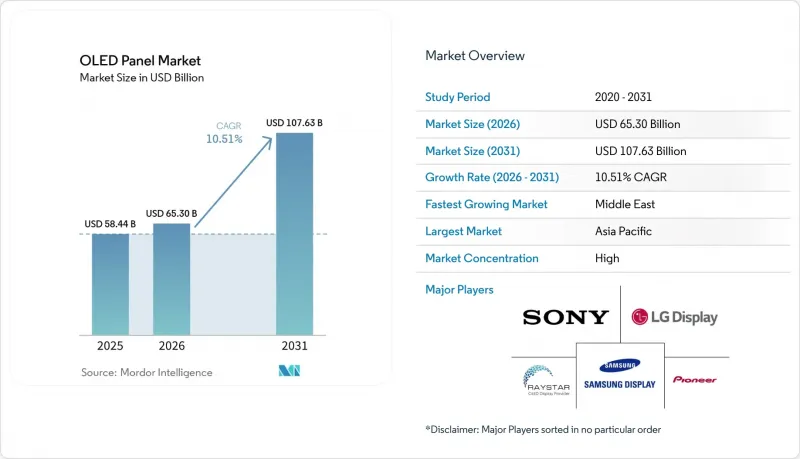
Mordor Intelligence에 의하면, OLED 패널 시장 규모는 2025년에 584억 4,000만 달러로 평가되었고, 2026년 653억 달러로 추정되고, 2031년까지 1,076억 3,000만 달러에 이를 것으로 예측되며, 예측 기간(2026-2031년) CAGR은 10.51%를 나타낼 전망입니다.
본 보고서는 유형별(플렉서블, 리지드, 투명), 디스플레이 어드레스 방식별(PMOLED 디스플레이, AMOLED 디스플레이), 크기별(소형, 중형, 대형), 제품별(모바일 및 태블릿, TV, 자동차, 웨어러블, 조명 제품, 의료기기 등), 지역별(북미, 유럽, 아시아태평양 등)로 분류되어 있습니다. 시장 전망은 금액(달러) 기준으로 제시되어 있습니다.
세계의 OLED 패널 시장 동향 및 인사이트
스마트폰에 적용되는 플렉서블 OLED의 확대
중국의 안드로이드 브랜드들이 중급형 모델에 플렉서블 패널을 표준으로 채택하고, 애플이 모든 아이폰 SKU를 OLED로 전환한 결과, 2025년 1분기에는 스마트폰 출하 대수에서 플렉서블 OLED의 보급률이 57%에 달했습니다. 삼성디스플레이의 아산 8세대 라인의 생산 규모가 확대됨에 따라, 6인치 플렉서블 패널의 단가는 2027년까지 30달러 아래로 떨어질 전망입니다. 리지드형 OLED와의 가격 차이가 15%로 좁혀짐에 따라, 플렉서블형이 기본적인 선택지가 되었고, 리지드형은 피처폰이나 산업용 제어 기기로 그 용도가 제한되게 되었습니다. IEC 62715-2:2022 인증 체계에 따라 OEM 인증 절차가 간소화되면서 도입이 더욱 가속화되고 있습니다.
중국에서 가격 주도형 리지드에서 플렉서블로 공급 전환
BOE의 89억 달러 규모 청두 공장과 CSOT의 41억 달러 규모 광저우 프린트 OLED 시설이 합쳐서 월 5만 4,500장의 기판을 추가로 공급함에 따라, 리지드형 패널의 가동률은 50% 미만으로 떨어졌으며, 플렉서블형과 리지드형 간의 가격 차이는 15% 미만으로 축소되었습니다. 현재 중국의 각 브랜드 업체들은 300달러 미만의 스마트폰에 플렉서블 OLED를 채택하도록 지정하고 있으며, 이로 인해 한국과 대만의 구형 리지드 생산 라인이 압박을 받고 있어 생산 라인 전환이나 철수 전략이 촉진되고 있습니다. 단기적인 공급 과잉의 위험은 여전히 남아 있지만, 감가상각 가속화와 정부의 인센티브 덕분에 수요가 생산 능력을 따라잡을 때까지 중국의 공장은 유지될 전망입니다.
청색 발광 소자의 수명에 대한 지속적인 제약
형광형 청색 발광 소자의 경우, 1,000니트에서 반감기가 10,000시간 미만이기 때문에 패널 제조업체는 서브픽셀을 오버드라이브하거나 탠덤 구조를 채택할 수밖에 없으며, 이로 인해 패널 1장당 50-80달러의 비용 증가가 발생합니다. 이러한 비용 부담이 75인치 이상 TV에서 OLED의 보급을 저해하고 있으며, 같은 크기의 미니 LED 액정 디스플레이는 가격의 60% 수준에서 동등한 HDR 성능을 구현하고 있습니다. 유니버설 디스플레이사의 연구 개발이 계속되고 있음에도 불구하고, 상용 수준의 청색 형광체 솔루션은 여전히 실현되지 못하고 있으며, 초대형 및 고휘도 용도에서 수명은 OLED의 ‘아킬레스건’이 되고 있습니다.
부문별 분석
플렉서블 OLED 패널 시장 규모는 2025년에 299억 달러에 달한 것으로 평가되었으며, 스마트폰 제조업체와 IT OEM 업체들이 구부릴 수 있고, 말아 올릴 수 있으며, 곡면 디스플레이로 전환함에 따라 연평균 성장률(CAGR) 10.81%로 확대될 것으로 전망됩니다. 투명형 제품은 2025년 매출에서 차지하는 비중이 고작 2%에 그쳤지만, 자동차 A필러에 적용되거나 소매점 간판 용도로 사용됨에 따라 2031년까지 연평균 성장률(CAGR) 11.09%라는 가장 높은 성장률을 나타낼 것으로 전망됩니다. 리지드 패널 수요는 계속 감소하고 있으며, 2028년까지 해당 부문 매출의 20% 미만으로 떨어질 전망입니다. 인쇄 및 마스크리스 공정을 통한 원자재 비용 절감과 Gen-8 팹에서의 기판 처리량 향상으로 인해, 중국의 보조금 삭감이 진행되더라도 플렉서블 패널의 가격은 기존의 리지드 패널에 비해 경쟁력을 유지할 것으로 보입니다.
높은 설계 자유도 덕분에 플렉서블 OLED는 휴대전화를 넘어 노트북, 태블릿, 웨어러블 기기로까지 용도 범위를 넓혀가고 있습니다. 삼성디스플레이의 17인치 롤업형 노트북용 디스플레이와 현대모비스의 18인치 곡면 콕핏 모듈은 굽힘 반경과 얇은 두께가 얼마나 혁신적인 산업 디자인을 가능하게 하는지 보여주고 있습니다. 투명 OLED는 투명 유리에 비해 투과율이 40% 낮아 실외에서의 가시성에 한계가 있다는 과제를 안고 있지만, 서울과 두바이의 실내 교통수단 및 스마트 시티 프로젝트는 그 상업적 실현 가능성이 점차 높아지고 있음을 보여주고 있습니다. 전반적으로, 플렉서블 구조는 소비자용 전자기기 분야에서 표준적인 선택지로 자리매김한 반면, 리지드 패널은 틈새 산업용 분야로 밀려나고 있습니다.
AMOLED는 2025년에 매출의 83.63%를 차지했으며, OLED 패널 시장의 주력으로 자리매김하고 있습니다. 연평균 성장률(CAGR) 10.95%로 가장 빠르게 성장하고 있는 LTPO-AMOLED는 산화물 트랜지스터와 폴리실리콘 트랜지스터를 결합하여 1-120Hz의 주사율 조절을 가능하게 하고, 휴대전화의 전력 소비를 최대 5분의 1까지 줄여줍니다. LTPO OLED 패널 시장 점유율은 2025년에 18%를 나타낼 것으로 보이며, 애플, 삼성 및 중국의 경쟁사들이 프리미엄급 제품군에서 이 기능을 표준화해 나감에 따라 2031년까지 35%를 넘어설 것으로 전망됩니다.
PMOLED는 2인치 미만의 웨어러블 기기나 산업용 디스플레이에 여전히 사용되고 있지만, 2029년까지 매출에서 차지하는 비중은 5% 미만으로 떨어질 전망입니다. 재팬디스플레이의 ‘eLEAP’ 공정은 개구율을 60%로 높이고 밝기를 2배로 향상시켜, 노트북 및 자동차 대시보드에 탑재된 AMOLED의 수명을 연장합니다. IEC 62341 시리즈를 준수함으로써 지역을 초월한 형식 인증이 용이해졌으며, mini-LED LCD와 micro-LED가 규모 확대의 과제에 직면한 가운데 AMOLED의 우위가 더욱 공고해질 것입니다.
지역별 분석
아시아태평양은 중국의 패널 매출액이 세계 시장 점유율의 52.1%를 차지했으며, BOE와 CSOT의 Gen-8/9에 대한 누적 설비 투자액이 130억 달러에 달함에 따라, 2025년 매출액의 71.49%를 차지했습니다. 한국은 기술적 우위를 유지하며, OLED TV 생산량의 82.6%, 아이폰 17용 패널 공급량의 64.5%를 차지했습니다. 한편, 일본은 고휘도 eLEAP 소자에 주력했습니다. 인도에서는 스마트폰 OLED 보급률이 30% 미만에 그치고 있어 여전히 가격에 민감한 상황이지만, 현지 브랜드들이 합리적인 가격의 플렉서블 AMOLED 수입으로 전략을 전환하고 있는 만큼 성장 여지가 보입니다. 이처럼 아시아·태평양 지역은 중국의 규모와 한국의 혁신 사이에서 균형을 유지하며, 여전히 생산의 중심지 역할을 하고 있습니다.
북미와 유럽에서는 국내 생산 거점을 갖추지 않은 제품들이 프리미엄 수요를 주도했습니다. 이 지역들에서는 2025년 상반기에 183만 대의 OLED TV가 출하되어 전년 동기 대비 13% 증가했습니다. 이는 77인치 모델의 가격이 3,000달러 아래로 떨어진 것이 호재로 작용했기 때문입니다. 자동차용 OLED의 성장세는 유럽에서 두드러지며, 메르세데스-벤츠, 아우디, BMW는 이미 확립된 1차 공급망을 활용하여 차량 내부 및 외부용 OLED 모듈을 채택하고 있습니다. 애플의 2025년형 ‘아이폰’ 라인업이 모두 OLED를 채택함에 따라, 북미의 플렉서블 패널 수요는 더욱 확대되고 있습니다.
중동은 매출 규모 면에서는 작지만, 사우디아라비아의 NEOM 및 UAE의 스마트시티 계획에서 공공 인프라용으로 투명 OLED와 사이니지용 OLED가 채택됨에 따라 연평균 성장률(CAGR) 11.83%로 성장할 것으로 전망됩니다. 남미와 아프리카는 환율 변동과 수입 관세로 인해 소매 가격이 상승하고 있어 보급률이 10% 미만에 그치고 있습니다. 따라서 기존 지역이 여전히 주류를 이루고 있는 한편, 걸프 연안 국가들에서의 목표 지향적인 인프라 도입이 지리적으로 분산된 수익원에 새로운 활력을 불어넣고 있습니다.
기타 혜택 :
- 엑셀 형식 시장 예측(ME) 시트
- 3개월간의 애널리스트 지원
자주 묻는 질문
목차
제1장 서론
제2장 조사 방법
제3장 주요 요약
제4장 시장 구도
제5장 시장 규모 및 성장 예측
제6장 경쟁 구도
제7장 시장 기회 및 향후 전망
AJY 26.06.24According to Mordor Intelligence, the oLED panel market size was valued at USD 58.44 billion in 2025 and is estimated to grow from USD 65.30 billion in 2026 to reach USD 107.63 billion by 2031, at a CAGR of 10.51% during the forecast period (2026-2031).
This report is Segmented by Type (Flexible, Rigid, and Transparent), Display Address Scheme (PMOLED Display, and AMOLED Display), Size (Small-Sized, Medium-Sized, and Large-Sized), Product (Mobile and Tablet, Television, Automotive, Wearable, Lighting Products, Healthcare Devices, and More), and Geography (North America, Europe, Asia-Pacific, and More). The Market Forecasts are Provided in Terms of Value (USD).
Global OLED Panel Market Trends and Insights
Rising Adoption of Flexible OLEDs In Smartphones
Flexible OLED penetration reached 57% of smartphone shipments in Q1 2025 as Chinese Android brands standardized flex panels in mid-tier models and Apple migrated every iPhone SKU to OLED. Unit prices for 6-inch flexible panels are trending below USD 30 by 2027 as Samsung Display's Asan Gen-8-line scales output. The narrowing 15% price gap versus rigid OLEDs positions flex architectures as the default choice, relegating rigid units to feature phones and industrial controls. IEC 62715-2:2022 certification frameworks simplify OEM qualification, further accelerating adoption.
Price-Driven Shift from Rigid to Flexible Supply in China
BOE's USD 8.9 billion Chengdu fab and CSOT's USD 4.1 billion Guangzhou printed-OLED facility add a combined 54,500 substrates per month, compressing rigid utilization below 50% and cutting the flex-rigid price spread to under 15%. Chinese brands now specify flexible OLEDs for smartphones priced under USD 300, squeezing older rigid lines in Korea and Taiwan and prompting conversion or exit strategies. Short-run oversupply risk persists, but accelerated depreciation and government incentives sustain Chinese fabs until demand matches capacity.
Persistent Blue-Emitter Lifetime Limitations
Fluorescent blue emitters exhibit half-lives below 10,000 hours at 1,000 nits, forcing panel makers to overdrive subpixels and adopt tandem stacks, which add USD 50-80 per panel. The cost penalty constrains OLED uptake in 75-inch-plus televisions, where mini-LED LCD delivers comparable HDR at 60% of the price. Commercial blue phosphorescent solutions remain elusive despite ongoing Universal Display R&D, leaving lifetime as OLED's Achilles' heel in ultra-large and high-luminance applications.
Other drivers and restraints analyzed in the detailed report include:
- Emergence Of LTPO Backplanes in Mainstream Models
- Rapid OLED Penetration in Gaming Monitors and Laptops
- Competition From Mini-LED LCD And Micro-LED Roadmaps
For complete list of drivers and restraints, kindly check the Table Of Contents.
Segment Analysis
The OLED panel market size for flexible formats captured USD 29.9 billion in 2025 and is forecast to expand at a 10.81% CAGR as smartphone vendors and IT OEMs pivot to bendable, rollable, and curved displays. Transparent variants, although only 2% of 2025 revenue, will rise fastest at 11.09% CAGR through 2031 thanks to automotive A-pillar integration and retail signage. Rigid panel demand continues to shrink, falling below 20% of segment revenue by 2028. Material savings from printed, maskless processes and higher substrate throughput at Gen-8 fabs will keep flexible pricing competitive against legacy rigid units even as Chinese subsidies taper.
Design latitude drives flexible OLED beyond handsets into laptops, tablets, and wearables. Samsung Display's 17-inch rollable laptop screen and Hyundai Mobis's 18-inch curved cockpit module illustrate how bend radius and thinness unlock novel industrial designs. Transparent OLEDs still struggle with 40% lower transmittance than clear glass, limiting outdoor readability, but indoor transportation and smart-city projects in Seoul and Dubai demonstrate emerging commercial viability. Overall, flexible architecture secures its position as the default across consumer electronics while rigid panels retreat to niche industrial utilities.
AMOLED commanded 83.63% revenue in 2025 and remains the workhorse engine of the OLED panel market. LTPO-AMOLED, the fastest-growing subset at 10.95% CAGR, marries oxide and poly-silicon transistors to enable 1-120 Hz refresh modulation, reducing handset power budgets by up to one-fifth. The OLED panel market share for LTPO reached 18% in 2025 and is projected to surpass 35% by 2031 as Apple, Samsung, and Chinese rivals standardize the feature in premium tiers.
PMOLED lingers in sub-2-inch wearables and industrial displays but will slip below 5% revenue contribution by 2029. Japan Display's eLEAP process, boosting aperture ratios to 60% and doubling luminance, advances AMOLED longevity in notebooks and automotive dashboards. Compliance with the IEC 62341 series eases homologation across regions, reinforcing AMOLED's lead as mini-LED LCD and micro-LED face scaling hurdles.
Geography Analysis
Asia Pacific controlled 71.49% of 2025 revenue, propelled by China's 52.1% share of global panel turnover and USD 13 billion in cumulative Gen-8/9 capex by BOE and CSOT. South Korea retained technological primacy, owning 82.6% of OLED TV output and 64.5% of iPhone 17 panel supply, while Japan focused on high brightness eLEAP devices. India, with sub-30% smartphone OLED penetration, remains price sensitive but shows upside as domestic brands pivot to affordable flexible AMOLED imports. Asia Pacific thus remains the production heartland, balancing Chinese scale and Korean innovation.
North America and Europe contributed premium demand without domestic fabrication. The regions shipped 1.83 million OLED TVs in H1 2025, a 13% annual uptick, buoyed by 77-inch units falling below USD 3,000. Automotive OLED momentum is notable in Europe, where Mercedes-Benz, Audi, and BMW deploy both interior and exterior OLED modules, leveraging established tier-one supply chains. Apple's all-OLED 2025 iPhone lineup further enlarges North American flexible panel pull-through.
The Middle East, though accounting for a small revenue base, is forecast to grow at 11.83% CAGR as Saudi Arabia's NEOM and the UAE's smart-city programs specify transparent and signage OLEDs for public infrastructure. South America and Africa trail with sub-10% penetration due to currency volatility and import tariffs that inflate retail prices. Hence, while traditional regions continue to dominate, targeted infrastructure deployments in the Gulf states provide a fresh spur to diversified geographic revenue.
- LG Display Co., Ltd
- Sony Corporation
- Pioneer Corporation
- Raystar Optronics Inc.
- Ritek Corporation
- OSRAM OLED GmbH
- WiseChip Semiconductor Inc.
- Winstar Display Co. Ltd
- Visionox Co. Ltd
- BOE Technology Group Co., Ltd
- Tianma Microelectronics Co., Ltd
- AU Optronics Corp.
- Japan Display Inc.
- Universal Display Corporation
- CSOT (China Star)
- JOLED Inc.
- Everdisplay Optronics (EDO)
- Sharp Corporation
- Royole Corporation
Additional Benefits:
- The market estimate (ME) sheet in Excel format
- 3 months of analyst support
TABLE OF CONTENTS
1 INTRODUCTION
- 1.1 Study Assumptions and Market Definition
- 1.2 Scope of the Study
2 RESEARCH METHODOLOGY
3 EXECUTIVE SUMMARY
4 MARKET LANDSCAPE
- 4.1 Market Overview
- 4.2 Market Drivers
- 4.2.1 Rising Adoption of Flexible OLEDs in Smartphones
- 4.2.2 Price-Driven Shift From Rigid to Flexible Supply in China
- 4.2.3 Emergence of LTPO Backplanes in Mainstream Models
- 4.2.4 Rapid OLED Penetration in Gaming Monitors and Laptops
- 4.2.5 Demand for Curved and Free-Form Automotive Cockpit Displays
- 4.2.6 Increasing Brand Adoption of Foldable and Rollable Form Factors
- 4.3 Market Restraints
- 4.3.1 Persistent Blue-Emitter Lifetime Limitations
- 4.3.2 Competition From Mini-LED LCD and Micro-LED Roadmaps
- 4.3.3 Capital-Intensive Gen-8/9 OLED Fab Build-outs
- 4.3.4 Oversupply Risk From Aggressive Chinese Capacity Expansion
- 4.4 Industry Value-Chain Analysis
- 4.5 Regulatory Landscape
- 4.6 Technological Outlook
- 4.7 Impact of Macroeconomic Factors on the Market
- 4.8 Porter's Five Forces Analysis
- 4.8.1 Bargaining Power of Suppliers
- 4.8.2 Bargaining Power of Buyers
- 4.8.3 Threat of New Entrants
- 4.8.4 Threat of Substitutes
- 4.8.5 Intensity of Competitive Rivalry
5 MARKET SIZE AND GROWTH FORECASTS (VALUE)
- 5.1 By Type
- 5.1.1 Flexible
- 5.1.2 Rigid
- 5.1.3 Transparent
- 5.2 By Display Address Scheme
- 5.2.1 PMOLED Display
- 5.2.2 AMOLED Display
- 5.3 By Size
- 5.3.1 Small-Sized OLED Panel
- 5.3.2 Medium-Sized OLED Panel
- 5.3.3 Large-Sized OLED Panel
- 5.4 By Product
- 5.4.1 Mobile and Tablet
- 5.4.2 Television
- 5.4.3 Automotive
- 5.4.4 Wearable
- 5.4.5 Lighting Products
- 5.4.6 Healthcare Devices
- 5.4.7 Home Appliances
- 5.5 By Geography
- 5.5.1 North America
- 5.5.1.1 United States
- 5.5.1.2 Canada
- 5.5.1.3 Mexico
- 5.5.2 Europe
- 5.5.2.1 United Kingdom
- 5.5.2.2 Germany
- 5.5.2.3 France
- 5.5.2.4 Italy
- 5.5.2.5 Rest of Europe
- 5.5.3 Asia-Pacific
- 5.5.3.1 China
- 5.5.3.2 Japan
- 5.5.3.3 India
- 5.5.3.4 South Korea
- 5.5.3.5 Rest of Asia
- 5.5.4 Middle East
- 5.5.4.1 Israel
- 5.5.4.2 Saudi Arabia
- 5.5.4.3 United Arab Emirates
- 5.5.4.4 Turkey
- 5.5.4.5 Rest of Middle East
- 5.5.5 Africa
- 5.5.5.1 South Africa
- 5.5.5.2 Egypt
- 5.5.5.3 Rest of Africa
- 5.5.6 South America
- 5.5.6.1 Brazil
- 5.5.6.2 Argentina
- 5.5.6.3 Rest of South America
- 5.5.1 North America
6 COMPETITIVE LANDSCAPE
- 6.1 Market Concentration
- 6.2 Strategic Moves
- 6.3 Market Share Analysis
- 6.4 Company Profiles (includes Global Level Overview, Market Level Overview, Core Segments, Financials as Available, Strategic Information, Market Rank/Share for Key Companies, Products and Services, and Recent Developments)
- 6.4.1 LG Display Co., Ltd
- 6.4.2 Sony Corporation
- 6.4.3 Pioneer Corporation
- 6.4.4 Raystar Optronics Inc.
- 6.4.5 Ritek Corporation
- 6.4.6 OSRAM OLED GmbH
- 6.4.7 WiseChip Semiconductor Inc.
- 6.4.8 Winstar Display Co. Ltd
- 6.4.9 Visionox Co. Ltd
- 6.4.10 BOE Technology Group Co., Ltd
- 6.4.11 Tianma Microelectronics Co., Ltd
- 6.4.12 AU Optronics Corp.
- 6.4.13 Japan Display Inc.
- 6.4.14 Universal Display Corporation
- 6.4.15 CSOT (China Star)
- 6.4.16 JOLED Inc.
- 6.4.17 Everdisplay Optronics (EDO)
- 6.4.18 Sharp Corporation
- 6.4.19 Royole Corporation
7 MARKET OPPORTUNITIES AND FUTURE OUTLOOK
- 7.1 White-Space and Unmet-Need Assessment