
|
시장보고서
상품코드
2066427
의료 분야 사물인터넷(IoT) : 시장 점유율 분석, 업계 동향 및 통계, 성장 예측(2026-2031년)IoT In Healthcare - Market Share Analysis, Industry Trends & Statistics, Growth Forecasts (2026 - 2031) |
||||||
 Mordor Intelligence
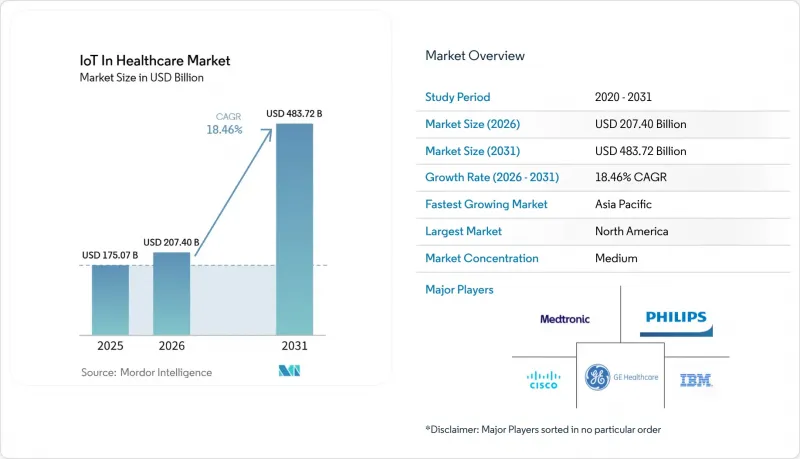
Mordor Intelligence에 의하면, 의료 분야 사물인터넷(IoT) 시장 규모는 2025년 1,750억 7,000만 달러로 평가되었습니다. 2026년에는 2,074억 달러로 확대되어 2031년까지 4,837억 2,000만 달러에 이를 것으로 예상되며 2026년부터 2031년에 걸쳐 CAGR 18.46%로 성장할 전망입니다.
본 보고서는 구성 요소(의료기기, 시스템 및 소프트웨어 등), 용도(원격 의료, 입원 환자 모니터링 등), 최종 사용자(병원 및 진료소, 재택 간호/환자 등), 연결 기술(Bluetooth Low Energy(BLE), Wi-Fi, 셀룰러 및 5G 등), 배포 모델(클라우드 및 On-Premise/엣지), 지역별로 분류되어 있습니다.
세계의 의료 분야 사물인터넷(IoT) 시장 동향 및 인사이트
웨어러블 기기의 보급이 급증하고 있습니다.
의료용 웨어러블 기기는 단순한 피트니스 관련 신기함에서 벗어나, 임상적으로 검증된 진단 도구로 발전했습니다. iRhythm사의 ‘Zio AT’는 2024년에 98%의 환자 순응도를 기록하며, 일상생활에 지장을 주지 않고도 지속적인 심전도 원격 모니터링이 가능함을 입증했습니다. 같은 해, Dexcom사의 시판용 혈당 모니터 ‘Stelo’가 FDA 승인을 획득함에 따라, 규제 대상인 바이오센서에 대한 소비자의 접근성이 확대되었습니다. 클라우드 연동형 분석을 통해 이러한 데이터 스트림이 실시간 알림으로 변환되어, 응급실 내원 및 재입원 건수가 감소하고 있습니다. Movano사의 ‘Evie Ring’과 같은 특수한 폼 팩터는 의료 서비스가 충분히 제공되지 않는 계층을 대상으로 하고 있으며, 새로운 시장 세분화 동향을 보여주고 있습니다. 기기의 다양화가 진행됨에 따라, 의료 분야 사물인터넷(IoT) 시장은 만성 질환 관리 및 예방적 선별 검사 분야에서 사용자층을 서서히 확대되고 있습니다.
IoT 센서 및 연결 비용의 감소
세계 반도체 공급 과잉과 소형화 추세로 인해 단가는 계속 하락하고 있으며, 병원들은 예산 1달러당 더 많은 엔드포인트를 연결할 수 있게 되었습니다. 5G 및 LPWAN 인프라의 보급으로 데이터 전송에 따른 오버헤드가 줄어들면서, 신뢰성도 향상되고 있습니다. 엣지 지원 칩셋이 신호를 로컬에서 처리하게 됨에 따라, 클라우드로의 데이터 전송 비용과 지연 시간이 줄어들었습니다. 자동차 업계의 저전력 센서에 대한 투자가 의료 분야 설계에도 영향을 미치며, 웨어러블 패치의 배터리 수명을 연장하고 있습니다. IEEE P2413에 기반한 상호운용성 표준 덕분에 여러 공급업체 간의 통합이 효율화되고 프로젝트 리드타임이 단축됨에 따라, 자금 조달에 제약이 있는 의료 제공업체들에게 의료 분야 사물인터넷(IoT) 시장이 더욱 매력적인 시장으로 부상하고 있습니다.
사이버 보안 및 데이터 개인정보 보호 관련 위험
제안된 HIPAA 개정안에서는 다단계 인증, 저장 데이터의 암호화, AI를 활용한 정보 유출 차단이 의무화되어 있으며, 이로 인해 첫해 규정 준수 예산에 약 93억 달러가 추가될 것으로 예측됩니다. EU의 의료 서비스 제공업체들은 GDPR(EU 개인정보보호규정)과 AI법의 병행 적용에 어려움을 겪고 있으며, 이에 따라 조달 주기가 길어지고 있습니다. 의료 업계는 건당 사고 비용이 1,010만 달러에 달하고, 여전히 데이터 침해로 인한 비용이 가장 높은 업계로 꼽히며, CIO들의 신중한 대응을 촉구하고 있습니다. 블록체인 시범 프로젝트는 위조가 불가능한 감사 추적을 보장하는 한편, 에너지 소비와 관련된 우려도 불러일으키고 있습니다. 보안 업체들은 성장 여지를 발견하고 있지만, 관성의 힘이 의료 시장 내 IoT의 확대 속도를 둔화시키고 있습니다.
부문별 분석
2025년 매출액 중 서비스가 45.40%를 차지했으며, 이는 병원이 ROI를 달성하기 위해 컨설팅, 통합, 라이프사이클 지원에 의존하고 있음을 반영합니다. '시스템 및 소프트웨어' 분야는 AI와 클라우드 네이티브 스택이 신규 기기 도입의 기준이 됨에 따라 연평균 성장률(CAGR) 19.12%로 성장할 것으로 전망됩니다. 메드트로닉은 구독 기반 수익을 촉진하기 위한 분석 레이어를 도입하기 위해 연구개발(R&D)에 27억 달러를 투자했습니다. Philips는 이미 AWS에서 130만 개의 IoT 엔드포인트를 통합 관리하고 있으며, 이를 통해 컴퓨팅 비용을 36% 절감하고 있습니다. 따라서 의료 분야 사물인터넷(IoT) 시장은 일회성 하드웨어 판매보다는 플랫폼 중심의 모델로 전환되고 있습니다.
엣지 분석, 사이버 보안 대책이 적용된 미들웨어, 그리고 예측 유지보수 대시보드가 새로운 지출 요청의 주류를 이루고 있습니다. 병원에서는 의료기기 리스에 실시간 분석 및 연중무휴 24시간 운영되는 서비스 데스크를 결합한 성과 기반 계약이 협상되고 있습니다. 조직이 여러 공급업체로 구성된 조각난 체제를 단계적으로 폐지해 나가는 가운데, 엔드투엔드 오케스트레이션 역량을 갖춘 벤더는 더 높은 지갑 점유율을 확보하고 있습니다. 2030년까지 서비스 부문의 매출액은 절대액 기준으로 하드웨어 부문을 넘어설 것으로 예상되며, 의료 분야 사물인터넷(IoT) 시장 전체에서 높은 지속 수익 구조를 확립하게 될 것입니다.
2025년 시점에서 원격의료는 기본적인 이용 사례로서 28.95%의 점유율을 유지했으나, 인력 부족과 처리 능력에 대한 압박으로 인해 ‘자산 및 직원 추적’ 분야는 연평균 성장률(CAGR) 20.87%로 성장하고 있습니다. 프라이빗 5G 및 초광대역 태그는 병상 단위의 지오펜싱을 지원하여, 중환자실 복도에서 인공호흡기를 찾는 데 소요되는 시간을 단축합니다. 예지정비 일정에 따라 장비의 가동 시간이 향상되고, 감사 규정 준수 사항도 확보됩니다. 이러한 운영상의 이점은 추적 프로젝트를 의료 분야의 보다 광범위한 IoT 시장 진출을 신속하게 실현할 수 있는 수단으로 여기는 CFO들의 관심을 끌고 있습니다.
입원 환자의 모니터링에는 텔레메트리 데이터를 AI 트리아지 엔진으로 전송하는 5G 게이트웨이가 활용되고 있습니다. 복약 관리 키오스크는 복약 준수 상황을 실시간으로 기록하여 부작용을 억제합니다. 영상진단실에서는 엣지 가속기를 도입하여 CT 스캔을 순식간에 처리함으로써, 방사선과 의사의 소견 작성 시간을 대폭 단축하고 있습니다. 응급 대응팀은 병원 지휘 센터와 연동된 위치 정보가 포함된 긴급 신고 버튼을 사용하여 ‘도어 투 니들(현장 도착부터 처치 시작까지)’ 시간을 몇 분 단축하고 있습니다. 이러한 워크플로우들이 결합되어 수익원의 다각화를 도모하고, 의료 업계에서의 IoT 보급을 더욱 확대되고 있습니다.
지역별 분석
북미는 2025년에 매출의 41.85%를 차지했으며, 메디케어의 상시 원격 모니터링 CPT 코드와 웨어러블 진단 기기에 대한 FDA의 패스트트랙 제도를 통해 그 기반이 강화되었습니다. EHR(전자건강기록)의 보급이 확대됨에 따라 기기와 플랫폼의 통합이 용이해졌으며, 벤처 캐피탈의 활동이 스타트업 기업의 사업 확장을 뒷받침하고 있습니다. 각 주의 메디케이드 프로그램에서는 연방 정부의 환급 제도를 본따려는 움직임이 점점 더 강해지고 있으며, 대상 인구가 확대되고 있습니다. 그 결과, 의료 분야 사물인터넷(IoT) 시장은 미국 및 캐나다 전역에서 예측 가능한 수요 곡선을 보이고 있습니다.
유럽에서는 ‘유럽 헬스 데이터 스페이스(European Health Data Space)’를 중심으로 꾸준한 성장이 나타났습니다. 이 이니셔티브에서는 상호운용성 프로젝트에 8억 1,000만 유로가 배정되었습니다. 독일의 병원 개혁법에서는 전자의무기록 도입이 의무화되어 있으며, 이것이 미들웨어 업그레이드를 촉진하고 있습니다. EU 배터리 규정(2023/1542)은 설계의 복잡성을 높이지만, 지속가능성에 관한 요건과 부합합니다. 동시에, AI법은 알고리즘의 투명성에 관한 규정을 명확히 함으로써 임상의들의 신뢰를 쌓아가고 있습니다. 이러한 협력적인 정책을 통해 유럽은 의료 분야 사물인터넷(IoT) 시장에서 품질을 중시하면서도 규제를 준수하는 시장 부문으로서의 입지를 확고히 하고 있습니다.
아시아태평양은 2031년까지 연평균 성장률(CAGR)이 22.70%로, 가장 빠르게 성장하고 있습니다. 일본의 ‘의료 DX’ 이니셔티브에서는 국민 ID 카드와 보험 데이터베이스를 연동하여 IoT 데이터 흐름을 효율화하고 있습니다. 중국에서는 100곳 이상의 스마트 병원이 5G 캠퍼스 네트워크를 활용해 환자에 대한 종단 간 추적을 실시했습니다. 인도의 ‘아유슈만 바라트 디지털 미션’은 향후 기기 통합을 위한 기반이 될 ID 도입을 추진하고 있습니다. 스마트폰의 높은 보급률과 경쟁력 있는 통신 요금 덕분에 가정용 모니터링 키트의 이용이 촉진되면서, 의료 분야 사물인터넷(IoT) 시장 규모는 대도시권을 훨씬 뛰어넘어 확대되고 있습니다. 남미, 중동 및 아프리카는 아직 발전 도상국이지만, 광대역 격차가 줄어들면 비약적인 보급이 예상됩니다.
기타 혜택 :
- 엑셀 형식 시장 예측(ME) 시트
- 3개월간의 애널리스트 지원
자주 묻는 질문
목차
제1장 서론
제2장 조사 방법
제3장 주요 요약
제4장 시장 구도
제5장 시장 규모 및 성장 예측
제6장 경쟁 구도
제7장 시장 기회 및 향후 전망
KTH 26.06.29According to Mordor Intelligence, the ioT in healthcare market size is expected to increase from USD 175.07 billion in 2025 to USD 207.40 billion in 2026 and reach USD 483.72 billion by 2031, growing at a CAGR of 18.46% over 2026-2031.
This report is Segmented by Component (Medical Devices, Systems and Software, and More), Application (Tele-Medicine, In-Patient Monitoring, and More), End-User (Hospitals and Clinics, Home-Care / Patients, and More), Connectivity Technology (Bluetooth Low Energy (BLE), Wi-Fi, Cellular and 5G, and More), Deployment Model (Cloud and On-Premise / Edge), and Geography.
Global IoT In Healthcare Market Trends and Insights
Wearable-device penetration surge
Medical-grade wearables have shifted from fitness novelties to clinically validated diagnostics. iRhythm's Zio AT logged 98% patient adherence in 2024, showing that continuous cardiac telemetry is feasible without lifestyle disruption. FDA clearance of Dexcom's over-the-counter Stelo glucose monitor in the same year widens consumer access to regulated biosensors.Cloud-linked analytics convert these streams into real-time alerts, cutting emergency visits and readmissions. Specialized form factors such as Movano's Evie Ring target underserved cohorts, signaling new segmentation dynamics. As device diversity grows, the Internet of Things in healthcare market gains incremental user pools across chronic-disease management and preventive screening.
Falling IoT sensor and connectivity costs
Global semiconductor overcapacity and miniaturization advances continue to pull unit prices down, allowing hospitals to connect more endpoints per budget dollar. The dispersion of 5G and LPWAN infrastructure trims data-transmission overheads while improving reliability. Edge-ready chipsets now process signals locally, lowering cloud egress fees and latency. Automotive-sector investments in power-efficient sensors spill over into medical designs, extending battery life on wearable patches. Interoperability standards under IEEE P2413 streamline multi-vendor integration, shrinking project lead-times and reinforcing the attractiveness of the IoT in healthcare market for cash-constrained providers.
Cyber-security and data-privacy risks
Proposed HIPAA updates mandate multi-factor authentication, encryption at rest, and AI-driven breach containment, adding an estimated USD 9.3 billion to first-year compliance budgets. EU providers juggle GDPR with the AI Act, extending procurement cycles. Healthcare remains the most expensive industry for breaches at USD 10.1 million per incident, driving cautious CIO behavior. Blockchain pilots promise immutable audit trails but raise energy-use worries. While security vendors see upside, inertia tempers expansion speed of the Internet of Things in healthcare market.
Other drivers and restraints analyzed in the detailed report include:
- Digital-twin guided therapy optimization
- Hospital-at-home reimbursement roll-outs
- Lack of AI-grade interoperability standards
For complete list of drivers and restraints, kindly check the Table Of Contents.
Segment Analysis
Services accounted for 45.40% of 2025 revenue, reflecting hospitals' reliance on consulting, integration, and lifecycle support to unlock ROI. Systems and Software is forecast to grow at 19.12% CAGR as AI and cloud-native stacks become the baseline for new device introductions. Medtronic invested USD 2.7 billion in R&D to embed analytics layers that drive subscription revenue. Philips already orchestrates 1.3 million IoT endpoints on AWS, lowering compute spend by 36%. The Internet of Things in healthcare market, therefore, tilts toward platform centricity rather than one-off hardware sales.
Edge analytics, cyber-secured middleware, and predictive-maintenance dashboards dominate fresh spending requests. Hospitals negotiate outcome-based contracts that bundle device leasing with real-time analytics and 24/7 service desks. Vendors that master end-to-end orchestration capture higher wallet share as organizations phase out multi-supplier patchworks. By 2030, the services subtotal is projected to eclipse hardware in absolute dollars, anchoring a high-recurring-revenue profile across the IoT in healthcare market.
Tele-medicine retained a 28.95% share in 2025 as the foundational use-case, yet Asset and Staff Tracking is climbing at 20.87% CAGR on the back of workforce shortages and throughput pressures. Private 5G and ultra-wideband tags support bed-level geofencing, cutting search times for ventilators in ICU corridors. Predictive maintenance schedules improve equipment uptime and audit compliance. These operational wins entice CFOs who view tracking projects as quick payback gateways into the broader Internet of Things (IoT) in healthcare market.
In-patient monitoring embraces 5G gateways that feed telemetry into AI triage engines. Medication-management kiosks register dose adherence in real time, curbing adverse events. Imaging suites deploy edge accelerators to render CT scans instantly, slashing radiologist turnaround. Emergency response teams use geotagged panic buttons linked to hospital command centers, shaving minutes off door-to-needle times. Collectively, these workflows diversify revenue streams and deepen penetration of the IoT in the healthcare industry.
Geography Analysis
North America retained 41.85% revenue in 2025, fortified by Medicare's permanent remote-monitoring CPT codes and an FDA fast-track environment for wearable diagnostics Strong EHR penetration eases device-platform integration, while venture-capital activity supplies scaling fuel for startups. State Medicaid programs increasingly replicate federal reimbursement, expanding addressable populations. As a result, the IoT in healthcare market enjoys predictable demand curves across the United States and Canada.
Europe posted steady growth under the European Health Data Space, which allocates EUR 810 million to interoperability projects. Germany's hospital reform law mandates electronic patient records, propelling middleware upgrades. The EU Battery Regulation 2023/1542 raises design complexity but aligns with sustainability mandates. Simultaneously, the AI Act clarifies algorithmic transparency rules, fostering clinician trust. These coordinated policies position Europe as a quality-driven yet compliant slice of the IoT in healthcare market.
Asia-Pacific is the fastest climber at 22.70% CAGR to 2031. Japan's Medical DX initiative links national ID cards to insurance databases, streamlining IoT-data flow. In China, more than 100 smart hospitals leverage 5G campus grids for end-to-end patient tracking. India's Ayushman Bharat Digital Mission seeds foundational IDs for future device integration. High smartphone penetration and competitive telecom pricing encourage household monitoring kits, expanding the IoT in healthcare market footprint well beyond megacities. South America and the Middle East and Africa are nascent but primed for leapfrog adoption once broadband gaps narrow.
- Medtronic plc
- Koninklijke Philips N.V.
- GE Healthcare
- Cisco Systems Inc.
- IBM Corporation
- Microsoft Corporation
- SAP SE
- Siemens Healthineers
- Honeywell International
- Oracle Corporation
- Amazon Web Services
- Cerner Corporation
- Qualcomm Life
- Capsule Technologies Inc.
- Resideo Technologies Inc.
- Stanley Healthcare
- Telit Communications
- AliveCor Inc.
- Dexcom Inc.
- Insulet Corporation
- BioTelemetry Inc.
- Masimo Corporation
- Intel Corporation
- Armis Security
- SoftServe Inc.
Additional Benefits:
- The market estimate (ME) sheet in Excel format
- 3 months of analyst support
TABLE OF CONTENTS
1 INTRODUCTION
- 1.1 Study Assumptions and Market Definition
- 1.2 Scope of the Study
2 RESEARCH METHODOLOGY
3 EXECUTIVE SUMMARY
4 MARKET LANDSCAPE
- 4.1 Market Overview
- 4.2 Market Drivers
- 4.2.1 Wearable-device penetration surge
- 4.2.2 Falling IoT sensor and connectivity costs
- 4.2.3 Digital-twin guided therapy optimisation
- 4.2.4 Hospital-at-home reimbursement roll-outs
- 4.2.5 Private 5G networks in hospital campuses
- 4.2.6 Remote patient monitoring after COVID-19
- 4.3 Market Restraints
- 4.3.1 Cyber-security and data-privacy risks
- 4.3.2 Up-front legacy-integration costs
- 4.3.3 Lack of AI-grade interoperability standards
- 4.3.4 Battery e-waste tightening regulations
- 4.4 Value Chain Analysis
- 4.5 Regulatory Landscape
- 4.6 Technological Outlook
- 4.7 Porter's Five Forces Analysis
- 4.7.1 Threat of New Entrants
- 4.7.2 Bargaining Power of Buyers
- 4.7.3 Bargaining Power of Suppliers
- 4.7.4 Threat of Substitutes
- 4.7.5 Intensity of Rivalry
- 4.8 Assessment of COVID-19 Impact
5 MARKET SIZE AND GROWTH FORECASTS (VALUE)
- 5.1 By Component
- 5.1.1 Medical Devices
- 5.1.1.1 Wearable External Medical Devices
- 5.1.1.2 Implanted Medical Devices
- 5.1.1.3 Stationary Medical Devices
- 5.1.2 Systems and Software
- 5.1.3 Services
- 5.1.1 Medical Devices
- 5.2 By Application
- 5.2.1 Tele-medicine
- 5.2.2 In-patient Monitoring
- 5.2.3 Medication Management
- 5.2.4 Imaging and Diagnostics
- 5.2.5 Asset and Staff Tracking
- 5.2.6 Emergency Response
- 5.3 By End-user
- 5.3.1 Hospitals and Clinics
- 5.3.2 Clinical Research Organisations
- 5.3.3 Home-care / Patients
- 5.3.4 Other End-users
- 5.4 By Connectivity Technology
- 5.4.1 Bluetooth Low Energy (BLE)
- 5.4.2 Wi-Fi
- 5.4.3 Cellular and 5G
- 5.4.4 LPWAN (NB-IoT, LoRaWAN)
- 5.4.5 Zigbee and Other Short-range
- 5.5 By Deployment Model
- 5.5.1 Cloud
- 5.5.2 On-premise / Edge
- 5.6 By Geography
- 5.6.1 North America
- 5.6.1.1 United States
- 5.6.1.2 Canada
- 5.6.1.3 Mexico
- 5.6.2 Europe
- 5.6.2.1 United Kingdom
- 5.6.2.2 Germany
- 5.6.2.3 France
- 5.6.2.4 Italy
- 5.6.2.5 Spain
- 5.6.2.6 Russia
- 5.6.3 Asia Pacific
- 5.6.3.1 China
- 5.6.3.2 India
- 5.6.3.3 Japan
- 5.6.3.4 South Korea
- 5.6.3.5 ASEAN
- 5.6.3.6 Rest of Asia Pacific
- 5.6.4 South America
- 5.6.4.1 Brazil
- 5.6.4.2 Argentina
- 5.6.5 Middle East and Africa
- 5.6.5.1 GCC
- 5.6.5.2 South Africa
- 5.6.1 North America
6 COMPETITIVE LANDSCAPE
- 6.1 Market Concentration
- 6.2 Strategic Moves
- 6.3 Market Share Analysis
- 6.4 Company Profiles (includes Global level Overview, Market level overview, Core Segments, Financials as available, Strategic Information, Market Rank/Share for key companies, Products and Services, and Recent Developments)
- 6.4.1 Medtronic plc
- 6.4.2 Koninklijke Philips N.V.
- 6.4.3 GE Healthcare
- 6.4.4 Cisco Systems Inc.
- 6.4.5 IBM Corporation
- 6.4.6 Microsoft Corporation
- 6.4.7 SAP SE
- 6.4.8 Siemens Healthineers
- 6.4.9 Honeywell International
- 6.4.10 Oracle Corporation
- 6.4.11 Amazon Web Services
- 6.4.12 Cerner Corporation
- 6.4.13 Qualcomm Life
- 6.4.14 Capsule Technologies Inc.
- 6.4.15 Resideo Technologies Inc.
- 6.4.16 Stanley Healthcare
- 6.4.17 Telit Communications
- 6.4.18 AliveCor Inc.
- 6.4.19 Dexcom Inc.
- 6.4.20 Insulet Corporation
- 6.4.21 BioTelemetry Inc.
- 6.4.22 Masimo Corporation
- 6.4.23 Intel Corporation
- 6.4.24 Armis Security
- 6.4.25 SoftServe Inc.
7 MARKET OPPORTUNITIES AND FUTURE OUTLOOK
- 7.1 White-space and Unmet-need Assessment