
|
시장보고서
상품코드
2066445
농업용 트랙터 : 시장 점유율 분석, 업계 동향 및 통계, 성장 예측(2026-2031년)Agricultural Tractors - Market Share Analysis, Industry Trends & Statistics, Growth Forecasts (2026 - 2031) |
||||||
 Mordor Intelligence
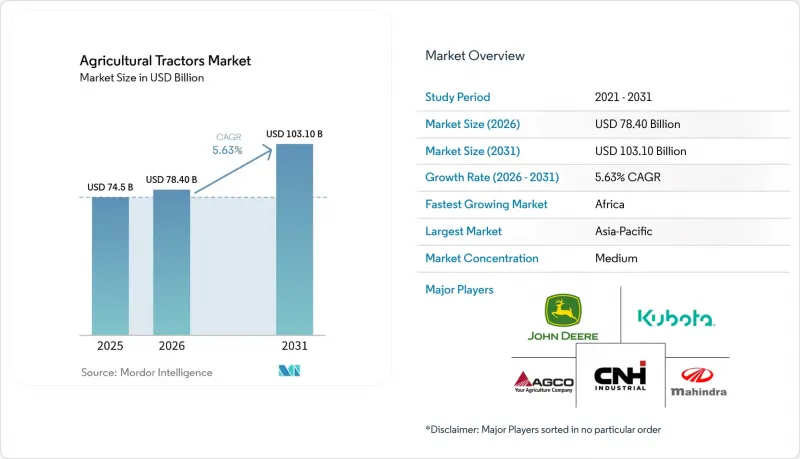
Mordor Intelligence에 의하면, 농업용 트랙터 시장 규모는 2025년 745억 달러로 평가되었습니다. 2026년에는 784억 달러로 확대되어 2031년까지 1,031억 달러에 이를 것으로 예측되며, 2026년부터 2031년에 걸쳐 CAGR 5.63%로 성장할 전망입니다.
본 보고서는 출력별(40 HP 미만, 40-100 HP, 101-200 HP, 200 HP 초과), 구동 방식(이륜 구동 및 사륜구동), 엔진 유형(디젤, 전기, 하이브리드), 트랙터 유형(범용, 밭갈이용 등), 지역(북미, 남미, 유럽, 아시아태평양, 중동 및 아프리카)별로 분류되어 있습니다. 시장 전망은 금액(달러) 기준으로 제시되어 있습니다.
세계의 농업용 트랙터 시장 동향 및 인사이트
정부의 기계화 보조금 지속
정부가 지원하는 기계화 프로그램은 인도, 사하라 이남 아프리카, 동남아시아 등의 지역에서 농업용 트랙터 시장 수요를 유지하는 데 있어 계속해서 중요한 역할을 하고 있습니다. 인도에서는 ‘농업 기계화 지원 사업’을 통해 제공되는 보조금이, 기계화 수준이 낮은 지역에서 트랙터를 이용할 수 있도록 하는 데 있어 여전히 중요한 요인으로 작용하고 있습니다. 나이지리아에서는 2025년에 시행된 체계적인 기계화 도입 계획에 따라, ‘리스-투-오너(Lease-to-Own)’ 모델을 통해 기계화 서비스 제공업체를 경유하여 2,000대의 대형 트랙터가 도입되었습니다. 이는 정부의 직접 소유와 비교했을 때, 보다 체계적인 조달 전략을 반영한 것입니다. 이러한 변화는 제조업체들이 농업용 트랙터 시장에 접근하는 방식에 영향을 미치고 있습니다. 이는 차량 플릿 중개업체에게는 대규모 자금 조달, 서비스 계획 및 부품 지원이 필요하기 때문입니다. 또한, 2025년까지 작물 파종, 수확, 가공 분야의 기계화율이 75.5%를 나타낼 것으로 예측되는 중국은 농업 현대화를 가속화하려는 주변국들에게 벤치마크가 되고 있습니다.
도입된 차량 군에 대한 정밀 농업의 통합
정밀 농업의 도입은 신규 트랙터 판매 대수만으로는 파악할 수 없는 추세보다, 기존 농업 기계 전체를 놓고 볼 때 훨씬 빠르게 진행되고 있습니다. 업그레이드를 통해 디지털 기능이 점점 더 통합되고 있는 만큼, 이러한 추세는 농업용 트랙터 시장에 중요한 의미를 지닙니다. 이러한 경제적 이점은 점점 더 분명해지고 있으며, 미국 농업기계제조업체협회(AEM)와 카니(Carney)사의 추산에 따르면, 현재 정밀농업의 도입으로 인해 2025년에는 미국의 연간 작물 생산량이 5% 증가하고, 연료 소비량이 연간 1억 4,700만 갤런 감소할 것으로 전망됩니다. 이로 인해 여러 제조업체의 기계를 함께 사용하는 농업 경영자들이 장비의 완전한 교체 주기를 기다리지 않고 통일된 지침이나 데이터 도구를 요구하게 되면서, 사후 개조 수요가 증가하고 있습니다. 그 결과, 농업용 트랙터 시장에서는 신제품 판매에만 의존하는 것이 아니라, 기존 장비 기반을 지원할 수 있는 제조업체나 기술 제공업체가 우위를 점하고 있습니다.
높은 취득 비용과 점점 더 엄격해지는 기계 대출 조건
대출 비용 상승과 신용 조건 강화로 인해 농업용 트랙터 시장, 특히 미국의 고가 기계 부문에서 구매 결정이 지연되고 있습니다. 미국의 고출력 부문에서는 2025년에 425 HP를 초과하는 트랙터의 소매 가격이 전년 대비 3.2% 하락했으며, 경매 가격도 6.7% 하락했습니다. 이는 매수 심리가 약화되고 있는 점과 딜러의 재고 보유 비용 증가로 인한 재정적 부담을 반영한 것입니다. 그 영향은 농장의 규모에 따라 다르며, 대규모 경영자들은 중고 장비 시장의 기회를 활용하는 반면, 소규모 농장은 자금 조달 문제에 직면하여 장비 교체 주기가 지연되고 있습니다. 그 결과, 농업용 트랙터 시장은 양극화가 점점 더 심화되고 있으며, 가격에 민감한 농업 부문에서는 고급 프리미엄 기계에 대한 수요가 늘어나는 반면, 보급형 및 범용 트랙터 모델에 대한 수요는 줄어들고 있습니다.
부문별 분석
2025년, 농업용 트랙터 시장에서 40-100 HP 부문이 42.9%라는 가장 높은 점유율을 차지했습니다. 이 부문은 신흥 농업 경제국에서 복합 농업, 운반, 경운 및 범용 작업에 적합하기 때문에 계속해서 지배적인 위치를 유지하고 있습니다. 중형 출력의 트랙터는 아시아태평양, 남미, 아프리카 일부 등 농장에서 연비 효율과 작업 기구와의 호환성 사이의 균형이 요구되는 지역에서 널리 채택되고 있습니다. 소규모 농장에서는 고출력 모델에 비해 운용상의 유연성이 높고 소유 비용이 저렴하기 때문에 이러한 트랙터가 선호되고 있습니다. 이 부문 수요 안정성은 범용성이 높고 다목적성을 중시하는 농업 기계화에 대한 의존이 지속되고 있음을 보여줍니다.
200 HP를 초과하는 농업용 트랙터 시장 규모는 2026년부터 203년까지 연평균 성장률(CAGR) 7.5%라는 가장 높은 성장률을 기록하며 확대될 것으로 전망됩니다. 이러한 성장은 북미, 브라질, 동유럽 등지에서 농장 통합이 진행되고 있으며, 대규모 농지의 생산성에 대한 수요가 높아지고 있는 데 기인합니다. 대규모 상업 농장에서는 밭의 작업 범위를 확대하고 계절별 작업 시간을 단축하기 위해 고출력 장비를 도입하고 있습니다. 주요 제조업체들은 정밀 농업 시스템을 탑재한 첨단 줄 재배용 및 대용량 트랙터 플랫폼 개발에 주력하고 있습니다. 그러나 전 세계의 농업 개발도상국에서는 중급 트랙터가 여전히 판매 대수의 주류를 이루고 있습니다.
2025년, 농업용 트랙터 시장 점유율에서 이륜 구동 트랙터가 71.8%로 가장 높은 비중을 차지했습니다. 이 트랙터들은 초기 비용이 저렴하고 유지보수 요건이 간단할 뿐만 아니라, 경운, 운반 및 줄 재배 농업에 적합하기 때문에 그 우위를 유지하고 있습니다. 중소규모 농가들이 합리적인 가격과 사용 편의성을 중시하는 인도, 동남아시아 및 아프리카 일부 지역 등에서 널리 선호되고 있습니다. 또한, 이 부문은 광범위한 유통업체 네트워크와 저마력 용도에서의 낮은 연비라는 이점도 누리고 있습니다. 이러한 요인들이 복합적으로 작용하여, 이륜 구동 트랙터는 많은 개발도상국에서 비용을 중시하는 농업 경영에 있어 여전히 최적의 선택지로 자리 잡고 있습니다.
농업용 트랙터 시장에서 사륜구동 트랙터 부문 시장 규모는 2026년부터 2031년에 걸쳐 연평균 성장률(CAGR) 7.6%라는 가장 높은 성장률을 기록하며 확대될 것으로 전망됩니다. 북미, 브라질, 동유럽 등의 지역에서는 농장 규모 확대와 더욱 다양한 농기계의 사용 수요를 배경으로, 높은 견인력을 갖춘 트랙터 시스템의 도입이 확대되고 있습니다. 대규모 상업용 농장에서는 견인력을 높이고 바퀴의 미끄러짐을 줄이며, 가혹한 밭 작업에 대응할 수 있기 때문에 사륜구동 사양이 선호됩니다. 또한, 각 제조업체들은 대규모 농업에 최적화된 첨단 유압 시스템과 정밀 농업 기술을 탑재한 프리미엄 트랙터 라인업을 확대되고 있습니다. 이 부문의 성장은 세계 농업 시장에서 기존의 이륜 구동 플랫폼에서 완전히 전환되고 있다는 것보다는 생산성에 대한 요구가 높아지고 있음을 반영한 것입니다.
지역별 분석
아시아태평양은 인도와 중국의 강력한 기계화 수요에 힘입어 2025년 농업용 트랙터 시장에서 38.6%라는 최대 점유율을 차지했습니다. 인도는 주로 중소규모 농장에서 다목적 트랙터가 널리 사용되고 있기 때문에 세계 유수의 트랙터 소비국 중 하나로 자리매김해 왔습니다. 중국은 첨단 농업 기계의 도입 확대와 국내 생산 능력 확충을 통해 농업의 기계화를 지속적으로 추진해 왔습니다. 일본과 한국에서는 특수한 농업 작업을 위해 설계된, 소형이며 정밀성을 중시한 트랙터에 대한 수요가 지속되었습니다. 이 지역은 정부 주도의 기계화 프로그램, 농촌 지역의 농업 기계 자금 조달 환경 개선, 그리고 확대되는 현지 생산 능력의 혜택을 받고 있으며, 이러한 요인들이 비용 효율적인 트랙터 생산과 전 세계 인근 농업 국가로의 수출을 뒷받침하고 있습니다.
아프리카에서는 농업 기계화에 대한 투자 증가와 체계적인 조달 프로그램의 확대로 인해, 2026년부터 2031년까지 연평균 성장률(CAGR) 7.6%라는 가장 높은 성장세가 예상됩니다. 나이지리아, 가나, 케냐, 탄자니아 등 각국 정부는 트랙터 대출 이니셔티브와 민관 협력을 통한 농업 현대화 프로그램을 통해 농업 기계화에 대한 지원을 강화하고 있습니다. 해당 지역에서는 단발적인 장비 구매에서 체계적인 유통 및 서비스 제공 모델로 전환되고 있으며, 장비에 대한 장기적인 접근성이 향상되고 있습니다. 또한, 전 세계 각 제조업체들도 해당 지역에서 시장 점유율을 높이기 위해 딜러 네트워크 및 유통 파트너십 강화를 추진하고 있습니다. 특히, 상업적 농업 활동이 확대되고 식량 안보 및 농업 생산성 향상에 대한 정책적 관심이 높아지고 있는 국가들에서는 그 성장세가 두드러집니다.
북미와 유럽에서는 2025년과 2026년 초, 금리 상승과 농업 수익성의 변동이 장비 구매 결정에 영향을 미치면서 수요 동향에 편차가 나타났습니다. 이러한 과제에도 불구하고, 갱신 수요와 지속적인 기계화에 대한 수요가 특정 시장을 지탱해 주었습니다. 미국 농업기계제조업체협회(AEM)에 따르면, 2025년 6월 기준 캐나다의 농업용 트랙터 총 판매 대수는 연초 대비 1.6% 증가했으며, 사륜구동 트랙터의 판매 대수는 24.7% 증가했습니다. 이는 고출력 농업 기계 및 대규모 농업 경영에 대한 투자가 지속되고 있음을 보여줍니다. 반면, 서유럽의 일부 시장에서는 수요가 점차 안정될 때까지 등록 대수가 부진했습니다.
기타 혜택 :
- 엑셀 형식 시장 예측(ME) 시트
- 3개월간의 애널리스트 지원
자주 묻는 질문
목차
제1장 서론
제2장 조사 방법
제3장 주요 요약
제4장 시장 구도
제5장 시장 규모 및 성장 예측
제6장 경쟁 구도
제7장 시장 기회 및 향후 전망
KTH 26.06.29According to Mordor Intelligence, the agricultural tractors market size is anticipated to increase from USD 74.5 billion in 2025 to USD 78.40 billion in 2026 and reach USD 103.10 billion by 2031, growing at a CAGR of 5.63% over 2026-2031.
This report is Segmented by Power Output (Less Than 40 HP, 40-100 HP, 101-200 HP, and More Than 200 HP), by Drive Type (2-Wheel Drive and 4-Wheel Drive), by Engine Type (Diesel, Electric, and Hybrid), by Tractor Type (Utility, Row-Crop, and More), and by Geography (North America, South America, Europe, Asia-Pacific, Middle East, and Africa). The Market Forecasts are Provided in Terms of Value (USD).
Global Agricultural Tractors Market Trends and Insights
Government Mechanization Subsidy Continuity
Government-supported mechanization programs continue to play a significant role in sustaining demand for the agricultural tractors market in regions such as India, Sub-Saharan Africa, and Southeast Asia. In India, subsidies provided under the Sub-Mission on Agricultural Mechanization remain a key factor in ensuring tractors are accessible in districts with lower levels of mechanization. In Nigeria, a structured mechanization rollout in 2025 introduced 2,000 heavy-capacity tractors through mechanization service providers under a lease-to-own model, reflecting a more organized procurement strategy compared to direct public ownership. This shift influences how manufacturers approach the agricultural tractors market, as fleet intermediaries require large-scale financing, service planning, and parts support. Additionally, China's 75.5% mechanization rate for crop planting, harvesting, and processing by 2025 serves as a benchmark for neighboring countries aiming to accelerate agricultural modernization .
Precision Agriculture Integration Across Installed Fleets
Precision agriculture adoption is advancing more rapidly across existing equipment fleets than new tractor sales alone indicate. This trend is significant for the agricultural tractors market, as digital capabilities are increasingly being integrated through upgrades. The economic benefits are becoming more evident, with the Association of Equipment Manufacturers and Kearney estimating that current precision agriculture adoption has increased annual crop production in the United States by 5% and reduced fuel consumption by 147 million gallons annually in 2025 . This is driving demand for retrofitting, as mixed-brand farm operators seek unified guidance and data tools without waiting for a complete equipment replacement cycle. Consequently, the agricultural tractors market is favoring manufacturers and technology providers capable of supporting the existing equipment base, rather than relying solely on new equipment sales.
High Acquisition Cost and Tighter Machinery Financing
Higher borrowing costs and tighter credit conditions are delaying purchase decisions in the agricultural tractors market, particularly for high-value machinery categories in the United States. In the United States high-horsepower segment, retail values for tractors above 425 HP decreased by 3.2% year-over-year in 2025, while auction values declined by 6.7%. This reflects weaker buyer sentiment and the financial strain caused by elevated dealer carrying costs. The impact varies across farm sizes, with large-scale operators taking advantage of opportunities in the used-equipment market, while smaller farms face greater financing challenges and delayed replacement cycles. Consequently, the agricultural tractors market is becoming increasingly polarized, with stronger demand for advanced premium machinery and weaker demand for entry-level and utility tractor models in more price-sensitive farming segments.
Other drivers and restraints analyzed in the detailed report include:
- High-Horsepower and 4-Wheel Drive Adoption on Large Farms
- Retrofit-First Autonomy and Guidance Upgrades
- Emissions-Compliant Diesel Powertrain Cost Inflation
For complete list of drivers and restraints, kindly check the Table Of Contents.
Segment Analysis
The agricultural tractors market share for the 40-100 HP segment led with the largest 42.9% in 2025. This segment remains dominant due to its suitability for mixed farming, haulage, tillage, and utility operations in emerging agricultural economies. Mid-range tractors are widely adopted in regions such as Asia-Pacific, South America, and parts of Africa, where farms require a balance of fuel efficiency and implement compatibility. Smaller farms favor these tractors for their operational flexibility and lower ownership costs compared to high-horsepower models. The stability in demand for this segment highlights the continued reliance on versatile, utility-focused farm mechanization.
The agricultural tractors market size for the more than 200 HP segment is forecast to grow at the fastest 7.5% CAGR from 2026 to 203. This growth is driven by increasing farm consolidation and the rising need for large-scale field productivity in regions such as North America, Brazil, and Eastern Europe. Large commercial operators are adopting higher horsepower equipment to enhance field coverage and reduce seasonal operating time. Premium manufacturers are focusing on developing advanced row-crop and high-capacity tractor platforms equipped with precision farming systems. However, mid-range tractors continue to form the structural volume base in developing agricultural economies worldwide.
2-wheel drive tractors accounted for the largest 71.8% of the agricultural tractors market share in 2025. These tractors maintain their dominance due to lower upfront costs, simpler maintenance requirements, and their suitability for light tillage, transport, and row-crop farming activities. They are widely preferred in regions such as India, Southeast Asia, and parts of Africa, where small and medium-sized farms prioritize affordability and operational simplicity. Additionally, the segment benefits from extensive dealer networks and lower fuel consumption in lower-horsepower applications. This combination ensures that 2-wheel drive tractors remain the preferred choice for cost-sensitive agricultural operations in several developing economies.
The agricultural tractors market size for the 4-wheel drive tractor segment is projected to grow at the fastest CAGR of 7.6% from 2026 to 2031. The adoption of higher-traction tractor systems is increasing in regions such as North America, Brazil, and Eastern Europe, driven by expanding farm sizes and the need for wider implement usage. Large commercial farms favor 4-wheel drive configurations for their ability to enhance drawbar pull, reduce wheel slippage, and support heavy-duty field operations. Manufacturers are also broadening their premium tractor portfolios with advanced hydraulic systems and precision farming technologies tailored for large-scale farming. The growth in this segment reflects rising productivity demands rather than a complete shift away from traditional 2-wheel drive platforms in global agricultural markets.
Geography Analysis
Asia-Pacific held the largest 38.6% agricultural tractors market share in 2025, supported by strong mechanization demand across India and China. India remained one of the leading tractor-consuming countries globally, primarily due to the widespread adoption of utility tractors on small and medium-sized farms. China continued to enhance agricultural mechanization through increased adoption of advanced farming equipment and the expansion of domestic manufacturing capabilities. Japan and South Korea sustained demand for compact, precision-oriented tractors tailored for specialized agricultural operations. The region benefits from government-backed mechanization programs, improved rural equipment financing access, and growing local manufacturing capacity, which supports cost-effective tractor production and exports to neighboring agricultural economies worldwide.
Africa is projected to grow at the fastest 7.6% CAGR from 2026 to 2031 due to rising mechanization investments and expanding organized procurement programs. Governments in countries such as Nigeria, Ghana, Kenya, and Tanzania are increasing support for farm mechanization through tractor financing initiatives and public-private agricultural modernization programs. The region is transitioning from fragmented equipment purchases to structured distribution and service-provider models, enhancing long-term equipment accessibility. Global manufacturers are also strengthening dealer networks and distribution partnerships to improve market penetration in the region. Growth is particularly robust in countries with expanding commercial farming activities and a heightened policy focus on food security and agricultural productivity improvements.
North America and Europe experienced varied demand trends in 2025 and early 2026, driven by higher interest rates and fluctuating farm profitability, which impacted equipment purchasing decisions. Despite these challenges, replacement demand and the need for ongoing mechanization supported specific markets. According to the Association of Equipment Manufacturers (AEM), total Canadian agricultural tractor sales increased by 1.6% year-to-date as of June 2025, while sales of 4-wheel-drive tractors grew by 24.7%, indicating sustained investment in high-power farm machinery and large-scale agricultural operations . In contrast, several Western European markets saw weaker registrations before demand gradually stabilized.
- Deere & Company
- CNH Industrial N.V.
- AGCO Corporation
- Kubota Corporation
- Mahindra & Mahindra Limited
- CLAAS KGaA mbH
- SDF S.p.A.
- Yanmar Holdings Co., Ltd.
- Argo Tractors S.p.A. (ARGO S.p.A.)
- Weichai Lovol Intelligent Agricultural Technology Co., Ltd.
- LS Mtron Ltd. (LS Corp.)
- Daedong Corporation
- International Tractors Limited
- Tractors and Farm Equipment Limited (Amalgamations Group)
- YTO Group Corporation (China National Machinery Industry Corporation)
Additional Benefits:
- The market estimate (ME) sheet in Excel format
- 3 months of analyst support
TABLE OF CONTENTS
1 Introduction
- 1.1 Study Assumptions and Market Definition
- 1.2 Scope of the Study
2 Research Methodology
3 Executive Summary
4 Market Landscape
- 4.1 Market Overview
- 4.2 Market Drivers
- 4.2.1 Government mechanization subsidy continuity
- 4.2.2 Precision agriculture integration across installed fleets
- 4.2.3 Replacement demand for an aging tractor fleet
- 4.2.4 High-horsepower and 4-wheel drive adoption on large farms
- 4.2.5 Retrofit-first autonomy and guidance upgrades
- 4.2.6 Specialty-crop electrification in orchards, vineyards, and greenhouses
- 4.3 Market Restraints
- 4.3.1 High acquisition cost and tighter machinery financing
- 4.3.2 Emissions-compliant diesel powertrain cost inflation
- 4.3.3 Weak farm cash flows and seasonal credit access gaps
- 4.3.4 Dealer and service-readiness gap for electric and autonomous models
- 4.4 Regulatory Landscape
- 4.5 Technological Outlook
- 4.6 Porter's Five Forces Analysis
- 4.6.1 Bargaining Power of Buyers
- 4.6.2 Bargaining Power of Suppliers
- 4.6.3 Threat of New Entrants
- 4.6.4 Threat of Substitutes
- 4.6.5 Intensity of Competitive Rivalry
5 Market Size and Growth Forecasts (Value)
- 5.1 By Power Output
- 5.1.1 Less than 40 HP
- 5.1.2 40-100 HP
- 5.1.3 101-200 HP
- 5.1.4 More than 200 HP
- 5.2 By Drive Type
- 5.2.1 2-Wheel Drive
- 5.2.2 4-Wheel Drive
- 5.3 By Engine Type
- 5.3.1 Diesel
- 5.3.2 Electric
- 5.3.3 Hybrid
- 5.4 By Tractor Type
- 5.4.1 Utility
- 5.4.2 Row-Crop
- 5.4.3 Orchard and Vineyard
- 5.4.4 Autonomous
- 5.5 By Geography
- 5.5.1 North America
- 5.5.1.1 United States
- 5.5.1.2 Canada
- 5.5.1.3 Mexico
- 5.5.1.4 Rest of North America
- 5.5.2 South America
- 5.5.2.1 Brazil
- 5.5.2.2 Argentina
- 5.5.2.3 Rest of South America
- 5.5.3 Europe
- 5.5.3.1 Germany
- 5.5.3.2 France
- 5.5.3.3 Russia
- 5.5.3.4 United Kingdom
- 5.5.3.5 Italy
- 5.5.3.6 Rest of Europe
- 5.5.4 Asia-Pacific
- 5.5.4.1 China
- 5.5.4.2 India
- 5.5.4.3 Japan
- 5.5.4.4 Australia
- 5.5.4.5 South Korea
- 5.5.4.6 Rest of Asia-Pacific
- 5.5.5 Middle East
- 5.5.5.1 Saudi Arabia
- 5.5.5.2 Turkey
- 5.5.5.3 United Arab Emirates
- 5.5.5.4 Rest of Middle East
- 5.5.6 Africa
- 5.5.6.1 South Africa
- 5.5.6.2 Egypt
- 5.5.6.3 Nigeria
- 5.5.6.4 Rest of Africa
- 5.5.1 North America
6 Competitive Landscape
- 6.1 Market Concentration
- 6.2 Strategic Moves
- 6.3 Market Share Analysis
- 6.4 Company Profiles (Includes Global Level Overview, Market Level Overview, Core Segments, Financials as Available, Strategic Information, Market Rank/Share for Key Companies, Products and Services, and Recent Developments)
- 6.4.1 Deere & Company
- 6.4.2 CNH Industrial N.V.
- 6.4.3 AGCO Corporation
- 6.4.4 Kubota Corporation
- 6.4.5 Mahindra & Mahindra Limited
- 6.4.6 CLAAS KGaA mbH
- 6.4.7 SDF S.p.A.
- 6.4.8 Yanmar Holdings Co., Ltd.
- 6.4.9 Argo Tractors S.p.A. (ARGO S.p.A.)
- 6.4.10 Weichai Lovol Intelligent Agricultural Technology Co., Ltd.
- 6.4.11 LS Mtron Ltd. (LS Corp.)
- 6.4.12 Daedong Corporation
- 6.4.13 International Tractors Limited
- 6.4.14 Tractors and Farm Equipment Limited (Amalgamations Group)
- 6.4.15 YTO Group Corporation (China National Machinery Industry Corporation)