

|
시장보고서
상품코드
2066458
잠수함 : 시장 점유율 분석, 업계 동향 및 통계, 성장 예측(2026-2031년)Submarine - Market Share Analysis, Industry Trends & Statistics, Growth Forecasts (2026 - 2031) |
||||||
 Mordor Intelligence
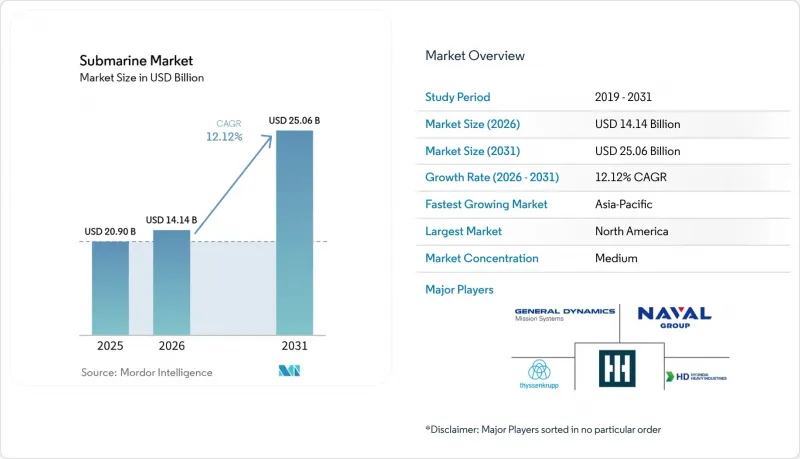
Mordor Intelligence에 의하면, 잠수함 시장 규모는 2025년에 209억 달러로 평가되었습니다. 2026년 141억 4,000만 달러에서 2031년까지 250억 6,000만 달러에 이를 것으로 예측되며, 2026년부터 2031년까지 CAGR은 12.12%를 나타낼 전망입니다.
본 보고서는 추진 방식(원자력 잠수함 및 디젤-전기 잠수함), 전투 역할(공격형, 탄도 미사일형 등), 배수량 등급(2,000톤 미만, 2,000-4,000톤, 그 이상), 구성 요소(선체 및 구조 모듈, 추진 시스템, 기타), 지역(북미, 유럽, 아시아태평양, 기타)별로 분류되어 있습니다. 시장 전망은 금액(달러) 기준으로 제시되어 있습니다.
세계의 잠수함 시장 동향 및 인사이트
국방 현대화 예산 증액이 잠수함 조달을 뒷받침
잠수함 시장은 전략적 지속성, 생존성 및 억지력을 갖춘 플랫폼을 위한 국방 예산 확대의 혜택을 받고 있습니다. 미국 국방부(DoD)의 2026 회계연도 예산안에서는 버지니아급 잠수함에 122억 달러, 콜롬비아급 잠수함에 115억 달러가 요청되었습니다. 북유럽 국가들도 수주 잔고를 확대하고 있으며, 노르웨이는 460억 노르웨이 크로네(45억 달러) 규모의 계약에 따라 212CD형 잠수함 주문 수량을 6척으로 늘렸습니다. 이로써 독일과 노르웨이의 공동 프로그램 총 대수는 12척이 되었습니다. 원자력 잠수함의 현대화와 일반 동력형 잠수함의 조달이 서로 시차를 두고 교체되는 것이 아니라 동시에 진행되고 있기 때문에 수요 사이클은 2010년대보다 견조합니다. 이러한 중복으로 인해 조선소의 물리적 생산 능력 확대 속도보다 빠르게 수주가 확정되고 있어, 예산이 이미 승인된 경우라도 수익 인식이 다음 해로 미뤄지는 상황이 발생하고 있습니다. 실질적으로는 자금 조달의 확실성에 힘입어 잠수함 시장이 호조를 보이고 있지만, 수익 실현 속도는 여전히 인증을 받은 조선소나 공급업체가 그 작업량을 얼마나 신속하게 소화해 낼 수 있는지에 달려 있습니다.
인도-태평양 지역의 해상 긴장 고조가 다자간 조달을 촉진하고 있습니다.
또한, 인도-태평양 지역 전체에서 구매층이 확대되고 있는 점도 잠수함 시장의 성장에 기여하고 있습니다. 해당 지역에서의 조달 활동은 더 이상 소수의 기존 운용국으로만 국한되지 않고 있습니다. 해당 지역의 긴장 고조로 인해, 점점 더 많은 해군들이 잠수함을 ‘해상 봉쇄’, ‘해상 감시’, ‘요충지 장악’, 그리고 ‘억지력 과시’를 위한 핵심 수단으로 자리매김하고 있습니다. 이러한 변화가 중요한 이유는 수요가 극소수의 1급 해군에 그치지 않고 확대되면서, 중국, 인도, 일본, 한국, 호주, 파키스탄에서 조달 일정이 겹치는 상황이 발생하고 있기 때문입니다. 그 결과, 잠수함 자체에 대한 수요가 증가할 뿐만 아니라, 기술 이전, 현지 생산, 전투 시스템 통합을 둘러싼 경쟁도 격화되고 있습니다. 따라서 조달 패턴은 더욱 광범위해지고 주기성이 낮아졌으며, 잠수함 시장은 기존의 원자력 잠수함 운용국들에 의해서만 주도되던 때보다 더욱 견고한 수요 기반을 갖추게 되었습니다. 또한, 이는 향후 수주가 플랫폼의 성능뿐만 아니라 지역 안보 협력, 산업 상쇄 조치, 납품 신뢰성에 따라 좌우될 가능성이 높아지고 있음을 의미합니다.
매우 높은 취득 비용과 수명 주기 비용이 수주량을 억제하고 있습니다.
잠수함 시장은 현대 잠수함 계획이 해군 자본 예산에서 매우 큰 비중을 차지하고 있다는 단순한 사실로 인해 여전히 제약을 받고 있습니다. 미국 의회조사국(CRS)의 자료에 따르면, 2026 회계연도 버지니아급 잠수함의 조달 비용은 1척당 50억 달러로 추정되며, 주요 해군 강국이라 하더라도 함대 계획의 규모 확대는 어려운 실정입니다. 의회예산국(CBO)은 콜롬비아급 프로그램 12척에 대한 총 비용을 1,300억 달러로 추산하는 한편, 해군의 전체 조선 계획에 있어 장기적으로는 잠수함에 대한 지출 압박이 커질 것으로 전망하고 있습니다. 이러한 비용 부담으로 인해 많은 해군들은 신조 함정, 유지 관리, 미사일, 그리고 인력 지원 사이에서 어려운 절충을 강요받고 있습니다. 잠수함 시장에서는 수요가 확실히 존재하고 전략적 시급성도 높지만, 수주량은 계약 체결 시점이 아니라 프로그램 전체 기간 동안 각국 정부가 어느 정도의 자금을 조달할 수 있는지에 여전히 좌우됩니다.
부문별 분석
2025년, 디젤-전기식 잠수함은 잠수함 시장의 55.62%를 차지하며, 기존 추진 방식이 여전히 최대의 수익원으로 자리 잡았습니다. 이러한 주도적 지위는 아시아태평양, 유럽 및 일부 남미 해군에서 재래식 잠수함이 예산 제약과 운용 요건 모두에 부합하기 때문에 구매자가 널리 분포되어 있음을 반영합니다. 이 부문은 연안 방어, 요충지 장악, 정보 수집 순찰, 특수부대 투입 등에 적합하기 때문에 임무 수행의 유연성이라는 장점이 있습니다. 따라서 원자력 잠수함의 현대화에 대한 관심이 높아지고는 있지만, 잠수함 시장의 판매량 기반은 여전히 재래식 잠수함의 조달에 의존하고 있습니다. 바로 이러한 균형 덕분에, 원자력 잠수함 건조에 관여하지 않는 조선소들에게 기존 잠수함 프로그램이 상업적으로 중요한 이유가 됩니다.
원자력 잠수함 시장은 2031년까지 연평균 성장률(CAGR) 14.21%를 나타낼 것으로 예측되며, 금액 기준 가장 빠르게 성장하는 추진 방식 부문이 될 전망입니다. 이러한 성장은 고가의 SSBN(전략 원자력 잠수함) 및 SSN(공격형 원자력 잠수함) 프로그램에 의해 주도되고 있으며, 각 함정의 계약 금액은 디젤-전기식 잠수함의 계약 금액을 훨씬 상회하고 있습니다. 잠수함 업계에서는 이로 인해 ‘양극 구조’가 형성되어 있으며, 일반 동력형 잠수함의 수주가 시장의 폭을 넓히고, 원자력 잠수함의 수주가 가치의 집중을 촉진하고 있습니다. 또한, 고성능 배터리와 AIP(비종속형 공기 공급) 시스템의 등장으로 첨단 일반 동력형 잠수함의 항속 거리와 전투 능력이 향상되었으며, 기술 격차도 점차 좁혀지고 있습니다. 잠수함 시장에서 이는 일반 동력 추진이 계속해서 가장 큰 점유율을 유지하는 한편, 원자력 추진이 지출 증가분에서 점유율을 확대해 나갈 것임을 의미합니다.
2025년 잠수함 시장 규모 중 공격형 잠수함이 48.70%를 차지했습니다. 이는 현재 조달 및 인도 단계에 있는 다수의 SSN 및 SSK 프로그램에 힘입은 결과입니다. 해군이 공격형 잠수함을 대수상전(ASuW), 대잠수함전(ASW), 정보 수집, 호위 임무 및 지역적 해상 봉쇄 임무에 활용하고 있는 점에서 그 우위는 운용상의 유용성을 반영하고 있습니다. 또한, 이 잠수함들은 첨단 원자력 해군을 보유한 국가부터 자국의 영해 경비를 위해 디젤-전기식 함대를 도입하는 국가에 이르기까지, 가장 폭넓은 고객층을 대상으로 하고 있습니다. 공격형 잠수함은 평시 및 전시의 요건을 모두 충족하기 때문에 잠수함 시장은 함대의 전력 깊이를 확보하는 데 있어 계속해서 이 역할에 의존하고 있습니다. 이러한 폭넓은 임무 프로파일 덕분에, 프로그램 간 조달 시기가 변동하더라도 이 부문은 구조적으로 탄력성을 유지하고 있습니다.
탄도 미사일 잠수함 시장은 2031년까지 연평균 성장률(CAGR) 13.13%로 확대될 것으로 예상되며, 금액 기준으로 가장 두드러진 성장을 보이는 전투 임무 분야가 될 것입니다. 이러한 증가는 핵보유국들 간의 현대화 주기가 겹치고 있기 때문이며, 여러 억지력 함대가 거의 같은 기간 내에 현대화되는 이례적인 상황입니다. 영국의 ‘드레드노트’ 계획은 하원 도서관이 그 규모와 장기간에 걸친 납품 기간을 지적한 바와 같이, 여전히 대규모이며 지속적인 사업으로 남아 있습니다. 잠수함 업계에서 이러한 시기의 중첩은 극소수의 매우 고부가가치 플랫폼에 대한 집중적인 설비 투자 열풍을 일으키고 있습니다. 그 결과, 잠수함 시장에서는 현재의 수익 측면에서 공격형 잠수함이 주도하는 반면, 장기적인 가치 확대가 가장 두드러지는 것은 SSBN(전략 원자력 잠수함)인 것으로 나타납니다.
지역별 분석
2025년, 북미는 잠수함 시장의 36.05%를 차지하며, 매출 측면에서 가장 큰 기여를 한 지역이 되었습니다. 이 지역의 위상은 주로 미국의 조달 규모, 장기적인 주기에 걸친 SSN 및 SSBN의 현대화, 그리고 지속적인 산업 기반에 대한 자금 지원에 의해 뒷받침되고 있습니다. 의회조사국(CRS)과 의회예산국(CBO)의 데이터를 종합해 보면, 미국은 잠수함 건조에 막대한 자원을 투입하고 있는 반면, 여전히 일정상의 압박, 공급업체의 집중, 그리고 인력 부족 문제에 직면해 있는 것으로 나타났습니다. 캐나다는 ‘캐나다 순찰 잠수함 프로젝트’를 통해 향후 중요한 수요층을 형성할 것으로 보입니다. 해당국 정부는 2025년 8월에 조달 절차를 진전시켰습니다. 잠수함 시장에서 북미는 가장 큰 수주액을 기록하고 있는 반면, 산업 역량이 일시적인 실행상의 문제가 아니라 전략적 제약 요인으로 변모하고 있다는 가장 명확한 증거를 보여주고 있습니다.
아시아태평양은 가장 빠르게 성장하고 있는 지역이며, 잠수함 시장은 2031년까지 연평균 성장률(CAGR) 13.76%로 확대될 것으로 예측됩니다. 이러한 성장은 중국, 인도, 일본, 한국, 호주에서 동시에 진행되고 있는 조달 및 함대 확충에 기인하며, 해당 지역에는 그 어디에서도 찾아볼 수 없는 광범위한 수요가 존재하고 있습니다. 전략적 환경의 변화에 따라 각국은 자체 개발, 해외와의 협력, 기술 이전 등의 방안을 조합하여 추진해야 하는 상황에 놓여 있습니다. 이 지역은 단일 국가 프로그램에만 의존해 성장하는 것이 아니라, 여러 대규모 프로그램이 동시에 진행되고 있기 때문에 잠수함 시장은 더욱 확대되고 있습니다. 또한, 각 구매국이 현지 건조, 정치적 협력, 납기, 장기적인 유지 관리에 대해 각기 다른 우선순위를 두기 때문에 공급업체 간의 경쟁도 치열해지고 있습니다.
유럽은 2025년 매출에서 상당한 비중을 차지했으며, 잠수함 시장에서 여전히 프로그램이 가장 집중된 지역 중 하나입니다. 독일과 노르웨이는 212CD 프로그램을 총 12척으로 확대했으며, 한편 독일 조선소들은 생산 능력 확충을 위해 연방 정부의 지원을 받고 있습니다. 또한 유럽은 잠수함 시장에서 국가 수요와 수출 의지를 어떻게 양립시킬 수 있는지를 보여주고 있습니다. 해당 지역의 여러 조선소가 국내 해군 프로그램에 참여하면서 해외 시장에서도 경쟁을 펼치고 있기 때문입니다. 남미는 현재 금액 기준으로 볼 때 여전히 규모가 작지만, 브라질은 일반 추진형 잠수함의 건조 확대와 원자력 잠수함에 대한 의지를 통해 해당 지역에 장기적으로 중요한 역할을 수행하고 있습니다. 중동 및 아프리카의 점유율은 여전히 낮은 수준이지만, 인프라 안보에 대한 우려와 해당 지역의 해군 현대화로 인해 수중전 능력에 대한 관심이 점차 높아지고 있습니다.
기타 혜택 :
- 엑셀 형식 시장 예측(ME) 시트
- 3개월간의 애널리스트 지원
자주 묻는 질문
목차
제1장 서론
제2장 조사 방법
제3장 주요 요약
제4장 시장 구도
제5장 시장 규모 및 성장 예측
제6장 경쟁 구도
제7장 시장 기회 및 향후 전망
KTH 26.06.29According to Mordor Intelligence, the submarine market size was valued at USD 20.90 billion in 2025 and is estimated to grow from USD 14.14 billion in 2026 to reach USD 25.06 billion by 2031, at a CAGR of 12.12% during the forecast period 2026-2031.
This report is Segmented by Propulsion Type (Nuclear-Powered and Diesel-Electric Submarines), Combat Role (Attack, Ballistic-Missile, and More), Displacement Class (Less Than 2, 000 Tons, 2, 000 To 4, 000 Tons, and More), Component (Hull and Structural Modules, Propulsion Systems, and More), and Geography (North America, Europe, Asia-Pacific, and More). The Market Forecasts are Provided in Terms of Value (USD).
Global Submarine Market Trends and Insights
Rising Defense Modernization Budgets Catalyze Submarine Procurement
The submarine market is benefiting from defense budget growth directed toward platforms with strategic persistence, survivability, and deterrence value. The US FY2026 Department of Defense (DoD) budget requested USD 12.2 billion for Virginia-class boats and USD 11.5 billion for Columbia-class boats. Northern Europe is also reinforcing the order book, with Norway raising its Type 212CD order to 6 boats under a NOK 46 billion (USD 4.5 billion) package, bringing the combined German-Norwegian program to 12 boats. The demand cycle is stronger than in the 2010s because nuclear recapitalization and conventional procurement are moving together rather than replacing one another in a staggered fashion. That overlap means authorizations are reaching shipyards faster than physical capacity is expanding, which delays recognition into later years, even when budgets have already been approved. In practical terms, the submarine market is being pushed upward by funding certainty, but the pace of realized revenue still depends on how quickly certified yards and suppliers can absorb that workload.
Escalating Indo-Pacific Maritime Tensions Drive Multi-Country Procurement
The submarine market is also being widened by a larger buyer base across the Indo-Pacific, where procurement is no longer limited to a few established operators. Tensions in the region are pushing more navies to treat submarines as central tools for sea denial, maritime surveillance, chokepoint control, and deterrence signaling. This shift matters because it expands demand beyond a handful of Tier-1 navies and creates overlapping acquisition schedules across China, India, Japan, South Korea, Australia, and Pakistan. The result is not only greater hull demand but also greater competition over technology transfer, local production, and combat-system integration. The procurement pattern is therefore becoming broader and less cyclical, which gives the submarine market a stronger demand base than one driven only by traditional nuclear operators. It also means future awards are more likely to be shaped by regional security alignment, industrial offsets, and delivery reliability rather than by platform performance alone.
Ultra-High Acquisition and Lifecycle Costs Cap Order Throughput
The submarine market remains constrained by the simple fact that modern submarine programs absorb a very large share of naval capital budgets. Congressional Research Service data placed the FY2026 Virginia-class procurement cost at USD 5 billion per boat, making it difficult to scale fleet plans even for major naval powers. The Congressional Budget Office estimated the Columbia-class program at USD 130 billion for 12 submarines and also projected higher long-run submarine spending pressure across the Navy's shipbuilding plan. This cost burden forces many navies to make hard tradeoffs between new builds, sustainment, missiles, and workforce support. In the submarine market, demand is real and strategic urgency is high, but order throughput still depends on what governments can fund over the full program life rather than at contract signing.
Other drivers and restraints analyzed in the detailed report include:
- AUKUS Pact Reshapes Allied Fleet Architecture and Supplier Roles
- AIP and Li-Ion Batteries Redefine The Diesel-Electric Submarine's Combat Value
- Skilled Labor Bottlenecks Constrain Western Build Rates
For complete list of drivers and restraints, kindly check the Table Of Contents.
Segment Analysis
Diesel-electric submarines accounted for 55.62% of the submarine market in 2025, keeping conventional propulsion as the largest revenue pool. That leadership reflects the broader number of active buyers across Asia-Pacific, Europe, and selected South American fleets, where conventional boats fit both budget limits and operating requirements. The segment benefits from mission flexibility, as these submarines are well-suited for coastal defense, chokepoint control, intelligence patrols, and special-forces insertion. The submarine market, therefore, still relies on conventional procurement for its volume base even as more attention shifts to nuclear recapitalization. This balance also explains why conventional programs remain commercially important for yards that do not participate in nuclear construction.
Nuclear-powered submarines are projected to grow at a 14.21% CAGR through 2031, making them the fastest-growing propulsion segment by value. Growth is being driven by high-ticket SSBN and SSN programs, where each boat carries a contract value much larger than that of a diesel-electric unit. In the submarine industry, this creates a two-speed structure in which conventional orders support breadth while nuclear awards drive value concentration. The technology gap is also becoming less pronounced as better batteries and AIP systems improve the endurance and combat relevance of advanced conventional boats. Within the submarine market, that means conventional propulsion should continue to hold the largest share, while nuclear propulsion captures a rising share of spending growth.
Attack submarines accounted for 48.70% of the submarine market size in 2025, supported by the large number of SSN and SSK programs now moving through procurement and delivery. Their lead reflects operational utility, as navies use attack boats for anti-surface warfare (ASuW), anti-submarine warfare (ASW), intelligence gathering, escort duties, and regional sea-denial missions. These boats also align with the broadest customer set, from advanced nuclear navies to countries buying diesel-electric fleets for national waters. The submarine market continues to rely on this role for installed fleet depth, as attack boats meet both peacetime and wartime requirements. That wide mission profile keeps the segment structurally resilient even when procurement timing shifts between programs.
Ballistic-missile submarines are forecast to expand at 13.13% CAGR through 2031, making them the fastest-growing combat role in value terms. Growth is tied to overlapping recapitalization cycles among nuclear-armed states, which is unusual because several deterrent fleets are being renewed within the same broad time window. The UK's Dreadnought program remains a great and sustained effort, with the House of Commons Library noting its scale and long delivery horizon. In the submarine industry, that overlap creates a concentrated wave of capital spending on a small number of very high-value platforms. For the submarine market, the result is a role mix in which attack boats lead on current revenue breadth while SSBNs drive the sharpest long-run value expansion.
Geography Analysis
North America accounted for 36.05% of the submarine market in 2025, making it the largest regional contributor to revenue. The region's position rests mainly on US procurement scale, long-cycle SSN and SSBN recapitalization, and sustained industrial-base funding. Congressional Research Service and CBO data together show that the US is committing large resources to submarine construction while still facing schedule pressure, supplier concentration, and workforce limits. Canada adds a meaningful future demand layer through the Canadian Patrol Submarine Project, where the government advanced the procurement process in August 2025. In the submarine market, North America combines the largest order values with the clearest evidence that industrial capacity is becoming a strategic constraint rather than a temporary execution issue.
Asia-Pacific is the fastest-growing region, with the submarine market expected to advance at 13.76% CAGR through 2031. Growth comes from simultaneous procurement and fleet expansion across China, India, Japan, South Korea, and Australia, giving the region an unmatched breadth of demand. The strategic environment is pushing countries to pursue a mix of indigenous development, foreign collaboration, and technology-transfer frameworks. That broadens the submarine market because the region is not growing from one national program alone, but from several large programs moving in parallel. It also increases competition among suppliers because each buyer assigns different weights to local construction, political alignment, delivery speed, and long-term sustainment.
Europe held a meaningful share of revenue in 2025 and remains one of the most program-dense regions in the submarine market. Germany and Norway expanded the 212CD program to 12 boats in total, while German shipyards have received federal support for upgrades to production capacity. Europe also shows how the submarine market can combine sovereign demand with export ambition, as several regional yards compete abroad while serving domestic naval programs. South America remains smaller in current value terms, but Brazil gives the region a visible long-horizon role through its conventional buildout and nuclear ambition. The Middle East and Africa still represent a modest share, yet infrastructure security concerns and regional naval modernization are supporting incremental interest in undersea capability.
- General Dynamics Mission Systems, Inc. (General Dynamics Corporation)
- Huntington Ingalls Industries, Inc.
- BAE Systems plc
- Naval Group
- thyssenkrupp Marine Systems GmbH (thyssenkrupp AG)
- HD Hyundai Heavy Industries Co. Ltd.
- Hanwha Corporation
- Mitsubishi Heavy Industries Ltd.
- Kawasaki Heavy Industries, Ltd.
- Saab AB
- NAVANTIA, S.A., SME
- Fincantieri S.p.A.
- United Shipbuilding Corporation
- China State Shipbuilding Corporation
- ASC Pty Ltd.
- PT PAL Indonesia
- SIMA PERU S.A.
Additional Benefits:
- The market estimate (ME) sheet in Excel format
- 3 months of analyst support
TABLE OF CONTENTS
1 INTRODUCTION
- 1.1 Study Assumptions and Market Definition
- 1.2 Scope of the Study
2 RESEARCH METHODOLOGY
3 EXECUTIVE SUMMARY
4 MARKET LANDSCAPE
- 4.1 Market Overview
- 4.2 Market Drivers
- 4.2.1 Rising defense-modernization budgets among Tier-1 navies
- 4.2.2 Escalating Indo-Pacific maritime tensions
- 4.2.3 Fleet-replacement cycles in legacy nuclear operators
- 4.2.4 Adoption of AIP and Li-ion batteries extending submerged endurance
- 4.2.5 AUKUS pact triggering allied fleet expansion
- 4.2.6 Need to secure subsea data-cable infrastructure
- 4.3 Market Restraints
- 4.3.1 Ultra-high acquisition and lifecycle costs
- 4.3.2 Skilled labor bottlenecks in submarine yards
- 4.3.3 Arms-control and nuclear-proliferation treaties
- 4.3.4 Supply-chain scarcity of marinized semiconductors
- 4.4 Value Chain Analysis
- 4.5 Regulatory Landscape
- 4.6 Technological Outlook
- 4.7 Porter's Five Forces Analysis
- 4.7.1 Bargaining Power of Buyers
- 4.7.2 Bargaining Power of Suppliers
- 4.7.3 Threat of New Entrants
- 4.7.4 Threat of Substitutes
- 4.7.5 Intensity of Competitive Rivalry
5 MARKET SIZE AND GROWTH FORECASTS (VALUE)
- 5.1 By Propulsion Type
- 5.1.1 Nuclear-Powered
- 5.1.2 Diesel-Electric (Conventional and AIP)
- 5.2 By Combat Role
- 5.2.1 Attack (SSN/SSK)
- 5.2.2 Ballistic-Missile (SSBN)
- 5.2.3 Guided-Missile (SSGN)
- 5.3 By Displacement Class
- 5.3.1 Less than 2,000 tons
- 5.3.2 2,000 to 4,000 tons
- 5.3.3 Greater than 4,000 tons
- 5.4 By Component
- 5.4.1 Hull and Structural Modules
- 5.4.2 Propulsion Systems
- 5.4.3 Combat and Sensor Suites
- 5.4.4 Energy Storage (Batteries, AIP)
- 5.5 By Geography
- 5.5.1 North America
- 5.5.1.1 United States
- 5.5.1.2 Canada
- 5.5.2 Europe
- 5.5.2.1 United Kingdom
- 5.5.2.2 France
- 5.5.2.3 Germany
- 5.5.2.4 Rest of Europe
- 5.5.3 South America
- 5.5.3.1 Brazil
- 5.5.3.2 Rest of South America
- 5.5.4 Asia-Pacific
- 5.5.4.1 China
- 5.5.4.2 India
- 5.5.4.3 Japan
- 5.5.4.4 Australia
- 5.5.4.5 Rest of Asia-Pacific
- 5.5.5 Middle East and Africa
- 5.5.5.1 Middle East
- 5.5.5.1.1 Israel
- 5.5.5.1.2 Turkey
- 5.5.5.1.3 Rest of Middle East
- 5.5.5.2 Africa
- 5.5.5.2.1 South Africa
- 5.5.5.2.2 Egypt
- 5.5.5.2.3 Rest of Africa
- 5.5.5.1 Middle East
- 5.5.1 North America
6 COMPETITIVE LANDSCAPE
- 6.1 Strategic Moves
- 6.2 Market Share Analysis
- 6.3 Company Profiles (includes Global level Overview, Market level overview, Core Segments, Financials as available, Strategic Information, Market Rank/Share for key companies, Products and Services, and Recent Developments)
- 6.3.1 General Dynamics Mission Systems, Inc. (General Dynamics Corporation)
- 6.3.2 Huntington Ingalls Industries, Inc.
- 6.3.3 BAE Systems plc
- 6.3.4 Naval Group
- 6.3.5 thyssenkrupp Marine Systems GmbH (thyssenkrupp AG)
- 6.3.6 HD Hyundai Heavy Industries Co. Ltd.
- 6.3.7 Hanwha Corporation
- 6.3.8 Mitsubishi Heavy Industries Ltd.
- 6.3.9 Kawasaki Heavy Industries, Ltd.
- 6.3.10 Saab AB
- 6.3.11 NAVANTIA, S.A., SME
- 6.3.12 Fincantieri S.p.A.
- 6.3.13 United Shipbuilding Corporation
- 6.3.14 China State Shipbuilding Corporation
- 6.3.15 ASC Pty Ltd.
- 6.3.16 PT PAL Indonesia
- 6.3.17 SIMA PERU S.A.
7 MARKET OPPORTUNITIES AND FUTURE OUTLOOK
- 7.1 White-space and Unmet-Need Assessment


