

|
시장보고서
상품코드
2066460
농업용 접종제 : 시장 점유율 분석, 업계 동향 및 통계, 성장 예측(2026-2031년)Agricultural Inoculants - Market Share Analysis, Industry Trends & Statistics, Growth Forecasts (2026 - 2031) |
||||||
 Mordor Intelligence
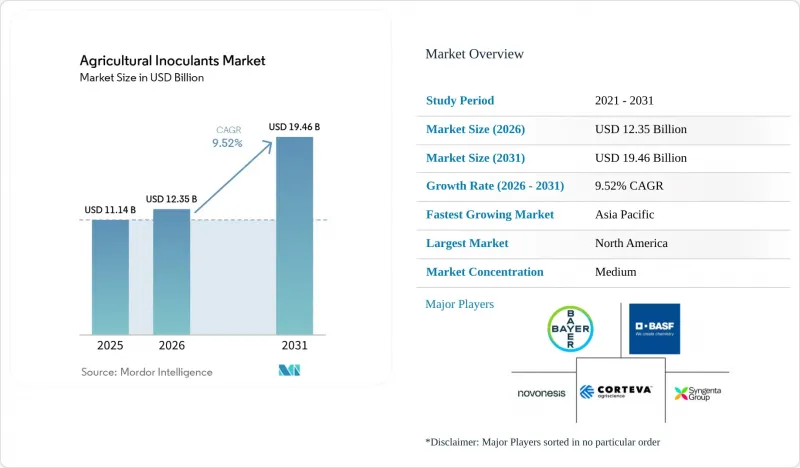
Mordor Intelligence에 의하면, 농업용 접종제 시장 규모는 2025년 111억 4,000만 달러로 평가되었습니다. 2026년에는 123억 5,000만 달러로 확대되어 2026년부터 2031년에 걸쳐 CAGR 9.52%로 성장을 지속하여, 2031년에는 194억 6,000만 달러에 이를 것으로 예측됩니다.
본 보고서는 기능별(작물 영양제 및 생물 방제제), 미생물별(세균, 균류, 바이러스), 시용 방법별(종자 처리, 토양 처리, 엽면 살포), 작물 유형(곡물·밀류, 유지종자, 상업 작물 등), 제형(액체·건조), 지역(북미, 아시아태평양, 남미 등)별로 분류되어 있습니다. 예상치는 금액(달러)으로 표시되어 있습니다.
세계의 농업용 접종제 시장 동향 및 인사이트
유기농지의 확대와 잔류물이 없는 식품에 대한 수요
농업용 접종제 시장은 유기농업의 확대와 세계 식품 밸류체인 내 잔류 기준의 강화에 힘입어 성장하고 있습니다. 유럽연합(EU) 및 북미의 소비자들은 잔류물이 최소화 된 농산물을 점점 더 선호하고 있으며, 이는 생물 유래 작물 투입 자재의 도입을 촉진하고 있습니다. 이러한 추세는 고부가가치 과일 및 채소에 그치지 않고 대규모 밭작물 분야로도 확대되고 있습니다. 2025년, 유럽연합 집행위원회의 바이오경제 프레임워크에서는 바이오 비료 및 생물학적 식물 보호 제품이 전략적 우선 과제로 지정되었으며, 농업 지속가능성 이니셔티브에 이를 통합하는 것이 추진되었습니다. 생산자에게 있어 제품을 ‘잔류물 제로’로 포지셔닝하는 것은 시장 접근성을 확대하고, 규정 준수를 중시하는 판매 채널에서 가격 안정성을 확보하는 데 기여하며, 그 결과 지속가능성에 중점을 둔 용도를 넘어 접종제의 상업적 중요성을 높이고 있습니다.
합성 자재의 가격 변동을 상쇄하기 위한 바이오 비료 도입
또한, 농가들이 비료 가격 변동에 대한 의존도를 낮추고 양분 이용 효율을 높이기 위해 미생물 영양제를 도입함에 따라 농업용 접종제 시장도 확대되고 있습니다. 많은 농장에서는 합성 비료를 완전히 대체하는 것이 아니라, 기존의 양분 관리 시스템 내에서 질소 고정 및 인 흡수를 촉진하기 위해 접종제를 도입하고 있습니다. 이러한 접근 방식은 비료 수입에 의존하는 농업 경제에서 특히 중요하며, 이러한 경제에서는 투입 비용의 변동이 농장의 수익성에 큰 영향을 미칠 수 있습니다. 『Plants』지에 게재된 연구에 따르면, 브라질의 일부 대두 재배 지역에서 Bradyrhizobium 속과 Azospirillum brasilense를 병용하여 접종한 결과, 요소를 대체함으로써 비용이 대폭 절감되고 직접적인 수익성이 향상된 것으로 나타났습니다. 이 발견은 생산자들이 이러한 제품을 효과적인 경제적 수단으로 여기는 이유를 여실히 보여주고 있습니다. 또한, 이 연구에서는 접종제가 단순한 기존 비료의 대체재가 아니라, 통합적인 영양 관리 프로그램의 일환으로 채택되고 있다는 점도 밝혀졌습니다. 그 결과, 농업용 접종제 시장은 투입 비용 절감과 수익성 향상이라는 두 가지 이점을 모두 누리고 있습니다.
토양 및 기후 조건에 따른 성능의 편차
미생물의 활성은 토양 온도, 수분, pH, 재배 이력, 토착 미생물 군집 등의 요인에 크게 좌우되기 때문에 성능의 편차는 여전히 농업용 접종제 시장에 있어 큰 과제로 남아 있습니다. 그 결과, 특히 대규모 농업 경영이나 변동이 심한 환경 조건에서는 접종제가 합성 비료에 비해 밭에서 일관된 성능을 발휘하지 못하는 경우가 종종 있습니다. 산업 미생물학의 연구 결과에 따르면, 접종제의 유효성은 여전히 환경 조건, 운반체 설계 및 살포 후의 생존 조건에 따라 큰 영향을 받는 것으로 밝혀졌습니다. 생산자들은 확실한 계획 수립을 위해 예측 가능한 투입 효과를 원하기 때문에 이러한 변동성은 신뢰의 격차로 이어지고 있습니다. 더 정확한 밭별 권장 사항이 제시되지 않는 한, 농업용 접종제 시장은 결과의 편차가 발생하기 쉬운 기후나 토양 조건을 가진 지역에서 계속해서 도입에 대한 주저함에 직면할 가능성이 높습니다.
부문별 분석
2025년에는 생물 방제제가 58.1%라는 가장 높은 시장 점유율을 차지하며, 기능별 카테고리 전체에서 농업용 접종제 시장에 가장 크게 기여했습니다. 이러한 우위는 주요 해충 방제 체계에서 합성 농약에 대한 내성이 증가하고, 주요 작물 시장에서 특정 화학 활성 성분에 대한 규제가 강화된 데 기인합니다. 농업용 접종제 시장은 다른 생물학적 제품군에 비해 잘 구축된 상업적 인프라의 혜택을 받고 있기 때문에 계속해서 생물학적 방제제에 의존하고 있습니다. BASF SE, Valent BioSciences LLC, Koppert Biological Systems B.V. 등의 기업들은 이 부문에서 탄탄한 생물학적 해충 방제 제품 포트폴리오를 구축하고 있으며, 전 세계적인 공급 능력과 유통업체의 신뢰를 확보하고 있습니다.
작물 영양 분야는 가장 빠르게 성장하고 있는 분야로, 2031년까지 연평균 성장률(CAGR) 5.1%로 확대될 것으로 전망됩니다. 이러한 성장은 생산자들이 영양 효율을 높이기 위해 노력하는 태도에서 나타난 광범위한 변화를 반영하고 있습니다. 농업용 접종제 시장에서 바이오 자극제는 단순한 선택적 식물 건강 보조제라기보다는 영양분 흡수를 높이고 스트레스를 관리하기 위한 실용적인 도구로서 점점 더 많이 판매되고 있습니다. 이러한 변화는 농업 전문가들이 바이오 자극제를 저비료 프로그램에 통합할 수 있게 되었으며, 농가에 기존 시스템을 완전히 대체할 것을 요구하지 않게 되었다는 점에서 매우 중요합니다. 2026년 3월, BASF SE는 AgBiTech Group 인수를 완료했습니다. 이는 주요 농업 자재 기업들이 생명공학을 자사의 포트폴리오 전략 및 장기 성장 계획에 통합하는 데 점점 더 주력하고 있음을 보여줍니다. 그 결과, 성숙한 생물 방제 플랫폼이 계속해서 수익의 기반을 이루고 있는 한편, 농업용 접종제 시장에서는 영양에 중점을 둔 제품의 성장이 가속화되고 있습니다.
2025년에는 박테리아가 43.4%라는 가장 높은 시장 점유율을 차지했으며, 미생물 유형별로 볼 때 농업용 접종제 시장에서 가장 중요한 부문이 되었습니다. 이러한 우위는 질소 고정, 영양분 동원 및 식물 성장 촉진에 활용되는 Bradyrhizobium, Azospirillum brasilense, Bacillus subtilis 등의 균주가 오랫동안 상업적으로 이용되어 온 데 기인합니다. 농업용 접종제 시장에서 박테리아 제품은 확립된 등록 절차와 대두, 콩류, 곡물 재배 시스템에서의 광범위한 적용이라는 장점을 가지고 있습니다. 남미는 이 부문에서 매우 중요한 역할을 하고 있는데, 이는 뿌리혹박테리아 제품이 콩과 작물의 생산 및 대두 재배의 경제적 타당성과 밀접한 관련이 있기 때문입니다. 곰팡이계 접종제도, 특히 원예 및 토양 전염병 관리에 있어 중요한 역할을 하고 있지만, 지역을 불문하고 세균계 제품이 여전히 가장 폭넓은 상업적 기반을 제공합니다.
바이러스는 미생물 분야에서 가장 빠르게 성장하고 있는 부문으로, 2031년까지 연평균 성장률(CAGR)이 8.0%를 나타낼 것으로 전망됩니다. 이러한 성장은 방제가 어려운 나비목 해충 관리를 위한 뉴클레오폴리헤드로바이러스 기술의 도입 확대에 힘입어 이루어지고 있습니다. 생산 경제성 향상과 밭에서의 실증 연구가 진행되면서 바이러스 기반 해충 방제의 규모 확대가 가능해짐에 따라, 농업용 접종제 시장에서 이 부문에 대한 관심이 높아지고 있습니다.
지역별 분석
북미는 2025년 농업용 접종제 시장 점유율의 32.1%를 차지하며, 계속해서 가장 큰 기여를 한 지역이 되었습니다. 이는 강력한 소매 네트워크, 첨단 농업 자문 시스템, 그리고 대두와 옥수수 생산 분야에서 높은 도입률이 뒷받침하고 있습니다. 미생물 제품이 종자 처리, 작물 보호 및 지속가능성에 중점을 둔 농업 프로그램과 효율적으로 통합됨에 따라, 미국은 계속해서 지역 수요를 주도하고 있습니다. 2025년, Pivot Bio, Inc.는 자사의 ‘N-OVATOR’ 프로그램과 콘벨트 전역에 걸친 소매 파트너십 확대를 통해 도입을 더욱 촉진했습니다. 이를 통해 농장의 생산성과 환경 성과 모두를 향상시키는 데 있어 생물학적 투입물이 수행하는 역할이 더욱 강화되었습니다.
아시아태평양은 2031년까지 연평균 성장률(CAGR)이 6.8%를 나타낼 것으로 예측되며, 가장 빠르게 성장하는 지역 부문입니다. 이러한 성장은 비료 비용 부담, 생물 유래 자재에 대한 정부의 지원, 그리고 농업 보급 프로그램의 확대에 힘입어 이루어지고 있습니다. 인도는 규제 체계가 정비됨에 따라 생물 유래 제품의 상업화 기준이 향상되고 있어, 계속해서 중요한 성장 시장으로 자리매김하고 있습니다. 2024년 9월, Novonesis A/S는 Krishak Bharati Cooperative Limited(KRIBHCO)와의 제휴를 통해 인도의 주요 작물을 대상으로 균근성 바이오 비료를 판매하며, 해당 지역에서의 입지를 강화했습니다. 호주 역시 정밀 농업의 도입 확대를 통해 해당 지역의 성장을 뒷받침하고 있습니다.
유럽은 농업용 접종제 시장에 있어 여전히 중요한 시장이지만, 미생물을 규제하는 현재의 유럽연합(EU) 규정으로 인해 성장이 일부 제약을 받고 있습니다. 유럽연합 집행위원회의 규제 재검토가 진행 중이며, 승인된 미생물 제품 목록이 점차 확대될 가능성이 있습니다. 남미는 여전히 주요 성장 지역이며, 특히 브라질에서는 대규모 대두 재배와 비료 수입에 대한 의존도가 생물 유래 자재 수요 증가를 이끌고 있습니다. 중동 및 아프리카는 여전히 소규모 시장이지만, 그동안 도입률이 낮았던 만큼, 특히 콩과 작물의 생산 시스템 분야에서 새로운 유통 및 자문 모델을 통한 성장 여지가 있어 업계의 관심이 높아지고 있습니다.
기타 혜택 :
- 엑셀 형식 시장 예측(ME) 시트
- 3개월간의 애널리스트 지원
자주 묻는 질문
목차
제1장 서론
제2장 조사 방법
제3장 주요 요약
제4장 시장 구도
제5장 시장 규모 및 성장 예측
제6장 경쟁 구도
제7장 시장 기회 및 향후 전망
KTH 26.06.29According to Mordor Intelligence, the agricultural inoculants market size is projected to grow from USD 11.14 billion in 2025 to USD 12.35 billion in 2026 and is forecast to reach USD 19.46 billion by 2031 at 9.52% CAGR over 2026-2031.
This report is Segmented by Function (Crop Nutrition and Biocontrol Agents), Microorganism (Bacteria, Fungi, and Viruses), Mode of Application (Seed Treatment, Soil Treatment, and Foliar Spray), Crop Type (Grains and Cereals, Oilseeds, Commercial Crops, and More), Formulation (Liquid and Dry), and Geography (North America, Asia-Pacific, South America, and More). Forecasts are in Terms of Value (USD).
Global Agricultural Inoculants Market Trends and Insights
Organic Acreage Expansion and Residue-Free Food Demand
The agricultural inoculants market is experiencing growth due to the expansion of organic farming and stricter residue standards in global food supply chains. Consumers in the European Union and North America are increasingly demanding agricultural products with minimal residues, driving the adoption of biological crop inputs. This trend is extending beyond high-value fruits and vegetables to include large-scale field crops. In 2025, the European Commission's bioeconomy framework identified bio-based fertilizers and biological plant-protection products as strategic priorities, promoting their integration into agricultural sustainability initiatives. For growers, positioning products as residue-free enhances market access and ensures pricing stability in compliance-driven sales channels, thereby strengthening the commercial importance of inoculants beyond sustainability-focused applications.
Biofertilizer Adoption to Offset Synthetic Input Cost Volatility
The agricultural inoculants market is also growing as farmers adopt microbial nutrition products to reduce dependence on volatile fertilizer prices and improve nutrient-use efficiency. Instead of completely replacing synthetic fertilizers, many farms are incorporating inoculants to enhance nitrogen fixation and phosphorus uptake within conventional nutrient-management systems. This approach is particularly significant in fertilizer-import-dependent agricultural economies, where input-cost fluctuations can heavily impact farm profitability. A study published in Plants demonstrated that co-inoculation with Bradyrhizobium species and Azospirillum brasilense in certain regions of Brazil's soybean cultivation resulted in significant savings in urea replacement and direct profitability gains. This finding highlights why growers consider these products as effective economic tools. The same study also shows that inoculants are being adopted as part of integrated nutrient programs rather than as simple substitutes for conventional fertilizers. As a result, the Agricultural inoculants market is benefiting from both input cost discipline and better return visibility.
Performance Variability Across Soil and Climate Conditions
Performance variability remains a significant challenge for the agricultural inoculants market, as microbial activity is highly dependent on factors such as soil temperature, moisture, pH, crop history, and native microbial populations. Consequently, inoculants often exhibit inconsistent field performance compared to synthetic inputs, particularly in large-scale farming operations and under varying environmental conditions. Industrial microbiology highlights that the efficacy of inoculants remains significantly influenced by environmental conditions, carrier design, and post-application survival conditions. This variability contributes to a trust gap, as growers seek predictable input responses for reliable planning. Without more precise field recommendations, the agricultural inoculants market is likely to continue to face hesitation in regions with climates and soils that yield inconsistent results.
Other drivers and restraints analyzed in the detailed report include:
- Policy Support for Biologicals and Lower-Residue Crop Protection
- Seed Treatment Adoption to Improve Application Precision
- Farmer Preference for Fast-Acting Synthetic Alternatives
For complete list of drivers and restraints, kindly check the Table Of Contents.
Segment Analysis
Biocontrol agents accounted for the largest market share at 58.1% in 2025, making the most significant contribution to the agricultural inoculants market across functional categories. This dominance is attributed to increasing resistance to synthetic pesticides in key pest systems and stricter regulations on certain chemically active ingredients in major crop markets. The agricultural inoculants market continues to rely on biocontrol agents, as they benefit from a well-established commercial infrastructure compared to other biological categories. Companies such as BASF SE, Valent BioSciences LLC, and Koppert Biological Systems B.V. operate in this segment with robust biological pest management portfolios, ensuring global supply capabilities and distributor confidence.
Crop nutrition is the fastest-growing function, projected to expand at a CAGR of 5.1% through 2031. This growth reflects a broader shift in how growers approach nutrient efficiency. In the agricultural inoculants market, biostimulants are increasingly marketed as practical tools for enhancing nutrient uptake and managing stress, rather than as optional plant health supplements. This shift is significant as agronomists can now integrate biostimulants into reduced-rate fertilizer programs, rather than requiring farmers to completely replace conventional systems. In March 2026, BASF SE completed the acquisition of AgBiTech Group, emphasizing the growing focus of major crop input companies on integrating biological technologies into their portfolio strategies and long-term growth plans. Consequently, while mature biocontrol platforms continue to anchor revenue, nutrition-focused products are growing faster in the agricultural inoculants market.
Bacteria accounted for the largest market share in 2025, at 43.4%, representing the most significant segment of the agricultural inoculants market by microorganism. This dominance is attributed to the long-standing commercial use of strains such as Bradyrhizobium, Azospirillum brasilense, and Bacillus subtilis, which are utilized for nitrogen fixation, nutrient mobilization, and plant growth enhancement. In the agricultural inoculants market, bacterial products benefit from established registration processes and widespread application in soybean, pulse, and cereal systems. South America plays a critical role in this segment, as rhizobial products are closely linked to legume production and the economic viability of soybean cultivation. While fungal inoculants are also significant, particularly in horticulture and soil-borne disease management, bacteria continue to provide the broadest commercial base across regions.
Viruses represent the fastest-growing segment of microorganisms, with a projected CAGR of 8.0% through 2031. This growth is driven by the increasing adoption of nucleopolyhedrovirus technologies for managing challenging lepidopteran pests. The agricultural inoculants market is focusing more on this segment as advancements in production economics and field validation make virus-based pest control more scalable.
Geography Analysis
North America held 32.1% of the agricultural inoculants market share in 2025 and remained the largest regional contributor. Strong retailer networks, advanced agronomic advisory systems, and high adoption across soybean and corn production supported this. The United States continues to lead regional demand as microbial products integrate efficiently with seed treatment, crop protection, and sustainability-focused farming programs. In 2025, Pivot Bio, Inc. further expanded adoption through its N-OVATOR program and broader retail partnerships across the Corn Belt. This reinforced the role of biological inputs in improving both farm productivity and environmental performance.
Asia-Pacific is the fastest regional segment with a projected 6.8% CAGR through 2031. This growth is driven by fertilizer cost pressures, government support for biological inputs, and expanding agronomic extension programs. India remains a key growth market as regulatory formalization improves commercialization standards for biological products. In September 2024, Novonesis A/S strengthened its regional presence through its partnership with Krishak Bharati Cooperative Limited (KRIBHCO) to distribute mycorrhizal biofertilizers across major Indian crops. Australia also supports regional growth by increasing the adoption of precision agriculture.
Europe remains an important market for agricultural inoculants, although growth is partly constrained by current European Union regulations governing microorganisms. Ongoing regulatory reviews by the European Commission may gradually expand the list of approved microbial products. South America continues to be a major growth region, particularly in Brazil, where large-scale soybean cultivation and reliance on fertilizer imports are driving rising demand for biological inputs. The Middle East and Africa remain smaller markets but are attracting increasing industry attention because lower historical adoption leaves room for expansion through new distribution and advisory models, particularly in legume production systems.
- BASF SE
- Bayer AG
- Novonesis A/S
- Corteva, Inc.
- Syngenta Group Co., Ltd.
- Valent BioSciences LLC
- Premier Tech Ltd.
- Lallemand Inc.
- Bioceres Crop Solutions Corp.
- Verdesian Life Sciences LLC
- Groundwork BioAg Ltd.
- Pivot Bio, Inc.
- Koppert Biological Systems B.V.
- XiteBio Technologies Inc.
Additional Benefits:
- The market estimate (ME) sheet in Excel format
- 3 months of analyst support
TABLE OF CONTENTS
1 Introduction
- 1.1 Study Assumptions and Market Definition
- 1.2 Scope of the Study
2 Research Methodology
3 Executive Summary
4 Market Landscape
- 4.1 Market Overview
- 4.2 Market Drivers
- 4.2.1 Organic acreage expansion and residue-free food demand
- 4.2.2 Biofertilizer adoption to offset synthetic input cost volatility
- 4.2.3 Policy support for biologicals and lower-residue crop protection
- 4.2.4 Seed treatment adoption to improve application precision
- 4.2.5 On-farm compatibility demand for integrated biological programs
- 4.2.6 Shelf-life gains from formulation and encapsulation innovation
- 4.3 Market Restraints
- 4.3.1 Performance variability across soil and climate conditions
- 4.3.2 Farmer preference for fast-acting synthetic alternatives
- 4.3.3 Registration complexity for multi-strain microbial products
- 4.3.4 Cold-chain and contamination risk in microbe distribution
- 4.4 Regulatory Landscape
- 4.5 Technological Outlook
- 4.6 Porter's Five Forces Analysis
- 4.6.1 Bargaining Power of Suppliers
- 4.6.2 Bargaining Power of Buyers
- 4.6.3 Threat of New Entrants
- 4.6.4 Threat of Substitutes
- 4.6.5 Intensity of Competitive Rivalry
5 Market Size and Growth Forecasts (Value)
- 5.1 By Function
- 5.1.1 Crop Nutrition
- 5.1.2 Biocontrol Agents
- 5.2 By Microorganism
- 5.2.1 Bacteria
- 5.2.1.1 Bacillus
- 5.2.1.2 Azotobacter
- 5.2.1.3 Rhizobium and Bradyrhizobium
- 5.2.1.4 Phosphate-solubilizing bacteria
- 5.2.2 Fungi
- 5.2.2.1 Trichoderma
- 5.2.2.2 Mycorrhiza
- 5.2.2.3 Beauveria bassiana
- 5.2.2.4 Metarhizium anisopliae
- 5.2.3 Viruses
- 5.2.1 Bacteria
- 5.3 By Mode of Application
- 5.3.1 Seed Treatment
- 5.3.2 Soil Treatment
- 5.3.3 Foliar Spray
- 5.4 By Crop Type
- 5.4.1 Grains and Cereals
- 5.4.2 Pulses and Oilseeds
- 5.4.3 Commercial Crops
- 5.4.4 Fruits and Vegetables
- 5.4.5 Other Applications
- 5.5 By Formulation
- 5.5.1 Liquid
- 5.5.2 Dry
- 5.6 By Geography
- 5.6.1 North America
- 5.6.1.1 United States
- 5.6.1.2 Canada
- 5.6.1.3 Mexico
- 5.6.1.4 Rest of North America
- 5.6.2 Europe
- 5.6.2.1 Germany
- 5.6.2.2 United Kingdom
- 5.6.2.3 France
- 5.6.2.4 Spain
- 5.6.2.5 Italy
- 5.6.2.6 Russia
- 5.6.2.7 Rest of Europe
- 5.6.3 Asia-Pacific
- 5.6.3.1 China
- 5.6.3.2 Japan
- 5.6.3.3 India
- 5.6.3.4 Australia
- 5.6.3.5 Rest of Asia-Pacific
- 5.6.4 South America
- 5.6.4.1 Brazil
- 5.6.4.2 Argentina
- 5.6.4.3 Rest of South America
- 5.6.5 Middle East
- 5.6.5.1 Saudi Arabia
- 5.6.5.2 United Arab Emirates
- 5.6.5.3 Rest of Middle East
- 5.6.6 Africa
- 5.6.6.1 South Africa
- 5.6.6.2 Kenya
- 5.6.6.3 Rest of Africa
- 5.6.1 North America
6 Competitive Landscape
- 6.1 Market Concentration
- 6.2 Strategic Moves
- 6.3 Market Share Analysis
- 6.4 Company Profiles (Includes Global Level Overview, Market Level Overview, Core Segments, Financials as Available, Strategic Information, Market Rank/Share, Products and Services, and Recent Developments)
- 6.4.1 BASF SE
- 6.4.2 Bayer AG
- 6.4.3 Novonesis A/S
- 6.4.4 Corteva, Inc.
- 6.4.5 Syngenta Group Co., Ltd.
- 6.4.6 Valent BioSciences LLC
- 6.4.7 Premier Tech Ltd.
- 6.4.8 Lallemand Inc.
- 6.4.9 Bioceres Crop Solutions Corp.
- 6.4.10 Verdesian Life Sciences LLC
- 6.4.11 Groundwork BioAg Ltd.
- 6.4.12 Pivot Bio, Inc.
- 6.4.13 Koppert Biological Systems B.V.
- 6.4.14 XiteBio Technologies Inc.


