

|
시장보고서
상품코드
2066461
아프리카의 쌀 시장 : 시장 점유율 분석, 업계 동향 및 통계, 성장 예측(2026-2031년)Africa Rice - Market Share Analysis, Industry Trends & Statistics, Growth Forecasts (2026 - 2031) |
||||||
 Mordor Intelligence
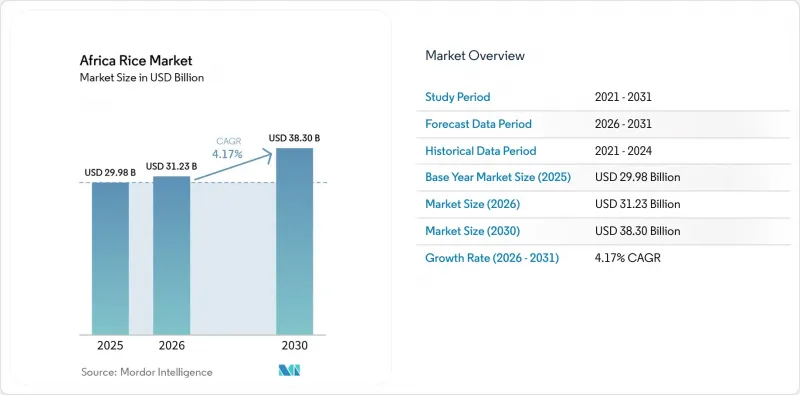
Mordor Intelligence에 의하면, 아프리카의 쌀 시장 규모는 2025년 299억 8,000만 달러로 평가되었고, 2026년에는 312억 3,000만 달러로 추정되고, 2026-2031년 CAGR 4.17%로 성장을 지속할 전망이며, 2031년까지 383억 달러에 이를 것으로 예측됩니다.
본 보고서는 지역별(나이지리아, 탄자니아, 코트디부아르 등)로 분류되어 있습니다. 본 보고서에는 생산 분석(수량), 소비 분석(금액 및 수량), 수입 분석(금액 및 수량), 수출 분석(금액 및 수량), 도매 가격 동향 분석 및 전망, 규제 체계 등이 포함되어 있습니다. 시장 전망은 금액(달러) 및 수량(미터톤) 단위로 제시되어 있습니다.
아프리카의 쌀 시장 동향 및 인사이트
도시 지역의 고칼로리 주식에 대한 수요가 급증
2020-2025년 아프리카의 메가시티에서 가처분 소득은 꾸준히 증가했으며, 라고스의 고소득 가구에서는 같은 기간 동안 식비 예산에서 쌀이 차지하는 비중이 증가했습니다. 파보일드 쌀이 주류를 이루고 있는 이유는 습도가 높은 보관 환경에서도 견딜 수 있고, 제한된 전력으로도 짧은 시간 내에 조리할 수 있어, 편의성을 중시하는 식생활에서 대표적인 곡물로 자리 잡았기 때문입니다. 아비장, 다르에스살람, 아크라에서 50킬로미터 반경 내에 위치한 정미 능력은 2024년부터 2025년에 걸쳐 대폭 확대되어, 반입 물류 비용을 최대 14% 절감했습니다. 따라서, 수거, 가공, 브랜드 유통을 총괄하는 통합형 사업자는 공급의 안정성과 높은 이익률을 모두 확보하고 있습니다. 연말연시 시즌에 소매 수요가 급증함에 따라, 가공업체들은 처리량의 계절적 변동을 완화하기 위해 사일로 저장 시설을 건설하기 시작했습니다. 안정적인 현금 흐름이 신용 위험을 줄여주기 때문에 금융기관들은 이러한 수직 통합형 모델을 점점 더 선호하고 있습니다.
소규모 중력식 및 태양광 발전식 관개 시스템의 확대
1세트당 약 800-1,200달러 상당의 독립형 태양광 펌프를 통해 탄자니아의 소규모 농가들은 건기에 두 번째 벼농사를 지을 수 있게 되었으며, 농가당 연간 생산량이 증가하고 있습니다. ‘페이-어즈-유-고(Pay-as-you-go)’ 방식의 자금 조달을 통해 자본 비용을 장기간에 걸쳐 분산할 수 있기 때문에 이러한 키트를 활용해 소규모 구획에 관개를 실시함으로써, 기존에는 빗물에 의존하던 밭을 상업용 농지로 전환하는 것이 가능해졌습니다. 말리의 니제르강 유역에서는 새로운 중력식 용수관이 가동을 시작하면서 디젤 연료비가 절감되고 톤당 생산 비용이 낮아짐에 따라, 이 지역은 아프리카 대륙에서 가장 경쟁력이 있는 지역 중 하나가 되었습니다. 이러한 인프라 확충을 통해 불안정한 강우로 인한 수확량 편차가 크게 줄어들었고, 농가들이 고부가가치 종자나 기계화에 투자할 자신감이 높아지고 있습니다. 그 결과, 관개 면적은 농업 자재 소매업체, 기계화 서비스 제공업체 및 소액금융 업체에게 대상 시장을 확대하기 위한 기반이 되고 있습니다. 이러한 시너지 효과로 인해 판매량과 비용 경쟁력 모두 향상되어, 아프리카 쌀 시장의 중기적인 성장 궤도가 강화되고 있습니다.
미비한 건조 및 저장 시스템으로 인한 수확 후 손실
사하라 이남 아프리카 전역에서 수확된 벼의 15%에서 18%가 정미소에 도착하기도 전에 품질이 저하되고 있습니다. 타포린 위에서 햇볕에 말리면 습기에 노출되는 시간이 길어지며, 우기에는 수분 함량이 14% 이상으로 유지되는 경우가 많아 곰팡이와 아플라톡신 발생을 초래합니다. 그 때문에 정미업자들은 이러한 벼의 가격을 최대 20%까지 인하하고 있으며, 이로 인해 농가의 소득이 잠식되고, 수확량 향상에 기여하는 생산자재에 대한 투자 의욕이 꺾이고 있습니다. 폴리프로필렌으로 만든 직물 자루는 곤충이나 설치류의 피해를 입기 쉬우며, 2025년 나이지리아 북부에서 실시된 조사에 따르면 저장된 쌀의 23%가 6주 이내에 품질이 저하된 것으로 밝혀졌습니다. 기밀성이 뛰어난 봉투나 기계식 건조기를 사용하면 손실을 한 자릿수 수준으로 억제할 수 있지만, 자산 대출에 따른 이자 부담을 안고 있는 대다수의 소규모 농가에게는 여전히 감당하기 어려운 가격입니다. 협동조합 소유 모델은 농가 1곳당 비용을 절감해 주지만, 수많은 소규모 생산자 그룹에 부족한 강력한 거버넌스가 필요합니다. 저렴한 가격의 수확 후 기술이 보급되기 전까지는 아프리카 쌀 시장이 잠재 공급량의 상당 부분을 잃게 되어 성장이 둔화될 것입니다.
기타 혜택 :
- 엑셀 형식 시장 예측(ME) 시트
- 3개월간의 애널리스트 지원
자주 묻는 질문
목차
제1장 서론
제2장 조사 방법
제3장 주요 요약
제4장 시장 구도
제5장 시장 세분화
제6장 최종 용도 및 산업
제7장 경쟁 구도
제8장 시장 기회 및 향후 동향
AJY 26.06.24According to Mordor Intelligence, the africa rice market size is projected to grow from USD 29.98 billion in 2025 to USD 31.23 billion in 2026 and is forecast to reach USD 38.30 billion by 2031 at a 4.17% CAGR over 2026-2031.
This report is Segmented by Geography (Nigeria, Tanzania, Cote D'Ivoire, and More). The Report Includes Production Analysis (Volume), Consumption Analysis (Value and Volume), Import Analysis (Value and Volume), Export Analysis (Value and Volume), Wholesale Price Trend Analysis and Forecast, Regulatory Framework, and More. The Market Forecasts are Provided in Terms of Value (USD) and Volume (Metric Tons).
Africa Rice Market Trends and Insights
Exploding Urban Demand for Calorie-dense Staples
Disposable incomes in Africa's megacities climbed steadily between 2020 and 2025, and higher-income households in Lagos increased the share of their food budgets allocated to rice over the period. Parboiled formats dominate because they tolerate humid storage conditions and cook quickly on limited electricity, making them the default grain in convenience-driven diets. Milling capacity located within 50 kilometers of Abidjan, Dar es Salaam, and Accra expanded significantly between 2024 and 2025, trimming inbound logistics costs by up to 14%. Integrated operators that control aggregation, processing, and branded distribution, therefore secure both supply stability and higher margins. Retail demand spikes during festive seasons have prompted processors to build silo storage for de-seasonalizing throughput. Financiers increasingly favor such vertically integrated models because consistent cash flow reduces credit risk.
Expansion of Small-scale Gravity and Solar Irrigation Schemes
Off-grid solar pumps costing about USD 800 to USD 1,200 per kit enable Tanzanian smallholders to cultivate a second rice crop during the dry season, lifting annual farm output per holding. Pay-as-you-go financing distributes capital costs over time, enabling the kits to irrigate small plot sizes and transform previously rain-fed fields into commercial farmland. In Mali's Office du Niger, additional gravity-fed canals came online, eliminating diesel expenses and lowering per-ton production costs, placing the region among the continent's most competitive benchmarks. These infrastructure upgrades sharply reduce yield variability linked to erratic rainfall, boosting farmer confidence to invest in higher-value seed and mechanization. Irrigated acreage thus serves as a platform for input retailers, mechanization service providers, and micro-lenders to expand their addressable market. The combined effect enhances the medium-term growth trajectory of the Africa rice market by improving both volumes and cost competitiveness.
Post-harvest Losses from Rudimentary Drying and Storage Systems
Across sub-Saharan Africa, 15% to 18% of harvested paddy spoils before reaching mills. Sun-drying on tarpaulins prolongs exposure to humidity, moisture content often remains above 14% during rainy months, enabling mold and aflatoxin. Millers accordingly discount such paddy by up to 20%, eroding farm income and discouraging investment in yield-enhancing inputs. Woven polypropylene bags permit insect and rodent damage, a 2025 survey in northern Nigeria found 23% of stored paddy downgraded in less than six weeks. Hermetic bags and mechanical dryers could cut losses to single digits but remain unaffordable for most smallholders who face interest rates on asset-finance loans. Cooperative ownership models lower per-farmer cost, yet require strong governance that many fragmented producer groups lack. Until affordable post-harvest technology scales, the Africa rice market forfeits a significant share of potential supply, dampening growth.
Other drivers and restraints analyzed in the detailed report include:
- African Continental Free Trade Area (AfCFTA) Tariff Cuts Accelerating Intra-Africa Paddy Trade
- Public Fertilizer and Seed Subsidy Programs Reviving Yields
- Domestic Cost of Production still above Asian Import Parity
For complete list of drivers and restraints, kindly check the Table Of Contents.
Additional Benefits:
- The market estimate (ME) sheet in Excel format
- 3 months of analyst support
TABLE OF CONTENTS
1 Introduction
- 1.1 Study Assumptions and Market Definition
- 1.2 Scope of the Study
2 Research Methodology
3 Executive Summary
4 Market Landscape
- 4.1 Market Overview
- 4.2 Market Drivers
- 4.2.1 Exploding Urban Demand for Calorie-dense Staples
- 4.2.2 Expansion of Small-scale Gravity and Solar Irrigation Schemes
- 4.2.3 African Continental Free Trade Area (AfCFTA) Tariff Cuts Accelerating Intra-Africa Paddy Trade
- 4.2.4 Public Fertilizer and Seed Subsidy Programs Reviving Yields
- 4.2.5 Adoption of Flood-tolerant, Early-maturing Rice Genetics
- 4.2.6 Monetising Paddy-methane Abatement via Voluntary Carbon Credits
- 4.3 Market Restraints
- 4.3.1 Post-harvest Losses from Rudimentary Drying and Storage Systems
- 4.3.2 Domestic Cost of Production still above Asian Import Parity
- 4.3.3 Currency and Diesel-price Volatility Squeezing Milling Margins
- 4.3.4 Land-tenure Insecurity Limiting Long-term On-farm Investment
- 4.4 Opportunities
- 4.5 Challenges
- 4.6 Value Chain Analysis
- 4.7 Technologies and Usage of AI in the Industry
- 4.8 Input Market Analysis
- 4.8.1 Seeds
- 4.8.2 Fertilizers
- 4.8.3 Crop Protection Chemicals
- 4.9 Distribution Channel Analysis
- 4.10 Market Sentiment Analysis
- 4.11 PESTLE Analysis
5 Market Segmentation
- 5.1 Geography
- 5.1.1 Nigeria
- 5.1.1.1 Production Analysis (Area Harvested, Yield, and Production Volume)
- 5.1.1.2 Consumption Analysis (Consumption Value and Volume)
- 5.1.1.3 Import Market Analysis (Import Value, Volume, and Key Supplying Markets)
- 5.1.1.4 Export Market Analysis (Export Value, Volume, and Key Destination Markets)
- 5.1.1.5 Wholesale Price Trend Analysis and Forecast
- 5.1.1.6 Regulatory Framework
- 5.1.1.7 List of Key Players
- 5.1.1.8 Logistics and Infrastructure
- 5.1.1.9 Seasonality Analysis
- 5.1.2 Tanzania
- 5.1.2.1 Production Analysis (Area Harvested, Yield, and Production Volume)
- 5.1.2.2 Consumption Analysis (Consumption Value and Volume)
- 5.1.2.3 Import Market Analysis (Import Value, Volume, and Key Supplying Markets)
- 5.1.2.4 Export Market Analysis (Export Value, Volume, and Key Destination Markets)
- 5.1.2.5 Wholesale Price Trend Analysis and Forecast
- 5.1.2.6 Regulatory Framework
- 5.1.2.7 List of Key Players
- 5.1.2.8 Logistics and Infrastructure
- 5.1.2.9 Seasonality Analysis
- 5.1.3 Cote d'Ivoire
- 5.1.3.1 Production Analysis (Area Harvested, Yield, and Production Volume)
- 5.1.3.2 Consumption Analysis (Consumption Value and Volume)
- 5.1.3.3 Import Market Analysis (Import Value, Volume, and Key Supplying Markets)
- 5.1.3.4 Export Market Analysis (Export Value, Volume, and Key Destination Markets)
- 5.1.3.5 Wholesale Price Trend Analysis and Forecast
- 5.1.3.6 Regulatory Framework
- 5.1.3.7 List of Key Players
- 5.1.3.8 Logistics and Infrastructure
- 5.1.3.9 Seasonality Analysis
- 5.1.4 Madagascar
- 5.1.4.1 Production Analysis (Area Harvested, Yield, and Production Volume)
- 5.1.4.2 Consumption Analysis (Consumption Value and Volume)
- 5.1.4.3 Import Market Analysis (Import Value, Volume, and Key Supplying Markets)
- 5.1.4.4 Export Market Analysis (Export Value, Volume, and Key Destination Markets)
- 5.1.4.5 Wholesale Price Trend Analysis and Forecast
- 5.1.4.6 Regulatory Framework
- 5.1.4.7 List of Key Players
- 5.1.4.8 Logistics and Infrastructure
- 5.1.4.9 Seasonality Analysis
- 5.1.5 Mali
- 5.1.5.1 Production Analysis (Area Harvested, Yield, and Production Volume)
- 5.1.5.2 Consumption Analysis (Consumption Value and Volume)
- 5.1.5.3 Import Market Analysis (Import Value, Volume, and Key Supplying Markets)
- 5.1.5.4 Export Market Analysis (Export Value, Volume, and Key Destination Markets)
- 5.1.5.5 Wholesale Price Trend Analysis and Forecast
- 5.1.5.6 Regulatory Framework
- 5.1.5.7 List of Key Players
- 5.1.5.8 Logistics and Infrastructure
- 5.1.5.9 Seasonality Analysis
- 5.1.6 Ghana
- 5.1.6.1 Production Analysis (Area Harvested, Yield, and Production Volume)
- 5.1.6.2 Consumption Analysis (Consumption Value and Volume)
- 5.1.6.3 Import Market Analysis (Import Value, Volume, and Key Supplying Markets)
- 5.1.6.4 Export Market Analysis (Export Value, Volume, and Key Destination Markets)
- 5.1.6.5 Wholesale Price Trend Analysis and Forecast
- 5.1.6.6 Regulatory Framework
- 5.1.6.7 List of Key Players
- 5.1.6.8 Logistics and Infrastructure
- 5.1.6.9 Seasonality Analysis
- 5.1.7 Senegal
- 5.1.7.1 Production Analysis (Area Harvested, Yield, and Production Volume)
- 5.1.7.2 Consumption Analysis (Consumption Value and Volume)
- 5.1.7.3 Import Market Analysis (Import Value, Volume, and Key Supplying Markets)
- 5.1.7.4 Export Market Analysis (Export Value, Volume, and Key Destination Markets)
- 5.1.7.5 Wholesale Price Trend Analysis and Forecast
- 5.1.7.6 Regulatory Framework
- 5.1.7.7 List of Key Players
- 5.1.7.8 Logistics and Infrastructure
- 5.1.7.9 Seasonality Analysis
- 5.1.8 Cameroon
- 5.1.8.1 Production Analysis (Area Harvested, Yield, and Production Volume)
- 5.1.8.2 Consumption Analysis (Consumption Value and Volume)
- 5.1.8.3 Import Market Analysis (Import Value, Volume, and Key Supplying Markets)
- 5.1.8.4 Export Market Analysis (Export Value, Volume, and Key Destination Markets)
- 5.1.8.5 Wholesale Price Trend Analysis and Forecast
- 5.1.8.6 Regulatory Framework
- 5.1.8.7 List of Key Players
- 5.1.8.8 Logistics and Infrastructure
- 5.1.8.9 Seasonality Analysis
- 5.1.9 Guinea
- 5.1.9.1 Production Analysis (Area Harvested, Yield, and Production Volume)
- 5.1.9.2 Consumption Analysis (Consumption Value and Volume)
- 5.1.9.3 Import Market Analysis (Import Value, Volume, and Key Supplying Markets)
- 5.1.9.4 Export Market Analysis (Export Value, Volume, and Key Destination Markets)
- 5.1.9.5 Wholesale Price Trend Analysis and Forecast
- 5.1.9.6 Regulatory Framework
- 5.1.9.7 List of Key Players
- 5.1.9.8 Logistics and Infrastructure
- 5.1.9.9 Seasonality Analysis
- 5.1.10 Sierra Leone
- 5.1.10.1 Production Analysis (Area Harvested, Yield, and Production Volume)
- 5.1.10.2 Consumption Analysis (Consumption Value and Volume)
- 5.1.10.3 Import Market Analysis (Import Value, Volume, and Key Supplying Markets)
- 5.1.10.4 Export Market Analysis (Export Value, Volume, and Key Destination Markets)
- 5.1.10.5 Wholesale Price Trend Analysis and Forecast
- 5.1.10.6 Regulatory Framework
- 5.1.10.7 List of Key Players
- 5.1.10.8 Logistics and Infrastructure
- 5.1.10.9 Seasonality Analysis
- 5.1.11 Niger
- 5.1.11.1 Production Analysis (Area Harvested, Yield, and Production Volume)
- 5.1.11.2 Consumption Analysis (Consumption Value and Volume)
- 5.1.11.3 Import Market Analysis (Import Value, Volume, and Key Supplying Markets)
- 5.1.11.4 Export Market Analysis (Export Value, Volume, and Key Destination Markets)
- 5.1.11.5 Wholesale Price Trend Analysis and Forecast
- 5.1.11.6 Regulatory Framework
- 5.1.11.7 List of Key Players
- 5.1.11.8 Logistics and Infrastructure
- 5.1.11.9 Seasonality Analysis
- 5.1.12 South Africa
- 5.1.12.1 Production Analysis (Area Harvested, Yield, and Production Volume)
- 5.1.12.2 Consumption Analysis (Consumption Value and Volume)
- 5.1.12.3 Import Market Analysis (Import Value, Volume, and Key Supplying Markets)
- 5.1.12.4 Export Market Analysis (Export Value, Volume, and Key Destination Markets)
- 5.1.12.5 Wholesale Price Trend Analysis and Forecast
- 5.1.12.6 Regulatory Framework
- 5.1.12.7 List of Key Players
- 5.1.12.8 Logistics and Infrastructure
- 5.1.12.9 Seasonality Analysis
- 5.1.1 Nigeria
6 End Use Applications and Industries
- 6.1 Primary Applications and Emerging Applications
- 6.2 Consumption Breakdown by Industries
7 Competitive Landscape
- 7.1 Overview of the Competition
- 7.2 Recent Developments
- 7.3 Market Concentration Analysis


