

|
시장보고서
상품코드
2066475
합성가스 : 시장 점유율 분석, 업계 동향 및 통계, 성장 예측(2026-2031년)Syngas - Market Share Analysis, Industry Trends & Statistics, Growth Forecasts (2026 - 2031) |
||||||
 Mordor Intelligence
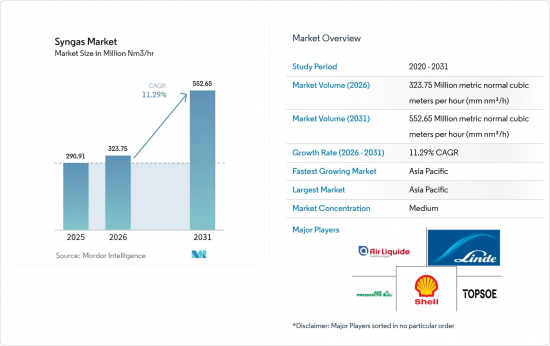
Mordor Intelligence에 의하면, 합성가스 시장 규모는 2025년 2억 9,091만 시학 표준 입방미터/시(mm nm3/h)로 평가되었습니다. 2026년에는 3억 2,375만 시학 표준 입방미터/시(mm nm3/h)에 달할것으로 예상되고 2031년에는 5억 5,265만 시학 표준 입방미터/시(mm nm3/h)에 이를 것으로 예측됩니다.
2026년부터 2031년에 걸쳐 연평균 성장률(CAGR) 11.29% 로 성장하여 2031년까지 552.65백만 메트릭 표준 입방미터/시간(mm nm³/h)에 달할 것으로 전망됩니다.
본 보고서는 원료(석탄, 천연가스 등), 기술(수증기 개질 및 가스화), 가스화로의 유형(고정층, 유동층 및 엔트레인 플로우), 용도(메탄올, 암모니아 등), 지역(아시아태평양, 북미, 유럽, 남미, 중동 및 아프리카)별로 분류되어 있습니다. 시장 전망은 수량(단위) 기준으로 제시되어 있습니다.
세계의 합성가스 시장 동향 및 인사이트
중국 내 메탄올-올레핀(MTO) 복합 시설에 대한 수요 급증
중국의 석유화학 산업은 휘발유 중심의 정제에서 부가가치가 높은 화학제품 생산으로 전환되고 있습니다. 닝샤 석탄 공업이 118억 위안 규모의 투자를 통해 건설한 연간 생산량 360만 톤 규모의 DMTO-III 플랜트의 완공은 MTO 공정에 대한 확신을 보여줍니다. 이 프로젝트는 원료탄과 천연가스의 절약은 물론 CO₂ 배출량 감축도 실현하고 있으며, 연료가 아닌 화학제품을 통해 석탄의 가치를 극대화하는 방향으로의 국가적 전환을 여실히 보여주고 있습니다. MTO 플랜트에서는 에틸렌 환산 기준 1톤을 생산하는 데 약 2.8톤의 합성가스가 필요하기 때문에 합성가스는 올레핀 생산량 증가의 제한 요인이 됩니다. 중국석유화학(SINOPEC)이 도입한 첨단 촉매 열분해 기술은 경질 올레핀의 수율을 높이고 배출량을 더욱 줄여줍니다. 원유에서 화학제품에 이르기까지를 통합한 복합 플랜트가 성숙해짐에 따라, 수요 변동 시에도 이익률을 안정적으로 유지할 수 있는 유연성이 생겨나며, 합성가스 시장의 지속적인 성장을 이끌고 있습니다.
남아시아 및 아프리카의 비료 생산 능력 확충
식량 안보의 우선 과제와 인구 증가를 배경으로 대규모 암모니아 프로젝트가 추진되고 있으며, 이로 인해 합성가스 수요가 더욱 증가하고 있습니다. AM Green Ammonia사는 카키나다에 연간 100만 톤 규모의 그린 암모니아 플랜트 건설에 대한 최종 투자 결정을 내렸으며, 2030년까지 연간 500만 톤 생산을 목표로 하고 있습니다. 이 프로젝트는 EU의 RFNBO 규정에 따른 사전 인증을 획득했으며, 유럽의 프리미엄 판매처를 확보하겠다는 전략적 의도를 보여주고 있습니다. 전 세계 암모니아 소비량은 2024년 2억 100만 톤에서 2040년까지 3억 1,000만 톤으로 증가할 것으로 예상되며, 그 대부분은 여전히 요소 비료로 사용될 전망입니다. 페르다만사는 일일 3,500메트르톤 규모의 플랜트에 탑소사의 ‘SynCOR’를 도입하여 규모의 경제를 실현함으로써 단위 비용을 대폭 절감하고, 합성가스의 이용 효율을 높이고 있습니다. 이러한 기가 스케일 설계로 인해 합성가스 수요가 소수의 허브에 집중됨에 따라, 지역별 수요의 급증 현상이 두드러지게 나타나며, 관련 인프라 구축이 촉진됩니다.
러시아산 가스화 설비에 대한 미국·EU의 규제
제재 조치에 따라 러시아로 수출되는 석유 및 가스 설비에 대한 수출 허가 심사가 강화되었으며, 합성가스 생산에 필수적인 가스화 장치 및 부대 시스템도 그 대상에 포함됩니다. 미국 상무부는 대부분의 신청에 대해 ‘거부를 전제로 하는’ 방침을 적용하고 있는 반면, EU의 제14차 제재 패키지에서는 건설 중인 러시아의 LNG 프로젝트에 대한 투자가 금지되어 있습니다. 합성가스 운송을 포함한 불법 해운 관행으로 인해 180척 이상의 선박이 수출 금지 대상에 포함되었습니다. 현재 유럽의 개발 사업자들은 러시아산 이외의 설비를 조달하기 위해 조달 주기의 장기화와 가격 상승에 대응할 수밖에 없는 상황이며, 그 결과 시운전 일정이 지연되고 있습니다. 금융기관들은 이러한 지정학적 리스크를 대출 조건에 반영하고 있어, 공급 제한 대상이 되는 공급업체에 의존하는 프로젝트의 차입 비용이 상승하고 있습니다. 그 결과, 대체 공급망이 안정될 때까지는 합성가스 시장이 단기적인 침체를 겪게 될 것입니다.
부문별 분석
2025년, 천연가스는 합성가스 시장 점유율의 69.10%를 차지했으며, 이는 증기 개질 인프라의 보급과 경쟁력 있는 가격공급을 반영한 것입니다. 이 부문은 기존 시설에 탄소 포집 기술을 접목한 블루 수소 투자에 힘입어 2031년까지 연평균 성장률(CAGR) 16.38%를 나타낼 것으로 예측되며, 이는 모든 원료 중 가장 높은 수치입니다. 엑슨모빌 등 사업자들은 베이타운 콤플렉스에서 발생하는 개질 가스에서 이산화탄소의 98%를 제거할 계획이며, 이는 탈탄소화의 가능성을 여실히 보여주고 있습니다. 저장 허브 및 수소 파이프라인과의 통합을 통해 추가 물류 비용을 절감하고 성장 모멘텀을 유지할 수 있습니다. 석유화학 기업들이 저탄소 분자로의 전환을 추진함에 따라, 천연가스를 원료로 하는 합성가스 시장 규모는 급속히 확대될 것으로 예측됩니다.
석탄은 여전히 구조적으로 중요한 위치를 차지하고 있으며, 특히 중국의 경우 국내 매장량이 에너지 안보와 비용 안정성을 보장하고 있습니다. 규제상의 의무에 따라 콜드 가스의 효율 향상과 탄소 포집가 요구되고 있으며, 이로 인해 설비 투자는 증가하지만 환경 성능은 향상됩니다. 석유 코크스의 가스화는 정유시설의 폐기물을 효율적으로 활용하는 방안으로, 사업자는 고황 유분을 수익원으로 전환하여 폐기물 처리 부담을 줄일 수 있습니다. 도시 고형 폐기물과 농업 잔여물을 중심으로 한 재생 가능 원료는 현재 시장 점유율은 낮지만, 저탄소 연료 기준에 따라 크레딧을 획득하고 있습니다. 기술이 성숙해짐에 따라 원료 구성의 다양화에 대한 기대가 높아지고 있으며, 장기 투자자들이 합성가스 시장에 지속적으로 참여하고 있습니다.
가스화 기술은 2025년 매출의 54.40%를 차지했으나, 증기 개질은 2031년까지 연평균 성장률(CAGR) 12.71%로 확대될 것으로 예상되며, 이는 블루 수소 제조 공정에 대한 적용 가능성을 반영한 것입니다. 증기 개질 장치는 폐열 회수와 결합함으로써 80% 이상의 열효율을 달성하고, 탄소 포집 기술을 도입함으로써 수명 주기 배출량을 충분히 저감하여 프리미엄 가격으로 판매 계약을 체결할 수 있게 됩니다. 에어 리퀴드의 재생 가능 수소 프로젝트는 재활용된 생물 유래 부산물이 개질기의 원료로 화석 탄화수소를 대체함으로써, 대규모 설비 변경 없이도 배출 강도를 낮출 수 있음을 입증하고 있습니다. 자가열 개질 분야의 기술 혁신을 통해 산소 수요가 더욱 감소하고, 그 결과 유틸리티 비용과 설비 투자가 절감됩니다.
가스화 기술은 원료의 유연성 측면에서 여전히 우위를 점하고 있으며, 동일한 반응기 계열 내에서 석탄, 석유 코크스, 바이오매스를 처리할 수 있습니다. 감싸는 유동식 가스화 장치와 유동층식 가스화 장치는 각각 처리 능력 향상과 원료의 다양성에 대한 대응을 최적화하고 있습니다. NETL의 촉매 증기 가스화 공정은 증기만을 사용하여 가동함으로써 질소의 희석을 방지하고, 암모니아 및 피셔-트로프스 합성에서 생산되는 제품의 순도를 높입니다. 린데(Linde)사의 ‘핫 옥시젠 테크놀로지(Hot Oxygen Technology)’와 같은 하이브리드 방식은 개질과 가스화를 결합하여 잔류 타르를 추가적인 합성 가스로 전환함으로써 전체적인 수율을 향상시킵니다. 이러한 지속적인 개선을 통해, 증기 개질 방식이 저탄소화의 추세를 가속화하는 상황에서도 가스화 기술의 경쟁력은 유지되고 있으며, 합성가스 시장에서 다양한 기술의 도입이 보장되고 있습니다.
지역별 분석
아시아태평양은 2025년 수요의 59.02%를 차지했으며, 2031년까지 연평균 성장률(CAGR) 13.57%를 나타낼 것으로 전망되는데, 이는 각 지역 중 가장 높은 수치입니다. 중국의 거대한 석탄 화학 산업 기반은 닝샤 석탄 공업이 118억 위안 규모의 DMTO-III 설비를 도입함에 따라 더욱 확대되고 있으며, 업스트림 단계의 합성 가스에 대한 막대한 수요를 확실히 창출하고 있습니다. 인도의 ‘국가 그린 수소 미션’은 AM Green Ammonia와 같은 프로젝트를 지원하고 있으며, 2030년까지 500만 톤 규모의 수출용 생산 능력 확보를 목표로 하고 있습니다. 동남아시아 각국에서는 농업 잔여물을 전력이나 비료의 중간 원료로 전환하기 위한 분산형 가스화 설비를 도입하여, 이를 통해 수입 비용을 절감하고 있습니다. 이러한 활동은 해당 지역의 합성가스 시장을 뒷받침하고, 전문 엔지니어링 거점의 육성을 촉진하고 있습니다.
북미에서는 저비용의 셰일가스와 탄탄한 탄소 포집 인센티브가 활용되고 있습니다. 에어 프로덕츠(Air Products)가 45억 달러를 투자한 루이지애나주의 복합 시설은 하루 7억 5,000만 scf의 블루 수소를 공급하고, 연간 500만 톤의 CO2를 격리하는 한편, 700마일에 달하는 파이프라인망과 연계됩니다. 린데(Linde)사의 앨버타주에 위치한 ‘Path2Zero’ 시설은 20억 달러 이상을 투자해 자가 가열식 개질 기술과 CCS를 결합함으로써 대륙 전체공급 탄력성을 강화하고 있습니다. 캐나다의 각 주는 아시아를 향한 암모니아 및 메탄올 수출 거점으로서의 입지를 확고히 하고 있으며, 합성가스 시장을 태평양 횡단 무역에 더욱 공고히 하고 있습니다.
유럽은 재생에너지로의 전환을 추진하고 있습니다. 에어 리퀴드와 파트너사들은 로테르담과 젤란트에서 450MW 규모의 전해 설비를 개발 중이며, 이를 통해 연간 총 5만 3,000톤의 그린 수소를 생산할 예정입니다. SAF(지속 가능한 항공 연료)에 관한 법적 의무 덕분에, 독일과 네덜란드의 전력에서 액체 연료(P2L)로 전환하는 플랜트에 안정적인 구매처가 확보되면서 자본 시장의 신뢰가 높아지고 있습니다. 중동 및 아프리카는 풍부한 천연가스와 잘 갖춰진 석유화학 항만의 혜택을 누리고 있으며, 아람코의 확장으로 2028년까지 하루 31억 5,000만 scf가 추가될 전망입니다. 남미의 잠재력은 칠레의 볼타(Volta)사가 추진하는 25억 달러 규모의 그린 암모니아 사업을 통해 부각되고 있습니다. 이러한 지리적 확장은 합성가스 시장이 다양한 정책 및 자원 환경 속에서 얼마나 번창하고 있는지를 여실히 보여주고 있습니다.
기타 혜택 :
- 엑셀 형식 시장 예측(ME) 시트
- 3개월간의 애널리스트 지원
자주 묻는 질문
목차
제1장 서론
제2장 조사 방법
제3장 주요 요약
제4장 시장 구도
제5장 시장 규모 및 성장 예측
제6장 경쟁 구도
제7장 시장 기회 및 향후 전망
KTH 26.06.29According to Mordor Intelligence, the syngas market size is expected to grow from 290.91 Million metric normal cubic meters per hour (mm nm3/h) in 2025 to 323.75 Million metric normal cubic meters per hour (mm nm3/h) in 2026 and is forecast to reach 552.65 Million metric normal cubic meters per hour (mm nm3/h) by 2031 at 11.29% CAGR over 2026-2031.
This report is Segmented by Feedstock (Coal, Natural Gas, and More), Technology (Steam Reforming and Gasification), Gasifier Type (Fixed Bed, Fluidized Bed, and Entrained Flow), Application (Methanol, Ammonia, and More), and Geography (Asia-Pacific, North America, Europe, South America, and Middle-East and Africa). The Market Forecasts are Provided in Terms of Volume (Units).
Global Syngas Market Trends and Insights
Surging Demand for Methanol-To-Olefins (MTO) Complexes in China
China's petrochemical industry is shifting from gasoline centric refining to higher-value chemical production. Completion of Ningxia Coal Industry's 3.6 million tons per annum DMTO-III plant, a CNY 11.8 billion investment, demonstrates confidence in the MTO route. The project saves raw coal and natural gas while cutting CO2 emissions, underscoring a broader national pivot toward monetizing coal via chemicals rather than fuels. MTO capacity requires about 2.8 tons of syngas to yield 1 ton of ethylene equivalent, so syngas becomes the limiting reagent for incremental olefins output. Advanced catalytic pyrolysis from SINOPEC boosts light-olefin yields and further lowers emissions. As integrated crude-to-chemical complexes mature, they unlock flexibility that buffers margins during demand swings, creating enduring syngas market growth.
Fertilizer Capacity Additions in South Asia and Africa
Food security priorities and population expansion drive large ammonia projects that intensify syngas demand. AM Green Ammonia reached a final investment decision on a 1 million ton green plant in Kakinada and targets 5 million tons per year by 2030. The project has pre-certification under EU RFNBO rules, signaling strategic intent to capture premium European offtake. Global ammonia consumption is forecast to rise from 201 million tons in 2024 to 310 million tons by 2040, with the bulk still routed to urea fertilizers. Perdaman selected Topsoe's SynCOR for a 3,500 metric tons per day plant, achieving economies of scale that slash unit costs and raise syngas utilization efficiency. Such gigascale designs concentrate syngas requirements in fewer hubs, heightening regional demand spikes and stimulating supporting infrastructure.
US-EU Restrictions on Russian Gasification Equipment
Sanctions have tightened export licensing for oil and gas equipment to Russia, covering gasifiers and ancillary systems critical for syngas production. The US Commerce Department applies a presumption of denial for most applications, while the EU's 14th package bars investment in Russian LNG projects under construction. More than 180 vessels face prohibition due to illicit shipping practices that include syngas technology deliveries. European developers now navigate longer procurement cycles and premium pricing to source non-Russian equipment, delaying commissioning schedules. Financing institutions incorporate these geopolitical risks into credit terms, raising debt costs for projects exposed to restricted suppliers. As a result, the syngas market faces near-term setbacks until alternative supply chains stabilize.
Other drivers and restraints analyzed in the detailed report include:
- Stringent Emission Norms Driving Coal-To-Gas Projects
- Carbon-Neutral Aviation Fuel Mandates (Power-To-Liquids)
- Volatility in Coal and Natural-Gas Feedstock Pricing
For complete list of drivers and restraints, kindly check the Table Of Contents.
Segment Analysis
Natural gas generated 69.10% of syngas market share in 2025, reflecting widespread steam reforming infrastructure and competitively priced supply. The segment is forecast to post a 16.38% CAGR through 2031, the highest among all feedstocks, driven by blue hydrogen investments that embed carbon capture into existing facilities. Operators such as ExxonMobil plan to remove 98% of CO2 from reforming streams at the Baytown complex, underscoring decarbonization potential. Integration with sequestration hubs and hydrogen pipelines lowers incremental logistics cost and sustains growth momentum. The syngas market size for natural gas feedstock is projected to expand quickly as petrochemical producers shift toward lower-carbon molecules.
Coal remains structurally important, especially in China where domestic reserves offer energy security and cost certainty. Regulatory mandates compel higher cold-gas efficiencies and carbon capture, which raises capital expenditure but improves environmental performance. Petroleum coke gasification addresses refinery waste valorization, allowing operators to monetize high-sulfur streams and reduce disposal liabilities. Renewable feedstocks, led by municipal solid waste and agricultural residues, currently represent a small portion but earn credits under low-carbon fuel standards. As technology matures, expectations of a broader feedstock mix keep long-term investors engaged in the syngas market.
Gasification technologies delivered 54.40% of 2025 revenue, yet steam reforming is expected to expand at a 12.71% CAGR through 2031, reflecting its adaptability to blue hydrogen pathways. Steam reformers achieve thermal efficiencies above 80% when complemented by waste-heat recovery, and carbon capture insertion lowers lifecycle emissions enough to earn premium offtake contracts. Air Liquide's renewable hydrogen projects demonstrate how recycled biogenic by-products can replace fossil hydrocarbons in reformer feedstocks, cutting emission intensity without major hardware changes. Innovations in autothermal reforming further reduce oxygen demand, thereby lowering utility cost and capital expenditure.
Gasification retains an edge in feedstock flexibility, processing coal, petcoke, and biomass within the same reactor family. Entrained flow and fluidized bed gasifiers optimize for higher throughput or feedstock variability, respectively. NETL's catalytic steam gasification eliminates nitrogen dilution by operating with steam alone, boosting product purity for ammonia or Fischer-Tropsch synthesis. Hybrid approaches such as Linde's Hot Oxygen Technology combine reforming and gasification, converting residual tars into additional syngas and lifting overall yield. These continuous improvements keep gasification competitive even as steam reforming gains low-carbon momentum, ensuring diverse technology adoption within the syngas market.
Geography Analysis
Asia-Pacific commanded 59.02% of 2025 demand and is forecast to register a 13.57% CAGR through 2031, the highest among regions. China's massive coal chemical base expands further with Ningxia Coal Industry's CNY 11.8 billion DMTO-III installation, ensuring a vast pull on upstream syngas. India's National Green Hydrogen Mission supports projects like AM Green Ammonia, aiming for 5 million tons of export-oriented capacity by 2030. Southeast Asian countries add distributed gasifiers to convert agricultural residues into power and fertiliser intermediates, thereby reducing import bills. These activities anchor the syngas market in the region and foster specialized engineering hubs.
North America leverages low-cost shale gas and generous carbon capture incentives. Air Products' USD 4.5 billion Louisiana complex will deliver 750 million scf/d of blue hydrogen and sequester 5 million tons of CO2 annually, integrating with 700 miles of pipeline. Linde's Path2Zero facility in Alberta invests more than USD 2 billion to combine autothermal reforming with CCS, strengthening continental supply resilience. Canadian provinces position themselves as export gateways for ammonium and methanol to Asia, further embedding the syngas market in trans-Pacific trade.
Europe pushes renewable pathways. Air Liquide and its partners are developing 450 MW of electrolyzers in Rotterdam and Zeeland, collectively producing 53,000 tons of green hydrogen each year. Statutory obligations on SAF create guaranteed offtake for power-to-liquid plants in Germany and the Netherlands, raising capital confidence. Middle-East and Africa benefit from abundant natural gas and established petrochemical ports, with Aramco's expansion adding 3.15 billion scf/d by 2028. South American potential emerges through Chile's Volta USD 2.5 billion green ammonia venture. The geographic spread underscores how the syngas market thrives in diverse policy and resource settings.
List of Companies Covered in this Report:
- AHT Syngas Technology N.V.
- Air Liquide
- Air Products and Chemicals, Inc.
- BASF SE
- John Wood Group PLC
- KBR Inc.
- Linde plc
- MAIRE S.p.A.
- POSCO
- Sasol
- Shell plc
- Technip Energies N.V.
- Thyssenkrupp
- Topsoe A/S
Additional Benefits:
- The market estimate (ME) sheet in Excel format
- 3 months of analyst support
TABLE OF CONTENTS
1 Introduction
- 1.1 Study Assumptions and Market Definition
- 1.2 Scope of the Study
2 Research Methodology
3 Executive Summary
4 Market Landscape
- 4.1 Market Overview
- 4.2 Market Drivers
- 4.2.1 Surging Demand for Methanol-To-Olefins (MTO) Complexes in China
- 4.2.2 Fertilizer Capacity Additions in South Asia and Africa
- 4.2.3 Stringent Emission Norms Driving Coal-To-Gas (CTG) Projects
- 4.2.4 Carbon-Neutral Aviation Fuel Mandates (Power-To-Liquids)
- 4.2.5 Municipal-Solid-Waste Gasification for Grid-Scale Hydrogen
- 4.3 Market Restraints
- 4.3.1 US-EU Restrictions on Russian Gasification Equipment
- 4.3.2 Volatility in Coal and Natural-Gas Feedstock Pricing
- 4.3.3 Limited Bankability of Biomass Gasification Projects
- 4.4 Value Chain Analysis
- 4.5 Porter's Five Forces
- 4.5.1 Bargaining Power of Suppliers
- 4.5.2 Bargaining Power of Buyers
- 4.5.3 Threat of New Entrants
- 4.5.4 Threat of Substitutes
- 4.5.5 Degree of Competition
5 Market Size and Growth Forecasts (Volume)
- 5.1 By Feedstock
- 5.1.1 Coal
- 5.1.2 Natural Gas
- 5.1.3 Petroleum Coke
- 5.1.4 Other Feedstock Types
- 5.2 By Technology
- 5.2.1 Steam Reforming
- 5.2.2 Gasification
- 5.3 By Gasifier Type
- 5.3.1 Fixed Bed
- 5.3.2 Fluidized Bed
- 5.3.3 Entrained Flow
- 5.4 By Application
- 5.4.1 Methanol
- 5.4.2 Ammonia
- 5.4.3 Hydrogen
- 5.4.4 Liquid Fuels
- 5.4.5 Synthetic Natural Gas
- 5.4.6 Direct Reduced Iron
- 5.4.7 Electricity
- 5.4.8 Others Applications
- 5.5 By Geography
- 5.5.1 Asia-Pacific
- 5.5.1.1 China
- 5.5.1.2 India
- 5.5.1.3 Rest of Asia-Pacific
- 5.5.2 North America
- 5.5.2.1 United States
- 5.5.2.2 Canada
- 5.5.2.3 Trinidad and Tobago
- 5.5.3 Europe
- 5.5.3.1 Russia
- 5.5.3.2 Rest of Europe
- 5.5.4 South America
- 5.5.4.1 Brazil
- 5.5.4.2 Venezuela
- 5.5.4.3 Rest of South America
- 5.5.5 Middle-East and Africa
- 5.5.5.1 Saudi Arabia
- 5.5.5.2 Qatar
- 5.5.5.3 South Africa
- 5.5.5.4 Iran
- 5.5.5.5 Rest of Middle-East and Africa
- 5.5.1 Asia-Pacific
6 Competitive Landscape
- 6.1 Market Concentration
- 6.2 Strategic Moves
- 6.3 Market Share(%)/Ranking Analysis
- 6.4 Company Profiles (includes Global level Overview, Market level overview, Core Segments, Financials as available, Strategic Information, Market Rank/Share for key companies, Products and Services, and Recent Developments)
- 6.4.1 AHT Syngas Technology N.V.
- 6.4.2 Air Liquide
- 6.4.3 Air Products and Chemicals, Inc.
- 6.4.4 BASF SE
- 6.4.5 John Wood Group PLC
- 6.4.6 KBR Inc.
- 6.4.7 Linde plc
- 6.4.8 MAIRE S.p.A.
- 6.4.9 POSCO
- 6.4.10 Sasol
- 6.4.11 Shell plc
- 6.4.12 Technip Energies N.V.
- 6.4.13 Thyssenkrupp
- 6.4.14 Topsoe A/S
7 Market Opportunities and Future Outlook
- 7.1 White-space and Unmet-Need Assessment


