

|
시장보고서
상품코드
2066482
소비자용 배터리 : 시장 점유율 분석, 업계 동향 및 통계, 성장 예측(2026-2031년)Consumer Battery - Market Share Analysis, Industry Trends & Statistics, Growth Forecasts (2026 - 2031) |
||||||
 Mordor Intelligence
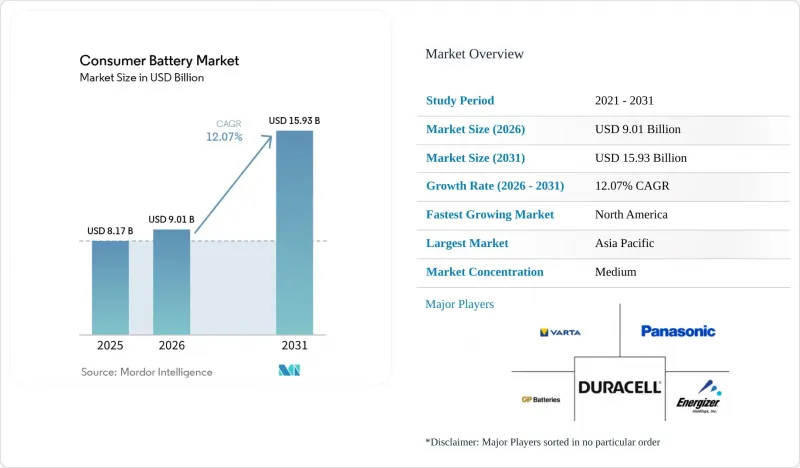
Mordor Intelligence에 의하면, 소비자용 배터리 시장 규모는 2025년에 81억 7,000만 달러로 평가되었습니다. 2026년 90억 1,000만 달러에서 2031년까지 159억 3,000만 달러에 이를 것으로 예상되며, 예측 기간(2026-2031년) CAGR은 12.07%를 나타낼 전망입니다.
본 보고서는 유형(리튬이온, 알칼리, 고체 마이크로 배터리 등), 충전 방식(1차 전지 및 2차 전지), 형태(원통형, 폴리머 박막 등), 용량(1,000 mAh 이하, 1,000-3,000 mAh, 3,000-10,000 mAh 및 10,000 mAh 이상), 용도(스마트폰, 노트북 및 태블릿 등), 지역(북미, 유럽, 아시아태평양 등)별로 분류되어 있습니다.
세계의 소비자용 배터리 시장 동향 및 인사이트
휴대용 가정용 전자기기 수요 급증
2025년에는 스마트폰, 태블릿, 노트북 등 21억 대 이상의 휴대용 기기가 출하되었으며, 각 기기에는 1-3개의 배터리 셀이 필요했습니다. 무선 이어폰이나 스마트 워치와 같은 부가적인 기기들도 휴대폰 수요를 크게 끌어올렸으며, 소비자의 평균 기기 보유 대수는 4.2대에 달했습니다. 저가형 휴대전화의 수명이 짧은 인도와 동남아시아에서는 교체 주기가 짧기 때문에 성숙 시장이 정체기에 접어든 상황에서도 출하량 증가세가 이어지고 있습니다. 이러한 차이로 인해 이중 공급 전략이 수립되었습니다. 즉, 플래그십 모델용으로는 1,000회 이상의 충방전 주기를 가진 프리미엄 리튬 이온 배터리 셀을, 일회용 제품용으로는 비용이 최적화된 니켈수소 배터리나 알칼리 배터리를 채택하는 전략입니다. 다양한 화학 성분을 조합한 제품 포트폴리오를 관리하는 공급업체는 더 넓은 지갑 점유율을 확보하고 있습니다.
리튬 이온 배터리 비용의 감소
리튬 이온 배터리의 가격은 2년 전 kW시당 132달러에서 2025년에는 89달러로 하락했습니다. 이는 주로 에너지 밀도가 20% 더 높은 니켈 함량이 높은 NMC 811 양극재가 채택되었기 때문입니다. 이러한 33%의 비용 절감으로 인해, 전체 사용 주기 동안 충전식 배터리와 알칼리 배터리의 비용이 동등해졌으며, 리모컨이나 손전등 분야에서 알칼리 배터리 대체가 촉진되고 있습니다. 그러나 이러한 비용 감소 추세는 둔화되고 있습니다. 인건비 급등과 원자재 헤지 계약으로 인해 2027년까지는 85달러 선에서 하락세가 주춤할 것으로 예상되며, 2023년 정점 시점에 리튬 가격을 고정해 둔 생산자들의 이익률은 압박을 받을 전망입니다. 수직 통합형 기업은 자사 광산 자산을 통해 위험을 헤지하고 있지만, 현물 시장에 의존하는 셀 조립 제조업체는 수익성 변동에 직면해 있습니다.
중요 광물공급망 변동성
리튬 탄산염 가격은 2024년 1월 톤당 1만 3,000달러에서 2025년 12월에는 2만 2,000달러로 변동했으며, 현물 시장에 대한 의존도가 20-30%인 제조업체의 경우, 매출 총이익률이 최대 500베이시스포인트 감소했습니다. 인도네시아의 수출 금지 조치와 호주 및 콩고민주공화국(DRC)의 광산 개발 지연으로 인해 공급 불확실성이 장기화되고 있어, 정제 시설에 대한 투자를 촉진하는 한편 리드타임을 2년 연장하고 있습니다. 고체 전지는 코발트 사용량을 줄여주지만, 규모의 경제가 실현되기 전까지는 상용화가 틈새 시장인 소비자용 기기에만 국한될 것입니다.
부문별 분석
리튬 이온 배터리는 성숙한 세계 공급망과 300 Wh/kg에 가까운 에너지 밀도 덕분에, 2025년에는 소비자용 배터리 시장에서 42.1%의 점유율을 차지했습니다. 고체 전지 기반 마이크로 배터리는 웨어러블 기기, 의료용 패치, 스마트 카드 등이 100mAh 미만의 용량과 10년의 수명을 필요로 하기 때문에 2031년까지 연평균 성장률(CAGR) 22.6%로 성장할 것으로 전망됩니다. 이 틈새 시장에서 소비자용 배터리 시장 규모가 확대된 것은 소비자들이 본질적인 안전성과 초슬림 디자인에 대해 다소 비싼 가격이라도 기꺼이 지불할 의사가 있음을 반영하고 있습니다. 알칼리 전지, 아연-탄소 전지, 니켈-수소 전지는 저전력 소비 기기용으로 여전히 사용되고 있지만, 그 시장 점유율은 해마다 감소하고 있습니다.
경쟁의 초점은 가연성 용매를 배제한 세라믹 또는 폴리머 전해질에 집중되어 있지만, 고부가가치 부문을 제외하면 여전히 비용이 너무 높아 보급에 걸림돌이 되고 있습니다. 양산 라인에 투자하고 있는 공급업체들은 2028년까지 가격 격차를 해소하는 것을 목표로 하고 있으며, 이에 따라 주류 웨어러블 기기에의 채택이 확대될 가능성이 있습니다.
2차 전지는 2025년 매출의 67.5%를 차지했으며, 리튬이온 전지의 원가 하락과 일회용 전지에 대한 생산자 책임 확대 제도에 따른 수수료 도입으로 인해 연평균 성장률(CAGR) 12.8%를 기록하며 소비자용 전지 시장 전체를 상회하는 성장을 보일 것으로 전망됩니다. 재활용 함량에 대한 최저 기준을 의무화하는 EU 규제와, 일회용 배터리 1개당 0.10달러의 수수료를 부과하는 캘리포니아주의 제도 덕분에 총 소유 비용(TCO) 측면에서는 재충전식 배터리가 분명히 유리합니다. 1차 전지와 관련된 소비자용 전지 시장 규모는 화재 경보기 및 비상용 손전등을 제외하고 계속해서 축소되고 있습니다. 이러한 제품들의 경우, 긴 보관 기간이 높은 수명 주기 비용을 상쇄하고 있습니다.
2027년까지 AA 및 AAA 규격의 일회용 배터리 판매를 중단하겠다고 공약한 소매업체들로 인해 알칼리 배터리의 진열 공간은 더욱 줄어들 것이며, 유서 깊은 브랜드들은 IoT 기기에 맞추어 포지셔닝된 충전식 배터리나 리튬 1차 전지 제품 라인으로 전환할 수밖에 없을 것입니다.
지역별 분석
아시아태평양은 중국의 420 GWh에 달하는 배터리 생산 능력과 비용 경쟁력이 있는 밸류체인을 바탕으로, 2025년 매출의 49.7%를 차지했습니다. 일본과 한국의 기업들은 프리미엄 원통형 및 전고체 배터리에 주력하고 있으며, 주력 전자기기 분야에서 60%가 넘는 이익률을 유지하고 있습니다. 인도에서는 보조금에 힘입어 조립 거점을 확대함으로써 일부 가치를 창출하고 있지만, 양극재와 전해액의 수입에 의존하고 있기 때문에 업스트림 공정으로의 통합은 제한적입니다.
북미는 kWh당 35달러 규모의 ‘선진 제조 생산 세액 공제(AMPC)’에 힘입어 2031년까지 연평균 성장률(CAGR) 17.7%로 성장하고 있습니다. 파나소닉, LG, 삼성SDI가 발표한 730억 달러를 넘는 생산 능력 덕분에 스마트폰, 노트북, 웨어러블 기기용 현지 공급이 확대되고 있습니다. 캐나다의 중요 광물 전략은 지역 수요의 최대 20%를 공급하고, 수입 의존도를 낮추는 것을 목표로 하고 있습니다.
유럽은 소비자용 배터리 시장 규모의 18.4%를 차지하고 있지만, ‘배터리 규제’로 인해 규정 준수 비용이 증가하고 있어 연평균 성장률(CAGR)은 9.3%로 다소 낮은 수준에 머물고 있습니다. 국내 기업인 VARTA와 Northvolt는 생산 능력을 확대하고 있지만 자금 조달에 어려움을 겪고 있으며, 규제로 인한 비용 압박이 이익률에 큰 부담으로 작용하고 있음이 드러나고 있습니다. 남미 및 중동 및 아프리카 시장 점유율은 작지만, 소득 증가에 따라 스마트폰 및 웨어러블 기기의 보급이 확대되면서 두 자릿수의 성장률을 기록하고 있습니다.
기타 혜택 :
- 엑셀 형식 시장 예측(ME) 시트
- 3개월간의 애널리스트 지원
자주 묻는 질문
목차
제1장 서론
제2장 조사 방법
제3장 주요 요약
제4장 시장 구도
제5장 시장 규모 및 성장 예측
제6장 경쟁 구도
제7장 시장 기회 및 향후 전망
KTH 26.06.29According to Mordor Intelligence, the consumer battery market size was valued at USD 8.17 billion in 2025 and is estimated to grow from USD 9.01 billion in 2026 to reach USD 15.93 billion by 2031, at a CAGR of 12.07% during the forecast period (2026-2031).
This report is Segmented by Type (Lithium-Ion, Alkaline, Solid-State Micro-Batteries, and More), Rechargeability (Primary and Secondary), Form Factor (Cylindrical, Polymer Thin-Film, and More), Capacity (Up To 1, 000 MAh, 1, 000 To 3, 000 MAh, 3, 000 To 10, 000 MAh, and Above 10, 000 MAh), Application (Smartphones, Laptops and Tablets, and More), and Geography (North America, Europe, Asia-Pacific, and More).
Global Consumer Battery Market Trends and Insights
Surging Demand for Portable Consumer Electronics
More than 2.1 billion portable devices were shipped in 2025, spanning smartphones, tablets, and laptops, and each required between one and three battery cells. Secondary gadgets such as wireless earbuds and smartwatches added sizeable incremental cell demand, pushing the average consumer's device count to 4.2. Shorter replacement cycles in India and Southeast Asia, where budget handsets degrade faster, reinforce volume growth even as mature markets plateau. This divergence shapes a dual-track supply strategy: premium lithium-ion cells with 1,000-plus charge cycles for flagship phones and cost-optimized nickel-metal hydride or alkaline cells for disposable uses. Suppliers that manage multi-chemistry portfolios capture broader wallet share.
Declining Lithium-Ion Battery Costs
Lithium-ion cell pricing slid to USD 89 per kilowatt-hour in 2025 from USD 132 two years prior, chiefly due to nickel-rich NMC 811 cathodes delivering 20% higher energy density. This 33% cost retreat places rechargeables on parity with alkalines over the full duty cycle, catalyzing substitution in remote controls and flashlights. The down-cycle, however, is flattening: inflated labor charges and hedged raw-material contracts are expected to cap further declines near USD 85 through 2027, tightening margins for producers that locked in lithium at 2023 peaks. Vertically integrated players hedge risk via captive mining assets, while cell assemblers reliant on spot markets face profitability swings.
Critical-Mineral Supply Chain Volatility
Lithium carbonate prices swung from USD 13,000 per ton in January 2024 to USD 22,000 by December 2025, compressing gross margins by up to 500 basis points for manufacturers with 20-30% spot exposure. Export bans in Indonesia and mine delays in Australia and the DRC prolong supply uncertainty, spurring refinery investments yet adding two-year lead times. Although solid-state batteries reduce cobalt intensity, commercialization remains limited to niche consumer devices pending scale economics.
Other drivers and restraints analyzed in the detailed report include:
- Expansion of Smart Wearables & IoT Ecosystem
- Right-to-Repair Laws Boosting Replacement Sales
- Safety Recalls from Thermal-Runaway Incidents
For complete list of drivers and restraints, kindly check the Table Of Contents.
Segment Analysis
Lithium-ion held 42.1% consumer battery market share in 2025, thanks to mature global supply networks and energy densities near 300 Wh/kg. Solid-state micro-batteries are projected to grow 22.6% CAGR through 2031 as hearables, medical patches, and smart cards require sub-100 mAh capacities and ten-year lifespans. The consumer battery market size expansion in this niche reflects a premium willingness to pay for intrinsic safety and ultra-thin profiles. Alkaline, zinc-carbon, and nickel-metal hydride chemistries continue to serve low-drain devices but yield a share each year.
Competition centers on ceramic or polymer electrolytes that remove flammable solvents, yet cost remains prohibitive outside high-value segments. Suppliers investing in mass-production lines aim to close the price gap by 2028, potentially widening adoption into mainstream wearables.
Secondary batteries controlled 67.5% of 2025 revenue and will outpace the overall consumer battery market at 12.8% CAGR thanks to falling lithium-ion costs and extended producer responsibility fees on disposables. EU rules mandating minimum recycled content and California's USD 0.10 fee per primary cell tilt total-cost-of-ownership decisively toward rechargeables. The consumer battery market size attached to primary cells continues to shrink except in smoke detectors and emergency flashlights, where long shelf life offsets higher life-cycle cost.
Retailers pledging to pull AA and AAA disposables by 2027 will compress shelf space for alkalines further, forcing legacy brands to pivot toward rechargeable or lithium primary lines positioned for IoT devices.
Geography Analysis
Asia-Pacific generated 49.7% of 2025 revenue, anchored by China's 420 GWh of cell capacity and cost-advantaged supply chains. Japanese and South Korean firms concentrate on premium cylindrical and solid-state formats, sustaining margins above 60% in flagship electronics. India's subsidy-backed assembly expansions capture partial value yet rely on imported cathode and electrolyte inputs, limiting upstream integration.
North America, buoyed by a USD 35 per kWh Advanced Manufacturing Production Credit, is expanding at a 17.7% CAGR through 2031. Over USD 73 billion of announced capacity from Panasonic, LG, and Samsung SDI is bringing localized supply to smartphones, laptops, and wearables. Canada's critical-mineral strategy seeks to supply up to 20% of regional demand, reducing import dependence.
Europe holds 18.4% of the consumer battery market size, but grows at a slower 9.3% CAGR as the Battery Regulation raises compliance costs. Domestic players VARTA and Northvolt expand capacity yet struggle with financing, highlighting regulatory cost pressure on margins. South America and the Middle East & Africa contribute smaller shares, yet post double-digit growth where rising incomes boost smartphone and wearable penetration.
- Duracell Inc.
- Energizer Holdings Inc.
- Panasonic Holdings Corp.
- VARTA AG
- GP Batteries International Ltd.
- LG Energy Solution Ltd.
- Samsung SDI Co. Ltd.
- Sony Group Corp.
- Maxell Holdings Ltd.
- Amperex Technology Ltd. (ATL)
- TDK Corp. (incl. Murata)
- Toshiba Corp.
- A123 Systems LLC
- BYD Co. Ltd.
- EVE Energy Co. Ltd.
- Renata SA
- FDK Corp.
- Ultralife Corp.
- NantEnergy Inc.
- PolyPlus Battery Co. Inc.
Additional Benefits:
- The market estimate (ME) sheet in Excel format
- 3 months of analyst support
TABLE OF CONTENTS
1 Introduction
- 1.1 Study Assumptions & Market Definition
- 1.2 Scope of the Study
2 Research Methodology
3 Executive Summary
4 Market Landscape
- 4.1 Market Overview
- 4.2 Market Drivers
- 4.2.1 Surging demand for portable consumer electronics
- 4.2.2 Declining lithium-ion battery costs
- 4.2.3 Expansion of smart wearables & IoT ecosystem
- 4.2.4 Right-to-repair laws boosting replacement sales
- 4.2.5 Emergence of solid-state micro-batteries for hearables
- 4.2.6 Rise of subscription-based battery-as-a-service models
- 4.3 Market Restraints
- 4.3.1 Critical-mineral supply chain volatility
- 4.3.2 Safety recalls from thermal-runaway incidents
- 4.3.3 Waste-disposal rules targeting single-use cells
- 4.3.4 Low-power semiconductors cutting replacement demand
- 4.4 Supply-Chain Analysis
- 4.5 Regulatory Landscape
- 4.6 Technological Outlook
- 4.7 Porter's Five Forces
- 4.7.1 Bargaining Power of Suppliers
- 4.7.2 Bargaining Power of Buyers
- 4.7.3 Threat of New Entrants
- 4.7.4 Threat of Substitutes
- 4.7.5 Competitive Rivalry
5 Market Size & Growth Forecasts
- 5.1 By Type
- 5.1.1 Lithium-ion
- 5.1.2 Alkaline
- 5.1.3 Zinc-Carbon
- 5.1.4 Nickel-Metal Hydride
- 5.1.5 Nickel-Cadmium
- 5.1.6 Solid-state Micro-batteries
- 5.1.7 Zinc-Air
- 5.1.8 Others
- 5.2 By Rechargeability
- 5.2.1 Primary (Disposable)
- 5.2.2 Secondary (Rechargeable)
- 5.3 By Form Factor
- 5.3.1 Cylindrical
- 5.3.2 Prismatic
- 5.3.3 Pouch
- 5.3.4 Coin/Button
- 5.3.5 Polymer Thin-Film
- 5.4 By Capacity Range
- 5.4.1 Up to 1,000 mAh
- 5.4.2 1,000 to 3,000 mAh
- 5.4.3 3,000 to 10,000 mAh
- 5.4.4 Above 10,000 mAh
- 5.5 By Application
- 5.5.1 Smartphones
- 5.5.2 Laptops and Tablets
- 5.5.3 Wearables
- 5.5.4 Gaming Controllers and Handhelds
- 5.5.5 Smart-Home Devices
- 5.5.6 Small Home Appliances
- 5.5.7 Personal Mobility Devices
- 5.5.8 Medical Consumer Devices
- 5.5.9 Others
- 5.6 By Geography
- 5.6.1 North America
- 5.6.1.1 United States
- 5.6.1.2 Canada
- 5.6.1.3 Mexico
- 5.6.2 Europe
- 5.6.2.1 United Kingdom
- 5.6.2.2 Germany
- 5.6.2.3 France
- 5.6.2.4 Spain
- 5.6.2.5 NORDIC Countries
- 5.6.2.6 Russia
- 5.6.2.7 Rest of Europe
- 5.6.3 Asia-Pacific
- 5.6.3.1 China
- 5.6.3.2 India
- 5.6.3.3 Japan
- 5.6.3.4 South Korea
- 5.6.3.5 ASEAN Countries
- 5.6.3.6 Australia and New Zealand
- 5.6.3.7 Rest of Asia-Pacific
- 5.6.4 South America
- 5.6.4.1 Brazil
- 5.6.4.2 Argentina
- 5.6.4.3 Colombia
- 5.6.4.4 Rest of South America
- 5.6.5 Middle East and Africa
- 5.6.5.1 Saudi Arabia
- 5.6.5.2 United Arab Emirates
- 5.6.5.3 South Africa
- 5.6.5.4 Egypt
- 5.6.5.5 Rest of Middle East and Africa
- 5.6.1 North America
6 Competitive Landscape
- 6.1 Market Concentration
- 6.2 Strategic Moves (M&A, Partnerships, PPAs)
- 6.3 Market Share Analysis (Market Rank/Share for key companies)
- 6.4 Company Profiles (includes Global level Overview, Market level overview, Core Segments, Financials as available, Strategic Information, Products & Services, and Recent Developments)
- 6.4.1 Duracell Inc.
- 6.4.2 Energizer Holdings Inc.
- 6.4.3 Panasonic Holdings Corp.
- 6.4.4 VARTA AG
- 6.4.5 GP Batteries International Ltd.
- 6.4.6 LG Energy Solution Ltd.
- 6.4.7 Samsung SDI Co. Ltd.
- 6.4.8 Sony Group Corp.
- 6.4.9 Maxell Holdings Ltd.
- 6.4.10 Amperex Technology Ltd. (ATL)
- 6.4.11 TDK Corp. (incl. Murata)
- 6.4.12 Toshiba Corp.
- 6.4.13 A123 Systems LLC
- 6.4.14 BYD Co. Ltd.
- 6.4.15 EVE Energy Co. Ltd.
- 6.4.16 Renata SA
- 6.4.17 FDK Corp.
- 6.4.18 Ultralife Corp.
- 6.4.19 NantEnergy Inc.
- 6.4.20 PolyPlus Battery Co. Inc.
7 Market Opportunities & Future Outlook
- 7.1 White-Space & Unmet-Need Assessment


