|
시장보고서
상품코드
2066488
군용 사이버 보안 시장 : 시장 점유율 분석, 업계 동향 및 통계, 성장 예측(2026-2031년)Military Cybersecurity - Market Share Analysis, Industry Trends & Statistics, Growth Forecasts (2026 - 2031) |
||||||
 Mordor Intelligence
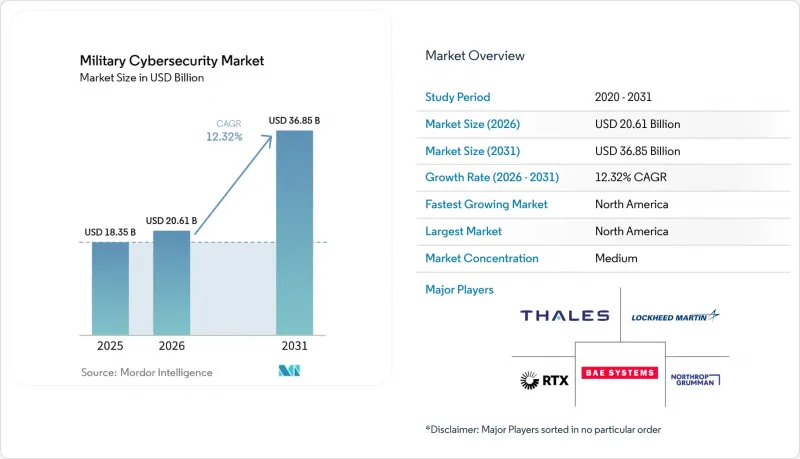
Mordor Intelligence에 의하면, 군용 사이버 보안 시장 규모는 2025년에 183억 5,000만 달러로 평가되었고, 2026년 206억 1,000만 달러로 추정되고, 2031년까지 368억 5,000만 달러에 이를 것으로 예측되며, 예측 기간(2026-2031년) CAGR은 12.32%를 나타낼 전망입니다.
본 보고서는 솔루션별(위협 인텔리전스 및 대응 등), 보안 계층별(엔드포인트 보안, 네트워크 보안 등), 도입 형태별(온프레미스 및 클라우드), 운용 분야별(육군 등), 구성 요소별(하드웨어, 소프트웨어, 서비스), 그리고 지역별(북미, 유럽, 아시아태평양 등)로 분류되어 있습니다. 시장 전망은 금액(달러) 기준으로 제시되어 있습니다.
세계의 군용 사이버 보안 시장 동향 및 인사이트
국가 주도의 사이버 침입이 격화되고 있습니다.
고도로 정교해진 국가 주도의 사이버 공격으로 인해 국방상의 우선순위가 재정의되었으며, 군사 조달은 경계 방어에서 ‘침해를 전제로 한 아키텍처’로 전환되었습니다. 2024년 12월에 발생한 중국의 미국 재무부 해킹 사건과 영국 국방부 급여 시스템 침입 사건은 고도화되고 지속적인 위협(APT) 활동이 여전히 계속되고 있음을 여실히 보여주었습니다. 이에 대응하여, 2025년 미국 국방수권법에서는 랜섬웨어 그룹을 적대적 행위자로 지정함에 따라, 대규모 공격의 배후를 규명하는 플랫폼에 대한 수요가 높아지고 있습니다. 국가정보국장실은 Recorded Future의 정보 분석을 활용한 ‘Sentinel Horizon’을 출범시키며, 상용 정보 분석 기법에 대한 의존을 드러냈습니다.
현대화 프로그램이 통합 사이버 아키텍처를 추진
통합 전 영역 지휘통제(JADC2)에서는 육·해·공·우주·사이버 각 영역에 걸친 통신을 보호하는 방어 체제가 요구되고 있으며, 각 벤더사는 상호 운용성이 확보되고 기밀 등급에 부합하는 솔루션을 제공해야 하는 압박을 받고 있습니다. 나토(NATO)의 ‘방위 혁신 가속화 프로그램’은 2025년에 70개 이중용도 기업에 자금을 지원했으며, 각 기업은 안전한 통신 기술의 성숙화를 위해 10만 유로(약 11만 6,000달러)의 보조금을 받았습니다. EU의 ‘사이버 연대법’은 국경을 초월한 보안 운영 센터에 11억 1,000만 유로(약 12억 8,000만 달러)를 투입함으로써, 연합군 차원에서 운영이 가능한 플랫폼에 대한 수요를 창출했습니다. 표준을 준수한 솔루션을 구축한 공급업체는 연합군 전체에서 비즈니스 기회를 확보했습니다.
보안 승인 자격을 갖춘 사이버 인재 부족이 도입 속도를 저해하고 있습니다.
국방 당국은 미국 내 약 22만 5,000건의 사이버 관련 공석 문제로 골머리를 앓고 있었으며, 보안 승인 요건이 인력 부족을 더욱 심화시키고 있었습니다. 2023년 3월의 ‘사이버 인재 전략’에서는 기술 중심의 채용으로 방침을 전환했으나, 보안 승인 획득에 소요되는 시간이 여전히 프로젝트 진행을 지연시키고 있었습니다. 국가사이버국장실은 4년제 대학 학위 취득 요건을 폐지했으나, 각 기관이 희소한 전문 지식을 갖춘 인재를 확보하기 위해 경쟁을 벌인 탓에 인건비는 계속 상승했습니다.
부문별 분석
2025년, 위협 인텔리전스 및 대응 분야는 군용 사이버 보안 시장 점유율의 28.31%를 차지했습니다. 이는 지휘관들이 작전 차원에서 공격원의 특정 및 예측 분석을 필요로 하고 있음을 반영하고 있습니다. 각 벤더사는 AI 모델을 통합하고, 여러 기밀 등급에 걸친 지표를 상호 연관시킴으로써 감지부터 운영상의 대응에 이르기까지의 지연을 단축했습니다. 조직이 인력 부족을 보완하기 위해 연중무휴 24시간 감시 업무를 외부에 위탁한 결과, 매니지드 보안 서비스 시장은 연평균 성장률(CAGR) 14.28%를 기록했습니다. ID 및 액세스 관리(IAM) 도구는 지속적인 인증을 의무화하는 제로 트러스트 지침을 배경으로 성장했습니다. 보안 정보 및 이벤트 관리(SIEM) 플랫폼은 규칙 기반의 경보에만 의존하는 것이 아니라, 미묘한 이상 징후를 식별하는 클라우드 네이티브 행동 분석 엔진으로 진화했습니다.
방위 기관에서는 위협 정보 피드와 실전 계획 시스템을 연계하려는 움직임이 가속화되면서, 지휘관이 물리적 작전과 병행하여 사이버상의 영향을 모델링할 수 있게 되었습니다. 군용 사이버 보안 시장 내 위협 인텔리전스 시장 규모는 2031년까지 102억 9,000만 달러에 달할 것으로 예상되며, 연평균 12.08%의 성장률을 보일 것으로 전망됩니다. SBOM 규정 준수 도구는 관리형 서비스 포트폴리오에 필수적인 요소로 자리 잡았으며, 신규 및 개량 프로그램에서 소프트웨어 공급망의 가시성을 확보했습니다.
2025년에는 기밀 링크를 보호하는 암호화, 세분화 및 크로스 도메인 가드를 핵심으로 하여 네트워크 보안이 매출의 38.12%를 차지했습니다. 프라이빗 5G 도입에 따라, 소프트웨어 정의 무선 경로를 보호하는 적응형 방화벽의 적용 범위가 확대되었습니다. 인증을 받은 하이퍼스케일 존이 기밀성이 높은 비기밀 워크로드를 처리하는 가운데, 클라우드 보안 시장은 연평균 성장률(CAGR) 16.18%를 기록했습니다. 다중 테넌트 경계 제어, 엔클레이브 수준의 키, 그리고 지속적인 규정 준수 점검이 조달 요건의 핵심을 차지했습니다.
엔드포인트 및 애플리케이션 보안은 제로 트러스트 오케스트레이션에 통합되어 있으며, 네트워크상의 위치와 관계없이 기기의 상태, 사용자 행동, 데이터 라벨을 기반으로 액세스 결정이 이루어집니다. 군용 사이버 보안 시장에서 클라우드 보안 시장 규모는 2031년까지 70억 5,000만 달러를 넘어설 것으로 전망됩니다. 한편, 하드웨어 기반 암호화 모듈은 포스트 양자암호화의 로드맵을 뒷받침하며, 2035년 이후에도 트래픽 보호를 보장하고 있습니다.
지역별 분석
북미는 2025년에 45.35%의 시장 점유율을 유지했습니다. 이는 미국의 300억 달러 규모의 사이버 보안 예산과 성숙한 조달 생태계에 힘입은 결과입니다. DISA의 ‘Thunderdome’, 육군의 SBOM 의무화, 민간 주도의 5G 구축과 같은 지역별 프로그램들이 전 세계적인 요구 사항을 형성했습니다. 캐나다는 NATO의 ‘방위 혁신 가속화 프로그램’을 활용하여 군·민 양용 스타트업에 공동 투자한 반면, 멕시코는 국경 경비 작전의 안전을 확보하기 위해 군용 클라우드 인증을 추진했습니다. 북미 군용 사이버 보안 시장 규모는 2031년까지 165억 8,000만 달러에 달할 것으로 전망됩니다.
아시아태평양은 일본이 적대 세력에 대한 선제 작전을 승인하는 등 적극적인 사이버 방어 태세를 취함에 따라 13.22%라는 가장 높은 연평균 성장률(CAGR)을 기록했습니다. QUAD의 노력 덕분에 호주, 인도, 일본, 미국에서 소프트웨어 보안 감사가 표준화되어 공급업체 시장 진입이 용이해졌습니다. 아세안(ASEAN) 각국의 군은 전용 사이버 사령부를 설립했습니다. 싱가포르의 디지털 인텔리전스 서비스는 해상 및 육상 자산을 아우르는 통합적인 위협 감지 운영을 시작했습니다. 괌의 인프라를 표적으로 한 중국의 ‘볼트 타이푼’ 작전으로 인해, 도서 지역의 조기 경보 시스템에 대한 투자가 가속화되었습니다.
유럽에서는 11억 1,000만 유로(약 12억 8,000만 달러) 규모의 ‘사이버 연대법’과 NATO 통합 사이버 방어 센터의 설립이 호재로 작용했습니다. 핀란드는 6G 보안 통신 기술을 연구하는 기술 허브를 유치하고, 북유럽의 스타트업 기업들을 초청했습니다. 그러나 조달 체계의 분산과 암호화 규격의 차이로 인해 국경을 넘어선 사업 확장 속도는 둔화되었습니다. 중동 및 아프리카에서는 지역 분쟁 속에서 중요 인프라를 보호하기 위해 사이버 보안 예산이 확대되었으나, 재정적 제약으로 인해 성장세는 여전히 고르지 못한 상태를 유지했습니다.
기타 혜택 :
- 엑셀 형식 시장 예측(ME) 시트
- 3개월간의 애널리스트 지원
자주 묻는 질문
목차
제1장 서론
제2장 조사 방법
제3장 주요 요약
제4장 시장 구도
제5장 시장 규모 및 성장 예측
제6장 경쟁 구도
제7장 시장 기회 및 향후 전망
AJY 26.06.24According to Mordor Intelligence, the military cybersecurity market size was valued at USD 18.35 billion in 2025 and estimated to grow from USD 20.61 billion in 2026 to reach USD 36.85 billion by 2031, at a CAGR of 12.32% during the forecast period (2026-2031).
This report is Segmented by Solution (Threat Intelligence and Response, and More), Security Layer (Endpoint Security, Network Security, and More), Deployment (On-Premise and Cloud), Operation Domain (Land Forces, and More), Component (Hardware and Software and Services), and Geography (North America, Europe, Asia-Pacific, and More). The Market Forecasts are Provided in Terms of Value (USD).
Global Military Cybersecurity Market Trends and Insights
Escalating state-sponsored cyber-intrusions
Sophisticated nation-state campaigns reshaped defense priorities, shifting military procurement from perimeter defenses toward assume-breach architectures. China's December 2024 Treasury hack and the UK Ministry of Defence payroll breach highlighted persistent advanced-persistent-threat activity. In response, the 2025 US National Defense Authorization Act classified ransomware groups as hostile actors, increasing demand for platforms that identify attribution at scale. The Office of the Director of National Intelligence launched Sentinel Horizon using Recorded Future intelligence, demonstrating reliance on commercial tradecraft.
Modernization programs drive integrated cyber architectures
Joint All-Domain Command and Control (JADC2) requires defenses that secure traffic spanning land, sea, air, space, and cyber domains, pushing vendors to deliver interoperable, classification-aware solutions. NATO's Defence Innovation Accelerator funded 70 dual-use firms in 2025, each receiving EUR 100,000 (~USD 116,000) to mature technologies for secure communications. The EU Cyber Solidarity Act injected EUR 1.11 billion (~USD 1.28 billion) into cross-border Security Operations Centres, prompting demand for coalition-ready platforms. Vendors that built standards-compliant solutions captured opportunities across allied forces.
Cleared-cyber talent shortage constrains implementation velocity
Defense agencies grappled with roughly 225,000 unfilled US cyber roles, with clearances exacerbating gaps. The March 2023 Cyber Workforce Strategy pivoted to skills-based hiring, yet clearance timelines still slowed project rollouts. The Office of the National Cyber Director removed four-year degree prerequisites, but labor costs continued to climb as agencies competed for scarce expertise.
Other drivers and restraints analyzed in the detailed report include:
- Cloud and zero-trust adoption accelerates military digital transformation
- Private-5G and Open RAN deployments expand attack surfaces
- Legacy OT/ICS fragmentation creates integration challenges
For complete list of drivers and restraints, kindly check the Table Of Contents.
Segment Analysis
The threat intelligence and response held 28.31% of the military cybersecurity market share in 2025, reflecting commanders' need for campaign-level attribution and predictive analytics. Vendors integrated AI models to correlate indicators across multiple classification tiers, reducing latency between detection and operational action. Managed security services posted a 14.28% CAGR as organizations outsourced 24/7 monitoring to offset staff shortages. Identity and Access Management tools grew on the back of zero-trust directives that mandated continuous verification. Security information and event management platforms evolved toward cloud-native, behavior analytics engines that identify subtle anomalies rather than rely solely on rule-based alerts.
Defense agencies increasingly paired threat intelligence feeds with kinetic planning systems, allowing commanders to model cyber effects alongside physical operations. The military cybersecurity market size for threat intelligence is projected to reach USD 10.29 billion by 2031, growing at 12.08% annually. SBOM compliance tools became integral to managed-service portfolios, ensuring software supply-chain visibility for new and retrofit programs.
Network security captured 38.12% revenue in 2025, anchored by encryption, segmentation, and cross-domain guards that protect classified links. Private 5G deployments widened the footprint for adaptive firewalls that secure software-defined radio paths. Cloud security logged a 16.18% CAGR as accredited hyperscale zones handled sensitive, unclassified workloads. Multi-tenant boundary controls, enclave-level keys, and continuous compliance checks dominated procurement requirements.
Endpoint and application security are blended into zero-trust orchestration, where device health, user behavior, and data labels drive access decisions irrespective of network location. The military cybersecurity market size for cloud security is forecast to exceed USD 7.05 billion by 2031. Meanwhile, hardware-based encryption modules supported post-quantum roadmaps, ensuring traffic protection beyond 2035.
Geography Analysis
North America retained 45.35% market share in 2025, underpinned by the United States' USD 30 billion cyber allocation and mature acquisition ecosystem. Regional programs such as DISA's Thunderdome, the Army's SBOM mandate, and private 5G rollouts shaped global requirements. Canada leveraged NATO's Defence Innovation Accelerator to co-fund dual-use startups, while Mexico advanced military cloud accreditation to secure border operations. The military cybersecurity market size for North America is projected to reach USD 16.58 billion by 2031.
Asia-Pacific posted the highest 13.22% CAGR as Japan adopted an active cyber defense posture, authorizing pre-emptive operations against adversaries. QUAD initiatives standardized software security audits across Australia, India, Japan, and the United States, easing vendor entry. ASEAN militaries formed dedicated cyber commands; Singapore's Digital Intelligence Service operationalized integrated threat-hunting across maritime and land assets. China's Volt Typhoon campaign against Guam's infrastructure accelerated investment in island-based early-warning systems.
Europe benefited from the EUR 1.11 billion (~USD 1.28 billion) Cyber Solidarity Act and the NATO Integrated Cyber Defence Centre. Finland hosted technology hubs working on 6G secure communications, attracting Northern European startups. However, fragmented procurement and divergent cryptographic standards slowed cross-border scaling. The Middle East and Africa expanded cyber budgets to protect critical infrastructure amid regional conflicts, though growth remained uneven due to fiscal constraints.
- BAE Systems plc
- Lockheed Martin Corporation
- Northrop Grumman Corporation
- General Dynamics Mission Systems, Inc. (General Dynamics Corporation)
- RTX Corporation
- Thales Group
- Airbus Defence and Space (Airbus SE)
- International Business Machines Corporation
- Booz Allen Hamilton, Inc.
- Leidos Holdings, Inc.
- CACI International Inc.
- L3Harris Technologies, Inc.
- Palo Alto Networks, Inc.
- Cisco Systems, Inc.
- Fortinet, Inc.
- DXC Technology Company
- Tyto Athene, LLC
- Clavister Holding AB
Additional Benefits:
- The market estimate (ME) sheet in Excel format
- 3 months of analyst support
TABLE OF CONTENTS
1 INTRODUCTION
- 1.1 Study Assumptions and Market Definition
- 1.2 Scope of the Study
2 RESEARCH METHODOLOGY
3 EXECUTIVE SUMMARY
4 MARKET LANDSCAPE
- 4.1 Market Overview
- 4.2 Market Drivers
- 4.2.1 Escalating state-sponsored cyber-intrusions
- 4.2.2 Modernization programs (JADC2, DIANA, etc.)
- 4.2.3 Cloud and Zero-Trust adoption across DoD
- 4.2.4 Private-5G/Open RAN roll-outs drive RF-layer security
- 4.2.5 SBOM mandates for weapon-system software
- 4.2.6 Post-quantum cryptography urgency
- 4.3 Market Restraints
- 4.3.1 Cleared-cyber talent shortage
- 4.3.2 Budget constraints/cost overruns
- 4.3.3 Legacy OT/ICS fragmentation
- 4.3.4 Data-sovereignty and export-control barriers
- 4.4 Value Chain Analysis
- 4.5 Regulatory Landscape
- 4.6 Technological Outlook
- 4.7 Porter's Five Forces Analysis
- 4.7.1 Bargaining Power of Buyers
- 4.7.2 Bargaining Power of Suppliers
- 4.7.3 Threat of New Entrants
- 4.7.4 Threat of Substitutes
- 4.7.5 Intensity of Rivalry
5 MARKET SIZE AND GROWTH FORECASTS (VALUE)
- 5.1 By Solution
- 5.1.1 Threat Intelligence and Response
- 5.1.2 Identity and Access Management
- 5.1.3 Data Loss Prevention
- 5.1.4 Security Information and Event Management
- 5.1.5 Unified Threat Management
- 5.1.6 Risk and Compliance Management
- 5.1.7 Managed Security Services
- 5.1.8 Others
- 5.2 By Security Layer
- 5.2.1 Endpoint Security
- 5.2.2 Network Security
- 5.2.3 Cloud Security
- 5.2.4 Application Security
- 5.3 By Deployment
- 5.3.1 On-Premise
- 5.3.2 Cloud
- 5.4 By Operation Domain
- 5.4.1 Land Forces
- 5.4.2 Air Forces
- 5.4.3 Naval Forces
- 5.5 By Component
- 5.5.1 Hardware Appliances
- 5.5.2 Software and Services
- 5.6 By Geography
- 5.6.1 North America
- 5.6.1.1 United States
- 5.6.1.2 Canada
- 5.6.1.3 Mexico
- 5.6.2 Europe
- 5.6.2.1 United Kingdom
- 5.6.2.2 Germany
- 5.6.2.3 France
- 5.6.2.4 Russia
- 5.6.2.5 Rest of Europe
- 5.6.3 Asia-Pacific
- 5.6.3.1 China
- 5.6.3.2 Japan
- 5.6.3.3 India
- 5.6.3.4 South Korea
- 5.6.3.5 Rest of Asia-Pacific
- 5.6.4 South America
- 5.6.4.1 Brazil
- 5.6.4.2 Mexico
- 5.6.4.3 Rest of South America
- 5.6.5 Middle East and Africa
- 5.6.5.1 Middle East
- 5.6.5.1.1 Saudi Arabia
- 5.6.5.1.2 UAE
- 5.6.5.1.3 Israel
- 5.6.5.1.4 Rest of Middle East
- 5.6.5.2 Africa
- 5.6.5.2.1 South Africa
- 5.6.5.2.2 Rest of Africa
- 5.6.5.1 Middle East
- 5.6.1 North America
6 COMPETITIVE LANDSCAPE
- 6.1 Market Concentration
- 6.2 Strategic Moves
- 6.3 Market Share Analysis
- 6.4 Company Profiles (includes Global-level Overview, Market-level Overview, Core Segments, Financials, Strategic Information, Market Rank/Share, Products and Services, Recent Developments)
- 6.4.1 BAE Systems plc
- 6.4.2 Lockheed Martin Corporation
- 6.4.3 Northrop Grumman Corporation
- 6.4.4 General Dynamics Mission Systems, Inc. (General Dynamics Corporation)
- 6.4.5 RTX Corporation
- 6.4.6 Thales Group
- 6.4.7 Airbus Defence and Space (Airbus SE)
- 6.4.8 International Business Machines Corporation
- 6.4.9 Booz Allen Hamilton, Inc.
- 6.4.10 Leidos Holdings, Inc.
- 6.4.11 CACI International Inc.
- 6.4.12 L3Harris Technologies, Inc.
- 6.4.13 Palo Alto Networks, Inc.
- 6.4.14 Cisco Systems, Inc.
- 6.4.15 Fortinet, Inc.
- 6.4.16 DXC Technology Company
- 6.4.17 Tyto Athene, LLC
- 6.4.18 Clavister Holding AB
7 MARKET OPPORTUNITIES AND FUTURE OUTLOOK
- 7.1 White-Space and Unmet-Need Assessment