

|
시장보고서
상품코드
2066490
대규모 공개 온라인 강좌(MOOC) : 시장 점유율 분석, 업계 동향 및 통계, 성장 예측(2026-2031년)Massive Open Online Course (MOOC) - Market Share Analysis, Industry Trends & Statistics, Growth Forecasts (2026 - 2031) |
||||||
 Mordor Intelligence
Mordor Intelligence에 의하면, 대규모 공개 온라인 강좌(MOOC) 시장 규모는 2025년에 317억 4,000만 달러로 평가되었습니다. 예측 기간(2026-2031년) 사이에 CAGR 36.92%로 성장을 지속하여, 2026년 434억 6,000만 달러에서 2031년까지 2,091억 3,000만 달러에 이를 것으로 추정되고 있습니다.
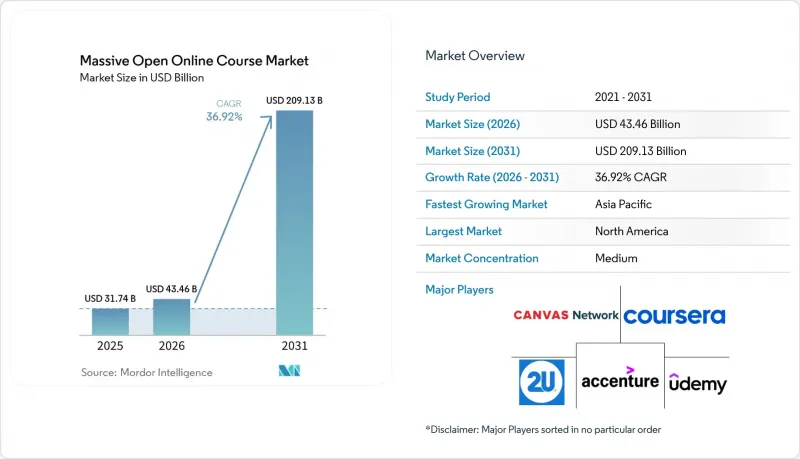
본 보고서는 플랫폼 유형(cMOOC, XMOOC, 하이브리드/SPOC), 대상 분야(기술 및 컴퓨터 과학, 비즈니스 및 경영학 등), 최종 사용자(고등교육 기관의 학생, K-12 학습자 등), 수익 모델(무료 청강만 가능, 프리미엄 등), 그리고 지역별로 분류되어 있습니다. 시장 전망치는 금액(달러)으로 표시되어 있습니다.
세계의 대규모 공개 온라인 강좌(MOOC) 시장 동향 및 인사이트
기업의 역량 강화 요구 사항이 기업 내 MOOC 도입을 촉진하고 있습니다.
고용주들이 경쟁 우위를 지속적인 기술 업데이트와 연계한 결과, 2025년에는 기업의 교육 예산이 3,500억 달러를 넘어섰습니다. FPT 코퍼레이션과 Udemy간의 제휴는 이러한 기세를 여실히 보여주고 있습니다. 이 회사는 1,873억 VND(760만 달러)를 투자하여 일본 및 한국 전역의 직원을 대상으로 교육을 실시하는 한편, 엄선된 MOOC를 성과 평가 체계에 도입했습니다. Skillsoft와 액센츄어의 LearnVantage가 진행하는 이와 같은 인재 중심 투자 역시, 공인된 수료증을 사내 경력 개발 경로와 연계함으로써 플랫폼에 대한 수요를 가속화하고 있습니다.
정부의 자금 지원이 디지털 교육 인프라 구축을 가속화
캐나다는 ‘CanCode’ 프로그램의 AI 과정에 3,920만 캐나다 달러(2,910만 달러)를 배정했고, 호주는 ‘Skills for Education and Employment’에 4억 3,640만 호주 달러(2억 9,160만 달러)를 배정했으며, EU의 ‘Digital Europe Programme’은 고급 디지털 기술 향상을 위해 1억 800만 유로(1억 1,770만 달러)를 투입했습니다. 이러한 보조금은 컨텐츠 개발 및 마이크로 크레덴셜 인증 지원, 광대역 용량 확충에 사용되며, MOOC를 국가 경쟁력 확보에 필수적인 인프라로 자리매김하고 있습니다.
혁신이 진행되고 있음에도 불구하고, 수료율은 여전히 극히 낮은 수준에 머물러 있습니다.
주요 플랫폼의 강좌 평균 수료율은 5%에서 15% 사이를 오가고 있으며, MIT와 하버드 대학이 공동으로 운영하는 MOOC조차 수료율은 3.13%에 그치고 있습니다. 인도의 SWAYAM은 정부의 학점 인정을 받고 있음에도 불구하고 수료율이 4% 미만에 그치고 있어, 지속적인 동기 부여 부족 문제가 두드러지고 있습니다. 조사에 따르면, 초기 중도 탈락은 디지털 리터러시 부족과 관련이 있는 반면, 후기 중도 탈락은 시간 관리 능력이나 학력과의 불일치와 상관관계가 있는 것으로 나타났습니다. 각 플랫폼에서는 중도 이탈을 줄이기 위해 코호트 멘토 제도, 마이크로러닝 형식, 게임화 요소를 도입한 마일스톤 등을 시도하고 있지만, 여전히 큰 개선 효과를 거두지는 못하고 있습니다.
부문별 분석
하이브리드/SPOC 솔루션은 고용주들이 비동기식 동영상과 실시간 코칭을 결합한 체계적인 코호트 프로그램을 요구하는 가운데, 2031년까지 연평균 성장률(CAGR) 40.11%의 성장 잠재력을 확보했습니다. xMOOC는 규정 준수 및 인증 요건을 충족하는 대학과의 제휴와 명확하게 정의된 교육 과정에 힘입어, 2025년 매출의 48.76%를 계속 차지하고 있습니다. cMOOC의 제공은 협력적인 지식 공동체에 지속적으로 기여하고 있지만, 그 규모는 제한적입니다.
기업들은 하이브리드/SPOC 플랫폼을 학습 관리 시스템에 직접 통합하여, 업무 시간 내에 짧은 가상 세션을 포함시키고 있습니다. 레알 마드리드 대학교 스쿨과 Coursera의 제휴를 통해, 동료 프로젝트와 교수진이 진행하는 웨비나를 결합한 12개의 스포츠 업계 대상 과정이 전 세계 수강생들에게 제공되고 있습니다. 이러한 체계화된 경험은 사회적 존재감과 책임감을 높여주며, 자기 주도형 xMOOC와 비교했을 때 피드백 주기와 수료율을 향상시키고 있습니다.
기술 및 컴퓨터 과학 분야는 프로그래밍, AI, 사이버 보안 기술에 대한 끊임없는 수요에 부응함으로써 2025년 대규모 공개 온라인 강좌(MOOC) 시장 점유율 32.52%를 유지했습니다. 언어 학습 분야의 대규모 공개 온라인 강좌(MOOC) 시장 규모는 가장 빠르게 확대되고 있으며, 재택근무의 확산에 따라 다국어 의사소통에 대한 수요가 증가하는 가운데 연평균 성장률(CAGR) 37.68%로 성장하고 있습니다. 비즈니스·경영 및 과학·공학 부문은 꾸준한 성장세를 보이고 있지만, 경쟁이 포화 상태에 이르렀습니다.
Duolingo의 2024년 매출액 7억 4,800만 달러는 게임 요소를 접목한 어학 앱에 대한 소비자들의 열기를 입증한 것이며, 이러한 앱들은 기업용 서비스로 원활하게 전환되었습니다. 동시에, 101 Blockchains는 Accredible과 제휴하여 3만 명 이상의 전문가에게 디지털 인증서를 발급하고 있으며, 이는 최첨단 기술 컨텐츠와 자격 인증 혁신의 융합을 보여주고 있습니다.
지역별 분석
2025년 북미는 대규모 공개 온라인 강좌(MOOC) 시장 점유율 31.65%를 유지했습니다. 이는 벤처 캐피털의 꾸준한 유입, 기업 교육 예산의 확충, 그리고 마이크로 크레덴셜에 대한 조기 규제 명확화에 힘입은 결과입니다. 미국이 그 대부분을 차지하고 있으며, 액센츄어가 Udacity를 10억 달러에 인수한 것은 플랫폼 경제에 대한 신뢰를 뒷받침하는 사례입니다. 캐나다의 ‘CanCode’에 대한 자금 지원으로 K-12(유치원부터 고등학교까지) 교육 과정에 AI 커리큘럼이 도입된 반면, 멕시코에서는 니어쇼어링 붐이 이중언어 인재의 역량 강화 수요를 뒷받침하고 있습니다.
아시아태평양은 가장 빠르게 성장하고 있는 지역으로, 연평균 성장률(CAGR) 37.25%를 기록하며 확대되고 있습니다. 인도의 ‘SWAYAM’과 중국의 국내 MOOC 생태계는 방대한 학습자 기반과 고등교육의 수용 능력 한계에 대한 확장성이 뛰어난 해결책으로서 MOOC를 자리매김하려는 정부의 지원을 활용하고 있습니다. 호주에서 4억 3,640만 호주 달러 규모로 추진되고 있는 ‘Skills for Education and Employment’ 이니셔티브는 지역 내 민관 협력을 강화하고 있으며, FPT와 Udemy가 제공하는 교육 프로그램은 일본, 한국, 베트남에 걸친 국경을 초월한 기업 대상 학습의 시너지 효과를 보여주고 있습니다.
유럽, 중동 및 아프리카에서는 규제와 인프라의 다양성으로 인해 확산 속도는 완만하지만, 꾸준한 보급이 이루어지고 있습니다. EU의 ‘디지털 유럽’ 보조금은 자격 인증 기준의 통일을 촉진하고, 고급 디지털 기술 관련 컨텐츠에 자금을 지원하고 있습니다. 한편, 샐리 대학교의 AR/VR 과정군은 몰입형 학습을 위한 학술적 노력의 한 사례를 보여주고 있습니다. 중동에서는 IHG 아카데미의 아랍어로 진행되는 호스피탈리티 분야 MOOC가 현지 인력 수요를 충족시키고 있습니다. 사하라 이남 아프리카에서는 캠퍼스 수용 능력 부족을 보완하기 위해 모바일 우선형 서비스를 활용하고 있는 반면, 남미에서는 브라질과 아르헨티나의 교육 기술 투자 환경을 배경으로 발전이 이루어지고 있습니다.
기타 혜택 :
- 엑셀 형식 시장 예측(ME) 시트
- 3개월간의 애널리스트 지원
자주 묻는 질문
목차
제1장 서론
제2장 조사 방법
제3장 주요 요약
제4장 시장 구도
제5장 시장 규모 및 성장 예측
제6장 경쟁 구도
제7장 시장 기회 및 향후 동향
KTH 26.06.29According to Mordor Intelligence, the massive open online course (MOOC) market size was valued at USD 31.74 billion in 2025 and estimated to grow from USD 43.46 billion in 2026 to reach USD 209.13 billion by 2031, at a CAGR of 36.92% during the forecast period (2026-2031).
This report is Segmented by Platform Type (cMOOC, XMOOC, Hybrid/SPOC), Subject Area (Technology and Computer Science, Business and Management, and More), End User (Higher-Education Students, K-12 Learners, and More), Revenue Model (Free Audit-Only, Freemium, and More), and Geography. The Market Forecasts are Provided in Terms of Value (USD).
Global Massive Open Online Course (MOOC) Market Trends and Insights
Corporate upskilling mandates drive enterprise adoption
Enterprise learning budgets surpassed USD 350 billion in 2025 as employers tied competitive advantage to continuous skill renewal. FPT Corporation's alliance with Udemy illustrates this momentum: the firm invested VND 187.3 billion (USD 7.6 million) to train staff across Japan and Korea, embedding curated MOOCs into its performance framework Similar talent-centric investments from Skillsoft and Accenture's LearnVantage accelerate platform demand by connecting verified certificates to internal career ladders.
Government funding accelerates digital education infrastructure
Canada earmarked CAD 39.2 million (USD 29.1 million) for the CanCode program's AI track, Australia allocated AUD 436.4 million (USD 291.6 million) to Skills for Education and Employment, and the EU's Digital Europe Programme injected EUR 108 million (USD 117.7 million) into advanced digital skills. These grants subsidize content development, subsidize micro-credential recognition, and upgrade broadband capacity, positioning MOOCs as critical national competitiveness infrastructure
Completion rates remain critically low despite innovation
Average course completion hovers between 5% and 15% on major platforms, and even MIT-Harvard joint MOOCs close at a 3.13% rate. India's SWAYAM registers sub-4% completions despite government credit recognition, underscoring a persistent motivation gap. Research links early dropout to limited digital literacy, while later attrition correlates with time-management and academic skill mismatches. Platforms experiment with cohort mentors, micro-learning formats, and gamified milestones to mitigate attrition, yet material improvement remains elusive.
Other drivers and restraints analyzed in the detailed report include:
- AI-driven personalization transforms learning outcomes
- Blockchain credentials gain enterprise recognition
- Data-privacy regulations constrain personalization capabilities
For complete list of drivers and restraints, kindly check the Table Of Contents.
Segment Analysis
Hybrid/SPOC solutions captured 40.11% CAGR potential through 2031 as employers seek structured cohorts that blend asynchronous video with live coaching. xMOOCs still hold 48.76% of 2025 revenue, buoyed by university partnerships and well-defined curricula that address compliance and accreditation requirements. cMOOC offerings continue to serve collaborative knowledge communities but command limited scale.
Enterprises integrate Hybrid/SPOC platforms directly into learning-management systems to embed bite-sized virtual sessions into the workday. Real Madrid University School's Coursera tie-up delivers 12 sports-industry courses that combine peer projects and faculty webinars to global cohorts. These structured experiences improve social presence and accountability, elevating feedback cycles and completion metrics compared with self-paced xMOOCs.
Technology and Computer Science retained 32.52% of the Massive Open Online Course market share in 2025 by catering to relentless demand for programming, AI, and cybersecurity competencies. Massive Open Online Course market size in language learning is rising fastest, expanding at a 37.68% CAGR as remote work multiplies multilingual communication needs. Business and Management and Science and Engineering segments post steady gains but face competitive saturation.
Duolingo's USD 748 million 2024 revenue validates consumer enthusiasm for gamified language apps that transition seamlessly into enterprise offerings. Simultaneously, 101 Blockchains collaborates with Accredible to issue digital certificates for over 30,000 professionals, demonstrating convergence between advanced tech content and credential innovation.
Geography Analysis
North America retained 31.65% of the Massive Open Online Course (MOOC) market share in 2025, anchored by robust venture-capital flows, deep corporate learning budgets, and early regulatory clarity on micro-credentials. The United States accounts for the lion's share, with Accenture's USD 1 billion Udacity acquisition underscoring confidence in platform economics. Canada's CanCode funding embeds AI curricula into K-12 pipelines, while Mexico's near-shoring boom fuels bilingual upskilling demand.
Asia-Pacific is the fastest-growing territory, expanding at a 37.25% CAGR. India's SWAYAM and China's domestic MOOC ecosystems tap colossal learner bases and government sponsorship that recognize MOOCs as scalable answers to higher-education capacity constraints. Australia's AUD 436.4 million Skills for Education and Employment initiative reinforces regional public-private collaboration, and FPT-Udemy training illustrates cross-border enterprise learning synergies spanning Japan, Korea, and Vietnam.
Europe, the Middle East, and Africa show steady uptake moderated by regulatory and infrastructure diversity. The EU's Digital Europe grants foster coordinated credential standards and fund advanced digital-skills content, while the University of Surrey's AR/VR course portfolio illustrates an academic push toward immersive learning. In the Middle East, IHG Academy's Arabic-language hospitality MOOC addresses local workforce needs. Sub-Saharan Africa leverages mobile-first delivery to mitigate campus capacity gaps, while South America advances through Brazil and Argentina's ed-tech investment climates.
- Coursera Inc.
- Udemy, Inc.
- edX LLC (2U, Inc.)
- LinkedIn Learning (Microsoft Corp.)
- FutureLearn Ltd. (Global University Systems)
- Khan Academy, Inc.
- Pluralsight LLC
- Instructure Holdings, Inc. (Canvas)
- Blackboard Inc. (Anthology)
- 360training.com, Inc.
- openSAP (SAP SE)
- Skillshare, Inc.
- Alison Ltd.
- Swayam (NPTEL, Govt. of India)
- Iversity GmbH (Springer Nature)
- Miriadax (Telefonica Learning Services)
- OpenWHO (World Health Organization)
- Udacity Inc. (Accenture plc)
- WizIQ Inc.
- OpenLearn (Open University)
Additional Benefits:
- The market estimate (ME) sheet in Excel format
- 3 months of analyst support
TABLE OF CONTENTS
1 INTRODUCTION
- 1.1 Study Assumptions and Market Definition
- 1.2 Scope of the Study
2 RESEARCH METHODOLOGY
3 EXECUTIVE SUMMARY
4 MARKET LANDSCAPE
- 4.1 Market Overview
- 4.2 Market Drivers
- 4.2.1 Rising demand for cost-effective, flexible learning
- 4.2.2 Corporate upskilling and reskilling mandates
- 4.2.3 Smartphone and broadband proliferation
- 4.2.4 Government push for micro-credentials and funding
- 4.2.5 AI-driven adaptive learning breakthroughs (under-radar)
- 4.2.6 Global employer consortiums validating MOOC badges (under-radar)
- 4.3 Markeat Restraints
- 4.3.1 Persistently low completion and engagement rates
- 4.3.2 Quality-assurance / accreditation gaps
- 4.3.3 Stricter data-privacy rules limiting learner analytics (under-radar)
- 4.3.4 Post-pandemic digital-fatigue dampening screen time (under-radar)
- 4.4 Value / Supply-Chain Analysis
- 4.5 Regulatory Landscape
- 4.6 Technological Outlook
- 4.7 Porter's Five Forces Analysis
- 4.7.1 Threat of New Entrants
- 4.7.2 Bargaining Power of Buyers
- 4.7.3 Bargaining Power of Suppliers
- 4.7.4 Threat of Substitutes
- 4.7.5 Intensity of Competitive Rivalry
5 MARKET SIZE AND GROWTH FORECASTS (VALUE)
- 5.1 By Platform Type
- 5.1.1 cMOOC
- 5.1.2 xMOOC
- 5.1.3 Hybrid / SPOC
- 5.2 By Subject Area
- 5.2.1 Technology and Computer Science
- 5.2.2 Business and Management
- 5.2.3 Science and Engineering
- 5.2.4 Arts and Humanities
- 5.2.5 Language Learning
- 5.3 By End User
- 5.3.1 Higher-Education Students
- 5.3.2 K-12 Learners
- 5.3.3 Working Professionals / Corporate
- 5.3.4 Lifelong Learners
- 5.4 By Revenue Model
- 5.4.1 Free (Audit-only)
- 5.4.2 Freemium
- 5.4.3 Subscription (B2C)
- 5.4.4 Pay-per-course / Certificate
- 5.4.5 Enterprise Licensing (B2B)
- 5.5 By Geography
- 5.5.1 North America
- 5.5.1.1 United States
- 5.5.1.2 Canada
- 5.5.1.3 Mexico
- 5.5.2 Europe
- 5.5.2.1 Germany
- 5.5.2.2 United Kingdom
- 5.5.2.3 France
- 5.5.2.4 Russia
- 5.5.2.5 Rest of Europe
- 5.5.3 Asia-Pacific
- 5.5.3.1 China
- 5.5.3.2 Japan
- 5.5.3.3 India
- 5.5.3.4 South Korea
- 5.5.3.5 Australia
- 5.5.3.6 Rest of Asia-Pacific
- 5.5.4 Middle East and Africa
- 5.5.4.1 Middle East
- 5.5.4.1.1 Saudi Arabia
- 5.5.4.1.2 United Arab Emirates
- 5.5.4.1.3 Rest of Middle East
- 5.5.4.2 Africa
- 5.5.4.2.1 South Africa
- 5.5.4.2.2 Egypt
- 5.5.4.2.3 Rest of Africa
- 5.5.4.1 Middle East
- 5.5.5 South America
- 5.5.5.1 Brazil
- 5.5.5.2 Argentina
- 5.5.5.3 Rest of South America
- 5.5.1 North America
6 COMPETITIVE LANDSCAPE
- 6.1 Market Concentration
- 6.2 Strategic Moves
- 6.3 Market Share Analysis
- 6.4 Company Profiles (includes Global-level Overview, Market-level Overview, Core Segments, Financials, Strategic Info, Market Rank/Share, Products and Services, Recent Developments)
- 6.4.1 Coursera Inc.
- 6.4.2 Udemy, Inc.
- 6.4.3 edX LLC (2U, Inc.)
- 6.4.4 LinkedIn Learning (Microsoft Corp.)
- 6.4.5 FutureLearn Ltd. (Global University Systems)
- 6.4.6 Khan Academy, Inc.
- 6.4.7 Pluralsight LLC
- 6.4.8 Instructure Holdings, Inc. (Canvas)
- 6.4.9 Blackboard Inc. (Anthology)
- 6.4.10 360training.com, Inc.
- 6.4.11 openSAP (SAP SE)
- 6.4.12 Skillshare, Inc.
- 6.4.13 Alison Ltd.
- 6.4.14 Swayam (NPTEL, Govt. of India)
- 6.4.15 Iversity GmbH (Springer Nature)
- 6.4.16 Miriadax (Telefonica Learning Services)
- 6.4.17 OpenWHO (World Health Organization)
- 6.4.18 Udacity Inc. (Accenture plc)
- 6.4.19 WizIQ Inc.
- 6.4.20 OpenLearn (Open University)
7 MARKET OPPORTUNITIES AND FUTURE TRENDS
- 7.1 White-space and Unmet-Need Assessment


