

|
시장보고서
상품코드
2066533
로봇 운영체제 : 시장 점유율 분석, 업계 동향 및 통계, 성장 예측(2026-2031년)Robot Operating System - Market Share Analysis, Industry Trends & Statistics, Growth Forecasts (2026 - 2031) |
||||||
 Mordor Intelligence
Mordor Intelligence에 의하면, 2026년 로봇 운영체제 시장 규모는 7억 6,000만 달러에 달할 것으로 예상됩니다. 2025년 6억 7,000만 달러에서 확대해, 2031년에는 13억 8,000만 달러에 이를 것으로 예측됩니다.
2026년부터 2031년까지의 연평균 성장률(CAGR)은 12.73%를 나타낼 것으로 전망됩니다.
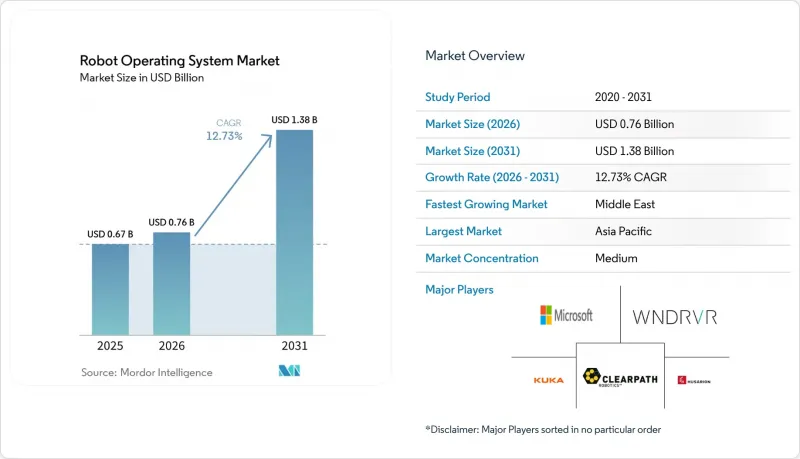
본 보고서는 로봇의 유형(산업용 로봇, 서비스 로봇), 최종 사용자 산업(자동차 산업 등), 구성 요소(소프트웨어 스택, 서비스), 도입 형태(On-Premise, 클라우드), OS 분포(ROS 1 등), 하드웨어 아키텍처 지원(x86 등), 지역별로 분류되어 있습니다. 시장 전망은 금액(달러) 기준으로 제시되어 있습니다.
세계의 로봇 운영체제 시장 동향 및 인사이트
자동차 조립 라인에서 ROS 호환 코봇의 도입 확대
각 자동차 제조업체들은 택트 타임 개선과 숙련된 인력 부족 문제에 대응하기 위해 협동 로봇 도입을 확대되고 있습니다. 폭스바겐, 제너럴 모터스, 테슬라는 접착, 검사, 나사 조임 작업에 ROS 기반의 코봇을 도입하여 작업 스테이션의 처리 능력을 향상시키는 동시에 높은 첫 번째 검사 합격률을 유지하고 있습니다. 스텔란티스는 미라피오리 공장에서 모바일 매니퓰레이터를 증강현실(AR) 기반 안내 시스템 및 디지털 트윈의 피드백과 연동함으로써 조립 효율을 27% 향상시켰습니다. ROS 2로 구성된 코봇은 DDS 미들웨어의 이점을 누리고 있으며, 이를 통해 단일 고장 지점이 제거되고 안전 매개변수의 실시간 업데이트가 가능해집니다. 시장의 성장은 센서 비용의 하락과 혼합 모델 생산 라인의 통합 시간을 단축하는 플러그 앤 플레이 방식의 툴링과 계속해서 밀접한 관련이 있습니다.
클라우드 기반 시뮬레이션 플랫폼의 확대
산업용 개발자들은 공장 현장에 하드웨어를 도입하기 전에 가상 환경에서 로봇의 전체 작업 부하를 검증하는 경우가 늘고 있습니다. 'FogROS2-FT' 프레임워크는 계산 부하가 높은 동작 계획 쿼리를 여러 클라우드 엔드포인트로 오프로드함으로써 시뮬레이션 비용을 2.2배 절감하고, 내결함성을 강화합니다. AWS RoboMaker 및 유사한 서비스는 지속적 통합(CI) 트리거 기능을 갖추고 있어, 코드를 커밋할 때마다 자동 회귀 테스트가 실행되므로 개발 스프린트 기간을 단축할 수 있습니다. 개발자들은 이러한 파이프라인을 활용하여 실제 생산 라인을 중단하지 않고도 지각 및 조작 알고리즘을 반복적으로 개발함으로써, 신규 SKU의 가동 시작까지 걸리는 기간을 단축하고 있습니다.
분산형 ROS 네트워크의 사이버 보안 취약점
ROS 1의 노드는 위장이나 재전송의 가능성이 있는 암호화되지 않은 TCPROS 토픽에 의존하고 있어, 안전상 중요한 액추에이터가 위험에 노출될 수 있습니다. ROS 2에는 DDS를 통해 인증 및 접근 제어 플러그인이 내장되어 있지만, 로봇 군이 여러 VLAN에 걸쳐 있는 경우 설정 오류가 여전히 빈번하게 발생하고 있습니다. 최근 침투 테스트 결과, 의료용 로봇 도입 환경에서 인증서 관리가 미흡한 것으로 드러났으며, 이에 따라 운영자들은 제로 트러스트 정책, 네트워크 세분화 및 실시간 이상 감지 시스템을 도입하도록 권고받고 있습니다. 업계 단체들은 현재 보안 강화 가이드를 발간하고 있지만, 중소규모 제조업체의 경우 권장되는 패치를 적용할 사이버 보안 담당자가 부족한 사례가 적지 않습니다.
부문별 분석
산업용 로봇은 2025년 매출의 56.40%를 차지했으며, 이는 용접, 팔레타이징, CNC 가공 보조 작업 등에서의 오랜 활용 실적을 반영한 것입니다. 파낙(FANUC)의 누적 출하 대수 100만 대라는 이정표는 그 규모와 도입 기반의 성숙도를 입증하고 있습니다. 이 도입 대수 중 협동 로봇은 자동차 업계 도입량의 4분의 1을 차지하고 있으며, 다양한 차종이 혼재된 생산 라인에서 인간과 기계의 협업으로의 전환 추세가 두드러지고 있습니다. 서비스 로봇, 특히 물류용 AMR과 병원 내 배송 로봇은 전자상거래 주문 처리 분야 수요 증가와 환자 치료의 질 향상을 위한 노력에 힘입어 2031년까지 연평균 성장률(CAGR) 16.55%를 나타낼 것으로 전망됩니다.
서비스 분야의 성장세는 진열대 보충 및 자율 청소를 위해 AI 비전 기술과 결합된 내비게이션 지원 플랫폼의 도입 증가에서 뚜렷이 드러나고 있습니다. 각 벤더사는 ROS 2의 실시간 품질 보증 설정을 활용하여 대규모 시설 전체에서 SLAM 맵의 일관성을 유지하고 있습니다. 전문 환경을 위한 서비스 유닛 분야의 로봇 운영체제 시장 규모는 구독 요금이 시설 관리 예산과 조화를 이루게 됨에 따라 급속히 확대될 것으로 전망됩니다. 산업용 제조업체들은 분석 대시보드를 함께 제공하는 경향이 강해지고 있으며, 가동 시간 지표를 향상시키는 예측 유지보수 기능을 추가하고 있습니다.
자동차 제조업체는 2025년 매출의 23.60%라는 압도적인 점유율을 차지했으며, ROS 기반의 모션 플래닝 및 품질 검사 파이프라인을 활용하여 생산 라인의 가동을 중단시키지 않고 더 많은 모델 변종을 관리하고 있습니다. 헥사포드를 활용한 정렬 시스템은 주행 보조 기능에 필요한 헤드램프 보정 및 광학 센서의 위치 설정을 지원합니다. 커넥티드 자율주행차의 실증 실험에서는 ROS 2를 통해 동기화된 AMR 태그가 적시에 부품 용기를 보충함으로써 라인 말단 스테이션 전체의 처리량을 향상시키는 모습이 더욱 명확히 드러났습니다.
의료 분야는 연평균 성장률(CAGR) 15.62%를 기록하며 가장 급격한 성장을 보이고 있습니다. ROS 기반의 수술 보조 시스템은 결정론적 루프 타이밍을 활용하여 다축 공구 경로를 조정함으로써, 엄격한 운동학적 정밀도 목표를 달성하고 있습니다. PeTRA와 같은 병원 물류 플랫폼은 ROS 2와 첨단 HRI(인간-로봇 상호작용) 모듈을 결합하여, 인파 속을 이동하거나 환자의 생체 신호에 실시간으로 대응합니다. 의료 기관들이 수술실의 디지털화를 추진함에 따라, 의료용 로봇용 로봇 운영체제 시장 규모는 진단 및 재활 분야로 확대될 것으로 예측됩니다.
지역별 분석
아시아태평양은 중국, 일본, 한국의 대규모 자동화 투자에 힘입어 2025년에는 전 세계 매출의 37.65%를 차지했습니다. 상하이에서 개최된 ‘ROSCon China’에는 200개 이상의 기업이 참가하여 현지 커뮤니티의 탄탄함을 보여주었습니다. 정부의 자금 지원이 도입을 가속화하고 있습니다. 한국의 ‘Tech Valley’ 보조금 제도는 소량 생산 전자기기 공장을 위한 AI 추론 가속기를 지원하고 있는 반면, 싱가포르의 ‘ART C’ 테스트베드에서는 첨단 3D 비전 라이브러리의 시범 운영이 진행되고 있습니다. 해당 지역의 로봇 운영체제 시장 규모는 국내 공급업체들이 아세안(ASEAN)의 제조 거점으로 저비용 로봇 팔을 확대해 나감에 따라, 이와 비슷한 속도로 성장을 이어갈 것으로 전망됩니다.
중동은 2031년까지 연평균 성장률(CAGR) 16.78%를 기록하며 가장 높은 성장률을 보이고 있습니다. 사우디아라비아의 ‘비전 2030’이나 UAE의 ‘오퍼레이션 300bn’과 같은 국가 프로그램은 탄화수소 의존에서 벗어나 경제 다각화를 도모하기 위해 로봇 공학에 주력하고 있습니다. 두바이 정부의 지원을 받는 실증 구역에서는 규제 준수 절차가 간소화되어 있어, 창고 로봇이나 수술용 로봇을 신속하게 시범 도입할 수 있습니다. 지역 시스템 통합사업자들은 유럽의 부품 제조업체들과 제휴하여 공급망의 현지화를 추진함으로써 자급자족 목표 달성을 뒷받침하고 있습니다.
북미는 ROS의 주요 유지보수 담당자와 하이퍼스케일 클라우드 제공업체를 보유하고 있어, 계속해서 혁신의 핵심 거점으로 자리매김하고 있습니다. ROS-Industrial Consortium Americas는 항공우주, 석유 및 가스, 식품 가공 등 다양한 분야에 걸쳐 있는 회원 기업들에게 오픈소스 품질 보증 파이프라인을 소개했습니다. 대학에서는 적응형 조작 기술에 관한 연구를 스핀오프 기업으로 이어가고, 벤처 캐피털을 확보함으로써 풍부한 스타트업 파이프라인을 유지하고 있습니다. 수요는 생산의 국내 복귀(리쇼어링) 노력과 첨단 제조 설비에 대한 세제 혜택에 힘입어 더욱 확대되고 있습니다.
유럽에서는 산업용 로봇의 도입 밀도가 높은 데다, 정부가 사이버 보안을 고려한 자동화를 의무화하고 있습니다. 독일 한 나라만으로도 유럽 내 도입 대수의 3분의 1을 차지하고 있으며, ‘인더스트리 4.0’ 프레임워크의 일환으로 ROS 기반의 기존 설비 개조를 추진하고 있습니다. 스페인과 헝가리 등 일부 국가에서는 2024년에 로봇 보유 대수가 두 자릿수 증가를 기록했습니다. 오덴세에서 개최되는 컨퍼런스에서는 공동 연구 개발이 중시되고 있으며, 덴마크의 협업 로봇 제조업체와 AI 연구자들이 협력하여 적응형 픽 앤 플레이스 기능의 상용화를 추진하고 있습니다.
기타 혜택 :
- 엑셀 형식 시장 예측(ME) 시트
- 3개월간의 애널리스트 지원
자주 묻는 질문
목차
제1장 서론
제2장 조사 방법
제3장 주요 요약
제4장 시장 구도
제5장 시장 규모 및 성장 예측
제6장 경쟁 구도
제7장 시장 기회 및 향후 전망
KTH 26.06.29According to Mordor Intelligence, the robot operating system market size in 2026 is estimated at USD 0.76 billion, growing from 2025 value of USD 0.67 billion with 2031 projections showing USD 1.38 billion, growing at 12.73% CAGR over 2026-2031.
This report is Segmented by Robot Type (Industrial Robots, Service Robots), End-User Industry (Automotive, and More), Component (Software Stack, Services), Deployment Mode (On-Premise, Cloud), Operating System Distribution (ROS 1, and More), Hardware Architecture Support (x86, and More) and by Geography. The Market Forecasts are Provided in Terms of Value (USD).
Global Robot Operating System Market Trends and Insights
Growing Adoption of ROS-enabled Cobots in Automotive Assembly Lines
Automotive groups are boosting collaborative-robot deployment to improve takt times and address skilled-labour gaps. Volkswagen, General Motors, and Tesla have integrated ROS-based cobots for gluing, inspection, and screw-fastening tasks, lifting station throughput and maintaining high first-pass yields. Stellantis demonstrated a 27% assembly-efficiency gain by synchronizing mobile manipulators with augmented-reality guidance and digital-twin feedback at its Mirafiori plant. Cobots configured with ROS 2 benefit from DDS middleware, which removes single points of failure and enables live safety-parameter updates. Growth remains linked to falling sensor costs and plug-and-play tooling that cuts integration time for mixed-model lines.
Expansion of Cloud-based Simulation Platforms
Industrial developers increasingly validate full robot workloads in virtual environments before placing hardware on a factory floor. The FogROS2-FT framework offloads compute-heavy motion-planning queries to multiple cloud endpoints, reducing simulation costs by 2.2X and strengthening fault tolerance. AWS RoboMaker and similar services attach continuous-integration hooks, so each code commit triggers automated regression tests, shortening development sprints. Developers use these pipelines to iterate perception and grasping algorithms without halting physical production lines, accelerating go-live timelines for new SKUs.
Cyber-Security Vulnerabilities in Distributed ROS Networks
ROS 1 nodes rely on unencrypted TCPROS topics that can be spoofed or replayed, exposing safety-critical actuators. Although ROS 2 embeds authentication and access-control plugins through DDS, misconfigurations remain common when fleets span multiple VLANs. Recent penetration tests revealed weak certificate management in healthcare robotics deployments, prompting operators to institute zero-trust policies, segmented networks, and real-time anomaly detection. Industry consortia now issue hardening guides, yet small and medium manufacturers often lack cyber-security personnel to apply recommended patches.
Other drivers and restraints analyzed in the detailed report include:
- Surge in Government-Funded Robotics Testbeds
- Integration of ROS 2 with 5G and Edge-AI for AMRs
- Scarcity of Certified ROS Talent in Emerging Markets
For complete list of drivers and restraints, kindly check the Table Of Contents.
Segment Analysis
Industrial robots contributed 56.40% of 2025 revenue, reflecting long-established use in welding, palletizing, and CNC tending tasks. FANUC's one-millionth unit milestone underscores the scale and installed base maturity. Within that cohort, cobots represent one-quarter of automotive deployments, highlighting the push toward human-machine collaboration on mixed-model lines. Service robots, particularly logistics AMRs and hospital couriers, are set to post a 16.55% CAGR through 2031, propelled by e-commerce fulfilment pressures and patient-care quality initiatives.
Service-segment momentum is evident in rising deployments of navigation-ready platforms paired with AI vision for shelf-restocking and autonomous cleaning. Vendors leverage ROS 2's real-time quality-of-service settings to keep SLAM maps consistent across large facilities. The Robot operating system market size for service units serving professional environments is forecast to expand rapidly as subscription pricing aligns with facility-management budgets. Industrial manufacturers increasingly bundle analytics dashboards, adding predictive-maintenance overlays that sharpen uptime metrics.
Automotive producers accounted for a commanding 23.60% slice of 2025 revenue, using ROS-based motion planning and quality-inspection pipelines to manage higher model variants without line stoppages. Hexapod alignment systems support headlamp calibration and optical-sensor positioning needed for driver-assistance features. Connected automated vehicle demonstrators further show how AMR tuggers synchronized by ROS 2 can replenish parts bins just-in-time, lifting throughput across end-of-line stations.
Healthcare records the steepest ascent with a 15.62% CAGR. ROS-based surgical assistants employ deterministic loop timing to coordinate multi-axis tool paths, meeting stringent kinematic accuracy targets. Hospital logistics platforms such as PeTRA combine ROS 2 with advanced HRI modules to navigate crowds and respond to patient vitals in real time. As providers digitize operating rooms, the Robot operating system market size for healthcare robotics is expected to broaden into diagnostics and rehabilitation.
Geography Analysis
Asia-Pacific held 37.65% of global revenue in 2025 due to heavy automation investment in China, Japan, and South Korea. Shanghai's ROSCon China attracted more than 200 firms, signifying local community depth. Government funding accelerates adoption: South Korea's Tech Valley subsidies underwrite AI inference accelerators for small-batch electronics plants, while Singapore's ART C testbeds trial advanced 3D vision libraries. The Robot operating system market size in the region is projected to keep pace as domestic suppliers extend low-cost arms into ASEAN manufacturing corridors.
The Middle East records the fastest 16.78% CAGR through 2031. National programs such as Saudi Arabia's Vision 2030 and the UAE's Operation 300bn lean on robotics to diversify away from hydrocarbons. Government-backed demonstration zones in Dubai simplify regulatory compliance, allowing rapid pilot launch for warehouse and surgical robots. Regional system integrators partner with European component makers to localize supply chains, reinforcing self-sufficiency goals.
North America remains an innovation nucleus, hosting core ROS maintainers and hyperscale cloud providers. The ROS-Industrial Consortium Americas showcases open-source quality-assurance pipelines to a membership spanning aerospace, oil & gas, and food processing. Universities funnel research on adaptive manipulation into spin-offs that secure venture capital, sustaining a rich start-up pipeline. Demand is further buoyed by reshoring initiatives and tax incentives for advanced manufacturing equipment.
Europe combines strong industrial-robot density with government mandates for cyber-secure automation. Germany alone houses one-third of Europe's installed base and pushes ROS-based retrofits as part of its Industrie 4.0 framework. Countries such as Spain and Hungary logged double-digit robot-stock growth in 2024. Conferences in Odense underscore collaborative R&D, linking Danish cobot makers with AI researchers to commercialize adaptive pick-and-place functions.
- Microsoft Corporation
- Amazon Web Services Inc.
- Clearpath Robotics Inc.
- KUKA AG
- Bosch Rexroth AG
- ABB Ltd.
- FANUC Corp.
- Yaskawa Electric Corp.
- Universal Robots A/S
- Open Robotics (Intrinsic)
- Wind River Systems Inc.
- Husarion Inc.
- Brain Corporation
- Neobotix GmbH
- PAL Robotics SL
- Locus Robotics Corp.
- Milvus Robotics
- iRobot Corporation
- Omron Corporation
- Siasun Robot & Automation
- Fetch Robotics (Zebra)
- Teradyne Mobility (AGV)
Additional Benefits:
- The market estimate (ME) sheet in Excel format
- 3 months of analyst support
TABLE OF CONTENTS
1 INTRODUCTION
- 1.1 Study Assumptions and Market Definition
- 1.2 Scope of the Study
2 RESEARCH METHODOLOGY
3 EXECUTIVE SUMMARY
4 MARKET LANDSCAPE
- 4.1 Market Overview
- 4.2 Market Drivers
- 4.2.1 Growing Adoption of ROS-enabled Cobots in Automotive Assembly Lines (Asia)
- 4.2.2 Expansion of Cloud-based Simulation Platforms (North America and Europe)
- 4.2.3 Surge in Government-funded Robotics Testbeds (APAC and Middle East)
- 4.2.4 Integration of ROS 2 with 5G & Edge-AI for AMRs (Global)
- 4.2.5 Rapid Proliferation of Open-Source Industrial Libraries (ROS-Industrial)
- 4.2.6 Vendor Shift toward Long-Term Support (LTS) Distributions
- 4.3 Market Restraints
- 4.3.1 Cyber-Security Vulnerabilities in Distributed ROS Networks
- 4.3.2 Fragmented Hardware Abstraction Layers Across OEMs
- 4.3.3 Scarcity of Certified ROS Talent in Emerging Markets
- 4.3.4 Real-Time Determinism Challenges in Safety-Critical Apps
- 4.4 Value / Supply-Chain Analysis
- 4.5 Technological Outlook
- 4.6 Porter's Five Forces Analysis
- 4.6.1 Bargaining Power of Suppliers
- 4.6.2 Bargaining Power of Consumers
- 4.6.3 Threat of New Entrants
- 4.6.4 Threat of Substitutes
- 4.6.5 Intensity of Competitive Rivalry
5 MARKET SIZE AND GROWTH FORECASTS (VALUE)
- 5.1 By Robot Type
- 5.1.1 Industrial Robots
- 5.1.1.1 Articulated
- 5.1.1.2 SCARA
- 5.1.1.3 Parallel/Delta
- 5.1.1.4 Cartesian/Linear
- 5.1.1.5 Collaborative Robots (Cobots)
- 5.1.2 Service Robots
- 5.1.2.1 Professional Service Robots
- 5.1.2.1.1 Logistics Robots
- 5.1.2.1.2 Healthcare and Medical Robots
- 5.1.2.1.3 Defense and Security Robots
- 5.1.2.1.4 Agricultural Robots
- 5.1.2.2 Personal and Domestic Service Robots
- 5.1.2.1 Professional Service Robots
- 5.1.1 Industrial Robots
- 5.2 By End-user Industry
- 5.2.1 Automotive
- 5.2.2 Electrical and Electronics
- 5.2.3 Healthcare and Life Sciences
- 5.2.4 E-commerce and Logistics
- 5.2.5 Aerospace and Defense
- 5.2.6 Food and Beverage
- 5.2.7 Agriculture
- 5.2.8 Education and Research
- 5.2.9 Others (Metal, Plastics, etc.)
- 5.3 By Component
- 5.3.1 Software Stack
- 5.3.1.1 Core ROS Libraries
- 5.3.1.2 Middleware / Communication Tools
- 5.3.1.3 Simulation & Visualization (Gazebo, RViz)
- 5.3.2 Services
- 5.3.2.1 System Integration and Consulting
- 5.3.2.2 Support and Maintenance
- 5.3.2.3 Training and Certification
- 5.3.1 Software Stack
- 5.4 By Operating System Distribution
- 5.4.1 ROS 1
- 5.4.2 ROS 2
- 5.4.3 Other Variants (ROS-Industrial, micro-ROS)
- 5.5 By Deployment Mode
- 5.5.1 On-premise
- 5.5.2 Cloud-based (ROS-aaS)
- 5.6 By Geography
- 5.6.1 North America
- 5.6.1.1 United States
- 5.6.1.2 Canada
- 5.6.1.3 Mexico
- 5.6.2 South America
- 5.6.2.1 Brazil
- 5.6.2.2 Argentina
- 5.6.2.3 Rest of South America
- 5.6.3 Europe
- 5.6.3.1 Germany
- 5.6.3.2 United Kingdom
- 5.6.3.3 France
- 5.6.3.4 Italy
- 5.6.3.5 Spain
- 5.6.3.6 Rest of Europe
- 5.6.4 Nordics
- 5.6.4.1 Sweden
- 5.6.4.2 Norway
- 5.6.4.3 Denmark
- 5.6.4.4 Finland
- 5.6.4.5 Iceland
- 5.6.5 Middle East
- 5.6.5.1 GCC
- 5.6.5.2 Turkey
- 5.6.5.3 Rest of Middle East
- 5.6.6 Africa
- 5.6.6.1 South Africa
- 5.6.6.2 Rest of Africa
- 5.6.7 Asia-Pacific
- 5.6.7.1 China
- 5.6.7.2 Japan
- 5.6.7.3 South Korea
- 5.6.7.4 India
- 5.6.7.5 Indonesia
- 5.6.7.6 Rest of Asia-Pacific
- 5.6.1 North America
6 COMPETITIVE LANDSCAPE
- 6.1 Market Concentration
- 6.2 Strategic Moves
- 6.3 Market Share Analysis
- 6.4 Company Profiles (includes Global level Overview, Market level overview, Core Segments, Financials as available, Strategic Information, Market Rank/Share for key companies, Products & Services, and Recent Developments)
- 6.4.1 Microsoft Corporation
- 6.4.2 Amazon Web Services Inc.
- 6.4.3 Clearpath Robotics Inc.
- 6.4.4 KUKA AG
- 6.4.5 Bosch Rexroth AG
- 6.4.6 ABB Ltd.
- 6.4.7 FANUC Corp.
- 6.4.8 Yaskawa Electric Corp.
- 6.4.9 Universal Robots A/S
- 6.4.10 Open Robotics (Intrinsic)
- 6.4.11 Wind River Systems Inc.
- 6.4.12 Husarion Inc.
- 6.4.13 Brain Corporation
- 6.4.14 Neobotix GmbH
- 6.4.15 PAL Robotics SL
- 6.4.16 Locus Robotics Corp.
- 6.4.17 Milvus Robotics
- 6.4.18 iRobot Corporation
- 6.4.19 Omron Corporation
- 6.4.20 Siasun Robot & Automation
- 6.4.21 Fetch Robotics (Zebra)
- 6.4.22 Teradyne Mobility (AGV)
7 MARKET OPPORTUNITIES AND FUTURE OUTLOOK
- 7.1 White-space and Unmet-Need Assessment


