|
시장보고서
상품코드
2066535
표면 소독제 : 시장 점유율 분석, 업계 동향 및 통계, 성장 예측(2026-2031년)Surface Disinfectant - Market Share Analysis, Industry Trends & Statistics, Growth Forecasts (2026 - 2031) |
||||||
 Mordor Intelligence
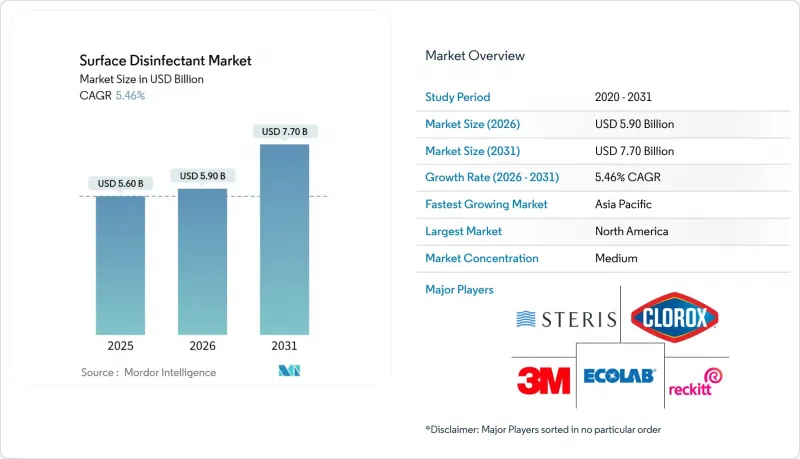
Mordor Intelligence에 의하면, 표면 소독제 시장 규모는 2025년 56억 달러로 평가되었습니다. 2026년에는 59억 달러로 확대되어 2031년까지 77억 달러에 이를 것으로 예상되며 2026년부터 2031년에 걸쳐 CAGR 5.46%로 성장할 전망입니다.
본 보고서는 화학 성분(4급 암모늄 화합물 등), 형태(액체 등), 용도(표면 소독 등), 최종 사용자(병원 및 진료소 등), 유통 채널(의료 기관에 대한 직접 판매 등) 및 지역(북미 등)별로 분류되어 있습니다. 시장 규모 및 전망은 금액(달러) 기준으로 제시되어 있습니다.
세계의 표면 소독제 시장 동향 및 인사이트
병원 내 감염 발생률 증가
세계의 병원들은 중심정맥 카테터, 카테터 및 수술 부위와 관련된 감염을 줄여야 한다는 지속적인 압박에 직면해 있습니다. 이러한 감염병들은 미국의 의료 시스템에 연간 280억-450억 달러의 재정적 부담을 안겨주고 있습니다. 2024년 감시 데이터에 따르면, 중심정맥카테터 관련 감염은 9% 감소했으며, 카테터 관련 감염은 10% 감소했습니다. 그러나 복강경 자궁적출술 후 수술 부위 감염이 8% 증가했으며, 일반적인 QAC 프로토콜로는 수술 특유의 감염 경로를 효과적으로 대처하지 못할 가능성이 드러났습니다. 저·중소득국의 환자들은 부유한 국가의 환자들에 비해 최대 20배나 높은 감염 위험에 노출되어 있습니다. 그 결과, 고소득 국가 시장에서는 과산화수소와 알코올의 혼합제가 주류를 이루고 있는 반면, 기타 지역에서는 차아염소산나트륨 용액이 비용 면에서 우위를 유지하고 있습니다. 또한, 메디케어는 감염률이 가장 높은 4분위에 속하는 병원에 대해 지급액의 최대 3%를 공제하는 벌칙을 부과하고 있어, 감염 예방은 수익을 보호하고 고품질 소독제에 대한 투자를 정당화하는 데 있어 매우 중요한 요소가 되고 있습니다. 이러한 요인들이 복합적으로 작용하여 표면 소독제 시장의 지속적인 성장세를 뒷받침하고 있습니다.
외과 수술 건수 및 만성 질환 환자 입원 건수 증가
2030년까지 전 세계 수술 건수는 연간 4억 건을 넘어설 것으로 예측됩니다. 이는 고령화의 진행과 중국, 인도 등 주요 시장에서 의료 서비스 접근성이 확대된 데 기인합니다. 미국에서는 현재 복부 선택 수술의 60% 이상이 최소 침습 수술로 시행되고 있습니다. 아시아태평양에서는 당뇨병, 심혈관 질환, 호흡기 질환 등 만성 질환으로 인한 입원 환자 수가 연간 4-5%의 속도로 증가하고 있습니다. 이러한 추세로 인해 입원 기간이 길어지면서, 병상 1일당 화학약품 소비량이 증가하고 있습니다. 2024년, 미국의 외래 진료 센터에서는 2,800만 건의 수술이 이루어졌으며, 이는 2020년의 2,300만 건에서 증가한 수치입니다. 이러한 시설들은 입원 병동과 동일한 조인트 커미션(Joint Commission)의 프로토콜을 준수해야 하며, 이로 인해 표면 소독제 시장이 더욱 확대되고 있습니다.
염소계 및 QAC계 화학물질에 대한 독성 및 환경적 측면의 면밀한 검토
2024년, 미국 환경보호청(EPA)은 수생 독성 관련 위반을 이유로 14종의 QAC 계열 농약 제품에 대한 규제안을 제안했습니다. 동시에 캘리포니아주는 QAC를 라벨 전면에 표시하도록 의무화함으로써, 과산화수소나 과초산 등의 대체 물질로의 전환을 가속화하고 있습니다. 2025년에는 유럽 규제 당국이 벤잘코늄 및 디데실디메틸암모늄 클로라이드에 대한 재검토를 실시했으며, 2027년까지 EU 전역에 걸쳐 농도 제한이 도입될 가능성이 있습니다. 또한, 2024년에 발표된 동료 심사를 거친 연구에 따르면 병원 폐수에서 QAC 내성 유전자가 확인되었으며, 각 위원회는 화학 약제의 순환 사용을 더욱 빈번히 실시할 것을 권고받고 있습니다.
부문별 분석
과산화수소 및 과초산 용액은 유효 성분 중 가장 빠른 연평균 성장률(CAGR) 7.80%를 기록하며 성장하고 있으며, 2031년까지 표면 소독제 시장 규모의 25억 5,000만 달러를 차지할 것으로 전망됩니다. 알코올계 제품은 즉효성이 있고 헹굴 필요가 없다는 점 때문에 2025년에도 매출 1위를 유지했으나, 가연성 및 표면 건조와 관련된 우려로 인해 전자기기 공장이나 식품 공장에의 보급은 제한적입니다. 4급 암모늄 화합물은 과산화물 계열 제품보다 30-50% 저렴하기 때문에 비용을 중시하는 지역에서는 여전히 주류를 이루고 있지만, 규제 당국의 감시가 강화됨에 따라 북미와 유럽의 구매자들은 과산화물 계열이나 알코올 계열 혼합 제품으로 전환하고 있습니다.
2025년, 액상 농축액은 표면 소독제 시장에서 43.2%의 점유율을 차지했으며, 높은 비용 대비 효과 덕분에 시장 규모 측면에서 가장 큰 제형 부문이 되었습니다. 시설 측에서는 투여량의 정확성이 감사 규정 준수에 기여하기 때문에 바닥 걸레 세척 시스템이나 중앙 희석 스테이션에 액상 제제를 선호하여 채택하고 있습니다. 부수적인 이점으로, 대용량 포장을 통해 포장 폐기물의 양이 줄어들어 헬스케어 분야의 지속가능성 노력과 부합할 뿐만 아니라, 간접적으로 매립지 추가 비용 발생을 억제합니다. 액체를 기준으로 유지함으로써, 공급업체는 예측 가능한 원자재 조달을 확보할 수 있으며, 이는 이익률 변동을 완화하는 요인이 됩니다. 스프레이 및 에어로졸 시장은 2031년까지 연평균 성장률(CAGR) 8.5%를 나타낼 것으로 예측되며, 표면 소독제 업계에서 가장 빠르게 성장하는 제형 부문이 될 전망입니다.
지역별 분석
북미는 2025년 표면 소독제 시장에서 34.7%의 점유율을 유지했습니다. 이는 감염 예방 지표와 자금 지원 수준을 연계하는 상환 규정에 따라 수요가 사실상 제도화되어 있기 때문입니다. 병원 구매 부서는 액상 농축액, 즉시 사용 가능한 물티슈, 정전기 분무기용 액체를 단일 계약으로 묶은 입찰을 점점 더 많이 발주하고 있으며, 이러한 구조는 종합적인 제품 포트폴리오를 제공하는 공급업체에 유리하게 작용하고 있습니다. 또한, 이 지역은 격리실에서 과산화수소 증기를 이용한 제염 방식을 도입한 선구적인 사례이기도 하며, 이를 통해 제염 대상 면적 1제곱미터당 평균 수익이 증가하고 있습니다. 공급업체들은 주 정부 조달 담당 팀이 현재 유효성 데이터 외에도 탄소 발자국 공개를 요구하고 있다는 점에 주목하고 있으며, 이는 환경 지표가 조만간 가격과 마찬가지로 입찰 평가에 큰 영향을 미칠 가능성이 있음을 시사합니다.
아시아태평양은 2025년부터 2030년에 걸쳐 연평균 성장률(CAGR) 8.9%를 나타낼 것으로 예측되며, 이는 표면 소독제 시장에서 지역별 가장 빠른 성장 속도입니다. 중국, 인도, 인도네시아에서 신규 병원 건설을 지원하는 정부의 인센티브가 소독제 공급업체와의 초기 단계 기본 계약으로 이어지면서, 장기적인 수익 전망이 확립되었습니다. 현지 제조업체들은 세분화된 유통 네트워크에 대한 깊은 이해를 바탕으로 지방 도시의 입찰을 따내고 있지만, 3급 수준의 시설에서는 여전히 고급 국제 브랜드가 지배적인 위치를 차지하고 있습니다. 건축기준법에 따라 소독제 저장·공급 시스템이 설비에 포함되어야 할 의무가 부과됨에 따라, 건축 입찰 단계에서 약제의 사양이 사전에 확정되게 되었으며, 이러한 미묘한 변화가 판매 주기의 순서를 재구성하고 있습니다. 제약용 클린룸 및 의료기기 공장에서 발생하는 추가 수요는 병행되는 산업용 수익원이 되며, 공급업체는 두 최종 시장 전반에 걸쳐 제제 연구개발비용을 상각할 수 있게 됩니다.
유럽은 여전히 규제 분야의 지표 역할을 하고 있으며, 성분 제한 및 유효성 시험 프로토콜을 주도하고 있는데, 이러한 기준들은 종종 세계적 기준을 앞서가고 있습니다. 지역 차원의 순환형 포장 방식에 대한 집중적인 노력은 농축 리필 제품과 골판지 캐니스터의 보급을 촉진하고 있으며, 이러한 관행은 그 효과가 입증되면 북미으로도 확산될 것입니다. 자본 예산 부족에 직면한 남유럽 및 동유럽의 병원들은 중요도가 낮은 구역에는 기존의 염소계 용액을, 중환자실에는 과산화수소계 물티슈를 조합한 혼합 방식을 채택하고 있으며, 이는 비용 계층화 전략이 공급업체의 제품 포트폴리오를 어떻게 형성하고 있는지를 보여줍니다. 2024년 3월, 유럽화학물질청(ECHA)은 4급 암모늄 화합물의 재분류안을 제시했습니다. 이러한 움직임은 제품의 재처방 주기를 가속화하고, 대체 유효 성분에 대한 수요를 촉진할 가능성이 있습니다. 단일 지불자 제도에서 혼합 제도에 이르기까지, 유럽 대륙의 다양한 보상 구조는 국가별로 가치 제안을 교묘하게 조정할 수 있는 공급자에게 유리한, 조각보 같은 시장을 만들어내고 있습니다.
기타 혜택 :
- 엑셀 형식 시장 예측(ME) 시트
- 3개월간의 애널리스트 지원
자주 묻는 질문
목차
제1장 서론
제2장 조사 방법
제3장 주요 요약
제4장 시장 구도
제5장 시장 규모 및 성장 예측
제6장 경쟁 구도
제7장 시장 기회 및 향후 전망
KTH 26.06.29According to Mordor Intelligence, the surface disinfectant market size is expected to increase from USD 5.60 billion in 2025 to USD 5.90 billion in 2026 and reach USD 7.70 billion by 2031, growing at a CAGR of 5.46% over 2026-2031.
This report is Segmented by Chemical Composition (Quaternary Ammonium Compounds, and More), Form (Liquids, and More), Application (Surface Disinfection, and More), End-User (Hospitals & Clinics, and More), Distribution Channel (Direct Institutional Sales, and More), and Geography (North America, and More). The Market Sizes and Forecasts are Provided in Terms of Value (USD).
Global Surface Disinfectant Market Trends and Insights
Rising Incidence of Hospital-Acquired Infections
Hospitals globally face ongoing pressure to reduce infections associated with central lines, catheters, and surgical sites. These infections impose an annual financial burden of USD 28 to 45 billion on the U.S. healthcare system. In 2024, surveillance data indicated a 9% decline in central-line infections and a 10% reduction in catheter-related infections. However, surgical-site infections following abdominal hysterectomies increased by 8%, highlighting that generalized QAC protocols may fail to address procedure-specific infection vectors. Patients in low- and middle-income countries experience infection risks up to 20 times higher than those in wealthier nations. As a result, peroxide and alcohol blends dominate high-income markets, while hypochlorite solutions maintain cost leadership in other regions. Additionally, Medicare penalizes hospitals in the highest infection quartile by withholding up to 3% of payments, making infection prevention a critical factor in protecting revenue and justifying investments in premium disinfectants. These factors collectively drive the surface disinfectant market's sustained growth trajectory.
Growth in Surgical Procedures & Chronic-Care Admissions
By 2030, global surgical volumes are expected to surpass 400 million annually, driven by aging populations and expanded healthcare access in key markets such as China and India. In the United States, minimally invasive techniques now account for over 60% of elective abdominal procedures. In the Asia-Pacific region, hospital admissions for chronic conditions, including diabetes, cardiovascular, and pulmonary diseases, are increasing by 4-5% annually. This trend is extending hospital stays and driving higher chemistry consumption per bed-day. In 2024, outpatient centers in the United States performed 28 million procedures, up from 23 million in 2020. These facilities are required to comply with the same Joint Commission protocols as inpatient wards, further expanding the market for surface disinfectants.
Toxicity & Environmental Scrutiny of Chlorine & QAC Chemistries
In 2024, the U.S. EPA proposed restrictions on 14 QAC pesticide products due to violations related to aquatic toxicity. At the same time, California introduced requirements for front-label disclosures of QACs, accelerating the transition toward alternatives like hydrogen peroxide and peracetic acid. In 2025, European regulators are set to review benzalkonium and didecyldimethylammonium chloride, with potential EU-wide concentration limits anticipated by 2027. Furthermore, peer-reviewed studies in 2024 identified QAC-resistance genes in hospital wastewater, driving committees to adopt more frequent rotations of chemical formulations.
Other drivers and restraints analyzed in the detailed report include:
- Stringent Infection-Control Regulations in Emerging Markets
- Post-Pandemic Hygiene-Budget Normalization at Elevated Baseline
- Emergence of Disinfectant-Tolerant Microbial Strains
For complete list of drivers and restraints, kindly check the Table Of Contents.
Segment Analysis
Hydrogen peroxide and peracetic acid solutions are expanding at a 7.80% CAGR, the swiftest among actives, and are on track to capture USD 2.55 billion of the surface disinfectant market size by 2031. Alcohols remained the revenue leader in 2025 because they offer quick kill and no rinse, but flammability and surface-drying concerns limit penetration in electronics and food plants. Quaternary ammonium compounds still dominate cost-sensitive geographies because they undercut peroxide prices by 30-50%, although rising regulatory scrutiny is nudging North American and European buyers toward peroxide and alcohol blends.
In 2025, liquid concentrates commanded a 43.2% share of the Surface Disinfectants market, making them the largest formulation segment by market size, thanks to their cost-to-coverage efficiency. Facilities prefer liquids for floor-mopping systems and central dilution stations because dosing precision supports audit compliance. A side benefit is that large packs reduce packaging disposal volumes, aligning with healthcare sustainability pledges and indirectly limiting landfill surcharges. By retaining liquids as the baseline, vendors secure predictable raw-material purchasing, a factor that cushions margin volatility. Sprays and aerosols are projected to grow at an 8.5% CAGR through 2031, making them the fastest-growing formulation segment within the Surface Disinfectants industry.
Geography Analysis
North America retained a 34.7% share of the surface disinfectants market in 2025, with reimbursement rules tying infection-prevention metrics to funding levels, effectively institutionalising demand. Hospital purchasing groups increasingly issue tenders that bundle liquid concentrates, ready-to-use wipes, and electrostatic sprayer fluids under a single contract, an arrangement that favours suppliers offering complete portfolios. The region is also a first mover in adopting hydrogen peroxide vapour decontamination for isolation rooms, thereby increasing the average revenue per disinfected square metre. Suppliers notice that state procurement teams now request carbon-footprint disclosures alongside efficacy data, signalling that environmental metrics may soon influence bid scoring as strongly as price.
Asia-Pacific is projected to deliver an 8.9% CAGR between 2025 and 2030, the fastest regional pace in the Surface Disinfectants market. Government incentives supporting new hospital construction in China, India, and Indonesia are translating into early-stage framework agreements with disinfectant vendors, embedding long-run revenue visibility. Local producers leverage familiarity with fragmented distribution networks to win tenders in secondary cities, yet premium international brands still dominate tertiary-level facilities. Because construction codes now specify built-in disinfection storage and dispensing systems, upfront chemical specifications are being locked in during architectural tendering, a nuance that reorders sales cycles. Incremental demand from pharmaceutical cleanrooms and medical-device factories adds a parallel industrial revenue stream, allowing suppliers to amortise formulation R&D across both end markets.
Europe remains a regulatory bellwether, guiding ingredient restrictions and efficacy testing protocols that often prefigure global norms. Regional emphasis on circular packaging has spurred concentrated refills and cardboard canisters, practices that later migrate to North America once proven viable. Southern and Eastern European hospitals, facing tighter capital budgets, opt for mixed approaches that combine legacy chlorine solutions for non-critical areas with peroxide wipes in intensive care units, demonstrating how cost-tiering strategies shape vendor portfolios. In March 2024, the European Chemicals Agency advanced proposals to reclassify quaternary ammonium compounds, a move that could accelerate product reformulation cycles and spur demand for alternative actives. The continent's variable reimbursement structures, from single-payer to mixed systems, create a patchwork market that rewards suppliers adept at tailoring value propositions by country.
- 3M
- BASF
- Betco Corporation
- Diversey Holdings Ltd.
- Ecolab
- Evonik Industries
- GOJO Industries Inc.
- Johnson & Johnson Services, Inc. (Microban 24)
- Kimberly-Clark Worldwide
- LANXESS AG
- Medline Industries
- Metrex Research
- Hartmann Group
- PDI Corporation
- Procter & Gamble
- Reckitt Benckiser Group
- SC Johnson Professional
- Spartan Chemical Company Inc.
- STERIS plc (incl. Cantel)
- The Clorox Company
- Unilever plc
- Whiteley Corporation
Additional Benefits:
- The market estimate (ME) sheet in Excel format
- 3 months of analyst support
TABLE OF CONTENTS
1 Introduction
- 1.1 Study Assumptions & Market Definition
- 1.2 Scope of the Study
2 Research Methodology
3 Executive Summary
4 Market Landscape
- 4.1 Market Overview
- 4.2 Market Drivers
- 4.2.1 Rising Incidence of Hospital-Acquired Infections
- 4.2.2 Growth in Surgical Procedures & Chronic-Care Admissions
- 4.2.3 Stringent Infection-Control Regulations in Emerging Markets
- 4.2.4 Post-Pandemic Institutional Hygiene-Budget Normalization at Elevated Baseline
- 4.2.5 Adoption of IoT-Enabled Smart-Disinfection Compliance Systems
- 4.2.6 Subscription-Based Chemical-Replenishment Models Gaining Traction
- 4.3 Market Restraints
- 4.3.1 Toxicity & Environmental Scrutiny of Chlorine & QAC Chemistries
- 4.3.2 Surface-Compatibility Issues with Sensitive Electronics & Finishes
- 4.3.3 Tariff Volatility & Raw-Material Supply Disruptions (Ethanol, Qacs)
- 4.3.4 Emergence of Disinfectant-Tolerant Microbial Strains
- 4.4 Supply-Chain Analysis
- 4.5 Regulatory Landscape
- 4.6 Technological Outlook
- 4.7 Porter's Five Forces Analysis
- 4.7.1 Bargaining Power of Buyers
- 4.7.2 Bargaining Power of Suppliers
- 4.7.3 Threat of New Entrants
- 4.7.4 Threat of Substitute Products
- 4.7.5 Intensity of Competitive Rivalry
5 Market Size & Growth Forecasts (Value, USD)
- 5.1 By Chemical Composition
- 5.1.1 Quaternary Ammonium Compounds
- 5.1.2 Hypochlorite
- 5.1.3 Alcohols
- 5.1.4 Aldehydes
- 5.1.5 Peroxides (Hydrogen & Peracetic Acid)
- 5.1.6 Phenolic Compounds
- 5.1.7 Iodine Compounds
- 5.2 By Form
- 5.2.1 Liquids (Dilutable & RTU)
- 5.2.2 Wipes
- 5.2.3 Sprays & Foams
- 5.2.4 Tablets & Powdered Concentrates
- 5.3 By Application
- 5.3.1 Surface Disinfection
- 5.3.2 Instrument Disinfection
- 5.3.3 Air & Room Decontamination
- 5.3.4 Food-Contact Surface Sanitization
- 5.4 By End-User
- 5.4.1 Hospitals & Clinics
- 5.4.2 Outpatient & Ambulatory Surgical Centers
- 5.4.3 Diagnostic Laboratories
- 5.4.4 Pharmaceutical & Biotechnology Manufacturing
- 5.4.5 Food & Beverage Processing Facilities
- 5.4.6 Commercial & Institutional Buildings
- 5.4.7 Residential / Household
- 5.5 By Distribution Channel
- 5.5.1 Direct Institutional Sales
- 5.5.2 Specialty Distributors
- 5.5.3 Retail (Super/Hypermarkets)
- 5.5.4 Online & Subscription E-commerce
- 5.6 By Geography
- 5.6.1 North America
- 5.6.1.1 United States
- 5.6.1.2 Canada
- 5.6.1.3 Mexico
- 5.6.2 Europe
- 5.6.2.1 Germany
- 5.6.2.2 United Kingdom
- 5.6.2.3 France
- 5.6.2.4 Italy
- 5.6.2.5 Spain
- 5.6.2.6 Rest of Europe
- 5.6.3 Asia-Pacific
- 5.6.3.1 China
- 5.6.3.2 India
- 5.6.3.3 Japan
- 5.6.3.4 Australia
- 5.6.3.5 South Korea
- 5.6.3.6 Rest of Asia-Pacific
- 5.6.4 Middle East and Africa
- 5.6.4.1 GCC
- 5.6.4.2 South Africa
- 5.6.4.3 Rest of Middle East and Africa
- 5.6.5 South America
- 5.6.5.1 Brazil
- 5.6.5.2 Argentina
- 5.6.5.3 Rest of South America
- 5.6.1 North America
6 Competitive Landscape
- 6.1 Market Concentration
- 6.2 Market Share Analysis
- 6.3 Company Profiles (includes Global level Overview, Market-level Overview, Core Segments, Financials, Strategic Information, Market Rank/Share, Products & Services, Recent Developments)
- 6.3.1 3M Company
- 6.3.2 BASF SE
- 6.3.3 Betco Corporation
- 6.3.4 Diversey Holdings Ltd.
- 6.3.5 Ecolab Inc.
- 6.3.6 Evonik Industries AG
- 6.3.7 GOJO Industries Inc.
- 6.3.8 Johnson & Johnson Services, Inc. (Microban 24)
- 6.3.9 Kimberly-Clark Corporation
- 6.3.10 LANXESS AG
- 6.3.11 Medline Industries LP
- 6.3.12 Metrex Research LLC
- 6.3.13 Paul Hartmann AG
- 6.3.14 PDI Corporation
- 6.3.15 Procter & Gamble
- 6.3.16 Reckitt Benckiser Group plc
- 6.3.17 SC Johnson Professional
- 6.3.18 Spartan Chemical Company Inc.
- 6.3.19 STERIS plc (incl. Cantel)
- 6.3.20 The Clorox Company
- 6.3.21 Unilever plc
- 6.3.22 Whiteley Corporation
7 Market Opportunities & Future Outlook
- 7.1 White-space & Unmet-Need Assessment