

|
시장보고서
상품코드
2066549
농기계 임대 시장 : 점유율 분석, 업계 동향과 통계, 성장 예측(2026-2031년)Farm Equipment Rental - Market Share Analysis, Industry Trends & Statistics, Growth Forecasts (2026 - 2031) |
||||||
 Mordor Intelligence
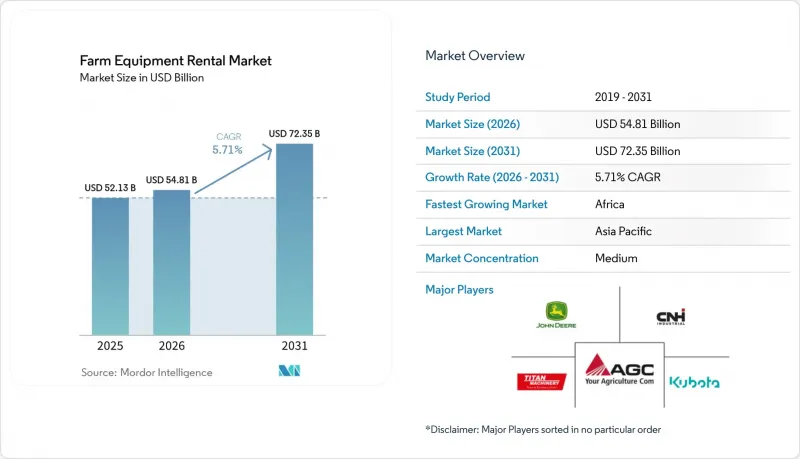
Mordor Intelligence에 의하면, 농기계 임대 시장 규모는 2025년에 521억 3,000만 달러로 평가되었고 2026년 548억 1,000만 달러에서 2031년까지 723억 5,000만 달러에 이를 것으로 예측되며, 예측 기간(2026-2031년) CAGR은 5.71%를 나타낼 전망입니다.
본 보고서는 장비의 유형(트랙터 등), 출력(30 HP 미만 등), 구동 방식(이륜 구동 등), 비즈니스 모델(오프라인 딜러 및 협동조합의 임대 거점 등), 최종 사용자의 농장 규모(소규모(5헥타르 미만) 등), 임대 기간(단기(3개월 미만) 등), 그리고 지역별로 분류되어 있습니다. 시장 전망은 금액(달러) 기준으로 제시되어 있습니다.
세계 농기계 임대 시장 동향과 인사이트
스마트 농기계의 비용 상승이 아시아태평양의 종량제 도입을 가속화하고 있습니다.
중형 트랙터의 정가는 정밀 부품의 채택으로 인해 대폭 상승하여, 소규모 농장의 경우 투자 회수 기간이 길어지고 있습니다. 그러나 ‘임대’라는 선택지가 현실적인 대안으로 떠오르고 있습니다. 예를 들어, Deere사의 ‘See &Spray’ 사후 장착 키트는 구매 비용이 비싸지만, 그 비용의 몇 분의 일만으로도 임대가 가능합니다. 이러한 접근 방식을 통해 아시아의 소규모 농가들은 막대한 설비 투자를 하지 않고도 농업 기술의 발전으로 인한 혜택을 누릴 수 있습니다. 또한, 인도의 Tringo 플랫폼에서 GPS가 탑재된 파종기의 예약 건수가 증가하고 있으며, 이는 정밀 농업용 도구에 대한 접근성이 개선되고 있음을 반영하고 있습니다. 농기계 사용 빈도가 제한적인 소규모 농가에서는 구매보다 임대가 더 경제적이라고 생각하는 경우가 늘어나고 있으며, 이것이 농업용 기계 임대 시장의 성장을 이끌고 있습니다.
인도의 CHC 연계형 보조금 제도가 마을 단위의 임대 거점 활성화를 촉진
인도는 수많은 맞춤형 농업 지원 센터(CHC)를 설립하기 위해 막대한 자금을 배정하고 있으며, 각 센터는 농기계에 대한 보조금을 받고 있습니다. 이용자 근처에 전략적으로 배치된 이러한 센터 덕분에 트랙터 운송 시간이 대폭 단축되었습니다. 이러한 노력을 통해 트랙터의 연간 가동률도 향상되고 있습니다. Trringo는 정부의 직접 지급(Direct Benefit Transfer) 포털과 연동하여 지급 주기를 단축함으로써 지연을 대폭 줄였습니다. 앞으로 인접국인 방글라데시와 네팔에서도 시범 도입이 계획되어 있어, 농기계 임대 시장의 확대가 예상됩니다.
사하라 이남 아프리카 소규모 농가들의 임대 경제성에 대한 인식 부족
농기계 임대 시장의 성장 전망은 밝지만, 아프리카의 임대 보급률은 여전히 낮은 수준에 머물러 있습니다. 이러한 정체는 주로 에티오피아, 탄자니아, 우간다의 많은 소규모 농가들이 임대 방식의 이점을 인식하지 못하고 있기 때문인 것으로 보입니다. 'Hello Tractor'가 신규 고객 1명당 여러 차례의 시연이 필요하다는 사실은 이러한 행동상의 과제를 여실히 드러내고 있습니다. 게다가 동아프리카의 농촌 지역에서는 모바일 머니 이용이 제한적이기 때문에 많은 사람들이 어쩔 수 없이 현금으로 결제해야 하며, 이로 인해 거래의 마찰이 커지고 있습니다. 게다가, 장비 유지보수와 관련된 신뢰 문제나 대금 지급 분쟁이 재예약을 저해하여 농기계 임대 시장의 성장을 가로막고 있습니다.
부문별 분석
트랙터는 경운, 파종, 운반 등 연중 활용되기 때문에 2025년 매출의 38.47%를 차지하며, 농기계 임대 시장에서 가장 큰 점유율을 차지하고 있습니다. 수확기가 도입되면서 수확 기간이 단축됨에 따라, 생산자들이 60만 미화 상당의 콤바인을 일시적으로 이용하는 경향이 강해지면서, 2031년까지 연평균 성장률(CAGR) 7.40%로 성장하고 있습니다. Trringo의 분무기 예약 건수는 ‘See &Spray’ 기술의 임대 서비스 개시에 따라 급증했습니다. 베일러와 분무기는 총 취급량의 대부분을 차지하고 있습니다. 피어 투 피어(P2P)를 통한 집약화의 혜택을 누리는 특수 농기구의 이용률이 상승하고 있으며, 이에 따라 이러한 틈새 시장을 겨냥한 농기계 임대 시장이 활성화되고 있습니다.
자율 주행이 가능한 트랙터에 대한 수요는 더욱 증가할 전망이며, Deere사의 무선 8R이 그 선두에 서 있습니다. 운영자는 위험 부담 없이 안내 소프트웨어를 테스트할 수 있게 되었으며, 이에 따라 트랙터 도입이 가속화되어 기존 예측을 뛰어넘는 추세를 보이고 있습니다. 베일러와 정밀 살포기가 계속해서 보급되는 가운데, 가변 시비를 통해 증가하는 투입 비용을 상쇄할 수 있는 그 능력은 농기계 임대 시장의 광범위한 중요성을 부각시키고 있습니다.
2025년 시장 점유율 중 71-130 HP급이 31.34%를 차지했습니다. 이는 다양한 작물을 재배하는 농가들이 연비 효율과 다용도성을 중시하기 때문입니다. 한편, 250 HP를 초과하는 기계는 연평균 성장률(CAGR) 8.50%로 성장하고 있으며, 특히 미국과 호주의 대규모 곡물 농장에서 고출력 기종의 농기계 임대 시장 규모를 주도하고 있습니다. 보조금을 통해 마을 거점의 혜택을 받고 있는 아시아의 소규모 농가들은 30 HP 미만의 소형 트랙터 출하 대수에서 큰 비중을 차지했습니다.
고출력 임대 장비는 연간 가동률은 낮지만, 시간당 임대 요금은 높은 임베디드니다. 이러한 추세는 디어 파이낸셜(Deere Financial)이 고출력 트랙터 부문에서 상당한 리스 노출을 안고 있다는 사실에서도 뒷받침됩니다. 게다가, 미국의 수확철에 중마력 콤바인이 부족한 상황은 보유 기종 구성의 불균형을 여실히 드러내고 있습니다. 임대 사업자는 농기계 임대 시장의 변화하는 동향을 중시하고, 데이터에 기반한 조달을 통해 이러한 과제에 대처해야 합니다.
지역별 분석
아시아태평양은 2025년 농기계 임대 시장의 매출의 44.25%를 차지했습니다. 인도의 CHC(공동 농지 소유) 제도와 중국의 농지 집약화 노력 덕분에 Trringo의 네트워크가 강화되어, 수많은 마을에서 자산 활용률을 대폭 향상시키는 동시에 대규모 농가 기반에 대한 서비스 제공이 가능해졌습니다. 또한, 일본 농가 인구의 고령화와 한국의 농기계 공유협동조합에 대한 보조금 제도가 해당 지역의 농업 분야에서의 우위를 지속적으로 뒷받침하고 있습니다.
아프리카는 연평균 성장률(CAGR) 7.50%로 성장을 지속하고, 있지만, 낮은 인지도 때문에 시장 침투율은 8% 미만에 그치고 있습니다. 'Hello Tractor'의 SMS 마켓플레이스는 12개국에 진출해 있지만, 여전히 대면 시연에 막대한 비용을 투자하고 있습니다. 기부자로부터 자금을 지원받아 진행된 기계화가 거래량을 끌어올리고 있지만, 모바일 머니 보급률이 낮아 디지털화 확대가 더딘 탓에 농기계 임대 시장의 확산을 저해하고 있습니다.
북미와 유럽은 농기계 임대 업계 매출의 상당 부분을 차지하고 있습니다. Deere사의 리스 채권은 이 회사가 이용 기반 모델을 통해 수익을 창출하는 데 주력하고 있음을 보여줍니다. FarmLease와 Growy는 여러 딜러의 재고를 통합하는 데 성공했으며, 동적 가격 책정 전략을 도입하여 가동률을 최적화하고 있습니다. 라틴아메리카에서는 농기계 임대 시장이 점차 발전하고 있으며, 대두 농장에서는 환율 변동을 관리하기 위한 전략의 일환으로 임대 서비스를 이용하는 경향이 강해지고 있습니다. 유럽연합(EU)의 전기화 추진은 송전망 인프라의 업그레이드가 필요하기 때문에 현재 도시 주변 지역으로 한정되어 있으며, 이는 해당 부문 내 지역별 성장 양상에 영향을 미치고 있습니다.
기타 혜택:
- 엑셀 형식 시장 예측(ME) 시트
- 3개월간의 애널리스트 지원
자주 묻는 질문
목차
제1장 서론
제2장 조사 방법
제3장 주요 요약
제4장 시장 구도
제5장 시장 규모와 성장 예측
제6장 경쟁 구도
제7장 시장 기회와 향후 전망
JHS 26.06.29According to Mordor Intelligence, the farm equipment rental market size was valued at USD 52.13 billion in 2025 and estimated to grow from USD 54.81 billion in 2026 to reach USD 72.35 billion by 2031, at a CAGR of 5.71% during the forecast period (2026-2031).
This report is Segmented by Equipment Type (Tractors, and More), Power Output (Less Than 30 HP, and More), Drive Type (Two-Wheel Drive and More), Business Model (Offline Dealer and Co-Op Yards and More), End-User Farm Size (Small (less Than 5 Ha) and More), Rental Duration (Short-Term (Less Than 3 M) and More) and Geography. The Market Forecasts are Provided in Terms of Value (USD).
Global Farm Equipment Rental Market Trends and Insights
Cost-Inflation of Smart Machinery Accelerating Pay-per-Use Adoption in Asia Pacific
Mid-range tractor list prices have increased significantly due to the use of precision components, which extend ownership payback periods for smaller farms. However, rental options provide a viable alternative . For example, Deere's See & Spray retrofit, while expensive to purchase, can be rented at a fraction of the cost. This approach allows smallholders in Asia to benefit from agronomic advancements without significant capital investment. Additionally, bookings for GPS planters on India's Tringo platform have risen, reflecting improved access to precision tools. Small farms with limited machine usage are increasingly finding rental options more economical than ownership, driving growth in the Farm Equipment Rental Market.
Indian CHC-Linked Subsidies Catalyzing Village-Level Rental Hubs
India has allocated significant funding to establish numerous Custom Hiring Centres, each of which benefits from an equipment subsidy . Strategically located in proximity to users, these centres have significantly reduced tractor transport times. This initiative has also increased annual tractor utilization. Trringo, in collaboration with the government's Direct Benefit Transfer portal, has expedited reimbursement cycles, significantly reducing delays. Looking ahead, neighboring countries Bangladesh and Nepal are planning pilot rollouts, signaling an expansion in the agricultural equipment rental market.
Low Awareness of Rental Economics Among Sub-Saharan Smallholders
Rental penetration in Africa remains low despite a positive growth outlook in the Farm Equipment Rental Market. This stagnation is primarily attributed to the fact that many smallholders in Ethiopia, Tanzania, and Uganda remain unaware of the benefits of rentals. Hello Tractor's need for multiple live demos for each first-time customer highlights these behavioral challenges. Furthermore, with limited access to mobile money in rural East Africa, many are compelled to resort to cash payments, increasing transaction friction. Additionally, trust issues surrounding equipment maintenance and payment disputes hinder repeat bookings, stunting the growth of the agricultural equipment rental market.
Other drivers and restraints analyzed in the detailed report include:
- Seasonal Workforce Deficit in OECD Nations Driving Autonomous Tractor Rentals
- App-Based Fleet Marketplaces Scaling Rapidly in Western Europe
- Scarcity of Less than 250 HP Units During North American Harvest Window
For complete list of drivers and restraints, kindly check the Table Of Contents.
Segment Analysis
Tractors generated 38.47% of 2025 revenue, the most significant slice of the agricultural equipment rental market share, thanks to their year-round utility across tillage, planting, and hauling. Harvesters are growing at a 7.40% CAGR to 2031, as compressed harvest windows nudge growers toward temporary access to USD 600,000 combines. Bookings for sprayers on Trringo surged as the See & Spray technology became available for rent. Balers and sprayers accounted for a significant portion of the total volume. Specialty implements, which benefit from peer-to-peer aggregation, are experiencing heightened utilization, thereby boosting the agricultural equipment rental market for these niche tools.
Demand for autonomous-ready tractors is set to escalate, with Deere's cableless 8R leading the charge. Operators now have the opportunity to test guidance software with no risk, paving the way for quicker adoption of tractors and surpassing earlier forecasts. As balers and precision sprayers continue to gain traction, their ability to offset rising input costs through variable-rate applications underscores the widespread significance of the agricultural equipment rental market.
The 71-130 HP band accounted for 31.34% of the 2025 share, as mixed-crop farms favor fuel efficiency and versatility. Machines above 250 HP, however, are accelerating at 8.50% CAGR, propelling the agricultural equipment rental market size for high-capacity units, especially in large United States and Australian grain estates. Asian smallholders, benefiting from subsidy-aided village hubs, accounted for a significant share of the volume in sub-30 HP compact tractors.
High-horsepower rentals, despite lower annual utilization, command premium hourly rates. This trend is underscored by Deere Financial's notable lease exposure to tractors in the higher horsepower category. Furthermore, the scarcity of mid-range combines during United States harvests highlights a misalignment in fleet mix. Rental operators are urged to address this through data-driven procurement, emphasizing the evolving dynamics of the agricultural equipment rental market.
Geography Analysis
Asia Pacific contributed 44.25% of 2025 revenue for the agricultural equipment rental market. India's CHC scheme and China's efforts in consolidating farm plots have strengthened Trringo's network, enabling it to achieve significant asset utilization across numerous villages while serving a large farmer base. Additionally, Japan's aging farmer population and South Korea's subsidy program for machinery-sharing cooperatives continue to support the region's agricultural dominance.
Africa is experiencing a 7.50% CAGR, although awareness hurdles are limiting penetration to under 8%. Hello Tractor's SMS marketplace spans 12 nations, yet it still spends heavily on in-person demos. Donor-funded mechanization drives volume, but low mobile-money reach slows digital scaling, tempering agricultural equipment rental market uptake.
North America and Europe collectively account for a significant portion of the revenue in the agricultural equipment rental industry. Deere's lease receivables emphasize the company's focus on generating income through usage-based models. FarmLease and Growy have successfully consolidated inventory from multiple dealers, optimizing utilization rates through the implementation of dynamic pricing strategies. In Latin America, the agricultural equipment rental market is gradually developing, with soybean estates increasingly turning to rentals as a strategy to manage currency fluctuations. Electrification initiatives in the European Union are currently restricted to peri-urban areas due to the need for grid infrastructure upgrades, which is influencing the regional growth patterns within the sector.
- Deere & Company
- CNH Industrial N.V.
- AGCO Corporation
- Kubota Corporation
- Titan Machinery Inc.
- Mahindra & Mahindra Ltd. (Trringo)
- Farmease
- JFarm Services
- Pacific AG Rental LLC
- The Pape Group Inc.
- Messick's
- Flaman Group of Companies
- Premier Equipment Rental
- Friesen Sales & Rentals
- Aktio Corporation
- United Rentals (Agricultural Line)
- H&E Equipment Services Inc.
- Kwipped Inc.
- Ashtead Group plc (Sunbelt)
Additional Benefits:
- The market estimate (ME) sheet in Excel format
- 3 months of analyst support
TABLE OF CONTENTS
1 Introduction
- 1.1 Study Assumptions and Market Definition
- 1.2 Scope of the Study
2 Research Methodology
3 Executive Summary
4 Market Landscape
- 4.1 Market Overview
- 4.2 Market Drivers
- 4.2.1 Cost-inflation of Smart Machinery Accelerating Pay-per-Use Adoption in Asia Pacific
- 4.2.2 Seasonal Workforce Deficit in OECD Nations Driving Autonomous Tractor Rentals
- 4.2.3 Peak-Harvest Demand Spikes in United States Corn-Belt Reinforcing Short-Term Leases
- 4.2.4 Indian CHC-Linked Subsidies Catalyzing Village-Level Rental Hubs
- 4.2.5 App-Based Fleet Marketplaces Scaling Rapidly in Western Europe
- 4.2.6 ESG-Linked Finance Steering Electrified Rental Fleets
- 4.3 Market Restraints
- 4.3.1 Low Awareness of Rental Economics among Sub-Saharan Smallholders
- 4.3.2 Scarcity of Less than 250 HP Units during North-American Harvest Window
- 4.3.3 High First-/Last-Mile Logistics Cost in Fragmented Asia Pacific Markets
- 4.3.4 Equipment Misuse Elevating Maintenance Downtime and Liability
- 4.4 Regulatory Outlook
- 4.5 Porter's Five Forces
- 4.5.1 Bargaining Power of Suppliers
- 4.5.2 Bargaining Power of Buyers
- 4.5.3 Threat of New Entrants
- 4.5.4 Threat of Substitutes
- 4.5.5 Intensity of Competitive Rivalry
5 Market Size and Growth Forecasts (Value in USD)
- 5.1 By Equipment Type
- 5.1.1 Tractors
- 5.1.2 Harvesters
- 5.1.3 Balers
- 5.1.4 Sprayers
- 5.1.5 Seeders & Planters
- 5.1.6 Tillage & Soil-Cultivation Equipment
- 5.1.7 Other Implements
- 5.2 By Power Output (HP)
- 5.2.1 Less than 30 HP
- 5.2.2 31-70 HP
- 5.2.3 71-130 HP
- 5.2.4 131-250 HP
- 5.2.5 More than 250 HP
- 5.3 By Drive Type
- 5.3.1 Two-Wheel Drive
- 5.3.2 Four-Wheel Drive
- 5.4 By Business Model
- 5.4.1 Offline Dealer & Co-op Yards
- 5.4.2 Online / App-Based Platforms
- 5.5 By End-User Farm Size
- 5.5.1 Small (Less than 5 ha)
- 5.5.2 Medium (5-20 ha)
- 5.5.3 Large (More than 20 ha)
- 5.6 By Rental Duration
- 5.6.1 Short-Term (Less than 3 m)
- 5.6.2 Seasonal (3-9 m)
- 5.6.3 Annual / Long-Term (More than 9 m)
- 5.7 By Geography
- 5.7.1 North America
- 5.7.1.1 United States
- 5.7.1.2 Canada
- 5.7.1.3 Rest of North America
- 5.7.2 South America
- 5.7.2.1 Brazil
- 5.7.2.2 Argentina
- 5.7.2.3 Rest of South America
- 5.7.3 Europe
- 5.7.3.1 Germany
- 5.7.3.2 United Kingdom
- 5.7.3.3 France
- 5.7.3.4 Italy
- 5.7.3.5 Spain
- 5.7.3.6 Rest of Europe
- 5.7.4 Asia Pacific
- 5.7.4.1 China
- 5.7.4.2 India
- 5.7.4.3 Japan
- 5.7.4.4 South Korea
- 5.7.4.5 Rest of Asia Pacific
- 5.7.5 Middle East and Africa
- 5.7.5.1 Saudi Arabia
- 5.7.5.2 United Arab Emirates
- 5.7.5.3 Turkey
- 5.7.5.4 South Africa
- 5.7.5.5 Egypt
- 5.7.5.6 Rest of Middle East and Africa
- 5.7.1 North America
6 Competitive Landscape
- 6.1 Market Concentration
- 6.2 Strategic Moves
- 6.3 Market Share Analysis
- 6.4 Company Profiles (Includes Global level Overview, Market level overview, Core Segments, Financials as available, Strategic Information, Market Rank/Share for key companies, Products and Services, and Recent Developments)
- 6.4.1 Deere & Company
- 6.4.2 CNH Industrial N.V.
- 6.4.3 AGCO Corporation
- 6.4.4 Kubota Corporation
- 6.4.5 Titan Machinery Inc.
- 6.4.6 Mahindra & Mahindra Ltd. (Trringo)
- 6.4.7 Farmease
- 6.4.8 JFarm Services
- 6.4.9 Pacific AG Rental LLC
- 6.4.10 The Pape Group Inc.
- 6.4.11 Messick's
- 6.4.12 Flaman Group of Companies
- 6.4.13 Premier Equipment Rental
- 6.4.14 Friesen Sales & Rentals
- 6.4.15 Aktio Corporation
- 6.4.16 United Rentals (Agricultural Line)
- 6.4.17 H&E Equipment Services Inc.
- 6.4.18 Kwipped Inc.
- 6.4.19 Ashtead Group plc (Sunbelt)
7 Market Opportunities and Future Outlook
- 7.1 White-Space and Unmet-Need Assessment


