

|
시장보고서
상품코드
2066562
파이프 단열 시장 : 점유율 분석, 업계 동향과 통계, 성장 예측(2026-2031년)Pipe Insulation - Market Share Analysis, Industry Trends & Statistics, Growth Forecasts (2026 - 2031) |
||||||
 Mordor Intelligence
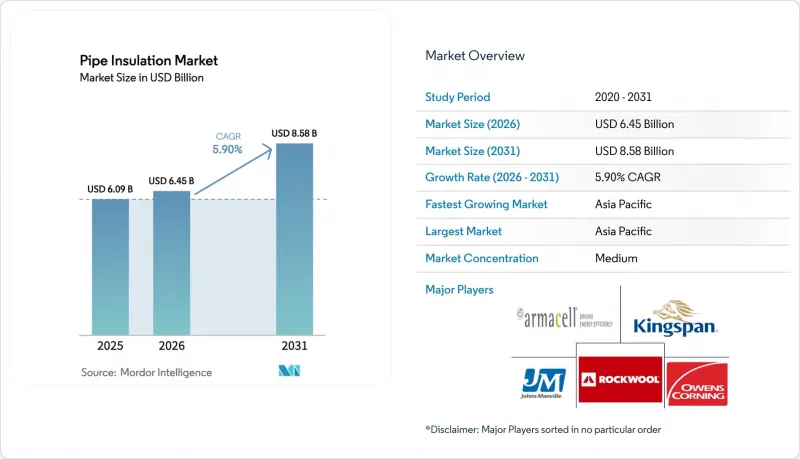
Mordor Intelligence에 의하면, 2026년 파이프 단열 시장 규모는 64억 5,000만 달러로 추정되고 있어 2025년 60억 9,000만 달러에서 확대해, 2031년에는 85억 8,000만 달러에 이를 것으로 예측됩니다.
2026년부터 2031년까지의 연평균 성장률(CAGR)은 5.90%가 될 것으로 전망됩니다.
본 보고서는 유형별(유리섬유, 암면, 규산염, 폴리우레탄, 고무 폼, 기타), 최종 사용 산업별(건축 및 건설, 석유 및 가스, 운송, 일반 산업, 기타 최종 사용 산업), 지역별(아시아태평양, 북미, 유럽, 남미, 중동 및 아프리카)로 분류되어 있습니다. 시장 전망은 금액(달러) 기준으로 제시되어 있습니다.
세계 파이프 단열 시장 동향과 인사이트
엄격한 건축 에너지 절약 기준
건축기준법에 따라 파이프 단열은 선택 사항에서 법적 요건으로 점차 변화하고 있습니다. 2024년판 국제 에너지 절약 기준(IECC)에서는 온수 배관의 두께를 최대 5인치로 규정하고 있으며, 이 규정에 따라 미국 내 주택의 현장 에너지 소비량이 7.80% 감소할 것으로 예측됩니다. 캘리포니아주의 타이틀 24 및 이와 유사한 유럽 지침에서는 최소 R값이 규정되어 있어, 이로 인해 성능이 낮은 단열재는 사실상 배제되고 있습니다. 이미 미국 14개 주에서 2024년판 IECC로의 전환을 추진 중이며, 북동부 에너지 효율 파트너십(NEEP)은 조기 도입 지역에서 6.80%의 원천 에너지 절감 효과가 있을 것으로 전망하고 있습니다. 상업시설에서도 동일한 요건이 적용되고 있으며, 소유주들은 초기 비용보다 수명 주기 전반에 걸친 에너지 절감에 더 중점을 두게 되었습니다. 이 또한 파이프 단열 시장을 확대시키는 요인 중 하나입니다.
LNG 및 극저온 파이프라인 프로젝트의 확대
미국 멕시코만 연안의 액화천연가스(LNG) 수출 터미널에서는 19,800마일이 넘는 신규 또는 교체용 배관이 필요하며, 그 대부분은 -160°C의 작동 온도에 대응하도록 설계되어 있습니다. 상압 에어로겔을 활용한 ‘파이프 인 파이프’ 구조는 수축 응력을 허용 범위 내로 억제하면서 설치 비용을 절감합니다. 아시아태평양에서 부유식 LNG 허브의 가동이 시작됨에 따라, 장거리 해저 파이프라인용 단열재에 대한 수요가 증가하면서 고급 소재의 가격을 끌어올리고 있습니다. 극저온용 폴리우레탄 및 다공질 유리 제품 라인을 보유한 제조업체들은 이익률 향상은 물론, 수년에 걸친 메가 프로젝트에서 선점자로서 계약을 따내고 있습니다.
높은 설치 비용과 노동 집약성
스프레이식 폴리우레탄 폼이나 다층 재킷의 현장 시공에는 인증을 받은 작업자와 전용 시공 장비가 필요하며, 대도시권 시장에서는 설치 비용이 1선형 피트당 15달러를 초과하고 있어 파이프 단열 업계에 비용 압박이 가해지고 있습니다. 개보수 후에는 에너지 비용이 30% 절감될 가능성이 있지만, ‘Better Buildings Neighborhood’의 데이터에 따르면 투자액 1달러당 첫해 절감액은 고작 0.08달러에 그쳐, 주택 소유자의 투자 회수 기간이 길어지고 있습니다. 조립식 배관 스풀은 기술 부족 문제를 부분적으로 해결해 주지만, 운송상의 제약으로 인해 직경 12인치를 초과하는 크기의 보급이 저해되고 있습니다. 노동력 부족이 가장 심각한 곳은 북유럽으로, 숙련된 장인들의 은퇴 속도가 견습생들이 직업 훈련 프로그램에 입학하는 속도를 앞지르고 있습니다. 제조업체 측은 현장에서의 노동력을 최대 40%까지 줄일 수 있는 스냅핏 방식의 광물 섬유 쉘이나 자가 접착식 에어로겔 랩을 통해 대응하고 있지만, 보급은 더딘 실정입니다.
부문별 분석
2025년, 유리섬유는 저렴한 비용과 0.04 W/(m·K)에 가까운 λ값 덕분에 파이프 단열 시장에서 39.10%의 1위 점유율을 유지했습니다. 락울은 고유한 내화성과 재활용이 가능하다는 점을 강점으로 내세우고 있습니다. 이 브랜드의 2023년 매출액은 818 TWh에 달하는 누적 에너지 절감 효과에 해당할 것으로 예측됩니다. 규산염계 단열재는 600°C를 초과하는 정유시설 및 발전소용 틈새 시장을 독점하고 있는 반면, 경질 폴리우레탄 폼은 바이오 배합에서 0.02 W/(m·K) 미만의 열전도율을 실현하고 있습니다. 고무 폼은 열 사이클에 따른 변형을 견딜 수 있기 때문에 HVAC 분야에서 꾸준히 주요 소재로 자리 잡고 있습니다.
그 밖의 유형(주로 에어로겔 담요 및 다공질 유리)은 메가 프로젝트에서 초저열손실에 대한 수요가 증가함에 따라 2031년까지 연평균 성장률(CAGR) 7.13%로 가장 빠르게 성장하고 있습니다. 차세대 Si3N4 강화 에어로겔은 밀도가 0.033 g/cm3로 매우 낮으며, 893°C의 온도 차이도 견딜 수 있습니다. 다공질 유리는 수분 흡수율이 0%이며 설계 수명이 100년인 만큼, LNG 및 극저온 파이프라인에 적합합니다. 초기 투자(CAPEX)는 높지만 유지보수 비용 절감으로 상쇄되기 때문에 공정 소유자는 고품질 자재를 우선시하는 성능 기반 입찰을 지정하는 추세입니다.
지역별 분석
아시아태평양은 시장 규모가 크고 정책 지원이 더해져 파이프 단열 시장을 주도하고 있습니다. 현재 중국 지방 당국은 건축 허가를 검증된 열 에너지 모델과 연계하고 있으며, 국가의 ‘에너지 절약 3개년 행동 계획’에서는 파이프 단열을 최우선 조치로 규정하고 있습니다. 인도의 재생에너지 통합 추진에 따라 공정 산업에서는 증기 배관의 손실을 줄여야 할 필요성이 대두되고 있으며, 이에 따라 적층 광물 섬유 쉘에 대한 수요가 증가하고 있습니다. 아시아개발은행(ADB)의 혼합금융 도구는 그린필드 열공급 네트워크 프로젝트의 위험을 완화하고 안정적인 자재 조달을 보장하고 있습니다.
북미에서는 LNG 파이프라인의 확충과 건축 기준 개정이 호재로 작용하고 있습니다. 미국 에너지부(DOE)가 2024년판 IECC(통합 에너지 절약 기준)에 따른 주택 부문의 에너지 절약률이 7.80%임을 확인함에 따라, 각 주에서는 장기간 이어져 온 비용 대비 효과에 대한 논의를 거치지 않고도 해당 기준을 채택하기가 더 쉬워졌습니다. 단열재 비용의 30%를 상쇄해 주는 연방 세액 공제 덕분에 투자 회수 기간이 더욱 단축됩니다. 캐나다의 각 주에서는 저금리 개보수 대출을 활용하고 있는 반면, 앨버타주의 산업 관계자들은 연료비 변동을 완화하기 위해 고효율 단열재로 전환함으로써 원자재 가격 변동 위험을 헤지하고 있습니다.
유럽에서는 파리 등 주요 도시에서 2042년까지 지역 냉방 파이프라인을 3배로 확대하겠다는 목표를 내걸고 있으며, 이는 2030년까지 3,500만 채의 건물을 개보수하는 것을 목표로 하는 EU의 ‘리노베이션 웨이브’와 연계되어 파이프 단열 업계에 긍정적인 영향을 미치고 있습니다. 스칸디나비아 시장에서는 생물 유래 결합제를 사용한 탄소 음성 단열재의 시범 도입이 진행되고 있으며, 이는 전문 제조업체에 조기 수익을 가져다주고 있습니다. 유틸리티자들은 단열 공사 계약을 히트펌프 조달과 연계함으로써, 공급업체와의 협상을 총소유비용(TCO) 지표 중심으로 전환하고 있습니다.
기타 혜택:
- 엑셀 형식 시장 예측(ME) 시트
- 3개월간의 애널리스트 지원
자주 묻는 질문
목차
제1장 서론
제2장 조사 방법
제3장 주요 요약
제4장 시장 구도
제5장 시장 규모와 성장 예측
제6장 경쟁 구도
제7장 시장 기회와 향후 전망
JHS 26.06.29According to Mordor Intelligence, pipe insulation market size in 2026 is estimated at USD 6.45 billion, growing from 2025 value of USD 6.09 billion with 2031 projections showing USD 8.58 billion, growing at 5.90% CAGR over 2026-2031.
This report is Segmented by Type (Fiberglass, Rockwool, Silicates, Polyurethane, Rubber Foams, Other Types), End-User Industry (Buildings and Construction, Oil and Gas, Transportation, General Industrial, Other End-User Industries), and Geography (Asia-Pacific, North America, Europe, South America, Middle East and Africa). The Market Forecasts are Provided in Terms of Value (USD).
Global Pipe Insulation Market Trends and Insights
Stringent Energy-Efficiency Building Codes
Building codes are turning pipe insulation from a discretionary line item into a legal requirement. The 2024 International Energy Conservation Code (IECC) mandates thicknesses of up to 5 inches for hot-water pipelines, a rule expected to cut residential site-energy use by 7.80% in the United States. California's Title 24 and similar European directives specify minimum R-values, effectively sidelining low-performance wraps. With 14 U.S. states already on the 2024 IECC path, Northeast Energy Efficiency Partnerships forecasts 6.80% source-energy savings for early adopters. Commercial facilities mirror these requirements, pushing owners to favor lifecycle energy savings over upfront costs-another lever that expands the pipe insulation market.
Expansion of LNG and Cryogenic Pipeline Projects
Liquefied-natural-gas export terminals alo ng the U.S. Gulf Coast require more than 19,800 miles of new or replacement piping, much of it designed for -160 °C operating temperatures. Ambient-pressure aerogel pipe-in-pipe designs cut installation costs while keeping contraction stresses within allowable limits. As Asia-Pacific commissions floating LNG hubs, demand for long-run subsea insulation miles pushes premium material pricing. Manufacturers with cryogenic-grade polyurethane or cellular glass lines enjoy margin upside and early-mover contracts on multi-year megaprojects.
High Installed Cost and Labour Intensity
Field application of spray polyurethane foam and multi-layer jacketing requires certified crews and specialized rigs, pushing installation charges above USD 15/linear foot in large metro markets creating cost pressures within the pipe insulation industry. Although energy bills can drop 30% post-retrofit, Better Buildings Neighborhood data show that every USD 1 invested yields only USD 0.08 in first-year savings, stretching homeowner payback horizons. Prefabricated pipe spools partially solve the skills gap, yet transport limits hamper uptake for diameters above 12 inches. Labor scarcity is most acute in Northern Europe, where aging tradespeople retire faster than apprentices enter vocational programs. Producers respond with snap-fit mineral-fiber shells and self-adhesive aerogel wraps that cut site labor by up to 40%, but widespread adoption lags.
Other drivers and restraints analyzed in the detailed report include:
- Surging District Heating and Cooling Investments
- Smart Insulation with Embedded Sensors
- Volatile Petrochemical Feedstock Prices
For complete list of drivers and restraints, kindly check the Table Of Contents.
Segment Analysis
Fiberglass maintained the leading 39.10% pipe insulation market share in 2025, underpinned by low cost and a λ-value near 0.04 W/(m*K). Rockwool leverages inherent fire resistance and circularity claims; the brand's 2023 sales translated to anticipated lifetime energy savings of 818 TWh. Silicate wraps own niche refinery and power-plant lines above 600 °C, while rigid polyurethane foams post sub-0.02 W/(m*K) conductivities in bio-based formulations. Rubber foams remain HVAC staples because they flex with thermal cycling.
Other Types-primarily aerogel blankets and cellular glass-grow fastest at 7.13% CAGR through 2031 as mega-projects demand ultra-low heat loss. Next-gen Si3N4-reinforced aerogels come in at densities as low as 0.033 g/cm3 withstanding 893 °C differentials. Cellular glass appeals to LNG and cryogenic pipelines for zero water absorption and 100-year design life. Higher capex is offset by maintenance savings, leading process owners to specify performance-based tenders that favor premium materials.
Geography Analysis
Asia-Pacific dominates the pipe insulation market, pairing volume scale with policy support. Chinese provincial authorities now tie building permits to verified thermal-energy models, and the national Three-Year Action Plan for energy conservation identifies pipework insulation as a Tier-1 measure. India's renewable-integration drive requires process industries to cut steam line losses, sending demand toward laminated mineral-fiber shells. The Asian Development Bank's blended-financing tools de-risk greenfield heat-network projects, assuring steady material off-take.
North America benefits from LNG pipeline rollouts and code updates. The U.S. DOE's confirmation of 7.80% residential energy savings from the 2024 IECC emboldens states to adopt without lengthy cost-effectiveness debates. Federal tax credits covering 30% of insulation spend further shorten paybacks. Canadian provinces tap low-interest retrofit loans, while industrial players in Alberta hedge feedstock volatility by switching to higher-efficiency jacketing to buffer fuel bills.
Europe's ambition is to treble district cooling pipes by 2042 in cities like Paris, intertwining with the EU Renovation Wave that targets 35 million building upgrades by 2030 in the pipe insulation industry. Scandinavian markets trial carbon-negative insulation made with biogenic binders, providing early revenue for specialty manufacturers. Utilities bundle insulation contracts with heat-pump procurement, shifting supplier negotiations toward total-cost-of-ownership metrics.
- Armacell
- Aspen Aerogels, Inc.
- BASF
- Beijing Coowor Network Technology Co., Ltd.
- Cellofoam North America Inc.
- Covestro AG
- Frost King Weatherization Products / Thermwell Products Co., Inc.
- Huamei Energy-saving Technology Group Co., Ltd.
- Huntsman International LLC
- Isoclima S.p.A.
- Johns Manville
- Kingspan Group
- Knauf Insulation, Inc.
- L'Isolante K-Flex S.p.A.
- NMC sa
- ODE YalItIm A.S.
- Owens Corning
- Polyguard
- Rockwool International
- Saint-Gobain
- Thermaflex
- Zotefoams plc.
Additional Benefits:
- The market estimate (ME) sheet in Excel format
- 3 months of analyst support
TABLE OF CONTENTS
1 Introduction
- 1.1 Study Assumptions and Market Definition
- 1.2 Scope of the Study
2 Research Methodology
3 Executive Summary
4 Market Landscape
- 4.1 Market Overview
- 4.2 Market Drivers
- 4.2.1 Stringent Energy-Efficiency Building Codes
- 4.2.2 Expansion of LNG and Cryogenic Pipeline Projects
- 4.2.3 Surging District Heating and Cooling Investments
- 4.2.4 Smart Insulation with Embedded Sensors
- 4.2.5 Carbon-Pricing Led Industrial Retrofits
- 4.3 Market Restraints
- 4.3.1 High Installed Cost and Labour Intensity
- 4.3.2 Volatile Petrochemical Feedstock Prices
- 4.3.3 Shift to Thin-Wall Plastic Piping Alternatives
- 4.4 Value Chain Analysis
- 4.5 Porter's Five Forces
- 4.5.1 Threat of New Entrants
- 4.5.2 Bargaining Power of Buyers
- 4.5.3 Bargaining Power of Suppliers
- 4.5.4 Threat of Substitute Products
- 4.5.5 Degree of Competition
5 Market Size and Growth Forecasts (Value)
- 5.1 By Type
- 5.1.1 Fiberglass
- 5.1.2 Rockwool
- 5.1.3 Silicates
- 5.1.4 Polyurethane
- 5.1.5 Rubber Foams
- 5.1.6 Other Types (Aerogel Blankets,Cellular Glass, etc.)
- 5.2 By End-User Industry
- 5.2.1 Buildings and Construction
- 5.2.2 Oil and Gas
- 5.2.3 Transportation
- 5.2.4 General Industrial
- 5.2.5 Other End-user Industries (Power Generation and Utilities, Chemical and Petrochemical Processing, etc.)
- 5.3 By Geography
- 5.3.1 Asia-Pacific
- 5.3.1.1 China
- 5.3.1.2 Japan
- 5.3.1.3 India
- 5.3.1.4 South Korea
- 5.3.1.5 ASEAN Countries
- 5.3.1.6 Rest of Asia-Pacific
- 5.3.2 North America
- 5.3.2.1 United States
- 5.3.2.2 Canada
- 5.3.2.3 Mexico
- 5.3.3 Europe
- 5.3.3.1 Germany
- 5.3.3.2 United Kingdom
- 5.3.3.3 France
- 5.3.3.4 Italy
- 5.3.3.5 Spain
- 5.3.3.6 Russia
- 5.3.3.7 NORDIC Countries
- 5.3.3.8 Rest of Europe
- 5.3.4 South America
- 5.3.4.1 Brazil
- 5.3.4.2 Argentina
- 5.3.4.3 Rest of South America
- 5.3.5 Middle-East and Africa
- 5.3.5.1 Saudi Arabia
- 5.3.5.2 South Africa
- 5.3.5.3 Rest of Middle-East and Africa
- 5.3.1 Asia-Pacific
6 Competitive Landscape
- 6.1 Market Concentration
- 6.2 Strategic Moves
- 6.3 Market Share(%)/Ranking Analysis
- 6.4 Company Profiles (includes Global level Overview, Market level overview, Core Segments, Financials as available, Strategic Information, Market Rank/Share for key companies, Products and Services, and Recent Developments)
- 6.4.1 Armacell
- 6.4.2 Aspen Aerogels, Inc.
- 6.4.3 BASF
- 6.4.4 Beijing Coowor Network Technology Co., Ltd.
- 6.4.5 Cellofoam North America Inc.
- 6.4.6 Covestro AG
- 6.4.7 Frost King Weatherization Products / Thermwell Products Co., Inc.
- 6.4.8 Huamei Energy-saving Technology Group Co., Ltd.
- 6.4.9 Huntsman International LLC
- 6.4.10 Isoclima S.p.A.
- 6.4.11 Johns Manville
- 6.4.12 Kingspan Group
- 6.4.13 Knauf Insulation, Inc.
- 6.4.14 L'Isolante K-Flex S.p.A.
- 6.4.15 NMC sa
- 6.4.16 ODE YalItIm A.S.
- 6.4.17 Owens Corning
- 6.4.18 Polyguard
- 6.4.19 Rockwool International
- 6.4.20 Saint-Gobain
- 6.4.21 Thermaflex
- 6.4.22 Zotefoams plc.
7 Market Opportunities and Future Outlook
- 7.1 White-space and Unmet-Need Assessment


