

|
시장보고서
상품코드
2066563
수술용 드레이프 및 가운 : 시장 점유율 분석, 업계 동향 및 통계, 성장 예측(2026-2031년)Surgical Drapes And Gowns - Market Share Analysis, Industry Trends & Statistics, Growth Forecasts (2026 - 2031) |
||||||
 Mordor Intelligence
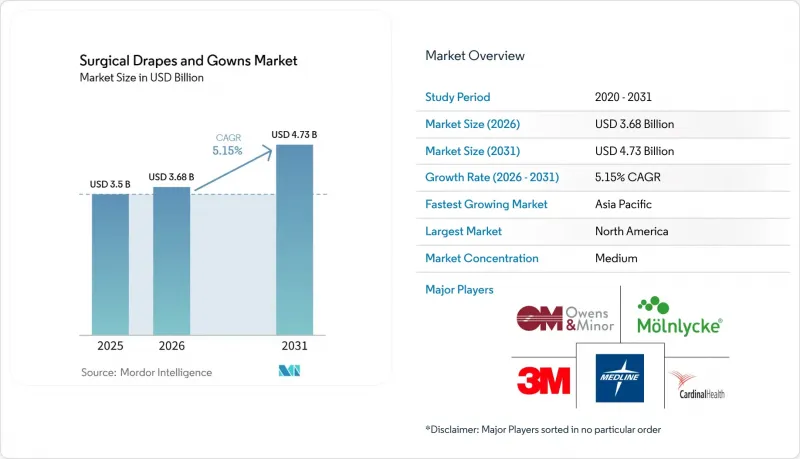
Mordor Intelligence에 의하면, 2026년 수술용 드레이프 및 가운 시장 규모는 36억 8,000만 달러에 달할 것으로 예상됩니다. 2025년 35억 달러에서 확대해, 2031년에는 47억 3,000만 달러에 이를 것으로 예측됩니다.
2026년부터 2031년까지의 연평균 성장률(CAGR)은 5.15%를 나타낼 것으로 전망됩니다.
본 보고서는 제품 유형(수술용 드레이프 및 수술용 가운), 소재(부직포, 라미네이트 부직포 등), 용도(일회용 및 재사용 가능), 보호 수준(AAMI 레벨 1, AAMI 레벨 2 등), 최종 사용자(병원, 외래수술센터(ASC) 등), 지역(북미, 유럽 등)별로 분류되어 있습니다. 시장 규모 및 전망은 금액(달러) 단위로 제시되어 있습니다.
세계의 수술용 드레이프 및 가운 시장 동향 및 인사이트
고령화로 인해 수술 건수가 팬데믹 이전 수준을 웃도는 속도로 증가하고 있습니다.
세계적으로 65세 이상 인구가 증가하고 있는 것은 수술 건수 증가로 직결되며, 권위 있는 외과 관련 단체들도 고령 환자가 현재 수술 건수에서 현저히 큰 비중을 차지하고 있음을 확인하고 있습니다. 시장에 미치는 영향으로는 정형외과나 심혈관외과에서 흔히 볼 수 있는 체액에 장시간 노출되는 상황에 대응할 수 있도록 중요한 부위를 보강한 수술용 드레이프 수요가 지속적으로 증가하고 있다는 점을 들 수 있습니다. 인구통계학적 데이터에서 도출된 관찰 결과에 따르면, 노화에 따른 생리적 변화로 인해 수술 시간이 길어지는 경우가 많으며, 그 결과 드레이프의 인장 강도 및 투과 저항성 매개변수에 이전보다 더 큰 부하가 가해지기 때문에 병원 측에서는 높은 차단 성능을 지닌 원단의 사용을 지정하고 있습니다.
보편적 의료 보장(UHC) 정책이 공립 병원 확대를 주도하고 있습니다.
아시아태평양과 라틴아메리카 일부 지역에서는 국가 차원의 프로그램을 통해 새로 조성된 수술실들이 잇달아 문을 열고 있습니다. 이러한 증설에 따라, 대량으로 확실하게 조달 가능한 표준 AAMI 레벨 2-3의 드레이프 및 가운에 대한 발주가 즉시 이루어지고 있습니다. 이를 통해 도출되는 실용적인 결론은 많은 첫 구매자들이 물류 과정의 복잡성을 줄이기 위해 단일 공급업체와의 기본 계약을 선호하는 경향이 있다는 것입니다. 이러한 추세에 따라, 최종 사용자당에 현지 멸균 및 마무리 공장을 설립하여 리드 타임을 단축하고 수입 관세를 절감하려는 공급업체들이 유리한 입지를 점하고 있습니다.
환경에 미치는 영향으로 인해 일회용 제품에 대한 규제가 강화되고 있습니다.
스코프 3 탄소 배출량 보고가 의무화된 의료 시스템에서는 일회용 팩의 온실가스 배출량이 미치는 영향을 산정하기 시작했습니다. 내부 감사 결과, 일회용 차단 제품이 수술실 탄소 배출량의 상당 부분을 차지하고 있는 것으로 나타났으며, 이러한 사실은 현재 가치 분석 위원회의 심의 과정에서 논의되고 있습니다. 이를 바탕으로 한 논리적 추론에 따르면, 향후 입찰에서는 SKU 단위의 배출량 공개가 요구될 가능성이 있으며, 조달 프로세스는 단가 협상에서 하이브리드형이나 재활용 가능한 솔루션을 우선시하는 전체 수명 주기에 걸친 영향 비교로 전환될 것으로 보입니다.
부문별 분석
2025년에는 수술용 드레이프가 전 세계 수술용 드레이프 및 가운 시장 규모의 54.60%를 차지했으며, 무균 구역을 보호하는 주요 수단으로서의 역할이 부각될 것입니다. 한편, 임상의들이 의료진과 환자의 보호를 동등하게 중요시하게 되면서 가운 시장은 연평균 성장률(CAGR) 7.45%라는 빠른 속도로 확대되고 있으며, 레벨 3-4 가운이 시장 점유율을 높이고 있습니다. 이로부터 알 수 있는 것은 소매와 장갑이 일체형으로 설계된 가운을 제조하는 업체는 체액이 침투하기 쉬운 틈새를 최소화할 수 있으므로, 프리미엄 가격을 책정할 가능성이 있다는 점입니다.
드레이프 분야에서는 정형외과용이 매출에서 가장 큰 비중을 차지하고 있지만, 복잡한 심장 수술 시 맞춤형 개구부가 필요하기 때문에 심혈관용 드레이프가 연평균 성장률(CAGR) 7.75%로 가장 빠르게 성장하고 있습니다. 이 데이터는 수술 시간에 따라 신속하게 조정할 수 있는 모듈식 드레이프 패턴에 사업 기회가 있음을 시사합니다. 이를 통해 의료기관은 과도한 SKU를 보유하지 않고도 재고를 유연하게 관리할 수 있게 되며, 이러한 운영상의 개선 방안은 전 세계 수술용 드레이프 및 가운 업계의 재고 관리 모델을 혁신적으로 변화시킬 것입니다.
2025년에는 부직포 폴리프로필렌 및 SMS 원단이 세계 수술용 드레이프 및 가운 시장의 82.00%를 차지했으며, 안정적인 차단 성능과 높은 비용 효율성으로 인해 높은 평가를 받았습니다. 그러나 환경에 대한 책임이 전략적 과제로서 중요성이 커지는 가운데, 바이오 및 재활용 가능한 폴리머는 연평균 성장률(CAGR) 11.10%로 성장을 지속하고, 있습니다. 여기서 도출되는 간단한 결론은 경쟁적 차별화 측면에서 소재 전반에 걸쳐 이미 높은 수준에 있는 차단 성능이라는 지표보다는 제3자 기관에 의한 탄소 라벨 인증 등 객관적인 지속가능성 검증에 더 중점을 두게 될 것이라는 점입니다.
기존 직물 시장 점유율은 4.10%로 축소되었으나, 차단 성능에 대한 요구가 비교적 낮고 제품의 수명이 긴 수술 분야에서 틈새 수요를 찾아내고 있습니다. 13.90%를 차지하는 라미네이트 부직포는 체액 배출량이 많은 수술에서 여전히 필수적이지만, 더 가벼운 바이오 복합 소재와의 경쟁에 직면해 있습니다. 여기서 도출되는 추론에 따르면, 라미네이트 제조업체가 생분해성 백시트를 제품에 적용하는 데 성공한다면, 보다 친환경적인 솔루션을 요구하는 규제 당국의 요청을 충족시키면서 시장 점유율 하락을 막을 수 있을 가능성이 있습니다.
지역별 분석
북미는 수술 건수가 많고 레벨 3-4 가운을 조기에 도입한 덕분에, 수술용 드레이프 및 가운 세계 시장 점유율에서 36.30%를 유지하고 있습니다. 미국공급업체들은 엄격한 FDA 심사를 충족하는 한편, 해당 품질 인증을 활용하여 수출 시장 진출을 더욱 원활하게 추진하고 있습니다. 이러한 상황에서 얻을 수 있는 인사이트로는 규정 준수 비용이 높다는 점, 이것이 사실상 ‘수출 신뢰도’로 이어지며, 인증을 받은 제조업체에게는 동일한 기준을 채택하고 있는 지역에서 명확한 우위를 가져다주고 있다는 점을 들 수 있습니다.
아시아태평양은 8.95%라는 지역별 최고 연평균 성장률(CAGR)을 기록하고 있습니다. 중국에서는 주요 도시 이외의 지역에서 병원 건설이 진행되고 있으며, 인도에서는 국내 의료용 섬유 제조에 대한 우대 조치가 시행되고 있어, 중간 수준의 보호 성능을 갖춘 제품에 대한 대량 구매 계약이 촉진되고 있습니다. 이로부터 도출되는 추론으로, 현지 클린룸 멸균 설비에 투자하는 지역 제조업체들은 현지 입찰에서 즉시 신뢰를 얻음으로써 국내 생산 능력 구축을 가속화하고, 전 세계 수술용 드레이프 및 가운 시장 점유율의 일부를 수입품으로부터 빼앗고 있다는 점을 들 수 있습니다.
유럽은 28.35%의 점유율을 차지하고 있으며, 폐기물 처리 비용의 급등과 엄격한 탄소 규제로 인해 재사용 제품의 비중이 비교적 높은 특징이 있습니다. EU 의료기기 규정에 따라 인증 기준이 강화됨에 따라, 판매업체들은 공급업체 기반을 합리화하고, 수는 적더라도 규정을 완벽하게 준수하는 파트너로 범위를 좁혀가고 있습니다. 이로부터 시사되는 바는 유럽에서 장벽 제품의 혁신이 점점 더 수명 주기 분석의 관점에서 추진되고 있다는 점입니다. 따라서 검증된 재활용 및 회수 체계를 제공하는 공급업체는 비용 효율성을 중시하는 각국의 의료 제도 하에서도 높은 이익률을 확보할 수 있는 입장에 있습니다.
기타 혜택 :
- 엑셀 형식 시장 예측(ME) 시트
- 3개월간의 애널리스트 지원
자주 묻는 질문
목차
제1장 서론
제2장 조사 방법
제3장 주요 요약
제4장 시장 구도
제5장 시장 규모 및 성장 예측
제6장 경쟁 구도
제7장 시장 기회 및 향후 전망
KTH 26.06.29According to Mordor Intelligence, the surgical drapes and gowns market size in 2026 is estimated at USD 3.68 billion, growing from 2025 value of USD 3.50 billion with 2031 projections showing USD 4.73 billion, growing at 5.15% CAGR over 2026-2031.
This report is Segmented by Product Type (Surgical Drapes and Surgical Gowns), Material (Non-Woven, Laminated Non-Woven, and More), Usage (Disposable and Reusable), Protection Level (AAMI Level 1, AAMI Level 2, and More), End-User (Hospitals, Ambulatory Surgical Centers, and More), and Geography (North America, Europe, and More). The Market Sizes and Forecasts are Provided in Terms of Value (USD).
Global Surgical Drapes And Gowns Market Trends and Insights
Aging Demographics Accelerate Procedure Volumes Beyond Pre-Pandemic Levels
An expanding global 65 + cohort is translating directly into higher surgical throughput, with authoritative surgical bodies confirming that older patients now account for a notably large proportion of procedures. The in-market implication is a sustained uptick for drapes offering reinforced critical zones capable of handling prolonged exposure to bodily fluids common in orthopedics and cardiovascular surgery. An observation flowing from the demographic data is that aging physiology often lengthens operative times, thereby stressing drape tensile and strike-through resistance parameters more than before, nudging hospitals to specify advanced barrier fabrics.
Universal Health Coverage Initiatives Drive Public Hospital Expansion
National programs in Asia-Pacific and parts of Latin America continue to unveil clusters of newly constructed operating suites. These additions convert immediately into purchase orders for standard AAMI Level 2-3 drapes and gowns that can be reliably sourced in high volumes. A practical inference is that many first-time buyers prefer a single-vendor framework agreement to reduce logistical complexity, a dynamic that rewards suppliers willing to establish local sterilization and finishing plants close to end users, thereby trimming lead times and import duties.
Environmental Impact Intensifies Scrutiny of Single-Use Products
Healthcare systems subject to mandatory Scope 3 carbon reporting have started to calculate the greenhouse-gas consequences of disposable packs. Internal audits suggest that single-use barrier products constitute a meaningful share of operating-room carbon output, an insight that is now surfacing in deliberations held by value-analysis committees. A logical inference is that future bids could require emission disclosures at the SKU level, transitioning procurement from unit price negotiations to full life-cycle impact comparisons that favor hybrid or recyclable solutions.
Other drivers and restraints analyzed in the detailed report include:
- Post-COVID Infection Control Protocols Elevate Barrier Performance Requirements
- Bio-based Material Innovations Address Sustainability Concerns
- Regulatory Harmonization Creates Global Compliance Challenges
For complete list of drivers and restraints, kindly check the Table Of Contents.
Segment Analysis
Surgical drapes will represent 54.60% of the Global Surgical Drapes and Gowns market size in 2025, underscoring their role as the primary sterile-field safeguard. Gowns, however, are expanding faster at a 7.45% CAGR as clinicians focus equally on staff and patient protection, causing Level 3-4 garments to capture increasing shelf space. A clear inference is that gown manufacturers offering integrated sleeve-glove interfaces could command premium pricing because they limit gaps where fluid ingress typically occurs.
Within drapes, orthopedic variants hold the most significant revenue slice, while cardiovascular drapes are advancing quickest at 7.75% CAGR due to complex cardiac cases demanding bespoke fenestrations. The data signal an opportunity for module-based drape patterns that can be quickly adjusted according to procedure length, giving facilities flexibility to manage stock without carrying excessive SKUs - an operational nuance set to reshape inventory models in the Global Surgical Drapes and Gowns industry.
Non-woven polypropylene and SMS fabrics dominate with 82.00% Global Surgical Drapes and Gowns market share in 2025, prized for consistent barrier properties and cost efficiency. Bio-based and recyclable polymers, however, post an 11.10% CAGR as environmental accountability climbs the strategic agenda. A simple inference is that competitive differentiation will hinge less on barrier metrics already high across materials and more on objective sustainability validations such as third-party carbon labeling.
Traditional woven fabrics contract to 4.10 % share but find niches in procedures where lighter barrier requirements pair well with long product lifetimes. Laminated non-wovens, accounting for 13.90 %, remain indispensable for fluid-intensive surgeries yet face competitive pressure from lighter bio-based composites. An embedded inference is that, should laminate manufacturers successfully incorporate biodegradable back sheets, they may arrest share erosion while satisfying regulatory push for greener solutions.
Geography Analysis
North America maintains a 36.30% Global market share in Surgical Drapes and Gowns, thanks to high surgical caseloads and early adoption of Level 3-4 garments. United States suppliers simultaneously navigate stringent FDA reviews and leverage those quality stamps to penetrate export markets more smoothly. An insight drawn from this scenario is that compliance costs, although high, effectively create an export credential, giving certified manufacturers a distinct edge in regions adopting similar standards.
Asia-Pacific records the highest regional CAGR of 8.95%. China's hospital construction beyond primary cities and India's incentives for local medical-textile manufacturing drive bulk purchase contracts for mid-level protection products. An inference arising here is that regional manufacturers investing in on-site clean-room sterilization gain immediate credibility in local tenders, accelerating indigenous capacity build-up and shifting a slice of the global Surgical Drapes and Gowns market share away from imports.
Europe holds a 28.35 % share, characterized by a comparatively large reusable footprint due to elevated disposal fees and rigorous carbon legislation. The EU Medical Device Regulation has tightened certification thresholds, prompting distributors to rationalize supplier bases toward fewer yet fully compliant partners. The implied inference is that barrier product innovation in Europe increasingly runs through the lens of lifecycle analysis; thus, suppliers offering validated recycling or take-back schemes stand to collect premium margins even under cost-conscious national health systems.
- 3M
- Cardinal Health
- Medline Industries
- Owens & Minor (Halyard Health)
- Molnlycke Health Care
- Steris plc
- Kimberly-Clark Worldwide
- DuPont
- Lohmann & Rauscher
- Ahlstrom-Munksjo
- Hartmann Group
- Winner Medical Co. Ltd.
- Sterimed Group
- Medica Europe
- Alpha Pro Tech
- Sterisets International
- Amaryllis Healthcare Pvt Ltd.
Additional Benefits:
- The market estimate (ME) sheet in Excel format
- 3 months of analyst support
TABLE OF CONTENTS
1 Introduction
- 1.1 Study Assumptions & Market Definition
- 1.2 Scope of the Study
2 Research Methodology
3 Executive Summary
4 Market Landscape
- 4.1 Market Overview
- 4.2 Market Drivers
- 4.2.1 Escalating Surgical Procedure Volume from Age-ing & Chronic Disease Burden
- 4.2.2 Universal Health-Coverage Expansion and Public-Hospital Build-outs
- 4.2.3 Post-COVID Heightened Infection-Control Protocols in Operating Rooms
- 4.2.4 Advances in Non-woven Barrier Fabric Technologies Enhancing Performance & Comfort
- 4.2.5 Rising Adoption of AAMI Level 4 Gowns for High-Risk Procedures
- 4.2.6 Shift Toward Disposable Surgical Textiles for Operating-Room Efficiency
- 4.3 Market Restraints
- 4.3.1 Environmental Impact & Disposal-Cost Pressure of Single-Use Drapes & Gowns
- 4.3.2 Intensifying Regulatory-Certification Burden
- 4.3.3 Extended Sterilization Cycle Times Limiting Reusable-Set Turnover in Rural African Hospitals
- 4.3.4 Volatile Polypropylene & Cellulose Raw-Material Prices Compressing Margins
- 4.4 Value Chain Analysis
- 4.5 Regulatory Outlook
- 4.6 Porter's Five Forces Analysis
- 4.6.1 Threat of New Entrants
- 4.6.2 Bargaining Power of Buyers
- 4.6.3 Bargaining Power of Suppliers
- 4.6.4 Threat of Substitute Products
- 4.6.5 Intensity of Competitive Rivalry
5 Market Size & Growth Forecasts (Value)
- 5.1 By Product Type
- 5.1.1 Surgical Drapes
- 5.1.1.1 Orthopaedic Drapes
- 5.1.1.2 Obstetrics & Gynaecology Drapes
- 5.1.1.3 Urology Drapes
- 5.1.1.4 Cardiovascular Drapes
- 5.1.1.5 Other Specialty Drapes
- 5.1.2 Surgical Gowns
- 5.1.2.1 High-Performance Gowns (AAMI 3-4)
- 5.1.2.2 Standard-Performance Gowns (AAMI 1-2)
- 5.1.1 Surgical Drapes
- 5.2 By Material
- 5.2.1 Non-woven (SMS, Spunlace)
- 5.2.2 Laminated Non-woven
- 5.2.3 Woven (Cotton, Polyester Blends)
- 5.2.4 Bio-based & Recyclable Polymers
- 5.3 By Usage
- 5.3.1 Disposable
- 5.3.2 Reusable
- 5.4 By Protection Level
- 5.4.1 AAMI Level 1
- 5.4.2 AAMI Level 2
- 5.4.3 AAMI Level 3
- 5.4.4 AAMI Level 4
- 5.5 By End-User
- 5.5.1 Hospitals
- 5.5.2 Ambulatory Surgical Centers
- 5.5.3 Specialty Clinics
- 5.5.4 Home Healthcare & Hospice
- 5.6 By Geography
- 5.6.1 North America
- 5.6.1.1 United States
- 5.6.1.2 Canada
- 5.6.1.3 Mexico
- 5.6.2 Europe
- 5.6.2.1 Germany
- 5.6.2.2 United Kingdom
- 5.6.2.3 France
- 5.6.2.4 Italy
- 5.6.2.5 Spain
- 5.6.2.6 Rest of Europe
- 5.6.3 Asia Pacific
- 5.6.3.1 China
- 5.6.3.2 Japan
- 5.6.3.3 India
- 5.6.3.4 South Korea
- 5.6.3.5 Australia
- 5.6.3.6 Rest of Asia
- 5.6.4 Middle East and Africa
- 5.6.4.1 GCC
- 5.6.4.2 South Africa
- 5.6.4.3 Rest of Middle East and Africa
- 5.6.5 South America
- 5.6.5.1 Brazil
- 5.6.5.2 Argentina
- 5.6.5.3 Rest of South America
- 5.6.1 North America
6 Competitive Landscape
- 6.1 Market Concentration
- 6.2 Market Share Analysis
- 6.3 Company profiles (includes Global level Overview, Market level overview, Core Segments, Financials as available, Strategic Information, Market Rank/Share for key companies, Products & Services, and Recent Developments)
- 6.3.1 3M
- 6.3.2 Cardinal Health
- 6.3.3 Medline Industries Inc.
- 6.3.4 Owens & Minor (Halyard Health)
- 6.3.5 Molnlycke Health Care AB
- 6.3.6 Steris plc
- 6.3.7 Kimberly-Clark Corporation
- 6.3.8 DuPont de Nemours Inc.
- 6.3.9 Lohmann & Rauscher GmbH & Co. KG
- 6.3.10 Ahlstrom-Munksjo
- 6.3.11 Paul Hartmann AG
- 6.3.12 Winner Medical Co. Ltd.
- 6.3.13 Sterimed Group
- 6.3.14 Medica Europe BV
- 6.3.15 Alpha Pro Tech
- 6.3.16 Sterisets International BV
- 6.3.17 Amaryllis Healthcare Pvt Ltd.
7 Market Opportunities & Future Outlook
- 7.1 White-space & Unmet-Need Assessment


