

|
시장보고서
상품코드
2066569
신경병증성 통증 시장 : 점유율 분석, 업계 동향과 통계, 성장 예측(2026-2031년)Neuropathic Pain - Market Share Analysis, Industry Trends & Statistics, Growth Forecasts (2026 - 2031) |
||||||
 Mordor Intelligence
Mordor Intelligence에 의하면, 2026년 신경병증성 통증 시장 규모는 87억 3,000만 달러로 추정되고 있어 2025년 80억 달러에서 확대해, 2031년에는 135억 5,000만 달러에 이를 것으로 예측됩니다.
2026년부터 2031년까지의 연평균 성장률(CAGR)은 9.18%가 될 것으로 전망됩니다.
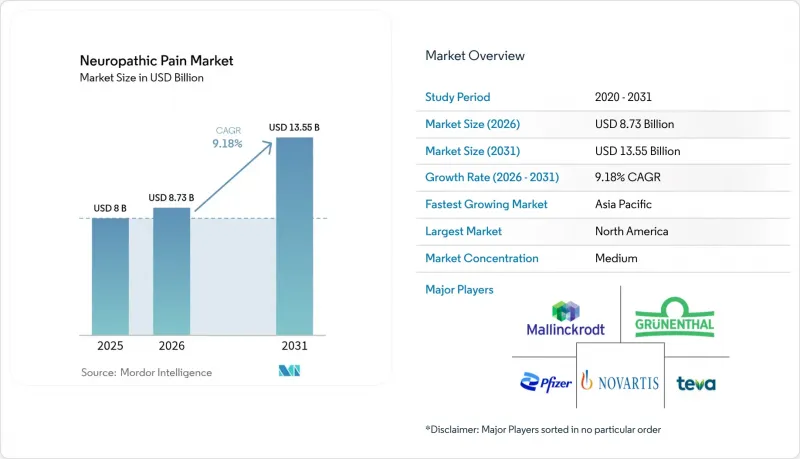
본 보고서에서는 업계를 약물 분류별(항경련제, 삼환계 항우울제 등), 적응증별(당뇨병성 말초신경병증, 대상포진 후 신경통 등), 유통 채널별(병원 약국, 소매 약국 등) 및 지역별로 분류하고 있습니다. 시장 전망치는 금액(달러)으로 표시되어 있습니다.
세계 신경병증성 통증 시장 동향 및 인사이트
전 세계적으로 당뇨병 및 비만 유병률이 증가함에 따라 당뇨병성 말초신경병증이 촉진되고 있습니다.
세계적으로 심각해지고 있는 당뇨병의 확산은 신경병증성 통증의 양상을 근본적으로 변화시키고 있으며, 당뇨병성 말초신경병증(DPN)은 당뇨병 환자의 약 50%에게 영향을 미치고 있습니다. 이처럼 높은 유병률은 효과적인 통증 관리 솔루션이 필요한 방대한 환자층이 존재함을 의미합니다. 최근 역학 연구에 따르면, DPN은 종종 진단에서 간과되고 있으며, 환자의 75%는 증상이 심각해질 때까지 발견되지 않는 것으로 밝혀졌는데, 이는 막대한 미개척 시장 기회를 창출하고 있습니다(Elafros등). DPN으로 인한 경제적 부담은 직접적인 치료비에만 그치지 않습니다. 통증을 동반한 DPN 환자들은 생산성 저하와 여러 전문 분야에 걸친 의료 서비스 이용 증가에 직면해 있으며, 부작용을 최소화하면서 기능적 예후를 개선할 수 있는 보다 효과적이고 내약성이 뛰어난 치료법에 대한 수요가 높아지고 있습니다.
암 생존율의 상승에 따라, 화학요법 유발성 말초신경병증(CIPN)으로 인한 부담이 커지고 있습니다.
암 치료의 효과가 향상됨에 따라, 화학요법 유발성 말초신경병증(CIPN)을 겪는 생존자의 수는 계속 증가하고 있으며, 효과적인 관리 전략이 시급히 요구되고 있습니다. Dove Press에 따르면, CIPN은 신경독성이 있는 항암제를 투여받은 환자의 30-40%에게 영향을 미치며, 증상은 치료 종료 후에도 장기간 지속되는 경우가 많다고 합니다. 이 질환은 삶의 질에 중대한 영향을 미치며, 화학요법 투여량을 줄일 수밖에 없는 경우도 있어, 그 결과 종양학적 예후를 악화시킬 가능성이 있습니다. CIPN의 병태생리에 관한 최근 연구 성과에 따라 산화 스트레스와 신경 염증의 역할이 밝혀지면서, 기존의 진통제를 뛰어넘는 새로운 치료의 길이 열리고 있습니다. CIPN의 조기 발견을 위한 바이오마커 개발도 탄력을 받고 있으며, 신경 영양 인자와 마이크로RNA가 고위험군 환자를 선별하는 데 유망한 것으로 평가받고 있습니다(Widyadharma). 예방적 개입을 통해 약물 치료가 필요한 중증 사례의 발생률이 낮아질 가능성이 있으므로, 이러한 추세는 CIPN 치료의 잠재적 시장 규모를 축소시킬 수 있습니다. 제약 기업들은 치료법의 혁신과 예방 및 조기 개입 전략의 개선을 통해 시장에 미치는 제약적 영향을 균형 있게 조율해야 하는 전략적 과제에 직면해 있습니다.
안전성에 대한 우려와 남용 위험으로 인해 오피오이드 및 가바펜티노이드 계열 약물의 사용이 제한되고 있습니다.
기존의 신경병증성 통증 치료의 임상적 유용성은 안전성에 대한 우려가 커지고 규제 당국의 감시가 강화됨에 따라 점점 더 제약을 받고 있습니다. 오피오이드는 진통 효과가 있음에도 불구하고, 높은 남용 위험과 오피오이드 오용과 관련된 지속적인 공중보건 위기로 인해 엄격한 처방 제한에 직면해 있습니다. 가바펜티노이드(프레가발린 및 가바펜틴)는 많은 신경병증성 통증에 효과적인 반면, 오용 가능성 및 의존성에 관한 새로운 증거가 밝혀짐에 따라 규제 당국의 감시가 강화되고 있습니다. 이러한 안전성 문제로 인해, 위험-이익 프로파일이 개선된 치료법으로의 근본적인 시장 전환이 진행되고 있습니다. 혈액-뇌 장벽을 통과하지 않는 말초 작용형 진통제의 개발은 이러한 우려에 대한 전략적 대응이며, 남용 위험의 한 원인이 되는 중추 신경계에 대한 영향을 수반하지 않으면서 통증을 완화시켜 줍니다(NIH). 이러한 안전성을 중시하는 시장의 진화는 현재의 표준 치료의 한계를 극복하면서도 유효성을 유지할 수 있는 새로운 치료 접근법을 모색할 기회를 창출하고 있습니다.
부문별 분석
항경련제는 2025년에 33.05%라는 가장 높은 시장 점유율을 차지하고 있으며, 프레가발린과 가바펜틴은 여러 신경병증성 통증 질환에서 입증된 효능 덕분에 핵심 치료제로서의 역할을 수행하고 있습니다. 이러한 약물의 작용기전은 주로 칼슘 채널의 조절과 GABA 활성 증강과 관련되어 있으며, 신경병증성 통증 상태에 특징적인 과흥분을 효과적으로 억제합니다. 최근의 비교 분석에 따르면, 프레가발린은 가바펜틴에 비해 통증 완화 효과가 뛰어나고 부작용도 적은 것으로 밝혀졌으며, 이것이 임상의들 사이에서 프레가발린에 대한 선호도가 높아지고 있는 이유 중 하나로 여겨집니다(Mayoral et al.). 항경련제는 시장을 독점하고 있는 기존 약물들이, 더 우수한 안전성 프로파일과 더 정밀한 작용기전을 가진 신흥 약물군으로부터 문제에 직면해 있습니다. 외용제는 특히 국소성 신경병증성 통증의 경우 위험-이익 비율이 양호하기 때문에 연평균 성장률(CAGR) 9.78%(2026-2031년)을 기록하며 가장 빠르게 성장하고 있는 부문입니다. SNRI는 당뇨병성 말초신경병증에 대한 두록세틴의 입증된 효능 덕분에 시장에서 여전히 중요한 입지를 유지하고 있는 반면, 오피오이드는 안전성 문제와 규제상의 제약으로 인해 사용이 감소하는 추세에 있습니다. NMDA 길항제 및 칸나비노이드를 포함하는 ‘기타 약물군’ 부문은 신경병증성 통증의 전달 경로를 표적으로 하는 새로운 작용기전에 대한 연구가 진전됨에 따라 유망한 성장 가능성을 보이고 있습니다.
각 제약사가 차별화된 작용기전을 목표로 포트폴리오를 전략적으로 재편함에 따라, 약물군 내의 경쟁 환경은 변화하고 있습니다. 여러 통증 경로를 동시에 표적으로 삼는 병용 요법은 단일 요법에 비해 우수한 치료 효과를 가져올 가능성이 있으며, 이는 치료 알고리즘의 재구축으로 이어질 수 있다는 새로운 연구 결과가 제시되었습니다(Kumar et al.). 이러한 추세에 따라, 신경병증성 통증의 복잡한 병태생리를 다루면서도 개별 약물의 부작용을 최소화할 수 있는 합리적인 다제 병용 요법이나 고정 용량 복합제에 대한 관심이 높아지고 있습니다. 최근 수제트리긴 등 신약이 승인된 것은 현재의 증상 중심 접근 방식에서 작용기전에 기반한 처방으로 전환되는 패러다임 전환의 가능성을 시사하며, 향후 몇 년 동안 약물 분류별 시장 점유율 분포를 근본적으로 바꿀 가능성이 있습니다.
당뇨병성 말초신경병증(DPN)은 2025년에 31.88%의 시장 점유율을 차지하며, 적응증 분야를 선도하고 있습니다. 이는 전 세계적으로 증가하는 당뇨병 환자의 높은 유병률을 반영한 것입니다. 이 질환은 당뇨병 발병 기간이 10년을 넘는 환자의 약 50%에게 영향을 미치고 있으며, 규모가 크고 계속해서 확대되고 있는 환자 집단을 형성하고 있습니다. DPN의 치료 접근법은 증상 관리에 그치지 않고 근본적인 병태생리학적 기전에 대응하는 방향으로 진화하고 있으며, 신경병증의 진행을 예방하거나 지연시킬 수 있는 질환 수정 요법에 대한 관심이 높아지고 있습니다. 화학요법 유발성 말초신경병증(CIPN)은 암 생존율의 향상과, CIPN이 삶의 질(QOL)에 미치는 영향에 대한 인식이 높아진 것을 배경으로, 연평균 성장률(CAGR) 11.05%(2026-2031년)를 기록하며 가장 빠르게 성장하고 있는 적응증 부문이 되었습니다. 대상포진 후 신경통은 그 특유의 병태생리와 치료상의 과제로 인해 여전히 큰 시장 점유율을 유지하고 있습니다. 한편, 3차신경통은 규모는 작지만 치료법이 다르며, 특정 치료 알고리즘이 존재하는 분야입니다.
적응증의 전반적인 양상은 조기 개입과 보다 정밀한 환자 분류가 가능하도록 하는 진단 능력의 향상 및 바이오마커 개발의 진전에 따라 재구성되고 있습니다. 최근 연구에 따르면, 신경 영양 인자나 마이크로RNA 등 CIPN의 잠재적 바이오마커가 확인되었으며, 이러한 바이오마커들은 고위험군 환자를 대상으로 한 예방 전략의 추진에 기여할 가능성이 있습니다(Widyadharma). HIV 관련 신경병증의 경우, 직접적인 통증 관리 외에도 항레트로바이러스 요법의 최적화가 관리에 있어 중요한 요소로 점점 더 인식되고 있습니다. 환지통 치료에는 FDA 승인을 받은 ‘Altius Direct Electrical Nerve Stimulation System’을 비롯한 혁신적인 접근법이 활용되고 있으며, 임상시험을 통해 현저한 통증 완화 효과가 입증되었습니다(FDA). 이러한 적응증 특이적 접근법의 발전은 시장 세분화를 촉진하고, 각 신경병증성 통증 질환 고유의 병태생리학적 특징에 대응하는 표적 치료의 기회를 창출하고 있습니다.
지역별 분석
북미는 높은 유병률, 선진적인 의료 인프라, 그리고 유리한 보험 지급 정책에 힘입어 2025년에는 41.90%의 점유율을 차지하며 신경병증성 통증 시장을 독점하고 있습니다. 이 지역의 선도적 지위는 혁신적인 치료법의 주요 도입 시장으로서의 역할에 힘입어 더욱 공고해지고 있으며, 그 대표적인 예로 20년여 만에 새로운 진통제 계열인 Journavx(수제트리긴)가 최근 FDA의 승인을 받은 사실을 들 수 있습니다. ‘NOPAIN법’의 시행은 외래 진료에서 비오피오이드계 통증 관리에 특화된 보험 급여 체계를 신설하는 것으로, 중요한 정책적 진전이라고 할 수 있습니다(Vertex Pharmaceuticals). 이러한 규제 측면의 호재에 힘입어, 새로운 신경병증성 통증 치료제, 특히 기존 치료법에 비해 우월성이 입증된 치료제 시장 진입이 가속화될 것으로 예측됩니다. 북미 시장에서 미국은 환자 수가 많고 의료비 지출이 높은 점을 바탕으로 가장 큰 시장 점유율을 차지하고 있지만, 캐나다와 멕시코 역시 접근성 프로그램 확대와 진단 능력 향상을 통해 이 지역의 성장에 크게 기여하고 있습니다.
유럽은 두 번째로 큰 지역 시장으로, 견고한 의료 제도와 신경병증성 통증 치료에 대한 접근성을 높이는 종합적인 보험 급여 체계가 특징입니다. 이 지역 시장 역학은 비교 유효성과 비용 대비 효과를 중시하는 엄격한 의료 기술 평가 과정을 통해 형성되어 있으며, 기존 치료법에 비해 입증된 우월성을 지닌 치료법에 대한 수요를 이끌고 있습니다. 영국과 독일은 혁신적인 치료법의 도입을 주도하고 있는 반면, 프랑스, 이탈리아, 스페인은 환자 수가 많고 확립된 통증 관리 인프라를 바탕으로 여전히 큰 시장 점유율을 유지하고 있습니다. 최근 유럽에서 첨단 척수 자극 시스템을 포함한 새로운 치료법과 의료기기가 승인된 것은 신경병증성 통증 환자를 위한 치료 선택지를 확대하기 위한 해당 지역의 노력을 반영하고 있습니다(메드트로닉).
아시아태평양은 질병 유병률 증가, 의료 서비스 접근성 개선, 의료비 증가에 힘입어 연평균 성장률(CAGR) 11.88%(2026-2031년)을 기록하는 가장 빠르게 성장하는 지역 시장입니다. 중국은 보험 적용 범위 확대와 의료 인프라에 대한 막대한 투자를 통해 지역 성장을 주도하고 있습니다. 한편, 일본은 선진적인 의료 제도와 신경병증성 통증 유병률이 높은 고령화 사회 덕분에 큰 시장 점유율을 차지하고 있습니다. 인도는 당뇨병 환자 수가 많고 진단 능력이 향상됨에 따라 주요 성장 시장으로 부상하고 있지만, 농촌 지역에서는 여전히 의료 접근성에 문제가 남아 있습니다. 이 지역에서는 기존의 치료법 외에도 전통 의학 기법이 점점 더 많이 채택되고 있으며, 최근 조사에서는 신경병증성 통증 치료에 있어 한의학의 가능성이 강조되고 있습니다(Zhang et al.). 한국 시장은 기술의 급속한 도입과 강력한 제약 연구 역량을 특징으로 하며, 지역 혁신에 기여하고 있습니다. 중동 및 아프리카 및 남미 지역은 규모는 작지만 성장세가 두드러지는 시장이며, 의료 인프라의 개선과 질병에 대한 인식 제고가 낮은 수준에서 출발한 시장 확대를 이끌고 있습니다.
기타 혜택:
- 엑셀 형식 시장 예측(ME) 시트
- 3개월간의 애널리스트 지원
자주 묻는 질문
목차
제1장 서론
제2장 조사 방법
제3장 주요 요약
제4장 시장 구도
제5장 시장 규모와 성장 예측
제6장 경쟁 구도
제7장 시장 기회와 향후 전망
JHS 26.06.29According to Mordor Intelligence, neuropathic pain market size in 2026 is estimated at USD 8.73 billion, growing from 2025 value of USD 8.00 billion with 2031 projections showing USD 13.55 billion, growing at 9.18% CAGR over 2026-2031.
This report Segments the Industry Into by Drug Class (Anticonvulsants, Tricyclic Antidepressants, and More), by Indication (Diabetic Peripheral Neuropathy, Postherpetic Neuralgia and More), by Distribution Channel (Hospital Pharmacies, Retail Pharmacies, and More) and Geography. The Market Forecasts are Provided in Terms of Value (USD).
Global Neuropathic Pain Market Trends and Insights
Growing Global Prevalence of Diabetes & Obesity Driving Diabetic Peripheral Neuropathy
The escalating global diabetes epidemic is fundamentally reshaping the neuropathic pain landscape, with diabetic peripheral neuropathy (DPN) affecting approximately 50% of diabetic patients. This high prevalence translates to a substantial patient population requiring effective pain management solutions. Recent epidemiological studies reveal that DPN is often underdiagnosed, with 75% of cases remaining undetected until symptoms become severe, creating a significant untapped market opportunity Elafros et al.. The economic burden of DPN extends beyond direct treatment costs, as patients with painful DPN experience reduced productivity and higher healthcare utilization across multiple specialties, driving demand for more effective and tolerable treatment options that can improve functional outcomes while minimizing side effects.
Increasing Cancer Survival Rates Elevating Chemotherapy-Induced Peripheral Neuropathy Burden
As cancer treatment efficacy improves, the population of survivors experiencing chemotherapy-induced peripheral neuropathy (CIPN) continues to expand, creating an urgent need for effective management strategies. CIPN affects 30-40% of patients receiving neurotoxic chemotherapy agents, with symptoms often persisting long after treatment completion Dove Press. The condition significantly impacts quality of life and may necessitate chemotherapy dose reductions, potentially compromising oncological outcomes. Recent advances in understanding CIPN pathophysiology have revealed the role of oxidative stress and neuroinflammation, opening new therapeutic avenues beyond traditional analgesics. Biomarker development for early CIPN detection is gaining momentum, with neurotrophic factors and microRNAs showing promise for identifying high-risk patients Widyadharma. This trend could potentially reduce the addressable market for CIPN treatments, as preventive interventions might decrease the incidence of severe cases requiring pharmaceutical management. Pharmaceutical companies face the strategic challenge of balancing innovation in treatment with the market-constraining effects of improved prevention and early intervention strategies.
Safety Concerns & Abuse Potential Limiting Opioid and Gabapentinoid Utilization
The clinical utility of traditional neuropathic pain treatments is increasingly constrained by mounting safety concerns and regulatory scrutiny. Opioids, despite their analgesic efficacy, face severe prescribing restrictions due to their high abuse potential and the ongoing public health crisis associated with opioid misuse. Gabapentinoids (pregabalin and gabapentin), while effective for many neuropathic pain conditions, are encountering growing regulatory oversight due to emerging evidence of misuse potential and dependence issues. These safety challenges are driving a fundamental market shift toward treatments with improved risk-benefit profiles. The development of peripherally-acting analgesics that do not cross the blood-brain barrier represents a strategic response to these concerns, offering pain relief without central nervous system effects that contribute to abuse potential NIH. This safety-driven market evolution is creating opportunities for novel therapeutic approaches that can maintain efficacy while addressing the limitations of current standard-of-care treatments.
Other drivers and restraints analyzed in the detailed report include:
- Rapid Clinical Adoption of Next-Generation Sodium-Channel Blockers & NGF Antagonists
- Accelerating R&D Investments in Non-Opioid Analgesics by Big Pharma & Biotech
- Patent Expirations of Blockbuster Therapies Driving Price Erosion & Generic Entry
For complete list of drivers and restraints, kindly check the Table Of Contents.
Segment Analysis
Anticonvulsants command the largest market share at 33.05% in 2025, with pregabalin and gabapentin serving as cornerstone therapies due to their established efficacy across multiple neuropathic pain conditions. Their mechanism of action, primarily involving calcium channel modulation and enhanced GABA activity, effectively addresses the hyperexcitability that characterizes neuropathic pain states. Recent comparative analyses reveal that pregabalin demonstrates superior pain reduction and fewer adverse events compared to gabapentin, potentially explaining its growing preference among clinicians Mayoral et al.. Despite their dominance, anticonvulsants face challenges from emerging drug classes with potentially superior safety profiles and more targeted mechanisms. Topical agents represent the fastest-growing segment with a 9.78% CAGR (2026-2031), driven by their favorable risk-benefit profile, particularly for localized neuropathic pain. SNRIs maintain significant market presence due to duloxetine's established efficacy in diabetic peripheral neuropathy, while opioids face declining utilization amid safety concerns and regulatory restrictions. The "Other Classes" segment, including NMDA antagonists and cannabinoids, shows promising growth potential as research advances on novel mechanisms targeting neuropathic pain pathways.
The competitive dynamics within drug classes are evolving as pharmaceutical companies strategically reposition their portfolios toward differentiated mechanisms. Emerging evidence suggests that combination approaches targeting multiple pain pathways simultaneously may offer superior outcomes compared to monotherapy, potentially reshaping treatment algorithms Kumar et al.. This trend is driving increased interest in rational polypharmacy and fixed-dose combinations that can address the complex pathophysiology of neuropathic pain while minimizing individual drug side effects. The recent approval of novel agents like suzetrigine signals a potential paradigm shift toward mechanism-based prescribing rather than the current symptom-based approach, which could fundamentally alter market share distribution across drug classes in the coming years.
Diabetic peripheral neuropathy (DPN) dominates the indication landscape with 31.88% market share in 2025, reflecting its high prevalence among the growing diabetic population worldwide. The condition affects approximately 50% of patients with diabetes duration exceeding 10 years, creating a substantial and expanding patient pool. Treatment approaches for DPN are evolving beyond symptom management to address underlying pathophysiological mechanisms, with increasing focus on disease-modifying therapies that can prevent or slow neuropathy progression. Chemotherapy-induced peripheral neuropathy (CIPN) represents the fastest-growing indication segment with an 11.05% CAGR (2026-2031), driven by improving cancer survival rates and growing recognition of CIPN's impact on quality of life. Postherpetic neuralgia maintains significant market share due to its distinctive pathophysiology and treatment challenges, while trigeminal neuralgia represents a smaller but therapeutically distinct segment with specific treatment algorithms.
The indication landscape is being reshaped by advances in diagnostic capabilities and biomarker development that enable earlier intervention and more precise patient stratification. Recent research has identified potential biomarkers for CIPN, including neurotrophic factors and microRNAs, which could facilitate preventive strategies in high-risk patients Widyadharma. For HIV-associated neuropathy, antiretroviral therapy optimization is increasingly recognized as a critical component of management alongside direct pain interventions. Phantom limb pain is benefiting from innovative approaches, including the FDA-approved Altius Direct Electrical Nerve Stimulation System, which demonstrated significant pain reduction in clinical studies FDA. These advances in indication-specific approaches are driving market segmentation and creating opportunities for targeted therapies that address the unique pathophysiological features of each neuropathic pain condition.
Geography Analysis
North America dominates the neuropathic pain market with 41.90% share in 2025, driven by high disease prevalence, advanced healthcare infrastructure, and favorable reimbursement policies. The region's leadership position is reinforced by its role as the primary launch market for innovative therapies, exemplified by the recent FDA approval of Journavx (suzetrigine) as the first new analgesic class in over two decades FDA. The implementation of the NOPAIN Act represents a significant policy advancement, creating reimbursement pathways specifically for non-opioid pain management in outpatient settings Vertex Pharmaceuticals. This regulatory tailwind is expected to accelerate market access for novel neuropathic pain therapies, particularly those with demonstrated advantages over existing options. The United States accounts for the largest share within North America, reflecting its substantial patient population and high healthcare expenditure, while Canada and Mexico contribute significantly to regional growth through expanding access programs and improving diagnostic capabilities.
Europe represents the second-largest regional market, characterized by strong healthcare systems and comprehensive reimbursement frameworks that facilitate access to advanced neuropathic pain therapies. The region's market dynamics are shaped by stringent health technology assessment processes that emphasize comparative effectiveness and cost-utility, driving demand for treatments with demonstrable advantages over existing options. The United Kingdom and Germany lead in adoption of innovative therapies, while France, Italy, and Spain maintain substantial market shares due to their large patient populations and established pain management infrastructure. Recent European approvals of novel treatments and devices, including advanced spinal cord stimulation systems, reflect the region's commitment to expanding therapeutic options for neuropathic pain patients Medtronic.
Asia-Pacific represents the fastest-growing regional market with a 11.88% CAGR (2026-2031), driven by increasing disease prevalence, improving healthcare access, and rising healthcare expenditure. China leads regional growth with expanding insurance coverage and significant investments in healthcare infrastructure, while Japan contributes substantial market share through its advanced healthcare system and aging population with high neuropathic pain prevalence. India is emerging as a key growth market due to its large diabetic population and improving diagnostic capabilities, though access challenges persist in rural areas. The region is witnessing increasing adoption of traditional medicine approaches alongside conventional therapies, with recent research highlighting the potential of traditional Chinese medicine in treating neuropathic pain Zhang et al.. South Korea's market is characterized by rapid technology adoption and strong pharmaceutical research capabilities, contributing to regional innovation. The Middle East & Africa and South America regions represent smaller but growing markets, with improving healthcare infrastructure and increasing disease awareness driving expansion from a lower base.
List of Companies Covered in this Report:
- Pfizer
- GlaxoSmithKline
- Eli Lilly and Company
- Johnson & Johnson
- Novartis
- Teva Pharmaceutical Industries
- Grunenthal GmbH
- UCB
- Sanofi
- Biogen
- Astellas Pharma
- Vertex Pharmaceuticals
- Aptinyx Inc.
- Daiichi Sankyo
- Takeda Pharmaceuticals
- Bayer
- Mallinckrodt Pharmaceuticals
- Sun Pharmaceuticals Industries
- Assertio Holdings, Inc.
- Ipsen
- Endo International
- Lexicon Pharmaceuticals, Inc.
Additional Benefits:
- The market estimate (ME) sheet in Excel format
- 3 months of analyst support
TABLE OF CONTENTS
1 Introduction
- 1.1 Study Assumptions & Market Definition
- 1.2 Scope of the Study
2 Research Methodology
3 Executive Summary
4 Market Landscape
- 4.1 Market Overview
- 4.2 Market Drivers
- 4.2.1 Growing Global Prevalence of Diabetes & Obesity Driving Diabetic Peripheral Neuropathy
- 4.2.2 Increasing Cancer Survival Rates Elevating Chemotherapy-Induced Peripheral Neuropathy Burden
- 4.2.3 Rapid Clinical Adoption of Next-Generation Sodium-Channel Blockers & NGF Antagonists
- 4.2.4 Accelerating R&D Investments in Non-Opioid Analgesics by Big Pharma & Biotech
- 4.2.5 Expanding Availability of Long-Acting Topical & Transdermal Formulations Worldwide
- 4.2.6 Favorable Global Reimbursement & HTA Outcomes for High-Cost Biologic Analgesics
- 4.3 Market Restraints
- 4.3.1 Safety Concerns & Abuse Potential Limiting Opioid and Gabapentinoid Utilization
- 4.3.2 Patent Expirations of Blockbuster Therapies Driving Price Erosion & Generic Entry
- 4.3.3 Stringent Regulatory Requirements Delaying Approval of Novel Analgesics
- 4.4 Supply-Chain Analysis
- 4.5 Regulatory Outlook
- 4.6 Technological Outlook
- 4.7 Porter's Five Forces
- 4.7.1 Threat of New Entrants
- 4.7.2 Bargaining Power of Suppliers
- 4.7.3 Bargaining Power of Buyers
- 4.7.4 Threat of Substitutes
- 4.7.5 Competitive Rivalry
5 Market Size & Growth Forecasts (Value)
- 5.1 By Drug Class
- 5.1.1 Anticonvulsants
- 5.1.2 Serotonin and Norepinephrine Reuptake Inhibitors
- 5.1.3 Tricyclic Antidepressant
- 5.1.4 Opioids
- 5.1.5 Topical Agents
- 5.1.6 Other Classes
- 5.2 By Indication
- 5.2.1 Diabetic Peripheral Neuropathy
- 5.2.2 Postherpetic Neuralgia
- 5.2.3 Chemotherapy-Induced Peripheral Neuropathy
- 5.2.4 Trigeminal Neuralgia
- 5.2.5 HIV-Associated Neuropathy
- 5.2.6 Phantom Limb Pain
- 5.2.7 Others (MS, Spinal Cord Injury)
- 5.3 By Route of Administration
- 5.3.1 Oral
- 5.3.2 Topical
- 5.3.3 Parenteral
- 5.4 By Distribution Channel
- 5.4.1 Hospital Pharmacies
- 5.4.2 Retail Pharmacies
- 5.4.3 Online Pharmacies
- 5.5 By Geography
- 5.5.1 North America
- 5.5.1.1 United States
- 5.5.1.2 Canada
- 5.5.1.3 Mexico
- 5.5.2 Europe
- 5.5.2.1 United Kingdom
- 5.5.2.2 Germany
- 5.5.2.3 France
- 5.5.2.4 Italy
- 5.5.2.5 Spain
- 5.5.2.6 Rest of Europe
- 5.5.3 Asia-Pacific
- 5.5.3.1 China
- 5.5.3.2 Japan
- 5.5.3.3 India
- 5.5.3.4 Australia
- 5.5.3.5 South Korea
- 5.5.3.6 Rest of Asia-Pacific
- 5.5.4 Middle East & Africa
- 5.5.4.1 GCC
- 5.5.4.2 South Africa
- 5.5.4.3 Rest of Middle East & Africa
- 5.5.5 South America
- 5.5.5.1 Brazil
- 5.5.5.2 Argentina
- 5.5.5.3 Rest of South America
- 5.5.1 North America
6 Competitive Landscape
- 6.1 Market Concentration
- 6.2 Strategic Moves
- 6.3 Market Share Analysis
- 6.4 Company Profiles {(includes Global level Overview, Market level overview, Core Segments, Financials as available, Strategic Information, Market Rank/Share for key companies, Products & Services, and Recent Developments)}
- 6.4.1 Pfizer Inc.
- 6.4.2 GlaxoSmithKline plc
- 6.4.3 Eli Lilly and Company
- 6.4.4 Johnson & Johnson Services, Inc.
- 6.4.5 Novartis AG
- 6.4.6 Teva Pharmaceutical Industries Ltd.
- 6.4.7 Grunenthal GmbH
- 6.4.8 UCB S.A.
- 6.4.9 Sanofi S.A.
- 6.4.10 Biogen Inc.
- 6.4.11 Astellas Pharma Inc.
- 6.4.12 Vertex Pharmaceuticals Incorporated
- 6.4.13 Aptinyx Inc.
- 6.4.14 Daiichi Sankyo Company, Limited
- 6.4.15 Takeda Pharmaceutical Company Limited
- 6.4.16 Bayer AG
- 6.4.17 Mallinckrodt Pharmaceuticals
- 6.4.18 Sun Pharmaceutical Industries Ltd.
- 6.4.19 Assertio Holdings, Inc.
- 6.4.20 Ipsen S.A.
- 6.4.21 Endo International plc
- 6.4.22 Lexicon Pharmaceuticals, Inc.
7 Market Opportunities & Future Outlook
- 7.1 White-space & Unmet-Need Assessment


