|
시장보고서
상품코드
2066571
소자 시스템 : 시장 점유율 분석, 업계 동향 및 통계, 성장 예측(2026-2031년)Degaussing Systems - Market Share Analysis, Industry Trends & Statistics, Growth Forecasts (2026 - 2031) |
||||||
 Mordor Intelligence
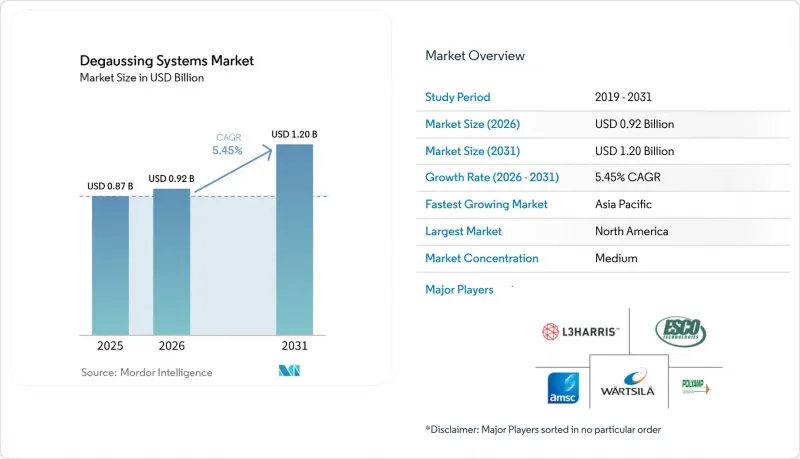
Mordor Intelligence에 의하면, 소자 시스템 시장 규모는 2025년 8억 7,000만 달러로 평가되었습니다. 2026년에는 9억 2,000만 달러로 확대되어 2026년부터 2031년에 걸쳐 CAGR 5.45%로 성장을 지속하여, 2031년까지 12억 달러에 이를 것으로 예측됩니다.
본 보고서는 선박 유형(항공모함, 구축함, 호위함, 코르벳, 잠수함 등), 솔루션(자성 제거, 탈자, 거리 측정), 구성 요소(제어 장치, 전력 증폭기, 코일 및 케이블 등), 설치 유형(신조선 설치 및 개조), 지역(북미, 유럽 등)별로 분류되어 있습니다. 시장 전망은 금액(달러) 기준으로 제시되어 있습니다.
세계의 소자 시스템 시장 동향 및 인사이트
해군 현대화 예산 증액으로 조달이 가속화
방위 투자 확대에 따라, 자력 제거 시스템의 업그레이드와 전투 시스템의 개량을 결합한, 수년에 걸친 조선 및 유지보수 프로그램이 강화되고 있습니다. 미국은 2026 회계연도 국방 투자로 3,843억 달러를 편성했으며, 이 중 650억 달러가 조선 및 해양 시스템에 배정되었으며, 여기에는 수상 전투함의 생존성 및 시그니처 관리와 관련된 작업도 포함됩니다. 캐나다의 2026년 방위산업 전략은 ‘건조·제휴·구매’라는 접근 방식을 중시하고 있으며, 국가 조선 로드맵을 수상 함정의 전자기 적합성 기준과 연계하고 있습니다. 나토(NATO) 회원국들도 함정 플랫폼을 중심으로 AI를 활용한 능력을 도입하고 있으며, 이는 현대화 과정에서 하드웨어와 소프트웨어를 결합해 실시간으로 현장을 제어하는 경향이 강해지고 있음을 보여줍니다. 해군이 더 많은 함정을 개조 도크로 보내고, 거리 측정, 자기 제거 및 함재 코일 재보정을 다른 임무 패키지 작업과 연계함에 따라, 소자 시스템 시장은 그 혜택을 누리고 있습니다. 북미의 단기적인 구매와 아시아태평양의 급속한 성장이 2031년까지 소자 시스템 시장 수요 증가를 이끄는 주요 원동력이 되고 있습니다.
자기 영향형 수중 기뢰가 시그니처 제어 수요를 견인하고 있습니다.
국방정보국(DIA)의 평가에 따르면, 북한은 상당량의 해군용 기뢰를 보유하고 있으며, 그 중에는 자력 신관을 장착한 영향형 기뢰도 포함되어 있어, 제한 구역 내의 수상 전투함에 즉각적인 위험을 초래할 가능성이 있습니다. 기뢰로 인한 위협은 남중국해에서도 마찬가지로 존재하며, 수심이 얕은 해역에서는 해저 기뢰나 계류 기뢰의 위협이 더욱 커질 가능성이 있습니다. 이러한 기뢰 위험에 대처하기 위해 미 해군은 2025년, 해군 해상 시스템 사령부를 통해 RTX 코퍼레이션 및 텍스트론사에 기뢰 대응 페이로드 계약을 수주했습니다. 이는 연안 전투함(LCS)에 탑재되는 모듈식 기뢰 제거 장비의 일부이며, 해당 함정의 자기 신호를 제어하는 것이 매우 중요합니다. 동시에, 다양한 연구에서 지적되고 있듯이, 루비듐을 이용한 양자 자력계에 관한 중국의 연구개발 활동은 자력 제거 장치를 장착한 함정이라 할지라도 자기 시그니처를 제어하는 것이 얼마나 중요한지를 여실히 보여주고 있습니다.
설비 투자 증가와 장기적인 유지비가 더 광범위한 도입을 제한하고 있습니다.
예산 수립 담당자들은 생존성 투자, 화력, 그리고 즉각적인 대응 능력 사이에서 절충점을 찾아야 하는 상황에 직면해 있으며, 이로 인해 일부 함대에서 자력 제거 장치의 업그레이드 속도가 둔화될 가능성이 있습니다. 총 소유 비용에는 설치, 정기적인 유지보수 및 거리 측정이 포함되며, 이러한 비용 항목은 조달 계획에서 다른 항목들과 경쟁 관계를 이룹니다. 신흥 시장의 프로그램은 초기 비용 및 수명 주기 비용에 가장 민감하며, 이것이 자석 제거 작업을 후반 단계로 미루는 요인이 될 수 있습니다. 의사결정권자들은 인건비와 도크 체류 시간을 줄이기 위해, 자석 제거 처리를 다른 중간 수명 정비 작업과 결합한 정비 패키지를 선택하는 경우가 많습니다. 이러한 비용 산정에 따라 도입은 안정적인 속도를 유지하겠지만, 그 결과 해당 연도에 우선순위가 낮은 함정에 대한 배치가 지연될 가능성이 있습니다.
부문별 분석
2025년에는 잠수함이 해당 부문 매출의 30.67%를 차지했습니다. 이는 잠수함 함대가 신조함 및 동형함 전체의 개량 과정에서 자기 신호 제어를 도입했기 때문입니다. 대기뢰함은 2031년까지 연평균 성장률(CAGR) 7.65%로 확대될 전망이며, 이는 저자기장 모함과 무인정을 활용해 기뢰를 탐색·무력화한다는 전술 방침을 반영한 것입니다. 북미의 조달은 아시아태평양의 성장을 염두에 둔 수명 연장 계획을 중심으로 진행되고 있으며, 이는 분쟁 중인 연안 해역 및 설계 단계부터 자기 신호 제어를 규정하는 새로운 수중 프로그램과 밀접한 관련이 있습니다. 무인 시스템이 기뢰 탐색 임무를 더 많이 담당하게 됨에 따라, 모함 및 지원함 역시 영향권 내에서의 운용 위험을 줄이기 위해 더 낮은 자기 기준치를 표준화하고 있습니다. 해군이 임무상의 필요성과 선체의 노후 정도에 따라 단계적으로 업그레이드를 실시하는 가운데, 데가우징 시스템 업계는 이러한 균형 잡힌 조합으로부터 혜택을 보고 있습니다.
구축함 및 호위함을 포함한 수상 전투함에 대해서는 함대가 저시그니처 순항 및 항해를 위한 실시간 제어를 조정함에 따라 수요가 지속적으로 유지되고 있습니다. 기뢰전과 관련된 요건은 원정 임무를 지원하는 초계정 및 보조 함정에도 적용되고 있어, 소형 코일 세트와 소형 제어 장치의 도입 기반이 확대되고 있습니다. 2026년 동맹국의 조선 로드맵에서는 더 높은 생존성 기준과 더 엄격한 전자기 호환성이 중시되고 있으며, 이에 따라 자성 제거는 단순한 선택적 개조가 아닌 핵심 요건이 되었습니다. 그 결과, 대형 함정에 대한 수요는 안정세를 보이고 있으며, 기뢰의 위협이 있는 해역에서 운용되는 특수 함정에 대한 수요는 더욱 빠르게 증가하고 있습니다. 이러한 ‘양극화’ 경향이 수요 예측의 기반이 되어, 소자 시스템 시장에서 각 함종에 걸친 공급업체들의 전략을 형성하고 있습니다.
2025년에는 해군이 일상 운용 중 발생하는 전자 신호를 억제하는 함재 코일 시스템을 우선시한 결과, 자성 제거 솔루션이 해당 부문 지출의 61.25%를 차지했습니다. 거리 측정 및 보정은 자화 제거와 탈자화 모두에서 현장 목표값을 설정하고 검증하기 위해, 가동 및 개조 워크플로우에서 여전히 핵심적인 역할을 수행하고 있습니다. 소프트웨어 정의 제어는 선체가 다양한 방위와 위도에서 어떻게 반응하는지를 학습함으로써 내결함성을 높이고, 이를 통해 승무원의 업무 부담을 줄이며, 항만 및 해상에서 목표 자기장에 도달하는 시간을 단축합니다. 조달팀은 이러한 기능들을 보다 광범위한 생존성 범위에 통합함으로써, 현대화 일정을 함정의 운용 가능 기간과 조율하고 있습니다. 소자 시스템 업계는 설계 및 인수 시험 기간을 단축하는 모듈식 증폭기, 스마트 컨트롤러, 디지털 트윈을 통해 이에 대응하고 있습니다.
해군이 일상적인 자기장 수준을 낮게 유지하기 위해 영구 자석의 재설정 빈도를 높이고 있는 만큼, 영구 자화 제거 시장은 2031년까지 연평균 성장률(CAGR) 6.27%로 확대되고 있습니다. 고정 시설로의 이동 시간을 최소화하는 휴대형 및 부두 기반 접근 방식이 점차 보급되고 있으며, 이를 통해 함정을 지정된 위치에 고정시켜 일정상의 위험을 줄이고 있습니다. 디퍼밍은 잔류 자기의 드리프트를 줄여 함재 코일의 효율을 높이기 때문에 많은 함대에서는 그 효과를 공고히 하기 위해 디퍼밍 주기와 거리 측정 데이터 갱신을 병행하고 있습니다. 또한, 모델 기반 설계를 통해 코일 레이아웃과 디퍼밍 프로파일이 개선되어, 처리 간 결과의 재현성이 향상되었습니다. 이러한 노력들이 어우러져 솔루션의 다양성이 강화되었으며, 소자 시스템 시장에서 실시간 자화 제거 기술의 우위가 유지되고 있습니다.
지역별 분석
2025년 북미는 소자 시스템 시장 규모의 35.65%를 차지했습니다. 이는 미국의 지속적인 조선 및 현대화 투자와, 국내 역량을 우선시하는 캐나다의 산업 정책에 힘입은 결과입니다. 미국의 2026 회계연도 예산안에서는 조선 및 해양 시스템에 650억 달러가 배정되었으며, 대기뢰 대책 및 생존성 향상 수단에 대한 자금 지원도 유지되고 있습니다. 캐나다의 2026년 방위산업 전략은 해군 생산 능력을 강화하고, 향후 수상함정의 전자기 호환성 대응을 포함하여, 공급업체들이 장기적인 플랫폼 요구 사항에 부응할 수 있는 로드맵을 공식적으로 제시하고 있습니다. 미 해군의 MCM USV 프로그램은 분산형 기뢰전을 추진하며, 플랫폼 조달과 저자기장 작전에 대한 임무상 요구를 연계하고 있습니다. 이러한 상황이 해당 지역의 소자 시스템 시장에 안정적인 기반을 마련해 주고 있습니다.
아시아태평양에서는 해군력 확충이 분쟁 중인 해상 항로 및 자율형 대기뢰 조치의 광범위한 도입과 맞물려, 2031년까지 연평균 성장률(CAGR) 8.12%로 성장할 것으로 전망됩니다. 해당 지역 전체를 대상으로 한 무인 프로그램에서는 마이크로 자력 제거 및 소프트웨어 정의 제어가 중시되고 있으며, 이를 통해 무인수상정(USV)과 모선이 자기장 강도가 더 낮은 기뢰 영향 해역에서도 운용될 수 있게 됩니다. 각 파트너는 기술적 선택을 생존성 목표와 지속적으로 조화시키고 있으며, 이를 통해 모델 기반 설계 및 보정 체계가 강화되고 있습니다. 공급업체들이 알고리즘을 현지 운영 환경 및 사거리 데이터 세트에 맞추어 최적화해 나감에 따라, 소프트웨어 혁신은 급속히 확대될 전망입니다. 이러한 요소들이 소자 시스템 시장에서 아시아태평양이 다른 지역을 앞서는 실적을 뒷받침하고 있습니다.
유럽에서는 대기뢰전 전통과 NATO 체제 내의 표준화를 바탕으로, 꾸준한 도입이 진행되고 있습니다. 가맹국들은 자율형 대기뢰 대책 및 관련 자화 제거 조정에 투자하고 있으며, 2026년 공급업체 발표에서는 함정 플랫폼 및 시그니처 관리에 특화된 AI 엔지니어링 자원이 확인되었습니다. 조달 주기는 전자기 호환성(EMC) 및 내충격성 요건을 충족하기 위해 신중한 속도가 유지되고 있으며, 이를 통해 단기 예산 전반에 걸쳐 안정적인 조달 물량이 확보되고 있습니다. 유럽의 우선순위는 개조 규모와 신규 건조로의 선택적 도입이라는 세계적 추세를 반영하고 있으며, 모듈식 및 소프트웨어 정의 제어에 중점을 두고 있습니다. 이러한 접근 방식 덕분에, 다른 방위 분야에서 볼 수 있는 변동성 없이 소자 시스템 시장에서 예측 가능한 비즈니스 기회가 뒷받침되고 있습니다.
기타 혜택 :
- 엑셀 형식 시장 예측(ME) 시트
- 3개월간의 애널리스트 지원
자주 묻는 질문
목차
제1장 서론
제2장 조사 방법
제3장 주요 요약
제4장 시장 구도
제5장 시장 규모 및 성장 예측
제6장 경쟁 구도
제7장 시장 기회 및 향후 전망
KTH 26.06.29According to Mordor Intelligence, the degaussing systems market size is expected to grow from USD 0.87 billion in 2025 to USD 0.92 billion in 2026 and is forecasted to reach USD 1.2 billion by 2031 at a 5.45% CAGR over 2026-2031.
This report is Segmented by Vessel Type (Aircraft Carriers, Destroyers, Frigates, Corvettes, Submarines, and More), Solution (Degaussing, Deperming, and Ranging), Component (Control Units, Power Amplifiers, Coils and Cabling, and More), Installation Type (New-Build Installation and Retrofit), and Geography (North America, Europe, and More). The Market Forecasts are Provided in Terms of Value (USD).
Global Degaussing Systems Market Trends and Insights
Rising Naval Modernization Budgets Accelerate Procurement
Higher defense investment is reinforcing multi-year shipbuilding and sustainment programs that bundle degaussing upgrades with combat-system refresh. The US allocates USD 384.3 billion for FY2026 defense investment, with USD 65 billion directed to shipbuilding and maritime systems, including survivability and signature-management work on surface combatants. Canada's 2026 defense industrial strategy emphasizes a build-partner-buy approach, aligning national shipbuilding roadmaps with electromagnetic-compatibility standards for surface ships. NATO members are also introducing AI-enabled capabilities around ship platforms, signaling that modernizations increasingly combine hardware and software for real-time field control. The degaussing systems market benefits as navies move more hulls through upgrade docks and sync ranging, deperming, and onboard-coil recalibration with other mission package work. Near-term buys in North America and faster growth in Asia-Pacific are the central volume drivers for the degaussing systems market through 2031.
Magnetic-Influence Sea Mines Propel Signature Control Demand
The Defense Intelligence Agency has evaluated that North Korea possesses a significant stockpile of naval mines, which include influence mines equipped with magnetic fuzes, which can cause imminent danger to surface warships in restricted areas. The threat from mines is equally present in the South China Sea, where shallow waters can enhance the effectiveness of bottom- and moored-mine hazards. To address these mine risks, the US Navy awarded contracts to RTX Corporation and Textron Inc. in 2025 for mine countermeasure payloads through the Naval Sea Systems Command, which is part of modular mine-sweeping equipment carried by Littoral Combat Ships, where it is critical to control magnetic signatures from these vessels. At the same time, Chinese research and development activities, as noted in various studies, on rubidium-based quantum magnetometers highlight the importance of controlling magnetic signatures, even from degaussing-equipped vessels.
Elevated Capital Expenditure and Long-Term Maintenance Costs Limit Broader Adoption
Budget planners face trade-offs among survivability investments, lethality, and readiness, which can slow the pace of degaussing upgrades in some fleets. Total cost of ownership includes installation, periodic maintenance, and ranging, and these line items compete with other line items in procurement plans. Programs in emerging markets are the most sensitive to upfront and lifecycle costs, which can push degaussing work into later phases. Decision makers often choose retrofit packages that combine degaussing with other mid-life tasks to secure savings on labor and dock time. This cost calculus keeps adoption steady, yet it can delay deployment across lower-priority hulls in any given year.
Other drivers and restraints analyzed in the detailed report include:
- Expansion of Retrofit Initiatives Targeting Older Surface Vessels for Degaussing Upgrades
- Emergence of High-Temperature Superconducting Coil Technology Enabling Compact and Efficient Systems
- Supply-Chain Vulnerabilities for HTS Tape and Rare-Earth-Based Magnetic Sensors Hinder Production Scalability
For complete list of drivers and restraints, kindly check the Table Of Contents.
Segment Analysis
Submarines accounted for 30.67% of segment revenue in 2025 as undersea fleets embedded magnetic-signature control into new builds and through-class upgrades. Mine countermeasure vessels are advancing at a 7.65% CAGR through 2031, which reflects a doctrine that relies on low-field motherships and unmanned craft to hunt and neutralize mines. Procurement in North America centers on life-extension plans for Asia-Pacific growth, which is tied to contested littorals and new undersea programs that specify signature control at the blueprint stage. As unmanned systems take on more minehunting roles, motherships and support vessels also standardize lower magnetic baselines to reduce operational risk in influence fields. The degaussing systems industry benefits from this balanced mix as navies sequence upgrades by mission need and hull age.
Surface combatants, including destroyers and frigates, continue to sustain demand as fleets calibrate real-time control for low-signature patrols and transits. Mine warfare requirements extend to patrol craft and auxiliary vessels that support expeditionary missions, broadening the installed base for smaller coil sets and compact controllers. Allied shipbuilding roadmaps in 2026 emphasize higher survivability standards and tighter electromagnetic compatibility, which makes degaussing a core requirement rather than an optional retrofit. The result is stable volume from large hulls and faster growth in specialized vessels that operate in mine-threatened zones. This two-speed pattern anchors forecast demand and shapes vendor strategies across vessel classes within the degaussing systems market.
Degaussing solutions led with 61.25% of segment spend in 2025 as navies prioritized onboard coil systems that suppress signatures during routine operations. Ranging and calibration remain central to commissioning and refit workflows because they set and validate field targets for both degaussing and deperming. Software-defined control adds resilience by learning how hulls behave across headings and latitudes, thereby reducing crew workload and shortening time to goal fields in port and at sea. Procurement teams integrate these capabilities within broader survivability scopes so modernization timelines align with ship availability windows. The degaussing systems industry is responding with modular amplifiers, smart controllers, and digital twins that compress design and acceptance testing.
Deperming is growing at a 6.27% CAGR through 2031 as navies increase the cadence of permanent magnetism resets to support lower day-to-day field levels. Portable and pierside approaches that minimize transit time to fixed facilities are gaining traction, keeping ships on station and reducing schedule risk. Since deperming improves the effectiveness of onboard coils by reducing remanence drift, many fleets pair deperming cycles with ranging updates to lock in gains. Model-based design is also improving coil layouts and deperming profiles, which supports more repeatable results between treatments. Together, these practices reinforce solution diversity and maintain real-time degaussing's leadership in the degaussing systems market.
Geography Analysis
North America held 35.65% of the degaussing systems market size in 2025, supported by sustained US shipbuilding and modernization outlays and Canadian industrial policy that prioritizes domestic capability. The US FY2026 portfolio directs USD 65 billion to shipbuilding and maritime systems and maintains funding for mine countermeasures and survivability enablers. Canada's 2026 defense industrial strategy formalizes a pathway to strengthen naval production capacity and align suppliers with long-term platform needs, including electromagnetic compatibility readiness for future surface ships. The US Navy's MCM USV program advances distributed mine warfare, bridging platform procurement with mission demand for low-field operations. These conditions secure a stable base for the degaussing systems market in the region.
Asia-Pacific is projected to grow at an 8.12% CAGR through 2031 as naval expansion aligns with contested sea lanes and broader adoption of autonomous mine countermeasures. Unmanned programs across the region place a premium on micro-degaussing and software-defined control, enabling USVs and motherships to operate in influence-mine areas with lower field strength. Partners continue to align technical choices with survivability goals, which reinforces model-based design and calibration discipline. Software innovation is likely to scale quickly as suppliers tailor algorithms to local operating environments and range datasets. These elements underpin Asia-Pacific's outperformance in the degaussing systems market.
Europe sustains steady adoption, anchored in its mine warfare legacy and in standardization within NATO frameworks. Member states invest in autonomous mine countermeasures and associated degaussing coordination, and 2026 supplier announcements confirm AI engineering resources dedicated to ship platforms and signature management. Procurement cycles remain deliberate to align with electromagnetic compatibility and shock requirements, which keeps throughput consistent across near-term budgets. European priorities mirror the global mix of retrofit volume and selective new-build adoption, with an emphasis on modular and software-defined control. This stance supports predictable opportunities for the degaussing systems market without the volatility seen in other defense categories.
- L3Harris Technologies, Inc.
- Wartsila Corporation
- Polyamp AB
- Larsen & Toubro Limited
- Exail SAS
- IFEN S.p.A.
- American Superconductor Corporation (AMSC)
- Dayatech Merin Sdn Bhd
- DA Group
- Ultra Electronics Holdings Ltd.
- Babcock International Group PLC
- Thales Group
- ESCO Technologies inc.
Additional Benefits:
- The market estimate (ME) sheet in Excel format
- 3 months of analyst support
TABLE OF CONTENTS
1 INTRODUCTION
- 1.1 Study Assumptions and Market Definition
- 1.2 Scope of the Study
2 RESEARCH METHODOLOGY
3 EXECUTIVE SUMMARY
4 MARKET LANDSCAPE
- 4.1 Market Overview
- 4.2 Market Drivers
- 4.2.1 Rising naval modernization budgets accelerating investment in degaussing systems
- 4.2.2 Increased deployment of magnetic-influence sea mines driving demand for magnetic signature control
- 4.2.3 Expansion of retrofit initiatives targeting older surface vessels for degaussing upgrades
- 4.2.4 Emergence of high-temperature superconducting (HTS) coil technology enabling compact and efficient systems
- 4.2.5 Integration of AI-powered adaptive algorithms for real-time signature management
- 4.2.6 Growing requirement for micro-degaussing systems in stealthy unmanned surface and underwater vehicles
- 4.3 Market Restraints
- 4.3.1 Elevated capital expenditure and long-term maintenance costs limit broader adoption
- 4.3.2 Extended acquisition timelines due to complex defense procurement procedures
- 4.3.3 Resource reallocation toward emerging railgun and directed-energy weapon systems reduces funding availability
- 4.3.4 Supply-chain vulnerabilities for HTS tape and rare-earth-based magnetic sensors hinder production scalability
- 4.4 Value Chain Analysis
- 4.5 Regulatory Landscape
- 4.6 Technological Outlook
- 4.7 Porter's Five Forces Analysis
- 4.7.1 Threat of New Entrants
- 4.7.2 Bargaining Power of Suppliers
- 4.7.3 Bargaining Power of Buyers
- 4.7.4 Threat of Substitutes
- 4.7.5 Intensity of Competitive Rivalry
5 MARKET SIZE AND GROWTH FORECASTS (VALUE)
- 5.1 By Vessel Type
- 5.1.1 Aircraft Carriers
- 5.1.2 Destroyers
- 5.1.3 Frigates
- 5.1.4 Corvettes
- 5.1.5 Submarines
- 5.1.6 Mine Countermeasure Vessels
- 5.1.7 Other Vessel Types
- 5.2 By Solution
- 5.2.1 Degaussing
- 5.2.2 Deperming
- 5.2.3 Ranging
- 5.3 By Component
- 5.3.1 Control Units (DCU)
- 5.3.2 Power Amplifiers
- 5.3.3 Coils and Cabling
- 5.3.4 Magnetometers and Sensors
- 5.3.5 Software and Analytics
- 5.4 By Installation Type
- 5.4.1 New-Build Installation
- 5.4.2 Retrofit
- 5.5 By Geography
- 5.5.1 North America
- 5.5.1.1 United States
- 5.5.1.2 Canada
- 5.5.1.3 Mexico
- 5.5.2 Europe
- 5.5.2.1 United Kingdom
- 5.5.2.2 Germany
- 5.5.2.3 France
- 5.5.2.4 Rest of Europe
- 5.5.3 Asia-Pacific
- 5.5.3.1 China
- 5.5.3.2 India
- 5.5.3.3 Japan
- 5.5.3.4 South Korea
- 5.5.3.5 Rest of Asia-Pacific
- 5.5.4 South America
- 5.5.4.1 Brazil
- 5.5.4.2 Rest of South America
- 5.5.5 Middle East and Africa
- 5.5.5.1 Middle East
- 5.5.5.1.1 United Arab Emirates
- 5.5.5.1.2 Saudi Arabia
- 5.5.5.1.3 Rest of Middle East
- 5.5.5.2 Africa
- 5.5.5.2.1 South Africa
- 5.5.5.2.2 Rest of Africa
- 5.5.5.1 Middle East
- 5.5.1 North America
6 COMPETITIVE LANDSCAPE
- 6.1 Market Concentration
- 6.2 Strategic Moves
- 6.3 Market Share Analysis
- 6.4 Company Profiles (includes Global level Overview, Market level overview, Core Segments, Financials as available, Strategic Information, Market Rank/Share for key companies, Products and Services, and Recent Developments)
- 6.4.1 L3Harris Technologies, Inc.
- 6.4.2 Wartsila Corporation
- 6.4.3 Polyamp AB
- 6.4.4 Larsen & Toubro Limited
- 6.4.5 Exail SAS
- 6.4.6 IFEN S.p.A.
- 6.4.7 American Superconductor Corporation (AMSC)
- 6.4.8 Dayatech Merin Sdn Bhd
- 6.4.9 DA Group
- 6.4.10 Ultra Electronics Holdings Ltd.
- 6.4.11 Babcock International Group PLC
- 6.4.12 Thales Group
- 6.4.13 ESCO Technologies inc.
7 MARKET OPPORTUNITIES AND FUTURE OUTLOOK
- 7.1 White-space and Unmet-Need Assessment