

|
시장보고서
상품코드
2066585
불포화 폴리에스테르 수지(UPR) 시장 : 시장 점유율 분석, 업계 동향 및 통계, 성장 예측(2026-2031년)Unsaturated Polyester Resin (UPR) - Market Share Analysis, Industry Trends & Statistics, Growth Forecasts (2026 - 2031) |
||||||
 Mordor Intelligence
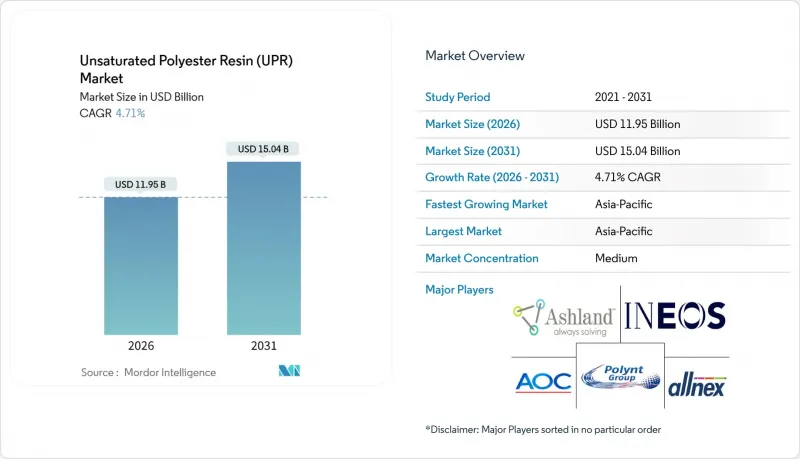
Mordor Intelligence에 의하면, 불포화 폴리에스테르 수지 시장 규모는 2026년에 119억 5,000만 달러로 추정되고 있어, 예측 기간(2026-2031년) CAGR 4.71%로 성장을 지속할 전망이며, 2031년에는 150억 4,000만 달러에 이를 전망입니다.
본 보고서는 원료별(말레산 무수물, 프탈산 무수물 등), 제품 유형별(오르토 수지, 이소 수지, DCPD, 기타 유형), 형태별(액체 및 분말), 최종 이용 산업별(건축 및 건설, 화학, 기타), 지역별(아시아태평양, 북미, 유럽, 남미, 중동 및 아프리카)별로 분류되어 있습니다. 시장 전망은 금액(달러) 기준으로 제시되어 있습니다.
세계 불포화 폴리에스테르 수지(UPR) 시장 동향 및 분석
풍력 터빈 블레이드에의 적용이 급증하고 있습니다.
불포화 폴리에스터 수지 시장에서 북해 및 대만 해협에서 로터의 평균 길이가 85미터를 넘어섬에 따라 해상 풍력 발전 설비의 설치로 인해 2025년에는 전 세계 블레이드용 복합재료 수요가 22% 증가했습니다(1). 진공 주입법에서는 에폭시계 시스템에 비해 kW당 비용이 매력적이기 때문에 불포화 폴리에스테르 수지는 스퍼 캡 및 쉘 적층재의 표준 매트릭스로 계속 사용되고 있습니다. 유럽의 순환형 경제 관련 규정에 따라 2030년까지 사용 후 블레이드의 회수 경로를 마련해야 할 의무가 부과됨에 따라, 이에 발맞추어 재활용 PET 폴리올을 배합한 UPR 블렌드에 대한 시험이 진행되고 있습니다. 이를 통해 폐지 조치에 따른 물류 비용을 최대 15%까지 절감할 수 있을 것으로 보입니다. 중국 국가에너지국은 2025년까지 신규 해상 풍력 발전 설비 용량을 확대하기 위해 180억 달러를 배정했으며, 2031년까지 아시아태평양이 주요 성장 동력이 될 것으로 확인되었습니다. 따라서 각 블레이드 제조업체들은 재활용성이 입증되었고, 발열량이 낮으며, 20년의 가동 기간에 적합한 피로 내구성을 갖춘 수지를 찾고 있습니다.
자동차 및 운송 부문의 성장
자동차 제조업체들은 2025년, 불포화 폴리에스테르 수지 시장에서 약 180만 톤의 복합 수지를 처리했으나, 그 양의 40%는 언더바디 실드, 배터리 트레이, 그리고 클래스 A 차체 패널용으로, 불포화 폴리에스테르 수지 기반의 시트 성형 컴파운드(SMC)에 의존하고 있었습니다. 전기차(EV) 플랫폼에는 경량화를 유지하면서도 전자기 간섭(EMI) 차폐 기능과 난연성이 요구되고 있으며, 이에 따라 이솔레진 및 디사이클로펜타디엔 계열 제품 시장 점유율이 확대되고 있습니다. 제너럴 모터스(GM)와 스텔란티스는 주행 거리를 10-15% 향상시키기 위한 차량 총중량 감축 목표를 뒷받침하기 위해, 2025년에 SMC 프레스 설비의 생산 능력을 30% 확대했습니다. 밀폐형 프레스기는 스티렌 배출을 차단하여, 복합재료 부품의 휘발성 유기 화합물(VOC)을 50 g L-1로 제한하는 캘리포니아주의 규정을 이미 준수하고 있습니다. 공급 계약에서는 UL 94 V-0의 난연 성능과 -40°C에서 120°C의 온도 범위에서 10년 동안의 내구 기간에 걸친 치수 안정성이 점점 더 많이 규정되고 있습니다.
무수 말레인의 가격 변동
2025년, 불포화 폴리에스테르 수지 시장에서는 원유 및 벤젠 공급 차질이 밸류체인 전반에 파급된 영향으로, 현물 가격이 톤당 1,400-2,100달러 사이에서 등락했습니다. 장기 공급 계약을 체결하지 않은 수지 제조업체들은 200-300 베이시스 포인트의 이익률 압박에 직면했으며, 이에 따라 폴린트사가 이탈리아에서 연간 5만 톤 규모의 말레산 무수물 생산 능력을 인수하는 등 수직 통합 움직임이 가속화되었습니다. 중국은 전 세계 무수 말레산 생산 능력의 55%를 차지하고 있으며, 유럽과 미국의 구매자들은 미국의 섹션 301 조치에 따른 운임 및 관세 위험에 노출되어 있습니다. 대안이 될 수 있는 바이오 제조 공정은 여전히 시범 단계에 머물러 있으며, 40-60%의 추가 비용이 발생하기 때문에 광범위한 도입에는 한계가 있습니다.
부문별 분석
말레산 무수물은 2025년 불포화 폴리에스터 수지 시장 매출의 51.26%를 차지했으며, 비용과 기계적 강도의 균형을 맞추는 오르토프탈산 및 이소프탈산의 골격에서 그 핵심적인 역할을 부각시키고 있습니다. 프로파일렌글리콜은 풍력 터빈 스파 캡의 진공 주입 공정에서 낮은 점도와 우수한 웻아웃 성능을 요구하는 가공업체들 수요에 힘입어 2031년까지 연평균 성장률(CAGR) 5.70%로 시장 규모가 확대되고 있습니다. 프탈산 무수물은 범용 오르토 등급 용도로 계속 사용되고 있으며, 스티렌 단량체는 배출량을 억제하기 위한 회수 시스템 도입 압력이 있음에도 불구하고, 가교용 희석제로서 여전히 필수적인 존재로 남아 있습니다.
프로파일렌글리콜의 성장세는 선박 및 화학 처리 설비에서 가수분해 안정성을 높이는 네오펜틸글리콜이나 디프로파일렌글리콜과 같은 공동 반응제에 대한 광범위한 대체 추세를 반영하고 있습니다. 중국에서는 석탄에서 올레핀을 생산하는 공정을 바탕으로, 2025년에 프로파일렌글리콜의 생산 능력을 18% 확대하여 아시아 지역 내 공급 비용을 절감했습니다. 현재 OEM 감사에서는 ISO 9001 인증과 배치 추적성이 요구되고 있으며, 항공우주 및 의료용 부품을 대상으로 하는 원자재 공급업체에 대한 품질에 대한 기대가 높아지고 있습니다.
2025년 불포화 폴리에스테르 수지 시장에서 오르토 수지는 매출의 53.31%를 차지했습니다. 이는 배합에 대한 자유도가 높아 건설 및 위생기기 분야에서 가격 경쟁력을 유지할 수 있기 때문입니다. 한편, 이소 수지는 고온 내성 및 내식성이 요구되는 선박, 해수 담수화 플랜트, 화학 처리 설비 수요에 힘입어 2031년까지 연평균 성장률(CAGR) 6.56%로 성장할 것으로 전망됩니다. 디사이클로펜타디엔 수지는 풍력 터빈의 나셀이나 대형 저장 탱크와 같은 분야에서 틈새 시장을 차지하고 있으며, 발열량이 적기 때문에 균열이 발생하지 않고 두꺼운 두께의 주조가 가능합니다.
이소레진 수지의 채택 확대는 EN 13121의 굽힘 강도 기준을 충족하는 유리섬유 강화 설비를 지정하는 액화천연가스(LNG) 터미널, 해상 생산 플랫폼 및 산업 폐수 처리 시설의 확장과 궤를 같이 하고 있습니다. AOC와 애슈랜드(Ashland) 등공급업체들은 2025년에 비가열 금형으로 성형이 가능하면서도 내식성을 갖춘 ‘iso-NPG’ 등급을 출시하여, 제한된 설비 투자만 가능한 제조업체들도 이를 도입할 수 있게 했습니다.
지역별 분석
아시아태평양은 2025년에 전 세계 매출의 43.45%를 차지했으며, 불포화 폴리에스터 수지 시장을 주도했습니다. 중국의 인프라 투자, 인도의 주택 붐, 그리고 동남아시아의 산업 확장에 힘입어 2031년까지 연평균 성장률(CAGR) 5.78%로 성장할 것으로 전망됩니다. 중국은 2025년까지 내식성 배관 및 블레이드용 복합재료가 사용되는 도시 철도, 상수도 시스템, 재생에너지 설비에 8,000억 달러를 배정했습니다. 인도의 생산 연계형 인센티브는 300억 달러 규모의 외국인 투자를 유치하여, 전기 이륜차, 가전제품, 통신 기기 분야의 부품 수요를 촉진했습니다. 해당 지역의 규제 체계는 여전히 제각각이지만, GB 규격 및 BIS 규격에 대한 대응에 능숙한 현지 컴파운더들이 다국적 기존 기업들을 상대로 시장 점유율을 확대되고 있습니다.
북미 시장 점유율은 자동차용 복합재료, 풍력 발전용 블레이드, 그리고 화학 처리 설비에 대한 미국 수요에 힘입어 유지되고 있습니다. ‘인플레이션 억제법(Inflation Reduction Act)’에 따라 2025년에는 수지 컴파운딩, SMC 프레스 및 블레이드 성형 공장에서 복합재료 관련 설비 투자가 150억 달러 규모로 촉진되었습니다. 캘리포니아주 대기자원국(CARB)의 규제에 따라 폐쇄형 금형 및 저스티렌 수지 시스템으로의 전환이 가속화되고 있으며, 초저배출 제품 포트폴리오를 보유한 공급업체들에게 프리미엄 부문으로의 진출 기회가 확대되고 있습니다. 멕시코의 자동차 조립 대수는 2025년에 400만 대를 넘어섰으며, 현지 1차 공급업체들은 북미 및 유럽의 전기차(EV) 프로그램에 대응하기 위해 SMC의 생산 능력을 확대했습니다.
유럽에서는 불포화 폴리에스테르 수지 시장에서 고부가가치의 선박, 자동차, 풍력 발전 용도에 주력하고 있습니다. 2025년, 독일의 자동차 제조업체들은 18만 톤의 복합 수지를 소비했습니다. 이는 폭스바겐, BMW, 메르세데스-벤츠가 SMC의 배터리 케이스 및 구조 부품을 채택했기 때문입니다. ‘순환형 경제 행동 계획’과 더욱 엄격해진 산업 배출 규제로 인해, 공급업체들은 재활용이 가능하고 바이오 유래인 화학 물질로 전환해야 하는 상황에 직면해 있습니다. 남미, 중동 및 아프리카의 불포화 폴리에스테르 수지 시장은 여전히 규모는 작지만 급속히 성장하고 있으며, 브라질의 위생 인프라 투자, 사우디아라비아의 화학 산업 다각화, 남아프리카공화국의 광업 인프라가 이를 뒷받침하고 있습니다. 이러한 지역에서는 금속에 비해 전체 수명 주기 비용을 절감할 수 있는 유리섬유 강화 설비가 선호되고 있습니다.
기타 혜택 :
- 엑셀 형식 시장 예측(ME) 시트
- 3개월간의 애널리스트 지원
자주 묻는 질문
목차
제1장 서론
제2장 조사 방법
제3장 주요 요약
제4장 시장 구도
제5장 시장 규모 및 성장 예측
제6장 경쟁 구도
제7장 시장 기회 및 향후 전망
AJY 26.06.30According to Mordor Intelligence, the unsaturated polyester resin market size is estimated at USD 11.95 billion in 2026, and is expected to reach USD 15.04 billion by 2031, at a CAGR of 4.71% during the forecast period (2026-2031).
This report is Segmented by Raw Material (Maleic Anhydride, Phthalic Anhydride, and More), Product Type (Ortho-Resins, Isoresins, DCPD, and Other Types), Form (Liquid and Powder), End-Use Industry (Building and Construction, Chemical, and More), and Geography (Asia-Pacific, North America, Europe, South America, and Middle East and Africa). The Market Forecasts are Provided in Terms of Value (USD).
Global Unsaturated Polyester Resin (UPR) Market Trends and Insights
Surging Adoption in Wind-Turbine Blades
Offshore installations lifted global blade-composite demand by 22% in 2025 as average rotor lengths moved beyond 85 meters in the North Sea andthe Taiwan Strait in the unsaturated polyester resin market [1]. Unsaturated polyester resin remains the default matrix for spar-cap and shell laminates because vacuum-infusion delivers attractive cost-per-kilowatt figures versus epoxy systems. European circular-economy mandates now require end-of-life blade recovery pathways by 2030, which is prompting trials of UPR blends incorporating recycled-PET polyols that can cut decommissioning logistics costs by up to 15%. China's National Energy Administration allocated USD 18 billion for new offshore capacity in 2025, confirming Asia-Pacific as the primary growth engine through 2031. Blade makers therefore seek resins with documented recyclability, low exotherm, and fatigue durability suitable for 20-year service intervals.
Growth of Automotive and Transportation Sectors
Automotive manufacturers processed roughly 1.8 million t of composite resins in 2025 in the unsaturated polyester resin market, and 40% of that volume relied on unsaturated polyester resin-based sheet-molding-compound for underbody shields, battery trays, and Class-A body panels. Electric-vehicle platforms need electromagnetic-interference shielding and flame retardancy while maintaining low mass; isoresin and dicyclopentadiene grades therefore gain share. General Motors and Stellantis lifted SMC press capacity by 30% during 2025 to support curb-weight reduction targets that improve driving range by 10-15%. Closed-mold presses eliminate styrene emissions and already comply with California rules that limit volatile-organic compounds to 50 g L-1 for composite parts. Supply contracts increasingly stipulate UL 94 V-0 flame-retardant performance and dimensional stability from -40 °C to 120 °C across a decade of service.
Maleic Anhydride Price Volatility
Spot prices swung between USD 1,400 and USD 2,100 t-1 in 2025 in the unsaturated polyester resin market as crude-oil and benzene disruptions rippled through the value chain. Resin makers without long-term supply contracts faced margin compression of 200-300 basis points, prompting vertical-integration moves such as Polynt's 50,000 t y-1 maleic-anhydride acquisition in Italy. China controls 55% of global maleic-anhydride capacity, exposing Western buyers to freight and tariff risks under Section 301 measures in the United States. Alternative bio-based pathways remain pilot-scale and carry 40-60% cost premiums, limiting broad adoption.
Other drivers and restraints analyzed in the detailed report include:
- Construction and Infrastructure Boom in Emerging Asia
- OEM Shift to Closed-Mold SMC/BMC for E-Mobility
- Environmental and Regulatory Challenges
For complete list of drivers and restraints, kindly check the Table Of Contents.
Segment Analysis
Maleic Anhydride held 51.26% of 2025 revenue within the unsaturated polyester resin market share, underscoring its central role in ortho-phthalic and iso-phthalic backbones that balance cost and mechanical strength. Propylene Glycol is expanding at a 5.70% CAGR through 2031, driven by processors who seek lower viscosity and better wet-out during vacuum-infusion of wind-turbine spar caps. Phthalic Anhydride continues to serve general-purpose ortho grades, while Styrene Monomer remains indispensable as a cross-linking diluent, despite pressure for recovery systems that cap emissions.
Propylene Glycol growth mirrors wider substitution toward neopentyl glycol and dipropylene glycol co-reactants that enhance hydrolytic stability in marine and chemical-processing equipment. China expanded propylene-glycol capacity by 18% in 2025 on the back of coal-to-olefin routes, reducing delivered costs within Asia. OEM audits now require ISO 9001 certification and batch traceability, reinforcing quality expectations for raw-material suppliers targeting aerospace and medical components.
Ortho-resins captured 53.31% of 2025 revenue in the unsaturated polyester resin market because broad formulation latitude keeps prices competitive across construction and sanitary-ware uses. Isoresins, however, are projected to climb 6.56% CAGR through 2031, propelled by marine vessels, desalination plants, and chemical-processing equipment that demand elevated temperature and corrosion resistance. Dicyclopentadiene resin occupies a niche in wind-turbine nacelles and large storage tanks, where low exotherm enables thick-section casting without cracking.
Isoresin uptake aligns with the expansion of liquefied-natural-gas terminals, offshore production platforms, and industrial wastewater facilities that specify fiberglass-reinforced equipment meeting EN 13121 flexural-strength thresholds. Suppliers such as AOC and Ashland launched iso-NPG grades in 2025 that provide corrosion resistance while processing on unheated molds, enabling adoption by fabricators with limited capital investment.
Geography Analysis
Asia-Pacific led the unsaturated polyester resin market with a delivered 43.45% of global revenue in 2025 and is forecast to grow at a 5.78% CAGR to 2031, driven by Chinese infrastructure outlays, India's housing boom, and Southeast Asian industrial expansion. China allocated USD 800 billion in 2025 for urban rail, water systems, and renewable energy installations that consume corrosion-resistant piping and blade-grade composites. India's production-linked incentives attracted USD 30 billion in foreign investment, spurring component demand in electric two-wheelers, appliances, and telecom equipment. Regulatory frameworks in the region remain fragmented, yet local compounders adept at navigating GB and BIS standards win share against multinational incumbents.
North America's share is anchored by United States demand in automotive composites, wind-energy blades, and chemical-processing equipment. The Inflation Reduction Act unlocked USD 15 billion in composite capital expenditure during 2025 across resin compounding, SMC presses, and blade-molding plants. California Air Resources Board rules speed the migration to closed-mold and low-styrene resin systems, opening premium segments for suppliers with ultra-low emission portfolios. Mexico's vehicle assemblies exceeded 4 million units in 2025, and local Tier-1s expanded SMC capacity to serve North American and European electric-vehicle programs.
Europe focuses on high-value marine, automotive, and wind-energy uses in the unsaturated polyester resin market. Germany's carmakers consumed 180,000 t of composite resins in 2025 as Volkswagen, BMW, and Mercedes-Benz integrated SMC battery enclosures and structural components. The Circular Economy Action Plan and stricter Industrial Emissions rules push suppliers toward recyclable, bio-based chemistries. South America and Middle East and Africa remain smaller but fast-growing in the unsaturated polyester resin market, buoyed by Brazilian sanitation investments, Saudi chemical diversification, and South African mining infrastructure, each favoring fiberglass-reinforced equipment that lowers total life-cycle costs versus metals.
- Allnex GmbH
- AOC
- Ashland
- BASF SE
- Covestro AG
- Crystic Resins India Pvt. Ltd.
- DIC Corporation
- INEOS
- Interplastic Corporation
- Polynt S.p.A.
- Scott Bader Company Ltd
- SWANCOR
- U-Pica Company
- Xinyang Technology Group
- Zhangzhou Yabang Chemical Co., Ltd.
- Zhejiang Tianhe Resin Co., Ltd.
Additional Benefits:
- The market estimate (ME) sheet in Excel format
- 3 months of analyst support
TABLE OF CONTENTS
1 Introduction
- 1.1 Study Assumptions and Market Definition
- 1.2 Scope of the Study
2 Research Methodology
3 Executive Summary
4 Market Landscape
- 4.1 Market Overview
- 4.2 Market Drivers
- 4.2.1 Surging Adoption in Wind-Turbine Blades
- 4.2.2 Growth of Automotive and Transportation Sectors
- 4.2.3 Construction And Infrastructure Boom in Emerging Asia
- 4.2.4 EU REACH Pressure for Low-Styrene Resins
- 4.2.5 OEM Shift to Closed-Mold SMC/BMC for E-Mobility
- 4.3 Market Restraints
- 4.3.1 Maleic Anhydride Price Volatility
- 4.3.2 Environmental and Regulatory Challenges
- 4.3.3 Rising LCA Scrutiny Favouring Bio-Epoxy Systems
- 4.4 Value Chain Analysis
- 4.5 Porter's Five Forces
- 4.5.1 Bargaining Power of Suppliers
- 4.5.2 Bargaining Power of Buyers
- 4.5.3 Threat of New Entrants
- 4.5.4 Threat of Substitutes
- 4.5.5 Degree of Competition
5 Market Size and Growth Forecasts (Value)
- 5.1 By Raw Material
- 5.1.1 Maleic Anhydride
- 5.1.2 Phthalic Anhydride
- 5.1.3 Propylene Glycol
- 5.1.4 Styrene Monomer
- 5.1.5 Others (Additives, Initiators)
- 5.2 By Product Type
- 5.2.1 Ortho-resins
- 5.2.2 Isoresins
- 5.2.3 Dicyclopentadiene (DCPD)
- 5.2.4 Other Types
- 5.3 By Form
- 5.3.1 Liquid
- 5.3.2 Powder
- 5.4 By End-use Industry
- 5.4.1 Building and Construction
- 5.4.2 Chemical
- 5.4.3 Electrical and Electronics
- 5.4.4 Paints and Coatings
- 5.4.5 Transportation
- 5.4.6 Other End-user Industries
- 5.5 By Geography
- 5.5.1 Asia-Pacific
- 5.5.1.1 China
- 5.5.1.2 India
- 5.5.1.3 Japan
- 5.5.1.4 South Korea
- 5.5.1.5 Rest of Asia-Pacific
- 5.5.2 North America
- 5.5.2.1 United States
- 5.5.2.2 Canada
- 5.5.2.3 Mexico
- 5.5.3 Europe
- 5.5.3.1 Germany
- 5.5.3.2 United Kingdom
- 5.5.3.3 France
- 5.5.3.4 Italy
- 5.5.3.5 Rest of Europe
- 5.5.4 South America
- 5.5.4.1 Brazil
- 5.5.4.2 Argentina
- 5.5.4.3 Rest of South America
- 5.5.5 Middle East and Africa
- 5.5.5.1 Saudi Arabia
- 5.5.5.2 South Africa
- 5.5.5.3 Rest of Middle East and Africa
- 5.5.1 Asia-Pacific
6 Competitive Landscape
- 6.1 Market Concentration
- 6.2 Strategic Moves
- 6.3 Market Share/Ranking Analysis
- 6.4 Company Profiles (includes Global-level Overview, Market-level Overview, Core Segments, Financials as available, Strategic Information, Market Rank/Share, Products and Services, Recent Developments)
- 6.4.1 Allnex GmbH
- 6.4.2 AOC
- 6.4.3 Ashland
- 6.4.4 BASF SE
- 6.4.5 Covestro AG
- 6.4.6 Crystic Resins India Pvt. Ltd.
- 6.4.7 DIC Corporation
- 6.4.8 INEOS
- 6.4.9 Interplastic Corporation
- 6.4.10 Polynt S.p.A.
- 6.4.11 Scott Bader Company Ltd
- 6.4.12 SWANCOR
- 6.4.13 U-Pica Company
- 6.4.14 Xinyang Technology Group
- 6.4.15 Zhangzhou Yabang Chemical Co., Ltd.
- 6.4.16 Zhejiang Tianhe Resin Co., Ltd.
7 Market Opportunities and Future Outlook
- 7.1 White-space and Unmet-Need Assessment
- 7.2 Emergence of Bio-based Unsaturated Polyester Resins


