|
시장보고서
상품코드
2066611
ASEAN의 에너지 저장 : 시장 점유율 분석, 업계 동향과 통계, 성장 예측(2026-2031년)ASEAN Energy Storage - Market Share Analysis, Industry Trends & Statistics, Growth Forecasts (2026 - 2031) |
||||||
 Mordor Intelligence
Mordor Intelligence에 의하면, ASEAN 에너지 저장 시장 규모는 2025년 36억 7,000만 달러, 2026년 39억 1,000만 달러에서 2031년까지 54억 3,000만 달러로 확대한다고 예측되고 있어 2026년부터 2031년까지 연평균 복합 성장률(CAGR)은 6.76%를 나타낼 전망입니다.
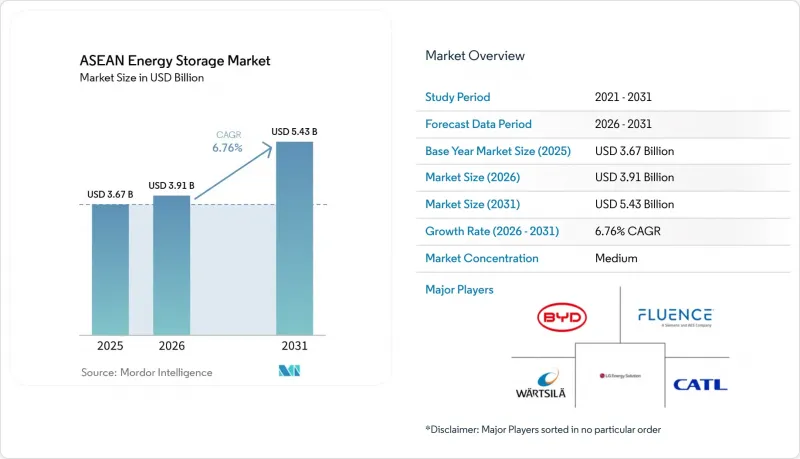
본 보고서는 저장 기술(배터리, 양수 발전, 열 에너지 저장 등), 연결 형태(계통 연계형, Off-grid형), 용도(계통 규모의 전력 사업, 주택, 상업 및 산업용, 데이터센터, 원격지·독립형, 기타), 지역(인도네시아, 베트남, 필리핀, 말레이시아, 태국, 싱가포르, 기타 아세안 국가)별로 분류되어 있습니다. 시장 전망은 금액(달러) 기준으로 제시되어 있습니다.
아세안 에너지 저장 시장 동향과 인사이트
아세안의 재생에너지 비중 목표가 에너지 저장 기술 도입을 가속화
아세안(ASEAN)의 에너지 저장 시장은 APAEC 2026-2030에 기반한 지역 전체의 재생에너지 목표 상향 조정에 따라 형성되고 있습니다. 이 계획에 따르면, 2030년 목표가 1차 에너지의 30%, 설치 발전 용량의 45%로 상향 조정되었습니다. 베트남의 개정판 ‘제8차 전력 마스터플랜’에서는 집중형 태양광 발전 프로젝트에 대해 설치 용량의 최소 10%에 해당하는 BESS를 설치하고 2시간 동안 전력을 저장하도록 의무화함으로써, 이러한 전환을 프로젝트 설계 단계에 반영했습니다. 인도네시아의 ‘RUPTL 2025-2034’ 역시 재생에너지의 대규모 확충과 병행하여, 신규 발전 용량의 15%를 에너지 저장 설비에 배정함으로써 에너지 저장에 계획적인 역할을 부여했습니다. 이러한 변화가 중요한 이유는 전력 저장이 단순한 선택적 균형 조정 수단에서 재생에너지 입찰 및 송전망 계획과 직접 연계된 유틸리티자의 조달 범주로 전환되기 때문입니다. IEA(국제에너지기구)의 동남아시아 통합 로드맵 역시 2025년부터 2028년까지 태양광 및 풍력 발전 도입이 가속화됨에 따라 전력계의 유연성이 더욱 필요해질 것임을 보여주고 있으며, 이에 따라 에너지 저장 시스템은 계속해서 지역 전력 정책의 중심적인 위치를 차지하게 될 것입니다.
C&I 부문의 전력 수요가 계량기 뒤편의 에너지 저장 시장을 창출
아세안(ASEAN)의 에너지 저장 시장은 보다 안정적인 전력 공급은 물론, 정전, 출력 제한, 운영 비용에 대한 보다 효과적인 관리를 필요로 하는 산업 사용자들로부터도 지지를 얻고 있습니다. 그리드 규모의 시스템이 여전히 가장 큰 도입 점유율을 차지하고 있지만, 데이터센터와 중요 시설은 2031년까지 연평균 성장률(CAGR) 10.3%로 가장 빠르게 성장하고 있는 분야이며, 이는 지역 전체에서 신뢰성을 중시하는 수요가 얼마나 강력하게 증가하고 있는지를 보여줍니다. 베트남에서는 새로운 계획 규제 및 전력 체계 내에서 에너지 저장 시스템의 공식적인 위상이 확립되면서 도입을 위한 로드맵이 명확해짐에 따라, 에너지 저장 설비가 공장 및 산업단지로 점차 확대되고 있습니다. 아세안(ASEAN)의 에너지 저장 시장에서 이 분야가 중요한 이유는 도매 유연성 시장이 아직 미성숙한 단계임에도 불구하고 제조업체와 디지털 사업자들이 사업 연속성과 전력 품질을 중시하기 때문입니다. 따라서 정책이 시스템 수요를 아직 따라가지 못하고 있는 국가들에서도 상업 및 산업용 에너지 저장 수요는 더욱 지속 가능한 양상을 띠고 있습니다.
자본 집약성과 프로젝트 파이낸싱 간의 격차
높은 초기 비용은 아세안(ASEAN) 에너지 저장 시장에서 여전히 가장 뚜렷한 제약 요인 중 하나로 남아 있으며, 특히 장시간 저장 자산이나 대규모 독립형 배터리 프로젝트에서 두드러지게 나타납니다. 베트남에서는 통지 62/2025/TT-BCT에 따라 독립형 저장 시설의 가격 책정 규칙, 부대 서비스에 대한 보상 및 용량 지급에 관한 규정이 아직 최종 확정되지 않아, 여러 BESS 프로젝트가 2026년 초까지 정체된 상태로 남아 있었던 점에서 이러한 상황이 명확히 드러나고 있습니다. 대규모 양수 발전 프로젝트는 진전을 보이고 있지만, Bac Ai의 자금 조달 구조나 인도네시아의 보다 광범위한 정부 지원을 받는 계획에서 볼 수 있듯이, 그 대부분은 상업은행의 광범위한 참여가 아닌 우대 대출이나 다자간 자금에 의존하고 있습니다. 이로 인해 아세안(ASEAN)의 전체 에너지 저장 시장에서 발표된 목표가 계약 완료 및 가동 중인 용량으로 전환되는 속도가 느려지고 있습니다. 또한, 국내 대출 기관들은 여전히 많은 저장 시설을 익숙하지 않은 위험 요소로 간주하고 있기 때문에 소규모 개발업체들은 불리한 입장에 놓여 있습니다.
부문별 분석
2025년, 아세안(ASEAN)의 에너지 저장 시장 규모 중 80.9%를 양수 발전이 차지하고 있으며, 이는 해당 지역이 여전히 대량 저장을 위해 오랫동안 구축되어 온 사회 기반 시설에 크게 의존하고 있음을 보여줍니다. 이러한 입지는 인도네시아, 베트남, 태국의 주요 프로젝트 파이프라인을 통해 더욱 공고해지고 있으며, 이들 국가의 국영 전력사들은 양수 발전 기술을 단순한 틈새 기술이 아닌 전략적 균형 조정 자산으로 계속해서 인식하고 있습니다. 베트남의 1,200 MW 규모 박아이(Bac Ai) 양수발전 프로젝트는 2026년에 본격적인 건설 단계에 접어들었으며, 발전 제한이 엄격한 지역의 재생에너지 발전량을 더욱 흡수하려는 베트남의 노력에서 여전히 핵심적인 역할을 수행하고 있습니다. 태국 역시 ‘PDP 2024’의 일환으로 추라본, 바지라롱콘, 크라툰 각 프로젝트를 통해 2,472 MW 규모의 양수 발전 설비를 추가할 계획이며, 이는 양수 발전이 현재 예측 기간을 훨씬 넘어 계속해서 중요한 역할을 할 것임을 뒷받침하고 있습니다.
그러나 아세안(ASEAN)의 에너지 저장 시장에서 가장 두드러진 다각화가 진행되고 있는 분야는 배터리 기술 분야입니다. 수소 기반 저장 기술은 2026년부터 2031년까지 연평균 성장률(CAGR) 11.1%를 기록하며 가장 빠르게 성장하는 기술 부문으로, 이는 장시간 유연성 및 고립된 전력망에 대한 적용에 대한 관심이 높아지고 있음을 반영합니다. 리튬이온 시스템은 여전히 유틸리티 규모 및 가정용 프로젝트에서 주요 배터리 옵션으로 자리 잡고 있으며, LFP, NMC, 그리고 새롭게 등장한 나트륨이온 화학계가 조달 구성을 형성하고 있습니다. 전 세계적으로 배터리 비용이 하락함에 따라 유틸리티 규모의 BESS 도입 이점이 커지고 있는 반면, 열대 지역의 운영 환경에서는 열적 안정성과 안전성이 그 어느 때보다 중요해지고 있습니다. 흐름 전지, 열 시스템, 압축 공기 에너지 저장 기술은 이 지역에서는 아직 도입 초기 단계이지만, 리튬 이온 배터리로는 효율적으로 대응할 수 없는 저장 시간에 대응하고 있습니다. 또한, 안전 인증도 구매 결정 요인으로서 그 중요성이 커지고 있으며, 이에 따라 체계적인 시스템 통합사업자는 공공기관이나 전력회사의 입찰에서 더욱 뚜렷한 우위를 점하고 있습니다.
기타 혜택:
- 엑셀 형식 시장 예측(ME) 시트
- 3개월간의 애널리스트 지원
자주 묻는 질문
목차
제1장 서론
제2장 조사 방법
제3장 주요 요약
제4장 시장 구도
제5장 시장 규모와 성장 예측
제6장 경쟁 구도
제7장 시장 기회와 향후 전망
JHS 26.07.01According to Mordor Intelligence, the aSEAN energy storage market size is projected to expand from USD 3.67 billion in 2025 and USD 3.91 billion in 2026 to USD 5.43 billion by 2031, registering a CAGR of 6.76% between 2026 and 2031.
This report is Segmented by Storage Technology (Batteries, Pumped-Storage Hydroelectricity, Thermal Energy Storage, and More), Connectivity (On-Grid, Off-Grid), Application (Grid-Scale Utility, Residential, C&I, Data Centers, Remote/Off-Grid, Others), and Geography (Indonesia, Vietnam, Philippines, Malaysia, Thailand, Singapore, Rest of ASEAN). The Market Forecasts are Provided in Terms of Value (USD).
ASEAN Energy Storage Market Trends and Insights
ASEAN Renewable-Portfolio Targets Accelerating Storage Deployment
The ASEAN energy storage market is being shaped by a higher regional renewable ambition under APAEC 2026-2030, which raised the 2030 target to 30% of primary energy and 45% of installed power capacity. Vietnam's adjusted Power Master Plan VIII moved this shift into project design by requiring centralised solar projects to install BESS equal to at least 10% of installed capacity for 2-hour storage. Indonesia's RUPTL 2025-2034 also gave storage a planned role by assigning 15% of new capacity additions to storage assets alongside a wider renewable build-out. These changes matter because they shift storage from a discretionary balancing tool into a utility procurement category with direct links to renewable auctions and grid planning. The IEA's integration roadmap for Southeast Asia also shows that faster solar and wind additions will need more system flexibility between 2025 and 2028, which keeps storage near the center of regional power policy.
Electricity Demand from C&I Sector Creating Behind-the-Meter Storage Markets
The ASEAN energy storage market is also gaining support from industrial users that need more stable power and better control over outages, curtailment, and operating costs. Grid-scale systems still take the largest application share, but data centres and critical facilities are the fastest-growing application block at 10.3% CAGR through 2031, which shows how strongly reliability-led demand is rising across the region. In Vietnam, storage is moving closer to factories and industrial parks as new planning rules and the formal recognition of storage in the power framework create a clearer path for deployment. This part of the ASEAN energy storage market is important because manufacturers and digital operators value continuity and power quality even when wholesale flexibility markets remain immature. That makes commercial and industrial storage demand more durable in countries where policy is still catching up with system needs.
Capital-Intensity and the Project Finance Gap
High upfront costs remain one of the clearest brakes on the ASEAN energy storage market, especially for long-duration assets and large standalone battery projects. Vietnam shows this clearly because multiple BESS projects remained stalled into early 2026 while pricing rules for standalone storage, ancillary compensation, and capacity payments were still being finalised under Circular 62/2025/TT-BCT. Large pumped hydro projects are moving forward, but many depend on concessional or multilateral funding rather than broad commercial bank participation, as seen in Bac Ai's financing structure and Indonesia's wider state-backed pipeline. This slows the conversion of announced targets into contracted and commissioned capacity across the ASEAN energy storage market. It also leaves smaller developers at a disadvantage because domestic lenders still treat many storage structures as unfamiliar risk.
Other drivers and restraints analyzed in the detailed report include:
- Grid-Stability Issues and Outage Mitigation as an Immediate Procurement Signal
- Island-Grid Resiliency Creating a Parallel Off-Grid Storage Economy
- Ambiguous Storage Asset-Class Regulation
For complete list of drivers and restraints, kindly check the Table Of Contents.
Segment Analysis
Pumped-Storage Hydroelectricity held 80.9% of the ASEAN energy storage market size in 2025, which shows how strongly the region still depends on long-established civil infrastructure for bulk storage. That position is reinforced by major project pipelines in Indonesia, Vietnam, and Thailand, where state utilities continue to treat pumped hydro as a strategic balancing asset rather than a niche technology. Vietnam's 1,200 MW Bac Ai pumped storage project entered its main construction phase in 2026 and remains central to the country's effort to absorb more renewable output from high-curtailment regions. Thailand also plans 2,472 MW of additional pumped hydro under PDP 2024 through the Chulabhorn, Vajiralongkorn, and Krathun projects, which confirms that PSH will stay important well beyond the current forecast period.
Battery technologies, however, are where most incremental diversification is taking place in the ASEAN energy storage market. Hydrogen-based storage is the fastest-growing technology segment at 11.1% CAGR from 2026 to 2031, which reflects growing interest in longer-duration flexibility and island-grid applications. Lithium-ion systems remain the main battery choice across utility and behind-the-meter projects, with LFP, NMC, and emerging sodium-ion chemistries shaping the procurement mix. Lower global battery costs are improving the case for utility-scale BESS, while thermal stability and safety are becoming more important in tropical operating conditions. Flow batteries, thermal systems, and compressed air are still early in the region, but they address storage durations that lithium-ion does not serve as efficiently. Safety certification is also becoming a stronger buying factor, which gives structured system integrators a clearer advantage in public and utility tenders.
List of Companies Covered in this Report:
- BYD Co Ltd
- Contemporary Amperex Technology Ltd (CATL)
- LG Energy Solution
- Wartsila Oyj Abp
- GS Yuasa Corporation
- NGK Insulators Ltd
- Fluence Energy Inc
- Sungrow Power Supply Co Ltd
- Tesla Inc (Megapack)
- Siemens Energy AG
- Hitachi Energy Ltd
- Toshiba Corp
- Samsung SDI Co Ltd
- Kokam Co Ltd
- Pylon Technologies Co Ltd
- AlphaESS Co Ltd
- NEC ES (portfolio legacy)
- SEC Battery Company
- Mitsubishi Power
- EnerSys
Additional Benefits:
- The market estimate (ME) sheet in Excel format
- 3 months of analyst support
TABLE OF CONTENTS
1 Introduction
- 1.1 Study Assumptions & Market Definition
- 1.2 Scope of the Study
2 Research Methodology
3 Executive Summary
4 Market Landscape
- 4.1 Market Overview
- 4.2 Market Drivers
- 4.2.1 Growth in electricity demand from C&I sector
- 4.2.2 Grid-stability issues & outage mitigation needs
- 4.2.3 ASEAN renewable-portfolio targets acceleration
- 4.2.4 Falling Li-ion battery costs
- 4.2.5 Digital twin-enabled optimisation of storage
- 4.2.6 Island-grid resiliency & diesel-offset programmes
- 4.3 Market Restraints
- 4.3.1 Capital-intensity & limited project finance
- 4.3.2 Ambiguous storage asset-class regulation
- 4.3.3 Community push-back on pumped hydro
- 4.3.4 Nickel-manganese supply-chain volatility
- 4.4 Supply-Chain Analysis
- 4.5 Regulatory Landscape
- 4.6 Technological Outlook
- 4.7 Porter's Five Forces
- 4.7.1 Bargaining Power of Suppliers
- 4.7.2 Bargaining Power of Consumers
- 4.7.3 Threat of New Entrants
- 4.7.4 Threat of Substitutes
- 4.7.5 Intensity of Rivalry
5 Market Size & Growth Forecasts
- 5.1 By Storage Technology
- 5.1.1 Batteries (Lithium-ion, Solid-State Li, Sodium-ion, Lead-acid, Sodium-Sulfur, and Flow Batteries (Vanadium, Zinc-Bromine))
- 5.1.2 Pumped-Storage Hydroelectricity (PSH)
- 5.1.3 Thermal Energy Storage (Sensible Heat (Molten Salt, Water), Latent Heat (Phase-Change Materials), Thermochemical)
- 5.1.4 Compressed Air Energy Storage
- 5.1.5 Liquid Air/Cryogenic Storage
- 5.1.6 Hydrogen-Based Storage (Power-to-H2-to-Power)
- 5.1.7 Other Technologies (Flywheel Energy Storage, Gravity-Based Storage, Iron-Air, Zinc-Air)
- 5.2 By Connectivity
- 5.2.1 On-Grid
- 5.2.2 Off-Grid
- 5.3 By Application
- 5.3.1 Grid-Scale Utility (Front-of-Meter)
- 5.3.2 Residential Behind-the-Meter
- 5.3.3 Commercial and Industrial Behind-the-Meter
- 5.3.4 Data Centers and Critical Facilities
- 5.3.5 Remote and Off-Grid/Microgrids
- 5.3.6 Others (Transportation and Rail Electrification, EV-Charging Infrastructure, Transmission and Distribution Deferral)
- 5.4 By Geography
- 5.4.1 Indonesia
- 5.4.2 Vietnam
- 5.4.3 Philippines
- 5.4.4 Malaysia
- 5.4.5 Thailand
- 5.4.6 Singapore
- 5.4.7 Rest of ASEAN
6 Competitive Landscape
- 6.1 Market Concentration
- 6.2 Strategic Moves
- 6.3 Market Share Analysis
- 6.4 Company Profiles (includes Global level Overview, Market level overview, Core Segments, Financials as available, Strategic Information, Market Rank/Share for key companies, Products & Services, Recent Developments)
- 6.4.1 BYD Co Ltd
- 6.4.2 Contemporary Amperex Technology Ltd (CATL)
- 6.4.3 LG Energy Solution
- 6.4.4 Wartsila Oyj Abp
- 6.4.5 GS Yuasa Corporation
- 6.4.6 NGK Insulators Ltd
- 6.4.7 Fluence Energy Inc
- 6.4.8 Sungrow Power Supply Co Ltd
- 6.4.9 Tesla Inc (Megapack)
- 6.4.10 Siemens Energy AG
- 6.4.11 Hitachi Energy Ltd
- 6.4.12 Toshiba Corp
- 6.4.13 Samsung SDI Co Ltd
- 6.4.14 Kokam Co Ltd
- 6.4.15 Pylon Technologies Co Ltd
- 6.4.16 AlphaESS Co Ltd
- 6.4.17 NEC ES (portfolio legacy)
- 6.4.18 SEC Battery Company
- 6.4.19 Mitsubishi Power
- 6.4.20 EnerSys
7 Market Opportunities & Future Outlook
- 7.1 White-space & Unmet-Need Assessment