|
시장보고서
상품코드
2066613
루비듐 시장 : 점유율 분석, 업계 동향과 통계, 성장 예측(2026-2031년)Rubidium - Market Share Analysis, Industry Trends & Statistics, Growth Forecasts (2026 - 2031) |
||||||
 Mordor Intelligence
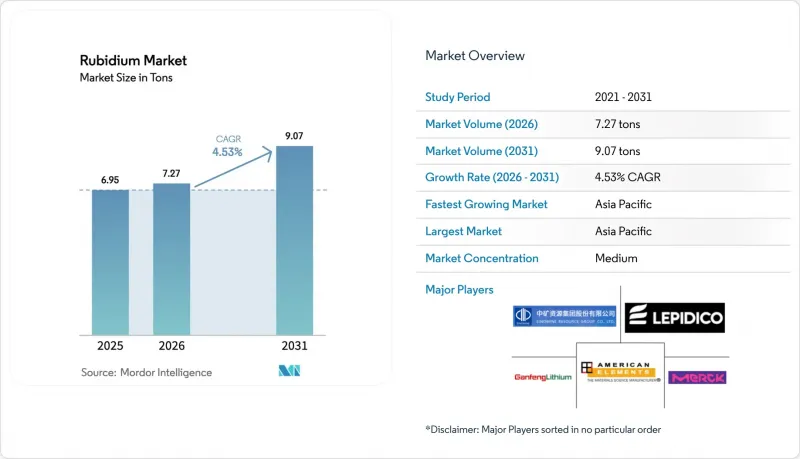
Mordor Intelligence에 의하면, 루비듐 시장 규모는 2025년 6.95톤, 2026년 7.27톤에서 , 2031년까지 9.07톤으로 확대한다고 예측되고 있어 2026년부터 2031년까지 연평균 복합 성장률(CAGR)은 4.53%를 나타낼 전망입니다.
본 보고서는 제조 공정(레피도라이트, 폴루사이트, 기타 공정), 용도 분야(생물의학 연구, 전자, 특수 유리, 불꽃놀이, 기타 용도) 및 지역(아시아태평양, 북미, 유럽, 남미, 중동 및 아프리카)별로 분류되어 있습니다. 시장 전망은 수량(톤) 기준으로 제시되어 있습니다.
세계 루비듐 시장 동향 및 분석
확대되는 생의학 분야의 활용
루비듐-82 PET 발생기는 반감기가 76초이기 때문에 매일 방사성 의약품을 공급받을 필요 없이 필요에 따라 심근 영상 촬영이 가능해져, 기존의 동위원소를 점차 대체하고 있습니다. 임상시험 결과, SPECT 스캔보다 관상동맥 질환의 진단 정확도가 높은 것으로 나타났으며, 미국, 캐나다, 독일의 병원에서는 심혈관 질환 치료 시설 개보수와 함께 제너레이터 도입이 활발히 진행되고 있습니다. 여러 발전기 시스템이 FDA 및 EMA의 승인을 획득함으로써, 보험 급여 승인이 원활해졌고 도입 장벽이 낮아졌습니다. 제약 회사들도 루비듐 화합물을 추적자로 사용하고 있지만, 그 사용량은 영상 진단 용도에 비해 여전히 소규모입니다. 향후 지속적인 성장은 PET 검사에 대한 보험 급여 수준 유지와 지역 병원의 하이브리드 PET-CT 스캐너 도입 확대에 달려 있습니다. 보험 환급 정책이 계속해서 우호적인 양상을 보인다면, 루비듐 시장은 심장 영상 진단의 추가적인 보급에 힘입어 더 큰 성장 여지를 확보할 수 있을 것입니다.
특수 광학 유리 및 광섬유 네트워크에서의 용도 확대
루비듐 탄산염 및 루비듐 산화물은 광섬유 케이블과 고해상도 렌즈용 저분산 유리에서 플럭스제 및 굴절률 조절제로 기능합니다. 데이터센터의 폭발적인 성장에 따라, 각 하이퍼스케일러 기업들은 광 인터커넥트의 고밀도화를 피할 수 없게 되었으며, 색 분산을 최소화하면서 400 Gbps 및 800 Gbps 전송을 지원하는 단일 모드 광섬유에 대한 수요가 증가하고 있습니다. 루비듐을 도핑한 유리는 열 안정성을 향상시켜 장거리 해저 회선에서 발생하는 신호 감쇠를 줄여줍니다. 이러한 화학적 특성은 LiDAR 및 적층 가공(애디티브 매뉴팩처링)용 주파수 배가 레이저에 사용되는 루비듐 티타닐 인산염 결정의 기초가 되고 있습니다. 유리 제조업체들은 지속적으로 저비용 대체 재료를 모색하고 있지만, 해저 네트워크나 정밀 광학 기기의 성능 요건 때문에 설계상의 타협 없이 루비듐을 배제하기는 어렵습니다. 포토닉스의 집적화가 가속화되는 한, 특수 유리는 루비듐 시장의 주요 최종 용도로 남아 있을 것입니다.
희귀한 1차 광상과 높은 정제 비용
천연 광석에서 상당량의 루비듐이 산출되는 경우는 드물며, 이 원소만을 채굴하는 광산은 존재하지 않습니다. 미국 지질조사국(USGS)에 따르면, 전 세계 매장량은 한정되어 있어 생산 능력의 신속한 확장을 저해하고 있습니다. 원자시계나 양자 센서 등에 적용하기 위해 정제 업체들은 99.9%라는 엄격한 순도를 목표로 하고 있습니다. 이러한 순도를 달성하기 위해서는 분획 결정화나 진공 증류와 같은 에너지 집약적인 방법에 의존하는 경우가 많으며, 이 방법들은 모두 유해한 부산물을 발생시킵니다. 실험실 규모의 미세 추출 기술 덕분에 에너지 소비는 대폭 감소했으나, 이 기술의 상용화에는 아직 몇 년이 더 걸릴 것으로 보입니다. 주문 제작된 소금이나 금속의 납기 기간이 길기 때문에 구매자는 현물 가격의 급등에 직면할 가능성이 있습니다. 이러한 구조적 과제는 단기적인 공급량 증가를 억제할 뿐만 아니라, 정제 기술에 획기적인 진전이 없는 한 루비듐 시장의 잠재적 성장도 제한하게 될 것입니다.
부문별 분석
2025년 생산 공정별 세분화에서 레피도라이트는 루비듐 시장 규모의 80.79%를 차지하고 있으며, 2031년까지 연평균 성장률(CAGR) 5.06%로 확대될 것으로 전망됩니다. 리튬 정제 업체는 병산 생산을 통한 경제성을 활용함으로써, 별도의 설비 투자를 하지 않고도 산 침출 또는 소성 공정에서 루비듐을 회수할 수 있습니다. 이러한 장점 덕분에, 루비듐 시장에서 레피돌라이트의 지배적 지위가 확고해졌습니다. 예비적인 미량 추출 시험 결과, 정제 공정에서 상당한 에너지 절감 효과가 확인되었으며, 이 공정이 확대될 경우 이익률 향상이 기대됩니다. 주로 Sinomine Resource Group이 지배권을 쥐고 있는 폴루사이트는 항공우주 관련 기업에 틈새 시장용 고순도 제품을 공급하고 있으며, 증기 전지 제조에 필요한 엄격한 요건을 충족하고 있습니다. 카르나라이트나 염수 같은 대체 자원은 여전히 실험 단계에 있지만, 칭하이 연구소의 염수 공정이 상용화된다면 그 기세가 더욱 거세질 가능성이 있습니다.
폴루사이트 시장 점유율은 낮지만, 세슘 함량이 높기 때문에 세슘 포메이트계 시추 유체의 원료로 사용되며, 루비듐 생산량에 대한 상호 보완 효과를 가져온다는 점에서 전략적으로 중요한 위치를 차지하고 있습니다. 염수에서 추출하는 방식은 특히 에너지 사용량과 시약 회수율이 실험실 결과와 동등하다면, 루비듐 산업에 장기적인 성장 여지를 가져다줄 것입니다. 그러나 자본 집약도가 높고 인허가 절차가 지연되고 있는 탓에, 신규 진출기업들은 여전히 신중한 태도를 고수하고 있습니다. 따라서 공급 증가세는 여전히 리튬 및 세슘의 수급 사이클에 좌우되고 있으며, 루비듐 시장의 가격 동향은 광산에 대한 직접 투자보다는 하류 수요의 급증에 더 민감하게 반응하게 될 것입니다.
지역별 분석
2025년에는 아시아태평양 지역이 루비듐 시장 점유율의 39.43%를 차지해 1위를 기록하고, 2031년까지 연평균 성장률(CAGR) 5.97%로 성장할 것으로 전망됩니다. 채굴에서 화합물 생산에 이르는 수직 통합을 통해 중국은 루비듐 시장에서 압도적인 우위를 점하고 있습니다. 시노마인사는 전년 대비 매출이 급증했다고 보고했습니다. 한편, Ganfeng Lithium의 신여 정련소에서는 탄산리튬 생산뿐만 아니라 질산루비듐 회수도 이루어지고 있어, 국내 시계 제조업체에 대한 공급 안정성을 높이고 있습니다. 일본과 한국은 고굴절률 카메라 렌즈 및 정밀 광학 기기용 루비듐 탄산염 수입에 의존하고 있는 반면, 인도에서는 2027년까지 5G 기지국을 구축하겠다는 야심 찬 목표가 수요를 더욱 부추길 것으로 전망됩니다.
북미 공급량은 다소 적은 편이지만, 국방 및 의료 분야 수요는 안정적입니다. 프리퀀시 일렉트로닉스(Frequency Electronics)사는 롱아일랜드에서 증기 셀을 제조함으로써 GPS III 및 기밀 위성 프로그램을 보호하고 있는 반면, 마이크로칩(Microchip)사의 클럭은 미국 내 데이터센터의 동기화를 지원하고 있습니다. 확립된 환급 기준에 힘입어, 미국의 병원에서는 루비듐-82를 이용한 PET 검사의 도입이 꾸준히 확대되고 있습니다. 그러나 미국 지질조사국(USGS)의 보고서에 따르면, 2019년 이후 국내 1차 생산량은 제로 상태이며, 구매자들은 수입이나 비축 물량의 방출에 의존할 수밖에 없는 상황입니다.
유럽은 북미와 마찬가지로 공급 취약성을 안고 있지만, 독일에 있는 가공 공장에서 수입 농축물을 정제하고 있다는 점에서 이점을 누리고 있습니다. 아큐비트사의 루비듐 클럭은 유럽 전역의 갈릴레오 지상국에 나노초 수준의 타이밍을 제공합니다. 영국, 프랑스, 독일은 자율 항해를 위해 루비듐 증기 셀을 활용하는 냉원자 센서 프로그램에 자금을 지원하고 있으며, 연구 주도형 수요의 거점을 형성하고 있습니다. 남미, 중동 및 아프리카는 현재로서는 규모가 작은 편이지만, 2025년에 인터내셔널 리튬사가 옵션권을 취득한 나미비아의 칼리비브 프로젝트는 자금 조달이 순조롭게 진행된다면 해당 지역공급원이 될 가능성이 있습니다. 전반적으로 볼 때, 이러한 지역적 동향은 루비듐 시장이 집중된 공급과 전 세계적으로 분산된 기술 수요 간의 균형을 어떻게 유지하고 있는지를 여실히 보여주고 있습니다.
기타 혜택:
- 엑셀 형식 시장 예측(ME) 시트
- 3개월간의 애널리스트 지원
자주 묻는 질문
목차
제1장 서론
제2장 조사 방법
제3장 주요 요약
제4장 시장 구도
제5장 시장 규모와 성장 예측
제6장 경쟁 구도
제7장 시장 기회와 향후 전망
JHS 26.06.29According to Mordor Intelligence, the rubidium market size is projected to expand from 6.95 tons in 2025 and 7.27 tons in 2026 to 9.07 tons by 2031, registering a CAGR of 4.53% between 2026 to 2031.
This report is Segmented by Production Process (Lepidolite, Pollucite, and Other Processes), Application Sector (Biomedical Research, Electronics, Specialty Glass, Pyrotechnics, and Other Applications), and Geography (Asia-Pacific, North America, Europe, South America, and Middle-East and Africa). The Market Forecasts are Provided in Terms of Volume (Tons).
Global Rubidium Market Trends and Insights
Growing Biomedical Applications
Rubidium-82 PET generators are displacing older isotopes because the 76-second half-life enables on-demand myocardial imaging without daily radiopharmaceutical deliveries. Clinical trials show higher diagnostic accuracy for coronary artery disease than SPECT scans, encouraging hospitals in the United States, Canada, and Germany to install generators during cardiology-suite upgrades. Multiple generator systems hold FDA and EMA clearance, smoothing reimbursement approvals and lowering adoption hurdles. Pharmaceutical laboratories also use rubidium compounds as tracers, although these volumes remain small relative to imaging. Continued growth depends on maintaining reimbursement levels for PET studies and on the rollout of hybrid PET-CT scanners in community hospitals. If reimbursement policy remains favorable, the rubidium market could capture additional upside from wider cardiac-imaging use.
Expanding Use in Specialty Optical Glass and Fiber Networks
Rubidium carbonate and oxide act as flux agents and index modifiers in low-dispersion glass for fiber-optic cables and high-resolution lenses. Explosive data-center growth is forcing hyperscalers to densify optical interconnects, pushing demand for single-mode fiber that supports 400 Gbps and 800 Gbps transmission with minimal chromatic dispersion. Rubidium-doped glass improves thermal stability, reducing signal attenuation on long-haul submarine routes. The same chemistry underpins rubidium titanyl phosphate crystals used in frequency-doubled lasers for lidar and additive manufacturing. Although glass producers continually seek lower-cost substitutes, performance requirements in subsea networks and precision optics make rubidium difficult to eliminate without design compromises. As long as photonics integration accelerates, specialty glass will stay the anchor end-use in the rubidium market.
Scarce Primary Deposits and High Purification Cost
Natural ores rarely yield rubidium in significant quantities, and dedicated mines for the element are nonexistent. The U.S. Geological Survey notes that global reserves are limited, which hampers swift capacity expansion. For applications in atomic clocks and quantum sensors, refiners aim for a stringent 99.9% purity. Achieving this purity often relies on energy-intensive methods like fractional crystallization or vacuum distillation, both of which produce hazardous by-products. While lab-scale micro-extraction has significantly reduced energy consumption, its commercial rollout remains several years away. Buyers face potential spot-price surges due to long lead times for custom salts and metals. These structural challenges not only cap short-term volume growth but also limit the rubidium market's potential unless there's a breakthrough in purification technologies.
Other drivers and restraints analyzed in the detailed report include:
- 5G and Satellite Rollout Driving Demand for Rubidium Atomic Clocks
- Quantum-Technology Scale-Up
- Geopolitical Risk: Greater Than 70% Refining in China
For complete list of drivers and restraints, kindly check the Table Of Contents.
Segment Analysis
Lepidolite contributed 80.79% of the rubidium market size under production-process segmentation in 2025 and is projected to climb at a 5.06% CAGR to 2031. Lithium refiners, leveraging co-production economics, can capture rubidium during acid-leach or roasting steps without incurring standalone capital expenditures. This advantage solidifies lepidolite's dominant position in the rubidium market. Preliminary micro-extraction trials indicate significant energy savings in purification, hinting at potential margin increases if the process is scaled. Pollucite, primarily controlled by Sinomine Resource Group, caters to aerospace contractors with its niche high-purity volumes, meeting the stringent requirements for vapor-cell fabrication. While alternative sources like carnallite and brine are still in the experimental phase, they could gain momentum if the Qinghai Institute's brine process achieves commercialization.
Pollucite's share lags but carries strategic significance because its high cesium content supports cesium formate drilling fluids, providing cross-subsidy for rubidium yields. Brine extraction offers longer-term upside for the rubidium industry, especially if energy use and reagent recovery mirror laboratory results. However, capital intensity and permitting delays keep new entrants cautious. Supply growth, therefore, remains tethered to lithium and cesium cycles, making price signals in the rubidium market more sensitive to downstream demand surges than to directed mine investment.
Geography Analysis
Asia-Pacific led with 39.43% of the rubidium market share in 2025 and is expected to grow at a 5.97% CAGR through 2031. China's dominance in the rubidium market is underscored by its vertical integration, spanning from mining to compound production. Sinomine reported a significant year-on-year revenue surge. Meanwhile, Ganfeng Lithium's Xinyu refinery is not just producing lithium carbonate but also capturing rubidium nitrate, bolstering supply security for domestic clock manufacturers. While Japan and South Korea turn to imports of rubidium carbonate for their high-index camera lenses and precision optics, India's ambitious target of establishing 5G base stations by 2027 is set to further fuel demand.
North America contributes modest volume but enjoys stable defense and medical demand. Frequency Electronics insulates GPS III and classified satellite programs by fabricating vapor cells on Long Island, while Microchip clocks underpin U.S. data-center synchronization. Rubidium-82 PET adoption grows steadily in U.S. hospitals, aided by established reimbursement codes. However, the U.S. Geological Survey reports zero domestic primary production post-2019, leaving buyers reliant on imports or stockpile drawdowns.
Europe mirrors North America's supply vulnerability but benefits from a processing plant in Germany that upgrades imported concentrates. AccuBeat's rubidium clocks secure nanosecond-level timing for Galileo ground stations across the continent. The United Kingdom, France, and Germany fund cold-atom sensor programs tapping rubidium vapor cells for autonomous navigation, creating research-driven demand pockets. South America, the Middle East, and Africa remain small today, though Namibia's Karibib project - optioned by International Lithium Corp in 2025 - could offer regional supply if financing aligns. Overall, geographic dynamics underscore how the rubidium market balances concentrated supply with globally dispersed technology pull.
- AccuBeat Ltd
- American Elements
- ESPI Metals
- Frequency Electronics, Inc.
- Ganfeng Lithium
- Hubei Baijierui Advanced Materials Co., Ltd
- INORGANIC VENTURES
- International Lithium Corp.
- IQD Frequency Products Ltd
- Jackson Laboratories Pvt. Ltd
- Jiangxi Special Electric Motor
- Lepidico
- Lithium Australia
- Merck KGaA
- Microchip Technology Inc.
- Nanjing Taiye Chemical Industry Co., Ltd.
- Otto Chemie Pvt Ltd
- Sinomine Resource Group
- Thermo Fisher Scientific
Additional Benefits:
- The market estimate (ME) sheet in Excel format
- 3 months of analyst support
TABLE OF CONTENTS
1 Introduction
- 1.1 Study Assumptions and Market Definition
- 1.2 Scope of the Study
2 Research Methodology
3 Executive Summary
4 Market Landscape
- 4.1 Market Overview
- 4.2 Market Drivers
- 4.2.1 Growing biomedical applications
- 4.2.2 Expanding use in specialty optical-glass and fibre networks
- 4.2.3 5G and satellite rollout driving demand for rubidium atomic clocks
- 4.2.4 Quantum-technology research and development scale-up (cold-atom sensors, qubits)
- 4.2.5 Co-production synergies from lithium-mica waste streams
- 4.3 Market Restraints
- 4.3.1 Scarce primary deposits and high purification cost
- 4.3.2 Handling/transport safety for highly reactive metal
- 4.3.3 Geopolitical risk: greater than 70% refining in China
- 4.4 Value Chain Analysis
- 4.5 Porter's Five Forces
- 4.5.1 Threat of New Entrants
- 4.5.2 Bargaining Power of Buyers
- 4.5.3 Bargaining Power of Suppliers
- 4.5.4 Threat of Substitutes
- 4.5.5 Degree of Competition
- 4.6 Supply Analysis
- 4.7 Regulatory Policy Analysis
- 4.8 Trade Analysis
5 Market Size and Growth Forecasts (Volume)
- 5.1 By Production Process
- 5.1.1 Lepidolite
- 5.1.2 Pollucite
- 5.1.3 Other Processes
- 5.2 By Application Sector
- 5.2.1 Biomedical Research
- 5.2.2 Electronics
- 5.2.3 Specialty Glass
- 5.2.4 Pyrotechnics
- 5.2.5 Other Applications
- 5.3 By Geography
- 5.3.1 Asia-Pacific
- 5.3.1.1 China
- 5.3.1.2 India
- 5.3.1.3 Japan
- 5.3.1.4 South Korea
- 5.3.1.5 ASEAN Countries
- 5.3.1.6 Rest of Asia-Pacific
- 5.3.2 North America
- 5.3.2.1 United States
- 5.3.2.2 Canada
- 5.3.2.3 Mexico
- 5.3.3 Europe
- 5.3.3.1 Germany
- 5.3.3.2 United Kingdom
- 5.3.3.3 France
- 5.3.3.4 Italy
- 5.3.3.5 Spain
- 5.3.3.6 NORDIC Countries
- 5.3.3.7 Russia
- 5.3.3.8 Rest of Europe
- 5.3.4 South America
- 5.3.4.1 Brazil
- 5.3.4.2 Argentina
- 5.3.4.3 Rest of South America
- 5.3.5 Middle-East and Africa
- 5.3.5.1 Saudi Arabia
- 5.3.5.2 South Africa
- 5.3.5.3 Rest of Middle-East and Africa
- 5.3.1 Asia-Pacific
6 Competitive Landscape
- 6.1 Market Concentration
- 6.2 Strategic Moves
- 6.3 Market Share/Ranking Analysis
- 6.4 Company Profiles (includes Global level Overview, Market level overview, Core Segments, Financials as available, Strategic Information, Market Rank/Share for key companies, Products and Services, and Recent Developments)
- 6.4.1 AccuBeat Ltd
- 6.4.2 American Elements
- 6.4.3 ESPI Metals
- 6.4.4 Frequency Electronics, Inc.
- 6.4.5 Ganfeng Lithium
- 6.4.6 Hubei Baijierui Advanced Materials Co., Ltd
- 6.4.7 INORGANIC VENTURES
- 6.4.8 International Lithium Corp.
- 6.4.9 IQD Frequency Products Ltd
- 6.4.10 Jackson Laboratories Pvt. Ltd
- 6.4.11 Jiangxi Special Electric Motor
- 6.4.12 Lepidico
- 6.4.13 Lithium Australia
- 6.4.14 Merck KGaA
- 6.4.15 Microchip Technology Inc.
- 6.4.16 Nanjing Taiye Chemical Industry Co., Ltd.
- 6.4.17 Otto Chemie Pvt Ltd
- 6.4.18 Sinomine Resource Group
- 6.4.19 Thermo Fisher Scientific
7 Market Opportunities and Future Outlook
- 7.1 White-space and Unmet-Need Assessment