
|
시장보고서
상품코드
2066622
전자 청진기 시장 : 점유율 분석, 업계 동향과 통계, 성장 예측(2026-2031년)Electronic Stethoscope - Market Share Analysis, Industry Trends & Statistics, Growth Forecasts (2026 - 2031) |
||||||
 Mordor Intelligence
Mordor Intelligence에 의하면, 전자 청진기 시장 규모는 2025년 1억 1,960만 달러, 2026년 1억 2,621만 달러에서 2031년까지 1억 6,518만 달러로 확대한다고 예측되고 있어 2026년부터 2031년까지 연평균 복합 성장률(CAGR)은 5.53%를 나타낼 전망입니다.
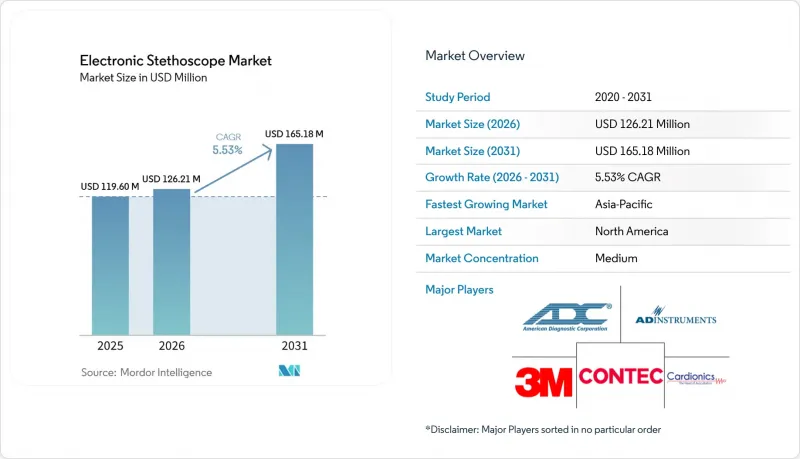
본 보고서에서는 업계를 제품별(증폭식 전자 청진기, 디지털 전자 청진기), 기술별(일체형 흉부 청진기 시스템, 무선 전송 시스템 등), 최종 사용자(병원 및 진료소, 외래수술센터(ASC) 등), 연결 방식(유선, 블루투스, Wi-Fi), 유통 채널(오프라인 매장·도매업체 등) 및 지역
세계 전자 청진기 시장 동향 및 인사이트
전 세계적으로 높은 심혈관 질환 및 호흡기 질환 유병률
심혈관 질환은 여전히 전 세계 주요 사망 원인이며, 호흡기 질환의 발병률이 증가함에 따라 음향 성능이 뛰어난 기기에 대한 수요가 높아지고 있습니다. 전자 청진기에 내장된 증폭 칩과 적응형 소음 제거 회로 덕분에, 임상의들은 혼잡한 응급실에서도 1등급 심잡음을 식별할 수 있게 되었습니다. 이는 기존 음향 모델로는 거의 불가능했던 일이었습니다. 심사된 연구 결과에 따르면, AI가 탑재된 기기는 심장 판막 질환으로 인한 심잡음을 감지하는 데 88%의 민감도를 달성할 수 있는 것으로 나타났습니다. 1차 진료에서 디지털 청진기를 도입한 병원에서는 심초음파 검사로의 의뢰 건수가 감소하고 있습니다. 이는 정확한 조기 분류가 대형 영상 진단 기기에 대한 수요에 변화를 가져오고 있음을 시사합니다.
고령화 사회에서 만성 질환의 재택 관리로의 전환이 진행되고 있습니다.
2030년까지 연평균 성장률(CAGR) 6.4%를 나타낼 것으로 예측되는 재택의료는 일반 소비자를 대상으로 한 디지털 청진 기술의 실증 무대가 되어가고 있습니다. 단 한 번의 버튼 조작으로 데이터를 업로드할 수 있는 기기를 통해, 고령자는 매일 심음 검사를 할 수 있으며, 주치의는 비동기 방식으로 파형을 확인할 수 있습니다. 최근 소아 천식에 관한 연구에서는 AI를 활용한 가정용 청진기를 통해 93.2%의 정확도가 기록되었으며, 임상의들은 행동적 측면에서의 장점도 지적하고 있습니다. 즉, 스마트폰 앱을 통해 청진 결과를 음성으로 확인할 수 있는 부모는 흡입약 복용 일정을 더 꾸준히 지키는 경향이 있습니다. 이러한 피드백 루프는 환자를 근거 기반의 자가 관리로 이끄는 것을 통해 보험사의 위험을 점진적으로 줄여줍니다. 이러한 장점은 기기의 ROI(투자 대비 효과) 계산표에는 거의 반영되지 않지만, 정액제 모델에서는 점점 더 중요하게 여겨지고 있습니다.
기존의 음향식 청진기와 비교했을 때, 높은 초기 도입 비용과 유지비
고급 디지털 청진기는 기존 음향식 청진기보다 가격이 최대 10배까지 비쌀 수 있어, 단가 절감을 중시하는 조달 사이클에서는 걸림돌이 됩니다. 그러나 예산 제약이 있는 의료기관의 경영진과의 인터뷰를 통해 미묘한 변화가 엿보입니다. 현재 의사결정권자들은 정가가 아닌, 진단 과정 전체의 총비용을 비교 검토하고 있습니다. 의뢰 환자 유입 감소 및 중복 영상 검사 방지를 통한 비용 절감을 고려할 때, CFO(최고재무책임자)들은 전자 청진기 도입 후 2-3년 이내에 비용이 상쇄될 것으로 보는 경향이 강해지고 있습니다. 여기서 얻을 수 있는 중요한 인사이트은 하드웨어의 기능이 아니라 진료 프로세스의 경제성을 중심으로 가치 제안을 구축하는 벤더야말로 신흥 시장에서도 구매 승인을 신속하게 얻을 수 있다는 점입니다.
부문별 분석
디지털 전자 청진기는 2025년에 58.62%의 시장 점유율을 차지해, 2031년까지 연평균 성장률(CAGR) 7.65%로 성장하고 있습니다. 이들은 음향 신호를 고해상도 디지털 파형으로 변환하여, 기존의 증폭형 전자 기기에서는 구현할 수 없었던 노이즈 필터링, 데이터 저장, 원격 스트리밍 기능을 실현합니다. 이러한 디지털 모델을 만성 질환 관리 프로그램에 도입한 의료 기관은 환자별 심음 ‘지문’ 아카이브를 축적할 수도 있습니다. 머신러닝 도구는 이 데이터를 분석하여 증상이 나타나기 며칠 전에 심부전 악화를 예측합니다. 전자기식 다이어프램 기술을 채택한 ‘Thinklabs One’은 고음질이 요구되는 신생아 심장병 병동 등, 저진폭 잡음이 가장 중요한 틈새 시장에서의 활용 사례를 개척할 수 있는 좋은 사례입니다.
AI 기반 청진 시스템은 2026년부터 2031년까지 연평균 성장률(CAGR) 7.72%를 나타낼 것으로 예측되며, 하드웨어와 소프트웨어의 로드맵이 빠르게 융합되고 있습니다. Eko Health사의 FDA 승인을 받은 알고리즘은 88%의 민감도와 특이도로 심잡음을 감지합니다. 대동맥판막협착증의 검출을 목적으로 하는 VoqX와 같은 보다 전문성이 높은 솔루션은 이미 보험 급여 코드가 존재하는 단일 질환 분야를 대상으로 하는 비즈니스 로직을 여실히 보여주고 있습니다. 블루투스 5.2 칩셋에서 작동하는 무선 전송 모듈은 50밀리초 미만의 지연 시간으로 무손실 오디오를 스마트폰에 스트리밍함으로써 그 유용성을 한층 더 확대되고 있습니다. 이 지연 시간은 임상의가 실시간 원격 진료에서 ‘충분하다’고 평가하는 기준치입니다.
지역별 분석
북미는 2025년에 37.92%의 시장 점유율을 차지하고 있으며, 그 배경으로는 원격 청진을 위한 정교한 보험 청구 코드와 자본 투자의 위험을 줄여주는 명확한 FDA 승인 절차가 꼽힙니다. 여러 주에 걸쳐 있는 병원 체인들은 입찰 과정에서 EHR(전자건강기록)과의 통합 호환성을 점점 더 많이 요구하고 있으며, 이러한 요건은 성숙한 애플리케이션 프로그래밍 인터페이스(API)를 보유한 공급업체에 유리하게 작용합니다.
아시아태평양의 연평균 성장률(CAGR) 8.45%는 다른 상황을 보여주고 있습니다. 현재 인도에서는 정부 프로그램을 통해 지역 병원에서 진행되는 원격 청진 시범 사업에 자금이 투입되고 있으며, 이는 사실상 블루투스 지원 기기에 대한 수요를 촉진하고 있습니다. 사용자 인터페이스를 지역 언어로 현지화할 수 있는 공급업체는 고객 이탈률이 낮은 경향이 있으며, 이는 문화적 적응이 장기적으로 중요함을 시사합니다. 유럽은 중간에 위치해 있습니다. CE 마크의 엄격한 기준으로 인해 품질 기준은 높아지고 있지만, 일단 기기가 규제 기준을 충족하면 공공 자금을 통한 의료 제도 하에서 전국적인 신속한 보급이 승인될 가능성이 있습니다. 한편, 걸프협력회의(GCC) 지역의 조기 도입 병원에서는 석유 수입에 힘입어 확보된 풍부한 의료 예산을 활용해 최첨단 진단 기술을 ‘위신 프로젝트’로 도입함으로써, AI 탑재 모델로 단숨에 전환하는 사례가 많이 나타나고 있습니다.
기타 혜택:
- 엑셀 형식 시장 예측(ME) 시트
- 3개월간의 애널리스트 지원
자주 묻는 질문
목차
제1장 서론
제2장 조사 방법
제3장 주요 요약
제4장 시장 구도
제5장 시장 규모와 성장 예측
제6장 경쟁 구도
제7장 시장 기회와 향후 전망
JHS 26.06.29According to Mordor Intelligence, the electronic stethoscope market size is projected to expand from USD 119.60 million in 2025 and USD 126.21 million in 2026 to USD 165.18 million by 2031, registering a CAGR of 5.53% between 2026 to 2031.
This report Segments the Industry Into by Product (Amplified Electronic Stethoscopes, Digital Electronic Stethoscopes), Technology (Integrated Chest-Piece System, Wireless Transmission System, and More), End User (Hospitals and Clinics, Ambulatory Surgery Centers, and More), Connectivity (Wired, Bluetooth, and Wi-Fi), Distribution Channel (Offline Retail & Distributors, and More), and Geography
Global Electronic Stethoscope Market Trends and Insights
High Prevalence of Cardiovascular & Pulmonary Diseases Globally
Cardiovascular diseases remain the leading global cause of mortality, and rising respiratory morbidity is amplifying demand for acoustically sophisticated tools. Amplification chips and adaptive noise-cancellation circuits embedded in electronic stethoscopes now allow clinicians to discern Grade I murmurs in crowded emergency rooms, a scenario nearly impossible with traditional acoustic models. Peer-reviewed research demonstrates that AI-augmented devices can reach 88 % sensitivity for valvular heart murmur detection . Hospitals using digital stethoscopes in primary care are seeing a drop in referrals to echocardiography. This suggests that accurate early triage is changing the demand for larger imaging equipment.
Increasing Shift Toward Home-Based Chronic-Disease Management in Ageing Populations
Home healthcare, forecast to grow at 6.4% CAGR through 2030, is becoming the test-bed for consumer-grade digital auscultation. Devices with single-button data upload let older adults conduct daily heart-sound checks while family physicians review waveforms asynchronously. A recent pediatric asthma study recorded 93.2% accuracy using an AI-aided home stethoscope, and clinicians note a behavioral dividend: parents who hear audible feedback through smartphone apps tend to adhere more consistently to inhaler regimens. That feedback loop quietly lowers payer risk by nudging patients toward evidence-based self-management, a benefit that seldom shows up in device ROI spreadsheets but increasingly resonates with capitated payment models.
High Upfront Device and Maintenance Costs Versus Conventional Acoustic Stethoscopes
Premium digital units can cost up to ten times more than acoustic instruments, a hurdle in procurement cycles that favor low unit-prices. Yet executive interviews in budget-constrained facilities reveal a subtle shift: decision makers are now comparing total diagnostic pathway costs rather than sticker prices. When savings from avoided referrals or duplicated imaging are factored in, CFOs increasingly view electronic stethoscopes as cost-neutral within two to three years of adoption. The insight here is that vendors who frame value propositions around care-pathway economics, rather than hardware features, accelerate purchase approvals even in emerging markets.
Other drivers and restraints analyzed in the detailed report include:
- Technological Advancements
- Growing Demand for Teleconsultation
- EHR Integration Partnerships Enhancing Diagnostic Workflow Efficiency
- Data-Privacy & Cybersecurity Concerns Limiting Cloud Connectivity
For complete list of drivers and restraints, kindly check the Table Of Contents.
Segment Analysis
Digital electronic stethoscopes hold a 58.62% share in 2025, expanding at 7.65 % CAGR toward 2031. They convert acoustic signals into high-resolution digital waveforms, enabling noise filtering, data storage, and tele-streaming-capabilities that legacy amplified electronic devices cannot match. Institutions that embed these digital models into chronic-care programs also gain a growing archive of patient-specific heart-sound "fingerprints," which machine-learning tools mine to predict decompensation events days before symptoms appear. Thinklabs One, which uses electromagnetic diaphragm technology, exemplifies how premium sound fidelity can unlock niche use cases such as neonatal cardiology wards where low-amplitude murmurs matter most .
AI-enabled auscultation systems, expected to grow at 7.72 % CAGR (2026-2031), are rapidly converging hardware and software roadmaps. Eko Health's FDA-cleared algorithm detects heart murmurs with 88 % sensitivity and specificity . More specialized solutions, such as VoqX for aortic stenosis detection, illustrate the business logic of targeting single-disease verticals where reimbursement codes already exist. Wireless transmission modules running on Bluetooth 5.2 chipsets further expand utility by streaming lossless audio to smartphones with sub-50 millisecond latency, a threshold clinicians cite as "good enough" for real-time teleconsults.
Geography Analysis
North America holds a 37.92% share in 2025, underpinned by sophisticated reimbursement codes for remote auscultation and clear FDA pathways that de-risk capital deployment. Multistate hospital chains increasingly stipulate EHR-integration compatibility in tenders, a requirement that favors vendors with mature application-programming interfaces.
Asia-Pacific's 8.45% CAGR tells a different story: government programs in India now fund tele-auscultation pilots in district hospitals, effectively underwriting demand for Bluetooth-capable devices. Vendors able to localize user interfaces into regional languages are finding lower churn rates, hinting at the long-run importance of cultural tailoring. Europe sits in a middle position; CE-marking rigor elevates quality thresholds, but once a device clears regulatory gates, publicly funded health systems can authorize rapid nationwide rollouts. Meanwhile, early-adopter hospitals in the Gulf Cooperation Council region often leapfrog straight to AI-enabled models, leveraging favorable oil-backed healthcare budgets to deploy cutting-edge diagnostics as prestige projects.
- 3M
- Eko Health Inc.
- Thinklabs Medical LLC
- American Diagnostic
- Cardionics, Inc.
- HD Medical Group
- eKuore (BID BIOTECH)
- Contec Medical Systems
- ADInstruments Pty Ltd
- Meditech Equipment
- Welch Allyn (Hillrom)
- Rudolf Riester
- SensiCardiac
- CliniCloud
- A&D Company, Ltd.
- Dongjin Medical
- M3DICINE
Additional Benefits:
- The market estimate (ME) sheet in Excel format
- 3 months of analyst support
TABLE OF CONTENTS
1 Introduction
- 1.1 Study Assumptions & Market Definition
- 1.2 Scope of the Study
2 Research Methodology
3 Executive Summary
4 Market Landscape
- 4.1 Market Overview
- 4.2 Market Drivers
- 4.2.1 High Prevalence of Cardiovascular & Pulmonary Diseases Globally
- 4.2.2 Increasing shift toward home-based chronic-disease management in ageing populations
- 4.2.3 Technological advancements
- 4.2.4 Expansion of reimbursed telehealth and remote-patient-monitoring programs across major healthcare systems
- 4.2.5 Growing demand for teleconsultation
- 4.2.6 EHR Integration Partnerships Enhancing Diagnostic Workflow Efficiency
- 4.3 Market Restraints
- 4.3.1 High upfront device and maintenance costs versus conventional acoustic stethoscopes
- 4.3.2 Electromagnetic Interference with Other Medical Electronics
- 4.3.3 Data-Privacy & Cybersecurity Concerns Limiting Cloud Connectivity
- 4.3.4 Limited Physician Training and Change Resistance
- 4.4 Supply-Chain Analysis
- 4.5 Regulatory Outlook
- 4.6 Technological Outlook
- 4.7 Porter's Five Forces Analysis
- 4.7.1 Threat of New Entrants
- 4.7.2 Bargaining Power of Buyers
- 4.7.3 Bargaining Power of Suppliers
- 4.7.4 Threat of Substitutes
- 4.7.5 Intensity of Competitive Rivalry
5 Market Size & Growth Forecasts (Value)
- 5.1 By Product
- 5.1.1 Amplified Electronic Stethoscopes
- 5.1.2 Digital Electronic Stethoscopes
- 5.2 By Technology
- 5.2.1 Integrated Chest-Piece System
- 5.2.2 Wireless Transmission System
- 5.2.3 Integrated Receiver Head-Piece System
- 5.2.4 AI-Enabled Auscultation System
- 5.3 By End User
- 5.3.1 Hospitals & Clinics
- 5.3.2 Ambulatory Surgery Centers
- 5.3.3 Home Healthcare Settings
- 5.3.4 Veterinary Clinics
- 5.4 By Connectivity
- 5.4.1 Wired
- 5.4.2 Bluetooth
- 5.4.3 Wi-Fi
- 5.5 By Distribution Channel
- 5.5.1 Offline Retail & Distributors
- 5.5.2 Online Marketplaces
- 5.5.3 Direct Institutional Tenders
- 5.6 By Geography
- 5.6.1 North America
- 5.6.1.1 United States
- 5.6.1.2 Canada
- 5.6.1.3 Mexico
- 5.6.2 Europe
- 5.6.2.1 Germany
- 5.6.2.2 United Kingdom
- 5.6.2.3 France
- 5.6.2.4 Italy
- 5.6.2.5 Spain
- 5.6.2.6 Rest of Europe
- 5.6.3 Asia-Pacific
- 5.6.3.1 China
- 5.6.3.2 Japan
- 5.6.3.3 India
- 5.6.3.4 South Korea
- 5.6.3.5 Australia
- 5.6.3.6 Rest of Asia-Pacific
- 5.6.4 Middle East
- 5.6.4.1 GCC
- 5.6.4.2 South Africa
- 5.6.4.3 Rest of Middle East
- 5.6.5 South America
- 5.6.5.1 Brazil
- 5.6.5.2 Argentina
- 5.6.5.3 Rest of South America
- 5.6.1 North America
6 Competitive Landscape
- 6.1 Market Concentration
- 6.2 Market Share Analysis
- 6.3 Company profiles (includes Global level Overview, Market level overview, Core Business Segments, Financials, Headcount, Key Information, Market Rank, Market Share, Products and Services, and analysis of Recent Developments)
- 6.3.1 3M
- 6.3.2 Eko Health Inc.
- 6.3.3 Thinklabs Medical LLC
- 6.3.4 American Diagnostic Corporation
- 6.3.5 Cardionics, Inc.
- 6.3.6 HD Medical Group
- 6.3.7 eKuore (BID BIOTECH)
- 6.3.8 Contec Medical Systems Co., Ltd.
- 6.3.9 ADInstruments Pty Ltd
- 6.3.10 Meditech Equipment Co., Ltd.
- 6.3.11 Welch Allyn (Hillrom)
- 6.3.12 Rudolf Riester GmbH
- 6.3.13 SensiCardiac
- 6.3.14 CliniCloud
- 6.3.15 A&D Company, Ltd.
- 6.3.16 Dongjin Medical
- 6.3.17 M3DICINE
7 Market Opportunities & Future Outlook
- 7.1 White-Space & Unmet-Need Assessment