
|
시장보고서
상품코드
2066623
고신뢰성 압력 보호 시스템(HIPPS) : 시장 점유율 분석, 업계 동향 및 통계, 성장 예측(2026-2031년)High Integrity Pressure Protection System - Market Share Analysis, Industry Trends & Statistics, Growth Forecasts (2026 - 2031) |
||||||
 Mordor Intelligence
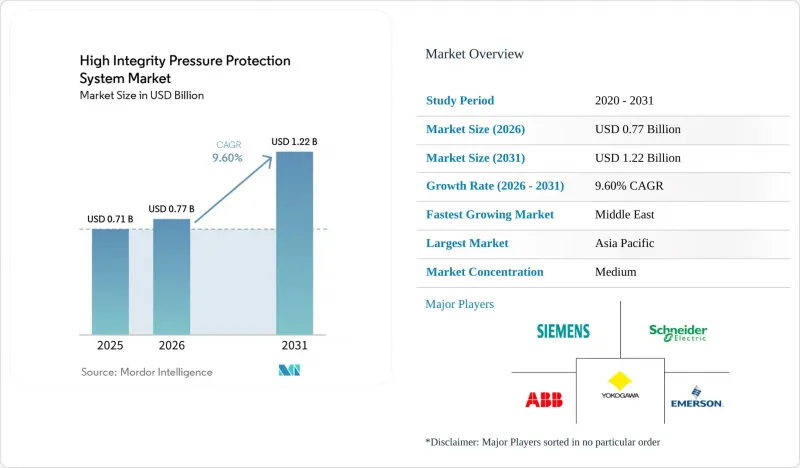
Mordor Intelligence에 의하면, 고신뢰성 압력 보호 시스템(HIPPS) 시장 규모는 2025년 7억 1,000만 달러로 평가되었습니다. 2026년에는 7억 7,000만 달러로 확대되어 2031년까지 12억 2,000만 달러에 이를 것으로 예상되며 2026년부터 2031년에 걸쳐 CAGR 9.60%로 성장할 전망입니다.
본 보고서는 제품별(센서, 밸브, 액추에이터 등의 부품), 최종 사용자 산업(석유 및 가스, 화학, 전력, 금속 및 광업, 식품 및 음료 등), 설치 형태(육상, 해상), 내압 등급(3000 Psi 이하, 3000-6000 Psi, 6000 Psi 이상), 지역별로 분류되어 있습니다. 시장 전망은 금액(달러) 기준으로 제시되어 있습니다.
세계의 고신뢰성 압력 보호 시스템(HIPPS) 시장 동향 및 인사이트
석유 및 가스 분야의 세계 기능 안전 지침 강화
IEC 61511 : 2026 SER 및 EEMUA 222 제2판의 제정으로, 내압 시험 주기, 소프트웨어 도구의 적합성 평가 및 변경 관리 절차에 관한 요구 사항이 더욱 엄격해졌습니다. 또한, 2025년에 개정된 영국의 지침에 따르면, HAZOP(위험 및 가동성 분석)과 SIL(안전 무결성 수준) 평가가 적절하게 연계될 수 있도록 자격을 갖춘 전문가의 감독이 의무화되어 있습니다. 이러한 규제 변경에 따라, 규정 준수 프로세스를 효율화하고 감사 준비 시간을 최대 40% 단축해 주는 제3자 검증 서비스 및 통합 라이프사이클 소프트웨어 솔루션에 대한 수요가 증가하고 있습니다. 이러한 업데이트로 인해 기존 시설의 운영 사업자들은 진단 범위의 확대와 신뢰성 향상을 실현하는 전자 아키텍처로, 기존의 공압식 HIPPS에서 전환할 수밖에 없게 되었습니다.
심해 해양 프로젝트의 급속한 확대
브라질의 프레솔트층이나 노르웨이 북해에 위치한 초고압 저류층에서는 압력이 1만 psi를 초과하는 것이 일상화되어 있으며, 과압 사고를 방지하기 위해 밀리초 단위로 차단이 가능한 해저용 고신뢰성 압력 보호 시스템(HIPPS)의 사용이 필수적입니다. 또한, 이러한 시스템에는 가혹한 해저 환경을 견디고 장기적인 신뢰성을 확보하기 위해 내식성 합금이 사용되어야 합니다. 압축 설비의 업그레이드와 대형 부유식 생산·저장·하역선(FPSO) 유닛과 관련된 최근 계약 수주는 전기적 고장 제한 장치 및 해저 압축 트레인과 원활하게 통합되는 압력 보호 시스템의 필요성이 매우 높다는 점을 여실히 보여주고 있습니다. 이러한 통합은 치명적인 파이프 파열 위험을 줄이고, 이처럼 가혹한 초심해 환경에서 작업의 안전성과 효율성을 확보하기 위해 필수적입니다.
초기 설계 및 인증에 드는 막대한 비용
중규모 석유화학 플랜트용 SIL3 고신뢰성 압력 보호 시스템(HIPPS)을 설계할 경우, 그 비용은 100만 달러에 달할 가능성이 있습니다. 이러한 비용에는 일반적으로 광범위한 조사, 제3자에 의한 검증 및 상세한 문서 작성이 포함되며, 이 모든 것은 하드웨어 조달에 앞서 필요한 사항입니다. 소규모 사업자의 경우, 프로젝트 비용의 10-15%를 컨설턴트 고용에 추가로 충당해야 하므로 재정적 부담이 더욱 커집니다. 이러한 컨설턴트들은 이러한 시스템의 안전 수명 주기를 규정하는 IEC 61511 조항에 명시된 복잡한 요구 사항을 준수하는 데 필수적입니다. 이러한 추가 지출로 인해 프로젝트의 투자 회수 기간이 크게 연장되므로, 특히 SIL3 HIPPS가 의무화되어 있지 않고 필수적이지도 않은 고위험 분야 이외의 업계에서는 SIL3 HIPPS 도입의 매력이 줄어들게 됩니다.
부문별 분석
2025년, 고신뢰성 압력 보호 시스템(HIPPS)의 부품 시장 규모는 63.28%라는 압도적인 점유율을 유지했으나, 서비스 분야는 더 빠른 속도로 성장하고 있습니다. 이 부품에서 창출되는 수익은 주로 수소 취성에 견딜 수 있도록 설계된 센서의 개량과, IEC 62443 사이버 보안 표준을 준수하는 로직 솔버의 업그레이드에 의해 주도되고 있습니다. 대규모 LNG 프로젝트나 심해 프로젝트에서는 SIL3 규격을 준수하고 2년마다 내압 시험 주기를 유지할 수 있는 트리플 모듈러 중복(TMR)형 솔버의 도입이 점점 더 늘어나고 있습니다. 이를 통해 기술의 지속적인 발전 속에서도 고신뢰성 압력 보호 시스템(HIPPS) 시장 전체가 견실하고 탄탄한 상태를 유지할 수 있을 것으로 보장됩니다.
내압 시험, SIL 검증, 예측 유지보수 분석 등을 포함하는 라이프사이클 서비스는 연평균 성장률(CAGR) 10.05%로 성장할 것으로 전망됩니다. 디지털 트윈의 도입이 중요한 촉진요인으로 작용하고 있으며, 이러한 모델은 과도기적 압력 시나리오를 시뮬레이션함으로써 위험 저감을 저해하지 않으면서도 운영자가 내압 시험을 연기할 수 있도록 해줍니다. 또한, 특히 이러한 전문 지식에 대한 수요가 높아지고 있는 아시아태평양에서 역량 격차를 해소하기 위해 제3자 검증 기관들이 시장에 진입하고 있습니다. 서비스의 급속한 성장은 자산 소유자들이 시장 증가하는 수요에 부응하기 위해 가동 시간, 운영 효율성, 일정의 신뢰성을 우선시함에 따라, 설비 투자에서 운영비로 큰 전환이 진행되고 있음을 여실히 보여주고 있습니다.
2025년 매출의 거의 절반(46.27%)을 석유 및 가스 분야가 차지했으며, 이는 심해 타이백에서 SIL3 기준을 준수하는 해저 HIPPS 루프에 대한 의존도가 주요 원동력이 되고 있습니다. 이러한 시스템은 고압 환경에서의 안전성과 운영 효율성을 확보하는 데 필수적입니다. 그러나 수소 파이프라인 및 연소 후 회수 장치가 가장 빠른 성장세를 보일 것으로 예상되며, 이에 따라 고신뢰성 압력 보호 시스템(HIPPS) 시장 전체의 점유율이 점차 더 깨끗한 에너지 분야로 이동할 것으로 전망됩니다. 이러한 변화는 전 세계적인 탈탄소화 추진 및 지속 가능한 에너지 솔루션 도입이라는 흐름과 일치합니다.
화학 업계는 인도 및 중동 등 지역의 폴리올레핀 및 방향족 화합물 프로젝트 확대에 힘입어 연평균 성장률(CAGR) 9.98%를 기록하며, 계속해서 HIPPS를 안정적으로 채택하고 있습니다. 발전 업계에서는 엄격한 안전 기준을 준수하기 위해 복합 사이클 발전의 드럼 보호에 HIPPS가 점점 더 많이 지정되고 있습니다. 한편, 금속, 광업, 식품, 음료 등의 업계에서는 규제 요건이 제한적이고 위험에 대한 인식도 낮기 때문에 도입 속도는 여전히 더딘 임베디드니다. 산업용도의 다양화에 따라 각 공급업체들은 수소 및 초임계 CO2에 대응할 수 있도록 야금 기술과 씰 재질을 최적화함으로써 제품 라인업을 강화하고 있습니다.
지역별 분석
2025년, 북미는 고신뢰성 압력 보호 시스템(HIPPS) 시장에서 가장 규모가 큰 지역 점유율을 차지했습니다. 이는 멕시코만에서의 초심해 시추, 활발한 LNG 수출 시설 건설, 그리고 성숙한 기능 안전 규제의 시행에 힘입은 결과입니다. 사업자들은 턴어라운드 주기를 연장하기 위해 서비스에 의존하고 있기 때문에 내압 시험 및 부분 스트로크 계약은 하드웨어 판매보다 더 빠르게 증가하고 있습니다. 중동은 카타르의 노스필드 확장 계획에 모듈식 LNG 트레인이 도입되고, 사우디아라비아의 하류 프로젝트가 석유화학 통합을 추진하며, 아부다비가 블루 암모니아 복합 시설 건설에 착수함에 따라 연평균 성장률(CAGR) 9.91%로 가장 빠른 성장이 예상됩니다.
공장에서 테스트를 마친 스키드에 통합된 사이버 보안 대응 로직 솔버가 결합되어 있으며, 이는 해당 지역이 요구하는 일정 단축 및 대용량 모듈에 대한 수요를 충족시킵니다. 유럽에서는 IEC 61511의 조화 및 EEMUA 222 가이드라인에 따라 북해, 독일, 지중해 전역에서 기존 시설 개보수에 대한 기대가 일치하고 있어, 수요가 견조한 추세를 보이고 있습니다. 독일과 네덜란드의 수소 인프라에 대한 핵심 투자는 북해의 CCS 클러스터와 맞물려 장기적인 성장 동력을 공고히 하고 있습니다.
아시아태평양은 매우 세분화되어 있습니다. 일본과 한국에서는 엄격한 SIL 검증이 실시되고 있으며, 인도의 정유시설는 개보수 작업이 한창이고, 동남아시아의 LNG 수입 터미널이 단기적인 스키드 수요를 견인하고 있습니다. 중국에서만도 여러 개의 수소 및 CCUS 파이프라인이 계획되어 있으며, 각각에 수백 개의 HIPPS 루프가 필요합니다. 남미 시장 점유율은 브라질의 프레솔트층 개발이 급속히 확대되는 데 달려 있으며, 아프리카는 아직 발전 단계에 있지만 나이지리아와 앙골라가 새로운 FPSO 도입을 검토하고 있어 주목을 받고 있습니다.
기타 혜택 :
- 엑셀 형식 시장 예측(ME) 시트
- 3개월간의 애널리스트 지원
자주 묻는 질문
목차
제1장 서론
제2장 조사 방법
제3장 주요 요약
제4장 시장 구도
제5장 시장 규모 및 성장 예측
제6장 경쟁 구도
제7장 시장 기회 및 향후 전망
KTH 26.06.29According to Mordor Intelligence, the high integrity pressure protection system market size is expected to increase from USD 0.71 billion in 2025 to USD 0.77 billion in 2026 and reach USD 1.22 billion by 2031, growing at a CAGR of 9.60% over 2026-2031.
This report is Segmented by Offering (Components Including Sensors, Valves and Actuators, and More), End-User Industry (Oil and Gas, Chemicals, Power, Metal and Mining, Food and Beverages, and More), Installation Type (Onshore, and Offshore), Pressure Rating (Up To 3000 Psi, 3000-6000 Psi, and Above 6000 Psi), and Geography. The Market Forecasts are Provided in Terms of Value (USD).
Global High Integrity Pressure Protection System Market Trends and Insights
Stricter Global Functional-Safety Directives in Oil and Gas
The publication of IEC 61511:2026 SER and EEMUA 222 Edition 2 introduced stricter requirements for proof-test intervals, software tool qualification, and management-of-change procedures. Additionally, the updated United Kingdom guidance in 2025 now mandates oversight by a competent person to ensure proper alignment between HAZOP (Hazard and Operability Study) and SIL (Safety Integrity Level) assessments. This regulatory shift has driven increased demand for third-party verification services and integrated lifecycle software solutions that streamline compliance processes and reduce audit preparation time by up to 40%. These updates have compelled brownfield operators to transition from pneumatic HIPPS to electronic architectures, which provide enhanced diagnostic coverage and improved reliability.
Rapid Growth of Deep-Water Offshore Projects
Ultra-high-pressure reservoirs in Brazil's pre-salt and Norway's North Sea routinely exceed 10,000 psi, necessitating the use of subsea High-Integrity Pressure Protection Systems (HIPPS) designed for millisecond closure to prevent overpressure incidents. These systems must also incorporate corrosion-resistant alloys to withstand the harsh subsea environment and ensure long-term reliability. Recent contract awards for compression upgrades and mega Floating Production Storage and Offloading (FPSO) units highlight the critical need for pressure protection systems that seamlessly integrate with electrical fault-limiter schemes and subsea compression trains.This integration is essential to mitigate the risk of catastrophic pipe ruptures, ensuring operational safety and efficiency in these challenging ultra-deepwater conditions.
High Up-Front Engineering and Certification Costs
Engineering a SIL3 High-Integrity Pressure Protection System for a mid-size petrochemical train can cost USD 1 million. These expenses typically cover extensive studies, third-party verification, and the preparation of detailed documentation, all of which are necessary before the hardware is even procured. For smaller operators, the financial burden increases further, as they often allocate an additional 10-15% of the project value to hire consultants. These consultants are essential for navigating the complex requirements outlined in IEC 61511 clauses, which govern the safety lifecycle of such systems. This additional expenditure significantly extends the payback periods for these projects, making the adoption of SIL3 HIPPS less appealing, particularly in industries outside high-hazard sectors where such systems are neither mandated nor critical.
Other drivers and restraints analyzed in the detailed report include:
- Expansion of Hydrogen and Carbon-Capture Infrastructure
- Increasing Adoption of Modular, Skid-Mounted HIPPS Packages
- Scarcity of SIL-Certified Professionals
For complete list of drivers and restraints, kindly check the Table Of Contents.
Segment Analysis
The High Integrity Pressure Protection System market size for components retained a commanding share in 2025 with 63.28%, yet services are advancing at a faster pace. The revenue generated from components is primarily driven by sensor retrofits designed to resist hydrogen embrittlement and by logic-solver upgrades that comply with IEC 62443 cybersecurity standards. Large-scale LNG and deep-water projects are increasingly specifying triple-modular-redundant solvers rated SIL3, capable of maintaining 2-year proof-test intervals. This ensures the overall High Integrity Pressure Protection System market remains robust and resilient, even as technological advancements continue to evolve.
Lifecycle services, which include proof testing, SIL verification, and predictive-maintenance analytics, are projected to grow at a compound annual growth rate (CAGR) of 10.05%. The adoption of digital twins has become a key enabler, as these models simulate transient pressure scenarios, allowing operators to defer proof tests without compromising risk reduction. Additionally, third-party verification houses are stepping in to address competency gaps, particularly in the Asia-Pacific region, where demand for such expertise is rising. The rapid growth of services highlights a significant shift from capital expenditure to operating expenditure, as asset owners prioritize uptime, operational efficiency, and schedule reliability to meet the increasing demands of the market.
Oil and gas accounted for nearly half of 2025 revenue, at 46.27%, driven by reliance on SIL3 subsea HIPPS loops in deep-water tiebacks. These systems are critical for ensuring safety and operational efficiency in high-pressure environments. However, hydrogen pipelines and post-combustion capture units are projected to grow the fastest, contributing to a gradual shift in the overall High Integrity Pressure Protection System market share toward cleaner-energy verticals. This shift aligns with the global push for decarbonization and the adoption of sustainable energy solutions.
The chemicals sector continues to be a consistent adopter of HIPPS with 9.98% CAGR, supported by the expansion of polyolefin and aromatics projects in regions such as India and the Middle East. In the power generation sector, HIPPS are increasingly specified for combined-cycle drum protection, ensuring compliance with stringent safety standards. Meanwhile, industries such as metals, mining, food, and beverages remain slower adopters due to limited regulatory requirements and lower perceived risks. The diversification of industrial applications is driving vendors to enhance their product offerings by optimizing metallurgy and sealing compounds to handle hydrogen and supercritical CO2.
Geography Analysis
North America captured the largest regional slice of the High Integrity Pressure Protection System market in 2025, supported by Gulf of Mexico ultra-deepwater drilling, a prolific LNG export build-out, and mature functional-safety enforcement. Operators rely on services to extend turnaround intervals, so proof-test and partial-stroke contracts are rising faster than hardware sales. The Middle East is projected to be the fastest riser, with a 9.91% CAGR, as Qatar's North Field Expansion replicates modular LNG trains, Saudi downstream projects pursue petrochemical integration, and Abu Dhabi embarks on blue-ammonia complexes.
Factory-tested skids, bundled with integrated cyber-secure logic solvers, align with the region's preference for compressed schedules and high-capacity modules. Europe maintains steady demand because IEC 61511 harmonization and EEMUA 222 guidelines have unified brownfield retrofit expectations across the North Sea, Germany, and the Mediterranean. Hydrogen backbone investments in Germany and the Netherlands, coupled with North Sea CCS clusters, ensure long-run momentum.
Asia-Pacific is highly fragmented: Japan and South Korea enforce strict SIL verification, India's refineries are in mid-upgrade, and Southeast Asian LNG import terminals are driving near-term skid demand. China alone commands multiple hydrogen and CCUS pipelines that will each require hundreds of HIPPS loops. South America's share hinges on Brazil's pre-salt surge, while Africa is nascent but gathering attention as Nigeria and Angola consider new FPSOs.
- ABB Ltd
- Emerson Electric Co.
- Rockwell Automation Inc.
- Schneider Electric SE
- Siemens AG
- Yokogawa Electric Corporation
- Schlumberger NV
- HIMA Paul Hildebrandt GmbH
- SELLA CONTROLS Ltd
- Mogas Industries Inc.
- Severn Glocon Group
- Mokveld Valves BV
- ATV HIPPS
- L&T Valves Limited
- PetrolValves SpA
- BEL Valves Ltd
- Baker Hughes Co.
- Honeywell International Inc.
- Johnson Controls International plc
- Eaton Corporation plc
Additional Benefits:
- The market estimate (ME) sheet in Excel format
- 3 months of analyst support
TABLE OF CONTENTS
1 INTRODUCTION
- 1.1 Study Assumptions And Market Definition
- 1.2 Scope of the Study
2 RESEARCH METHODOLOGY
3 EXECUTIVE SUMMARY
4 MARKET LANDSCAPE
- 4.1 Market Overview
- 4.2 Industry Value-Chain Analysis
- 4.3 Impact of Macroeconomic Factors on the Market
- 4.4 Market Drivers
- 4.4.1 Stricter Global Functional-Safety Directives in Oil and Gas
- 4.4.2 Rapid Growth of Deep-Water Offshore Projects
- 4.4.3 Expansion of Hydrogen and Carbon-Capture Infrastructure
- 4.4.4 Increasing Adoption of Modular, Skid-Mounted HIPPS Packages
- 4.4.5 Integration With Digital Twins for Predictive Maintenance
- 4.4.6 Surge in LNG Import Terminals Across Emerging Markets
- 4.5 Market Restraints
- 4.5.1 High Up-Front Engineering and Certification Costs
- 4.5.2 Scarcity of SIL-Certified Professionals
- 4.5.3 Complex Retrofit Challenges in Brownfield Plants
- 4.5.4 Cyber-Security Vulnerabilities in Connected Safety Systems
- 4.6 Regulatory Landscape
- 4.7 Technological Outlook
- 4.8 Porter's Five Forces Analysis
- 4.8.1 Threat of New Entrants
- 4.8.2 Bargaining Power of Buyers/Consumers
- 4.8.3 Bargaining Power of Suppliers
- 4.8.4 Threat of Substitute Products
- 4.8.5 Intensity of Competitive Rivalry
5 MARKET SIZE AND GROWTH FORECASTS (VALUE)
- 5.1 By Offering
- 5.1.1 Components
- 5.1.1.1 Sensors
- 5.1.1.2 Logic Solvers
- 5.1.1.3 Valves and Actuators
- 5.1.2 Services
- 5.1.1 Components
- 5.2 By End-User Industry
- 5.2.1 Oil and Gas
- 5.2.2 Chemicals
- 5.2.3 Power
- 5.2.4 Metal and Mining
- 5.2.5 Food and Beverages
- 5.2.6 Other Process Industries
- 5.3 By Installation Type
- 5.3.1 Onshore
- 5.3.2 Offshore
- 5.4 By Pressure Rating
- 5.4.1 Up to 3000 psi
- 5.4.2 3000 - 6000 psi
- 5.4.3 Above 6000 psi
- 5.5 By Geography
- 5.5.1 North America
- 5.5.1.1 United States
- 5.5.1.2 Canada
- 5.5.1.3 Mexico
- 5.5.2 South America
- 5.5.2.1 Brazil
- 5.5.2.2 Argentina
- 5.5.2.3 Rest of South America
- 5.5.3 Europe
- 5.5.3.1 Germany
- 5.5.3.2 United Kingdom
- 5.5.3.3 France
- 5.5.3.4 Italy
- 5.5.3.5 Rest of Europe
- 5.5.4 Asia-Pacific
- 5.5.4.1 China
- 5.5.4.2 Japan
- 5.5.4.3 India
- 5.5.4.4 South Korea
- 5.5.4.5 Australia and New Zealand
- 5.5.4.6 Rest of Asia-Pacific
- 5.5.5 Middle East
- 5.5.5.1 Saudi Arabia
- 5.5.5.2 United Arab Emirates
- 5.5.5.3 Qatar
- 5.5.5.4 Turkey
- 5.5.5.5 Rest of Middle East
- 5.5.6 Africa
- 5.5.6.1 Nigeria
- 5.5.6.2 South Africa
- 5.5.6.3 Rest of Africa
- 5.5.1 North America
6 COMPETITIVE LANDSCAPE
- 6.1 Market Concentration
- 6.2 Strategic Moves
- 6.3 Market Share Analysis
- 6.4 Vendor Positioning Analysis
- 6.5 Company Profiles (includes Global Level Overview, Market Level Overview, Core Segments, Financials as available, Strategic Information, Market Rank/Share, Products and Services, Recent Developments)
- 6.5.1 ABB Ltd
- 6.5.2 Emerson Electric Co.
- 6.5.3 Rockwell Automation Inc.
- 6.5.4 Schneider Electric SE
- 6.5.5 Siemens AG
- 6.5.6 Yokogawa Electric Corporation
- 6.5.7 Schlumberger NV
- 6.5.8 HIMA Paul Hildebrandt GmbH
- 6.5.9 SELLA CONTROLS Ltd
- 6.5.10 Mogas Industries Inc.
- 6.5.11 Severn Glocon Group
- 6.5.12 Mokveld Valves BV
- 6.5.13 ATV HIPPS
- 6.5.14 L&T Valves Limited
- 6.5.15 PetrolValves SpA
- 6.5.16 BEL Valves Ltd
- 6.5.17 Baker Hughes Co.
- 6.5.18 Honeywell International Inc.
- 6.5.19 Johnson Controls International plc
- 6.5.20 Eaton Corporation plc
7 MARKET OPPORTUNITIES AND FUTURE OUTLOOK
- 7.1 White-Space and Unmet-Need Assessment